

Prop firm payouts let eligible traders request a share of their simulated trading profits, which the firm pays by bank transfer or an online payment service. The process varies by firm, but most follow the same steps: meet the payout requirements, submit a request, pass any checks, and wait for processing.
Separate payout eligibility (when you can request your profits) from payout processing time (how long the money takes to arrive after approval). This guide covers payout rules, timing, frequency, and payment methods.
Key Takeaway
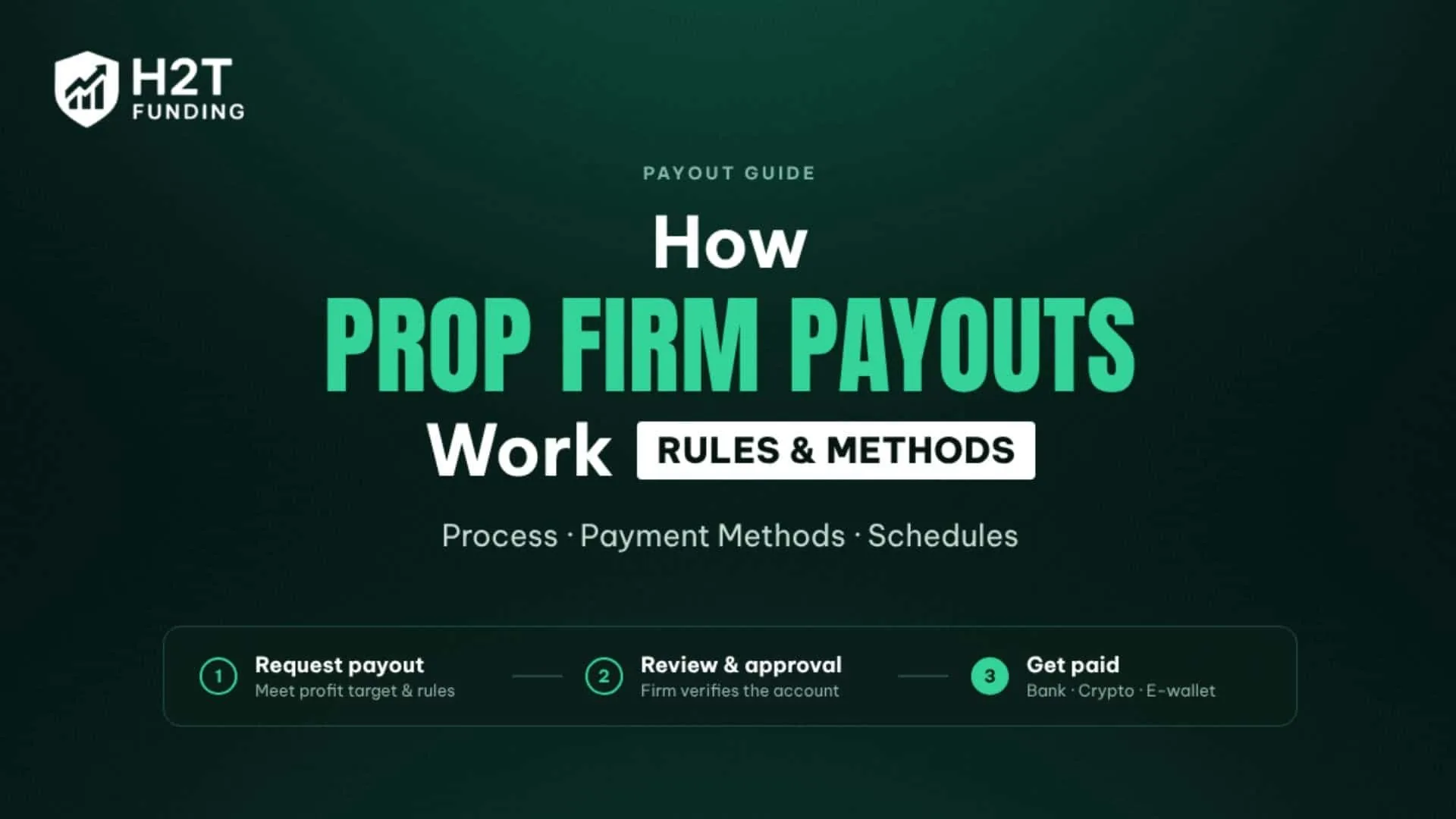
- How payouts work: You pass the evaluation, meet the payout requirements on your funded account, submit a request, and the firm reviews it before sending your profit share through a supported payment method.
- Eligibility and processing are different: Eligibility decides when you can request a payout; processing decides when the funds arrive.
- Your profit split is not your full withdrawal: Payout caps, buffers, and minimum thresholds limit how much you can withdraw.
- Extra conditions may apply: Minimum trading days, profit or balance requirements, and consistency requirements where applicable.
- Schedules vary: Payouts may be on-demand, cycle-based, or fixed-date, and frequency does not set how fast the money arrives.
- Payment methods affect timing and cost: Fees, currency conversion, and country restrictions change what you receive and when.
- Check your program’s rules: Conditions vary by firm and account type and change over time, so verify the latest terms before requesting a payout.
How We Researched Prop Firm Payout Rules
We reviewed the published payout policies and account rules of eight selected prop firms, covering futures and Forex/CFD programs. We compared minimum trading days, buffers, consistency rules, payout caps, frequency, processing times, and payment methods. We also drew on the H2T Funding team’s experience reviewing prop-firm rules.
The examples show the range of payout models, not universal standards. Because firms change their rules, we use current published policies as our primary reference. Examples and calculations are illustrative, so verify the latest firm-specific rules before requesting a payout. (Last updated: September 2026)
1. What Is a Prop Firm Payout?
A prop firm payout is the money you receive after meeting a firm’s payout requirements and generating eligible profits on a funded account.
Many firms use simulated trading accounts, meaning trades are not necessarily executed with the firm’s capital. However, eligible traders still receive a share of simulated profits in real money. Payout eligibility, limits, frequency, and payment methods vary by firm and account type.
2. How Does the Prop Firm Payout Process Work?
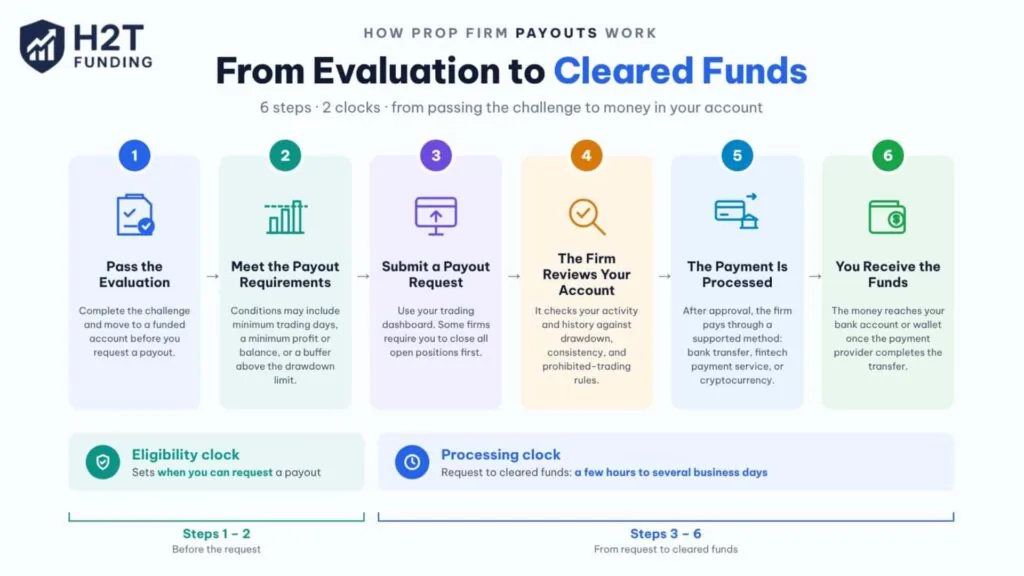
Most challenge-based prop firms follow six steps:
- Step 1: Pass the evaluation. Complete the challenge and move to a funded account before you request a payout.
- Step 2: Meet the payout requirements. Conditions may include minimum trading days, a minimum profit or balance, or a buffer above the drawdown limit.
- Step 3: Submit a payout request. Use your trading dashboard. Some firms require you to close all open positions first.
- Step 4: The firm reviews your account. It checks your activity and history against drawdown, consistency, and prohibited-trading rules.
- Step 5: The payment is processed. After approval, the firm pays through a supported method: bank transfer, fintech payment service, or cryptocurrency.
- Step 6: You receive the funds. The money reaches your bank account or wallet once the payment provider completes the transfer. From request to cleared funds, the full process usually takes a few hours to several business days (see section 5).
3. What Are the Requirements for Your First Prop Firm Payout?
Before your first payout, you generally need to meet the program’s eligibility requirements:
- Minimum trading days: A set number of qualifying trading days.
- Minimum profit: A minimum profit or balance before you can request.
- Drawdown compliance: Staying within the daily and maximum loss limits.
- Consistency requirements: Profits spread across several days, not one large gain.

These conditions make you eligible to request a payout, not necessarily to withdraw all your profit. Caps and buffers apply (see section 4). Example: a program may require five qualifying trading days and a minimum daily profit. One large profitable day does not satisfy the requirement if the other qualifying days are incomplete. Thresholds differ by firm, so check your account’s current rules. For what happens after you pass, see our guide to funded trading accounts.
4. How Much Can You Withdraw From a Prop Firm?
Being eligible does not mean you can withdraw all the profit shown in your account. These limits apply:
- Payout cap: A maximum amount per payout or per period.
- Required buffer: An amount you must leave in the account as a cushion above the drawdown limit.
- Minimum payout: Your available amount must reach a threshold before you can request.
- Withdrawable profit: What you can request depends on the program’s rules, not the total profit shown in your account.
Example: from account profit to money received. Assume a funded account with an 80% profit split, a $1,000 required buffer, a $2,000 payout cap, a $500 minimum payout, and a $30 transfer fee:
- Profit shown in the account: $4,000
- Minus the required buffer: $4,000 − $1,000 = $3,000 withdrawable
- Apply the payout cap: the lower of $3,000 and $2,000 = $2,000 requested (above the $500 minimum)
- Apply the 80% profit split: $2,000 × 80% = $1,600
- Minus the transfer fee: $1,600 − $30 = $1,570 received
The trader made $4,000 in profit but receives $1,570 from this payout. The remaining $2,000 stays in the account: $1,000 as the buffer and $1,000 that may be requested in a later payout. The key distinction is account profit vs. withdrawable profit. Firms apply caps, splits, and fees in different orders, so check your program’s terms before requesting.
5. How Long Does a Prop Firm Payout Take, and How Often Can You Get Paid?
A payout can take a few hours to several business days. Advertised times often describe different stages, so separate them.
5.1. Payout Eligibility Time
First you must become eligible to request a payout through minimum trading days, profit requirements, or other conditions. A firm with fast processing may still make you wait several days before your first request.
5.2. Firm Review, Processing, and Delivery
After you submit a request, the firm reviews the account and verifies the conditions. This takes hours to several business days; some firms state a window, others say “within 24 hours” or “up to several business days.” Once the firm sends the payout, the payment provider or bank may need more time. Bank transfers can take longer than digital methods, and international transfers may add processing or currency conversion.
Plan around the full timeline from request to cleared funds, not only the firm’s approval time. If speed matters, see our list of prop firms with the fastest payout, where we compare 9 firms by verified processing time rather than marketing claims.
5.3. Payout Frequency
- On-demand or frequent payouts: Request once you meet the eligibility requirements, with no calendar date to wait for.
- Cycle-based payouts: You become eligible after a required period or conditions, then a new period starts after your request.
- Fixed-date payouts: Requests are allowed on set dates or windows, such as every 14 or 30 days.
Frequency is not speed. A firm with weekly payouts lets you request every seven days, but the money may still wait on account review and payment-provider processing.
6. What Are the Most Common Prop Firm Payout Methods?
Payout methods vary by firm, payment provider, and country. Common options include bank transfers, ACH, fintech payment platforms, and, in some programs, cryptocurrency.
| Method | Speed | Cost | Key considerations |
|---|---|---|---|
| Bank transfer / wire | Usually several business days | May include a flat fee or bank charges | Common for larger withdrawals; international transfers take longer |
| ACH transfer | Usually a few business days | Often low-cost or free | Mainly for eligible US bank accounts |
| Fintech payment platforms | Varies by provider | Provider- or firm-dependent | May require account verification or tax information |
| Cryptocurrency | Often within hours once the firm sends it | Network fees; possible conversion costs | Offered only by some firms and in some countries; double-check the wallet address and network; value can change unless paid in a stablecoin |
Fees change what you receive: a $30 flat fee on a $300 payout cuts it by 10%, while the same fee on $3,000 cuts it by 1%. Before choosing a method, check:
- Fees: Firm charges, payment-provider fees, and currency conversion.
- Timing: The firm’s approval time and the provider’s delivery time.
- Availability: Supported countries, the methods the firm offers, and whether you are paid in USD or another currency.
- Verification: Identity, tax, or account information the firm or provider may require.
The fastest advertised method is not always the best. Compare the total cost, delivery time, country availability, and the amount you actually receive.
7. Why Can a Prop Firm Payout Be Delayed or Denied?
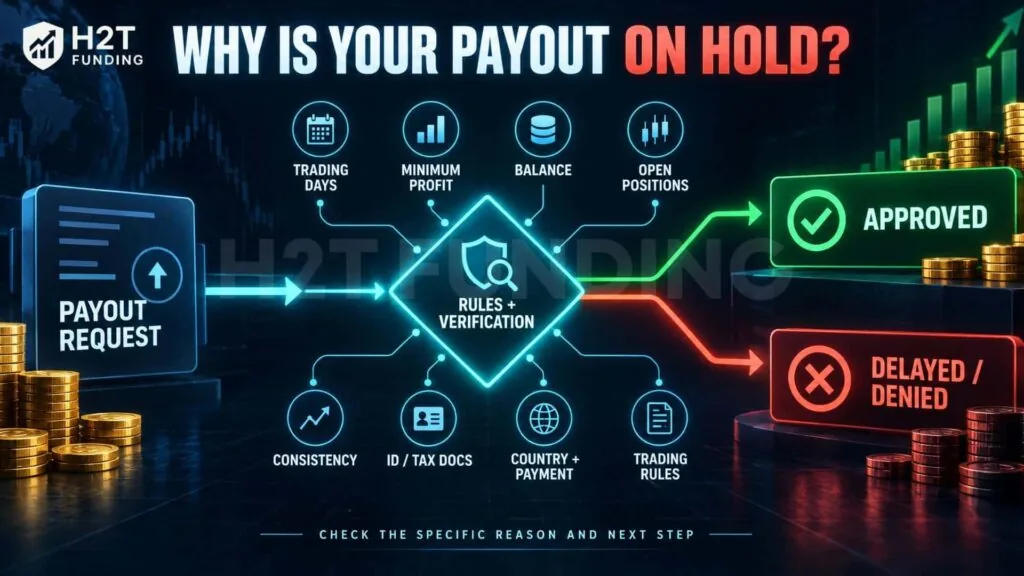
A payout can be delayed or denied when you do not meet the payout conditions or the firm needs more information. Common reasons:
- Requirements not met: A missed minimum of trading days, profit, balance, or another condition.
- Account no longer meets the conditions: Some programs require a minimum balance or buffer until approval.
- Open positions or restrictions: A firm may require you to close positions before requesting a payout or restrict certain trading activity around the request.
- Consistency rules: A large winning day can exceed the threshold or change the eligible amount.
- Missing verification or tax information: Identity, tax, or other documents.
- Country or payment restrictions: Your location or chosen method may not be supported.
- Rule violations: A payout review may find a breach of the firm’s trading or risk rules that affects payout eligibility.
A delay is not automatically a sign of a problem. If the firm names a specific rule or verification requirement and explains the next steps, it is likely part of its process. Repeated unexplained denials, no response beyond the published processing window, or requirements that contradict the stated rules deserve more attention. Look for consistent explanations, clear payout terms, and a documented dispute process.
For a closer look at withdrawal risks, our guide to prop firm payout delays and disputes explains common issues that can affect when you receive your profits.
8. How Do Prop Firm Payouts Compare Across Different Prop Firms?
Payout rules differ widely even when firms advertise similar profit splits. The main differences are first-payout eligibility, frequency, minimum withdrawal, consistency requirements, buffers, and payout caps. We compared eight selected prop firms using their current published rules. The table shows selected programs, not every account type a firm offers.
| Firm | First Payout | Frequency | Minimum | Key Condition | Profit Split | Coupon Code | Actions |
|---|---|---|---|---|---|---|---|

4.4
(14,600+ reviews)
|
5 winning days of $150+ (XFA Standard) |
Daily after 30 winning days (Live) |
$125 |
Balance-based caps on XFA |
90% – 100%
|
No code
|
Visit Official Website |

4.9
(21,100+ reviews)
|
24h after first trade (Rapid) |
Daily (Rapid) / 14 days (Pro) |
$500 (Rapid) |
Buffer and plan-specific limits |
80% – 90%
|
No code
|
Visit Official Website |

4.4
(20,700+ reviews)
|
5 qualifying trading days |
Up to weekly |
$500 |
50% consistency, safety net |
100%
|
VLSLOVIR
|
Open an account |

4.8
(53,770+ reviews)
|
14 days after first trade |
Program-specific |
None fixed |
No open positions |
90%
|
No code
|
Visit Official Website |

4.4
(3,200+ reviews)
|
From day 3 (on-demand products) |
On-demand or daily |
$100 |
Best Day rule, buffers, caps |
80% – 100%
|
H2T01
|
Open an account |

4.9
(35,600+ reviews)
|
14 days after activation |
Every 2 weeks |
$150 |
No open trades |
50% – 100%
|
NAXW1ULCR
|
Open an account |

4.4
(810+ reviews)
|
14 days after inception |
Program-specific |
$300 ($150 on $5K) |
No open positions |
70% – 80%
|
6E9KLOIQ
|
Open an account |

4.5
(2,600+ reviews)
|
10 days (2-Step Classic) |
Every 10 days |
1% of account balance |
50% consistency |
80% – 100%
|
H2T
|
Open an account |
Important: The table compares selected programs, not entire firms. Rules can differ by account type, asset class, or program, so check the latest rules for the account you are considering. (Last updated: September 2026)
Terms in the table:
- Apex’s Safety Net works like a buffer: it equals the drawdown limit plus $100, your balance must stay above it after a payout, and only profit above that level can be withdrawn.
- E8’s Best Day rule is a consistency rule: your best trading day cannot exceed a set share of your total profit for the payout period (35% or 40%, depending on the product). If it does, you keep trading until total profit is high enough before you can request a payout.
Payout frequency alone is not enough to compare prop firms. A daily or on-demand program can still require a buffer, consistency target, or minimum balance, while a less frequent schedule may be more practical if it has fewer restrictions or a higher withdrawal allowance.
Futures programs also differ from Forex/CFD programs. Qualifying trading days, safety nets, buffers, consistency rules, and payout caps are the main factors to check. My Funded Futures shows how rules vary by plan: our My Funded Futures payout policy guide breaks them down, and our Tradeify payout rules show another futures example.
9. FAQs
-
From request to cleared funds, it usually takes a few hours to several business days, depending on the firm’s review process and payment method.
-
Only a small share. In FPFX Tech data on about 300,000 accounts reported by Finance Magnates, about 14% of traders passed the challenge, and roughly 45% of those received a payout, or about 7% of all traders. The average payout was about 4% of the account size. Results vary by firm and program, so treat these figures as an industry estimate, not a benchmark for any single firm.
-
It depends on the program: minimum trading days, profit or balance thresholds, buffers, or waiting periods. For a firm-specific example, see our breakdown of Apex Trader Funding payout rules.
-
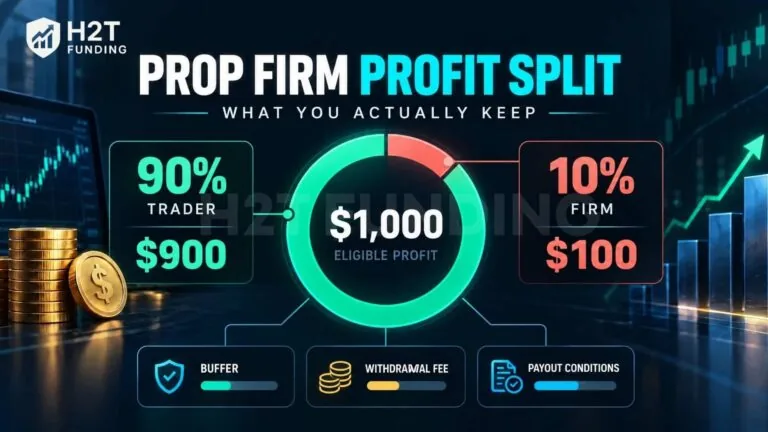
Many firms offer trader splits between 70% and 90%, but the percentage and conditions vary by firm and program. The split applies to eligible profit: $5,000 × 80% = $4,000 trader’s share, before caps, buffers, and fees.
-
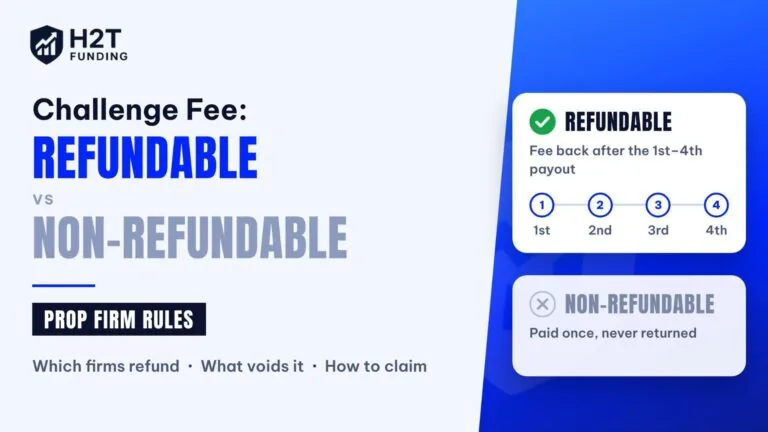
Some do, but it depends on the firm and program. FTMO, for example, may refund the 2-Step Challenge fee with the first Reward withdrawal, while its 1-Step fee is not refunded. Other firms return the fee only after several payouts, as account credit, or not at all, so check the refund terms of the exact program before you buy.
-
Yes, if you fail to meet the program’s requirements, violate its rules, or provide incomplete verification or payment information.
-
In many countries, yes, but it depends on your country, tax residency, and how the payment is classified. Some firms also ask for tax forms before paying. Consult a qualified tax professional for your situation.
-
It depends on the firm and pricing model. A $50K evaluation can cost from roughly $30 to $100 a month on subscription-based futures programs to a few hundred dollars one-time on many Forex/CFD challenges, and some firms add an activation fee after you pass.
Compare the total cost to reach a payout, including resets and activation fees, not just the headline price. Our list of cheapest prop firms compares entry costs across firms.
-
Choose the program whose payout rules fit your trading style first, then apply a verified discount code at checkout. Check whether the fee is refundable and whether an activation fee applies before you pay. You can find tested codes on our prop firm coupon codes page.
10. Conclusion
Prop firm payouts depend on both when you qualify to withdraw and how long funds take to arrive. Before buying a challenge, compare eligibility requirements, drawdown rules, consistency requirements, fees, payout frequency, processing times, and payment methods.
If you’re ready to choose a firm, explore our best prop firms for 2026 to compare payout terms and trading rules, or browse our prop firm reviews for in-depth evaluations of individual firms, including their payout policies, account conditions, and potential limitations.