


H2T Funding ranked 8 prop firms that clear US eligibility requirements across 6 criteria: instrument-access requirements and platform compatibility, then compared them on drawdown structure, payout reliability, cost of entry, and profit split.
Among the 8 firms compared, three stand out for different reasons tied to the barriers US traders actually face:
- Topstep: carries the longest operating history, dating back to 2012, and publishes real pass-rate data (51.8% reached funding at least once in 2025). Its Trustpilot score dropped from 4.5 to 3.4 in 2026 following a platform migration, worth checking before committing to a larger account size.
- The5ers: the strongest pick for traders who want more than futures. It’s one of the few firms letting US clients trade CFDs through cTrader without the heavy restrictions most CFD providers impose, alongside full CME futures access via Black Arrow.
- MyFundedFutures: holds the highest Trustpilot rating in this group at 4.9, with no daily loss limit on most plans and a $0 activation fee, making it the lowest-friction entry point for pure futures traders.
The table below ranks these firms by category, futures-only options first, followed by CFD/futures hybrids, so you can compare drawdown, profit split, and payout speed before reading the full eligibility breakdown.
| Firm | Profit Split | Coupon Code | Actions |
|---|---|---|---|

4.4
(20,700+ reviews)
|
100%
|
SEO
|
Open an account |

4.9
(21,100+ reviews)
|
80% – 90%
|
No code
|
Visit Official Website |

4.4
(14,600+ reviews)
|
90% – 100%
|
No code
|
Visit Official Website |
4.3
(10,300+ reviews)
|
80% – 90%
|
FUNDEDFUTURESTRADERS
|
Open an account |

4.6
(4,000+ reviews)
|
90%
|
No code
|
Visit Official Website |

4.6
(4,900+ reviews)
|
80%
|
H2TFUNDING
|
Open an account |

4.5
(78,300+ reviews)
|
80% – 95%
|
No code
|
Visit Official Website |

4.9
(35,600+ reviews)
|
50% – 100%
|
NAXW1ULCR
|
Open an account |
Note: All data sourced from official firm websites as of May 2026. Prop firm rules change without notice. Confirm current terms before purchasing any evaluation.
1. Why Prop Trading Is Harder for US Traders?
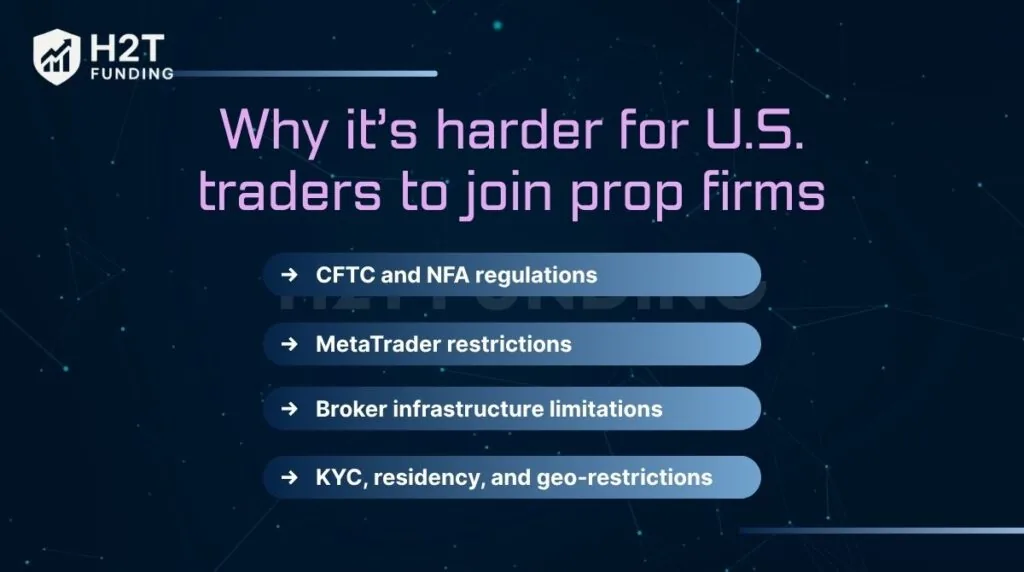
Most international prop firms block US traders before any evaluation begins, not because of trading performance, but because of 4 structural barriers.
- CFTC and NFA regulations: Any firm serving US residents must meet federal registration and capital requirements. Most offshore forex/CFD prop firms skip compliance entirely and block US access instead.
- MetaTrader restrictions: MetaQuotes withdrew US platform licensing, making MT4 and MT5 inaccessible for US-based firms. Any prop firm built on MetaTrader cannot serve US traders.
- Broker infrastructure limitations: US execution requires CFTC/NFA-registered brokers, a standard most international CFD brokers do not meet.
- KYC, residency, and geo-restrictions: Residency, citizenship, and IP address are all checked. Any one of them can block access, regardless of trading record.
CME futures firms clear all 4 barriers by operating through regulated exchanges. That is why 6 of the 8 firms in this review are futures-based, and why this list starts there.
Difference between CME Futures vs CFD Prop Firms for US Traders
For traders in the U.S., the main difference between CME Futures and CFD Prop Firms comes down to regulation, market structure, and execution transparency.
- CME Futures (US-regulated path): Traded on centralized exchanges like CME Group, offering transparent pricing, strong regulation (CFTC oversight), tax efficiency (60/40 rule), and no Pattern Day Trader (PDT) restriction. Instruments like Micro E-mini S&P 500 (MES) and Nasdaq (MNQ) are widely used for low-capital access with institutional-grade execution.
- CFD Prop Firms (OTC model): CFDs are typically traded as over-the-counter contracts where pricing is set by the broker or prop firm. Some CFD prop firms may accept U.S. traders indirectly, but CFDs remain less standardized, with wider spreads, funding/overnight costs, and higher counterparty risk since you trade against the provider rather than a centralized exchange.
2. How We Ranked These Firms for US Traders
Those structural barriers eliminate a large portion of the global prop firm market before any comparison on pricing, payouts, or rules even begins. The 8 firms in this review cleared that first filter: all currently accept US traders without registration workarounds, offshore entities, or unsupported platform setups.
From there, we ranked each prop firm based on 7 criteria that matter specifically to US traders, especially around regulation, platform access, drawdown structure, and payout reliability.
| Criterion | What We Measured |
|---|---|
| US Eligibility | No geo restriction, no registration workaround, confirmed US checkout |
| Drawdown Structure | EOD vs intraday trailing; whether mechanics change between eval and funded phase |
| Payout Reliability | Track record length, total payouts published, and processing speed documented |
| Cost of Entry | Evaluation fee + activation fee + reset cost; promo availability |
| Funded Account Rules | Consistency rule phase; overnight/news restrictions; contract limit changes post-eval |
| Platform Access | US-compatible platforms; data feed quality; multi-account support |
| Profit Split | Net % kept; payout cap; any consistency gate on withdrawals |
This updated 2026 list features the top 8 firms that combine transparency, realistic rules, and reliable funding for American traders. See the full breakdown below to explore which trading firms best fit your trading goals.
3. Detailed Reviews: Best Prop Firms for US traders
Each of the 8 firms below is reviewed against the same 7 criteria used in the comparison above, so you can see exactly why each firm cleared US eligibility and where it stands out. The reviews follow the same order as the table, starting with Apex Trader Funding, the first of six pure futures firms in this group, before moving to the two CFD/futures hybrids at the end.
Apex Trader Funding
#1
Account Types
1-step
Trading Platforms
Tradovate, Rithmic, WealthCharts
Profit Target
6%
Our take on Apex Trader Funding
Apex Trader Funding is built for US futures traders who want to scale across multiple funded accounts, with support for up to 20 accounts simultaneously and ACH Direct Deposit processed straight to US bank accounts, no international wire delays.
Zero Payout Denials Under the 4.0 Payout System
The payout system runs on minimal manual review: as long as the 50% consistency rule holds and the Safety Net buffer stays intact, payouts process automatically. The EOD trailing drawdown recalculates the floor once daily at 4:59 PM ET rather than in real time, softening the impact of intraday volatility on the available buffer. An intraday trailing option is also available, usually at a lower evaluation cost, but it demands stricter discipline during active sessions.
Trader Insight: the 6-payout cap is a lifetime limit per Performance Account, not a resettable condition. After the 6th approved withdrawal, the account closes permanently. Many traders simply buy a new evaluation afterward, especially during Apex’s frequent 70–90% discount promotions, treating each funded account as a finite income cycle rather than a long-term hold.
| 💳 Challenge Fee | $199 – $799 |
| 👥 Account Types | 1-step |
| 💰 Profit Split | 100% |
| 💵 Account Size | $25K – $150K |
| ⏱️ Time Limit | 30 days |
| 🎯 Profit Target | 6% |
| 📊 Trading Platforms | Tradovate, Rithmic, WealthCharts |
| 🛍️ Asset Types | Futures Contracts |
Verdict: Apex suits US futures traders who want the lowest all-in cost with 100% profit split and automated payouts. The one-time fee and frequent discounts make it the most accessible entry point.
It fits traders who can pass within 30 days and manage consistency rules in Apex. Traders needing more flexible timelines may prefer subscription-based firms. For strategies requiring broader instrument access beyond Apex 4.0, alternatives like Tradeify or TakeProfit Trader may be more suitable.
My Funded Futures
#2
Account Types
1-step
Trading Platforms
Tradovate, NinjaTrader 8, TradingView, Quantower, Volsys, Volumetricatrading
Profit Target
6%
Our take on My Funded Futures
MyFundedFutures (MFFU) offers a structure built around one key advantage: no daily loss limit on almost all plans (a DLL of $1,000 on the Builder plan). The firm offers four plans: Rapid, Pro, Flex, and Builder (new – apply on $50K account), all focused on futures trading on the CME.
Founded in late 2023, MFFU has grown quickly, reaching 17,800+ Trustpilot reviews with a 4.9 rating, making it one of the highest-rated futures prop firms. US traders can access platforms like NinjaTrader, Tradovate, TradingView, and ATAS.
No Daily Loss Limit, EOD Drawdown on all plans, 4.9 Trustpilot
MyFundedFutures removes the daily loss limit, giving traders more flexibility during volatile sessions. Instead of being stopped out early, positions can be managed throughout the day, as long as the trailing drawdown is respected, which is useful for strategies that recover within the same session.
All MFFU plans apply EOD trailing drawdown during both evaluation and funded stages, keeping risk rules consistent. The only exception is the Rapid plan, which switches to real-time (intraday) drawdown once funded, making it more sensitive to live PnL changes.
Payout frequency varies by plan: Rapid (daily), Builder (every 48 hours), Pro (bi-weekly), and Flex (weekly). Combined with the removal of activation fees, this keeps the total cost of funding low while offering multiple payout structures to fit different trading styles.
| 💳 Challenge Fee | $109 – $477 |
| 👥 Account Types | 1-step |
| 💰 Profit Split | 80% – 90% |
| 💵 Account Size | $25K – $150K |
| ⏱️ Time Limit | No time limit |
| 🎯 Profit Target | 6% |
| 📊 Trading Platforms | Tradovate, NinjaTrader 8, TradingView, Quantower, Volsys, Volumetricatrading |
| 🛍️ Asset Types | Futures Contracts |
Verdict: MyFundedFutures suits US futures traders who want no daily loss limit, EOD drawdown on the funded account, and the highest Trustpilot rating in this review. The $0 activation fee and no consistency rule once funded make it a low-friction path from passing to paid. Traders who need a longer track record should compare Topstep (2012) or Apex (2021). Traders who want 100% profit split should compare Apex.
Topstep
#3
Account Types
2-step
Trading Platforms
TopstepX
Profit Target
6%
Our take on Topstep
Topstep has operated as a futures prop firm since 2012, one of the longest track records in the industry. The firm offers a structured evaluation model with payouts processed as fast as the next trading day, and profit splits up to 90%.
In 2025, 51.8% of traders who entered one or more Trading Combines advanced to funded in at least one attempt, making it one of the most transparent firms in terms of performance data.
14-Year Track Record, Next-Day Payouts, and a 51.8% Funded Rate
Topstep’s core advantage is not pricing or profit split; it is verified longevity and payout reliability. The firm has processed real payouts through major market events, including the 2015 correction, 2020 COVID crash, and 2022 rate hikes. This track record adds a level of trust that newer firms cannot match.
Unlike most competitors, Topstep publishes performance statistics. In 2025, 33.3% of funded traders received at least one payout, offering a clearer view of real outcomes.
Payout processing can be as fast as the next trading day, making it one of the fastest documented systems. For US traders who prioritize reliability over aggressive profit splits, this reduces uncertainty.
The Trading Combine has no minimum trading days to pass, meaning some traders complete it in as little as 2 days. However, it includes a 50% consistency target, where your best trading day must not exceed 50% of your total profit. If exceeded, the profit target increases rather than failing the account.
Once funded under the Express Funded Account (Consistency), payouts are governed by a 40% consistency rule. Your largest trading day must be ≤ 40% of total net profit during the payout window. This rule affects payout eligibility only and does not close or reset the account.
Trader Insight: The 40% consistency rule does not close your account, but it directly impacts when you can withdraw profits. If one trading day exceeds 40% of total net profit, you must continue trading and increase overall profit until the ratio falls back within the limit. The required adjustment depends on how large the initial winning day was.
| 💳 Challenge Fee | $49 – $229 |
| 👥 Account Types | 2-step |
| 💰 Profit Split | 90% – 100% |
| 💵 Account Size | $50K – $150K |
| ⏱️ Time Limit | No time limit |
| 🎯 Profit Target | 6% |
| 📊 Trading Platforms | TopstepX |
| 🛍️ Asset Types | Futures Contracts |
Verdict: Topstep suits US futures beginners who need structure, transparency, and a proven payout system. The long track record and published performance data make it one of the most trusted firms available.
It works best for traders who value consistency and process over aggressive scaling. Traders focused on higher profit splits or fewer payout restrictions may consider alternatives like Apex or Tradeify.
Important: Topstep’s 2026 Trustpilot score dropped from 4.5 to 3.4, driven by the TopstepX platform migration, pricing updates, and rule changes. The operational track record since 2012 remains intact. The community sentiment shift is real and worth monitoring. Read recent Trustpilot reviews and the Topstep Discord before committing to a $150K account size.
Take Profit Trader
#4
Account Types
1-step
Trading Platforms
NinjaTrader 8, Tradovate, TradingView
Profit Target
6%
Our take on Take Profit Trader
TakeProfit Trader is built around one core advantage: fast, on-demand payouts. Funded traders can request withdrawals as soon as Day 1 on the PRO account, once the buffer requirement is cleared. For example, on a $50K account with a $2,000 drawdown, the buffer equals $2,000; profits above that level become eligible for withdrawal.
There is no fixed payout schedule after this point. Processing typically takes around 24 hours to the trader’s wallet, making it one of the fastest payout systems among US-friendly futures prop firms. The firm holds a 4.4/5 Trustpilot rating from 9,000+ reviews (data updated on May, 2026).
Day 1 Payouts, 24-Hour Processing, and Intraday Drawdown Model
TakeProfit Trader’s payout structure is designed for quick capital access rather than long accumulation cycles. There are no minimum payout days on PRO accounts once the buffer is cleared, and no consistency rule applies after funding.
The payout infrastructure supports multiple methods depending on the region.
- US traders: via Plaid-connected bank transfers (ACH/wire) directly to US bank accounts.
- International traders: via PayPal or Wise
Processing is automated through the dashboard, though identity and account matching must comply with AML rules. Mismatched account details can delay or block payouts.
The evaluation (Test) phase uses EOD trailing drawdown, while the PRO funded account switches to intraday trailing drawdown, where the drawdown level moves in real time with unrealized PnL. This transition increases risk sensitivity and often requires smaller position sizing after funding.
Note: The shift from EOD to intraday drawdown is a key adjustment point. The drawdown floor can move up quickly during profitable trades, reducing the buffer if not managed carefully.
| 💳 Challenge Fee | $150 – $360 |
| 👥 Account Types | 1-step |
| 💰 Profit Split | 80% – 90% |
| 💵 Account Size | $25K – $150K |
| ⏱️ Time Limit | No time limit |
| 🎯 Profit Target | 6% |
| 📊 Trading Platforms | NinjaTrader 8, Tradovate, TradingView |
| 🛍️ Asset Types | Futures Contracts |
Verdict: TakeProfit Trader suits US futures traders who want fast access to profits and flexible withdrawal timing. It works best for intraday traders who can manage real-time drawdown and do not rely on automation or news trading strategies.
Traders who prefer EOD drawdown on funded accounts or fewer restrictions may consider Tradeify. Those focused on higher profit splits (100%) may prefer Apex.
Tradeify
#5
Account Types
1-step and instant funding
Trading Platforms
Tradovate, TradingView, NinjaTrader, WealthCharts, Rithmic, Tradesea, Quantower
Profit Target
6%
Our take on Tradeify
Tradeify is built around flexible risk structures across multiple funding paths. Unlike most prop firms that change drawdown mechanics between evaluation and funded stages, Tradeify maintains a consistent EOD trailing drawdown across all accounts.
This structure applies to all plans and ensures traders operate under the same risk model from evaluation through funding. However, consistency rules vary by plan, with Growth, Select, and Lightning each following different thresholds depending on stage.
Tradeify also offers a $0 activation fee, fast payouts as quick as 1 hour, and a 90% profit split. The firm offers a 90% profit split, over $150M+ in verified payouts, and runs on Tradeify 3.0 with a built-in trading journal, no subscriptions, and instant account activation. That makes it one of the most adaptable setups for US futures traders.
EOD Drawdown, 3.0 integrates TradeSea, and $0 Activation Fee
Tradeify applies EOD trailing drawdown across both evaluation and funded accounts with no change in mechanics between stages. The drawdown floor is recalculated once per day at 4:59 PM ET, meaning intraday unrealized gains only update the risk buffer at the end of the trading session. This keeps the risk model consistent and predictable across all account types.
The $0 activation fee makes Tradeify the lowest total-cost path from evaluation to first payout among the firms reviewed. By comparison, Apex charges $89-$159, TakeProfit Trader charges $130, and Topstep charges $149 on its Standard path.
Consistency rules vary depending on the plan structure. Growth accounts have no consistency rule during evaluation, but require 35% in funded stages. Select accounts apply a 40% rule during evaluation and remove it after funding. Lightning accounts follow a staged model: 20% -> 25% -> 30% across payout levels. This creates different scaling paths based on trading behavior.
Payouts can be requested once the required conditions are met, with processing times as fast as 1 hour, depending on the account and payout setup.
Trader Insight: Tradeify 3.0 launched with TradeSea integration, a built-in free trading journal, no subscription model, and instant account activation. The platform updates more frequently than most competitors. Verify current pricing and account structures directly on tradeify.co, especially if comparing costs across multiple evaluation cycles.
| 💳 Challenge Fee | $99 – $796 |
| 👥 Account Types | 1-step and instant funding |
| 💰 Profit Split | 90% |
| 💵 Account Size | $25K – $150K |
| ⏱️ Time Limit | No time limit |
| 🎯 Profit Target | 6% |
| 📊 Trading Platforms | Tradovate, TradingView, NinjaTrader, WealthCharts, Rithmic, Tradesea, Quantower |
| 🛍️ Asset Types | Futures Contracts |
Verdict: Tradeify suits US futures traders who want flexible scaling paths across different account types. The combination of EOD drawdown consistency and multiple consistency rule structures makes it adaptable for different trading styles.
It works best for traders who prioritize fast payouts, low entry costs, and structured intraday execution. However, it is not suitable for swing traders due to strict end-of-day flat rules. Traders who prioritize longer track records may prefer Topstep, while those seeking 100% profit split may consider Apex.
Earn2Trade
#6
Account Types
1-step
Trading Platforms
NinjaTrader 8, Finamark, R | Trader Pro
Profit Target
5.5% – 7%
Our take on Earn2Trade
Earn2Trade is the structured path to real brokerage capital through its Trader Career Path (TCP) program. Founded over 9 years ago and based in Wyoming, Earn2Trade funded 6,400+ traders in 2025 and holds a 4.7/5 Trustpilot rating from 4,700+ reviews (updated on May, 2026). The Gauntlet Mini evaluation can be passed in as little as 10 days. The TCP program scales funded accounts up to $400,000 through milestone-based live account upgrades.
Scaling to $400K, 10-Day Gauntlet Mini, and Live Account Path
Earn2Trade’s Trader Career Path (TCP) is a structured scaling system that begins with passing a virtual evaluation. Traders can choose a starting account of $25K, $50K, or $100K. Upon passing, you transition to a funded stage (Live or LiveSim® account) and upgrade to larger capital as specific profit targets are met. The progression ceiling depends on your initial plan:
- TCP25: Scales from $25K up to a $200K live account. At the $200K level, the drawdown is fixed at $194,000.
- TCP50 & TCP100: Scale through intermediate steps up to a $400K live account. At the $400K level, the drawdown is fixed at $388,000 (not trailing), removing the risk of the floor rising with profits.
The Gauntlet Mini™ is a standalone evaluation program offering account sizes of $50K, $100K, $150K, and $200K. Both the TCP and Gauntlet Mini evaluations enforce a strict Daily Loss Limit and an EOD (End of Day) Drawdown.
Earn2Trade is highly transparent with its data. According to their 2025 exam disclaimer, 8.89% of candidates passed the TCP or Gauntlet Mini examinations. Of those who passed and progressed, 5.23% traded a Live account, and 94.77% traded a LiveSim® account. Furthermore, 18.04% of Live accounts and 18.20% of LiveSim accounts had at least one successful withdrawal.
Trader Insight: If you choose to be funded on a LiveSim® account, the $139 activation fee is not charged upfront; it is deducted from your first withdrawal. This means no out-of-pocket cost initially, but your first payout is reduced. If moving to a Live account, monthly data fees are $140-$156 per exchange (CME pass-through fees).
| 💳 Challenge Fee | $150 – $550 |
| 👥 Account Types | 1-step |
| 💰 Profit Split | 80% |
| 💵 Account Size | $25K – $200K |
| ⏱️ Time Limit | No time limit |
| 🎯 Profit Target | 5.5% – 7% |
| 📊 Trading Platforms | NinjaTrader 8, Finamark, R | Trader Pro |
| 🛍️ Asset Types | Futures |
Verdict: Earn2Trade is designed for serious, experienced US futures traders who want a clearly documented ladder to real brokerage capital, rather than just staying on simulated environments indefinitely.
The unique advantage lies at the end of the Trader Career Path: achieving a $200K or $400K account with a completely fixed drawdown. Traders who prefer instant funding or trade asset classes outside of CME futures should look elsewhere, but for disciplined futures traders, E2T provides the professional scaling plans in the industry.
FundedNext
#7
Account Types
1-step, 2-step, and Instant Funding
Trading Platforms
MT4, MT5, cTrader, Match Trader
Profit Target
4% – 10%
Our take on FundedNext
FundedNext is an industry giant offering both CFD and CME Futures trading divisions. With a massive track record, they have paid out over $293M+ to 113,000+ traders and hold a stellar 4.5/5 Trustpilot rating based on over 66,000 reviews (updated in May 2026). Their most unique feature across all divisions is the Guaranteed Payout: they promise to process withdrawals within 24 hours (averaging just 5 hours), or they will pay you an extra $1,000.
The 24-Hour Payout Guarantee, News Trading Permissions
FundedNext is a great choice for any trading style because they offer both CFD and Futures accounts. No matter which account you choose, you are completely allowed to trade during the news.
Their biggest standout feature is their Payout Guarantee: they promise to process your withdrawal within 24 hours (though it usually takes just 5 hours on average). If they are late, they will pay you an extra $1,000.
- CFD Division (Stellar Plans): Offers various models, including Stellar 1-Step, 2-Step, Lite, and Instant. The popular Stellar 2-Step features an 8% Phase 1 target, 5% Phase 2 target, a 10% maximum loss limit, and up to a 95% profit split.
- Futures Division: Offers Rapid, Legacy, and Bolt challenges via Tradovate and NinjaTrader. The Rapid plan stands out by offering No Daily Loss Limit, giving traders maximum intraday flexibility alongside a fast 5-day payout cycle.
Important U.S. Trader Rules: FundedNext accepts U.S. clients, but rules differ by division.
- For Futures: U.S. traders have full access to all plans and platforms (Tradovate/NinjaTrader) normally.
- For CFDs: U.S. traders are restricted. They can only use the Match-Trader platform (MT4/MT5/cTrader are banned). The Instant Account is not available, and U.S. clients do not receive the 15% reward from the challenge phase.
| 💳 Challenge Fee | $32.99 – $1,099.99 |
| 👥 Account Types | 1-step, 2-step, and Instant Funding |
| 💰 Profit Split | 80% – 95% |
| 💵 Account Size | $2K – $200K |
| ⏱️ Time Limit | No time limit |
| 🎯 Profit Target | 4% – 10% |
| 📊 Trading Platforms | MT4, MT5, cTrader, Match Trader |
| 🛍️ Asset Types | Forex, Indices, Commodities, Crypto, CFDs |
Verdict: FundedNext is a strong choice for traders who prioritize firm stability, massive payout proof, and lightning-fast withdrawals. Having both CFD and Futures under one roof is highly convenient. However, U.S. traders must weigh their options carefully: if you trade Futures, FundedNext is highly flexible and competitive. But if you trade CFDs, you must be comfortable using the Match-Trader platform and forfeiting the challenge phase bonus.
The5ers
#8
Account Types
1-step, 2-step, 3-step
Trading Platforms
MT5, cTrader
Profit Target
5% – 10%
Our take on The5ers
The5ers, operating since 2016, is one of the most established prop firms in the industry, with a verified track record of over $1,6M+ in traders worldwide. What makes it stand out is its ability to combine CFD trading and CME Futures under one platform, while still allowing U.S. traders to participate fully. CFD trading is handled through cTrader, while futures trading runs on the Black Arrow platform, giving traders flexibility depending on their style.
Overnight Holding, Unrestricted News Trading, and No Monthly Fees
The5ers stands out by offering trading conditions that are exceptionally rare in the prop firm space. Across both the CFD and Futures divisions, overnight holding is permitted, making this an ideal firm for swing traders who cannot use strict intraday-only firms. Furthermore, news trading is fully allowed without restrictions on Futures and most CFD plans (the High Stakes CFD plan applies a brief 2-minute freeze).
The firm provides immense flexibility in how you execute your strategy. The CFD programs impose absolutely no time limits and no consistency rules, fully allowing EAs and copy trading across your own accounts.
On the Futures side, The5ers disrupts the standard model by charging a one-time fee only, eliminating the stress of recurring monthly subscriptions. They even offer an innovative “Rebate” program that refunds your commissions on funded trades. Depending on your chosen path, you can scale your capital massively: up to $500K on Futures, and a staggering $4,000,000 on CFDs.
| 💳 Challenge Fee | $19 – $850 |
| 👥 Account Types | 1-step, 2-step, 3-step |
| 💰 Profit Split | 50% – 100% |
| 💵 Account Size | $2.5K – $250K |
| ⏱️ Time Limit | No time limit |
| 🎯 Profit Target | 5% – 10% |
| 📊 Trading Platforms | MT5, cTrader |
| 🛍️ Asset Types | Forex / CFD |
Verdict: The5ers is the ultimate destination for U.S. traders who want the security of a 9-year track record and the flexibility to trade both CFDs and CME Futures. It is the strongest option on the market for swing traders who need to hold positions overnight, a feature most competitors strictly forbid.
While pure intraday scalpers might dislike the bi-weekly payout schedule or the 30% consistency rule on Futures, traders seeking a reliable firm with no monthly fees, EA permissions, and massive $4M scaling potential will find The5ers unmatched.
Read more:
How to Choose the Best Prop Firm as a US Trader
The best prop firm for a US trader is the one whose rules match the way you actually trade. A high profit split or large account size means very little if the funded-account restrictions conflict with your strategy, payout goals, or risk management style. For US traders, platform access, drawdown structure, and payout rules are often more important than the challenge itself.
Before purchasing any evaluation, focus on these 5 factors:
- US eligibility and platform access: Some firms still restrict US traders or require alternative platforms such as cTrader, Match-Trader, DXTrade, NinjaTrader, or Tradovate instead of MT4/MT5.
- Drawdown structure: EOD trailing drawdown is generally more flexible for volatile intraday trading, while realtime trailing drawdown requires tighter position management.
- Funded-account restrictions: Overnight holds, news trading rules, automation limits, and consistency requirements can directly affect your strategy.
- Total cost to first payout: Evaluation fees alone do not show the real cost. Activation fees, reset costs, and monthly subscriptions matter just as much.
- Payout structure: Some firms offer faster withdrawals, while others delay payouts through consistency rules or minimum trading-day requirements.
For US traders, choosing the wrong rule structure is usually more expensive than choosing the wrong profit split. If you want a deeper breakdown of evaluation models, drawdown types, and payout systems, read our full guide on how to choose a prop firm.
What Traders Say About US Prop Firms on Reddit?
Reddit discussions, especially in communities like r/Daytrading, highlight a consistent theme: US traders care less about marketing claims and more about rules, payout reliability, and execution conditions. The feedback below reflects real trader priorities when choosing a prop firm.
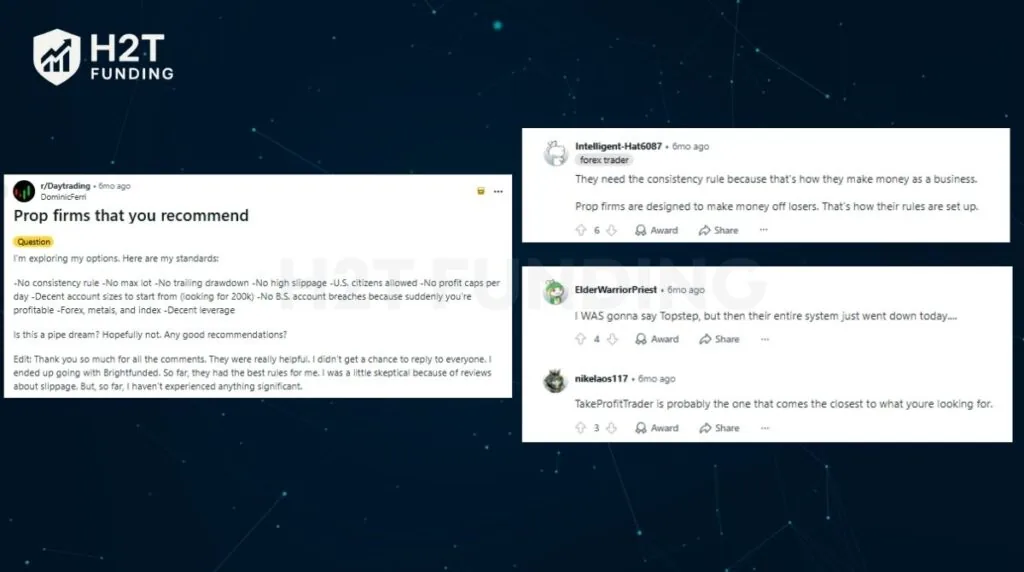
Most Recommended Firms
Across multiple threads, a few firms are repeatedly mentioned based on rule structure and usability:
- TakeProfit Trader is often recommended for traders who want faster payouts and fewer restrictions after funding.
- Topstep is recognized for its long track record and structured system, especially for structured beginners.
- The5ers is highlighted for clear rules, consistency-based evaluation, and growing appeal among US traders.
Overall, traders tend to recommend firms that balance clear rules + realistic payout conditions, rather than just high profit splits.
Common Complaints
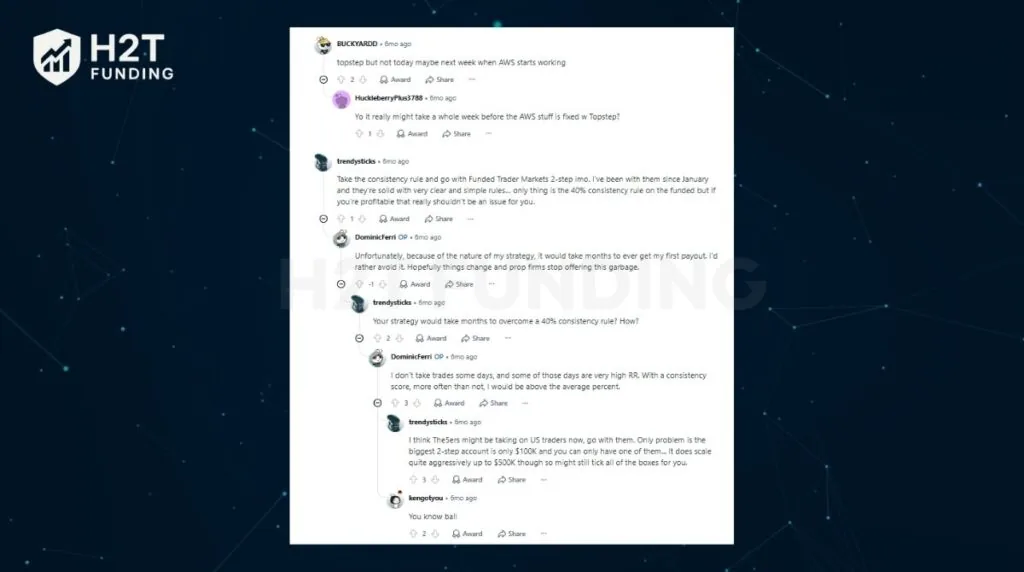
Most negative feedback is not about profitability, but about rules interfering with execution. Traders frequently point out that consistency rules, payout conditions, and platform reliability create more friction than the strategy itself.
“I was gonna say Topstep, but then their entire system just went down today…” – (ElderWarriorPriest, r/Daytrading)
System stability is a recurring concern. Platform outages or infrastructure issues can interrupt trading sessions, which is critical when traders are operating under strict drawdown limits. Even short disruptions can impact results and confidence.
Another common issue is rule-strategy mismatch. Traders using high R:R or low-frequency strategies often struggle with consistency rules, while others find payout conditions too restrictive. In practice, many complaints come down to one factor: the firm’s rules do not align with how the trader actually trades.
Real User Insights
These comments reflect a broader pattern: traders are highly sensitive to how rules affect real trading behavior. Consistency rules are often viewed as a barrier to payouts, especially for strategies that rely on uneven profit distribution.
“They need the consistency rule because that’s how they make money as a business.” – (Intelligent-Hat6087, r/Daytrading)
“TakeProfitTrader is probably the one that comes the closest to what you’re looking for.” – (nikelaos117, r/Daytrading)At the same time, firms that reduce friction, either through faster payouts or simpler funding rules, tend to gain stronger support. For US traders, where options are already limited, the ability to execute a strategy without rule conflict is often more important than profit split or branding.
Common Mistakes US Traders Make When Choosing a Prop Firm
US traders often fail not because of strategy, but because they choose the wrong prop firm structure for their trading style and regulatory constraints. Limited access to forex firms, strict CME futures rules, and platform restrictions make firm selection more critical for US-based traders than in other regions.
- Ignoring drawdown mechanics (EOD vs intraday). Many US traders don’t understand how trailing drawdown works. Choosing the wrong model, especially intraday trailing, can lead to fast violations even with a profitable strategy.
- Choosing firms incompatible with their trading style. Some firms restrict news trading, automation, or overnight holds. If your strategy depends on these, the account becomes unusable from day one.
- Falling for high leverage or fast targets. Aggressive profit targets and short deadlines often push traders into overtrading. This leads to drawdown breaches rather than consistent performance.
- Not understanding payout structures and rules. Profit splits (80-100%) don’t matter if payout rules block withdrawals. Traders often overlook consistency rules, payout caps, or minimum trading day requirements.
- Overlooking firm reputation and payout history. US traders face more restrictions, so choosing a firm with a weak payout history or unclear policies increases risk. Verified payouts and track record matter more than marketing claims.
- Ignoring cost structure and reset fees. Low entry fees can be misleading if resets or activation fees are high. Total cost over multiple attempts is what impacts long-term profitability.
- Overleveraging to pass challenges quickly. Many traders increase position size too early to hit profit targets. This usually results in failing the evaluation rather than passing efficiently.
- Not reading firm-specific restrictions. Rules around HFT, copy trading, hedging, or even trade duration can disqualify accounts. These details are often buried in the fine print.
In short, US traders need to treat prop firm selection as a risk decision, not a marketing decision, align rules, payouts, and platform access with their actual trading behavior.
Tips to pass a prop trading challenge successfully
Most prop firm evaluation failures happen because traders mismanage drawdown, ignore funded-account rule changes, or oversize positions too early. For US futures traders, passing a challenge is usually more about consistency and rule management than reaching the profit target quickly.
- Risk the drawdown buffer, not the profit target: Position sizing should be based on your maximum acceptable loss streak, not how fast you want to pass.
- Understand funded-account rule changes early: Some firms switch from EOD to realtime drawdown, activate consistency rules, or reduce contract limits after funding.
- Always close positions before rollover: Most US futures prop firms require traders to be flat before market close, and one open trade can terminate the account.
- Start with smaller account sizes: Lower-cost evaluations help traders understand the rule structure before scaling up.
- Know the required daily pace: Traders using time-limited evaluations should calculate the minimum daily average needed to pass without increasing risk late in the challenge.
- Trade the evaluation like a funded account: Consistent execution usually translates better to long-term payouts than aggressive short-term trading.
If you want a deeper breakdown of drawdown management, consistency rules, and common evaluation mistakes, we cover the full process step-by-step in our guide on how to pass a prop firm challenge.
FAQs about prop firms for U.S traders
-
Yes, but in a limited form. FTMO partners with OANDA to offer a simulated trading and evaluation environment, not its traditional funded account model. US traders do not receive real capital funding or direct payouts from FTMO.
-
Yes. Topstep is one of the few prop firms officially based in the United States and operates under transparent regulatory oversight. The firm focuses exclusively on futures trading and follows CFTC and NFA guidelines, making it one of the safest and most compliant options for American traders. Most other prop firms are headquartered internationally but remain legally accessible to U.S. residents through simulated trading programs.
-
Yes. Prop firm income is generally taxable (often treated as self-employment income). Some firms provide 1099 forms, but not all, so traders are responsible for reporting their income.
-
Several prop firms now offer instant funding programs that let traders skip the evaluation phase. Popular examples include Funded Trading Plus, Maven Trading, Top One Trader, and Ment Funding. These programs require a higher upfront fee but allow traders to start trading immediately with simulated capital and real payouts once profit targets are reached.
-
MyFundedFutures is the best choice for scalpers because most of their plans have No Daily Loss Limit, which prevents you from being disqualified by a single quick market spike. If you prioritize the highest possible earnings, Apex is the runner-up for its 100% profit split, while Tradeify is the best option for scalpers who want their profits fast (1-hour payouts).
-
For most U.S. traders, cTrader, DXtrade, and TradeLocker are the best alternatives to MetaTrader 4/5, which remain restricted for some regions. These platforms offer low latency, reliable execution, and compliance with U.S. trading regulations. Futures traders, meanwhile, often use TopstepX or NinjaTrader for professional-grade order management.
-
Strict regulations from the Commodity Futures Trading Commission (CFTC) and National Futures Association (NFA) make it costly for foreign firms to serve American clients. To avoid compliance risks, many firms exclude U.S. residents entirely. Others create separate simulated or educational programs to stay within legal limits.
-
Using a VPN or a false address to bypass regional restrictions is strongly discouraged. Prop firms actively monitor IP data, and discrepancies can result in account termination without refund. Always trade transparently; it’s not worth losing your progress or payouts over a technical violation.
-
Most firms now process bi-weekly or on-demand payouts, depending on the trader’s performance and account type. Some, like BrightFunded and Top One Trader, handle withdrawals in just a few hours, while others have standard 7–14 business day cycles. Always check the firm’s payout terms before joining.
-
Yes, many prop firms now support multi-asset trading, including crypto, stocks, and indices. Platforms like Match-Trader, TradeLocker, and cTrader allow smooth execution across asset classes. However, crypto access can depend on each firm’s broker partner; check asset availability in advance.
-
Start small with a low-cost evaluation or demo challenge. Focus on firms that clearly accept U.S. traders, provide transparent rules, and offer refunds or educational trials. Avoid instant funding programs until you’re confident in your strategy and risk management. Building consistency first is far more valuable than scaling too quickly.
Our final verdict: How to pick the best prop firm for US traders?
There is no single best prop firm for US traders. The right choice depends on your priorities, such as drawdown rules, payout speed, profit split, and how quickly you want to complete the evaluation. Use the guidelines below to match a firm with your trading style.
- Choose Apex Trader Funding if you want the 100% profit split and want to trade up to 20 accounts at once using deep promotional discounts (often 80–90% off).
- Choose MyFundedFutures (MFFU) if you want No Daily Loss Limit (on most plans) and a firm with the highest customer rating (4.9/5) and $0 activation fees.
- Choose Tradeify if you want the absolute fastest payouts (1 hour), consistent EOD drawdown, and the lowest total cost to get paid.
- Choose Topstep if you value a 14-year track record of reliability, next-day payouts, and a highly professional environment for serious beginners.
- Choose TakeProfit Trader if you need on-demand payouts from Day 1 and prefer a firm that removes consistency rules the moment you are funded.
- Choose Earn2Trade if you want a professional path to real brokerage capital and want your drawdown to become fixed (not trailing) once you reach the highest scaling levels.
- Choose FundedNext if you want a guaranteed 24-hour payout (or they pay you an extra $1,000) and want to trade both CFDs and Futures under one roof.
- Choose The5ers if you want a firm with a 9-year history, the ability to hold trades overnight/weekends, and no monthly subscription fees for their Futures programs.
Before starting any evaluation, review the H2T Funding offers page for the latest discount codes. Pricing changes frequently, and promotions can significantly reduce your upfront cost, so it’s worth checking before paying for any challenge.
For more insights and in-depth reviews, visit the best prop firm, your trusted source for transparent comparisons and funding updates from H2T Funding.