

Passing the evaluation is just the first step. For many traders using Apex Trader Funding, the real challenge arises when a payout request is denied, not because of a loss, but because of a single “too profitable” day.
As of the March 1, 2026, update, Apex has replaced the older 30% consistency requirement with a more flexible 50% threshold. Your single best trading day must now not exceed 50% of your total accumulated profit at the time of your payout request.
Key consistency rules include:
- 50% consistency rule (Apex 4.0, March 2026+): Your best day must be < 50% of total net profit, raised from the previous 30% (pre-March 2026).
- Consistency formula: Consistency % = Best Profitable Day ÷ Total Net Profit
- When it applies: Only applies when you request withdrawals from a Performance Account (PA), not during evaluation.
- How to fix: Continue trading and increase total profit with smaller, consistent winning days to reduce the ratio.
- Calculation logic: Only profitable days are counted; losing days have no impact.
- Reset rule: The consistency calculation resets after each approved payout.
In this comprehensive guide, H2T Funding breaks down exactly how to calculate the 50% threshold for the Apex Trader Funding consistency rule, with clear, real-world examples. We will also provide actionable strategies to balance your performance, allowing you to bypass common payout blocks and build a sustainable career with Apex.
1. What is the Apex Trader Funding consistency rule? (and why it changed in 2026)
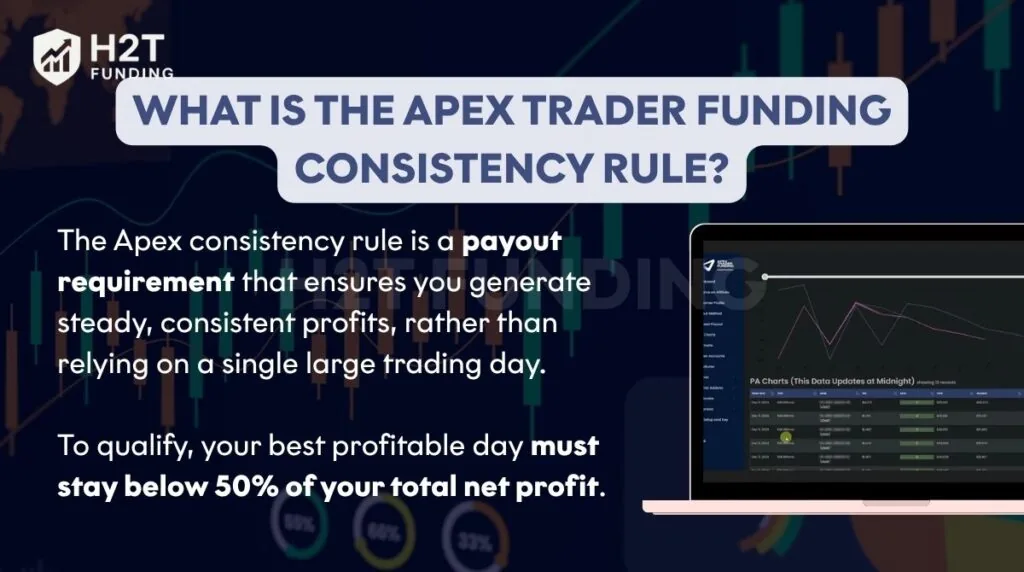
The Apex consistency rule is a payout requirement that ensures you generate steady, consistent profits, rather than relying on a single large trading day. It only applies when you request a withdrawal from a Performance Account (PA) and does not affect evaluation accounts.
To qualify, your best profitable day must stay below 50% of your total net profit. If this threshold is exceeded, your payout is not denied permanently; it is simply paused until you continue trading and rebalance your profit distribution.
Before March 2026, the limit was stricter at 30%, which frequently blocked withdrawals. The Apex 4.0 update increased it to 50%, giving traders more flexibility while still enforcing consistency.
Key update:
- Legacy consistency rule (pre-March 2026): Best day must be < 30% of total profit
- Current consistency rule (Apex 4.0, March 2026+): Best day must be < 50% of total profit
- Applies to: Performance Account payout requests only
- Account status: Remains active if you are above 50%; only the payout button is locked
2. How the 50% consistency rule works: The exact math
The 50% consistency rule mandates that your best trading day must account for less than 50% of your total net profit. If one day’s performance exceeds this limit, your payout request will be blocked until you generate enough additional profit to balance the ratio.
To check your compliance, divide your Best Profitable Day by your Total Net Profit. The resulting percentage must stay strictly below 50%.
The Consistency Formula: Consistency % = Best Profitable Day ÷ Total Net Profit
If this result is 50% or higher, your payout button will be locked. To simplify your planning, you can use this reverse formula to find your target:
Highest Profit Day ÷ 0.50 = Minimum Total Profit Required
Use the table below to see the minimum total profit you need to reach based on your best trading day:
| Best Profitable Day | Minimum Total Profit Required | Formula |
|---|---|---|
| $500 | $1,000 | $500 ÷ 0.50 = $1,000 |
| $1,000 | $2,000 | $1,000 ÷ 0.50 = $2,000 |
| $1,500 | $3,000 | $1,500 ÷ 0.50 = $3,000 |
| $2,000 | $4,000 | $2,000 ÷ 0.50 = $4,000 |
| $2,500 | $5,000 | $2,500 ÷ 0.50 = $5,000 |
| $3,000 | $6,000 | $3,000 ÷ 0.50 = $6,000 |
Example: Your best trading day earns $1,500. You need a total net profit of at least $3,000 before Apex will allow a payout request. If your total profit sits at $2,400, you continue trading until the ratio clears.
3. When does the Apex consistency rule apply? (And when it doesn’t)
The Apex consistency rule applies when you request a payout from a Performance Account (PA). It does not apply during the evaluation phase, where you can trade without any consistency restrictions.
After each approved payout, the consistency resets and a new profit cycle begins. The rule will be checked again at your next withdrawal request. This process continues throughout your payout cycles in a PA until you eventually transition beyond this stage (such as moving to a live account).
The table below breaks down exactly when the rule is active and when it does not apply, so you can plan your trading strategy accordingly.
| Account Stage | Consistency Rule Active? | Notes |
|---|---|---|
| Evaluation Account | No | Pass with any profit distribution, even one large trade |
| Performance Account (PA): Trading | No | Trade freely; rule only checks at payout time |
| PA: Requesting First Payout | Yes | Best day must be < 50% of the total profit since the account started |
| PA: After Each Payout | Yes | Counter resets; rule checks profit since last approved payout |
| After 6th Payout | No | PA account closes; rule no longer applies |
There is no time limit to meet the consistency requirement. Your account stays active. You keep trading until the ratio falls below 50%, then request your payout.
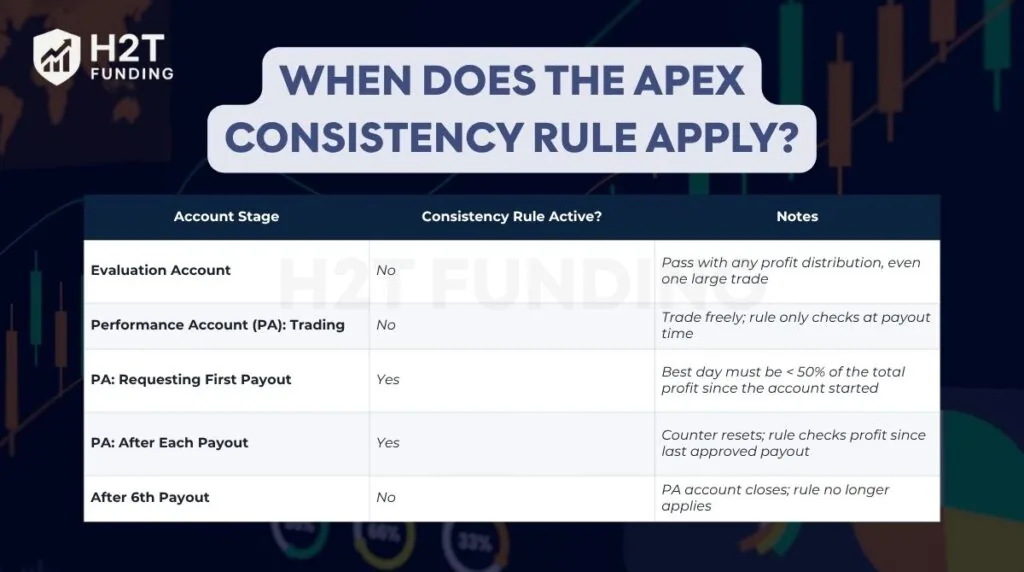
IMPORTANT: Losing days are NOT included in the consistency calculation. Only profitable days count toward the ratio. The calculation resets after each approved payout. Your profit counter starts at zero for the next cycle.
4. What counts as a profitable day in the consistency calculation?
Apex defines a profitable trading day as any session where your net realized profit is positive. Losing days drop out of the formula entirely. Only profitable sessions factor into both the numerator (best day) and denominator (total profit).
Edge case: Mixed-result days
If you end a session at +$40, that day contributes to total profit, but the amount is small, which helps dilute a large outlier day’s percentage. If you end at -$200, that session does not affect the consistency ratio at all.
Qualifying vs. Non-qualifying days
The consistency rule and the payout eligibility requirements are separate. To qualify for a payout, Apex requires a minimum number of trading days with profit above a threshold. Meeting the consistency ratio does not automatically satisfy the trading day requirement; both must be met simultaneously.
IMPORTANT: A fast flip trade that closes the same day counts as a qualifying trading day, but only if it generates realized profit. Zero-profit or breakeven days do not count toward your required profitable day total.
5. Common mistakes that block your payout (Consistency rule edition)
Most payout denials linked to the consistency rule aren’t due to rule ignorance; they stem from predictable behavioral patterns. Recognizing these traps before you request a withdrawal protects your capital and your time. These are the 4 most common mistakes that can block your payout:
- Front-loading profits and stopping too early
- Over-trading after submitting a payout request
- Ignoring the Safety Net requirement
- Not tracking consistency manually
Review each mistake in detail below to avoid unnecessary denials and keep your payout process smooth.
5.1. Mistake 1: Front-loading profits and waiting
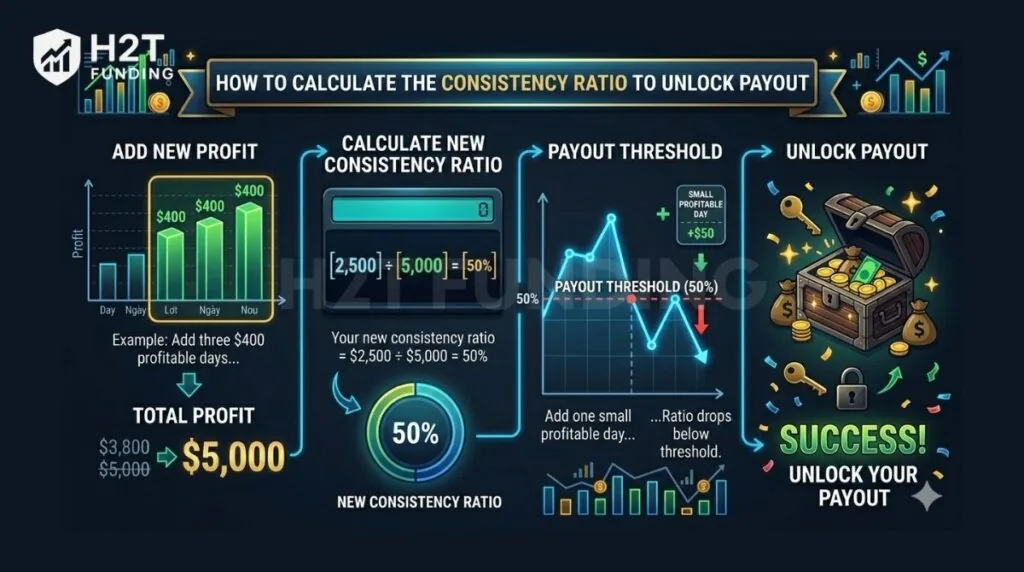
Many traders hit a strong day, like a $2,500 profit, and then stop trading, expecting the ratio to naturally drop over time. It will not. Sitting idle keeps your ratio locked at an ineligible percentage indefinitely, so you must trade normally to dilute that high-profit day.
Each additional profitable session adds to your total net profit, gradually bringing your best-day percentage down until it finally clears the 50% threshold.
Example: If you add three $400 profitable days, your total profit becomes $5,000. Your new consistency ratio is $2,500 ÷ $5,000 = 50%. One more small profitable day drops you below the threshold, finally unlocking your payout.
5.2. Mistake 2: Over-trading after a payout request
A frequent error is continuing to trade with aggressive sizing immediately after submitting a payout request. If a minor losing streak drags your account balance below the “Min Balance to Request” threshold while the payout is still pending, the system automatically denies your request. Always trade as if the requested funds have already been removed from your account to avoid a surprise denial.
5.3. Mistake 3: Ignoring the safety net for early payouts
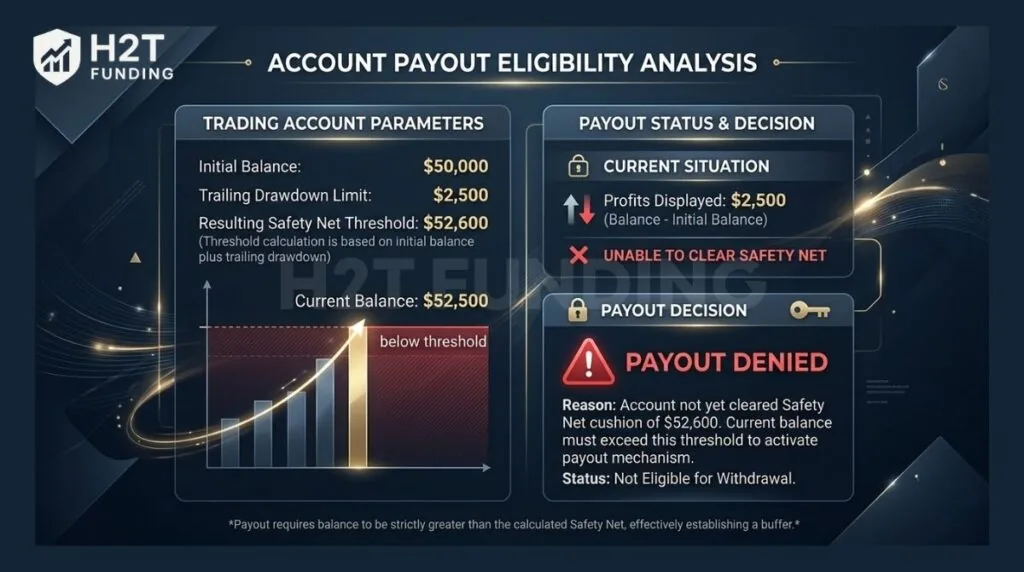
The Safety Net is maintained for the lifetime of the Performance Account. Your account balance must exceed the trailing drawdown level plus $100.
Example: On a $50,000 account with a $2,500 trailing drawdown, your Safety Net is $52,600. If your balance is $52,500, you are below the required threshold. Even if you have “profits,” the system will not allow a payout because your account has not yet cleared the required Safety Net cushion.
5.4. Mistake 4: Not tracking consistency manually
Apex does not provide a real-time “consistency meter” on your dashboard. Many traders only find out they are ineligible when they click the request button and are met with an error message.
You should manually track your consistency ratio using the Highest Profit Day ÷ Total Profit formula before every session. If you know you are close to the 50% limit, adjust your position sizing to prioritize smaller, consistent gains until the payout is successfully cleared.
6. How to comply with the Apex consistency rule
The consistency rule is not an obstacle; it is a shape constraint on your equity curve. Traders who understand this build it into their daily process from day one.
6.1. Set a soft daily profit cap
Decide in advance the maximum profit you will bank on a single day. A cap of $1,000–$1,500 on a $50,000 account keeps your best-day percentage manageable across a typical payout cycle. If the market hands you a $3,000 day, that is fine; you simply need to accumulate more total profit before requesting a payout.
6.2. Build a consistency buffer before requesting
Do not request a payout the moment your ratio clears 50%. Give yourself a buffer. If your ratio sits at 48%, one additional profitable session can bring it to 44–45%. A request at 45% has room to absorb minor recalculation variances.
6.3. Dilute actively, not passively
If a large day pushes your ratio above 50%, trade your normal plan. Each profitable session adds denominator weight. Do not cut size or stop trading, that stalls dilution and extends your wait.
6.4. Multi-account traders: Map each account separately
Each Performance Account has its own payout cycle and consistency counter. A copy-trading setup that treats all accounts identically can accidentally push one account’s ratio over 50% while another clears cleanly. Assign individual tracking sheets per account.
To ensure you meet all requirements, including Safety Net buffers and payout schedules, review our full breakdown of Apex Trader Funding payout rules.
7. Apex consistency rule vs. other prop firms: How it compares
Comparing Apex’s consistency policy with that of other firms reveals that the industry is shifting toward more flexible, professional standards. These benchmarks are essential because not all prop firms calculate consistency in the same way. Below is how the Apex Trader Funding consistency rule stacks up against industry peers:
| Firm | Consistency Rule? | Threshold | Resets After Payout? | Applies in Evaluation? |
|---|---|---|---|---|
| Apex Trader Funding (4.0) | 50% for Payout PA | 50% (best day < 50% of total profit) | Yes | No |
| Topstep | 50% for Trading Combine | 50% of your total profit and your profit target | Yes | Yes |
| My Funded Futures | 50% consistency rule applies to all Rapid, Flex, and Pro plans | 50% of your total evaluation profits made | Yes | Yes |
| Earn2Trade (Gauntlet) | 30% of your total PnL | 30% or more of your total PnL | Yes | Yes |
The key advantage for Apex traders is that the 50% rule only triggers during the Performance Account (PA) phase. Unlike Topstep or Earn2Trade, Apex allows you full freedom during your evaluation, meaning you won’t be blocked from passing due to one lucky breakout trade.
While other firms penalize high-performing sessions early on, Apex reserves its consistency check strictly for when you request a real-money withdrawal. This makes Apex’s model significantly more “evaluation-friendly,” as it avoids the psychological pressure of balancing your daily P&L while you are still trying to hit your initial funding milestone.
However, once you are in the funded stage, Apex’s 50% threshold remains a standard industry benchmark. Regardless of the firm you choose, the goal is consistent, repeatable results; if your trading strategy relies on “one-hit wonders” to pass, you will likely face payout delays across any of these major platforms.
8. Real trader experiences on Reddit: How the Apex 50% consistency rule works in practice
The Reddit community provides an unfiltered view of the 50% rule, revealing that many traders initially misunderstand the math. You do not need to limit your daily profits or intentionally lose money to “balance” your account stats.
Your biggest trading day simply acts as a moving target. If your best day is $2,600, your total account profit must reach $5,200 to satisfy the 50% requirement. As your total profit grows, the amount you can “safely” earn in a single day also increases.
- The Math: Total account profit must always be at least double your single most profitable trading day.
- The Reality: High-profit days do not ruin your account; they just require you to generate more consistent, smaller wins afterward to reach the required payout ratio.
- Expert Insight: Seasoned traders view this rule as a natural growth filter. It forces you to build a buffer of small, repeatable profits rather than relying on one lucky home-run trade.
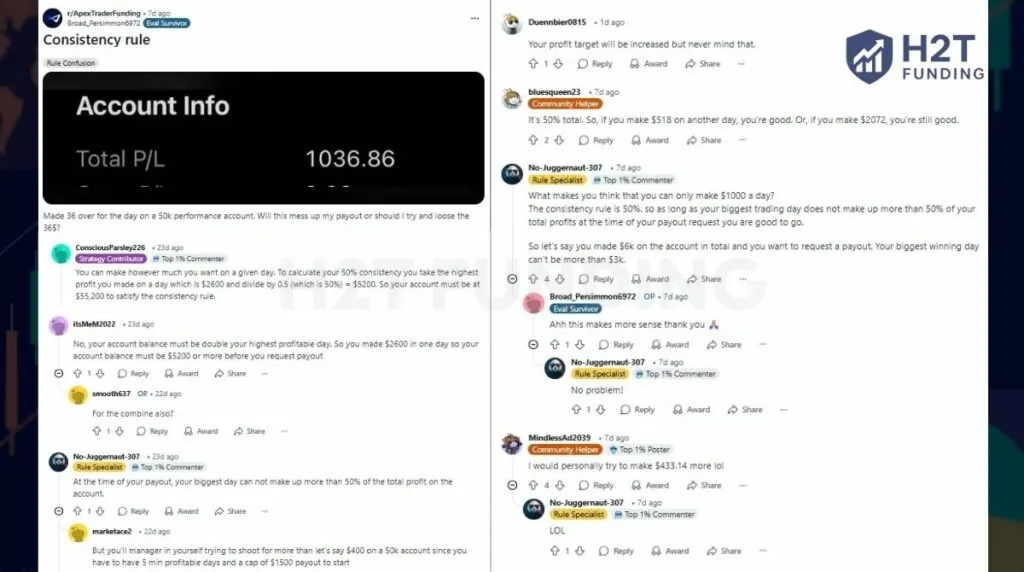
Consistency is not an account-breaker. If you hit a massive win that skews your ratio, simply continue trading profitably on subsequent days. Your total net profit will naturally grow, eventually diluting the percentage of that big day until it falls back under the 50% threshold.
Reddit users emphasize that patience is the ultimate solution. Instead of trying to “game” the math, focus on logging five to ten disciplined, profitable sessions after a big win. This approach solves the consistency requirement organically while protecting your account from the urge to overtrade.
9. Is Apex Trader Funding right for you?
Apex’s consistency rule is a filter. It systematically excludes traders who rely on a single lucky trade or erratic contract scaling to generate profits. It funds traders who can produce repeatable results across multiple sessions.
You are likely a fit if:
- Your strategy generates profit across multiple trading days, not concentrated in one session.
- You can define your trade entries, exits, and position sizing before each session.
- You treat risk management: stop losses, profit targets, and max daily loss, as non-negotiable.
- The 50% ratio math feels workable, given your typical daily profit distribution.
You may want to evaluate other firms if:
- Your strategy requires infrequent, very large trades (e.g., news event spikes) as the primary profit source.
- You prefer automated or fully algorithmic trading, but Apex prohibits fully automated strategies.
- You want immediate access to payouts with no waiting period after account opening.
Still comparing your options? See our full list of the best prop firms for futures traders in 2026
10. FAQs
-
The consistency rule is a payout eligibility requirement in Apex Performance Accounts. At the time you request a withdrawal, your single best profitable trading day cannot account for 50% or more of your total net profit since your last approved payout. If the ratio is 50% or above, the payout request option is unavailable, but your account stays active.
-
The current rule (Apex 4.0, updated March 2026) is 50%. The 30% rule was part of the Legacy system and no longer applies to new accounts. If you opened a Legacy account before the 4.0 update, verify which ruleset governs your account through Apex support.
-
No. The consistency rule has no effect during the evaluation stage. You can pass an evaluation with any profit distribution, including profits concentrated in a single trading session. The rule only activates when you request a payout from a funded Performance Account.
-
Your account is not closed or failed. The payout request button becomes unavailable until your consistency percentage drops below 50%. You continue trading, adding profitable days to increase total profit and reduce the best-day ratio.
-
Divide your best profitable day’s net profit by your total net profit since your last approved payout (or since account inception for your first payout). Example: Best day $1,200 / Total profit $3,000 = 40%. This clears the 50% threshold. If the result is 50% or above, continue trading until it falls below.
-
No. Only profitable days factor into the formula. Losing sessions do not affect the numerator (best day) or the denominator (total profit). A $500 losing day leaves your consistency ratio unchanged.
-
After each approved payout, the profit counter resets to zero. The next payout cycle starts fresh from that point. Your consistency calculation for cycle two covers only profit earned after the first payout was approved.
-
The rule applies across all six payouts available in a Performance Account. After the sixth payout, the PA account closes. There is no stage where the rule automatically relaxes within the PA phase under the 4.0 structure.
-
Yes. There is no time limit and no account restriction. You trade your normal plan. Each profitable session adds to your total profit and reduces the best-day percentage. Sitting idle keeps the ratio fixed; active trading is the only way to dilute it.
11. Conclusion
Apex Trader Funding consistency rule is a professional standard designed to filter for sustainable trading rather than “all-in” gambling. With the 2026 update to a 50% threshold, it is now significantly easier to manage your performance and secure consistent withdrawals.
The key to success is viewing this requirement as a roadmap for steady account growth rather than an obstacle. For more ways to refine your strategy or to compare how other leading prop firms structure their payouts, visit our comprehensive library of Prop Firm Guides at H2T Funding.