

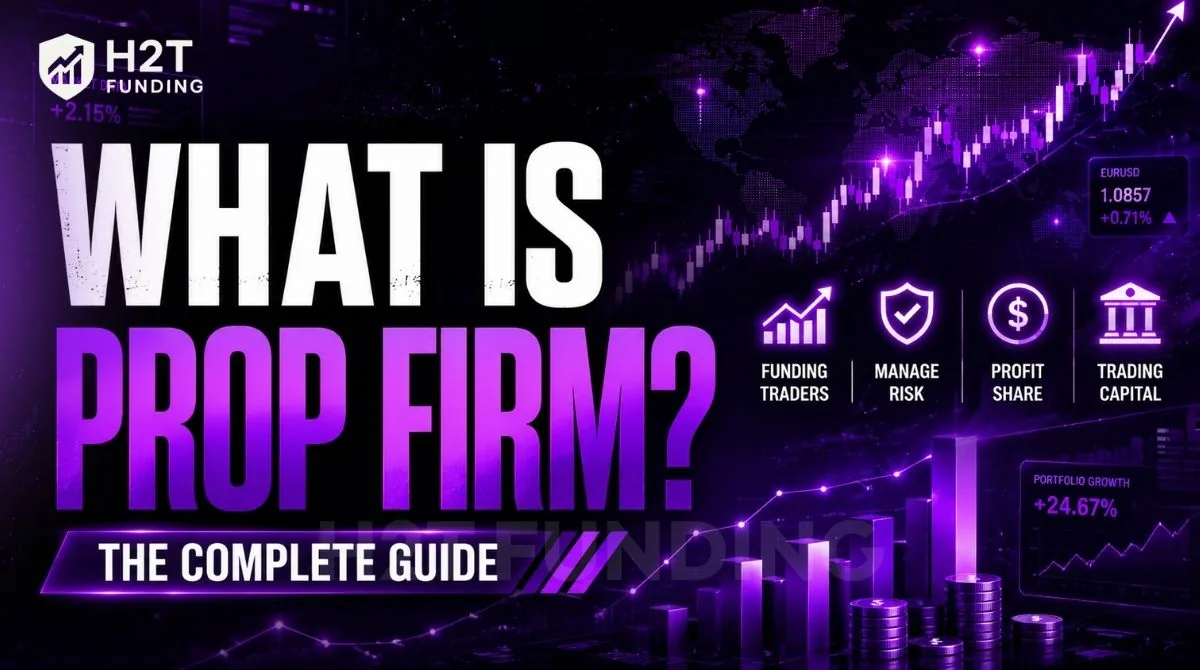
A prop firm (short for proprietary trading firm) is a company that provides traders with capital to trade financial markets in exchange for following predefined risk rules and sharing a portion of the profits. Most retail prop firms require traders to pass an evaluation challenge before receiving a funded account. Once funded, traders typically keep 70% to 90% of the profits, while the firm absorbs trading losses within its established risk limits.
What you need to know about a prop firm:
- Best suited for: Traders with a profitable strategy who want to trade larger accounts without committing significant personal capital.
- Capital provider: The prop firm provides the trading capital.
- Entry requirement: Most traders must pass an evaluation or challenge before receiving funding.
- Profit split: Traders typically keep 70%–90% of the profits they generate.
- Risk rules: Funded accounts operate under predefined rules, such as profit targets and maximum drawdown limits.
Every firm has its own evaluation model, drawdown rules, payout policies, trading restrictions, and scaling opportunities that directly affect a trader’s chances of long-term success. In this guide, you’ll learn how prop firms work, why they have become so popular, the benefits and risks of funded trading, how firms make money, and the key factors to consider before purchasing a prop firm challenge.
1. What Is a Prop Firm? (The Simple Definition)
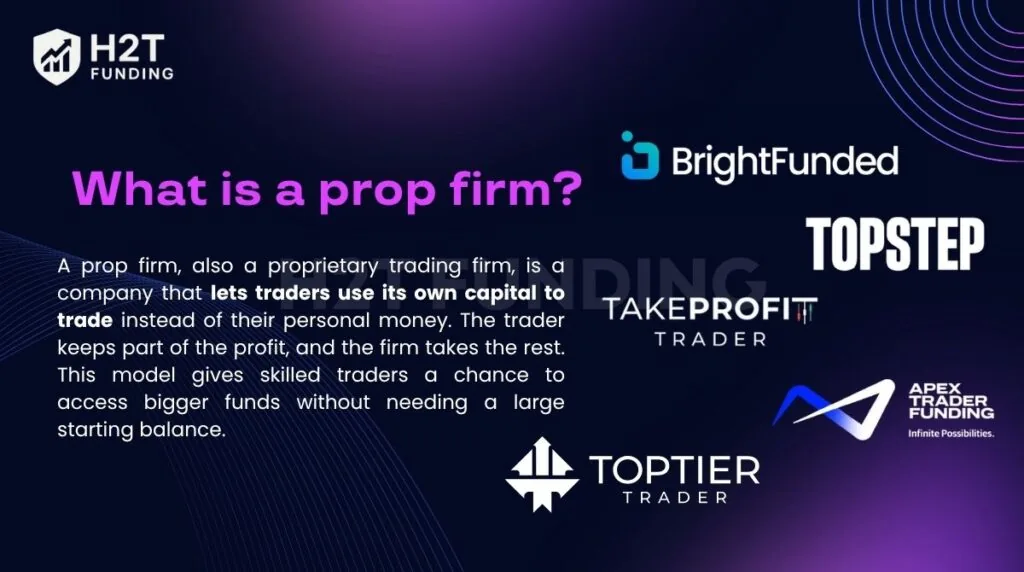
A prop firm, short for proprietary trading firm, gives traders access to capital to trade financial markets. You trade the firm’s money, not your own. In return, you keep a share of the profits, typically between 70% and 90%. The firm keeps the rest. This single distinction separates prop trading from every personal brokerage account: when you trade with a prop firm, all market risk sits on the firm’s capital, not yours.
Today’s market includes two types of prop firms that beginners often confuse.
- Traditional prop firms operate like the old bank desks. Firms such as Jane Street and other high-frequency trading (HFT) shops hire salaried traders, provide direct capital without a paid entry test, and require professional credentials or a rigorous interview process.
- Retail prop firms work differently. Firms such as FTMO and Topstep sell a trading challenge to any trader who applies. You pay an evaluation fee, prove your consistency, and receive a funded account once you pass.
2. How Does a Prop Firm Work? (Step-by-Step)
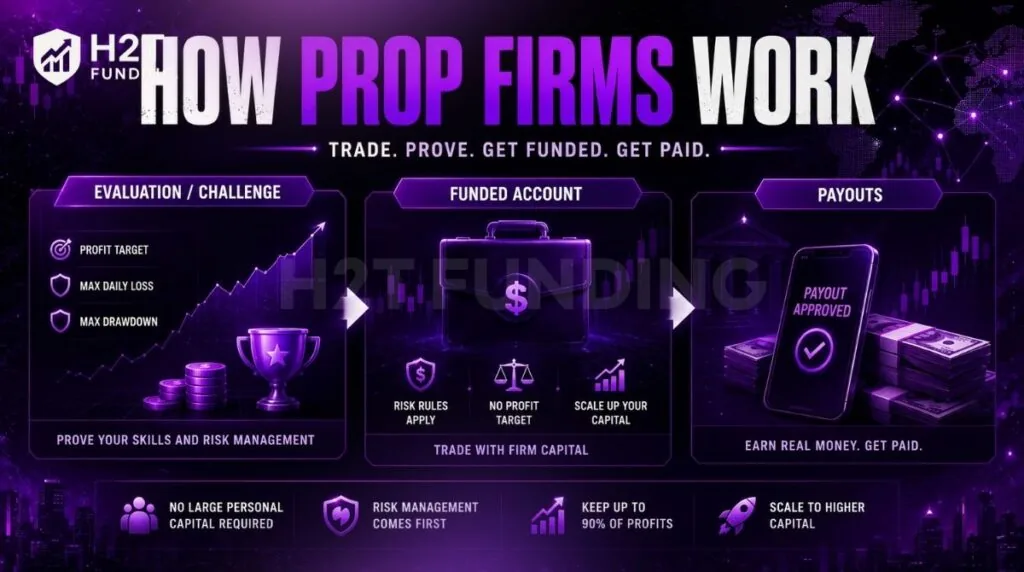
Most modern prop firms follow a simple three-step process: Evaluation -> Funded Account -> Profit Payouts. Instead of depositing a large amount of personal capital, traders prove their skills first and gain access to larger buying power after meeting the firm’s requirements.
2.1. Step 1: The Challenge / Evaluation
The challenge is a paid evaluation designed to test both profitability and risk management. After paying a one-time fee, traders receive a demo account loaded with simulated capital, typically ranging from $10,000 to $200,000. While the account balance is virtual, trading takes place using live market data and real-time price movements, creating conditions that closely mirror an actual trading environment.
Your task is to reach a profit target, usually 8% to 10% of the account, without breaching two risk limits: a maximum daily loss (typically 4% to 5%) and a maximum total drawdown (typically 8% to 10%). Both limits are hard floors. A single session that crosses the daily limit terminates the challenge immediately, regardless of your overall profit.
1-Phase vs 2-Phase formats differ in how many rounds of testing are required before the funded account activates.
| 1-Phase Challenge | 2-Phase Challenge | |
|---|---|---|
| Stages | 1 evaluation round | 2 evaluation rounds |
| Profit Target | Typically 8–10% | Phase 1: 8–10% / Phase 2: 4–5% |
| Time Limit | 30–60 days | 30 days per phase (varies by firm) |
| Fee | Higher (consolidates both phases) | Lower entry; full cycle takes longer |
| Best For | Experienced traders who pass consistently | Traders who prefer a staged risk filter |
| Examples | FundedNext Express, Apex Trader Funding | FTMO, The5ers Hyper Gwoth |
According to PropFundHub’s 2026 industry analysis, the average prop firm challenge pass rate is only 5–15%. Most firms report Phase 1 pass rates of roughly 15–25%, while significantly fewer traders complete Phase 2. One-step evaluations generally show slightly higher completion rates because traders only need to clear a single objective.
2.2. Step 2: The Funded Account
Once the evaluation is completed successfully, traders receive access to a funded account. At this stage, the profit target is removed, but risk-management rules typically remain in place. Maximum drawdown limits, position sizing restrictions, and prohibited trading practices still apply. Most firms offer funded accounts ranging from $10,000 to $200,000, while scaling plans can increase available capital well beyond those initial limits for consistently profitable traders.
Simulated vs Real Funds: What Most Traders Don’t Realize
In reality, most retail prop firms operate using simulated or demo-funded accounts, even after a trader becomes “funded.” The trader sees live market prices and follows real trading conditions, but the account itself may remain simulated. The firm then uses its internal risk models to determine whether trades are copied to live markets, partially hedged, or kept entirely within its own ecosystem.
Importantly, simulated funding does not mean simulated payouts. Traders who meet the firm’s payout requirements still receive real cash withdrawals based on their performance. This is why many firms refer to payouts as performance-based compensation rather than profits generated from a personal brokerage account.
2.3. Step 3: Payouts
When profits are generated in a funded account, traders receive a percentage of those earnings according to the firm’s payout structure. Most retail prop firms offer payouts ranging from 70% to 90%, with top firms often providing traders the larger share.
For example, a trader who earns $5,000 in a funded account with a 90% profit split would receive $4,500, while the prop firm retains $500. Once approved, payouts are typically processed within one to five business days, depending on the firm’s payment provider and withdrawal schedule.
Firms also establish payout rules that often include a minimum payout amount, a scheduled withdrawal cycle, and eligibility criteria designed to verify consistent trading performance before funds are released.
As traders demonstrate consistent profitability, many prop firms offer scaling plans, allowing account sizes and earning potential to increase over time. This creates a pathway from a small evaluation account to managing significantly larger amounts of trading capital without risking substantial personal funds.
3. Prop Firm Rules: What You Need to Follow
Prop firm rules cap how much risk you can take, not how much profit you can make, and breaking a single limit closes your account regardless of your open profit. Seven constraints govern nearly every retail evaluation and funded account, and the first two account for the large majority of failed challenges.
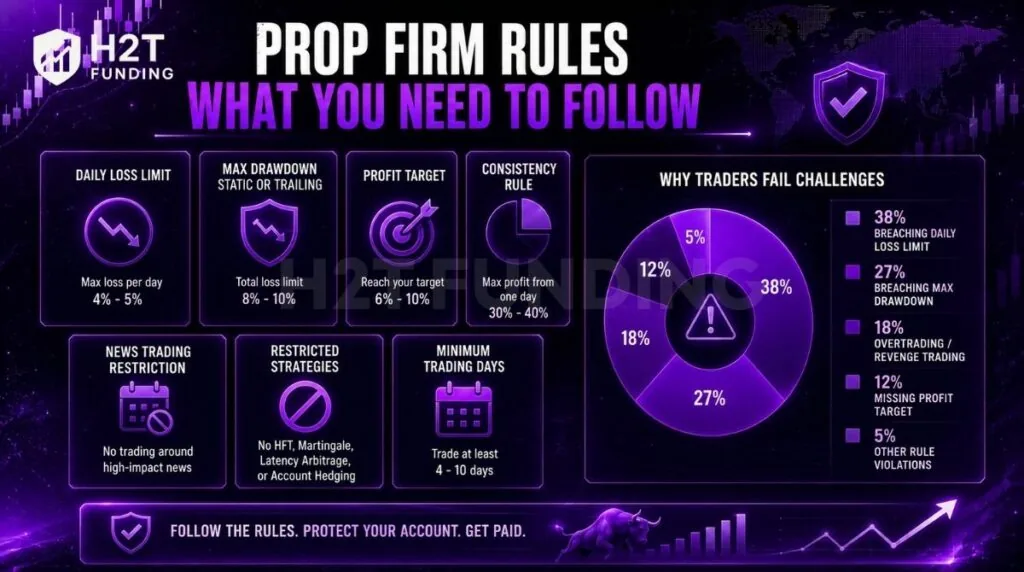
- Daily Loss Limit: The maximum you can lose in one trading day, commonly set between 4% and 5% of your starting balance. The counter resets at the start of the next session, but a single oversized loss still ends the account for that day.
- Maximum Drawdown, Static or Trailing: The total distance your balance can fall before the account closes. A static drawdown holds the floor at your starting balance. A trailing drawdown rises with your account as you hit new equity highs, which locks in a higher floor and quietly shrinks your buffer the more you earn.
- Profit Target: The gain you must reach during the evaluation, typically 6% to 10% of the starting balance, within a set window or with no time limit, depending on the firm.
- Consistency Rule: A cap on how much of your total profit can come from a single day, often 30% to 40% of the target. The rule forces you to build your result across several sessions instead of one outsized trade.
- News Trading Restriction: A ban on opening or closing positions around high-impact releases such as FOMC decisions or CPI data. Firms enforce this because volatility spikes distort risk, and a breach can void the trade or the account.
- Restricted Strategies: A list of banned techniques that firms treat as exploiting the evaluation rather than trading it, including latency arbitrage, high-frequency execution, martingale sizing, and hedging the same position across multiple funded accounts.
- Minimum Trading Days: A floor on active trading days, usually 4 to 10, that stops you from clearing the challenge on one lucky session. Hitting the profit target early does not end the evaluation; you still place small, compliant trades until the day count is met.
Most traders lose their accounts by breaking a risk rule, not by picking the wrong trade. Data reported by propfirms-hub.com in a 2026 breakdown of failed challenges shows where most losses actually come from: 38% of failures come from breaching the daily loss limit, 27% from breaching the maximum drawdown, 18% from overtrading or revenge trading after a loss, 12% from missing the profit target within the time window, and 5% from other rule violations such as news trading.
To reduce the risk of breaking these rules, learn how to build better trading discipline before attempting another prop firm challenge.
For that reason, read a firm’s rule book in full before you pay for a challenge. The specific numbers above shift from firm to firm, but the categories rarely do, and knowing which rule is most likely to end your account tells you exactly where to focus your risk management.
4. Types of Prop Firms: Forex, Futures, and CFD
Prop firms split into three core categories based on what you actually trade: Forex, Futures, and CFD, which decides everything else: the exchange or venue behind your fills, the platform you trade on, and how many phases the evaluation runs.
| Forex Prop Firms | Futures Prop Firms | CFD Prop Firms | |
|---|---|---|---|
| What you trade | Currency pairs, quoted and filled through the firm’s OTC liquidity partners | Standardized futures contracts on commodities (crude oil, gold), stock indices (S&P 500, Nasdaq 100), and rates | Index CFDs, single-stock CFDs (Apple, Tesla), commodities, and sometimes crypto CFDs |
| Where does the price come from | The firm’s chosen liquidity provider, you never touch a public order book | A regulated exchange such as the CME, CBOT, or Eurex, so pricing is public and exchange-verified | A synthetic price feed the firm selects, since a CFD is a derivative, not the underlying asset |
| Common platforms | MetaTrader 4, MetaTrader 5, cTrader | NinjaTrader, Tradovate, Rithmic-based terminals | Mainly MT4, MT5, or the firm’s proprietary platform |
| Typical evaluation style | Usually two phases, such as an 8% Phase 1 target followed by a 5% Phase 2 target, under strict daily and overall drawdown caps | Often one step: hit a profit target while staying above a trailing drawdown, with no added data or platform fees | Multi-step, similar to forex, but spread across a wider instrument list |
| Main advantage | Round-the-clock access five days a week, plus flexible position sizing down to micro lots | Exchange-backed pricing with no broker slippage, in a regulated trading environment | The widest single-account instrument mix, without exchange fees per trade |
| Firms known for this model | FTMO, The5ers | Topstep, TradeDay | FundedNext, FXIFY |
Crypto prop firms sit outside this table as a smaller, newer category built around cryptocurrency pairs. Pricing and execution here still vary widely from provider to provider, and the segment carries a shorter payout track record than futures, forex, or CFD firms, so treat any crypto-focused program with extra caution until it has a longer history behind it.
5. Who Is a Prop Firm For?
A prop firm is best suited for traders who have a profitable trading process but do not have enough personal capital to trade at a meaningful size. Instead of risking tens of thousands of dollars, you pay a relatively small evaluation fee to access a much larger funded account if you meet the firm’s requirements.
Not every trader benefits equally from this model. Here’s who typically gets the most value from a prop firm:
- Traders with proven skills but limited capital: If you can consistently manage risk and generate positive returns on a small account, a prop firm lets you trade larger buying power without depositing $25,000, $50,000, or more of your own money.
- Experienced traders who want to scale faster: Many full-time and part-time traders use prop firms to increase position size, diversify across multiple funded accounts, or reduce the amount of personal capital tied up in trading.
- Traders who prefer defined financial risk: Your maximum upfront cost is usually the evaluation fee. If you fail the challenge, you lose the fee rather than a large trading account, making the financial risk easier to quantify.
- Forex, futures, and crypto traders: Most retail prop firms focus on leveraged markets such as Forex, futures, indices, commodities, and cryptocurrencies, although the available instruments vary by firm.
A prop firm is a poor match for two groups in particular. The first is a complete beginner chasing quick income without a tested strategy behind them; the evaluation’s risk rules exist specifically to filter out that kind of trading. The second is anyone who cannot accept losing the challenge fee outright if the evaluation fails, since firms do not refund a failed attempt. Go in treating the fee as the full price of the opportunity, win or lose.
So, can beginners join a prop firm?
Yes, but passing a prop firm challenge is difficult for most beginners. Learning a trading platform is only one part of the process. You also need to follow strict drawdown limits, hit profit targets, and avoid emotional mistakes under pressure.
A common example is increasing position size to recover a loss, only to breach the daily drawdown limit on the next trade. If you have not traded consistently on a demo or small live account, building risk management habits first is usually more cost-effective than paying for multiple evaluation attempts.
Pros and Cons of Prop Trading
Pros & Cons Analysis
Pros
- No large personal capital is required to access accounts worth tens or hundreds of thousands of dollars.
- Defined financial risk, with your maximum upfront loss typically limited to the evaluation fee.
- Scale your trading faster through larger funded accounts and, in some firms, account scaling plans.
- The profit-sharing model lets you keep a large percentage of trading profits without providing all the capital yourself.
Cons
- Challenge fees are non-refundable in most cases if you fail the evaluation.
- Strict trading rules such as daily loss limits, maximum drawdown, and consistency requirements.
- Most retail prop firms use simulated evaluation environments, and funded trading conditions may differ from trading your own brokerage account.
- Performance pressure is higher because one rule violation can immediately end the evaluation or the funded account.
6. Are Prop Firms Legitimate? (The Honest Answer)
Yes, legitimate prop firms exist, but the honest answer sits between “scam” and “guaranteed payout.” Community discussions across Reddit and trading forums point to the same pattern again and again: a firm is not lying to you when it says it funds traders, but most of its cash flow comes from evaluation fees, not from your trading profit.

Reddit discussions reflect this balanced view. One experienced trader explained:
- “They’re not scams… It’s more accurate to call them a funded trader program.”
The same trader also pointed out that challenge fees are part of the business model, allowing firms to cover operating costs while paying traders who complete evaluations and remain profitable. That is why paying an evaluation fee does not automatically make a prop firm illegitimate.
Experienced prop traders also recommend looking beyond discounts and account size. One Reddit user summarized their selection criteria:
- “Don’t go for the easiest rules or the cheapest firm. Pick one with good rules, a payout history, and one that’s been around long enough to survive.”

Watch for a specific set of red flags before you pay for any challenge:
- No payout proof anywhere. A firm with zero visible track record of paying traders, verified or otherwise, has nothing to show you beyond its own marketing.
- An anonymous or unverifiable team. If you cannot find who runs the firm or where it operates from, you cannot hold anyone accountable if something goes wrong.
- A profit split or reset offer that beats the rest of the market by a wide margin. Terms that sound unusually generous often hide stricter fine print elsewhere in the contract.
- Vague answers about whether the firm actually trades your funded account. A firm that cannot explain its own execution model in plain terms is not being straight with you.
A short list of established retail prop firms includes FTMO, Topstep, Apex Trader Funding, FundedNext, and The5ers. Each has a public history of payouts referenced across trader communities, but each also sets its own rules, so confirm the specifics directly with the firm before you pay for a challenge.
7. Prop Firm vs Broker – What’s the Difference?
A broker gives you access to the market using your own money, while a prop firm provides access to larger buying power if you can meet its performance requirements. Although both allow you to trade the same financial markets, they operate under very different business models.
| Feature | Broker | Prop Firm |
|---|---|---|
| Capital Source | You trade your own deposited funds. | You trade a funded or simulated funded account provided by the firm. |
| Profit & Loss | You keep 100% of profits and bear 100% of losses. | Profits are shared, typically between 70% and 90% to the trader. |
| Entry Requirement | Open an account and deposit capital. | Pass an evaluation or challenge before receiving funding. |
| Risk Limits | Determined largely by your account balance and leverage. | Strict rules, including drawdown limits, daily loss caps, and trading restrictions. |
| Account Growth | Requires adding more personal capital. | Many firms offer scaling plans that increase account size over time. |
| Regulation | Typically regulated by financial authorities. | Varies by firm and jurisdiction; many retail prop firms operate independently. |
A broker gives you full ownership of your results and full exposure to your losses. A prop firm caps your downside at the challenge fee but requires you to share your upside and follow stricter rules than a personal account demands.
8. How to Choose the Right Prop Firm for You
The right prop firm is the one whose rules, payout structure, and trading conditions match your strategy. A firm that works well for a scalper may be a poor fit for a swing trader, while a trader focused on futures will have very different requirements from someone trading forex.
Before purchasing a challenge, evaluate the following factors carefully:
- Markets and instruments: Make sure the firm supports the products you trade, whether that’s forex, futures, indices, commodities, stocks, or cryptocurrencies.
- Challenge difficulty: Compare profit targets, drawdown rules, minimum trading days, and any consistency requirements. Small differences in these rules can have a major impact on pass rates.
- Drawdown model: Understand whether the firm uses a trailing drawdown, static drawdown, or end-of-day drawdown. This is often more important than the advertised account size.
- Profit split and scaling opportunities: Higher profit splits are attractive, but long-term earning potential also depends on scaling plans and account growth opportunities.
- Payout speed and withdrawal requirements: Review how often payouts are available, minimum withdrawal thresholds, and average processing times.
- Trading restrictions: Check whether the firm permits news trading, overnight positions, weekend holding, copy trading, EAs, or algorithmic strategies.
- Reputation and payout history: Look for independently verified payout reports, trader feedback, and a consistent operating history before paying any evaluation fee.
If you are still asking what prop firms are good for your specific instrument and budget, compare the full rule set side by side rather than the headline profit split alone. H2T Funding keeps an updated, criteria-based breakdown of the prop firm review options across these exact factors.
9. FAQs
-
“Prop firm” stands for proprietary trading firm, a company that trades or funds trading with its own capital rather than client deposits.
-
Your earnings depend on your account size, your profit split, and your trading performance. A trader with a $100,000 funded account and an 80% split keeps $4,000 of every $5,000 in profit, but no firm or article can guarantee a specific income, since results vary by trader.
-
No, you do not need professional credentials to join a retail prop firm, but you do need a consistent, tested strategy. Firms evaluate discipline and risk management, not formal trading experience.
-
Your account closes, and you lose the evaluation fee you paid. Most firms let you purchase a new challenge and retry as many times as you want.
-
Yes, payouts are real cash even though most funded accounts trade on simulated capital. The firm pays you from its own operating funds based on the profit your simulated account generates.
-
A prop firm is a company. A funded account is the specific trading account it grants you after you pass its challenge, and it is the account where your profit split and payout rules apply.
-
FTMO, Funding Pips, The5ers, and Topstep are among the best prop firms for beginners because they offer transparent rules, strong reputations, and evaluation models that are easier for new traders to understand. See H2T Funding’s dedicated ranking of the best prop firms for beginners for a full, criteria-based comparison.
-
No, prop firm trading is not illegal. Proprietary trading is a legitimate business model in which traders access a firm’s capital and earn a share of the profits they generate. Most retail prop firms operate as evaluation and funding companies rather than traditional brokers, which is why their regulatory requirements may differ depending on the country and business structure.
-
Yes, the reputable ones do; their business model depends on it. Verified payouts are proof of their legitimacy. While payouts are regular, the key is to choose a trustworthy firm with a long track record. Your due diligence here is non-negotiable.
10. Conclusion
Understanding “what is a prop firm” is only the first step. Choosing the right prop firm requires looking beyond account size or profit split to evaluate its rules, drawdown model, payout history, and overall trading conditions. The better these align with your strategy, the greater your chances of succeeding in a funded account.
To explore more insights, reviews, and strategies, visit our dedicated section on Prop Firm Guides at H2T Funding. You can also check out our in-depth prop firm reviews to compare rules, profit splits, and funding models across top firms before making your choice.