

How do funded trading accounts work? A funded trading account is an arrangement where a proprietary trading firm provides the capital, and the trader earns a percentage of profits, typically 70% to 90%, without putting personal savings at risk. To access that capital, traders must first pass an evaluation challenge: paying an upfront fee and proving consistent, rule-compliant trading on a simulated account before receiving a funded account.
How funded trading accounts work: At a glance
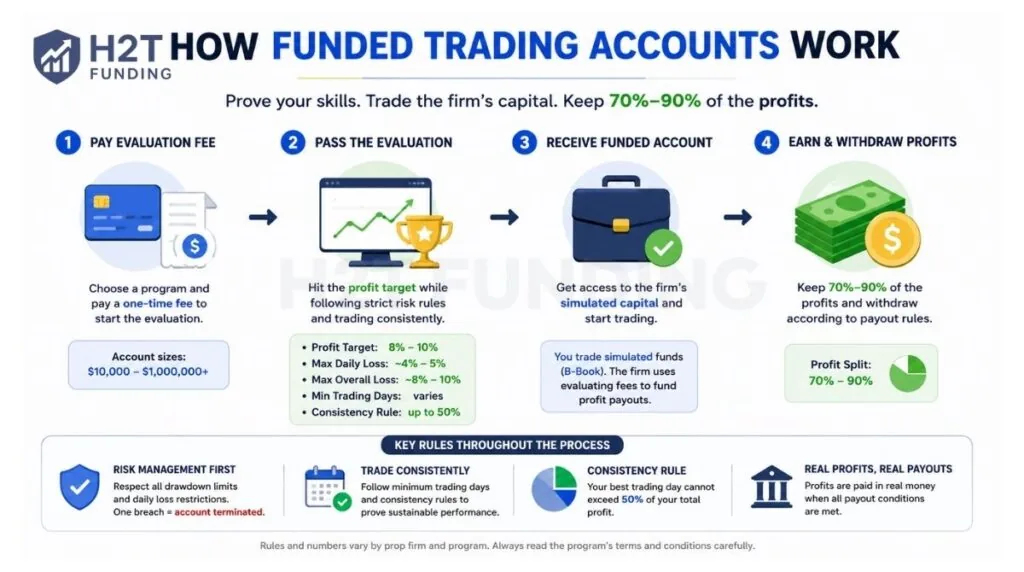
- The Core Mechanism: You pay a small upfront fee to enter an evaluation, prove your trading skills on a simulated account, and in return, earn a 70%–90% share of the profits without risking your personal savings.
- The Evaluation Phase: To get funded, you must hit a specific profit target (typically 8%–10%) without breaching the firm’s strict risk limits.
- Strict Risk Management: Account survival depends entirely on respecting maximum drawdowns (static or trailing) and daily loss limits. Breaching these terminates the account.
- The Capital Reality (Simulated Funds): Even when “funded,” you trade virtual funds in a simulated environment (B-Book). The firm pays your profit splits using real money derived from evaluation fees.
- Profit Withdrawals: You can withdraw your profits, but you must comply with payout conditions, such as the consistency rule (e.g., your best trading day cannot exceed 50% of your total profit).
- Forex vs. Futures: Funded programs are categorized by asset class. Forex firms offer flexible micro-lots (CFDs), while Futures firms offer exchange-cleared transparency with strict intraday rules.
- The Trade-Off: Funded accounts offer massive buying power for undercapitalized traders with zero personal risk, but they lack the absolute freedom of a regulated personal brokerage account.
Unlike a standard brokerage account, where you trade your own money and keep 100% of returns, a funded account shifts the capital risk to the firm within strict drawdown boundaries. The trade-off matters: rule violations cost you the account, not just a single trade. This guide breaks down how the evaluation process works step by step, how funded accounts compare to regulated trading accounts, what separates a strong program from a weak one, and how payouts are structured once you are funded.
1. What exactly is a funded trading account?
A funded trading account is a setup where a proprietary trading firm supplies the money needed for a trader to operate in the markets. In return, the trader agrees to split a portion of any profits earned with the firm.
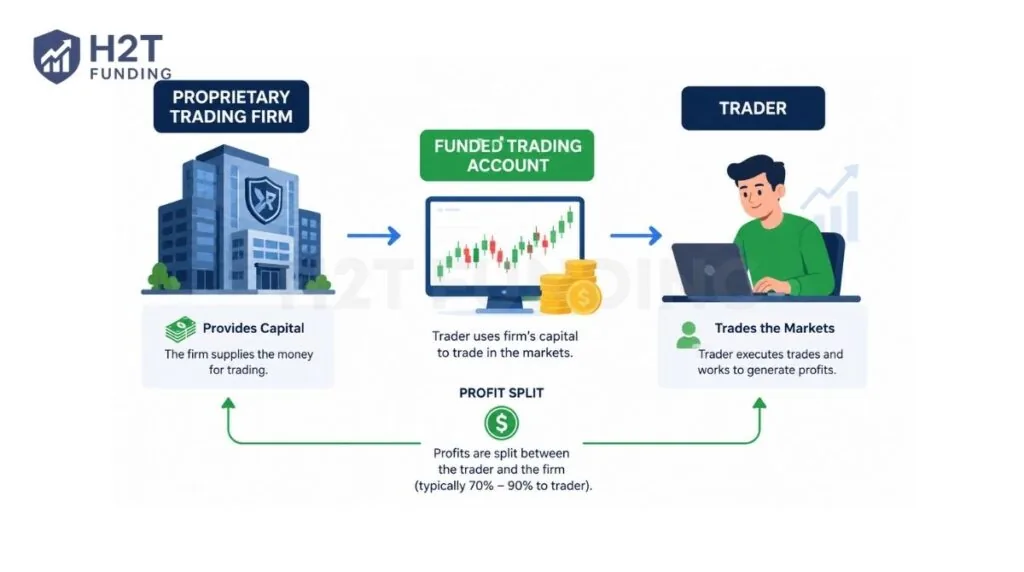
The unique arrangement of trading accounts allows talented individuals to bypass the barrier of insufficient capital, leveraging the firm’s resources to achieve larger trading volumes and potentially greater returns.
Unlike traditional personal trading accounts, where you risk 100% of your own money, a prop firm bears the majority of the financial risk (up to specific drawdown limits).
This arrangement thrives on a win-win dynamic: the firm earns from the profits of your effective trades, while you, as the funded trader, receive significant trading capital and the opportunity to take a portion of the profits.
This all sounds great, but how do funded trading accounts work? And more importantly, how do you earn money from it? The process typically involves a few key stages.
2. How do funded trading accounts work?
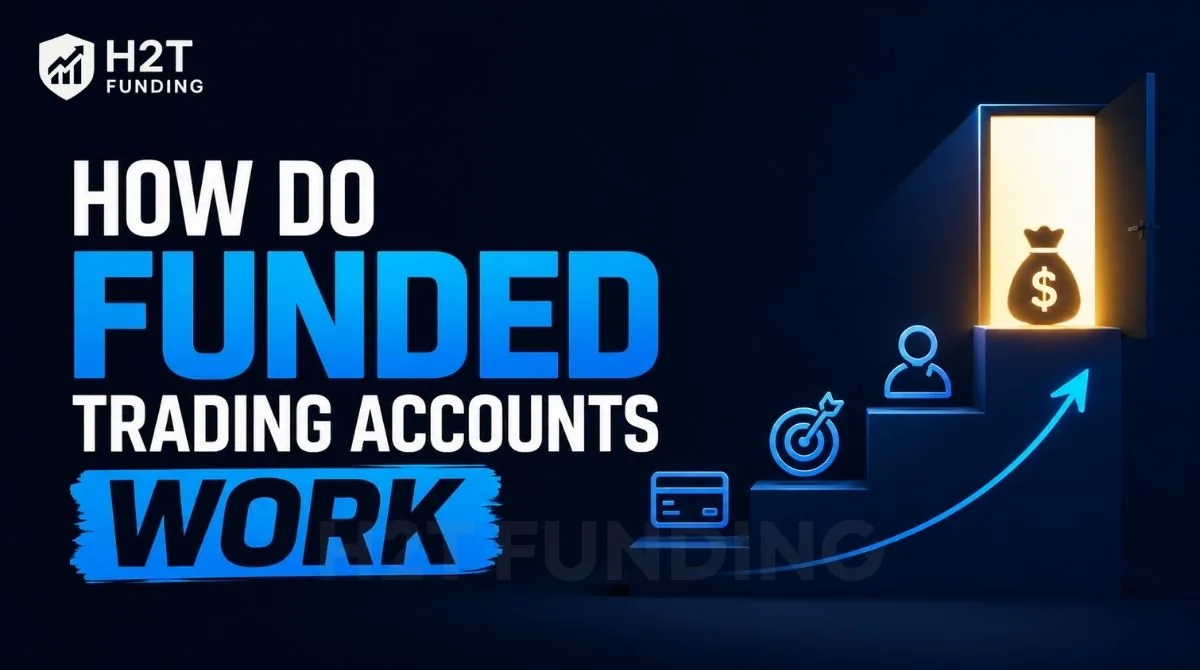
Funded trading accounts work through a strict four-step evaluation model: you purchase a challenge, prove your risk management skills on a demo account, receive access to the firm’s simulated capital, and finally, withdraw a 70% to 90% share of your profits.
Instead of depositing thousands of dollars into a personal broker, you pay a small one-time fee to access buying power ranging from $10,000 to over $1,000,000. Here is the exact step-by-step process of how a funded trading account operates:
2.1. Step 1: The application and choosing a program
The first step in your trading journey is choosing a prop firm and funded trader program that suits your trading approach, appetite for risk, and long-term financial objectives.
Firms offer a variety of account sizes, typically ranging from $10,000 to over $1,000,000 in virtual capital, each with a corresponding one-time evaluation fee. This fee is often refundable upon successfully passing the evaluation and receiving your first profit split.
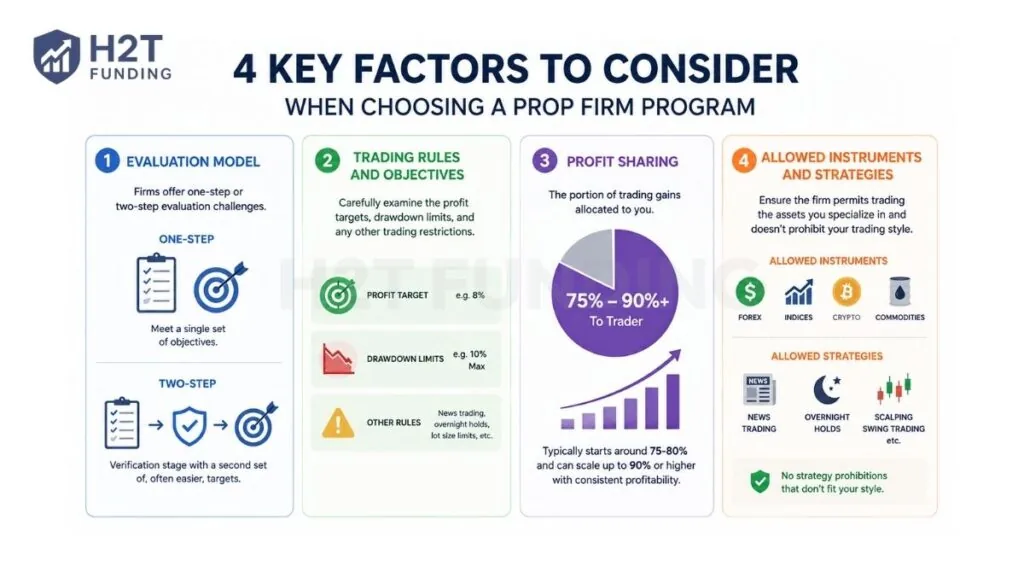
4 key factors to consider when choosing a program include:
- Evaluation model: Firms typically offer one-step or two-step evaluation challenges. One-step challenges require traders to meet a single set of objectives, while two-step challenges have a verification stage with a second set of, often easier, targets.
- Trading rules and objectives: Carefully examine the profit targets, drawdown limits, and any other trading restrictions.
- Profit sharing: This refers to the portion of trading gains allocated to you. It typically starts around 75-80% for the trader and can often scale up to 90% or higher with consistent profitability.
- Allowed instruments and strategies: Ensure the firm permits trading the assets you specialize in (e.g., forex, indices, crypto) and doesn’t prohibit your trading style (e.g., news trading, holding positions overnight).
2.2. Step 2: The evaluation phase
The evaluation phase, or “challenge,” is the most critical stage of the process. You will trade on a demo account to prove your skills under strict rules. Your goal is to demonstrate consistent profitability while managing risk strictly within the firm’s limits.
You must meet a specific profit target, usually between 8% to 10% of the account balance. Trading is also bound by drawdown limits, which restrict your maximum daily and overall losses. These rules test your risk management abilities under pressure.
Other rules include minimum trading days to ensure consistent activity. Some firms also enforce consistency rules to prevent one large win from meeting the target. Adherence to all regulations is mandatory to pass this crucial stage.
Any rule violation, particularly one involving drawdown limits, results in the account being terminated immediately. To try again, you’ll usually have to pay for a new evaluation. Some firms may offer a discounted “reset” option for another attempt.
2.3. Step 3: The funded account
Once you pass the test, you receive your officially funded account credentials. While you continue to trade in a simulated environment (often a B-Book model), your account is now fully eligible for payouts. This means the virtual profits you generate will be paid out to you in real money by the prop firm.
You will continue trading while following rules similar to the evaluation phase. After a particular period, you can request your first profit payout. Payouts are based on a certain profit split percentage between you and the firm.
Many reputable firms also offer scaling plans to reward consistent traders. If you accomplish certain profit targets over time, the firm will expand your account size. This allows you to trade with greater capital and make higher profits.
After a specified period (often your first 30 days of trading), you can request your first profit payout. The profit split is calculated based on the net profit you’ve generated in your funded account.
For example, on a $100,000 account with an 80/20 profit split, if you make a $5,000 profit, you would receive $4,000, and the firm would retain $1,000.
2.4. Step 4: Maintaining funded status
Consistent trading discipline is essential for a successful long-term partnership with a prop business. The same drawdown rules as in your evaluation will apply to your funded account.
In essence, the funded trader process is a performance-based system for mutual benefit. Allowing skilled traders to leverage a firm’s capital for ideal opportunities. Success demands high discipline and excellent risk management to navigate the markets consistently.
So, to recap, how funded trading accounts work is straightforward: you choose a firm, prove your skills in their challenge by following the rules, get verified, and then you’re ready to trade with their capital.
Maybe you need:
3. Understanding the Risk Rules: Drawdown Limits Explained
In proprietary trading, a drawdown limit is a strict risk rule that caps the maximum allowable decline from an account’s starting balance or highest peak. It is designed to preserve the firm’s capital and prevent catastrophic losses. Drawdown metrics include the following common variations:
- Maximum (Static) Drawdown: The absolute floor for an account. If you trade a $50,000 account with a $5,000 static limit, the account is closed if your equity drops to $45,000, regardless of any profits you make later.
- Daily Drawdown: Limits the maximum amount you can lose in a single trading day (typically 3% to 5% of your balance). It resets daily at a specific time to prevent emotional “revenge trading” after a loss.
- Trailing Drawdown: A protective mechanism where the failure threshold moves upward as your account profit increases, but never moves down. For example, on a $50,000 account with a $2,500 trailing limit (like Apex Trader Funding), making $1,000 in profit moves your failure point from $47,500 up to $48,500.
Breaching these thresholds results in immediate account termination. To control your risk strictly within the firm’s limits, successful funded traders follow these rules:
- Calculate Exact Amounts: Translate your percentage limits into concrete dollar amounts before beginning any trading session.
- Cap Risk Per Trade: Limit your risk exposure to 0.5%–1% of your total account size to avoid a single bad trade triggering a daily limit breach.
- Use Stop-Loss Orders: Always place hard stop-loss orders to protect your position automatically from execution slippage or sudden market volatility.
- Scale Down After Losses: Reduce your position size (lot size or contracts) if your account experiences a consecutive losing streak.
4. Simulated vs. real capital: What is actually happening?
Simulated capital refers to virtual funds provided by prop firms during and after evaluations, whereas real capital is exposed to actual market liquidity. Most firms evaluate and “fund” traders in simulated environments, distributing real profits derived from challenge fees rather than direct market exchanges.
Here is a direct comparison of the fundamental differences and real-world dynamics between the two models:
| Feature | Simulated Capital (Virtual Funds) | Real Capital (Live Market) |
|---|---|---|
| Execution & Fills | Instantly filled at the displayed price, allowing for theoretically perfect execution. | Traders face execution slippage (getting filled at a different, often worse price). |
| Market Liquidity | Assumes unlimited liquidity with zero risk of market impact on your orders. | Real-world limitations apply, including wider bid-ask spreads during major news events. |
| Psychology & Pressure | Removes financial risk, creating a “fearless” mindset that often improves strategy execution. | Introduces a strong emotional element that can cause hesitation, over-trading, or premature exits. |
| Risk of Loss | No personal money is lost if a trade fails; only the evaluation fee is forfeited. | Actual financial loss directly impacts the trader’s personal savings or the firm’s live equity. |
The Prop Firm Business Model (Addressing the Skepticism)
- The B-Book Reality: Even after passing the evaluation, your account often remains in a simulated environment (known as a B-Book). You trade virtual funds, but the firm pays your 80% to 90% profit splits using real money.
- Where the Money Comes From: A common question on trading forums is how firms afford this. The model relies heavily on evaluation failure rates. Industry data suggests only about 14% of traders pass the initial evaluation. The fees collected from failed challenges fund the payouts for the successful minority.
- The A-Book Copy Trading: If you prove to be consistently profitable over a long period, the firm may use copy-trading software to mirror your specific positions into a real live master account (A-Book), keeping the lion’s share of those real-market profits.
Which Capital Model is Best for You?
- Choose Simulated Capital (Prop Firm Accounts) if: You are an undercapitalized trader looking to access large buying power without risking personal savings. It is ideal for beginners and intermediate traders who need to test strategies under strict risk rules, build a disciplined track record, and remove the paralyzing fear of losing real money.
- Choose Real Capital (Personal Brokerage Accounts) if: You are a well-capitalized, experienced trader who wants absolute freedom over your trading style. It suits those who want to avoid strict trailing drawdowns, hold positions long-term without consistency rules, and truly pressure-test their psychological discipline in actual market liquidity.
5. Forex funded vs. futures funded: Which fits your style?
Forex funded accounts are ideal if you trade currencies, prefer flexible micro-lots, and value 24/5 market access. Futures-funded accounts are better for U.S.-based traders and those who want institutional-grade transparency, order flow visibility, and exchange-traded indices like the S&P 500.
Choosing between these two models depends on your specific market, regulation, and execution preferences. Here is a direct comparison:
| Feature | Forex Funded Trading | Futures Funded Trading |
|---|---|---|
| Markets Traded | Currency Pairs, Commodities, and Indices traded as CFDs. | Exchange-traded contracts (S&P E-mini, Micro Nasdaq, Crude Oil). |
| Execution & Transparency | Over-The-Counter (OTC) via broker infrastructure; no central order flow. | Centralized clearing on regulated exchanges (CME); real-time volume data. |
| Position Sizing | Highly flexible, using fractional micro-lots to fine-tune exact dollar risk. | Restricted by standardized contract sizes (e.g., standard vs. micro contracts). |
| U.S. Availability | Stricter CFD regulations mean many retail prop programs restrict U.S. traders. | Highly accessible and widely adopted by U.S.-based traders. |
| Evaluation Style | Usually, 2-step evaluations (like FTMO). Permits holding trades overnight. | Often, 1-step evaluations (like Apex, Topstep). Strict intraday close rules (by 4:59 PM ET). |
If you rely on exact fractional position sizing, prefer swing trading, and reside outside the U.S., a Forex prop firm is the logical choice. Conversely, if you are a day trader or scalper who relies on Level 2 volume data, reside in the U.S., and strictly close trades daily, a Futures prop firm is the superior option.
6. Funded accounts vs. regulated trading accounts
Funded accounts provide third-party capital for a small evaluation fee, requiring profit splits and strict risk rules. Regulated trading accounts use your personal capital, offering 100% profit retention and total strategic freedom, but you bear 100% of the financial risk.
The core differences between the two models break down across four key criteria:
| Feature | Funded Trading Accounts | Regulated Trading Accounts |
|---|---|---|
| Capital & Risk | You pay a small upfront fee (50–50–500+). Your personal financial risk is strictly limited to this evaluation fee. | You deposit and risk your own funds. Requires higher capital (e.g., $25,000 for U.S. PDT rule). |
| Rules & Constraints | Strict parameters to protect the firm’s capital (e.g., 3%–5% daily drawdowns). Breaching causes immediate account termination. | No drawdown limits or minimum trading days. Bound only by regulatory margin limits and exchange rules. |
| Profit & Ownership | Profits are shared (you keep 70%–90%). You do not own the account or the underlying funds. | You own the account entirely. You keep 100% of the profits and directly absorb 100% of the losses. |
| Regulation | They operate largely outside traditional brokerage regulations, as they provide simulated trading environments. | Operated by licensed brokers with strict oversight by authorities (SEC, FINRA, FCA) to ensure segregated funds. |
The decision usually comes down to your available capital and risk tolerance. If your personal trading capital is under $25,000, growing a personal account can be incredibly slow, and one bad streak can wipe out your savings. In this scenario, a funded account is the better choice: you pay a small evaluation fee to access $50,000 or more in buying power.
However, if you already possess significant capital, hate strict drawdown limits, and want absolute freedom to hold trades long-term without consistency rules, a personal regulated account is the superior option.
A real-world perspective from the trading community highlights this exact point:
“With $15k, trade futures and skip the prop firm. Each NQ future takes $1,800 of margin and gives you $320,000 of buying power. Before trading live, spend months paper-trading to ensure you are profitable.” — u/Affectionate-Aide422, r/Trading

7. How to create a funded trading account?
While the evaluation mechanics take time, the actual process of setting up and creating your account takes less than five minutes. Here is the administrative checklist to get started:
- Select your Asset Class & Firm: First, decide if you want to trade Forex (CFDs) or Futures. Choose a reputable firm that supports your style.
- Choose your Trading Platform: During checkout, you must select your data feed and platform. Forex traders often select MT4/MT5, DXtrade, or cTrader. Futures traders typically select NinjaTrader, Tradovate, or Rithmic.
- Pay the Evaluation Fee: Select your desired account size (e.g., $50,000) and pay the one-time upfront fee using a credit card or crypto. Once payment clears, your login credentials are automatically emailed to you.
- Pass the Challenge & Complete KYC: After you successfully hit the profit target, you cannot trade the funded account immediately. You must first pass KYC/AML checks by submitting your government ID and proof of address. Once verified (usually 24–72 hours), your funded dashboard is unlocked.
8. The upsides and downsides of funded trading accounts
Funded trading accounts open significant doors for traders, yet like any investment opportunity, they come with both advantages and disadvantages. To make an informed decision, you must objectively weigh both sides of the trade.
8.1. Advantages of funded trading accounts
Funded trading accounts offer a compelling path for traders to scale their careers and access significant capital. While the initial evaluation might be simulated, the benefits of qualifying for a real funded account are substantial. These are key advantages of choosing a funded trading platform:
- You aren’t risking your own money: This is the biggest advantage. When a trade goes against you, and it will, the loss comes out of the firm’s capital, not your personal savings. For many traders, being free from that financial fear is a massive psychological edge that allows them to execute their strategy properly
- Skill development in a realistic environment: Though technically simulated, many accounts closely mirror the dynamics of real market conditions. This immersive experience supports the cultivation of strategic thinking, disciplined execution, and adaptability, all essential traits for long-term success in trading.
- Built-in risk management: Proprietary firms often enforce predefined risk management protocols, such as drawdown thresholds and position limits. These measures train traders to make sound decisions, helping them develop a strong instinct for identifying and strictly controlling market exposure.
- Flexible trading lifestyle: The idea is to think of funded traders as freelancers; you can see that both groups have many similarities. There are no fixed schedules or mandatory hours. You can choose to trade anywhere and anytime.
- Education & support: Many firms equip traders with a toolkit for growth. This offers training materials and webinars. With ongoing support to develop strategies, a beginner trader can sharpen their skills with aid.
One of the biggest hurdles I see traders face is the psychological pressure of the evaluation. It’s not just about hitting a profit target; it’s about doing it while knowing one mistake can end your attempt. This pressure is often underestimated.
8.2. Drawbacks of funded trading accounts
While funded trading accounts offer unique opportunities for traders to grow without committing personal capital, they also come with limitations that may not suit every individual.
- Evaluation challenges can be a barrier: This process can be demanding and time-consuming, especially for beginners. Unless an instant funding option is available, this prerequisite may delay entry into live trading and lead to frustration.
- Trading rules and restrictions: Funded trading comes with a set of operational rules, such as daily drawdown limits, time restrictions, and trading style constraints. Breaking these guidelines may lead to the closure of your trading account.
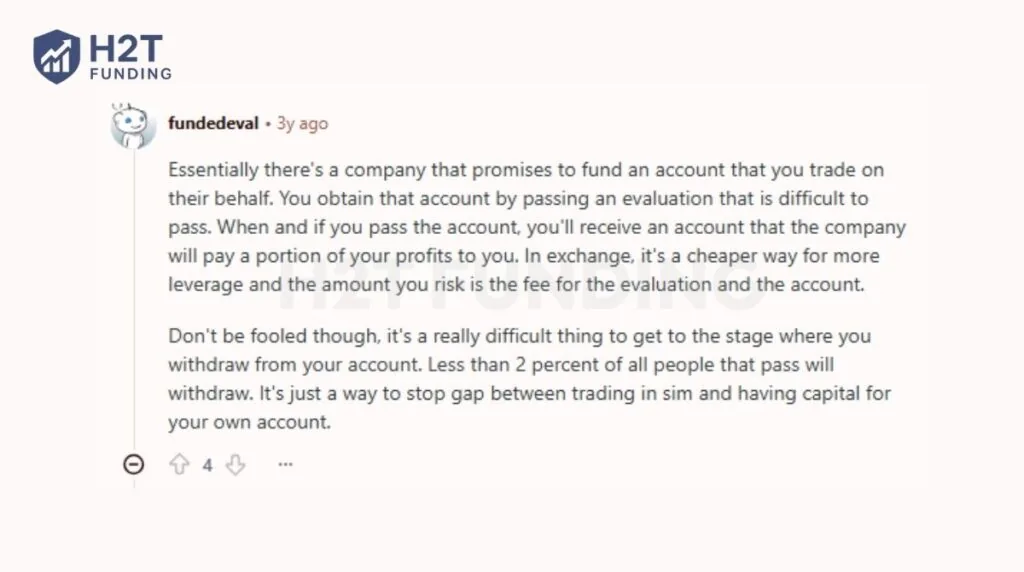
“Don’t be fooled though, it’s a really difficult thing to get to the stage where you withdraw from your account. Less than 2 percent of all people that pass will actually withdraw. It’s just a way to stop-gap between trading in sim and having capital for your own personal account.” — u/fundedeval, r/Trading
It is important for aspiring traders to thoroughly understand these constraints before entering a partnership with a proprietary trading firm.
9. How to choose the best funded trader program for you
Selecting the right funded trader program hinges on your personal trading approach, financial objectives, and psychological tendencies. To help narrow your options, ask yourself:
- Do you prefer a manual trading style or rely on algorithms?
- Are you comfortable operating within strict time constraints, or do you need more trading flexibility?
- Which category best fits you (scalper, swing trader, or algorithmic trader)?
If you’re still exploring your style, consider starting with firms that offer trial accounts or affordable entry points, such as FTUK. For a comprehensive comparison, check out our guide that evaluates prop firms side by side.
For a deeper look, explore this article featuring the Top 12 easiest prop firms to pass in 2026.
10. How do funded trading accounts pay out?
After actively trading and meeting the required performance criteria, you should be able to request a withdrawal from your funded trading account. Here is an example of a payout process for a funded trading account.
To begin, complete the KYC/AML verification by submitting your ID and proof of address, ensuring that you avoid using any VPN or VPS during this process.
Once verified, proceed to submit a payout request through the firm’s dashboard, such as Trade Hub, and select your preferred payout method.
After the firm reviews the request, it will enforce specific payout conditions, such as the consistency rule (ensuring no single trading day accounts for more than 30% to 50% of your total profits). Once your account is cleared of any rule violations, the firm applies the agreed profit split, typically 80/20 in your favor.
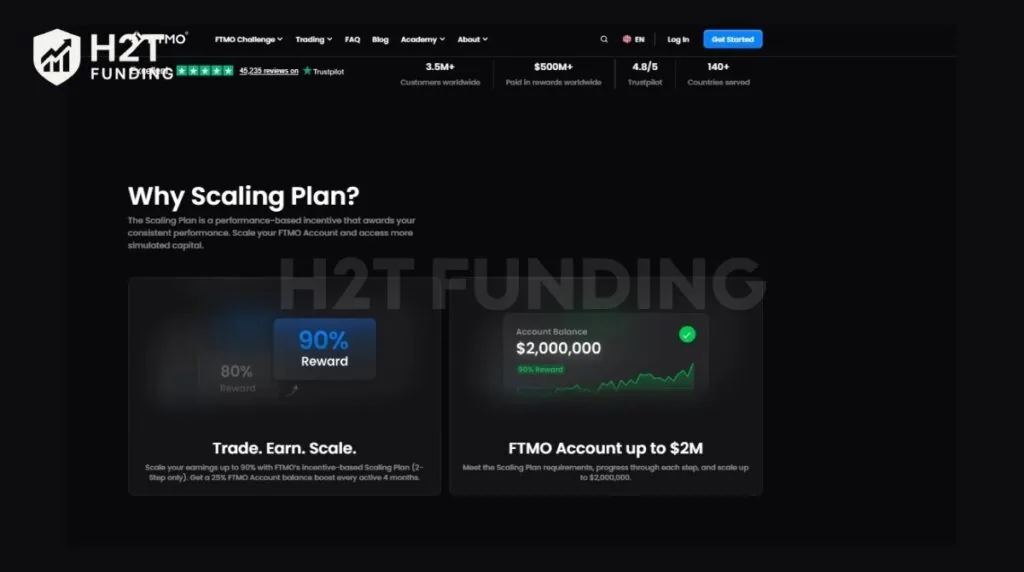
Official Policy Insight: “Scale your earnings up to 90% with FTMO’s incentive-based Scaling Plan (2-Step only). Get a 25% FTMO Account balance boost every active 4 months… Get a 90% share of your simulated profits.” — Source: FTMO Official Scaling Plan.
The funds are then transferred to you, with the processing period generally taking about 3 to 5 business days, depending on whether you chose bank wire, crypto, or direct platform withdrawal.
11. FAQs
-
The biggest misconception is that a funded account is a risk-free shortcut to quick wealth. In reality, it is a highly restrictive environment designed to filter out undisciplined traders. While you don’t risk personal capital on trades, you risk the evaluation fees, and the strict rules are designed to protect the firm, not guarantee your success.
-
From my experience, it’s overwhelmingly poor risk management. Traders overleveraged, chasing quick profits and hitting drawdown limits. Data I’ve seen suggests 90-95% fail the initial challenge due to this. Other key reasons include the absence of a tested trading strategy, emotional decision-making, and ignoring the firm’s specific rules.
-
Relentlessly focus on risk management before profit. Your primary goal in a challenge is not to lose money according to the rules. Prop firms filter out risky traders.
Instead of taking on the actual challenge, begin with the smallest account and spend months practicing rigorous risk management on a demo. It’s a marathon where survival is the first, most important victory.
-
After passing the challenge, you are moved to a funded account. In most modern prop firms, this remains a live-simulated environment (B-Book). While the trading funds are virtual, you are fully eligible to withdraw real money based on the virtual profits you generate.
-
One of the most concerning red flags is a firm’s lack of transparency. Especially when paired with a pattern of delayed or disputed payouts.
If you notice recurring complaints in independent reviews about payment issues, you should consider the credibility of the firm. A firm’s track record of honoring payouts should always be a top priority in your selection criteria.
-
Yes, you can make money with funded trading accounts. But keep one thing in mind: you need to prove you have the skills by applying consistent discipline and being able to strictly control your risk exposure. Lastly, you must have a strategy that aligns with the prop firm’s rules.
-
You generally cannot get a live funded account completely for free, as prop firms require an upfront fee to cover their operational risks. However, many reputable firms like FTMO offer “Free Trials” allowing you to practice their rules without risking money. Additionally, some firms host free monthly trading competitions where top performers can win a free evaluation challenge.
-
Yes, this is known as “Instant Funding,” offered by specific prop firms like The5ers. Instead of passing a multi-phase challenge, you pay a significantly higher upfront fee to immediately access a live-funded environment. The trade-off is that instant funding accounts usually start with much smaller capital and enforce stricter initial scaling rules.
-
Yes, but your options depend heavily on the asset class. Futures prop firms (such as Apex Trader Funding or Topstep) are highly accessible and popular for U.S. residents due to regulated CME structures. Conversely, many retail Forex prop firms currently restrict U.S. clients due to strict regulatory crackdowns on CFDs.
12. Final thoughts
We have explored how do funded trading accounts work through this article. To sum up, getting a funded account isn’t about the money. It’s about discipline. Prop firms are not searching for lottery winners who get lucky on one big trade; they are searching for consistent professionals who manage risk obsessively.
If you can prove you are that trader, the capital will follow. The real challenge, and the true reward, is in mastering your own discipline, not just mastering the market. The journey to becoming funded is a testament to consistent performance and strategic partnership, creating a path toward professional trading.
Ready to explore its full potential? Dive into our Prop Firm Guides section. And remember, every expert at H2T Funding is here to accompany you on your journey to becoming a trader.
Disclaimer: Proprietary trading firm rules, payout conditions, and evaluation fees can change without prior notice. Always verify the most current terms and conditions directly on the official websites (such as FTMO, Topstep, or Apex Trader Funding) before purchasing any challenge. The data, firm rules, and industry statistics mentioned in this guide were last verified as of July 2026.