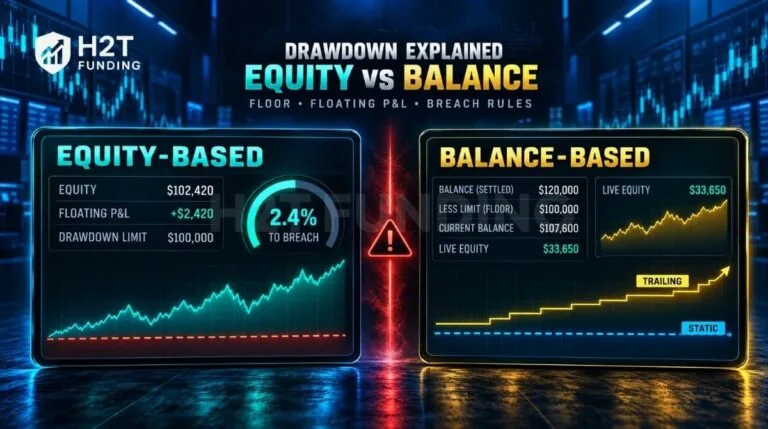


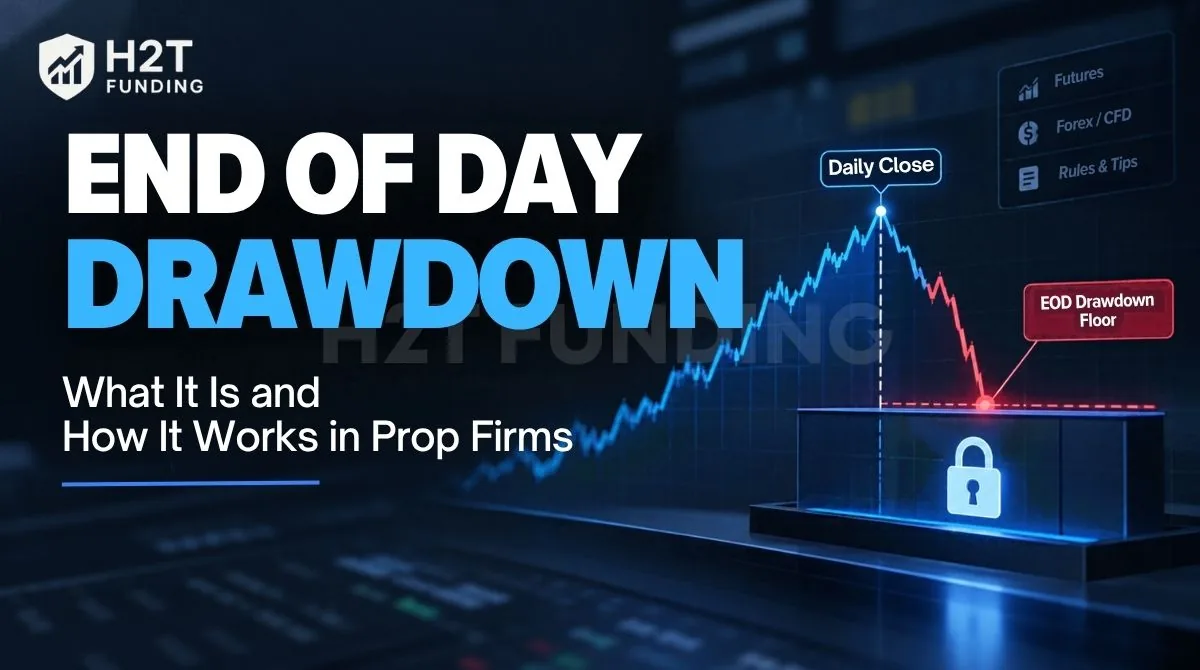
End of day (EOD) drawdown sounds simple: the floor updates once a day, at the close. Many traders read that as “the account is only checked at the close”, and that assumption is how accounts get breached mid-session. The floor is calculated at the close, but it is enforced in real time during the next session.
This guide explains how end of day drawdown works in prop firms, how it differs from a daily loss limit, intraday trailing, and static drawdown, why traders breach EOD accounts, and which firms use it. Where futures and Forex/CFD firms differ, each is explained separately.
Key takeaway
- End of day (EOD) drawdown is a prop firm rule that sets the lowest balance your account can reach. The floor is recalculated once a day, at the close, from your highest closing balance.
- How it works: Floor = highest closing balance minus the max drawdown. It rises only when you close at a new high and never moves down.
- Which firms use it: Apex, Topstep, MyFundedFutures, Tradeify, TradeDay, Earn2Trade, E8 Markets (Signature), and Instant Funding (Evolve).
- Before you buy: Compare the drawdown amount, daily loss limit, lock point, and close time for your exact plan, not just the drawdown label.
Note
Prop firms update their rules often. Always check the current terms for your exact plan and platform before trading.
How we compiled this information
The mechanics and firm details in this guide come from the firms’ own Help Centers and rule pages, checked in October 2026. Dollar figures used to illustrate a rule are examples from specific plans and do not apply to every firm. This article is for education only and is not financial advice.
1. What Is End of Day Drawdown?
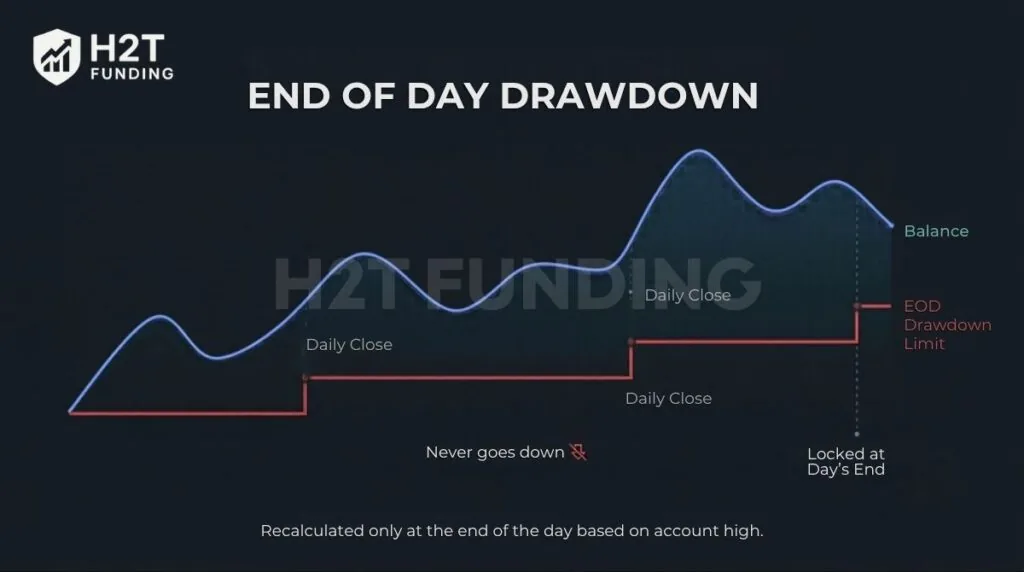
End of day (EOD) drawdown is a prop firm risk rule that sets the lowest balance your account can reach and recalculates that limit only once per day, at the daily close. The limit is based on your highest closing balance and rises only when you close at a new high.
Futures: The limit is usually a fixed dollar amount, calculated at the session close. Firms name it differently, such as EOD Threshold, Max EOD Trailing, or Maximum Loss Limit.
Forex/CFD: The limit is usually a percentage of the starting balance. Static drawdown is more common at these firms, but some programs use an EOD trailing limit, such as E8 Signature. Many Forex/CFD firms also use an end-of-day snapshot for their daily drawdown, which is a separate rule.
2. How Does End of Day Drawdown Work?
EOD drawdown follows the same daily cycle at every firm: the floor is set at the close, then enforced during the next session. Here is how each step works:
- Calculation time: The floor is recalculated once per day, at the daily close or rollover, using your settled closing balance
- Balance-based: Only realized profit and loss count toward the floor. Unrealized gains and losses on open positions do not move it during the session
- Ratchet effect: If you close at a new high, the floor moves up by the same amount. If you finish flat or down, the floor stays where it is and never moves down
- Real-time enforcement: The floor only updates at the close, but it is enforced live. If your balance or equity touches or falls below it at any point in the session, positions are liquidated and the account is breached
- Lock point: Most firms stop the floor from trailing once it reaches a fixed level.
In formula terms, the floor equals your highest closing balance minus the maximum drawdown amount.
2.1. Can you breach EOD drawdown during the day?
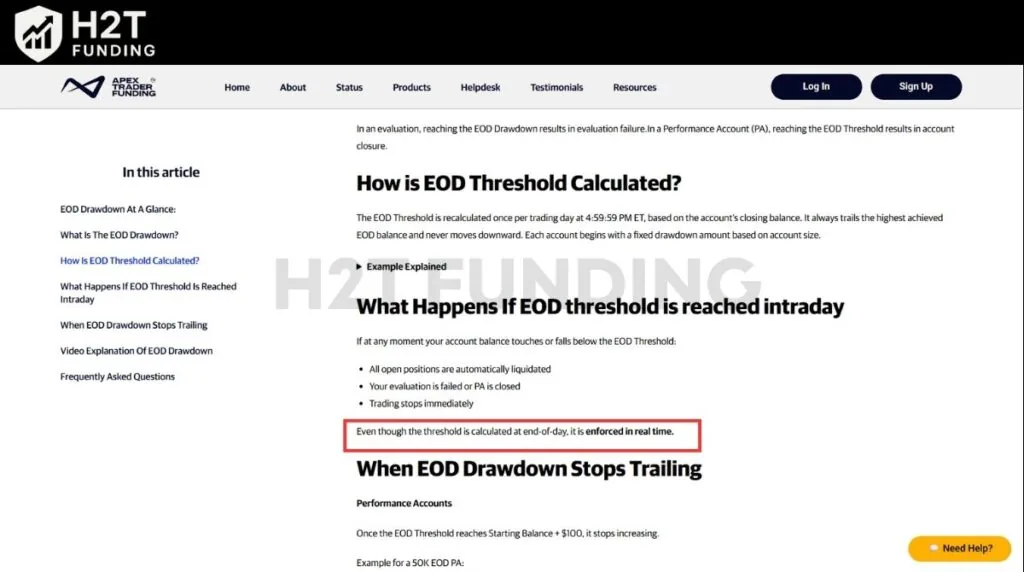
Yes. The floor is calculated at the close, but it is enforced in real time throughout the next session, so touching it at any point ends the account.
Apex’s Help Center says it directly: “Even though the threshold is calculated at end-of-day, it is enforced in real time.” E8 Markets applies the same logic, stating that closing back above the loss level after touching it does not undo the breach.
2.2. When does the EOD drawdown floor stop trailing?
Most firms stop the floor from trailing once it reaches a fixed level. Where it locks depends on the firm type.
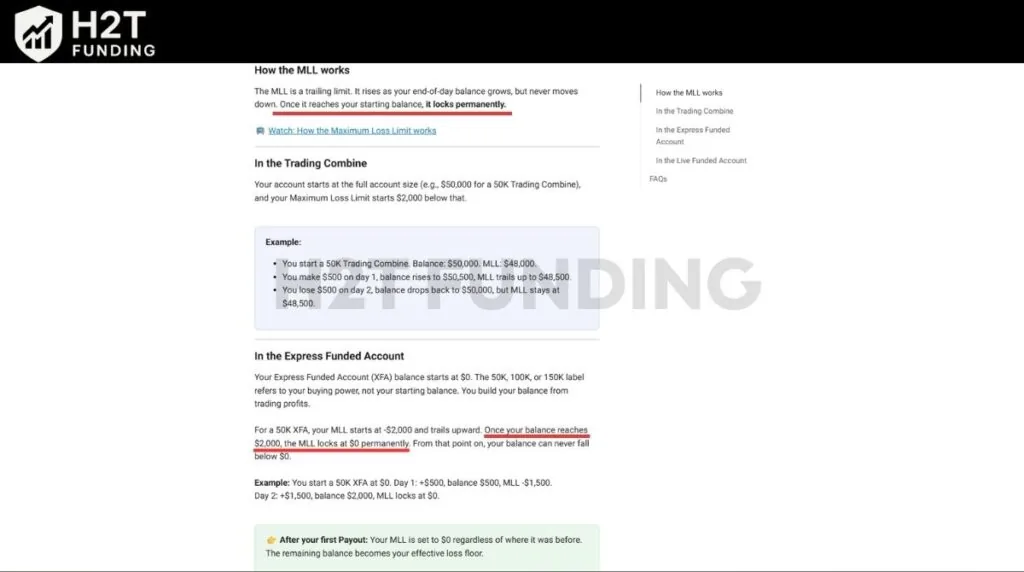
Futures: The floor usually locks at the starting balance or slightly above it. At Topstep it locks at $50,000 once your highest closing balance reaches $52,000 on a $50K Combine. At Apex funded (PA) accounts and several others, it locks at $50,100 once your highest closing balance reaches $52,100.
Some firms apply different lock rules by platform or stage, so check your plan’s rule page.
Forex/CFD: The floor typically locks at the initial balance once your closed profit equals the drawdown amount. On E8 Signature, for example, a 3% drawdown on a $100,000 account locks at $100,000 after $3,000 of closed profit.
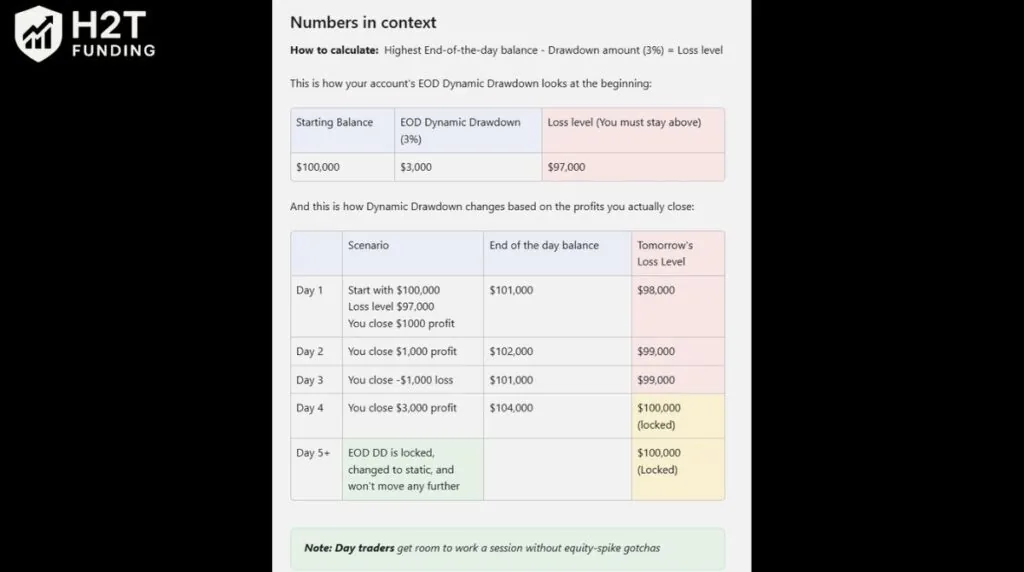
After the lock, the floor behaves like a static limit and no longer rises with new highs. The exact lock point depends on the firm and plan.
3. EOD Drawdown vs. Daily Loss Limit (and Other Drawdown Types)
EOD drawdown differs from a daily loss limit, intraday trailing, and static drawdown in the following ways:
- Daily loss limit: EOD drawdown is a lifetime floor that ends the account when touched. A daily loss limit is a separate per-session cap, and what happens when you hit it depends on the firm type.
- Intraday trailing: The EOD floor moves only on your closing balance. The intraday floor moves in real time with your highest equity, including open profit.
- Static: The EOD floor rises with new closing highs until it locks. A static floor never moves.
No type is better in every case. What matters is the dollar amount and the extra rules each firm attaches to it. The two sections below compare the details.
3.1. EOD drawdown vs. daily loss limit
A daily loss limit (DLL) is not a type of drawdown. It is a separate rule that works alongside the EOD floor instead of replacing it. The table compares the two, including where futures and Forex/CFD firms differ.
| EOD drawdown | Daily loss limit (DLL) | |
|---|---|---|
| What it limits | The account’s total drawdown over its lifetime | The maximum loss allowed in one trading day |
| Measured from | Your highest closing balance | Futures: your balance at the start of the session. Forex/CFD: often the higher of balance or equity at a daily reset (for example 5 PM EST at Fast Fund) |
| When triggered | Fails the evaluation or closes the account | Futures: usually pauses trading for the day and the account stays alive (Apex’s 50K EOD evaluation, $1,000 DLL). Forex/CFD: often fails the account (FundedSquad) |
| Does it reset? | No, it only trails upward or locks in place | Yes, fresh at the start of every day |
| Common name | EOD Threshold, Max EOD Trailing, Maximum Loss Limit | Daily loss limit (futures), daily drawdown (Forex/CFD) |
3.2. EOD vs. intraday trailing vs. static drawdown
These three structures differ first in when the floor is calculated. The table below shows how each one responds to your balance during a session.
| EOD | Intraday trailing | Static | |
|---|---|---|---|
| When the floor is calculated | Once per day, at the close | Continuously, in real time | Fixed from the start |
| Based on | Closing (realized) balance | Peak equity, including unrealized profit | A fixed amount below the starting balance |
| Rises with intraday peaks? | No | Yes | No |
| Enforced in real time? | Yes, using the floor set at the previous close | Yes | Yes |
| If open profit hits $52,100 on a $50K account | Floor stays at its prior level until the close | Floor rises with the peak, up to the firm’s lock point | Floor does not change |
| Main thing to watch | Distance between live equity and yesterday’s floor | A floor that moves up with every new peak | Nothing moves, so the limit is easy to plan around |
Because the EOD floor ignores open profit, a pullback after an intraday peak does not pull the floor closer to you. That is a difference in mechanism, though, and not a reason to call EOD easier.
The amount of drawdown and the DLL attached to each type still vary by firm. An EOD plan can carry a smaller drawdown or an added DLL compared with the same firm’s intraday plan. Compare the dollar figures on the plan, not just the label.
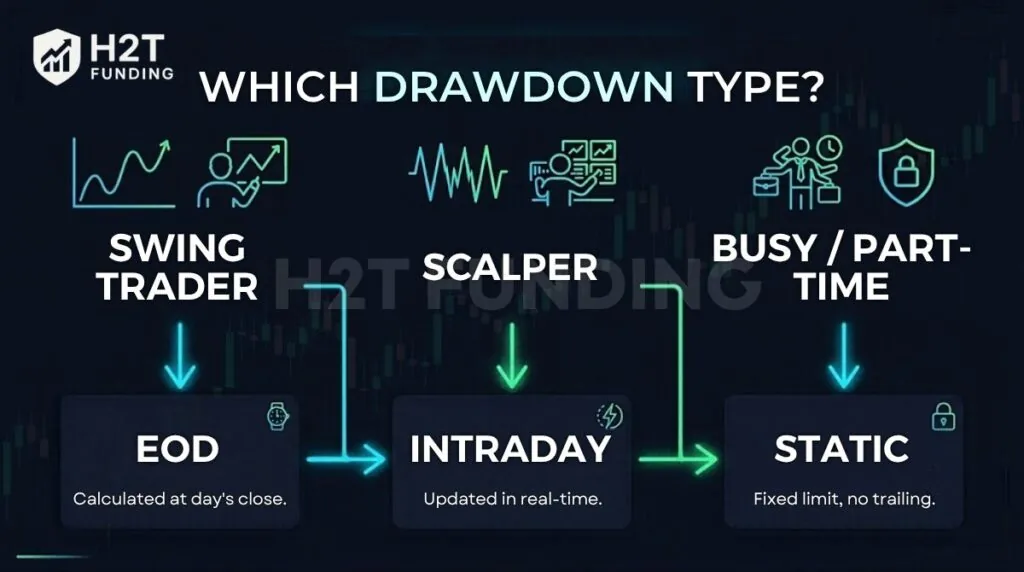
3.3. Which drawdown type should you choose?
No single type works for everyone, so match the drawdown type to how you trade:
- You hold trades through big swings or add to winners: choose EOD, since open profit peaks do not raise the floor (a drop below yesterday’s floor still breaches).
- You take profits quickly and rarely give back open profit: intraday trailing can work.
- You cannot watch the account all day: choose EOD or static, since the floor stays fixed during the session, but still use stop losses because it is enforced live.
- You tend to keep trading through losing streaks: choose a plan with a DLL, whatever the type.
- Before you buy: confirm the drawdown amount, DLL, and lock point for the specific plan.
4. Why Traders Breach EOD Accounts: Common Mistakes
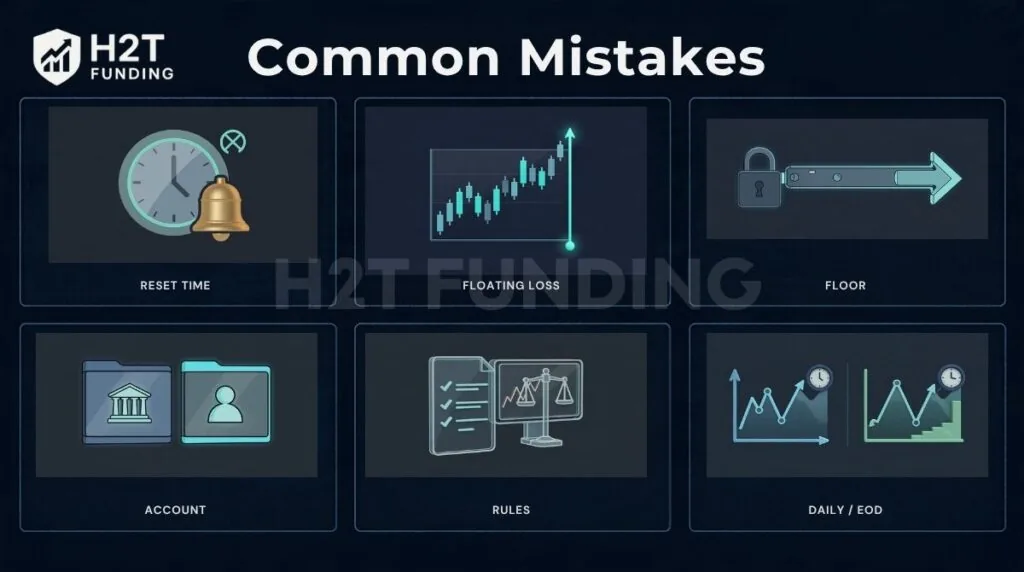
Traders most often breach EOD accounts by missing the close time, ignoring floating loss, assuming the floor resets, or mixing up account versions. Below are the most common mistakes in detail, with a quick fix for each.
1. Not tracking the daily close or reset time. Futures firms set their close at different times, for example 4:59:59 PM ET at Apex or 4:00 PM CT at TradeDay. Forex/CFD firms use their own reset time and time zone, so your calendar day may not match the firm’s trading day.
- Fix: confirm your firm’s close or reset time and set a reminder around it.
2. Ignoring floating (unrealized) loss. Some traders assume only the closing balance is checked, but as covered in Section 2.1, floating loss counts in real time against the floor.
- Fix: watch your live equity against the floor, not just your closing balance.
3. Assuming the floor resets. The floor never resets. It only trails upward or locks in place, as covered in Section 2.2.
- Fix: treat every prior gain as permanently locked into the floor, not as a cushion that refreshes.
4. Confusing a legacy account with a current one. Apex restructured its account types around March 1, 2026, separating EOD and intraday products, and legacy accounts can carry different rules entirely.
- Fix: confirm which specific product and rule version your account falls under before assuming a rule applies.
5. Not checking platform or program rules. Lock points and enforcement can differ across platforms and programs, even within the same firm. At E8 Markets, for example, E8 One’s trailing limit updates as soon as your balance sets a new high, while E8 Signature’s EOD limit updates only at the end of the day.
- Fix: check the rule page for your specific platform and program, not just the firm’s general rule page.
6. Confusing daily drawdown with EOD drawdown. At Forex/CFD firms, “daily drawdown” is a per-day loss cap, not the lifetime EOD floor. Mixing them up leads traders to watch the wrong limit.
- Fix: check which limit your firm’s page is describing before reading its numbers.
If you’ve just breached an account, a quick self-check: what was the floor for that session, what account type are you actually on, and what time zone was the close calculated in?
5. Which Prop Firms Use EOD Drawdown?
Futures prop firms such as Apex, Topstep, MyFundedFutures, Tradeify, TradeDay, and Earn2Trade use end of day drawdown. A few Forex/CFD firms use it too, including E8 Markets (Signature) and Instant Funding (Evolve). Rules can differ by plan and platform even within the same firm, so check your exact plan before you buy.
5.1. Futures prop firms
The firms below are listed only because their Help Centers or official rule pages confirm EOD drawdown: Apex, Topstep, MyFundedFutures, Tradeify, TradeDay, and Earn2Trade.
| Firm | Plan (example) | EOD rule | Floor lock point |
|---|---|---|---|
| Apex Trader Funding | EOD Evaluation / PA (25K–150K) | Calculated once daily at close (4:59:59 PM ET); enforced in real time; 1K–4K max drawdown by size | PA: starting balance + $100; evaluation: Rithmic/WealthCharts stop at the profit-target balance, Tradovate keeps trailing |
| Topstep | Trading Combine / Express Funded Account | Maximum Loss Limit trails the highest EOD balance; enforced in real time | Combine: locks at starting balance. Express Funded: locks at $0 (once balance reaches the starting loss limit, or after the first payout) |
| MyFundedFutures | Pro / Builder / Rapid | Max EOD Trailing; open equity counts; Pro and Builder use EOD in both stages, Rapid uses it only in evaluation (intraday trailing when funded) | Typically locks at starting balance + $100 |
| Tradeify | Growth / Lightning | EOD Trailing; updates at close; enforced in real time | Funded stage typically locks at starting balance + $100 |
| TradeDay | EOD TMD plans | EOD Trailing Max Drawdown, calculated at the 4:00 PM CT close | Freezes at starting balance |
| Earn2Trade | Gauntlet Mini / Trader Career Path (TCP) | End-of-Day Drawdown in evaluation and LiveSim; updates at close; open equity counts in real time | Typically locks at starting balance; fixed at the highest TCP levels |
5.2. Forex/CFD prop firms
At Forex/CFD firms, E8 Markets (Signature) and Instant Funding (Evolve) use EOD trailing drawdown.
| Firm | Plan (example) | EOD rule | Floor lock point |
|---|---|---|---|
| E8 Markets | Signature (Forex, Crypto) | EOD trailing drawdown calculated on your closed balance at the end of each trading day; touching the loss level by balance or equity closes the account | Locks at the initial balance once closed profit equals the drawdown amount |
| Instant Funding | Evolve (4% Maximum Loss Limit) | EOD trailing drawdown updated once per day at 5:00 PM EST, based on your highest end-of-day balance; no separate daily loss limit | Locks at the starting balance (on a $50,000 account, from $48,000 to $50,000 once the highest end-of-day balance reaches $52,000) |
Disclaimer: Firm information in this section was last checked in October 2026. The exact percentage and rules vary by program, so confirm the current terms on the firm’s website or Help Center before trading.
For a broader comparison before choosing a firm, see H2T Funding’s list of the best prop firms.
6. FAQs
-
It’s a drawdown floor recalculated once daily at the session close, based on your highest closing balance.
-
The floor equals your highest closing balance minus the max drawdown, updated once a day at the close.
-
Yes. The EOD floor is set at the previous close and enforced in real time. If your balance or equity touches it at any point in the session, positions are liquidated and the account is breached, even if you would have recovered by the close.
-
No. EOD drawdown is a lifetime floor based on your highest closing balance, and touching it ends the account. A daily loss limit is a separate per-day cap that resets every day. At futures firms, hitting it usually pauses trading for the day. At Forex/CFD firms, it often fails the account.
-
EOD drawdown moves the floor only at the daily close, based on your closing balance. Intraday trailing moves it in real time with your peak equity, including open profit. Neither is better in every case. Compare the drawdown amount, daily loss limit, and lock point on the specific plan, not just the label.
-
Yes. In most cases it locks at a fixed point, usually the starting balance or starting balance + $100.
-
Apex, Topstep, MyFundedFutures, Tradeify, TradeDay, and Earn2Trade. For more details on each firm, read our prop firm reviews.
-
Yes, but less often than at futures firms. Static drawdown is more common in Forex/CFD, and daily drawdown is usually measured from an end-of-day snapshot.
7. Conclusion
End of day drawdown recalculates your floor once a day at the close, based on your highest closing balance, and enforces it in real time during the next session. The floor only rises when you close at a new high, and most firms stop it from trailing at or near the starting balance.
It is a lifetime limit, separate from the daily loss limit, and it differs from intraday trailing and static drawdown in when the floor is calculated. Most EOD breaches come from watching the closing balance instead of live equity, missing the firm’s close or reset time, or mixing up account versions and rule types.
Which drawdown type do you trade with, and what has worked for you? Let us know in the comments. To compare firms, explore the H2T Funding homepage, or read our prop firm guides for more on drawdown rules and how to choose the right plan.
Disclaimer: This article compiles information from official firm sources and may change over time. It is not financial advice. Always verify current rules directly on the relevant firm’s Help Center or dashboard before trading.