

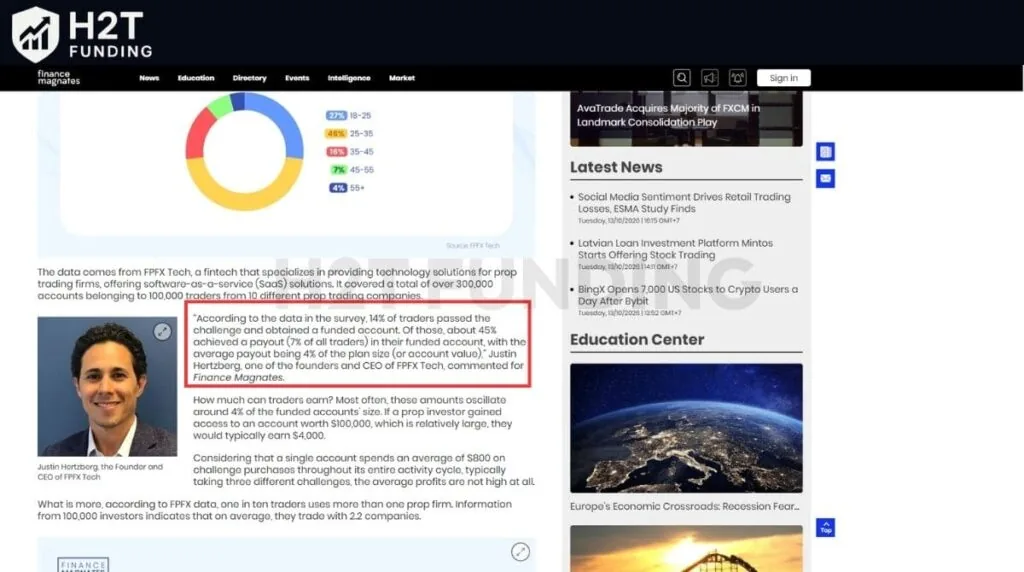
The prop firm challenge failure rate is high, but no audited figure covers the whole industry. A large third-party dataset reported by Finance Magnates found that about 14% of traders passed a challenge and about 7% ever received a payout.
Firms that publish their own numbers report anything from about 5% to over 20%, depending on their rules.
If you are deciding whether to buy a challenge, or trying to understand why your last one failed, this guide covers five things: what the numbers mean, why traders fail, what you lose when you fail, how to improve your odds, and how to choose a firm whose rules fit your style.
Key Takeaways
- About 86% of traders did not pass a challenge, and only about 7% ever received a payout. Firms that publish their own data show pass rates from roughly 5% to over 20%.
- Traders usually fail for these reasons: oversizing, position stacking, misreading daily and trailing drawdown rules, and revenge trading. This comes from firm rules and community reports, not a measured ranking.
- Traders can improve their odds by risking 0.5-1% per trade, practising under the firm’s exact rules on a demo, reading the drawdown and position limits before buying, and setting a budget for attempts.
Our methodology: The numbers in this article come from studies by trading software companies (FPFX Tech and Swiset, as reported by Finance Magnates) and from results that prop firms publish themselves (such as Topstep and ATFunded). Rules, fees and refund terms come from each firm’s official Help Center.
Important: Some sources count accounts while others count traders, so treat them as estimates, not exact totals. This information was last checked in October 2026, and the newest study we found covers 2024 – 2025. Fees and rules change often, so confirm current terms on the firm’s official website before you buy.
1. What is the prop firm challenge failure rate?
Most traders fail prop firm challenges. The largest third-party dataset available (FPFX Tech, 2024) found that about 14% of traders passed, so roughly 86% did not. Only about 7% of all traders went on to receive a payout.
Most published results show about 80% to 95% of attempts or traders failing, depending on the firm. In Swiset’s dataset (2024 – 2025, reported by Finance Magnates), two-step challenges had a lower pass rate than one-step challenges.
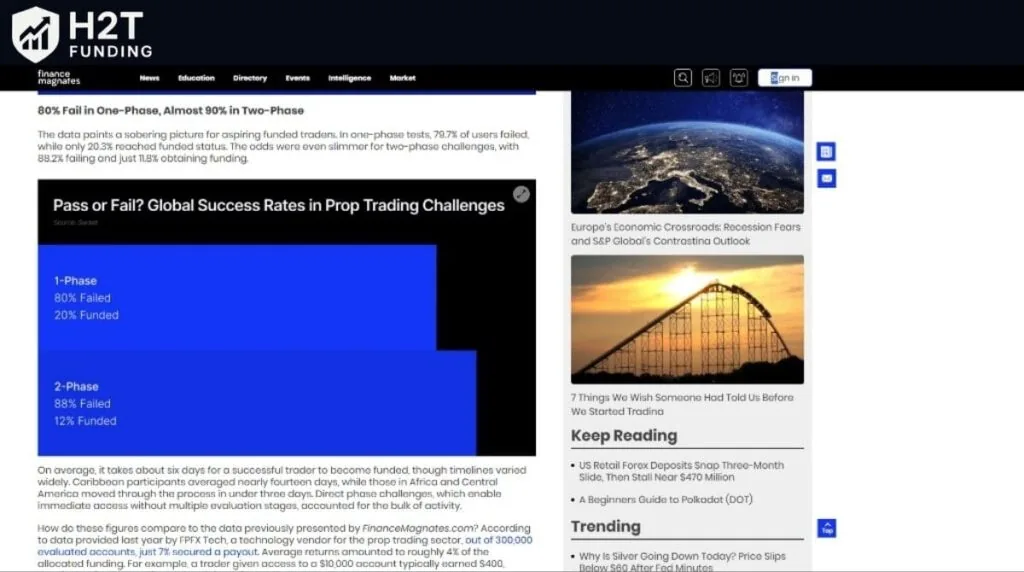
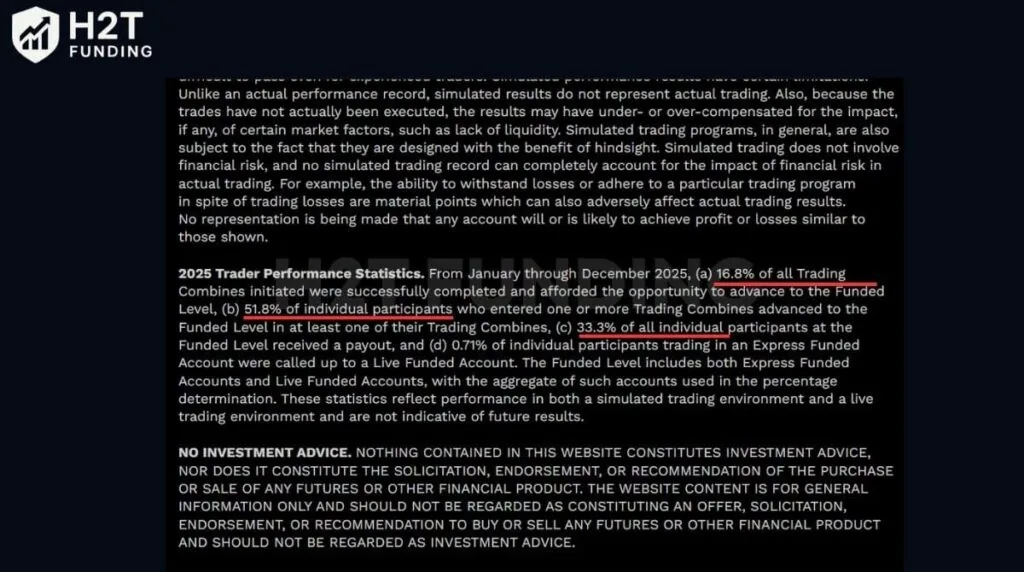
Many traders buy more than one challenge, so the share of attempts that fail is higher than the share of traders who never get funded. Topstep’s 2025 figures show the gap: 16.8% of Combines passed, yet 51.8% of traders reached the funded level at least once.
2. Why do traders fail prop firm challenges?
A challenge ends when you break a loss limit or, at firms with a time limit, run out of time. The causes behind this are usually risk-management mistakes, but no firm publishes a breakdown, so the reasons below come from the rules and community reports, not from a measured ranking.
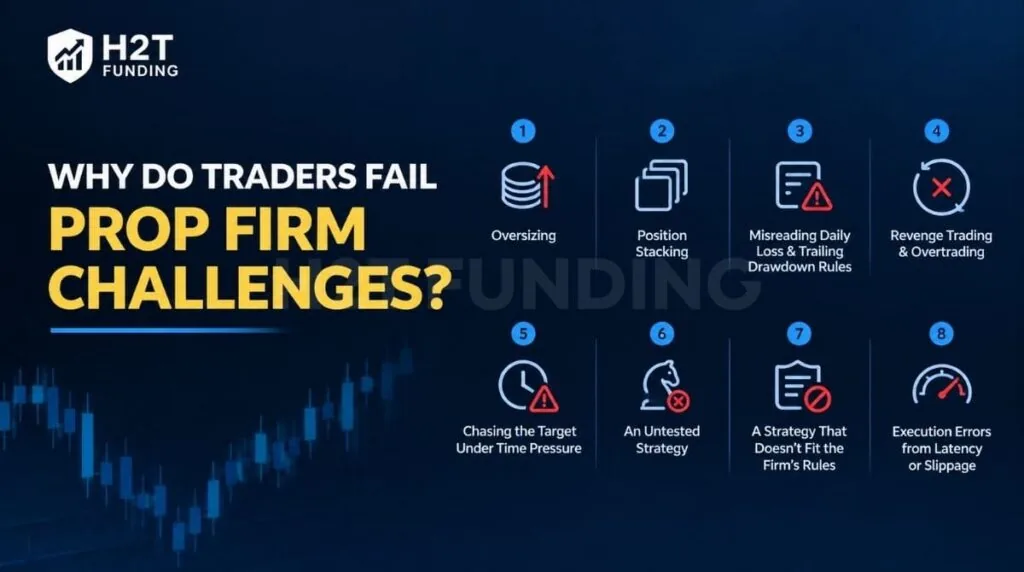
1. Oversizing. Risking too much per trade relative to the daily or maximum drawdown limit means one or two losing trades can end the challenge.
- Example: risking 2–3% per trade on a 4–5% daily loss limit can turn two consecutive losses into a breach.
- Fix: cap risk at 0.5–1% per trade.
2. Position stacking. Opening several positions in the same direction on the same instrument, potentially breaching a firm’s limit on simultaneously open positions.
- Example: A firm allows a maximum of three open positions in the same direction on one instrument. A trader opens a fourth position while the first three are still open, breaching the rule and risking immediate challenge termination even if the account has not hit its drawdown limit.
- Fix: Check the firm’s position limits, count all open positions on the same instrument before placing a new order, and confirm whether the rule applies per instrument, direction, or account.
We encountered this issue firsthand during our Pipcy $50K Classic 1-Step Challenge, which was closed after we opened a fourth US500 buy position while three were still open. Read our Pipcy review for the details of our experience and the firm’s position-limit rule
3. Misreading daily loss and trailing drawdown rules. The daily loss limit is usually tighter than the maximum drawdown, and a trailing drawdown moves with your equity high rather than staying fixed.
- Example: a trader who climbs 3% in profit and then gives it all back assumes they still have room, not realizing the trailing floor has already moved up with them.
- Fix: read the rule in full before buying, and track both the daily and trailing limits in real time, not just the headline drawdown number.
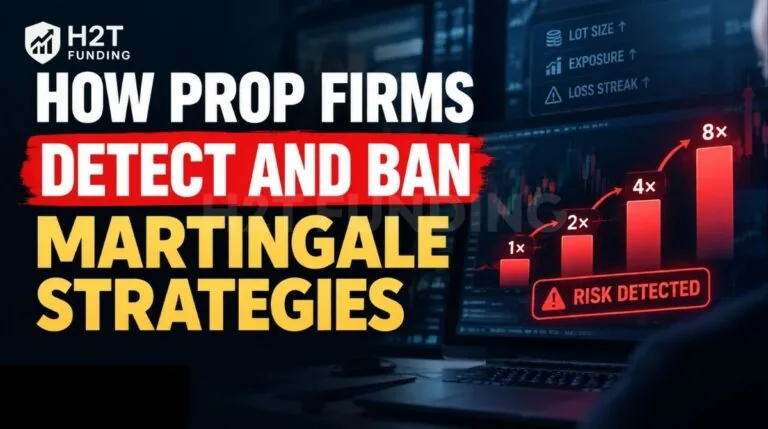
4. Revenge trading and overtrading. A loss triggers an attempt to recover the money through larger position sizes or additional trades, often without reassessing the risk.
- Example: After two consecutive losing trades, a trader doubles their position size to recover the losses. The next trade also loses, pushing the account past its daily loss limit.
- Fix: Set a maximum daily loss and a predefined stop after consecutive losses. Never increase position size solely to recover previous losses.
5. Chasing the target under time pressure. A minimum trading-day requirement or time limit can push a trader into lower-quality setups near the deadline.
- Example: five days left and 4% still needed on the target pushes a trader to take every setup instead of the good ones.
- Fix: treat the profit target as a byproduct of good process, not the goal to force.
6. An untested strategy. Trading a strategy that has not been backtested or forward-tested under the firm’s actual rules.
- Fix: demo or forward-test the strategy under the exact rule set you’ll be trading before paying for a challenge.
7. A strategy that doesn’t fit the firm’s rules. News trading, overnight holding, or scalping restrictions – or a consistency rule – can disqualify a style that would otherwise be profitable.
- Fix: match your trading style to a firm’s specific rules before buying, not after.
8. Execution errors from latency or slippage. This hits scalping and news-driven strategies hardest, where a few milliseconds or pips of slippage can be the difference between a win and a breach.
- Fix: avoid latency-sensitive strategies on platforms known for wider spreads, and check execution quality before committing – how platform latency affects prop firm trade execution and slippage covers this in more depth.
3. When do traders fail a prop firm challenge, and what happens next?
Most traders who fail do so early, and failing costs you what you paid for that attempt. A losing trade does not create a debt, but how much you pay depends on how the firm charges. The sections below show where traders drop out, what you lose, and what your options are afterwards.
3.1. Where traders drop out: Phase 1, Phase 2 and funded accounts
Most traders stop at the first stage. ATFunded, a firm with a two-step challenge, reported that 22.6% of its traders moved from Phase 1 to Phase 2 in June 2025, so about 77% stopped at Phase 1. Phase 1 usually has the higher profit target: ATFunded’s was 8% in Phase 1 and 5% in Phase 2 at the time.
Phase 2 still loses most traders. In the same month, 26.9% of Phase 2 traders became funded, so about 73% did not. A lower target does not mean lower risk, because the loss limits are often the same, and community reports suggest that being close to the finish adds pressure. This is one firm’s monthly snapshot, not an industry average.
Failures tend to come quickly. Swiset found that traders who became funded took about six days on average, while traders who failed typically did so within a week.
Passing the challenge is not the end. Topstep reported that 33.3% of its funded traders received a payout in 2025, so about two-thirds did not. Funded accounts have their own payout conditions, such as a minimum number of winning days or a consistency rule (a limit on how much of your total profit can come from your best day), and these vary by firm.
3.2. What you lose and what you keep
When you fail, you lose what you paid for that attempt, and the account stops counting toward funding.
Some firms, such as FTMO, charge a one-time fee. Others, such as Topstep, charge a monthly subscription that keeps renewing until you pass or cancel, even after you break a loss limit. A losing trade does not create a debt, but resets, activation fees and renewals can add to the cost. Check the Terms before you buy.
What you keep is information. The rule that ended your attempt tells you exactly what to fix before the next one.
3.3. Your options after failing: retake, reset or refund
You can usually try again by buying a new challenge. Some firms also let you reset a challenge you have not finished, which restarts it with a fresh balance, usually for a fee. For example, as of October 2026, Topstep’s website lists a $49 reset fee on its $50K Trading Combine and one free reset at each monthly rebill. Its fee rebills monthly until you pass or cancel, so a long attempt costs more.
A refund after failing is rare. Refunds usually apply when you pass or get paid, for example when a firm returns the challenge fee with your first payout. When a firm advertises “refundable fees”, check which of the two it means. Policies change often, so confirm the current terms on the firm’s Help Center before you buy.
4. How to improve your odds
You can improve your odds mainly by controlling risk and knowing the rules before you pay.
4.1. Practical habits that move the needle
- Risk 0.5–1% per trade, not 2–3%, so that no single loss threatens the daily limit.
- Practice under the firm’s exact rules using a demo or forward-test before paying for the real challenge.
- Read the full rule set before buying, especially the drawdown type (static vs. trailing) and any consistency requirement.
- Keep a post-failure review – a short log of what rule was breached, what the emotional state was, and what the strategy was doing at the time. This single habit is what turns a second attempt into a better-informed one rather than a repeat of the first.
4.2. A realistic way to think about the odds
Set a maximum budget for how many attempts you’re willing to pay for, and treat that budget as the cost of learning rather than money you expect back. As a simplified illustration, if each attempt had a 10% chance of passing, three attempts would give about a 27% chance of passing at least once, and five attempts about 41%.
In practice, attempts are not independent: the same skill gaps and habits tend to repeat unless something changes between tries. FPFX data puts the average trader’s spend at roughly $800 across about three challenges, a useful benchmark for your own budget.
5. How to choose a prop firm with rules that fit your style
Choose a firm whose rules match how you trade, because the same strategy can pass at one firm and fail at another.
5.1. How to choose a firm that fits your style
Check these four things before you pay:
- Trading style vs. rules. Scalpers should check for consistency rules, while news traders and swing traders should check news, overnight and weekend restrictions. EA users should confirm EAs are allowed.
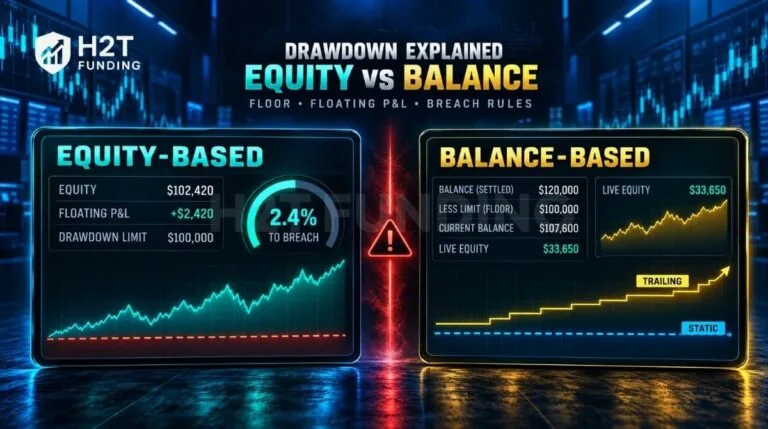
- Drawdown type. Static drawdown keeps your loss floor fixed. Trailing drawdown moves the floor up as your equity rises, so it leaves less room after winning days. Before choosing, it also helps to understand how different scaling models work, such as comparing equity-based vs balance-based drawdown structures, to see which one gives your strategy more breathing room.
- Cost of failure. Compare the challenge fee, reset fee and any activation fee after passing. These add up over several attempts.
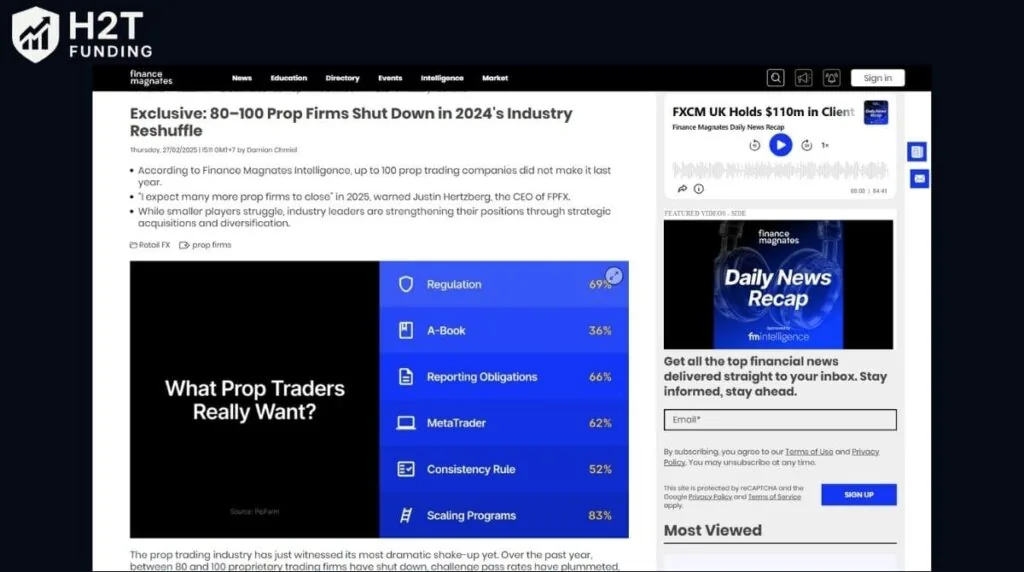
- Trust and payouts. Look for a verifiable payout history, a Trustpilot presence, a clearly stated legal entity and fully published rules. Finance Magnates Intelligence reported that roughly 80 – 100 prop firms shut down in 2024, so this check matters.
For a wider comparison, see H2T Funding’s list of top-rated prop firms and individual firm reviews.
5.2 Prop firms for beginners
Beginners do best with clear rules, manageable costs and rules they can track easily. Based on best prop firms for beginners, these are good starting points:
| Firm | Market | Why it suits beginners | Check first |
|---|---|---|---|
| The5ers | Forex/CFD | Entry from $19, no time limit | Lower leverage, conservative targets |
| FTMO | Forex/CFD | Free 14-day trial, long payout record | Restricted in 70+ countries, challenge fees rise on large accounts |
| Funding Pips | Forex/CFD | No time limit, no consistency rule to pass the challenge | Payout rules apply on funded accounts |
| Tradeify | Futures | End-of-day drawdown, no activation fee | The loss floor follows your highest end-of-day balance. |
| Topstep | Futures | Coaching and education, from $49/month | Monthly fee renews until you pass or cancel; a loss-limit breach counts in real time |
If you struggle with intraday fluctuations, checking firms that calculate limits using an end of day drawdown model can prevent premature breaches during volatile sessions. Start with a smaller account: the fee and the dollar risk are lower, so mistakes cost less.
6. FAQs
-
Yes, most traders do not pass: about 86% did not in the largest third-party dataset. The difficulty usually comes from strict loss limits and rules rather than the profit target. Traders who size small, learn the rules and practise under them first have better odds.
-
About 45% of traders who passed a challenge went on to receive at least one payout, according to a third-party dataset from FPFX Tech (2024, reported by Finance Magnates). That is roughly 7% of all traders. Topstep reported a lower share for 2025: 33.3% of its funded traders received a payout. The figures differ because the firms, years and rules differ.
-
You lose what you paid for that attempt. A losing trade does not create a debt, but some firms charge a monthly fee that keeps renewing until you cancel, so check how your challenge is billed.
-
Yes, at many firms. You can usually try again by buying a new challenge, and some firms also offer a reset. Fees and limits differ, so check the firm’s Terms.
-
Phase 2 failures usually come from the same risk and rule mistakes as Phase 1. Only 26.9% of ATFunded’s Phase 2 traders became funded in June 2025, so about 73% did not. That is one firm’s monthly figure, not an industry average.
7. Conclusion
The prop firm challenge failure rate is high: in a large third-party dataset from FPFX Tech (2024), about 86% of traders did not pass, and only about 7% ever received a payout. The exact figure changes by firm, by rule type and by whether you count attempts or traders, so treat every number as an estimate.
What you can control is your preparation: size your trades to the loss limits, learn the rules before you pay, check how the challenge is billed, and set a budget for attempts.
If you want to keep learning before you buy, explore more prop firm guides from H2T Funding to find rules that fit your style. Which rule worries you most before your next challenge? Share it in the comments.
This article is for informational and educational purposes only. Pass rates, fees, and reset policies change frequently and vary by firm – always verify current terms directly on a firm’s official Help Center before purchasing a challenge.