


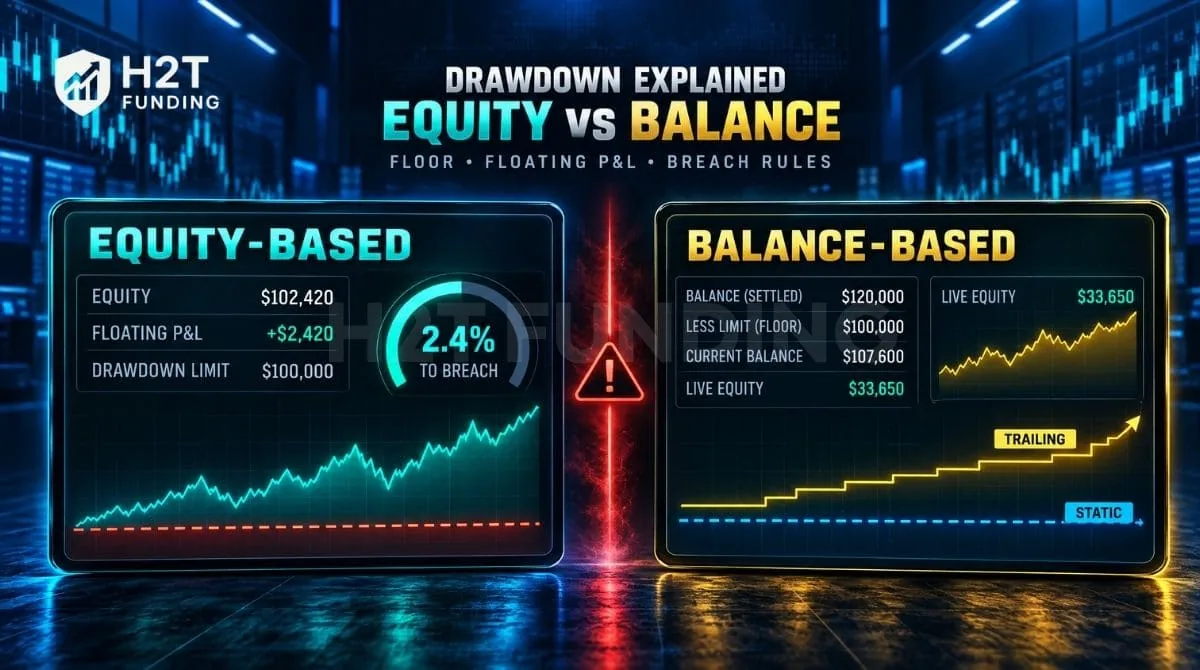
Equity based drawdown uses account equity, including floating profit and loss, to enforce a loss limit. Balance based drawdown uses a balance figure to establish the limit, but the firm may still monitor live equity to detect breaches. The key is to check both how the floor is calculated and which account value the firm monitors.
This guide explains how each drawdown model affects floating losses, breach conditions, and risk exposure, helping traders avoid violations and choose the right prop firm.
Key Takeaways
- Equity based drawdown uses equity as the reference, while balance based drawdown uses a defined balance figure to calculate the loss floor.
- Balance based does not mean floating losses are excluded. Firms may enforce the floor against real-time equity or P&L.
- Static floors remain fixed, while trailing floors rise as the reference value reaches new highs and may stop at a predefined level.
- Drawdown rules vary by firm and program. FTMO and Topstep use different floor calculations and update schedules.
- Before buying a challenge, check the floor reference, breach-monitoring value, update schedule, and whether the floor is static or trailing.
1. Equity Based vs Balance Based Drawdown: Key Differences
Both models set a loss limit to protect the account, but they differ in the account value used to calculate the drawdown floor. Balance based drawdown uses a defined balance reference, while equity based drawdown uses an equity reference that includes floating P&L.
Quick Comparison
| Criteria | Balance Based Reference | Equity Based Reference |
|---|---|---|
| Floor reference | A defined balance value, such as starting balance or qualifying end-of-day balance | A defined equity value, which may include floating P&L |
| Breach monitoring | May use closed balance or live equity, depending on the rules | Commonly checks live equity against the applicable limit |
| Floor updates | May remain static or trail qualifying balance increases | May remain static or trail qualifying equity increases |
| Main risk to check | Whether open losses can breach the floor before a trade closes | Whether floating losses or unrealized profits affect the floor and breach threshold |
Important: Do not choose a challenge based on its drawdown label alone. Confirm the floor reference, breach-monitoring value, update schedule, and whether the floor is static or trailing.
2. What Is Drawdown in Prop Firm Challenges?
Drawdown is the maximum amount your account can lose before the firm terminates your challenge. Prop firms typically set two loss limits:
- Daily loss limit: Caps how much you can lose in one trading day. On a $100,000 account with a 5% daily loss limit, the cap is $5,000.
- Maximum loss limit: Caps your total losses from a defined reference level.
Either limit may be enforced against live equity, so floating losses can count even when the reference is based on balance. Check the reset time and whether each limit is static or trailing.
3. What Is Equity Based Drawdown?
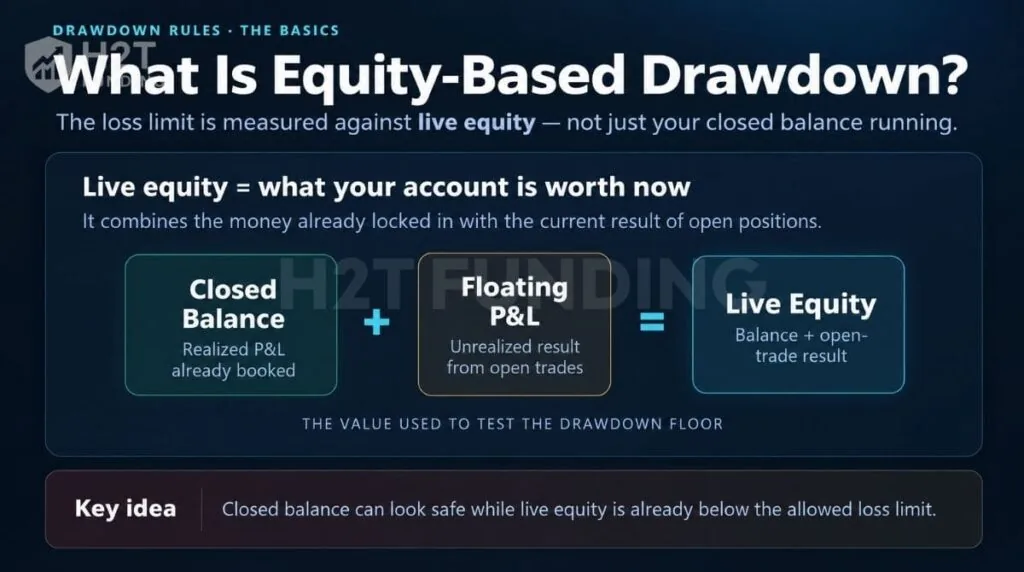
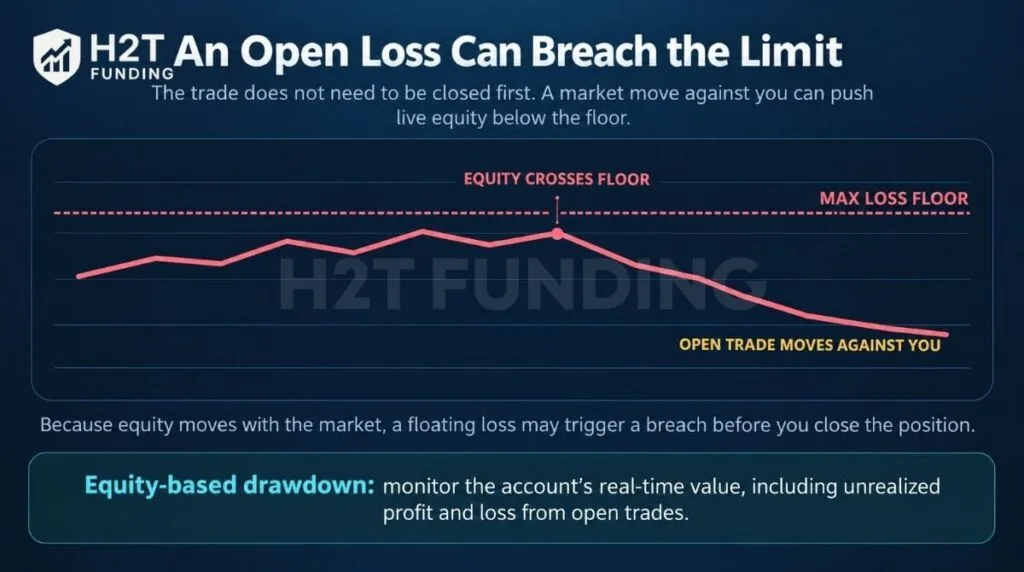
Equity based drawdown is a loss limit measured against live equity, which is your closed balance plus floating (unrealized) P&L from open trades. Equity moves with the market, so an open trade that moves against you can breach the limit before you close it.
How Equity Is Calculated
Equity = Account Balance + Floating Profit/Loss
Floating profit or loss is the unrealized gain or loss on open trades. Depending on the firm and platform, commissions and swaps may also affect equity.
For example, on a $100,000 account:
| Account component | Amount |
|---|---|
| Account balance | $100,000 |
| Floating loss on open trades | −$2,000 |
| Live equity | $98,000 |
Your balance remains $100,000 because you have not closed the losing trade, but your live equity falls to $98,000. The firm monitors this changing value when enforcing an equity based loss limit.
4. What Is Balance Based Drawdown?
Balance based drawdown is a loss limit calculated from your account balance rather than its live equity. The balance typically reflects closed-trade results, while equity also includes unrealized profits and losses from open trades. However, a firm can use balance to set the loss floor and still monitor live equity to enforce it.
4.1. How the Loss Floor Is Calculated
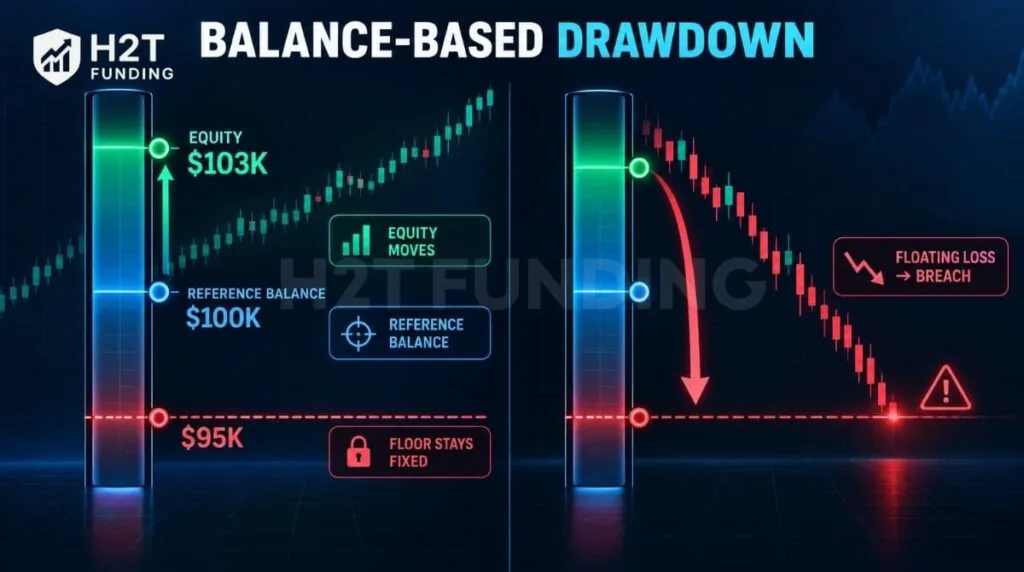
The loss floor is based on a defined balance reference, such as your starting or start-of-day balance. Unrealized profits do not change that balance, so they do not automatically raise the floor.
For example, a $100,000 account with a 5% loss limit has a $95,000 floor if the rule calculates the limit from the $100,000 reference balance.
If an open trade reaches $3,000 in profit, your equity rises to $103,000, but your balance remains $100,000. The floor stays at $95,000 as long as the rule uses the same balance reference.
4.2. Why Floating Losses Can Still Trigger a Breach
A balance based floor does not mean the firm checks the balance to detect a breach. Several firms measure live equity against the floor:
- FTMO states that equity cannot fall below its daily limit at any time.
- Topstep’s Daily Loss Limit uses net P&L that includes unrealized and realized results.
- OneFunded’s help center says unrealized losses on open trades count toward the limit.
The example in the next section shows the timing. A firm that checks the closed balance only would not flag that loss until you close the trade. Confirm which one your firm uses.
5. Equity vs. Balance Drawdown Example ($100K Account)
The same open trade can trigger a drawdown breach at different times depending on how the firm sets the loss floor and monitors losses. This example compares three rule setups using a $100,000 account and a $5,000 loss limit. One trade remains open throughout, and no other transactions occur.
- Hypothetical Peak-Equity Trailing Floor: The floor rises as peak equity increases.
- Balance based floor with live equity monitoring: The floor stays fixed, but unrealized losses count toward the limit.
- Closed-balance monitoring: Only losses reflected in the closed-trade balance count toward the limit.
This is a simplified hypothetical rule, not a standard definition of equity based drawdown. It assumes a fixed $5,000 loss amount trailing peak equity and real-time equity monitoring.
| Time | Open Trade P&L | Account Equity | Hypothetical Peak-Equity Trailing Floor | Balance Based, Live Equity Monitoring | Closed-Balance Monitoring |
|---|---|---|---|---|---|
| 09:00 | $0 | $100,000 | Floor: $95,000. No breach | Floor: $95,000. No breach | Floor: $95,000. No breach |
| 11:00 | +$3,000 | $103,000 | Floor rises to $98,000. No breach | Floor: $95,000. No breach | Floor: $95,000. No breach |
| 14:00 | −$2,500 | $97,500 | Breach: Equity falls below $98,000 | No breach: Equity remains above $95,000 | No breach: No closed loss |
| 15:30 | −$5,500 | $94,500 | Already breached | Breach: Equity falls below $95,000 | No breach while the trade remains open |
The first rule triggers a breach when equity falls below $98,000 because the loss floor rose after the trade reached a $3,000 profit. The second triggers a breach only when equity falls below the fixed $95,000 floor. The third does not count the open loss until the trade closes, assuming the firm monitors the closed balance only.
6. Key Switches in Prop Firm Drawdown Rules
Every drawdown rule has three key features:
- Calculation basis: Balance or equity
- Update timing: End-of-day or intraday
- Floor type: Static or trailing
The calculation basis alone does not define how a drawdown rule works. Update timing determines when the floor changes, while the floor type determines whether it can rise as your account grows.
6.1. End-of-Day vs. Intraday Drawdown Updates
- End-of-day: The floor updates at the end of the trading day or at a specified daily snapshot.
- Intraday: The floor can update during the trading session as the relevant balance or equity changes.
Topstep’s Maximum Loss Limit (MLL) illustrates end-of-day updates. The floor follows the highest end-of-day balance and updates after the trading day closes. However, the account is monitored in real time, so an intraday loss can breach the existing floor before the next update.
6.2. Static vs. Trailing Drawdown Floors
A static floor stays fixed. A trailing floor rises as the reference value reaches new highs and does not fall back. On a $100,000 account, a 10% static max loss keeps the floor at $90,000.
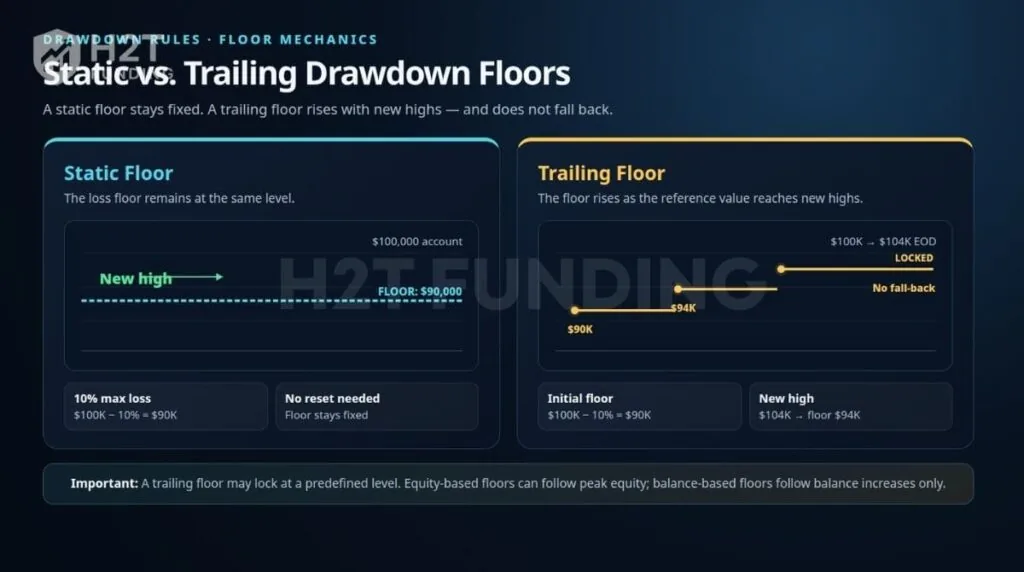
FTMO’s 1-Step Challenge shows a trailing floor. On a $100,000 account, the initial max loss floor is $90,000. If the end-of-day balance reaches $104,000, the floor moves to $94,000. A lower balance the next day does not move it back.
Some trailing floors stop rising at a set level. Topstep’s Maximum Loss Limit locks at $0 on an Express Funded Account, and locks at the starting balance in the Trading Combine.
An equity based trailing floor can rise with peak equity, including floating profit. A balance based trailing floor follows balance increases only.
For a deeper look at how these mechanisms differ, see our guide to static vs. trailing drawdown.
7. Prop Firm Drawdown Rules Comparison (2026)
The table compares drawdown rules across four firms, covering multiple programs and account stages. Each uses its own floor calculation, monitoring method, and update schedule.
| Firm and program | Daily floor | Max loss floor | Value monitored | Timing |
|---|---|---|---|---|
| FTMO 1-Step | Balance at 00:00 CE(S)T minus 3% of initial capital | Highest 00:00 balance (or initial capital, if higher) minus 10% of initial capital. Only rises | Equity: balance plus open P/L, swaps and commissions | Both recalculate daily at 00:00 CE(S)T |
| FTMO 2-Step | Balance at 00:00 CE(S)T minus 5% of initial capital | Initial capital minus 10%. Static | Equity | Daily floor recalculates at 00:00 CE(S)T |
| Topstep Trading Combine and Express Funded | Optional Daily Loss Limit on net P&L: $1,000 / $2,000 / $3,000 for $50K / $100K / $150K | MLL trails the highest end-of-day balance: $2,000 / $3,000 / $4,500. Locks at starting balance (Combine) or $0 (Express Funded) | Real time, realized plus unrealized P&L | MLL updates at the end of the day |
| Funded Trading Plus Instant Funding | 6% of the higher of the prior day’s closed balance or equity (snapshot at 17:00 EST) | 6% trailing from balance high-water mark (minus 6% of initial balance), locks at initial balance | Equity (including floating P&L) must stay above both floors | Equity, including floating P&L, must stay above both floors. | Daily snapshot at 17:00 EST; Max trails balance highs then locks |
| OneFunded Core | 5%; resets at 00:00 UTC. | 10% static drawdown from initial balance. | Equity, including floating P&L, must stay above both limits. | Maximum-loss floor remains fixed. |
Note: The rules above were verified in October 2026 against each firm’s official help center.
To evaluate other factors, explore our our side-by-side prop firm comparison to assess fees, profit splits, and trading rules.
8. Equity Based vs. Balance-Based Drawdown: Which Model Fits Your Trading Style?
The better fit depends on how you manage open positions, tolerate floating losses, and respond to drawdown limits. Use the following comparisons as general guidance, since each firm’s breach-monitoring rules can change how a model affects your trading strategy.
8.1. Balance Based Drawdown Fits:
A balance-based floor may suit traders who need room for floating losses only when the program also monitors closed balance rather than live equity.
- Swing Traders: Traders who hold positions overnight or tolerate larger pullbacks before a trade reaches its target. A balance-based floor may provide more room for floating losses if the firm does not enforce the limit against live equity.
- Traders Using Wide Stop-Losses or Holding Positions Through Pullbacks: Strategies that need room for normal price fluctuations may benefit from a balance-based floor that does not trail intraday. However, floating losses can still trigger a breach if the firm monitors live equity.
8.2. Equity Based Drawdown Fits:
Equity-based limits may be easier to manage for strategies with short holding times, controlled position sizes, and small expected floating drawdowns. They can be restrictive for any strategy whose normal open-trade swings approach the loss floor.
- Day Traders and Scalpers: Traders who close positions quickly and keep floating P&L under control may find it easier to manage equity based limits.
- Traders Who Manage Risk in Real Time: Traders who use tight stop-losses and controlled position sizes can limit floating losses and reduce the risk of breaching the equity-based limit.
9. How to Check a Prop Firm’s Drawdown Rule Before Buying
Before buying a challenge, answer four questions using the firm’s official rules:
- Identify the floor reference: Is it based on closed balance, start-of-day balance, the higher of balance or equity, or peak equity?
- Confirm breach monitoring: Does the firm check closed balance or live equity, including floating P&L?
- Find the update schedule: Does the floor update intraday, at the end of the day, or at a daily snapshot? Check the time zone.
- Check the floor type: Is it static or trailing? If trailing, does it stop rising at a predefined level?
Drawdown is only one factor, so our guide on how to choose a prop firm walks through the rest of the checklist.
10. FAQs
-
They can. Some firms calculate the loss floor from balance but check live equity, including floating losses, against that floor. Check the specific program’s rules rather than assuming that balance-based drawdown excludes unrealized losses.
-
It refers to a prop firm or program that calculates its drawdown floor using a balance reference rather than live equity. The term does not tell you whether floating losses count toward a breach or when the floor updates, so verify both details.
-
It does when the rule trails peak equity. If unrealized profit pushes equity to a new high, the floor may rise and remain higher even if the profit later disappears. Other trailing rules use balance or end-of-day values instead. Topstep’s Maximum Loss Limit, for example, follows the highest end-of-day balance.
-
The answer depends on the specific program and its current rules. As shown in the table above, FTMO’s daily loss floor and Topstep’s Maximum Loss Limit use balance figures as their reference, but both are enforced against real-time equity or P&L. Compare each program’s floor calculation, monitoring method, and update schedule before choosing a firm.
-
That depends on the firm’s trading rules, not just its drawdown model. If overnight trading is allowed, floating P&L may continue to affect equity and your remaining drawdown buffer. Check the firm’s overnight and daily-reset policies before holding a position through the reset.
11. Conclusion
The key difference between equity-based and balance based drawdown is how the loss floor is calculated, but breach monitoring determines whether an open trade can violate that limit.
A balance based floor can still be breached by floating losses, while an equity-based trailing floor may rise after unrealized profits. Before buying a challenge, verify the floor reference, monitoring value, update schedule, and whether the floor is static or trailing.
To learn more about prop firm trading rules, explore our other prop firm guides. You can also read our in-depth prop firm reviews to examine individual firms, or compare the best prop firms to find a program that aligns with your trading strategy.
Disclaimer: This article is for informational and educational purposes only and does not constitute financial or investment advice. Always review a prop firm’s official rules and assess the risks before making trading or purchasing decisions.