



Prop firm payouts are taxed as self-employment income, not capital gains. You must report this money on Schedule C and pay both ordinary income tax and self-employment tax. Prop firms do not withhold taxes from your withdrawals.
Prop firm taxes are the federal and state tax obligations generated when you receive a profit split from a proprietary trading firm. Most prop firms treat traders as independent contractors, so payouts are generally reported as self-employment income on Schedule C. This classification dictates exactly how you must report your earnings and write off your trading expenses.
Note: This guide is for educational purposes and is accurate as of October 2026. This is not tax advice. Consult a Certified Public Accountant (CPA) for your specific tax situation.
Key Takeaways
- Payouts are self-employment income. The IRS taxes profit splits as ordinary business income on Schedule C, not as capital gains.
- Firms do not withhold taxes. You must set aside money to pay both your standard income tax and a 15.3% self-employment tax.
- The federal 1099-NEC threshold is $2,000 for 2026 payments. Firms set their own policies for issuing the form, but you must report all earnings regardless.
- Trading expenses are deductible. You can write off business costs like challenge fees and data feeds to lower your taxable income.
- You must pay quarterly taxes. The IRS requires four estimated tax payments a year if you expect to owe $1,000 or more.
1. Are Prop Firm Payouts Taxable?
Yes, you must report all earnings to the IRS, no matter how often you withdraw or where the funding company operates. Because taxpayers use the cash basis of accounting, a payout becomes taxable the exact moment it arrives in your personal account.
This timing rule means you do not owe taxes on the virtual profits sitting inside your funded account dashboard. During the evaluation phase, you trade simulated capital and generate zero taxable income.
Once funded, every actual withdrawal counts as taxable business income, meaning even your very first $500 payout triggers a tax event. Additionally, using a foreign firm does not exempt you from taxes, because the IRS requires US citizens to report all global income.
2. How Are Prop Firm Payouts Taxed in the US?
The IRS treats your payouts as ordinary self-employment income reported on Schedule C. When contracting with a firm, you act as an independent contractor providing trading services rather than an employee.
The IRS uses behavioral and financial control tests to determine worker status. Because you set your schedule, use your own hardware, and absorb operating costs, your earnings fall under self-employment rules.
Why Capital Gains and Section 1256 Do Not Apply
Your payouts do not qualify for capital gains rates or Section 1256 tax treatment because you do not trade in your personal name or own the underlying assets. You trade simulated capital or firm funds, receiving a performance fee for contracted services.
Section 1256 gives regulated futures contracts a blended rate of 60% long-term and 40% short-term capital gains, but only for accounts held in your own name.
Attempting to file payouts under Form 6781 to claim the 60/40 split creates a severe audit risk. Always consult a licensed CPA before claiming preferential capital rates.
3. How Much Tax Do You Pay on a Prop Firm Payout?
You pay income tax plus self-employment tax on your net profit. Your ordinary income tax depends on your overall tax bracket, filing status, and state residency. Meanwhile, your self-employment tax is a separate calculation based on your business earnings.
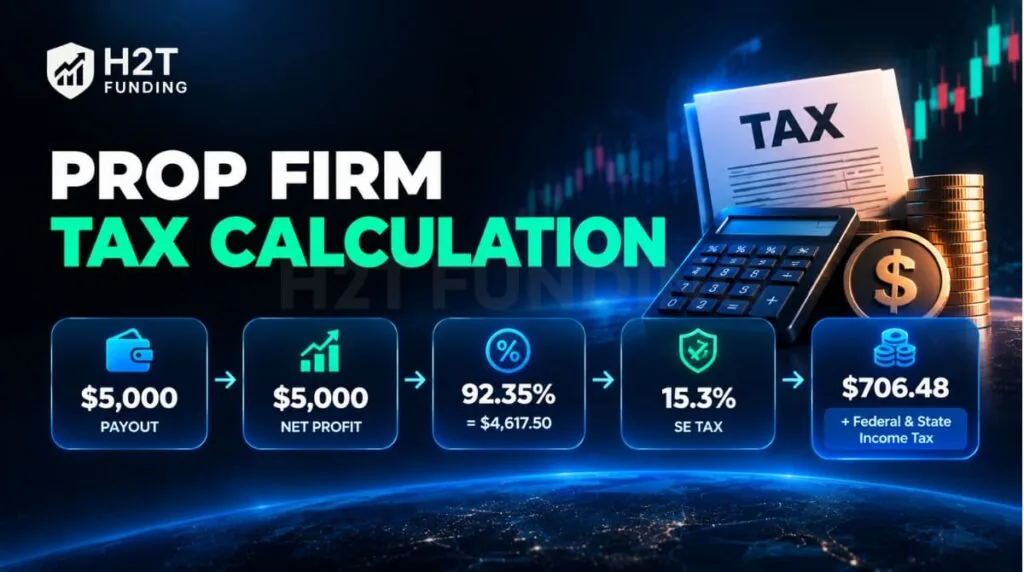
The table below shows the self-employment (SE) portion of your tax liability before any personal income tax factors apply.
| Payout | Expenses | Net Profit | Net × 92.35% | SE Tax (15.3%) | Half SE Tax (Deduction) |
|---|---|---|---|---|---|
| $5,000 | $0 | $5,000 | $4,617.50 | $706.48 | $353.24 |
| $5,000 | $500 | $4,500 | $4,155.75 | $635.83 | $317.92 |
| $10,000 | $0 | $10,000 | $9,235.00 | $1,412.96 | $706.48 |
| $20,000 | $0 | $20,000 | $18,470.00 | $2,825.91 | $1,412.96 |
Note: This table illustrates SE tax calculations based on IRS Schedule SE formulas. Income tax depends on your specific bracket and state laws, so you should always have a CPA review your total tax liability.
How Is Self-Employment Tax Calculated?
The IRS calculates your self-employment tax at a flat rate of 15.3% based on 92.35% of your net business earnings. This 15.3% total consists of two specific parts: 12.4% for Social Security and 2.9% for Medicare.
As of October 2026, the 12.4% Social Security tax only applies to the first $184,500 of your earnings. The 2.9% Medicare tax applies to all of your net business income. If your total income exceeds $200,000 as a single filer, you also owe a 0.9% additional Medicare tax.
To offset this cost, the IRS allows you to claim half of your self-employment tax as a deduction. This rule reduces your adjusted gross income before you calculate your standard federal income tax.
4. Do Prop Firms Send You a 1099?
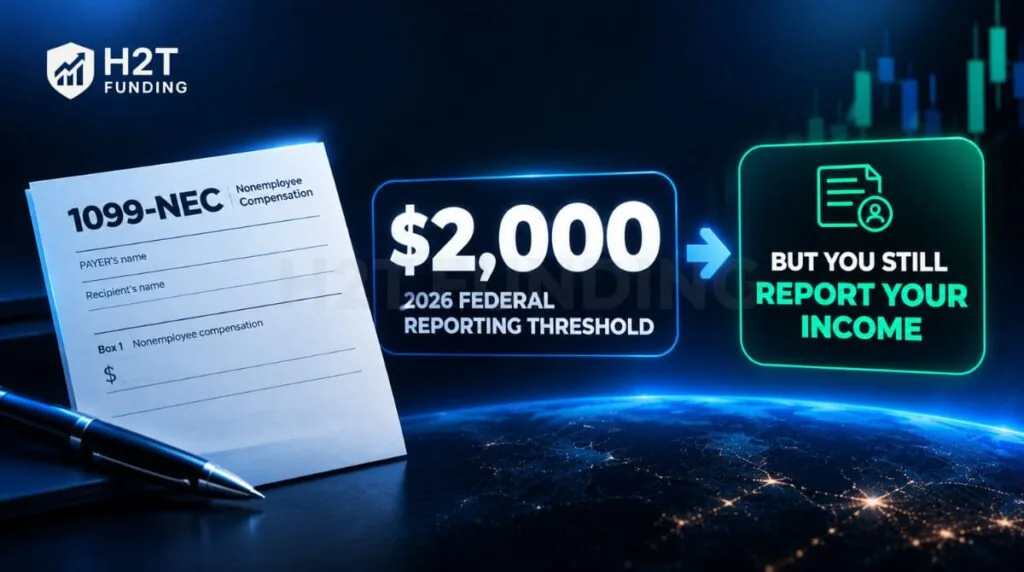
Whether you receive a Form 1099-NEC depends on the firm’s policy and your tax status. The federal reporting threshold is $2,000 for 2026 payments. Several firms, including Topstep and FundedNext, collect a W-9 from US traders and issue a 1099-NEC. You must track your own withdrawal records because your filing obligations exist regardless of whether a company sends you paperwork.
The table below outlines the tax reporting practices of prominent funding companies based on their operating jurisdiction.
| Firm | US traders | Non-US traders | Policy note (per firm) | Source |
|---|---|---|---|---|
| Apex Trader Funding | Form 1099-NEC for US taxpayers who received payouts | No 1099; report income under local law | Apex uses a third-party service (TaxBandits) to issue and store 1099 forms. | Apex Help Center: “1099 Forms and Tax Information” |
| Topstep | W-9, then 1099-NEC for US citizens with $600+ in 2025 payouts (Note: Threshold increases to $2,000 for 2026 payments) | W-8BEN; no form from Topstep | The 1099 shows the gross payout before processing fees. | Topstep Help Center: “Funded Trader Tax Questions” |
| Tradeify | 1099 forms for payout income | Not stated | Issued by Rise, the payout processor, not by Tradeify | Tradeify Help Center: “Common FAQs” |
| FTMO | W-9 required before the first payout for US-based clients | Not stated | FTMO says traders are solely responsible for their own taxes. It does not state whether it issues a 1099. | FTMO FAQ: “How do I withdraw my payout from a Sim-Funded Account?” |
| FundedNext | W-9, then 1099-NEC if total withdrawals exceed $600 (Note: Federal threshold is $2,000 for 2026 calendar year) | No tax forms | Delivered by Jan 31 via email and the dashboard “Tax Documents”. | FundedNext Help Center: “Tax & Compliance (US Traders)” |
Note: The federal 1099-NEC reporting threshold has officially increased from $600 to $2,000 starting with the 2026 tax year. While individual prop firm help centers may still legacy-reference the historical $600 limit for older 2025 payouts, all entities are required to follow the updated $2,000 IRS rules for payments distributed throughout 2026.
4.1. What Changed With the $600 Rule in 2026?
Starting January 1, 2026, the federal reporting threshold for Form 1099-NEC increased from $600 to $2,000 for independent contractor payments. US prop firms only submit a 1099 copy to the IRS when your total withdrawals hit or exceed $2,000 during the 2026 tax year. For your 2025 tax year filings, the old $600 rule still applies.
Additionally, the IRS plans to adjust the $2,000 limit for inflation starting in 2027. You must also remember that some individual states may still keep their local reporting thresholds at $600.
This higher threshold changes only the reporting duty of the company, not your duty as a taxpayer. The IRS requires you to report all self-employment earnings once your net business profit reaches $400. Not receiving an official form never excuses you from paying taxes on the money you earned.
4.2. What if the Firm Is Outside the US?
If you contract with a foreign company, you must still self-report and pay taxes on all payouts received. The IRS taxes US citizens and resident aliens on their worldwide income. This rule means foreign earnings face the exact same tax rates as domestic income.
During account setup, some firms ask US traders to submit Form W-9 to certify their taxpayer identification number and US tax status. FTMO, for example, requires US-based clients to submit a W-9 before the first payout. Traders who live outside the US and receive payouts from a US-based payer may submit Form W-8BEN to certify foreign status. Topstep collects this form from non-US citizens living outside the US.
Even if a foreign firm provides no annual tax paperwork, you must pull your personal withdrawal records and declare the total on Schedule C.
5. Which Prop Firm Expenses Can You Deduct?
You can deduct ordinary and necessary business expenses to lower your taxable net profit on Schedule C. Under IRS Publication 334, you can deduct expenses that are ordinary and necessary for your trading business.
To reduce your tax liability, you can apply the following deductions:
- Deduct upfront evaluation and challenge fees paid to enter a funded program.
- Write off account reset and extension fees required to restart a breached evaluation.
- Track monthly subscriptions for trading platforms, charting software, and specialized indicators.
- Claim exchange and real-time market data feed fees necessary to place trades.
- Log Virtual Private Server (VPS) hosting fees used to maintain continuous platform connectivity.
- Calculate home office expenses if you maintain a dedicated, exclusive workspace for your trading activity.
- Include tax preparation fees paid to an accountant or tax professional who manages your business filings.
- Deduct payout processing fees charged by the firm or its payment provider.

Payout processing fees are deductible, but they affect how you read your Form 1099-NEC. Topstep, for example, reports your gross payout before any processing fee. If you request a $500 payout and a $30 fee applies, you receive $470, but your 1099-NEC shows $500.
Report the full $500 as income, then deduct the $30 fee as a business expense on Schedule C. Your net taxable income from that payout is $470. Check your firm’s Help Center to see whether it reports payouts before or after fees.
Are Failed Challenge Fees Deductible?
Yes, failed challenge fees are generally deductible as ordinary business expenses. The IRS recognizes that testing and failing evaluations are standard costs of attempting to secure contracts as a trader.
However, you must satisfy specific tax conditions to claim these deductions. You must operate an active business with an ongoing profit motive rather than trading casually as an occasional hobby.
Additionally, you cannot claim a tax deduction for any evaluation fee that a prop firm refunds to you. Many firms return your initial fee alongside your first funded withdrawal. Once refunded, that fee no longer qualifies as an out-of-pocket business expense. Because deducting unrecovered assessment fees requires proper trade documentation, always verify your write-offs with a licensed CPA.
6. How and When Do You Pay Estimated Taxes?
You must submit your estimated taxes four times a year using Form 1040-ES or an online IRS payment portal. Prop firms do not withhold any taxes from your profit splits. Because no employer deducts taxes from your payouts, the IRS requires you to send these payments yourself if you expect to owe at least $1,000 for the year.
The IRS sets four specific deadlines for these quarterly payments: April 15, June 15, September 15, and January 15 of the following year. If you miss a deadline or send an insufficient amount, the IRS will charge you underpayment penalties and interest.
To avoid these penalties, you can rely on the IRS safe harbor rule. This rule protects you if your total estimated payments equal at least 90% of your current year’s tax liability, or 100% of your previous year’s taxes. If your prior-year adjusted gross income (AGI) exceeded $150,000, that prior-year requirement increases to 110%.
7. How Do You File Prop Firm Taxes? (Step by Step)
You file your annual return by reporting your net trading profits as business income on Schedule C and attaching it to Form 1040. Because funding companies classify you as an independent contractor, you must organize your records, deduct allowable expenses, and compute both income and self-employment taxes.
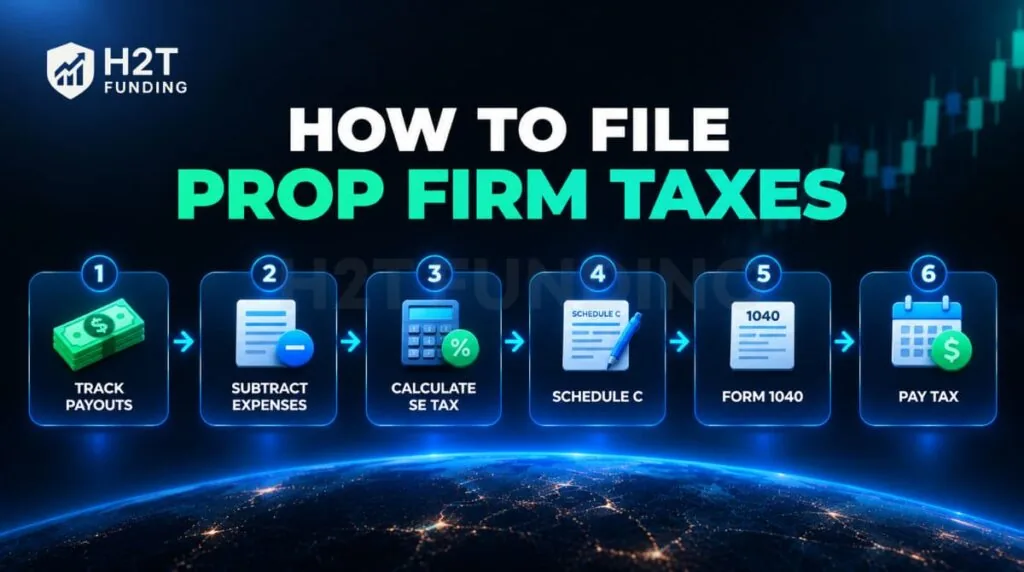
Follow these six steps to file your annual return correctly:
- Log every gross payout received across all your funded accounts during the calendar year using bank statements and payment processor records.
- Subtract your ordinary and necessary business expenses, including evaluation fees, data feeds, and charting software, to establish your net profit.
- Calculate your self-employment tax obligation on 92.35% of your net business profit using Schedule SE, and determine your deductible half.
- Report your gross revenue and business expenses on Schedule C, transferring the final profit and tax figures onto your Form 1040.
- Pay your remaining tax balance through IRS Direct Pay or EFTPS by April 15, applying credit for any quarterly estimated taxes already paid.
- Save all evaluation receipts, monthly platform invoices, payout confirmations, and filed tax returns for at least three to seven years to protect against an audit.
8. Do You Need an LLC or S-Corp for Prop Trading?
No, you do not strictly need a formal business entity to trade. Operating as a sole proprietor under your own name is perfectly legal and standard for most beginners.
However, forming an LLC and electing S-Corp status can offer tax benefits for high earners. This structure might help reduce your self-employment tax burden by dividing your profits into a reasonable salary and owner distributions. Because entity creation involves strict payroll rules and state fees, you should always consult a licensed CPA to determine if the tax savings outweigh the maintenance costs.
9. How Are Prop Firm Payouts Taxed Outside the US?
Tax policies vary depending on your country of residence. While the US treats this money as self-employment income, other tax authorities have their own specific classifications, tax allowances, and reporting thresholds.
The table below summarizes the official tax authorities and key considerations for funded traders across major global jurisdictions.
| Country | Tax Authority | Key Tax Consideration | Official Source |
|---|---|---|---|
| United States | IRS | Schedule C income and self-employment tax | irs.gov |
| United Kingdom | HMRC | Self Assessment, £1,000 trading allowance, Class 4 NIC, and MTD | gov.uk |
| Canada | CRA | Business income classification and provincial taxes | canada.ca |
| Australia | ATO | Assessment of active business versus hobby trading | ato.gov.au |
| European Union | Local Authorities | Localized business income rules | Varies by country |
| India | Income Tax Dept | Advance tax requirements and potential GST | incometax.gov.in |
Note: Because international tax codes are highly complex, we may cover these specific regions in separate, dedicated guides. Always consult a local tax professional to ensure full compliance with your jurisdiction’s laws.
10. What Are the Most Common Prop Firm Tax Mistakes?
The most common tax mistakes involve misclassifying your income and missing IRS payment deadlines. Tax errors can lead to expensive IRS penalties or an audit.
You should avoid these six mistakes when managing your funded account earnings:
- Claiming capital gains: Traders often report their profit splits as capital gains instead of ordinary self-employment income.
- Ignoring undocumented payouts: Many traders fail to report their withdrawals if a funding company does not send a Form 1099-NEC.
- Skipping quarterly payments: Beginners frequently forget to pay their estimated taxes four times a year, which triggers heavy underpayment penalties.
- Mixing finances: Using a single personal checking account for both daily living costs and trading subscriptions makes it difficult to track and prove deductions.
- Missing write-offs: Traders often forget to deduct allowable business expenses like upfront challenge fees, data feeds, and charting platforms.
- Misapplying Section 1256: Futures traders sometimes claim the 60/40 tax split on their payouts, creating a high audit risk because they do not own the underlying contracts.
11. How to Choose a Prop Firm With Tax Paperwork in Mind
You should choose a funding company based on its reporting policies, withdrawal terms, and payment rails. A firm with organized accounting procedures simplifies your quarterly tracking and annual filing.
When evaluating funding providers, apply these four criteria:
- Confirm tax form delivery: Check whether the firm operates in the US and issues Form 1099-NEC, or operates abroad with no formal paperwork.
- Assess payout frequency: Evaluate withdrawal windows and consistency rules. Weekly or on-demand payouts require disciplined cash management to reserve funds for quarterly estimated taxes. Payout timing differs by firm, and our guides to FTMO payout rules and Topstep payout rules show how first-payout timing and request conditions compare.
- Examine payment methods: Verify whether the firm pays through bank transfer, Deel, or cryptocurrency. Crypto withdrawals introduce extra record-keeping because converting tokens to fiat creates a separate capital gain or loss.
- Verify international support: Check whether the firm collects Form W-8BEN from non-US traders and explains how it handles withholding for them.
To find compliant companies with proven payout track records, explore our curated list of the best prop firms. You can also verify the exact payout terms and tax paperwork of specific firms in our detailed breakdowns.
12. FAQs
-
Yes. You must pay federal income tax and self-employment tax on every funded payout you receive. The IRS classifies prop firm earnings as ordinary business income earned through independent contractor services, not capital gains.
-
The $600 rule was the previous IRS reporting threshold requiring US businesses to issue Form 1099-NEC to contractors. Starting January 1, 2026, the federal threshold increased to $2,000. Even if you earn less than $2,000 and receive no form, you must still report all net profits of $400 or more.
-
Some prop firms issue Form 1099-NEC to US traders, but policies differ by firm. Topstep and FundedNext collect a W-9 from US traders and issue a 1099-NEC, while Apex, Topstep, and FundedNext issue no form to non-US traders.
The federal reporting threshold is $2,000 for 2026 payments, although some firm Help Center pages still cite $600 (the 2025 threshold). If you receive no form, you must still report all payouts using your bank or payment processor records. Check your firm’s Help Center for its current policy.
-
Yes, you can deduct legitimate prop firm fees as ordinary business expenses on Schedule C. Deductible items include evaluation costs, account reset fees, charting software, data feeds, and dedicated home office space. However, you cannot deduct any evaluation fee that a firm later refunds to you.
-
On a $5,000 payout with zero business expenses, you owe approximately $706.48 in self-employment tax (15.3% calculated on 92.35% of net profit). You also owe ordinary federal and state income tax based on your personal tax bracket. Claiming eligible deductions lowers both your net profit and final tax liability.
-
You reduce your taxes by tracking all allowable business write-offs (such as challenge fees, data feeds, and VPS hosting) and claiming the standard 50% deduction on your self-employment tax. Higher earners may also consult a CPA about establishing an LLC taxed as an S-Corp to reduce self-employment tax on distributions.
-
Prop trading is not illegal in itself, as firms use corporate or simulated capital rather than public funds. Therefore, they do not fall under standard retail broker licensing rules. According to the Commodity Futures Trading Commission (CFTC) and National Futures Association (NFA) frameworks, compliance depends on how individual firms structured their programs. Traders can verify a firm’s registration status or regulatory background directly through the official NFA BASIC System.
13. Conclusion
Managing prop firm taxes requires strict financial discipline. As an independent contractor, you must report all payouts as self-employment income on Schedule C and submit quarterly estimated taxes. Funding companies will not withhold this money for you.
To maximize your net profit, always track your deductible business expenses, including upfront evaluation fees and data subscriptions.
At H2T Funding, we deliver the objective data you need to build a compliant trading career. Explore our Prop Firm Guides section for deeper insights into payout policies and industry rules.
Tax Disclaimer: The information contained in this guide is provided for educational and informational purposes only and does not constitute formal legal, accounting, or tax advice. Tax regulations, filing thresholds, and reporting requirements vary by jurisdiction and individual financial circumstances. Always consult a qualified Certified Public Accountant (CPA) or Enrolled Agent (EA) before making tax-related decisions or filing your annual returns.