

Navigating prop firm payout delays and disputes requires immediate and precise action. This guide breaks down expected payout timelines across different payment methods and explains the specific rule violations that trigger a denial.
You will learn how to spot the red flags of a firm at risk of failing and execute a step-by-step evidence plan to secure your funds. If support ignores your request, we provide a complete escalation ladder, from strict chargeback deadlines to external regulatory options.
Key Takeaways
- Identify the exact status: A delay means your payout missed the official processing window, while a denial is a formal rejection. You must verify your exact situation before taking action.
- Count business days only: Payout time has two parts: the firm’s internal review and the payment network’s clearing time. You must calculate these timelines using business days, excluding weekends and bank holidays.
- Separate errors from violations: KYC mismatches or payment bottlenecks typically cause temporary delays, whereas consistency rule breaches or prohibited strategies result in permanent denials.
- Demand written evidence: Never initiate a formal dispute without first collecting your trade logs, saving the active rule policy, and requesting a written explanation from support.
- Act within strict deadlines: External dispute escalation requires immediate action. US credit card chargebacks, for example, operate under a strict 60-day legal window (FCBA).
Note: This guide was fact-checked and updated in October 2026. All platform limits, subscription pricing, and proprietary trading firm integrations reflect the most current TradingView policies.
1. Payout delay, payout denial, and payout dispute: what is the difference?
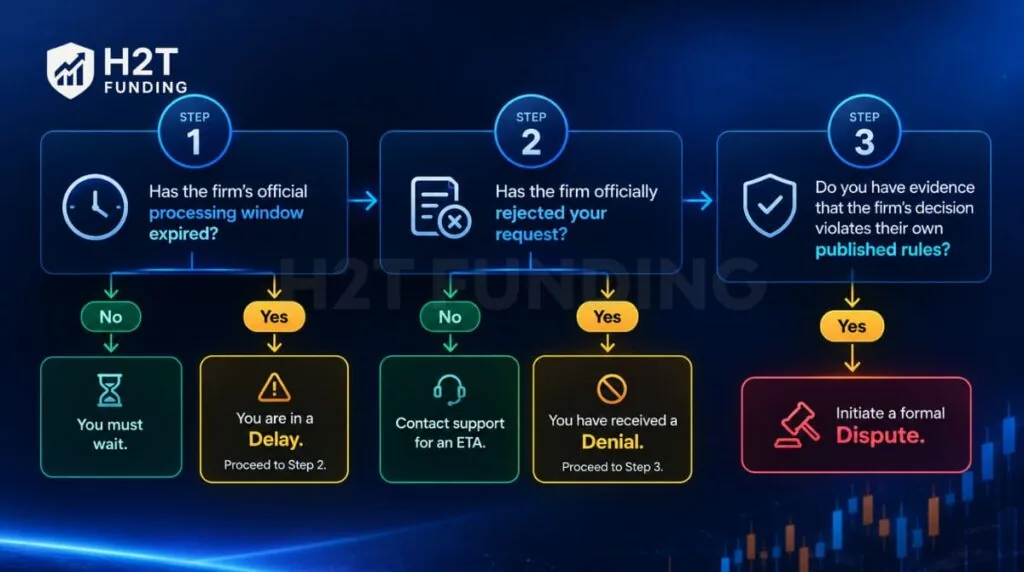
Traders frequently confuse administrative processing delays with permanent account rejections. You must identify your exact status using the framework below before taking any action, as escalating a simple delay into a formal dispute can permanently damage your relationship with the firm.
| Status | What It Means | First Action to Take |
|---|---|---|
| Payout Delay | The firm has not processed your request within their officially stated timeframe, or the payment network (e.g., ACH, Wire) is lagging. | Verify the firm’s exact business-day count and check for payment network bottlenecks. |
| Payout Denial | The firm has officially rejected your withdrawal request, usually citing a specific policy violation (e.g., consistency rule, prohibited strategy). | Demand a detailed, written explanation citing the exact rule broken and the specific trades involved. |
| Payout Dispute | You formally contest a denial or an unresolved delay by escalating the issue internally or externally. | Compile your trade logs, save the policy version active on your trade dates, and prepare your evidence kit. |
| Account Termination | The firm permanently closes your account. This is a separate action that often accompanies a severe denial. | Prepare your trade logs and policy screenshots for an appeal. |
| Payout Reduction | The firm deducts illegal profits but processes the remainder. | Check if the deduction matches the restricted news windows. |
When does a delay stop being normal?
Do not rely on community forums to calculate your personal payout ETA, as individual timelines vary strictly by payment method. A delay stops being normal only when it explicitly exceeds the firm’s official approval window plus the payment provider’s standard clearing time. (You should only monitor forums to identify systemic company-wide failures after your personal deadline expires).
You must calculate these timelines based on specific firm policies and payment rails, not generic industry assumptions. Because internal approvals and network clearing times are separate steps, a seemingly long wait can still be perfectly normal.
For example, if you request a payout via ACH on a Friday, the firm might take their maximum 3 business days (until Wednesday) to approve it internally. The ACH network may then take until the following Monday to clear. In this scenario, a 10-calendar-day wait is entirely normal because weekends are excluded. It only becomes an official delay on day 11.
Conversely, if you use an international Bank Wire (SWIFT), a 15-calendar-day wait can still fall within standard policy limits.
2. How long should a prop firm payout take?
A complete payout cycle consists of two distinct phases: the firm’s internal compliance review and the payment network’s clearing time. You must combine both to calculate your actual waiting period.
To provide an accurate baseline, the table below outlines the official internal review timelines and supported payment networks across top-rated prop firms.
Prop Firm Internal Payout Timelines (2026)
| Firm | Internal Review Time | Supported Payment Methods | Official Source |
|---|---|---|---|
| FundedNext | Within 24 hours | Crypto, PerfectMoney, Bank Transfer | FundedNext Help Center |
| FTMO | 1 to 2 business days | Crypto, Bank Wire, Skrill | FTMO Payout FAQ |
| Topstep | Real-time (or 1-3 business days) | ACH, Wire, Swift, Aeropay | Topstep Payout Policy |
| Apex Trader Funding | Up to weekly (After 5 qualifying days) | Bank Wire, ACH, Crypto | Apex EOD Payouts |
Note: The 1-3 day internal review reflects Topstep’s official policy. Crypto timelines reflect general industry standards, as Topstep does not currently support crypto payouts. Prop firms frequently update these policies without public announcements. Always verify current timelines directly at the firm’s official Help Center.
2.1. Business days vs calendar days
Traders frequently panic because they count calendar days instead of business days. Prop firm compliance teams and traditional banking networks do not operate on weekends or national bank holidays.
A business day is strictly Monday through Friday. If you submit a withdrawal request late on a Friday afternoon, the processing clock does not start until Monday morning. Furthermore, if Monday is a US federal holiday, the first actual processing day becomes Tuesday. Always exclude Saturdays, Sundays, and major holidays when tracking your payout ETA.
2.2. First payout vs later payouts
For many firms, your first withdrawal request may take longer than subsequent payouts. During the first payout, the firm’s compliance team conducts a rigorous manual audit of your entire account history, covering both the evaluation and live funded stages.
They must also verify your initial KYC documents, check for IP address discrepancies, and establish a secure connection with your chosen payment gateway. Once you clear this initial hurdle, subsequent payouts process faster at some firms, assuming you do not change your payment method or trigger a new automated risk flag.
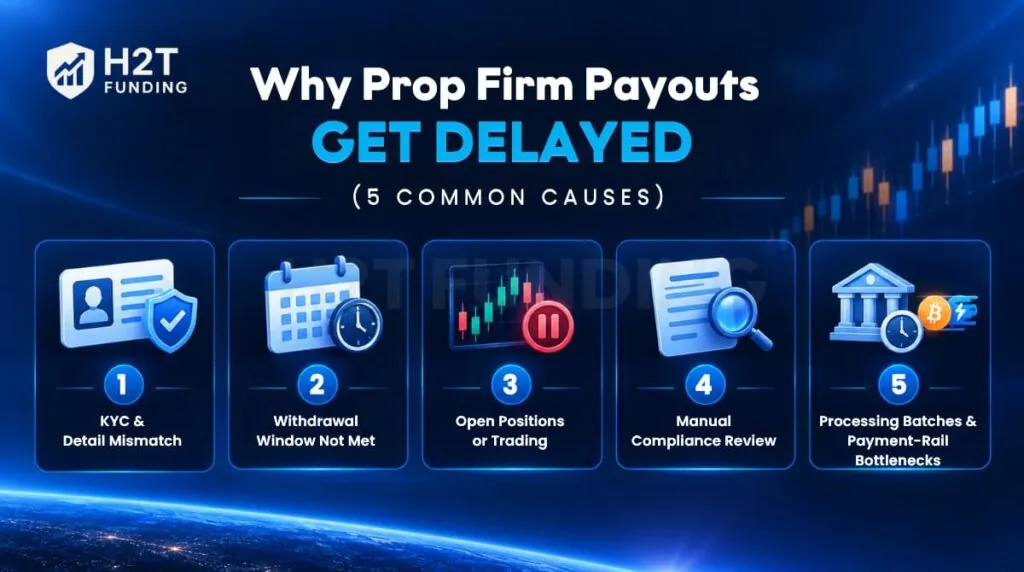
3. Why prop firm payouts get delayed (5 common causes)
Most payout delays stem from administrative friction rather than malicious intent. Understanding these five operational bottlenecks can help you secure your funds on time.
3.1. KYC and payment-detail mismatch
This delay happens when the personal information registered on your funded account does not perfectly match your submitted identification or banking details.
- How to identify: You will receive an email from the firm’s compliance team or their third-party payment processor (like Deel or Plane) requesting additional verification documents.
- How to avoid: Register your prop firm account using your exact legal name as it appears on your government-issued ID. Ensure your payout bank account is entirely in your own name, as firms strictly prohibit third-party withdrawals.
3.2. Payout window or waiting period not met
A waiting period delay occurs when you request a withdrawal before completing the firm’s mandatory minimum trading days or the required time elapsed since your last payout.
- How to identify: The withdrawal button in your dashboard remains grayed out, or an automated system message instantly rejects your request.
- How to avoid: Track your firm’s specific eligibility rules meticulously, such as completing Topstep’s requirement of 5 winning days of $150+ net P&L before clicking the request button.
3.3. Open positions or trading while the request is pending
Trading while a payout is pending forces some firms (such as Topstep) to halt the withdrawal process because your account balance is actively fluctuating.
- How to identify: Your payout status may remain “pending”, or the firm may cancel the request entirely if a losing trade drops your balance below the requested withdrawal amount (as outlined in the Topstep Payout Policy).
- How to avoid: Flatten all positions before requesting a payout and pause trading completely until the funds are fully deducted from your account.
3.4. Manual compliance review of account history
Firms periodically freeze payouts to conduct deep manual audits of your trading logs to ensure you did not violate consistency rules or use prohibited strategies.
- How to identify: The firm exceeds their standard 1-to-3 business day approval window without asking for KYC updates, and customer support states your account is under a “routine review.”
- How to avoid: Trade cleanly without exploiting toxic strategies (like latency arbitrage or tick scalping). Maintain a steady lot size to avoid triggering automated risk flags that mandate manual human inspections.
3.5. Processing batches and payment-rail bottlenecks
This external delay occurs when a firm only batches payouts on specific days of the week, or the banking network itself experiences high traffic and processing lags.
- How to identify: The firm officially marks your payout as “approved” or “processed” in the dashboard, but the funds have not yet appeared in your actual bank account or crypto wallet.
- How to avoid: Choose faster payment rails like Real-Time Payments (RTP) or crypto if available. Submit your withdrawal requests early in the week (Monday or Tuesday) to ensure the funds clear before weekend banking closures.
4. Why prop firm payouts get denied or reduced (6 rule categories)
Before reviewing the specific violations, note the difference in compliance actions: the firm may reject the request, reduce it, or close the account, depending on the violation and the firm’s rules. Firms trigger these actions based on the following six categories discovered during their manual audit.
Common Payout Violations and Typical Outcomes
| Violation Category | Typical Outcome | Official Source (Verify Here) |
|---|---|---|
| Historical breach | Denial and account termination | Tradeify Payout Denials |
| Consistency rules | Denial (allows continued trading to rebalance) | Topstep Payout Policy |
| News-trading | Payout reduction (profits deducted) | FundedNext Rules |
| Copy trading / sharing | Denial and account termination | FTMO FAQ |
| Prohibited strategies | Denial and account termination | Apex Policies |
| KYC / Identity failure | Denial and account termination (for VPN or ID fraud) | FundingPips Security |
Note: Outcomes vary strictly by firm and account stage. Always verify your specific program’s Terms of Service.
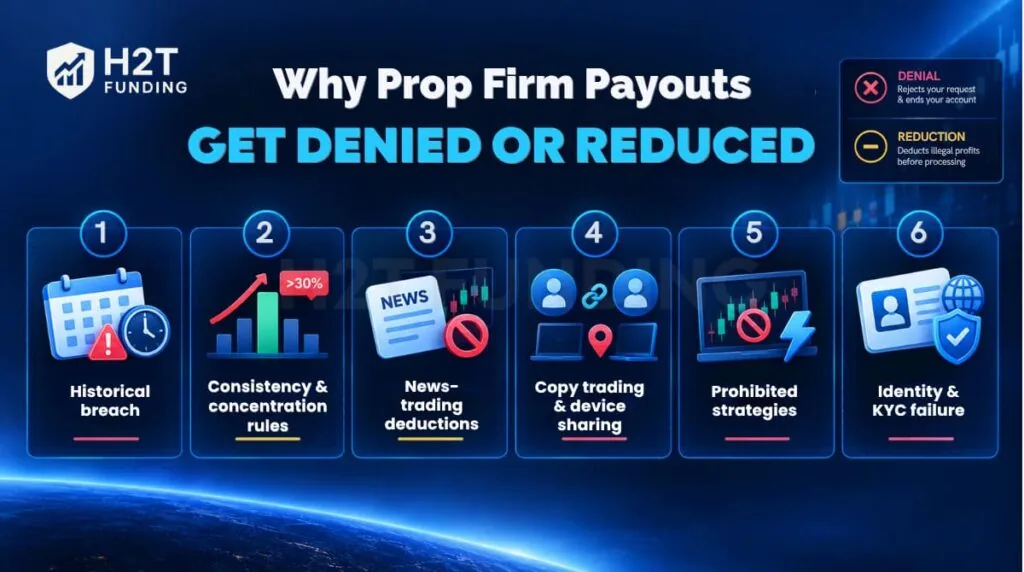
4.1. Historical breach
A historical breach happens when a firm discovers a rule violation that occurred days or weeks prior, which their automated system failed to catch in real-time. Even if you continued trading and generated profits after the incident, the firm will deny the payout and terminate the account based on that delayed discovery of your past violation.
4.2. Consistency and concentration rules
Firms enforce consistency rules to ensure your profits come from repeatable strategies rather than gambling. If a single trade or one specific trading day accounts for a massive percentage of your total profit (often flagged if it exceeds 30% to 40%), the firm will deny the payout. You must usually continue trading to dilute that massive gain and balance your consistency metrics before requesting again.
4.3. News-trading deductions
Many evaluation programs prohibit executing trades minutes before and after high-impact macroeconomic data releases (like CPI or NFP). If the audit reveals you opened or closed a position within this restricted window, the firm will generally reduce your payout by deducting the exact profits generated from that specific news trade.
4.4. Copy trading and device sharing
You must be the sole individual executing your trades. While some firms permit local trade copiers across your own personal accounts, copying third-party signals or mirroring other users is strictly prohibited. If compliance detects overlapping IP addresses or identical execution patterns across distinct users, they will issue an immediate payout denial and a permanent ban for unauthorized account management.
4.5. Prohibited strategies
During the payout audit, firms scan your logs for toxic trading behaviors that exploit the simulated demo environment rather than reflecting live market conditions. If the system detects latency arbitrage, tick scalping, or high-frequency grid trading, the firm will categorize it as a prohibited strategy and deny the withdrawal.
4.6. Identity and KYC failure
A payout will fail if the trader cannot pass the final identity and geographic verification. This denial frequently occurs if a trader uses a VPN or proxy server to hide their true location during the evaluation phase, or if the name on the requested bank account does not perfectly match the verified ID on file.
5. Normal delay or red flag? 6 signals to check
Distinguishing between a temporary banking bottleneck and a firm on the verge of insolvency is critical. If your payout is delayed, evaluate the firm’s behavior against these six systemic red flags.
- Endless KYC loops: The firm repeatedly asks for new, obscure verification documents. You submit a passport, they demand a utility bill, then a live selfie; these repeated new document requests can restart the review clock.
- Vague “risk review” clauses: Support freezes your account for an indefinite “internal risk review” without citing a specific rule violation or providing a legal deadline for the investigation to conclude.
- Retroactive rule changes: The firm denies your payout based on a new trading restriction that was added to their Terms of Service after you executed the profitable trade.
- No public processing timeline: The firm refuses to publish a concrete, maximum business-day processing window anywhere on their official Help Center, giving them the loophole to delay funds indefinitely.
- Silent customer support: The firm suddenly stops responding to your emails, instantly closes your support tickets without resolution, or disables live chat access exclusively for your account.
- No verifiable payout track record: The firm cannot produce independent proof of recent successful payouts, such as verified on-chain crypto transactions or third-party authenticated payment certificates.
Do other traders report the same delay?
You must distinguish between an isolated administrative error and a company-wide liquidity crisis. Based on community reports from forums like Reddit (r/Daytrading) and ForexFactory, a sudden cluster of delayed payouts reported by several traders may signal a severe problem.
A single trader experiencing a wire delay is normal. However, multiple traders on Reddit simultaneously reporting missed payment batches is a severe red flag indicating a potential financial deficit, not a mere technical glitch.
6. What to do when your payout is delayed: step-by-step
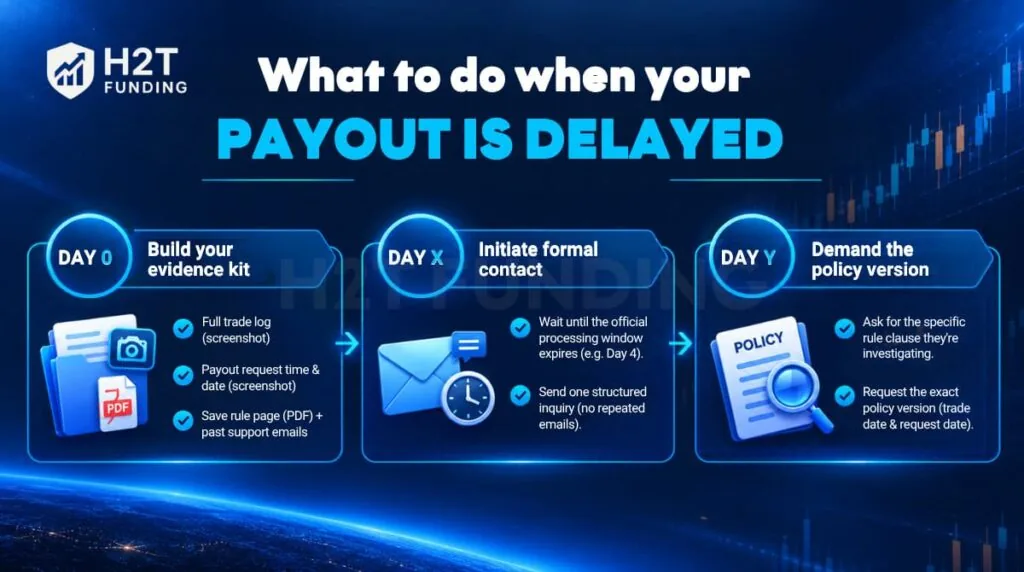
When a payout delay occurs, panic is your worst enemy. Do not flood the firm with angry emails. Instead, you must systematically build an evidence kit and follow a strict timeline to protect your claim against retroactive rule changes.
- Day 0 (The Request Day): Build your evidence kit. Before you click the withdrawal button, take screenshots of your full trade log and capture the exact date and time of your payout request. Save an offline PDF of the firm’s active rule page to prove the exact conditions in place when you traded. Finally, screenshot any prior email support conversations to prove the firm previously validated your account status.
- Day X (Post-Timeline Milestone): Initiate formal contact. Do not contact support while your request is still within the official processing window. If the firm explicitly states a 3-business-day approval time, wait until Day 4. Once the window officially expires, submit a single, highly structured inquiry.
- Day Y (Post-Unresponsive Milestone): Demand the policy version. If support ignores your initial email for another 3 business days, or provides a vague “risk review” excuse, you must escalate your demand. You must explicitly request the specific rule clause they are investigating and demand they cite the exact policy version that was active on both your trade date and request date.
What to send to support (template)
When you contact support, eliminate all emotion. Use this exact 5-line template to force the compliance team into providing a concrete, documented answer:
Subject: Payout Status Inquiry – Account #[Your Account Number]
- My payout request submitted on [Date] has now exceeded your official [Number]-business-day processing window.
- Please provide the exact status of this transfer and a concrete estimated clearing time.
- If my account is under a compliance review, I require the specific rule clause causing this delay.
- I also request confirmation of the exact policy version applied on both my trade dates and my request date.
- I have attached my full trade logs and payout request confirmation for your immediate review.
7. How to escalate a payout dispute: 6 steps in order
If a prop firm arbitrarily denies your payout and ignores your evidence, you must escalate the dispute. Follow this strict six-step ladder. Do not jump straight to a chargeback without exhausting internal options first, as banks require proof that you attempted to resolve the issue with the merchant directly.
Disclaimer: The following escalation steps are for educational purposes only and do not constitute financial or legal advice. Dispute resolution success depends entirely on your jurisdiction, payment method, and the firm’s specific terms of service.
| Step | When to Use | Deadline | Limitation |
|---|---|---|---|
| 1. Request Written Reason | Upon receiving an official payout denial. | Immediately | Support may ignore you or provide automated, vague responses. |
| 2. Internal Escalation | Support refuses to cite specific rule clauses. | As soon as possible after the denial | Relies entirely on the firm’s internal goodwill and compliance team. |
| 3. Card Issuer Chargeback | Firm violates their own rules and keeps your funds. | 60 days (FCBA) to 120 days (Network) | Only recovers the initial evaluation fee, not your generated trading profits. |
| 4. Crypto Recourse Assessment | You purchased the evaluation using cryptocurrency. | N/A | Blockchain transfers are immutable; traditional chargebacks do not exist. |
| 5. External Dispute Resolution | Firm ignores chargebacks or uses crypto. | Varies by organization | The firm must be a voluntary member of a body like the Financial Commission. |
| 6. Regulatory Reporting | You suspect systemic, company-wide fraud. | No strict deadline | Regulators (like the CFTC) penalize companies but rarely recover individual funds. |
7.1. Chargeback: What the deadlines actually are
Community forums falsely claim you have 24 to 48 hours to file a chargeback. Under the Fair Credit Billing Act (FCBA), you have exactly 60 days from your credit card statement date to dispute a charge in writing. Major card networks may also set their own internal operating windows.
Contact your issuer, describe the situation accurately, and ask which dispute codes apply. Provide your evidence kit. Be aware: a successful chargeback only refunds your challenge fee, not unverified profits, and success is never guaranteed. We strongly recommend consulting a legal professional before initiating a dispute.
7.2. Paying with crypto: what changes
If you paid your initial evaluation fee using cryptocurrency (like USDT, USDC, or Bitcoin), you completely forfeit the robust consumer protections provided by traditional banking regulations like the FCBA or Regulation E.
Blockchain transactions are immutable. No central authority can reverse a confirmed crypto transfer. If a firm denies your payout, you cannot chargeback a crypto deposit. Your only recourse is external dispute resolution or government regulators.
8. What the industry is doing about payout disputes
The proprietary trading space faces a severe credibility crisis. Disputes can come from unclear policies or rule violations. In response, the industry is moving toward self-regulation.
In July 2026, the Financial Commission launched a dedicated Prop Firm Certification. This initiative introduces a voluntary framework for prop firms to demonstrate alignment with established global standards of conduct. Under this program, certified firms demonstrate a commitment to:
- Clear, plain-language trading rules and evaluation criteria.
- Fair and consistent enforcement of firm policies.
- Transparent payout terms and dispute escalation pathways.
- Responsible risk management and sustainable business practices.
This push for standardization heavily draws from the regulatory fallout of MyForexFunds. In 2023, the CFTC filed a high-profile fraud complaint against the firm. However, in May 2025, a U.S. judge dismissed the case with prejudice and sanctioned the CFTC for misconduct, highlighting the unprecedented legal complexities in prop firm oversight.
Traders must maintain realistic expectations regarding these new industry standards. As the Financial Commission explicitly states, this is a “voluntary, non-regulatory certification program”. It does not constitute a government license or authorization.
Most importantly, the certification does not guarantee a firm’s financial strength, solvency, or future performance, nor does it guarantee that any trader will successfully receive their profits.
9. How often do traders actually get paid? What firms disclose
Few proprietary trading firms publish verified success rates, making it impossible to calculate an exact industry-wide payout probability. However, increasing trader demand for operational transparency is prompting select platforms to release internal performance disclosures.
For example, Tradeify officially reported that 28.5% of their funded participants successfully received a payout between August 2025 and July 2026.
You must evaluate this metric in its proper context:
- Define the denominator: This percentage applies strictly to funded participants (traders who already passed the evaluation and received a live funded or simulated-funded account), not the total volume of casual retail buyers who failed the initial challenge.
- Platform specificity: Tradeify’s figure represents a single, self-reported metric based exclusively on their proprietary evaluation model, risk parameters, and profit-split rules.
Because the vast majority of competing firms do not release their internal metrics, traders should treat disclosed figures as isolated case studies rather than a universal industry benchmark.
10. Pre-payout checklist (Example based on Topstep)
Protect your profits by verifying your account against this strict eight-point checklist before submitting a withdrawal request.
- Identity & Tax Compliance: Verify your government ID is approved and ensure your mandatory tax forms (which some firms require, as explained in our prop firm tax guide) are fully signed and submitted.
- Eligibility Criteria & Winning Days: Confirm you have logged the required session count (such as Topstep’s rule of 5 winning days with $150+ net P&L, verified as of October 2026 at the Topstep Help Center) and generated positive net profit since your last withdrawal.
- Consistency & Cap Constraints: Verify that no single trading day accounts for more than the allowed percentage of total profit (e.g., 30% to 40% cap) and that your withdrawal amount remains within the maximum per-request limit.
- Position & Order Status: Flatten all open trades and cancel every pending limit/stop order; holding active positions while a request is pending stalls the payout cycle.
- Drawdown Floor & MLL Buffer: Check the Maximum Loss Limit (the drawdown floor used by some firms) after your deduction to ensure the remaining balance provides enough cushion to avoid breaching the drawdown limit on your next trade.
- Payment Detail & Direct Ownership: Confirm your receiving account (bank account, Wise, or crypto wallet) is registered strictly under your legal name, as third-party transfers trigger instant denials.
- News & Strategy Compliance: Audit your trade history to ensure you did not execute trades within restricted news release windows or utilize prohibited high-frequency/latency arbitrage tactics.
- Session Cutoff & Processing Timing: Submit your request during official market hours and before the daily session cutoff (e.g., 6:00 PM ET) to prevent your trading days from resetting into the next cycle.
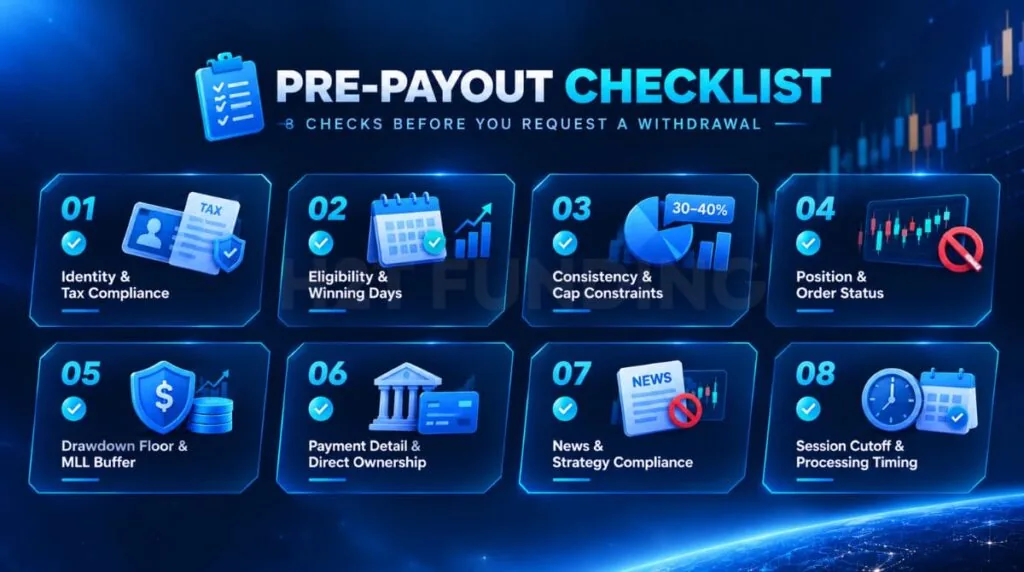
Missing just one of these criteria will trigger an automated denial or an indefinite delay, so always cross-reference your trading history with the Topstep payout rules (or your specific firm’s exact policy page) to ensure full compliance.
11. How to choose a prop firm with reliable payouts (Next steps)
Navigating the prop firm industry requires looking past marketing hype and focusing entirely on a company’s payout infrastructure and rule transparency. To protect your time and capital, evaluate every prospective firm against these three core metrics.
- Public payout data: Choose firms that voluntarily disclose their success rates, processing batches, and exact payment network timelines.
- Transparent compliance: Avoid programs with obscure “risk review” clauses. Prioritize companies that publish their exact consistency rules and evaluation limits in plain language.
- Verified track records: Rely on independent community reports, verifiable financial data, and structured evaluations rather than cherry-picked website testimonials.
Before committing to an evaluation, check how the firm handles withdrawals: whether it publishes a processing window, how it states its consistency rules, and whether traders report payouts arriving on time. Our list of the best prop firms compares programs on rules and payout terms.
For a single firm, start with its payout terms. For example, see our FTMO payout rules or the full FTMO review.
Finally, never execute a trade without understanding the fine print; master the specific compliance requirements to ensure you know exactly what it takes to secure your funds.
12. FAQs
-
Payout speed depends entirely on the specific firm and your chosen payment method. For example, FundedNext processes internal reviews within 24 hours, while Apex Trader Funding requires 1 to 7 business days during specific request windows. Once internally approved, crypto transfers clear within hours, whereas international bank wires take an additional 3 to 5 business days to reach your account.
-
Yes. Passing an evaluation does not bypass compliance reviews. Firms will deny your payout and close the account if they detect live-stage violations like breaching consistency rules, news trading, or latency arbitrage.
-
No. A delayed payout means the request is paused for KYC verification, payment routing, or routine auditing. A denial means the firm rejected this request. Whether the account stays open depends on the reason and the firm’s policy.
-
Few prop firms publish payout rates, so there is no industry-wide average. However, Tradeify reports that 28.5% of its funded participants successfully received a payout between August 2025 and July 2026. This metric is specific to one firm and cannot be generalized.
-
Yes, but a chargeback only recovers your initial evaluation fee, not your trading profits. Under the FCBA and Regulation E, you have 60 days from your statement date to dispute traditional card payments. Crypto payments are irreversible and cannot be charged back.
-
Firms that utilize instant crypto gateways or direct RTP networks offer the fastest payouts, often processing daily. To compare processing speeds and verify operational track records, use our guide to find the best prop firms.
-
Yes. Several trading platforms have halted operations due to regulatory pressures or liquidity failures, such as the high-profile closure of MyForexFunds.
When evaluating platform stability, do not rely solely on claims of being “regulated.” Instead, verify the underlying entity’s compliance history directly through official registries like the NFA BASIC system or CFTC enforcement records.
-
Stop trading to freeze your equity. Compile an evidence kit (trade logs and policy screenshots) and demand the firm cite the exact rule clause delaying your funds. If they remain unresponsive, escalate to a card dispute or an external regulatory body.
-
Official prop firm payout rules are located in the company’s Terms of Service, master trader agreement, and Help Center. Always review these documents directly on the firm’s website to confirm consistency caps and prohibited trading windows.
13. Conclusion
Navigating payout delays and disputes is a critical challenge in proprietary trading. While routine compliance reviews are normal, traders must stay vigilant against systemic insolvency and retroactive rule changes.
Protect your earnings by documenting your trades and building a proactive evidence kit. If a conflict arises, follow a strict escalation ladder. Move from internal compliance to formal external disputes to resolve the issue objectively.
At H2T Funding, we deliver objective data to help you trade safely. Explore our Prop Firm Guides section for verified reviews and practical compliance strategies.
Disclaimer: The information provided in this guide is strictly for educational and informational purposes and does not constitute financial, investment, or legal advice. Proprietary trading involves substantial risk. The regulatory landscape and firm policies change frequently. You must always conduct your own independent research and consult with a qualified financial or legal professional before participating in any evaluation program or submitting personal funds.