


A prop trading firm uses its own capital to trade, while a hedge fund pools outside investor capital and manages it to seek returns. The key difference is who provides the capital and how the business or investment vehicle is structured around it.
Both can trade similar markets and use similar strategies, but they serve different roles. This guide explains the differences in capital, participants, compensation, risk, regulation, career paths, and practical access.
Key Takeaways:
- Retail prop firms typically use evaluations and predefined trading rules, while institutional prop firms generally hire professional traders.
- Hedge funds pool outside capital and manage it according to a defined investment strategy.
- Prop trading is primarily structured around trading firm capital, while hedge funds are structured around managing investor capital.
- The two models can trade similar instruments, but their participants, compensation, and regulatory structures differ.
How We Research for This Guide:
We use official firm documentation, regulatory sources, industry sources, and established financial publications to compare current capital structures, compensation, trading models, risk requirements, and regulations. Firm-specific details are cross-checked against current sources where available. Last updated: September 2026.
1. Prop Trading vs Hedge Fund: Key Differences
The clearest way to compare the two models is to look at where the capital comes from, who participates, and how each model operates.
| Factor | Prop Trading Firm | Hedge Fund |
|---|---|---|
| Capital | Primarily the firm’s own trading capital | Capital pooled from outside investors |
| Who participates | Retail traders or professional employees, depending on the firm | Eligible investors and professional investment staff |
| How traders are compensated | Profit share for some retail programs; salary and bonuses at institutional firms | Salary, bonuses, and/or performance-based compensation for employees |
| Entry | Retail programs may use evaluations; institutional firms generally hire employees | Investor eligibility and fund terms apply |
| Risk | The firm bears losses on its proprietary trading capital | Investors bear investment losses |
| Regulation | Depends on the firm’s activities, structure, and jurisdiction | Depends on the fund, adviser, structure, and jurisdiction |
| Investor lock-ups | Generally not applicable to traders | May include lock-ups or limited redemption periods |
2. What Is Prop Trading (Proprietary Trading)?
Proprietary trading, or prop trading, is trading conducted for a firm’s own account rather than primarily managing money for outside investors. “Prop” stands for proprietary, meaning the firm trades for its own account.
Prop trading exists in both institutional and retail forms, but the two models work differently. Institutional prop firms employ professional traders who trade firm capital, while retail prop firms offer funded-account programs through which individuals can qualify for profit-sharing opportunities.
2.1. Institutional Prop Trading Firms
An institutional prop trading firm is a professional trading company that uses its own capital to trade financial markets. Firms such as Jane Street, Citadel Securities, and Optiver typically hire traders, quantitative researchers, and engineers rather than offering retail-style evaluations.
These firms may use quantitative models, algorithmic trading, and market-making strategies. Traders are generally employees who receive salaries and performance-based bonuses rather than the retail-style profit split offered by funded-account programs.
2.2. Retail Prop Firms: How Funded Accounts Work
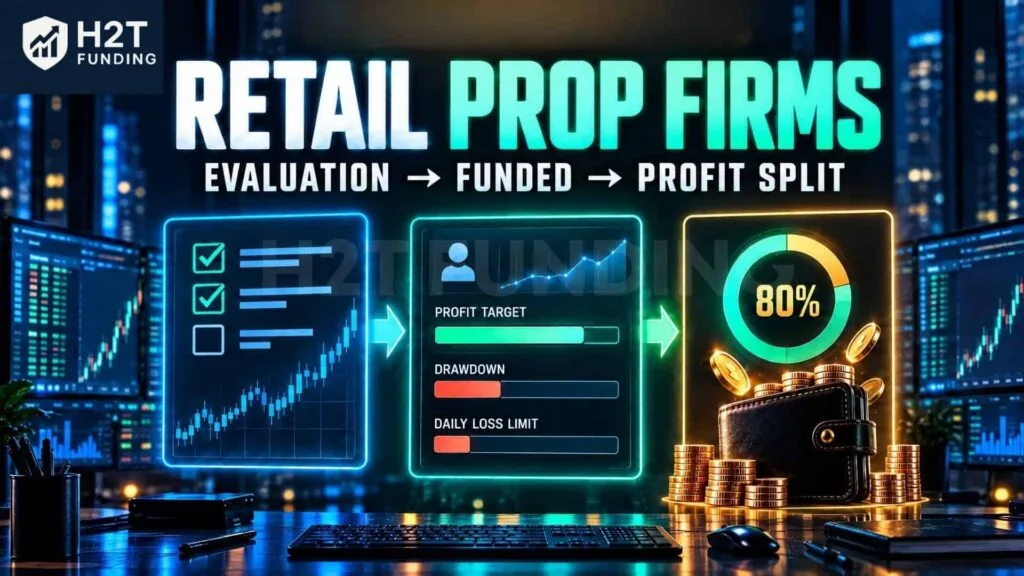
A retail prop firm typically offers a funded-account program in which individual traders first complete an evaluation. The evaluation usually includes rules such as a profit target, maximum drawdown, and daily loss limit.
After passing, a trader may receive access to an account that uses simulated or live capital, depending on the firm’s model. The trader may then become eligible for a profit split, receiving a percentage of eligible profits.
For example, FTMO, FundedNext and Earn2Trade offer retail trading programs with different evaluation costs, drawdown rules, payout conditions, and profit-sharing structures.
| Firm | Program | Account Size | Price | Profit Split |
|---|---|---|---|---|
| FTMO | FTMO Challenge 2-Step | $100K | €439 (~$493) | Up to 90% |
| FundedNext | Stellar 2-Step | $100K | $529.99 | 80%, up to 90% |
| Earn2Trade | TCP50 | $50K | $190 | Up to 80% |
3. What Is a Hedge Fund?
A hedge fund is a private investment fund that pools money from outside investors and uses it to seek returns in financial markets. A professional fund manager controls the portfolio and may use strategies such as long/short equity, global macro, event-driven investing, leverage, and derivatives.
Hedge funds target accredited or qualified investors, rather than everyday retail investors. In the U.S., eligibility can depend on factors such as income, net worth, investment experience, and the fund’s specific requirements. Investors should check the fund’s offering documents to confirm whether they qualify.
Investors typically pay two main types of fees:
- Management fee: Commonly around 1%–2% of assets under management, charged for managing the fund.
- Performance fee: Often around 20% of investment profits, although the actual rate and structure vary by fund.
Some funds may also apply hurdle rates, high-water marks, or additional expenses. These fees can significantly affect an investor’s net returns, so they should be considered alongside the fund’s strategy and potential performance.
In short, hedge funds give qualified investors access to professionally managed investment strategies, but eligibility requirements, fees, and investment terms can vary significantly between funds.
4. Similarities Between Prop Trading and Hedge Funds
Despite their different capital structures, prop firms and hedge funds can share several characteristics:
- Both seek to generate returns from financial markets.
- Both use risk-management controls to manage exposure and potential losses.
- Both can trade instruments such as equities, futures, forex, and options, depending on the firm or fund.
- Both may use leverage and derivatives.
- Both can rely on quantitative research, market analysis, and systematic or discretionary trading strategies.
The specific markets, strategies, and risk controls vary significantly between individual firms and funds.
5. What Happens When You Lose Money in Prop Trading or a Hedge Fund?
What happens when you lose money depends on whether you are trading for a prop firm or investing in a hedge fund.
5.1. Prop Trading
With a retail prop firm, you trade under preset loss limits. Maximum drawdown is the most your account can lose before the account is considered to have failed. A daily loss limit is the most you can lose in one trading day.
If you reach one of these limits, you may fail the evaluation or lose the funded account, depending on the program. You may then need to pay for a new evaluation or reset to continue.
For most retail programs, you are not putting the full advertised account size at risk. Your main upfront cost is usually the evaluation fee, and funded account costs vary by firm.
If this sounds like your situation, our best prop firms for beginners compares programs built for traders just starting out.
5.2. Hedge Funds
With a hedge fund, you invest your own money into the fund. If the fund’s investments lose value, your investment also loses value.
For example, if you invest $10,000 and the fund loses 10%, your investment would be worth about $9,000 before fees and other adjustments.
There is no pass-or-fail challenge like there is at a retail prop firm. Instead, investors generally remain invested according to the fund’s terms and may be able to withdraw their money during specified redemption periods.
The key difference: a prop trader can lose access to an account after breaking the firm’s trading rules, while a hedge fund investor loses money when the value of the fund’s investments falls.
6. Prop Trading vs Hedge Fund: Which Is Better for You?
Neither model is universally better. The more useful question is which role fits what you want to do with capital.
6.1. Funded Prop Trading May Fit You If
- You want to make your own trading decisions.
- You want access to a larger trading account without committing a large personal bankroll.
- You are comfortable following predefined trading and risk rules.
- You want compensation linked directly to your trading performance.
6.2. A Hedge Fund May Fit You If
- You want professional portfolio management rather than trading yourself.
- You meet the fund’s investor eligibility requirements.
- You are comfortable with the fund’s investment terms, fees, and redemption conditions.
- You want exposure to strategies managed by an investment team.
The practical distinction is simple: funded prop trading is primarily a route for traders to trade under a firm’s structure, while a hedge fund is an investment vehicle for managing pooled investor capital.
See H2T Funding’s best prop firms guide for more prop firm options.
7. Can You Move From Prop Trading to a Hedge Fund?
Yes. A prop trading background can be relevant to a hedge fund career, particularly for roles involving trading, research, or risk management. A documented trading record may demonstrate practical market experience, but hedge funds can also consider quantitative ability, market knowledge, education, and previous professional experience.
Another related career path is sales and trading, which is typically found at investment banks. Sales professionals work with institutional clients, while traders execute and manage trades for clients or the bank. It is a separate career path from both proprietary trading and hedge fund investing.
There is no single standard route between these careers. Some professionals move into institutional trading or investment roles, while others remain in prop trading based on their preferred career structure.
If you are still at the entry stage, read how to get into prop trading.
8. Hedging vs a Hedge Fund: Clearing Up the Confusion
Hedging is a risk-management strategy, while a hedge fund is an investment fund.
Hedging means taking a position intended to reduce the potential loss from another position. For example, an investor holding stocks might use put options to limit potential downside.
A hedge fund, by contrast, is a private investment fund that pools outside capital and uses one or more strategies to seek returns. The name does not mean that every hedge fund hedges every position. Some funds use hedging extensively, while others may take directional positions or use different investment approaches.
9. FAQs
-
No. A prop firm primarily trades its own capital, while a hedge fund pools and manages outside investor capital. They may trade similar markets, but they operate under different business models.
-
Some hedge funds may invest money from their managers or partners alongside client capital. However, the core hedge fund model is managing capital from outside investors.
-
Retail prop firms typically require an evaluation fee rather than a large personal trading deposit. Hedge fund investment requirements vary by fund and jurisdiction and may be subject to investor eligibility requirements.
-
Sales and trading is generally a bank-based career focused on serving clients and executing trades. Prop trading focuses on trading the firm’s own capital, while hedge funds manage investment capital on behalf of investors.
-
It depends on the prop firm’s rules. Some firms allow hedging, while others restrict certain hedging strategies or hedging across multiple accounts. Always check the firm’s prohibited-strategies policy before trading.
-
Yes, some prop traders do make money, but profitability is not guaranteed. Independent prop traders typically earn through profit splits after meeting a firm’s trading and payout requirements. However, many traders do not pass evaluations or maintain funded accounts long enough to receive payouts. Results depend on trading skill, risk management, strategy, and the firm’s rules.
-
There is no single top three for every trader because the best prop firm depends on the market, account model, fees, drawdown rules, and payout terms. For a broad comparison, FTMO, FundedNext, and Topstep are among the well-known names to consider, with Topstep among the best futures prop firms, while FTMO and FundedNext offer broader trading options.
10. Conclusion: Which One Is Better?
Neither prop trading nor hedge funds is universally better. The right model depends on whether you want to trade capital yourself or invest capital through a professional manager.
A prop firm is built around proprietary trading, while a hedge fund is built around managing pooled investor capital. Once you understand who provides the capital, who makes the trading decisions, and how participants are compensated, the difference between the two models becomes much clearer.
Now you understand the differences, see our full list of prop firm reviews to find a program that matches your trading style.