

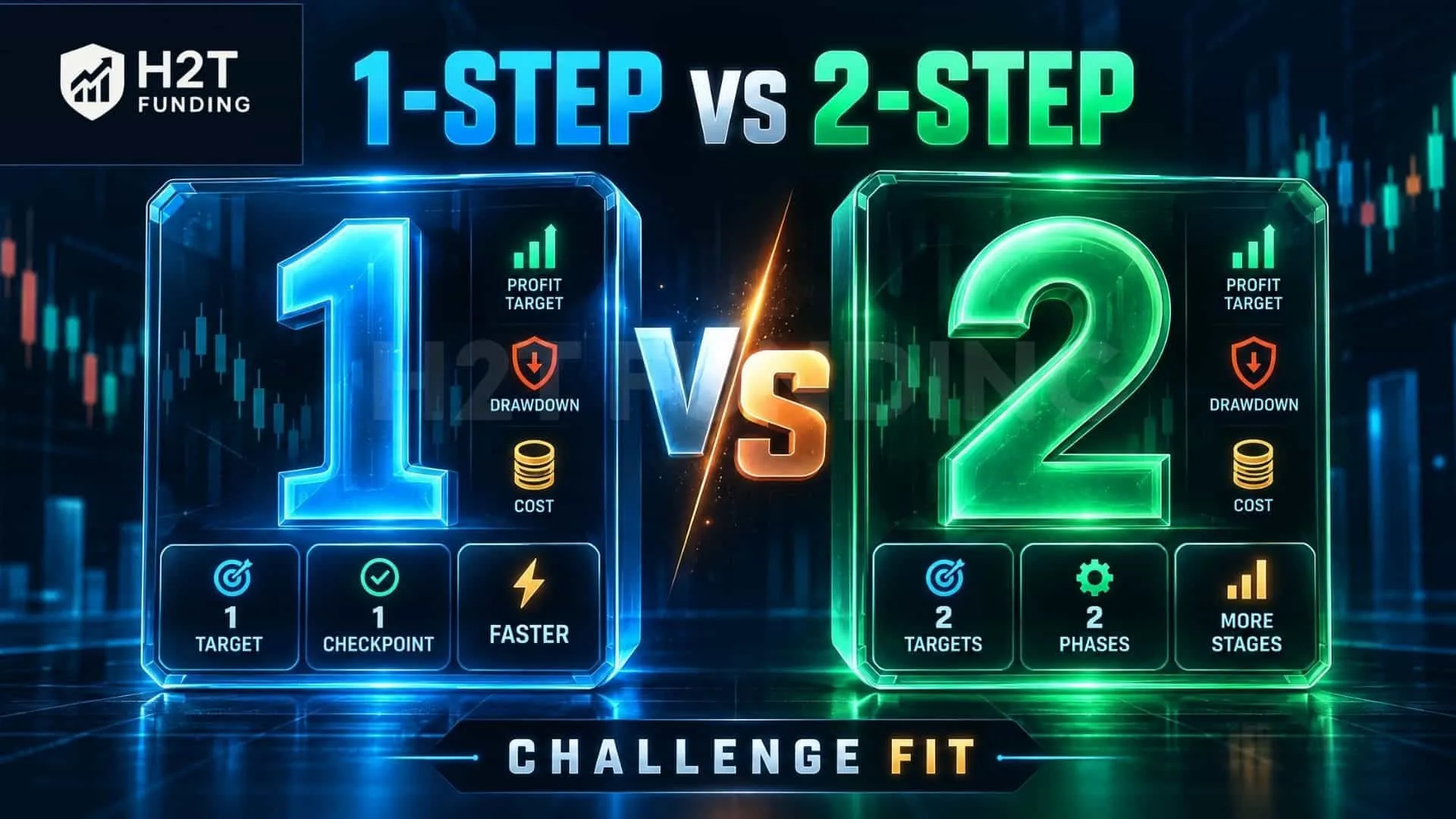
Neither is universally better. A 1-step program completes the evaluation in one phase, which may reduce the time needed to reach funded status, while a 2-step program splits the evaluation across two phases, often with a lower target at each stage but a longer path to funding.
This guide breaks down 1-step vs 2-step prop firm challenges side by side, including their costs, risk rules, evaluation targets, funding process, and key differences, so you can see which format better matches your trading approach.
Key Takeaway:
- 1-step offers a single evaluation phase and may provide a shorter path to funding.
- 2-step splits the evaluation into two phases, often with separate targets for each stage.
- Drawdown and daily loss limits can matter more than phase count when assessing the actual risk of a challenge.
- Compare the profit target, drawdown, daily loss limit, total cost, trading rules, and payout conditions before choosing a program.
Methodology:
This comparison reviews current 1-step and 2-step programs from 10 prop firms, using official challenge pages, rulebooks, pricing pages, and payout information. Figures were checked in September 2026 and may change.
To keep the guide concise, 5 firms are used as named examples, while data from all 10 firms informs the cross-firm comparisons and ranges throughout the article. Examples are illustrative unless otherwise stated.
1. 1-Step vs 2-Step: Key Differences
Both 1-step and 2-step programs are evaluation stages designed to assess your trading performance against the firm’s profit and risk rules. The two formats differ by more than the number of phases.
The table below summarizes patterns found across 10 prop firms reviewed for this guide. The figures are based on published rules checked in September 2026.
| Metric | 1-Step | 2-Step |
|---|---|---|
| Time to funded | Potentially shorter because there is one evaluation phase | Usually longer because both phases must be completed |
| Profit target | Varies by program; one target of around 8-10% | Varies by program; 8-10% in Phase 1, followed by a lower Phase 2 target (e.g., 5%) |
| Daily loss limit | Varies by program; commonly around 3-4% | Varies by program; commonly around 4-5% |
| Drawdown Rules | Often tighter or trailing drawdown limits (e.g., 5% to 6%) | Often more forgiving/wider daily and total loss limits (e.g., 5% daily / 8%-10% total) |
| Minimum trading days | Can be 0 days in some programs | Often 3-4 days per phase |
| Consistency / Best Day rule | More frequently found in 1-step programs in the examples reviewed | Less common during the evaluation in the examples reviewed |
2. What Is a 1-Step Prop Firm Challenge?
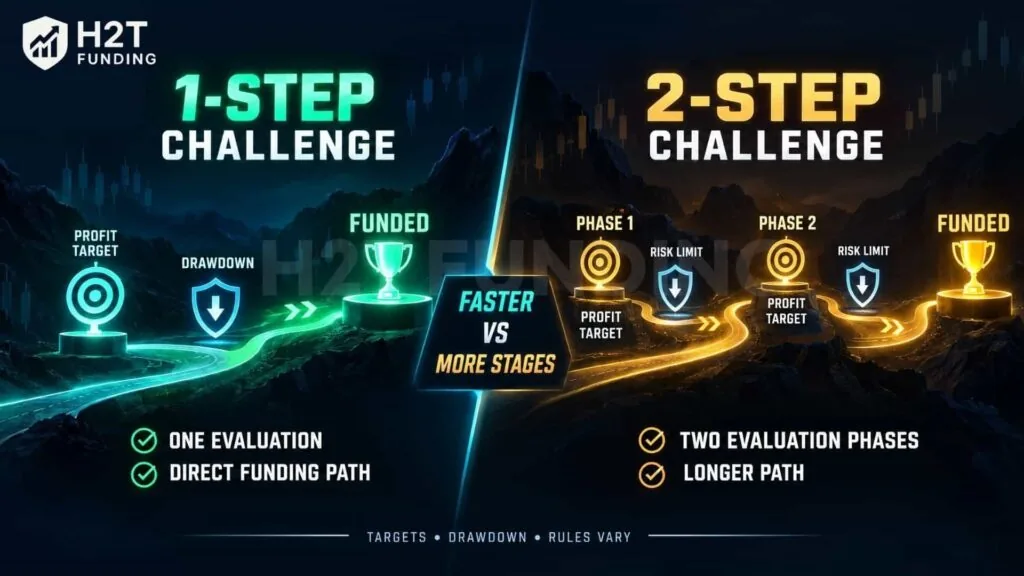
A 1-step prop firm challenge is a single-phase evaluation where you must meet the firm’s profit target and risk limits to qualify for a funded account. Because there is only one evaluation phase, it can offer a faster path to funding, but the specific drawdown, daily loss limit, and trading rules vary by firm.
After passing: You complete any required review, verification, or account setup before trading under the firm’s funded-account terms.
3. What Is a 2-Step Prop Firm Challenge?
A 2-step prop firm challenge is a two-phase evaluation where you must meet separate profit targets and risk limits in each phase before qualifying for a funded account. It usually takes longer than a 1-step challenge, but the targets may be split across two stages, depending on the firm’s rules.
After Phase 1: You move to Phase 2, rather than directly to a funded account. After passing both phases, you proceed to the firm’s post-evaluation review or account setup.
4. FTMO Example: 1-step vs 2-step challenge comparison
FTMO is a useful example of why phase count alone does not tell you how a challenge works. FTMO currently offers both a 1-Step and a 2-Step evaluation, but their trading objectives are different.
| Rule | FTMO 1-Step | FTMO 2-Step |
|---|---|---|
| Evaluation phases | 1 | 2 |
| Profit target | 10% | 10% Phase 1, 5% Phase 2 |
| Maximum daily loss | 3% | 5% |
| Maximum loss | 10% | 10% |
| Drawdown type | End-of-day trailing | Static |
| Minimum trading days | None | 4 per phase |
| Best Day Rule | 50% | None during evaluation |
| Profit reward | 90% | Up to 90% |
| Fee | From €79 | From €89 |
For a $100,000 account, the 1-Step requires $10,000 in profit and uses a 3% maximum daily loss with a 10% end-of-day trailing maximum loss. The 2-Step requires $10,000 in Phase 1 and another $5,000 in Verification, with a 5% maximum daily loss and a 10% static maximum loss.
The difference is therefore more than one phase versus two. The 1-Step has a single evaluation and no minimum trading-day requirement, but its daily loss limit is lower and its maximum loss is end-of-day trailing. The 2-Step takes two phases and requires four trading days in each, but its maximum loss remains static at 10%.
FTMO’s own process also confirms the different paths: passing the 1-Step leads directly to review before FTMO Identity and the Signal Provider Agreement, while the 2-Step requires traders to pass both the Challenge and Verification before reaching the same stage.
5. Static vs Trailing Drawdown: Why This Matters More Than Phase Count
Phase count does not determine how much room you have to trade. Drawdown type can matter more, as 1-step and 2-step programs can use different loss-floor models.
| Static Drawdown | Trailing Drawdown |
|---|---|
| Loss floor stays fixed | Loss floor moves up as the account grows |
| $100K account, 10% max loss → $90K floor | $100K account, 10% trailing loss → floor can rise |
| Profits do not move the floor | Giving back profits can reduce available room |
| Easier to calculate fixed risk | More sensitive to profit givebacks |
| Can be intraday or end-of-day, depending on rules | Can be real-time or end-of-day, depending on rules |
For the full mechanics, see our Static Drawdown vs. Trailing Drawdown guide and Trailing Drawdown Guide.
6. The Real Cost of Failing: Reset Fees and Retry Math
The entry fee is only part of the cost. If you fail, the full cost of reaching a funded account depends on how many attempts you need, regardless of whether the challenge has one or two phases.
For example, using a $200 fee for illustration:
| Scenario | Attempts | Total fees |
|---|---|---|
| 1-Step: fail twice, pass on the third | 3 | $600 |
| 2-Step: fail Phase 2 twice, pass on the third | 3 | $600 |
With a 2-step challenge, passing Phase 1 does not carry over after a failed Phase 2. You must start a new evaluation, although your previous attempts can provide useful information about where your process broke down.
The key point is simple: retry costs depend more on your number of failed attempts.
7. Prop Firms Offering Both 1-Step and 2-Step Challenges
Several established prop firms offer both 1-step and 2-step challenges, allowing traders to choose between different evaluation structures within the same firm.
| Prop Firm | 1-Step Challenge | 2-Step Challenge |
|---|---|---|
| FTMO | FTMO 1-Step | FTMO 2-Step |
| The5ers | Hyper Growth | High Stakes |
| FXIFY | One Phase | Two Phase |
| Alpha Capital Group | Alpha One | Alpha Pro |
| FundingPips | 1-Step | 2-Step |
The rules can differ significantly between the two models, including profit targets, drawdown, daily loss limits, minimum trading days, and payout conditions. Compare the specific program rather than assuming all 1-step or 2-step challenges follow the same structure.
If you want to compare more single-phase programs, see our guide to the best 1-step prop firm challenges.
8. 1-Step vs 2-Step Challenge: What Should I Choose?
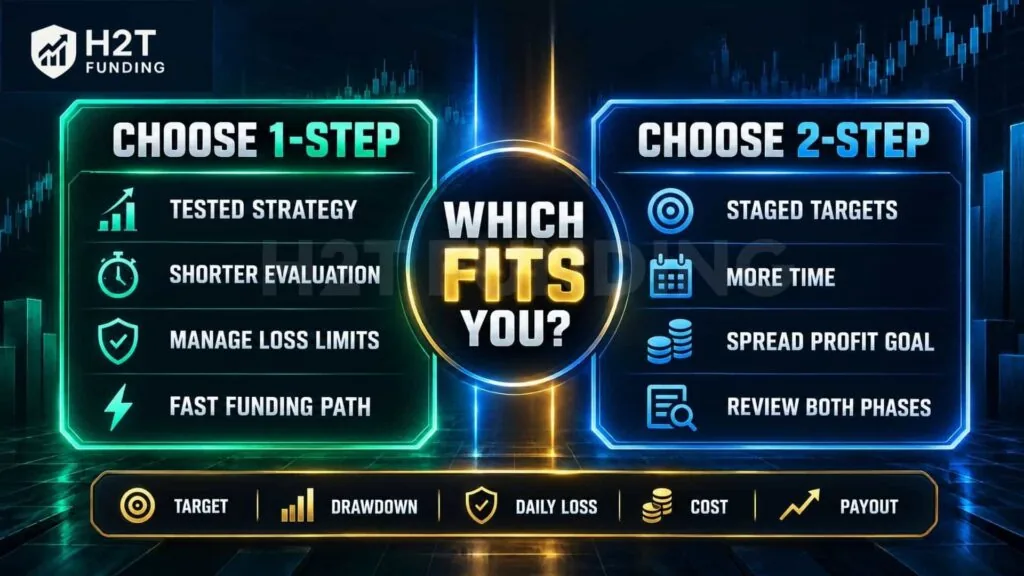
Neither format is right for every trader. Your choice should depend on how you trade, how quickly you want to reach a funded account, and which drawdown and risk rules you can manage consistently.
8.1. Who Should Choose a 1-Step Challenge?
- You have a tested strategy and want a shorter evaluation path with one phase to complete.
- You can consistently manage the program’s daily loss and drawdown limits.
- You prefer reaching the funded stage without completing a second evaluation phase.
8.2. Who Should Choose a 2-Step Challenge?
- You prefer a staged evaluation, where each phase has its own profit target and risk limits.
- You are comfortable spending more time completing the evaluation in exchange for a more gradual progression.
- You prefer a program where the evaluation is split into two separate phases, rather than completing the full evaluation in one phase.
A 1-step challenge may offer a shorter route to funding, while a 2-step challenge may provide a more gradual evaluation. Compare the target, drawdown, daily loss limit, cost, and payout rules before deciding.
9. FAQs
-
Not necessarily. A 1-step challenge has one evaluation phase, while a 2-step challenge spreads the evaluation across two phases. The actual difficulty depends on the profit target, drawdown, daily loss limit, and other rules.
-
Static drawdown keeps the loss floor fixed, while trailing drawdown moves the floor as the account reaches new highs. The exact calculation and when the floor stops moving depend on the firm’s rules. Both types can appear in 1-step and 2-step challenges.
-
Yes. Phase count and drawdown type are separate features. A 2-step challenge can use either static or trailing drawdown, depending on the program. For example, FXIFY offers different Two Phase programs with different maximum-loss models.
-
Not really. A 2-step challenge may feel more gradual because the evaluation is divided into two phases, but the daily loss limit and drawdown model still determine how much risk you can take. Compare the specific rules rather than assuming 2-step is safer.
You can also review H2T Funding’s guide to prop firm rules for a broader look at the risk limits and restrictions firms apply; best prop firms for beginners guide compares programs built for traders just starting out.
10. Conclusion: Which Is Better?
Neither format is universally better. Choose based on the rules you can manage consistently, especially the profit target, drawdown, daily loss limit, total cost, and payout conditions. Compare specific programs rather than choosing by phase count alone.
If you want to understand what happens after passing an evaluation, see our guide to how funded trading accounts work.