


A prop firm fee structure is the complete set of costs you may face from buying an evaluation to receiving payouts. It can include the challenge or evaluation fee, reset fee, activation fee, reactivation fee, profit split, withdrawal costs, and ongoing data, platform, or trading commissions.
The actual cost of getting funded can exceed the headline challenge price when a program adds recurring or post-pass charges. Monthly subscriptions, one-time fees, and Pay After You Pass models mainly change when you pay, not necessarily how much you pay.
This guide explains each fee, when it applies, and how it affects total cost. Because pricing and rules can change, firm-specific figures are current as of the date checked and should be verified against the firm’s latest official pricing or help-center information before purchase.
Our methodology:
We reviewed the fee structures of 15 prop firm programs across Forex/CFD and Futures, focusing on official pricing pages, help centers, and program terms. We also incorporated practical observations from traders on the H2T team to identify fee mechanics that can be easy to overlook.
Important: Because prop firm pricing and rules can change, firm-specific figures were checked against the relevant official source as of September 2026.
1. What Fees Do Prop Firms Charge?
A prop firm’s fee structure covers all costs from evaluation to payout. Not every firm charges all of them, and the structure often differs between Forex/CFD and Futures programs.
The table below summarizes the main fee types, when they apply, and how they typically affect your total cost.
| Fee Type | When You Pay It | Applies To | What It Covers |
|---|---|---|---|
| Challenge / Evaluation fee | Before starting an evaluation; may be one-time or recurring | Forex + Futures | Access to the firm’s evaluation program |
| Reset fee | After failing an evaluation, if a reset is available | Forex + Futures | Restarting an existing evaluation instead of buying a new one |
| Activation fee | After passing, before entering the funded stage | Forex + Futures | Activating or opening the funded account |
| Reactivation fee | After losing a funded account, if reactivation is offered | Mostly Futures | Restoring access to a previously funded account |
| Profit split | When you receive trading profits | Forex + Futures | The portion of eligible profits retained by the firm |
| Data / platform / commissions | During trading, depending on the program | Mostly Futures | Market data, platform access, and trading-related costs |
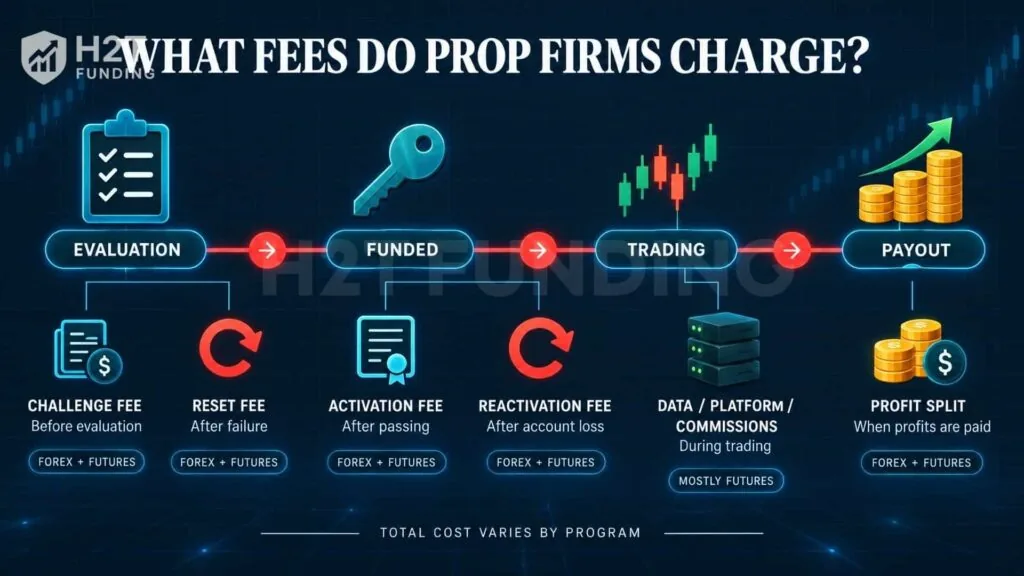
The key distinction is that not all costs are paid at the same stage. The challenge fee is usually the first cost you see, while resets and activation fees may only apply after a specific event.
Data, platform, and commission costs can continue while you trade, and the profit split affects how much of your trading profits you ultimately keep.
This means the advertised challenge price is only one part of the overall fee structure. To understand the actual cost of a prop firm program, you need to look at the full fee stack and identify which charges apply before funding, after passing, and during the funded stage.
2. Challenge (Evaluation) Fee: What You Pay to Start
A challenge or evaluation fee is usually the first cost you pay to enter a prop firm program. Depending on the firm, it may be charged as a one-time purchase or as a recurring subscription.
The amount varies by market, account size, program structure, billing model, and promotional pricing.
For example, current Futures pricing illustrates how widely fees can vary within one firm. Tradeify lists Growth evaluations from $99 for a 25K account to $369 for a 150K account, while Select evaluations range from $109 to $369 for its standard 25K–150K tiers.
3. Reset Fee: What It Costs to Try Again After Failing
A reset fee is the cost of restarting a failed evaluation without buying a completely new evaluation. Depending on the firm, a reset may restore the account to its original balance and reset its trading progress, loss limits, and other evaluation metrics.
Reset pricing varies by firm, account size, and payment model. Some programs charge a separate reset fee, while others include a reset through their billing structure or require traders to purchase a new evaluation after failure.
| Reset Structure | How It Works |
|---|---|
| Paid reset | You pay a separate fee to restart the failed evaluation. |
| Reset included with subscription | Some recurring evaluation models provide a reset credit when the subscription renews. |
| No reset | Some programs require you to purchase a new evaluation after failure instead of offering a reset. |
A reset applies only to a failed evaluation and gives you another attempt. It is different from reactivation, which restores a lost funded account (covered in the next sections).
Always confirm whether a reset extends your access period, changes the next billing date, or has usage limits.
4. Payment Model Comparison: Pay Upfront vs. Pay After Passing
Prop firms generally use three payment models:
| Payment Model | When You Pay | Main Cost Consideration |
|---|---|---|
| Pay Upfront | Before starting the evaluation | The full evaluation fee is paid at the start |
| Pay After Passing (PAYP) | Part before and part after passing | The remaining balance is paid only after you pass |
| Recurring Subscription | Monthly or recurring | Total cost depends on how long you remain enrolled |
With Pay After Passing, part of the program cost is delayed until you pass. This can lower the initial payment without necessarily lowering the total cost. For example, The5ers Bootcamp charges an initial entry fee and the remaining balance after the trader passes and reaches the funded stage.
This is different from an activation fee. An activation fee is a separate post-pass charge that applies to some programs, while PAYP is a payment structure in which part of the program’s total cost is intentionally deferred until after passing.
When comparing programs, look at the full payment structure, including evaluation fees, recurring charges, resets, activation fees, and other post-pass costs.
5. Are Prop Firm Evaluation Fees Refundable?
Prop firm fees are not always refundable. Whether you can recover a fee depends on the program, fee type, and refund conditions. Some evaluation fees are non-refundable, while others are refunded after passing and reaching a specific payout milestone.
For example, FTMO‘s 1-Step Challenge fee is not refunded, while its 2-Step Challenge fee may be refunded with the first Reward withdrawal.
Treat refunds as conditional, not as an automatic reduction in your initial cost. Check which fees qualify, when the refund is triggered, and what happens if you fail, reset, or lose the account before reaching the required milestone.
6. Ongoing Costs You May Have To Pay
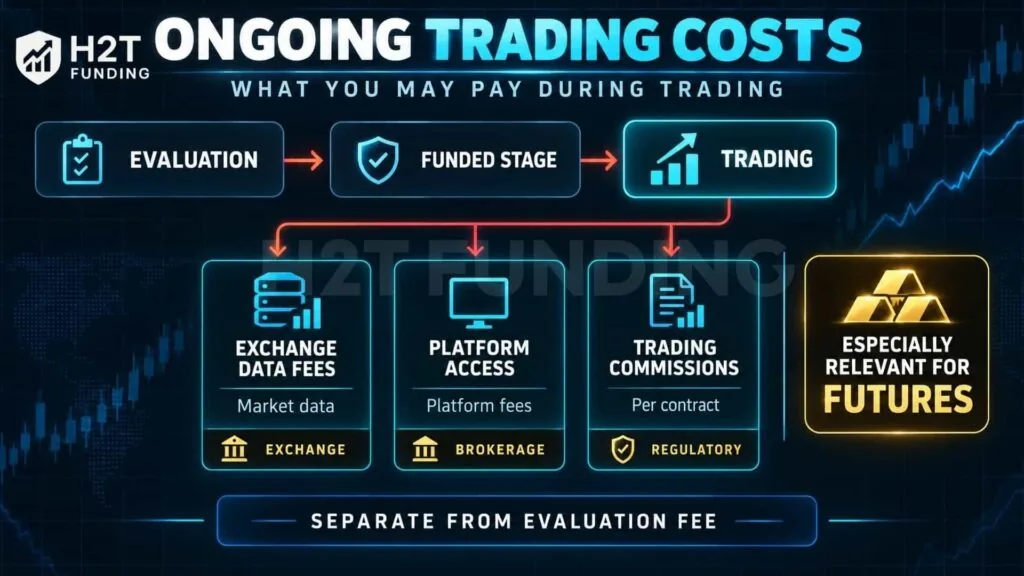
Some prop firm programs charge ongoing trading costs during the evaluation or funded stage. These are especially relevant to Futures programs, where market data, platform access, and commissions may be separate from the evaluation fee.
For example, Topstep applies trading commissions and fees to its Trading Combine, Express Funded Account, and Live Funded Account.
6.1. Exchange Data Fees
Futures market data can become a separate funded-stage cost. Fees vary by exchange, trader classification, and the number of exchanges required.
| Prop Firm | Program / Account | Market Data Cost | Coverage / Note |
|---|---|---|---|
| Topstep | Live Funded Account | $133 per exchange/month | Topstep covers one exchange |
| Topstep | Live Funded Account | $540/month | Access to all four CME Group exchanges; trader pays the remaining $399/month |
| Earn2Trade | Professional CME data | $140/exchange/month (Rithmic); $156/exchange/month (NinjaTrader) | Professional market data |
Topstep’s published pricing states that it covers one exchange, while each additional exchange is charged at $133 per month. It also lists $540 per month for access to all four CME Group exchanges, with $399 paid by the trader.
These costs are separate from the evaluation fee and can affect the ongoing cost of a funded account.
6.2. Platform and Trading Costs
Platform fees and trading commissions are separate from market data costs. Depending on the program and account type, traders may pay platform access fees and commissions based on the contracts traded. These can include brokerage, exchange, and regulatory charges.
These are usage-based costs rather than entry fees, so your total ongoing expense can increase if you trade more contracts, use additional exchanges, or require paid platform access.
7. Activation Fee: Why It Exists and What It Really Covers
An activation fee is a separate post-pass charge that some prop firms require before you can enter a funded account. It is different from a Pay After Passing model, where part of the program’s total cost is simply deferred until after you pass.
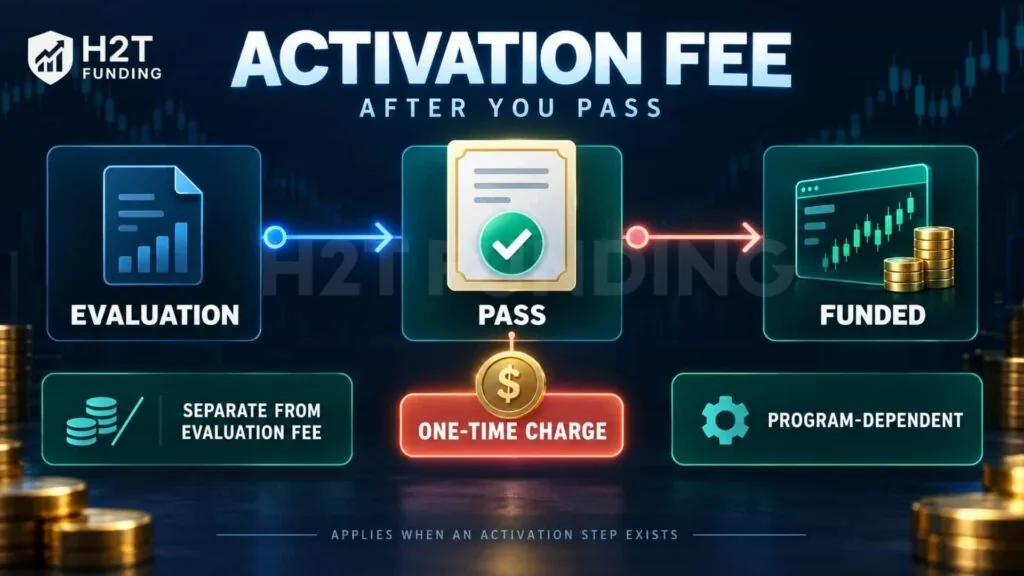
Activation policies vary across prop firms. Some charge a separate fee after passing, while others set the activation fee at $0.
For example, Topstep currently charges $149 to activate an Express Funded Account on its Standard Path, while its No Activation Fee Path charges $0. MyFundedFutures currently charges no activation fee.
The key comparison is whether the post-pass payment is part of the program’s deferred cost or an additional activation charge.
8. Reactivation Fee: The Cost of Losing a Funded Account
A reactivation fee lets you restore a lost funded account without completing a new evaluation. Unlike a reset, which usually applies to an evaluation account, reactivation applies to an already-funded account.
Eligibility varies by program and may depend on how the account was lost, previous payouts, and when you request reactivation. The reactivated account may also start fresh. For example, Topstep resets the balance, P&L, trade history, and winning days to zero.
Before relying on reactivation, check:
- Whether the lost account is eligible
- How long you have to reactivate
- Whether the original payout rules still apply
9. Profit Split: The Cost That Comes From Your Payout
A profit split determines how much of your eligible profit you keep and how much the firm retains. Unlike an upfront fee, it applies when you receive a funded-account payout.
Across the programs reviewed, trader shares commonly range from 80% to 90%, although the applicable rate varies by firm, account type, payout option, and performance conditions.
For example:
| Trader Share | $5,000 Profit | Firm’s Share |
|---|---|---|
| 80% | $4,000 | $1,000 |
| 90% | $4,500 | $500 |
The advertised maximum split does not tell the full story. Focus on the standard split that applies to your account and payout.
For more on payout eligibility, consistency rules, profit splits, and payment methods, see our guide on how prop firm payouts work.
10. Withdrawal Fees and Minimum Payout Thresholds
Withdrawal fees are costs that may apply when you transfer trading profits from a prop firm to your bank account, payment wallet, or other payout method. Many firms do not charge a separate withdrawal fee, but payout methods can have their own processing charges, minimum withdrawal amounts, or other conditions.
The main factors to check before requesting a payout are:
- Minimum payout: the minimum profit or balance required to withdraw.
- Payout fee: whether the firm or payment provider charges a processing fee.
- Payment method: available options can include bank transfers, payment processors, or cryptocurrency.
- Processing time: how long the firm states it normally takes to process the request.
These costs are separate from the profit split. The profit split determines how much of your eligible profit belongs to you, while a withdrawal fee, if applicable, is a charge associated with processing the payout.
Always check the firm’s current payout terms before making a withdrawal request. Minimums, available payment methods, fees, and processing times can vary by program and may change over time.
11. Real Example: What It Actually Costs to Get Funded
A real prop firm example shows how the advertised fee differs from the overall payout economics. Consider the MyFundedFutures Builder 50K:
| Cost Component | MFFU Builder 50K |
|---|---|
| Evaluation fee | $153 |
| Activation fee | $0 |
| Minimum payout | $500 |
| First payout requirement | $500 above the $2,100 buffer |
| Maximum payout per cycle | $2,000 |
| Profit split | 80/20 |
The Builder 50K has a $3,000 profit target, $2,000 EOD maximum loss limit, and one-day minimum trading requirement. There is no separate activation fee after passing.
For a deeper look at the program’s rules, payouts, and current costs, see our MyFundedFutures review.
Suppose you clear the $2,100 buffer and generate another $1,500 in profit. With an 80/20 split, you receive $1,200, while $300 goes to the firm.
Your total cost is not necessarily $153. A failed evaluation, reset, or additional purchase can increase your spending. This shows why you should consider both the upfront fee and payout structure when comparing prop firm costs.
For a broader comparison of futures programs, see our best futures prop firms guide.
Note: As of September 2026, MFFU lists the Builder 50K at $153 before discounts. Prices and rules can change, so verify the current terms before purchasing.
12. Prop Firm Fee Structure Comparison: Forex vs. Futures
Fee structures can differ significantly even when two prop firms have similar entry prices. The tables below compare the main cost components across selected programs, including billing model, resets, activation, profit split, and refundability.
12.1. Futures Programs
| Firm | Billing model | Reset | Activation fee | Profit split | Evaluation fee refundable? |
|---|---|---|---|---|---|
| Topstep | Monthly subscription | Paid; each rebill adds one reset credit | $149 Standard / $0 No Activation Fee path | 90/10 | No |
| MyFundedFutures | Varies by plan | Varies by plan | $0 | 80/20 on Builder | No |
| Tradeify | One-time purchase, no recurring billing | Paid reset available on evaluations | $0 | 90/10 on applicable Sim Funded plans | No |
| Earn2Trade | Monthly subscription (TCP) | Paid reset | Varies by account/data status | Varies by stage | No |
(Futures programs may also have market data, platform, and commission costs after funding.)
12.2. Forex / CFD Programs
| Firm | Billing model | Reset | Activation fee | Profit split | Evaluation fee refundable? |
|---|---|---|---|---|---|
| FTMO | One-time, no recurring fees | No reset | None | 80% base, up to 90% via Scaling Plan | 2-Step: Yes with first Reward; 1-Step: No |
| The5ers | One-time | Not offered on Bootcamp | None on referenced programs | Varies by plan | Varies by program |
| FXIFY | One-time | Discounted reset | None | 80% base; up to 90%; 100% on eligible Two Phase Classic plans | Yes on eligible 1-, 2- and 3-Phase plans |
The main difference is not simply Forex vs. Futures, but where and when each program charges. Futures programs may add market data, platform, commission, or activation costs, while Forex/CFD programs can combine upfront fees with resets, payout conditions, refunds, or post-pass charges.
When comparing programs, review the full fee structure rather than the entry price alone.
If upfront cost is your main concern, see our guides to free prop firms and cheapest prop firms for programs with lower or no initial fees.
13. FAQs
-
You may pay an evaluation fee, reset fee, activation fee, or ongoing trading costs depending on the program. A profit split also affects how much of your eligible profits you keep.
-
It is a one-time fee some firms charge after you pass an evaluation and move to the funded stage. Some programs charge $0.
-
It depends on the firm and program. Some fees are non-refundable, while others may be refunded after a specific payout milestone or under certain conditions.
-
A regular challenge fee is paid when you start. Pay-after-passing models delay part or all of the payment until you pass, changing when you pay rather than necessarily reducing the total cost.
-
There is no standard price. Costs vary by account size, asset class, payment model, and whether additional fees such as resets or activation apply.
-
Common costs to check include resets, activation or reactivation fees, market data, platform charges, commissions, and payout-related fees. Not every program charges all of them.
14. Conclusion
A prop firm fee structure includes more than the advertised evaluation price. Depending on the program, your total cost can include resets, activation or reactivation fees, market data, platform charges, commissions, and the portion of profits retained through the profit split.
Before purchasing, compare the costs that apply at each stage of the program and verify the firm’s current pricing, payout, and refund terms. For a broader side-by-side comparison, see our prop firm comparison.