

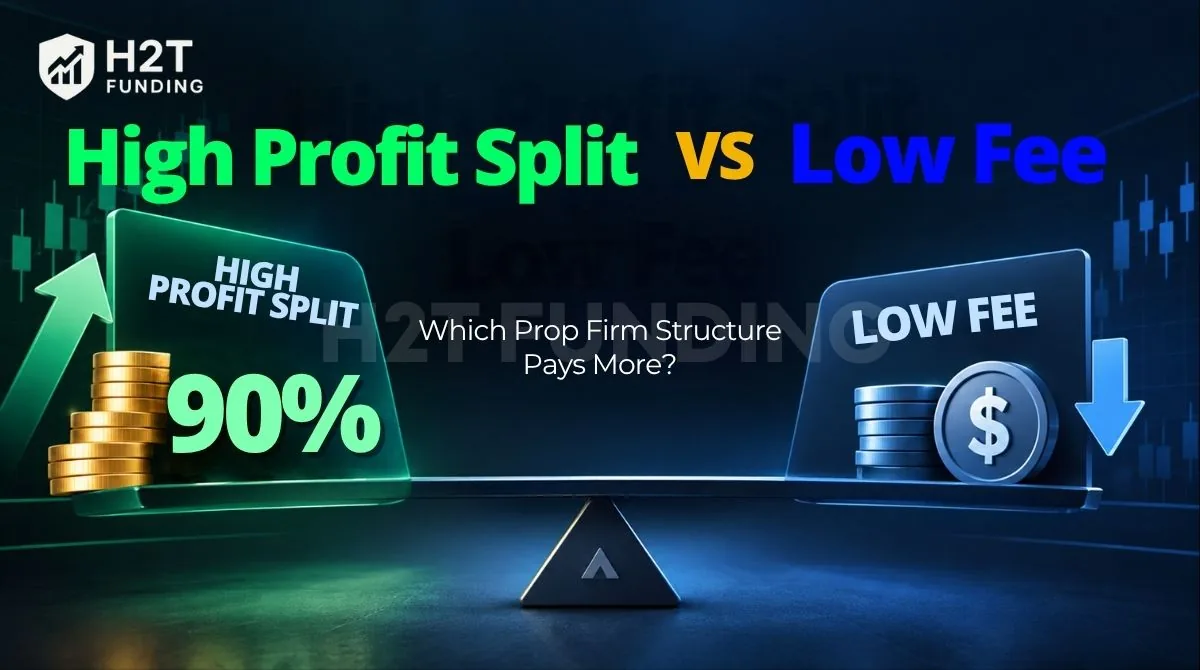
A higher split (the share of profit you keep) only pays off if the profit that counts toward your payout is large enough, and lasts long enough, to cover its extra costs. Below that point, the lower fee pays more. The deciding number is your break-even profit, the point where both options leave you with the same money.
This guide explains both options in plain terms. You will see the key differences, the costs and payout rules behind each one, and a simple formula with a worked example you can rerun with your own numbers.
1. High profit split vs low fee: Key differences at a glance
A high profit split pays more when your profit is large and steady for several months, while a low fee pays more when profit is small, the holding time is short, or you have not yet proven how often you pass.
| High profit split | Low fee | |
|---|---|---|
| What it changes | The share of profit you keep (90% or above) | The upfront price of each attempt |
| Pays more when | Profit is steady and you hold the account for several months | You are still testing how often you pass, or you hold the account briefly |
| Main risk | A higher fee is lost on every failed attempt, and rules are often stricter | A cheap challenge can still be failed quickly, so retries erase the saving |
| Check first | How profit is counted, payout limits, refund terms | Loss limits, reset policy, monthly fees |
In short:
- High split: suits traders who already pass regularly and make steady profit.
- Low fee: can suit traders who are still checking their pass rate, but it does not mean the challenge is easier.
- Beginners: build a demo track record and learn the rules before buying either option.
2. What is a profit split, and what counts as “high”?
Profit split is the percentage of profit you keep when you withdraw from a funded account, and the firm keeps the rest. The profit it applies to is called eligible profit: the profit that counts toward your payout under the firm’s rules. In this article, “high” means 90% or above.
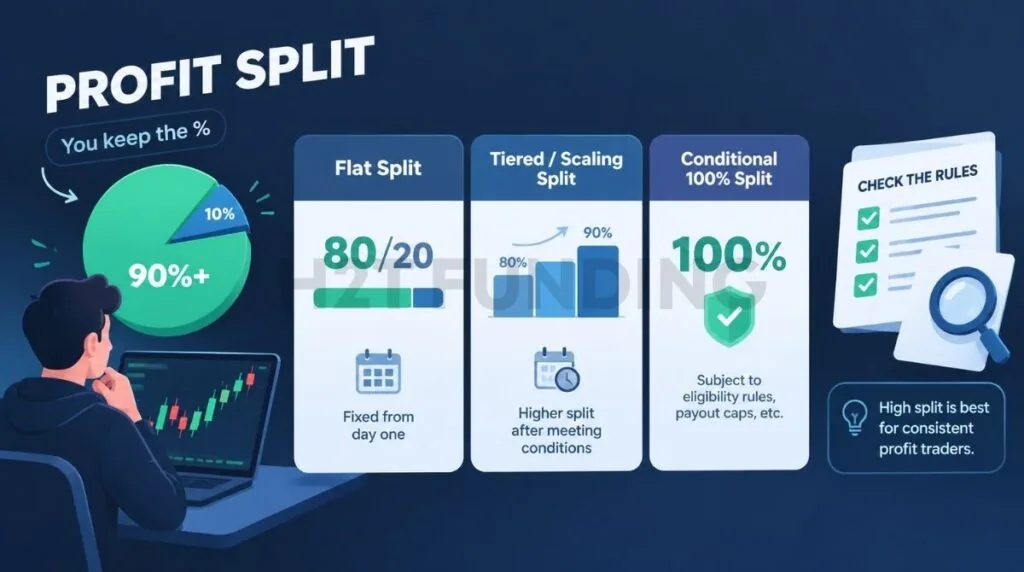
Firms structure splits in three common ways:
- Flat split: A fixed percentage from day one, for example 80/20. It is easy to calculate.
- Rising (tiered) split: The share grows when you meet conditions. FTMO’s 1-Step pays 90% from the start, while its 2-Step can reach 90% through its Scaling Plan. That plan needs at least four months of trading, at least 10% profit in that period, and at least two processed payouts.
- Conditional 100% split: The headline is 100%, but payouts come with limits. Apex’s current end-of-day (EOD) funded accounts pay 100% on approved payouts, with limits on payout count, minimum trading days, and how much one day’s profit can count.
A high split rewards steady profit. It does not make you earn more.
3. What is a challenge fee, and what counts as “low”?
The challenge fee is the price you pay upfront to take a firm’s evaluation, and you pay it whether you pass or fail. It is not a deposit, because the money you trade is simulated.
There is no official line for a “low” fee. It depends on account size and on what the fee includes, so compare challenges of the same size with similar rules. For reference, FTMO lists its 1-Step from €79 and its 2-Step from €89. To see what else a funded account can cost, read how much a funded account costs.
4. Costs and risks behind each structure
The real cost of a challenge is its fee divided by how often you pass, plus any monthly fees, and that total, not the headline price, shows whether a higher split is worth it.
4.1. The fee stack beyond the challenge fee
To accurately calculate your expenses, you must look beyond the initial price tag and evaluate how a typical prop firm fee structure handles hidden overheads. Depending on the firm, other charges can sit on top of the challenge fee:
- Reset fee: A payment to restart a failed challenge. Some firms do not offer it, so you buy a new one.
- Activation fee: A one-time charge to open the funded account after you pass.
- Monthly fees: Data or platform charges, more common on futures programs.
- Withdrawal fees: Costs of getting paid, such as bank transfer fees.
Monthly fees matter more than they look. A $90 monthly gap pushes your break-even up by $900 for every month you hold the account.
4.2. Pass rate, retries, and “cheap is not easy”
A low fee suits traders who are still proving their pass rate (how often they pass a challenge), but cheap does not mean easy. If you pass once in three tries, you buy about three challenges per pass, so a $200 fee effectively costs about $600.
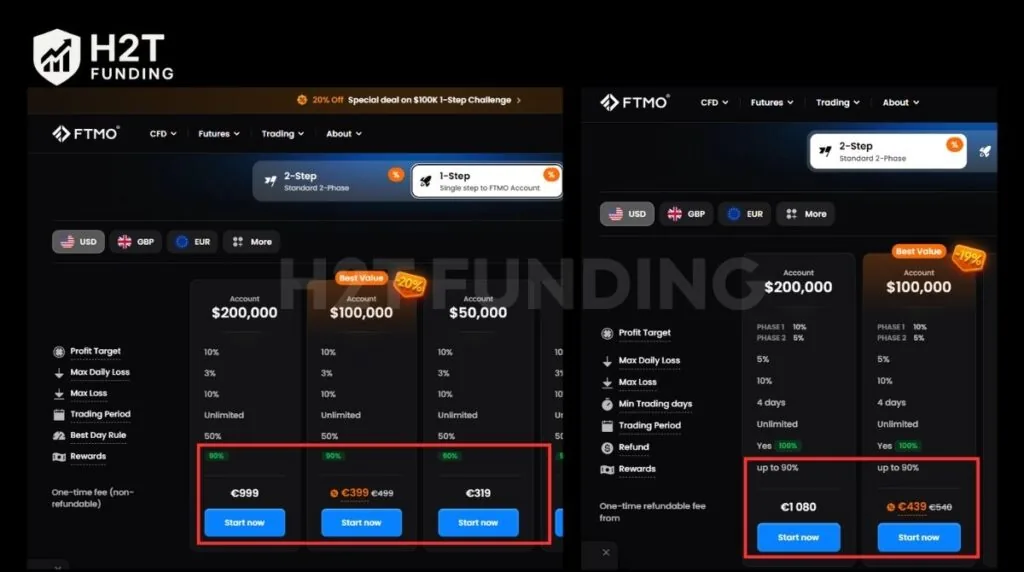
A cheap challenge can also have tighter loss limits, which makes it easier to fail. FTMO shows the trade-off. Its 1-Step has the lower starting price and pays 90% from the start, but allows only a 3% daily loss (the most your account can lose in one day) and has no refund. Its 2-Step allows 5% and lists a 100% refund.
4.3. Refunds and the real cost of a challenge
A refundable fee is still money you pay upfront and wait to get back, and the refund depends on conditions. Check whether the fee is refunded, when it is paid (for example after a first payout), and to which payment method.
Count a refund in your calculation only if you expect to qualify. Our guide to refundable vs non-refundable challenge fees covers the usual conditions.
5. Payout rules that decide how much of the split you keep
A 90% split applies only to the profit that counts toward your payout, so the payout rules decide how much of your profit you really keep.
5.1. Eligible profit: limits on one-day profit and payout caps
Eligible profit can be lower, or arrive later, than your account profit when a firm limits how much a single day can count. This is called a consistency rule. Apex’s EOD accounts, for example, require that no single winning day makes up 50% or more of your profit since your last approved payout.
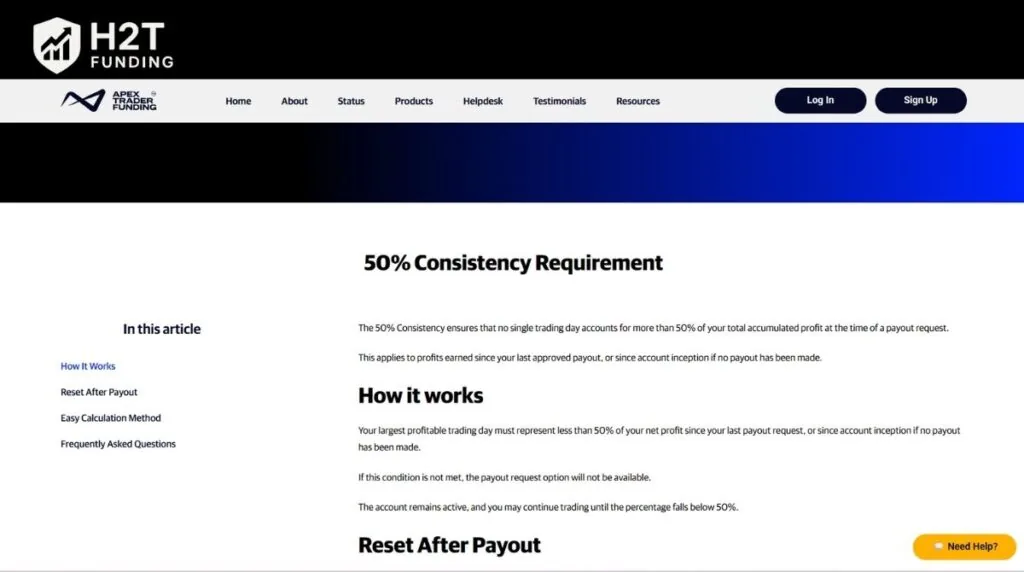
If your best day made $1,500, you need more than $3,000 in total profit before you can withdraw. This is an illustration of the rule, not a forecast.
Payout limits matter too. Apex‘s current EOD accounts allow up to six payouts per account. Older Apex legacy accounts follow different rules, such as 100% on the first $25,000 and 90% after that, with a stricter 30% limit on one day. Always confirm which rules apply to the exact account you buy.
5.2. Payout frequency vs processing time
Payout frequency is how often you may ask to withdraw, and processing time is how long the firm takes to handle each request. A firm can allow weekly requests and still take several days to process each one, so check both, plus the minimum payout amount, on its official payout page. For the full process, read how prop firm payouts work.
6. How to calculate your net take-home
To compare two firms, subtract each firm’s total cost from your share of the profit; the firm with the higher result pays more.
6.1. The formula in plain terms
Net take-home = (Eligible profit × Split %) − Total cost
Total cost = (Challenge fee ÷ Pass rate) + (Monthly fees × Months held) + Other fees − Refund
Use the pass rate as a decimal, so 50% is 0.5. A $200 fee at a 50% pass rate gives an expected spend of $400 per successful pass. “Other fees” means activation, reset, and withdrawal fees.
6.2. Break-even profit
Break-even profit = Extra cost of the high-split firm ÷ Split gap
For example, a $300 higher cost with a 10-point split gap breaks even at $3,000 of eligible profit ($300 ÷ 0.10). Above that, the high split pays more. Below it, the low fee does.
To estimate your pass rate, divide the challenges or demo runs you passed by your total attempts. With fewer than about ten attempts the estimate is unreliable, so test several values such as 30%, 50%, and 70%.
7. Worked example: When does the higher split win?
In this example, the higher split only wins once you earn more than $8,700 over three months; below that, the low fee pays more.
Both firms are hypothetical, and the numbers only illustrate the method, so replace them with your own. Assume a $100K account, a 50% pass rate at both firms, no refund, and a three-month holding period.
| Firm A (high split) | Firm B (low fee) | |
|---|---|---|
| Split | 90% | 80% |
| Challenge fee | $500 | $200 |
| Monthly fee | $100 | $10 |
| Total cost (50% pass rate, 3 months) | $1,300 | $430 |
Firm A costs $870 more and the split gap is 10 points, so break-even is $8,700 of eligible profit over three months (about $2,900 a month). Now test three profit levels:
| Eligible profit over 3 months | Firm A net | Firm B net | Winner |
|---|---|---|---|
| $4,500 (about $1,500/month) | $2,750 | $3,170 | Firm B (low fee) |
| $8,700 (about $2,900/month) | $6,530 | $6,530 | Tie |
| $12,000 (about $4,000/month) | $9,500 | $9,170 | Firm A (high split) |
The next table shows how break-even moves with pass rate and holding time, as the monthly eligible profit you need for the higher split to win. For example, at a 50% pass rate and 3 months, you need about $2,900 a month.
| Pass rate | 1 month | 3 months | 6 months |
|---|---|---|---|
| 100% | $3,900 | $1,900 | $1,400 |
| 50% | $6,900 | $2,900 | $1,900 |
| 30% | $10,900 | $4,233 | $2,567 |
A lower pass rate raises the bar, because every failed attempt adds to Firm A’s cost. A longer holding period lowers it, because the extra fee is paid once while the split advantage builds every month. The example assumes the same profit at both firms and does not estimate your chance of getting paid.

8. Which structure fits which trader?
A low fee tends to fit beginners and part-time traders, while a high split tends to fit full-time traders with steady profit.
| Trader type | Guidance |
|---|---|
| Beginner | Build a demo track record and learn the rules first. Use a free trial where offered (FTMO lists free trials with no time limit). A lower fee limits the cost of each attempt while you learn how often you pass. |
| Part-time | A lower fee is easier to justify when your monthly profit is modest or irregular. |
| Full-time / high-volume | A higher split has more impact when profit is consistently high. Compare it with the extra total cost. |
| Scalper (very short trades) | Check trading costs, loss limits, and payout conditions alongside split and fee. |
| Swing / position trader (holds trades for days or weeks) | Check holding-time restrictions and total fees. A lower fee is not better if the rules do not fit your strategy. |
9. Are 90–100% splits a good deal or a red flag?
A 90–100% split is neither a good deal nor a red flag on its own; the limits and the payout record behind it decide. High splits are often balanced by a higher fee or stricter rules, so check both before you pay.
9.1. When a 100% split is legitimate
A 100% split can be legitimate when its limits are published. Apex’s EOD terms are an example: the split is 100%, but payouts are limited by count, minimum days, and the one-day profit limit. It does not mean all visible profit is withdrawable.
Trading costs shown on a platform, such as spreads and commissions (the built-in costs of each trade), should not automatically be treated as the firm’s income, so rely on the firm’s own disclosures.
9.2. Red flags to check
Check for these four warning signs before you pay:
- Hidden or changing rules: Rules shown only after payment, or changed on an account that is already funded.
- Guarantee language: “Guaranteed funding” or “guaranteed income,” which conflicts with a challenge you can fail.
- Unexplained terms: A near-100% split with a very low fee and no stated payout limit or reset policy.
- Payout-delay patterns: The same delay reported by several traders, not a single complaint.
One flag alone does not prove a firm is unreliable. Two or more together are a reason to dig further before paying.
9.3. How to verify a firm’s payout record
Trustpilot and Reddit show what traders report. They do not prove that a specific payout happened or that future payouts are guaranteed. Read them for patterns:
- Volume and age: Many reviews over a long period tell you more than a recent burst of ratings.
- Recency: Rules change, so weigh the last few months more than older reviews.
- Specifics: Look for account type, date, payout method, and the reason for any denial, not just the star rating.
- Where complaints cluster: Denials tied to a published rule usually mean a misunderstanding. Unexplained delays or changed terms point to risk.
Then cross-check against the firm’s current terms and, where a payout used a traceable method such as a blockchain transaction, the transaction details. Keep documented facts separate from unverified claims.
To see which platforms consistently pass these verification checks and maintain clean payout histories, explore our expert curated list of the best prop firm options currently available.
10. Your step-by-step decision checklist
Follow these five steps in order to choose between a high split and a low fee using your own numbers.
- Shortlist: Keep firms whose rules are published before purchase and whose payouts can be checked independently.
- Collect the numbers: Write down each firm’s real split, fees, monthly costs, and refund terms. If a rule is unclear, ask the firm’s support to confirm how eligible profit is counted before you pay.
- Calculate: Find the break-even profit for your two shortlisted firms, using each firm’s own pass rate. Label any guesses as assumptions.
- Retest with worse numbers: Recalculate with a lower pass rate and a shorter holding period, using a demo or free trial where offered.
- Compare with your real payout: After your first payout, check it against your calculation. A gap explained by published rules means updating your numbers. A deduction you cannot find in the terms is worth raising with the firm.
11. FAQs
-
No. A higher split can be offset by a higher fee, stricter rules, a lower pass rate, or a short holding period. Calculate net take-home before assuming a bigger percentage means more money. To see which firms advertise the biggest splits, start with our list of prop firms with the highest profit split, then check each one’s fees and payout rules.
-
Yes. It can be legitimate when limits such as payout caps, minimum trading days, and one-day profit limits are published and payouts can be verified. It is a warning sign when those limits and the fee logic are not disclosed.
-
It applies to the eligible profit defined in the firm’s terms. Commissions and swap (overnight holding fees) may reduce that figure, while platform or data fees may be charged separately. To compare entry prices, see the cheapest prop firm challenges, then check what each fee includes.
-
Choose the high split if your realistic profit over the holding period is above your break-even and you expect to hold the account for several months. Choose the low fee if your pass rate is still unproven or your profit is below break-even. If you have no demo track record yet, build one first, then run the formula in section 6 before you pay.
12. Conclusion
The high profit split vs low fee decision has no default winner. A higher split pays more once your eligible profit clears the break-even point, which is the extra expected cost divided by the split gap. A lower fee is more practical while your pass rate is uncertain or your holding time is short.
Run your own numbers, check each firm’s latest terms, and compare firms side by side using the resources on H2T Funding, including our detailed prop firm guide. Which factor moves your break-even most: pass rate or holding time? Share your numbers in the comments.
Disclaimer: This article is for educational purposes and does not constitute financial or tax advice. Prop firm terms, fees, and profit splits change frequently. Verify current terms directly with each firm before purchasing a challenge. Consult a qualified tax professional for guidance specific to your situation.