

Neither instant funding nor challenge-based funding is better for every trader. Instant funding gives you faster access but can come with higher upfront costs or different payout and drawdown conditions. Challenge-based funding takes longer because you must pass an evaluation, but the entry cost and risk structure may be more suitable for some traders.
Both models provide access to a firm’s capital, or a risk-managed simulation of capital, in exchange for a fee and a set of rules. The main difference is when you reach the funded stage: immediately with instant funding, or after passing an evaluation with a challenge prop firm.
This guide compares instant funding vs challenge prop firms across the factors that most affect the cost, risk, and speed of reaching a payout, including access and evaluation requirements, total cost, drawdown and usable risk, profit splits and payouts, and scaling potential. It also looks at the cost of failure, refund policies, consistency rules, and other conditions that can affect the overall value of each funding model.
Key Takeaways:
- Access: Instant funding skips the traditional evaluation, while challenge accounts require traders to pass one or more evaluation stages.
- Cost: Instant programs can have higher upfront costs, while challenges often have lower entry fees but add the risk of failing the evaluation.
- Cost of failure: Compare how much you can lose before reaching a payout and what another attempt costs after a breach or failed evaluation.
- Risk: Both models have drawdown limits, so the advertised account size does not equal usable risk capital.
- Payouts: Compare first-payout requirements, payout frequency, profit splits, and any consistency or withdrawal limits-not just how quickly you can start trading.
- Best choice: Compare the total cost, cost of failure, usable risk, payout conditions, and scaling potential rather than choosing based on access speed alone.
Note: This guide is based on data collected from 20+ prop firms, including their published pricing, rules, payout terms, and account structures. We also considered trader experiences shared on online forums and insights gathered by the H2T Funding team.
1. Instant Funding vs Challenge: Key Differences
The biggest difference between the two models is when you can start trading under the funded program. Instant funding generally provides access after purchase, while a challenge requires you to complete an evaluation first.
| Feature | Instant Funding | Challenge Prop Firm |
|---|---|---|
| Access | After purchasing the program | After passing the evaluation |
| Evaluation | No traditional evaluation | Usually 1-step or 2-step |
| Entry Cost | Often higher upfront | Usually lower evaluation fee |
| Profit Target | Usually no evaluation target | Usually required |
| Drawdown | Still applies | Applies during evaluation and/or funded stage |
| Profit Split | Varies by program | Varies by program |
| Payout | Subject to program conditions | Subject to funded-stage conditions |
| Scaling | Depends on the program | Usually based on performance |
| Cost of Failure | Program fee may be lost after a breach | Evaluation fee may be lost if the challenge fails |
| Best Fit | Traders prioritizing immediate access | Traders comfortable proving their strategy first |
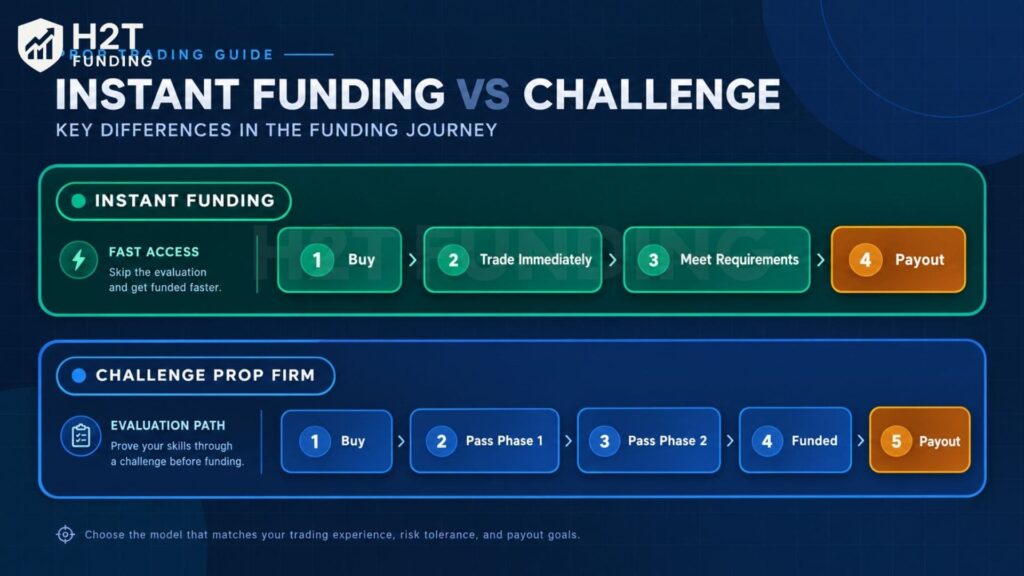
The main difference between the two models is when you gain access to the funded stage. Instant funding lets you start trading after purchase, while a challenge requires you to complete an evaluation first. That difference affects more than speed: it can also change your upfront cost, cost of failure, drawdown, payout timing, profit split, and scaling potential.
Instant funding may remove the evaluation but still impose strict drawdown and payout rules. A challenge adds an evaluation stage, but the lower entry fee or fee refund available on some programs can change its overall cost. Because firms structure these rules differently, the best comparison is not simply instant access versus evaluation-it is how much you pay, how much risk you have, and how quickly you can realistically reach a payout.
2. What Is Instant Funding?
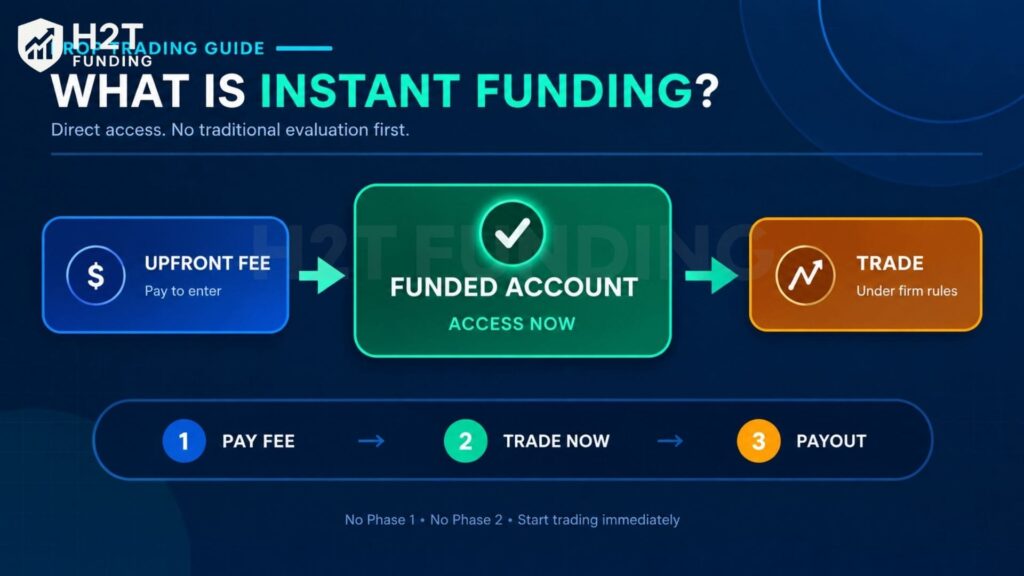
Instant funding is a prop firm model that gives traders direct access to a funded trading account without completing a traditional evaluation first. Traders pay an upfront fee and can start trading under the firm’s rules.
2.1. How Does Instant Funding Work?
The main difference is that instant funding removes the evaluation stage. You do not need to reach a profit target to qualify for the account.
However, instant funding does not mean unlimited trading freedom. The account can still have daily loss limits, maximum drawdown, profit requirements, minimum trading days, consistency rules, and payout conditions.
For example, an instant program may allow trading from Day 1 but require a certain profit level before the first payout. Another may use a trailing drawdown that moves as the account reaches new equity highs.
In practice, instant funding removes the evaluation, not the firm’s risk controls. The exact rules depend on the program.
2.2. Which Prop Firms Offer Instant Funding?
FundedNext is not the only prop firm offering instant funding. Several firms now provide direct-access programs that skip the traditional evaluation stage, although the account structure, drawdown rules, payout timing, and profit split can differ substantially.
The table below shows 3 Instant Funding Firms to compare
| Firm | Instant Funding Program | Key Structure |
|---|---|---|
| Funding Pips | Zero | No evaluation, 5% trailing drawdown, 3% daily loss limit |
| Funded Trading Plus | Instant Funding | No evaluation, 6% daily and 6% relative trailing drawdown, 80% base reward split |
| Goat Funded Trader | Instant GOAT | No evaluation, 3% trailing daily drawdown, 6% trailing max loss, 80% reward split |
Funding Pips offers its Zero instant funding model without an evaluation. The current structure uses a 5% trailing maximum drawdown and a 3% daily loss limit, with payout eligibility subject to its consistency and trading-day requirements.
Funded Trading Plus offers Instant Funding with no profit target or evaluation. Its current rules include a 6% daily loss limit, 6% relative trailing maximum drawdown, an 80% base reward split, and reward eligibility from the first active trading day, followed by a seven-day cycle.
Goat Funded Trader offers several instant models. Its Instant GOAT account currently has a 3% trailing daily drawdown, 6% trailing maximum loss, a 15% consistency rule, five valid trading days, and an 80% profit split with rewards on a 14-day cycle.
The key point is that instant funding is not a standardized model. Before purchasing, compare the specific program’s drawdown method, payout requirements, consistency rules, and profit split.
For a broader comparison, see our Best Instant Funding Prop Firms guide.
3. What Is a Challenge Prop Firm?
A challenge, also called an evaluation, requires you to meet predefined trading objectives before moving to the funded stage. The rules typically combine a profit target with drawdown limits, and some programs also require a minimum number of trading days or other consistency conditions.
Challenges commonly use one, two, or three steps:
- 1-step: You complete one evaluation stage by meeting the required trading objectives.
- 2-step: You complete a challenge phase followed by a verification phase, usually with different profit targets and risk limits.
- 3-step: You complete three evaluation stages before reaching the funded stage.
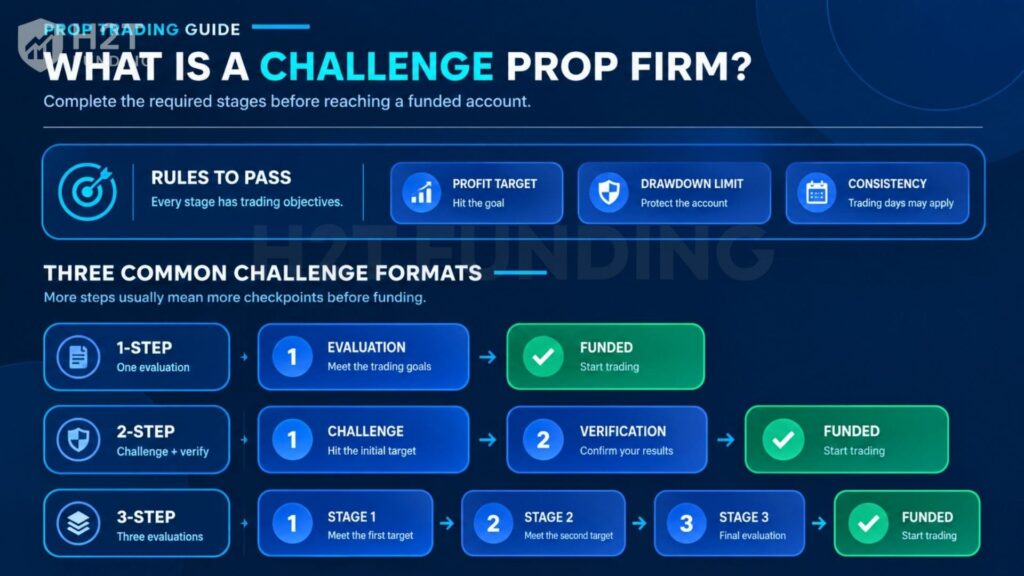
For example, a two-step challenge might require a 10% profit target in the first phase and 5% in the second, while keeping losses within specified drawdown limits. Passing both stages allows you to move to the firm’s funded program.
The key difference is therefore when the performance test happens. With instant funding, you trade first and work toward payout eligibility. With a challenge, you must meet the evaluation objectives before reaching the funded stage.
4. The Real Cost of Instant Funding vs Challenge
The entry fee is only one part of the total cost. When comparing instant funding with a challenge, look at four cost factors:
| Cost factor | Challenge | Instant Funding |
|---|---|---|
| Initial fee | Usually lower | Often higher |
| Cost of failure | Lose evaluation fee if failed | Account fee may be lost after a breach |
| Retry/reset | May require another evaluation | May require another account or reset |
| Refund | Some programs offer refunds after passing | Depends on the program |
A challenge with a lower entry price is not cheaper if you need several attempts. Conversely, a higher-priced instant account does not necessarily result in a higher total cost if you avoid repeated purchases and reach payout eligibility sooner.
The most useful comparison is therefore the potential cost before your first payout:
Total cost before payout = Initial fee + retry/reset costs + applicable recurring fees − eligible refunds
The actual cost will depend on the firm’s current terms and how many attempts you need. Before purchasing either type of account, check the fee structure, refund conditions, reset policy, and whether any charges continue after the initial purchase.
5. FundedNext Example: Instant Funding vs Challenge
FundedNext is a useful case study because it offers both Stellar Instant and challenge-based programs. For a direct comparison, the table below uses Stellar Instant vs Stellar 2-Step, rather than treating all FundedNext Challenge models as having the same rules.
| Factor | Stellar Instant | Stellar 2-Step |
|---|---|---|
| Account access | Direct FundedNext Account | After completing both challenge phases |
| Evaluation | No challenge | 2 phases |
| Profit target | None | 8% in Phase 1, 5% in Phase 2 |
| Daily loss limit | None | 5% |
| Maximum loss | 6% trailing | 10% static |
| Minimum trading days | None | 5 days per phase |
| First reward eligibility | On-demand at 5% growth, or bi-weekly at ≥1% growth | 21 days under the Standard option |
| Reward share | 70% at Tiers 1–2, up to 80% from Tier 3 | 80% under Standard, with scaling available |
| Challenge fee refund | N/A | Refundable with the first reward |
FundedNext states that Stellar Instant provides direct access without a challenge or profit target. It has no daily loss limit, while its maximum loss limit is a 6% trailing drawdown. Traders can request an on-demand reward after reaching 5% growth, or use the bi-weekly option with at least 1% growth. The reward share starts at 70% and increases to 80% from Tier 3.
For Stellar 2-Step, traders must reach an 8% Phase 1 target and 5% Phase 2 target, trade at least 5 days in each phase, and stay within a 5% daily loss limit and 10% static maximum loss limit. Under the Standard payout option, the first Performance Reward is available after 21 days, followed by 14-day cycles. The challenge fee is refundable with the first reward.
The reward structure also differs. Stellar Instant starts at a 70% reward share, while Stellar 2-Step’s Standard option starts at 80% after reaching the FundedNext Account. Other 2-Step payout options can change both the reward percentage and payout timing, so the selected option at checkout matters.
The FundedNext example shows that instant funding mainly removes the evaluation stage; it does not automatically mean lower risk, faster payouts, or a higher profit split. The actual drawdown, payout conditions, and reward structure depend on the specific program.
6. Instant Funding vs Challenge: Which Is Right for You?
There is no single funding model that works best for every trader. The better choice depends on how much you want to spend, how comfortable you are with an evaluation, how much usable drawdown you need, and how quickly you want to become eligible for a payout.
| Trader Profile | Better Fit |
|---|---|
| Beginner, still building a track record | Challenge. A lower-cost evaluation can provide a more controlled way to test your strategy against a firm’s rules before committing to an instant-funding account. You can also compare our best prop firms for beginners. |
| Experienced, consistent track record | Either, with instant funding worth considering. If you already have a consistent process, skipping the evaluation may be valuable when the program’s cost, drawdown, and payout rules fit your strategy. |
| Budget-conscious | Challenge. Some challenge programs have lower entry fees than instant accounts, and some offer a fee refund after passing and meeting payout conditions. Compare the full cost, including retries and resets. |
| Scalper, high trade frequency | Either, depending on drawdown. Pay close attention to whether the account uses an intraday or trailing drawdown, how it is calculated, and whether unrealized losses affect the limit. |
| Part-time trader | Either, depending on time limits. Look for a program without restrictive minimum-day or deadline requirements. A slower trading schedule should not force you to take unnecessary trades just to satisfy a rule. |
| Long-term scaler aiming for a large account | Either, depending on the scaling plan. Compare starting size, scaling milestones, maximum allocation, profit split changes, and the conditions required to increase your account. |
The table is only a starting point. Program rules matter more than the funding label itself. Two instant programs can have very different costs and drawdown rules, just as two challenge programs can have very different evaluation targets, payout conditions, and scaling structures.
6.1. Can You Use Both Models?
Yes. Using both models can make sense when each account serves a different purpose. For example, you might use an instant-funding program for immediate access while keeping a challenge account as a lower-cost route toward a larger allocation. You could also test two different models with a limited budget to see which rule structure better matches your trading approach.
However, using multiple accounts also increases the number of drawdown limits, payout conditions, trading restrictions, and account rules you need to monitor. A breach on one account does not necessarily affect another account, but each account creates a separate financial cost and management burden.
Before combining models, consider whether you can comfortably absorb the cost of another account if one is breached. It is also important to check each firm’s rules on copy trading, coordinated trading, hedging, account sharing, and other relationships between accounts, because these policies can differ.
The goal should be to use each account for a clear reason, rather than buying multiple programs simply because they offer different funding models.
7. FAQ
Neither is universally better. Instant funding provides direct access without a traditional evaluation, while a challenge requires predefined objectives first. Compare the total cost, drawdown rules, trading process, and payout terms.
It can suit traders who want immediate access and accept the program’s fees, drawdown, and payout rules. The value depends on the full cost and conditions, not access speed alone.
Costs vary by firm and account size. Some charge a one-time fee, while others may add recurring charges. Compare the total cost with the challenge fee and any refund or reset conditions.
There is no universal answer. Beginners should compare the cost of failure, drawdown rules, and trading requirements before choosing between the two models.
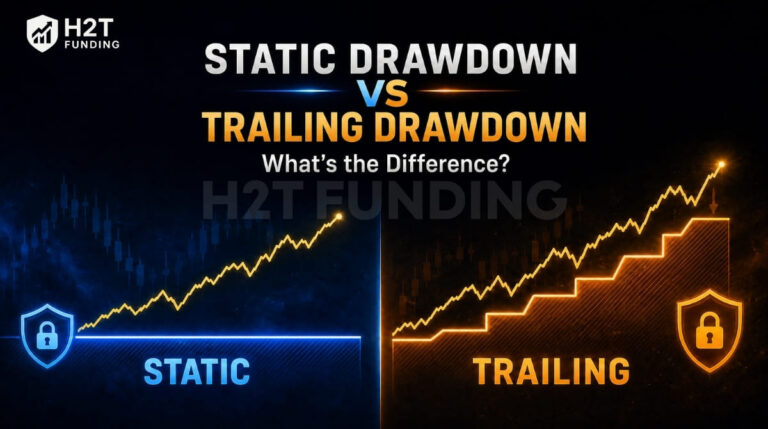
Neither model has a standard drawdown structure. Both can use static, trailing, dynamic, daily, or maximum drawdown rules. Check how the limit is calculated, when it updates, and whether it uses balance or equity.
There is no standard payout timeline. Programs may require minimum trading days, profit thresholds, consistency conditions, or fixed payout cycles. Immediate account access does not necessarily mean immediate profit withdrawals.
Many retail prop firms use simulated trading environments, while some offer a later path to live capital. “Funded” does not automatically mean the advertised account balance is real cash in a live brokerage account.
A 1-step challenge has one evaluation phase, while a 2-step challenge has two. Their profit targets, drawdown, minimum-day, consistency, and payout rules can differ, so compare the actual requirements.
For more examples, see our guide to one-step challenge prop firms.
Yes. Some traders use an instant account while evaluating a challenge account. This increases total cost and the number of rules to manage, so compare whether each account serves a distinct purpose.
8. Conclusion: Which Is the Better Choice?
Instant funding and challenge-based funding solve different problems. Instant funding prioritizes access: you can start trading without first completing a traditional evaluation. A challenge prioritizes evaluation: you pay for an opportunity to prove that you can meet the firm’s objectives before reaching its funded stage.
Instant funding may be a better fit if speed of access is important, you already have a consistent trading process, and the program’s cost, drawdown, and payout rules work with your strategy. A challenge may be a better fit if you want to limit the initial cost, are comfortable completing an evaluation, or prefer a program where passing can unlock different account or fee conditions.
The best choice is the model whose rules give you a realistic path from the initial payment to a sustainable payout. If you are ready to compare specific firms, explore our guide to best prop firms. Always check the firm’s current rules before purchasing because pricing, drawdown, payout, and eligibility conditions can change.