

DXtrade is a multi-asset, white-label trading platform developed by Devexperts. The platform experienced rapid adoption after 2024, when MetaQuotes, the company behind MetaTrader 4 (MT4) and MetaTrader 5 (MT5), restricted licensing for prop firms and forced traders to seek alternative software.
Built as a browser-based solution with integrated TradingView charting, DXtrade offers firms greater operational flexibility than traditional systems. However, you must navigate critical trade-offs such as automation limitations, firm-specific restrictions, and a high dependency on each firm’s individual setup.
This guide explains what DXtrade is, how it works, which firms currently use it, and the essential factors to consider before trading a funded account on this platform. If you are looking for a fast summary of the DXtrade platform, here are the essential facts:
Key Takeaways
- Software developer: Built by Devexperts (operated under Devexperts Solutions IE Limited), a financial software provider founded in 2002.
- Business model: Operates strictly as B2B software for brokers and prop firms. Devexperts does not hold trader funds, open accounts, or set trading rules.
- Asset coverage: Covers FX, CFDs, and crypto via DXtrade CFD, as well as U.S. stocks, options, and futures through DXtrade XT.
- Industry adoption: Onboarded over 40 prop firms within a year following the 2024 MetaTrader licensing shifts.
- Automation limits: Lacks native MetaTrader-style EA support (MQL4/MQL5). API access relies on individual firm permissions and is increasingly restricted.
- Custom setup: Trading rules, drawdown limits, and interface layouts are configured by the licensing prop firm, not Devexperts.
How we researched this guide?
This guide draws on Devexperts’ official documentation (dx.trade), Finance Magnates’ prop-trading coverage, and direct verification of individual firm policies (BrightFunded, Alpha Capital Group, FTMO). Claims below are grouped by source tier – official, industry-reported, and trader-reported – so you can judge how much weight to give each one.
1. What is the DXtrade platform?
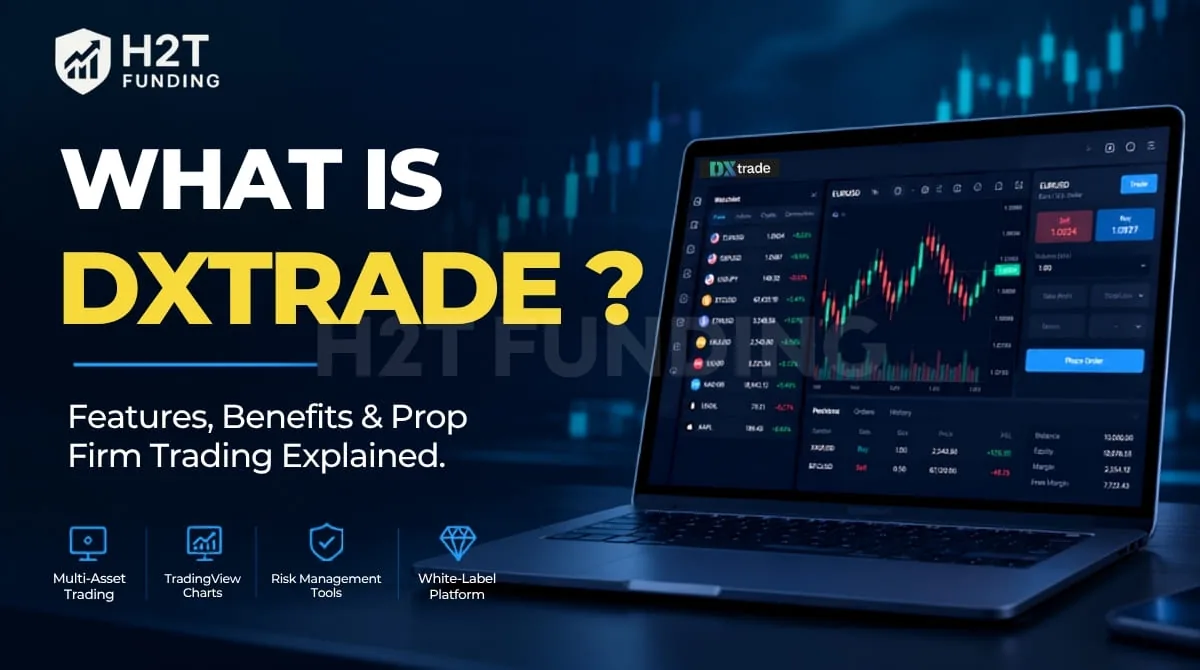
DXtrade is a multi-asset, white-label trading platform developed by financial software provider Devexperts. Designed specifically for brokers and prop trading firms, it delivers a browser-based trading interface covering forex, CFDs, commodities, crypto, stocks, options, and futures.
Because it operates as B2B software, individual brokers and prop firms license the technology to set their own trading rules, drawdown limits, and payout schedules.
1.1. Who owns DXtrade? Devexperts and its role
Devexperts is a financial software provider founded in 2002 in Munich, Germany. Per DXtrade’s own official site, the platform is currently operated under Devexperts Solutions IE Limited – an Ireland-registered entity – while the company maintains offices in multiple countries, including Germany and the U.S.
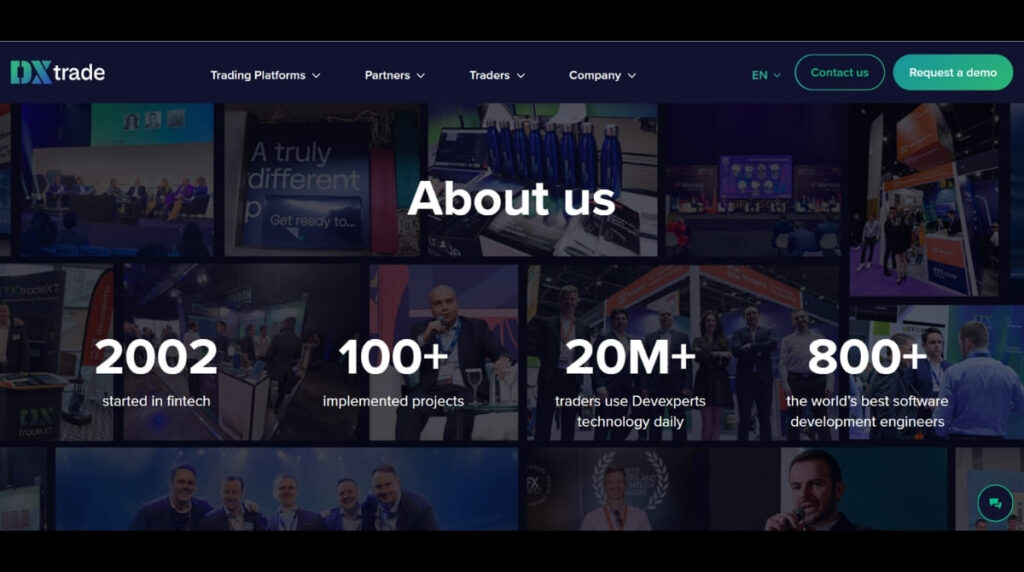
The firm also owns dxFeed, a real-time market data subsidiary that supplies pricing data directly to DXtrade XT.
Per DXtrade’s own Traders’ FAQ, Devexperts positions itself explicitly as a technology and software provider for brokers and prop firms – not a broker itself. It doesn’t hold trader funds, open trader accounts, or set trading rules; that responsibility sits entirely with the broker or prop firm licensing the platform.
Devexperts states plainly that it “does not provide any services to traders” and cannot engage with traders directly on account matters.
Devexperts has also been expanding beyond the core trading interface. In 2026, it integrated with Arizet Labs’ PropTech suite, connecting licensees to CRM, real-time risk monitoring, and payout-automation tools.
This extends its prop-trading offering into the operational layer that sits behind the trading interface itself, rather than remaining just a front-end platform.
1.2. DXtrade is a platform, not a broker or prop firm
The DXtrade platform is strictly a trading technology solution, not a financial broker or proprietary trading firm. Devexperts develops and licenses the underlying software, meaning it does not hold trader funds, issue trading accounts, or enforce evaluation rules.
Per its official Traders’ FAQ, all account-related inquiries – including login credentials, withdrawal requests, and rule disputes – must be managed directly with your specific broker or prop firm. Devexperts support teams have no access or visibility into individual firm accounts.
If you have already received your trading credentials from your firm and need assistance accessing the platform, you can follow our step-by-step guide on how to log in to your DXtrade account
1.3. Who uses DXtrade? Brokers and prop firms
The DXtrade platform is broker-agnostic and browser-based – with no desktop installation required – and is used by forex/CFD brokers, futures brokers, and prop trading firms.
Adoption accelerated after the 2024 MetaTrader licensing disruption in the prop trading industry. Devexperts has repeatedly reported onboarding more than 40 prop firms within roughly a year of that period – a figure describing a burst of adoption during 2024–2025, rather than a live, current headcount.
As of mid-2026, Finance Magnates coverage of continued platform expansion (including the Arizet integration and a new DDXpro dealing-desk integration) still cites that same “40+ in a year” figure rather than a newer total. Therefore, treat “40+” as historical rather than a current tally.
2. DXtrade vs. MetaTrader (MT4/MT5): why prop firms diversified
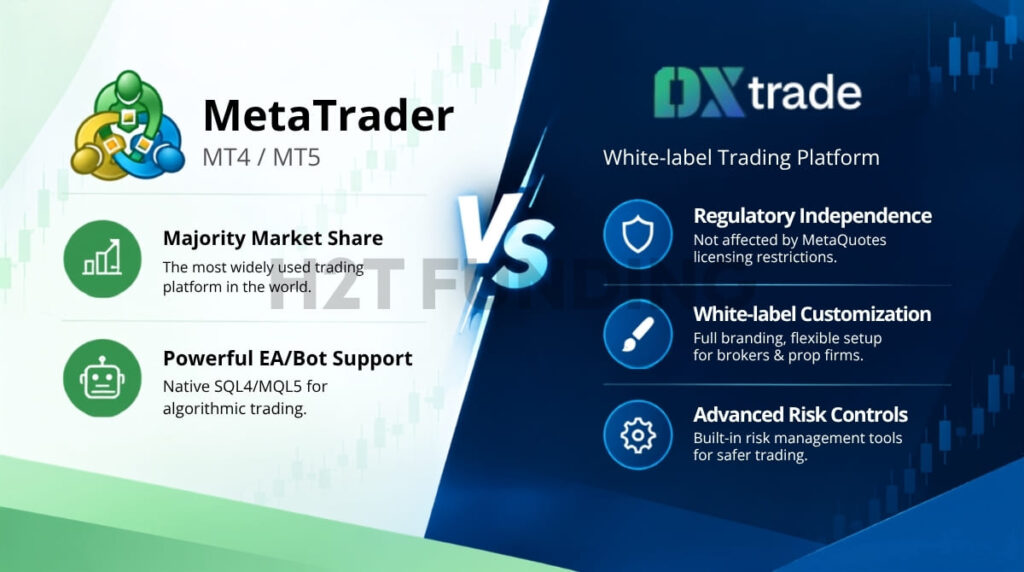
Prop firms diversified from MetaTrader to alternative platforms like DXtrade primarily due to MetaQuotes’ 2024 licensing crackdown on grey-label arrangements serving U.S. clients.
While MetaTrader still holds the majority market share, DXtrade offers firms greater regulatory independence, custom white-label branding, and built-in risk controls. However, this comes with significant trade-offs in native EA and algorithmic trading support.
2.1. The 2024 MetaTrader licensing disruption, explained
In early 2024, MetaQuotes began tightening its relationship with the prop-trading sector, disrupting firms that relied on MT4 or MT5 through broker or grey-label arrangements. During this upheaval, multiple firms faced severe operational impacts.
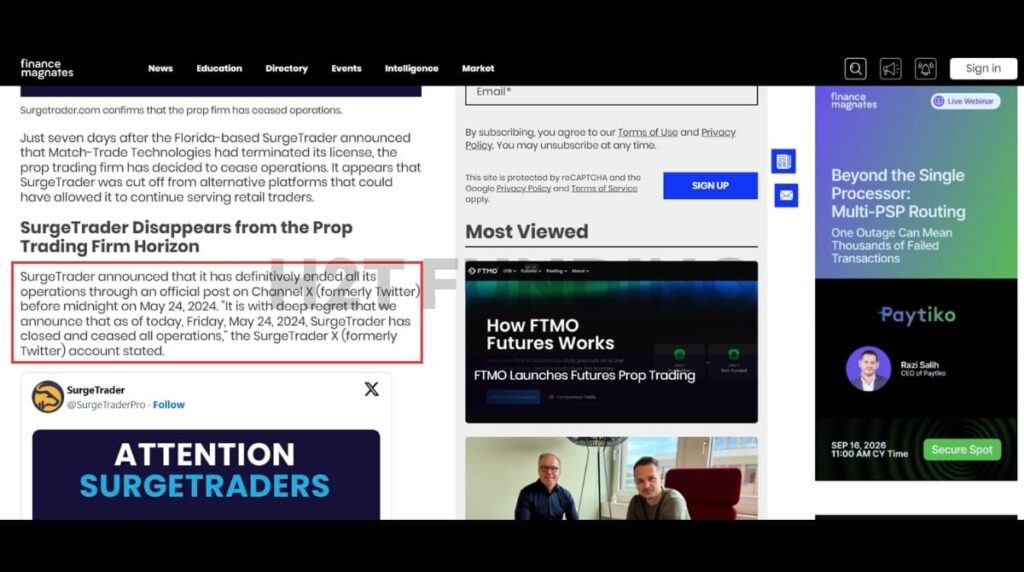
SurgeTrader, for example, lost access to MetaQuotes and subsequently had its Match-Trader license terminated before ceasing operations in May 2024.
The core issue centered on the grey-label licensing model, where firms ran evaluations through indirect broker setups rather than direct licenses.
This shift was widely attributed to concerns regarding U.S. regulatory exposure for firms serving American traders. The resulting industry fallout was substantial, with estimates suggesting that 80 to 100 prop firms may have disappeared during 2024.
Even during this shakeout, MT5 maintained its dominance, holding roughly 62% of prop-trading accounts according to Finance Magnates Intelligence. However, alternative platforms like cTrader, DXtrade, Match-Trader, and TradeLocker captured a growing share, leading firms like FTMO and FundedNext to diversify.
Devexperts benefited directly from this transition, onboarding more than 40 prop firms within a single year. The provider also expanded into futures trading support in August 2024 to better serve U.S.-focused clients
2.2. The EA and automation limitation
Limited automation remains a major constraint for algorithmic traders on this platform. DXtrade has no built-in scripting environment (such as MQL4 or MQL5) and offers no native Expert Advisor (EA) support out of the box.
While Devexperts provides REST, WebSocket, and FIX APIs for custom automation, access is strictly controlled by individual prop firms. Implementing these requires custom programming rather than standard plug-and-play files.
Furthermore, third-party integrations are actively being restricted. For instance, the trade-copier service PineConnector confirmed its integration was discontinued after several firms removed API access entirely.
Individual firm policies reflect this restrictive stance. Alpha Capital Group explicitly states that EA functionality is unavailable, while BrightFunded confirms that API and automated trading are not supported on their setups.
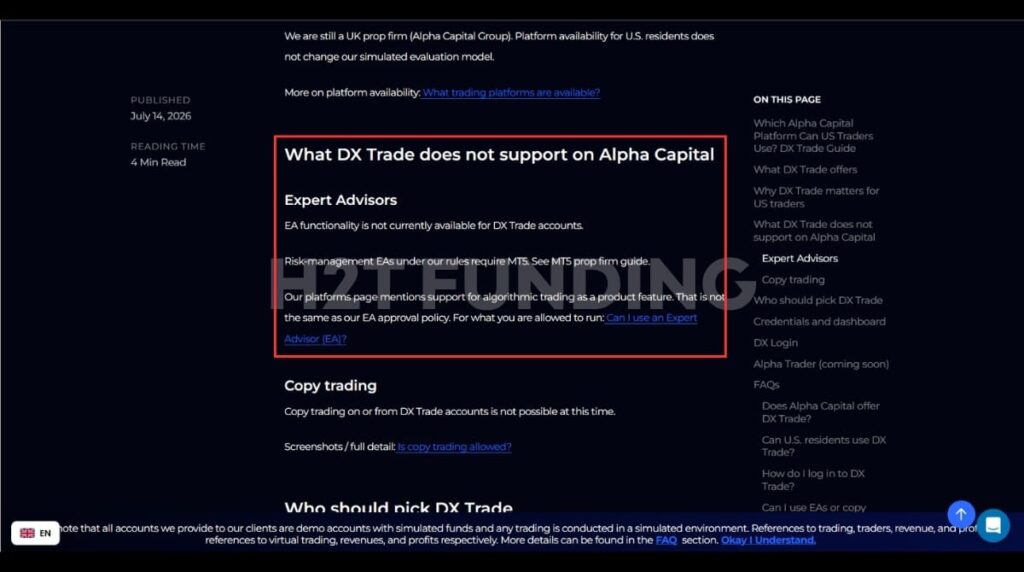
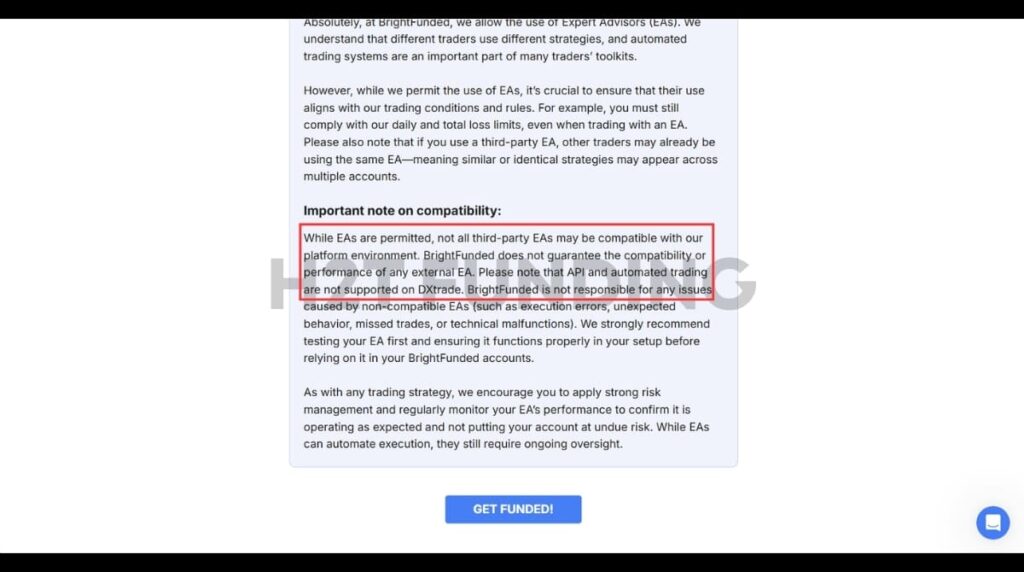
The practical takeaway is to assume the platform offers little to no automation support by default. Traders must always verify specific API policies directly with their chosen firm before opening an account.
2.3. The white-label model, and what it means for prop firms
Under a white-label licensing model, a prop firm licenses the software from Devexperts, fully brands the interface, and configures its own rules. This includes customized drawdown limits, profit splits, position limits, and daily loss limits.
Consequently, two firms using the exact same underlying technology can feel like completely different products. For example, FXIFY and Alpha Capital Group both offer DXtrade, yet each applies distinct rule sets and operational parameters.
If you encounter technical lag or system crashes, your primary point of contact is the prop firm. Day-to-day platform stability depends heavily on the firm’s specific infrastructure, server capacity, and software implementation.
2.4. Charting, mobile app, and branding differences
The platform features integrated charting capabilities powered by TradingView, allowing you to utilize advanced tools directly within the web interface, depending on the prop firm’s customized setup.
User feedback regarding the mobile application remains mixed. Recent reviews on Trustpilot note complaints regarding mobile crashes and layout glitches, although Devexperts has released continuous updates, including a redesigned home screen and expanded mobile charting.
Given the limited sample size of public reviews, it is more accurate to say that some traders report mobile issues rather than viewing this as a definitive, universal weakness of the platform.
3. DXtrade CFD vs. DXtrade XT: what’s the difference?
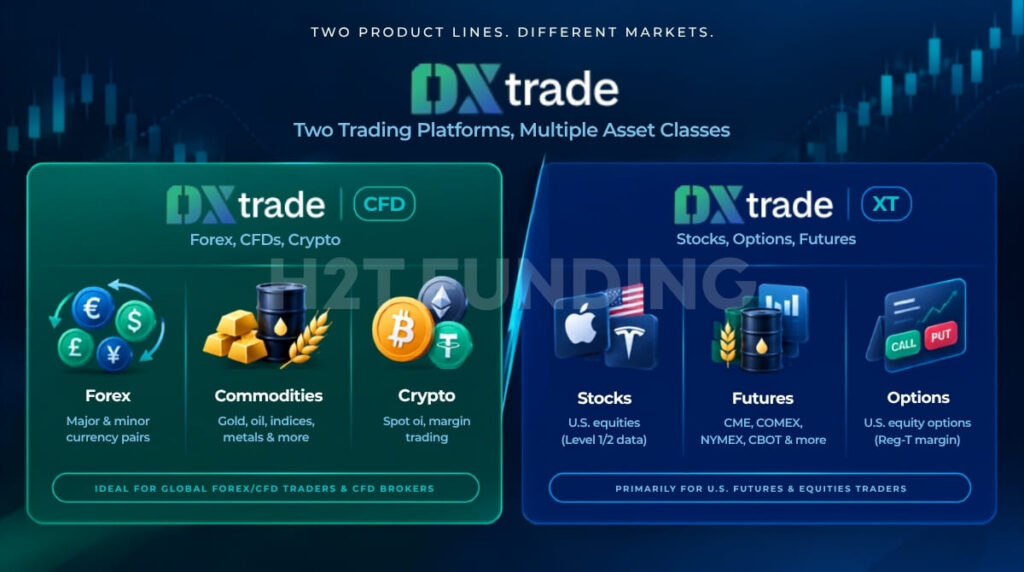
DXtrade comes in two distinct product lines, and conflating them is a common source of confusion.
| Criteria | DXtrade CFD | DXtrade XT |
|---|---|---|
| Asset classes | Forex, CFDs, spread bets, crypto | Stocks, options, futures |
| Target market | Global forex/CFD traders | Primarily U.S. futures and equities traders |
| Common use case | Forex prop firms, CFD brokers | Futures-focused and U.S.-based prop firms |
| Deployment time | Marketed as “up and running in a week” | Broker-dependent; Devexperts does not publish a specific XT timeline — futures data/margin setup (dxFeed, CME feeds, Reg-T/SPAN) can add time |
| Margin model | Broker-defined CFD margin | Reg-T / CME SPAN |
| Data source | Liquidity providers | dxFeed (CME Level 1/2 data) |
| Announced/launched | Live since May 2020 | Futures capability announced August 2024; ready for prop trading configuration by September 2024 |
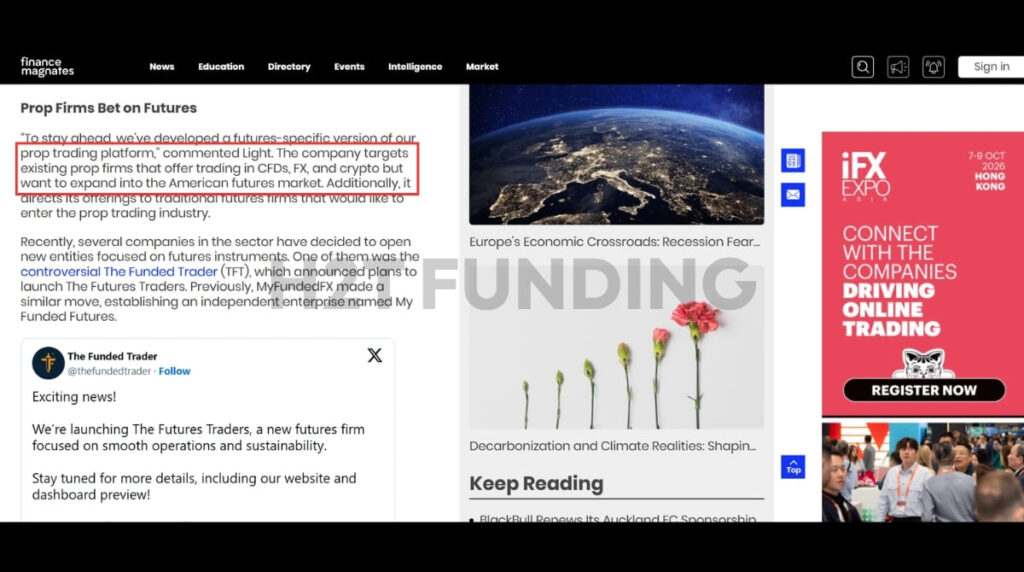
DXtrade XT was expanded to support U.S. futures prop firms as the prop trading industry diversified beyond MetaTrader, with futures requiring different market-data, margin, and risk-management infrastructure from FX/CFD trading.
3.1. Forex, CFDs, and crypto (DXtrade CFD)
DXtrade CFD covers forex pairs (availability varies by broker), CFDs on major indices, commodities, and metals, plus spot and margin crypto trading.
In June 2026, Devexperts announced a dedicated DXtrade Crypto front end aimed at brokers and prop firms running crypto-focused operations. Initially, it was made available for demonstrations only.
3.2 Stocks, options, and futures (DXtrade XT)
DXtrade XT handles U.S. equities, equity options, and futures contracts across major exchanges, including CME, COMEX, NYMEX, and CBOT.
Futures capability for prop trading configuration was ready by September 2024, largely developed to serve firms displaced by the MetaTrader licensing disruption.
4. Key features of DXtrade
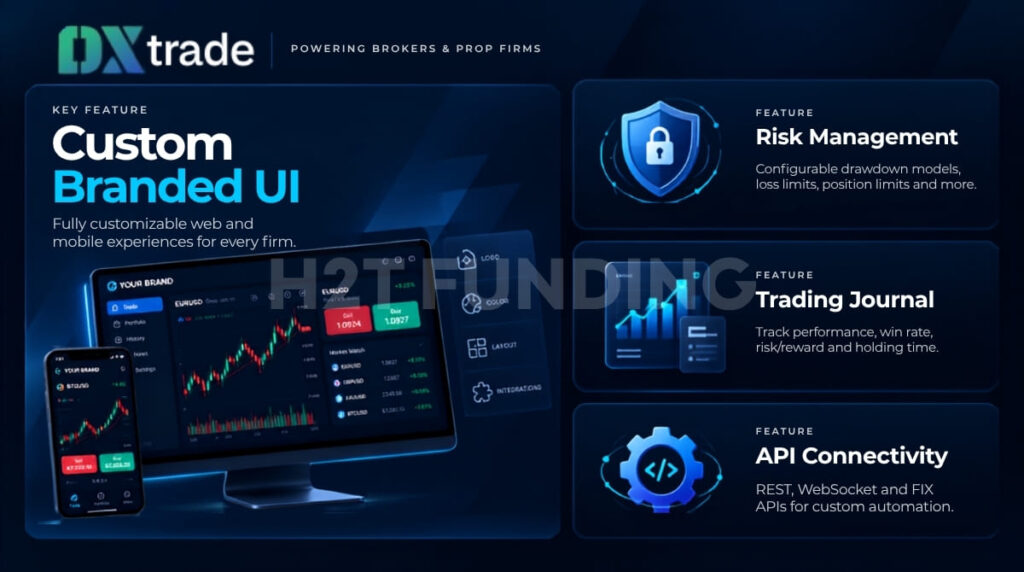
The core features of DXtrade focus on operational flexibility for prop firm operators and structured analytics for traders. Key highlights include fully customizable web and mobile interfaces, advanced back-office risk management tools (such as trailing drawdown controls and A/B/C book routing), a real-time trading journal, and API connectivity.
4.1 Branded web and mobile apps
The DXtrade platform allows licensees to offer fully branded web and mobile trading experiences. Visual branding, color schemes, page layouts, and third-party integrations are completely configurable according to each firm’s setup.
4.2 Risk management and back-office tools
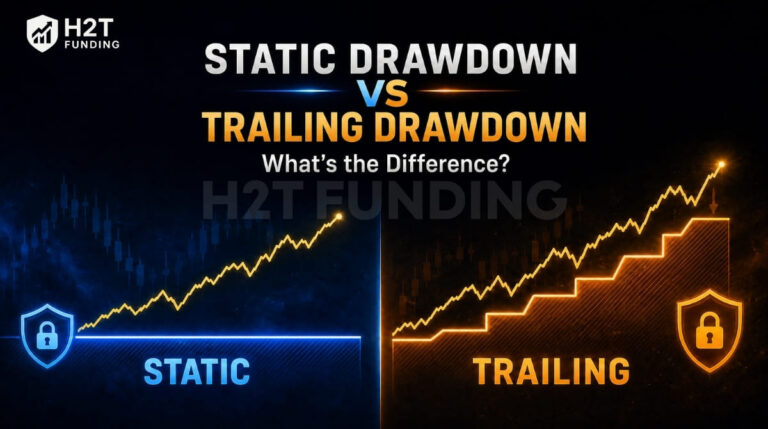
Per official technology documentation, the platform supports highly configurable risk parameters. These include multiple drawdown models (end-of-day trailing, real-time trailing, and static), daily loss limits, position limits, and automatic liquidation on rule breach.
It also features A/B/C book functionality for liquidity management alongside Reg-T and SPAN margin support for equities and futures respectively.
Critically, while the software provides these infrastructure tools, each prop firm determines its own rules and threshold parameters. Specific drawdown models or loss limits are prop firm decisions, not platform defaults.
4.3 Dashboard and trading journal
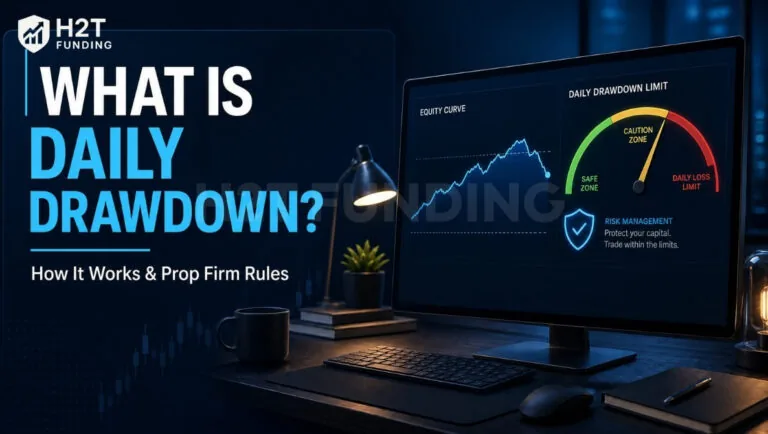
A real-time dashboard continuously tracks equity, drawdown, and margin status.
The built-in trading journal provides detailed performance metrics – including win rate, risk/reward ratio, and holding time for winning versus losing trades – confirmed directly on product documentation pages.
4.4 API access for custom automation
REST, WebSocket, and FIX APIs exist and are fully documented by Devexperts.
However, broker- and firm-level access to these APIs is strictly controlled. As of 2026, third-party automation bridges have been actively restricted or removed by multiple providers. An API existing on paper does not guarantee that individual traders will be granted access.
Note: DXtrade has no native EA support (no MQL4/MQL5). API access exists but is controlled entirely by your prop firm and is increasingly restricted – always confirm your firm’s specific policy before assuming you can run a bot.
5. DXtrade vs. cTrader
As prop trading firms diversified beyond MetaTrader, both cTrader and the DXtrade platform emerged as leading alternative trading solutions. While both cater to proprietary trading firms, they are designed around fundamentally different operational priorities.
The comparison table below outlines their key structural differences across developer background, deployment models, automation capabilities, and target use cases:
| Criteria | DXtrade | cTrader |
|---|---|---|
| Developer | Devexperts | Spotware |
| Deployment | White-label platform for brokers/prop firms | Broker/prop-firm platform |
| Automation | API-based; access controlled by and varies per provider, and increasingly restricted | Native cBots/cAlgo (C#) |
| Interface | Highly configurable per firm | Trader-focused, standardized interface |
| Best suited for | Firms needing configurable, fast-to-deploy infrastructure | Traders prioritizing native algo-trading tools |
Both platforms serve overlapping use cases in the prop trading space, but they optimize for different things: DXtrade for operator flexibility and white-label branding, cTrader for native trader-side automation.
Claims about relative execution speed or “which traders prefer which platform” aren’t backed by any independent benchmark we could verify, so this guide sticks to structural differences rather than performance claims.
6. Which prop firms use DXtrade?
This list reflects firms with a current, verifiable “Platforms” listing at the time of research. Platform availability changes often, so always confirm directly on the firm’s own website before signing up for an evaluation.
Currently listing DXtrade:
- FXIFY – lists DXtrade alongside MT4, MT5, and TradingView across its programs.
- Alpha Capital Group – lists DXtrade alongside MT5 and cTrader.
- Funded Trading Plus – lists DXtrade alongside MT5, Match-Trader, and cTrader.
- BrightFunded – supports DXtrade. EAs are generally permitted at BrightFunded, but API and automated trading are explicitly not supported on the DXtrade platform specifically.
- Tradeify Crypto – partnered with Devexperts in 2026 to offer DXtrade to perpetuals/crypto traders.
Note:
Do not list as a current DXtrade user: FTMO previously offered DXtrade but discontinued it as a selectable platform for new accounts effective March 24, 2026; existing DXtrade accounts were migrated to other platforms. FTMO should not appear in a “currently uses DXtrade” list.
7. Choosing a prop firm that uses DXtrade
Since platform quality depends heavily on how each firm implements it, a few practical checks matter more than the platform name itself:
- Check the automation policy directly with the firm. DXtrade has no native EA support, and API/automation access is increasingly restricted, not standard – if you rely on an EA, an MT5 or cTrader-based firm is likely a better fit.
- Read firm-specific reviews, not just general DXtrade sentiment, since implementation quality varies by firm.
- Confirm asset coverage. Some firms only offer DXtrade CFD (forex/crypto); others also offer DXtrade XT for futures.
- Review the drawdown and loss-limit rules the firm has configured – these are set by the firm, not by DXtrade itself.
- Verify the platform is still current before paying for an evaluation; FTMO’s March 2026 removal of DXtrade shows this can change with little notice.
Ultimately, choosing the right firm matters more than choosing the platform.
8. Is DXtrade good? What traders are actually saying
Whether DXtrade is good depends on your specific needs and how your prop firm implements it.
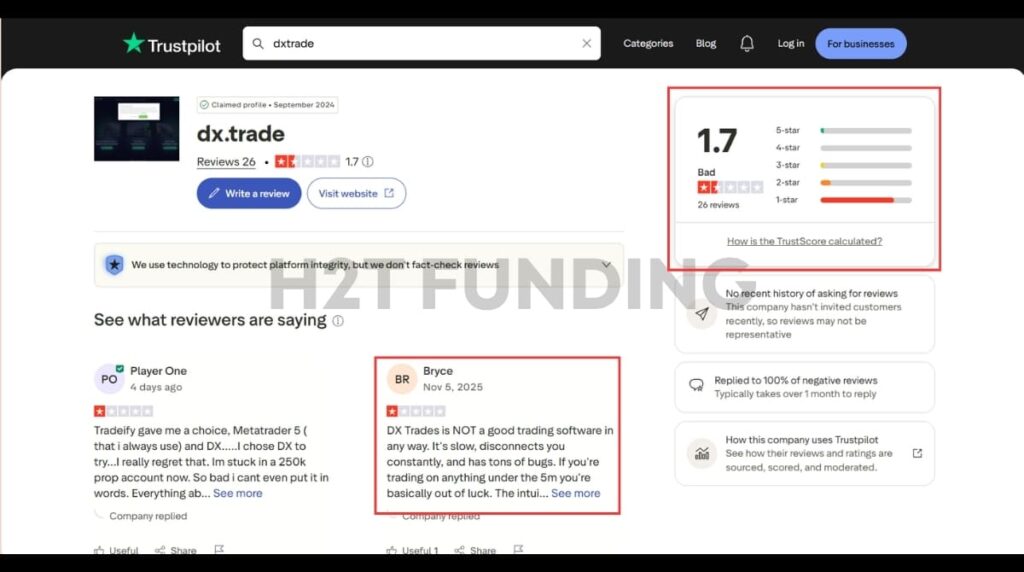
Prop firm operators favor its rapid 7-day deployment, integrated TradingView charts, and built-in risk controls. However, trader feedback on Trustpilot is mixed, with complaints about mobile crashes, lag, and lack of native EA support.
Evaluating the DXtrade platform fairly requires separating information sources by Tier based on the specific type of claims they actually support:
Tier 1 – Official sources (Devexperts & prop firms)
The software is positioned around integrated TradingView charts, configurable risk controls, and fast turnkey deployment (~7 days marketed for DXtrade CFD). With its 2026 Arizet integration, it offers a broader “prop stack” combining trading interfaces with CRM and risk management tools.
Tier 2 – Industry reporting (Finance Magnates & similar)
Platform growth is well documented as a direct beneficiary of firms diversifying away from MetaTrader. Key milestones include onboarding over 40 prop firms within a year, expanding into futures in 2024, and launching Arizet and DDXpro integrations in 2026.
Tier 3 – Trader reviews (Trustpilot – small sample):
Its Trustpilot profile is currently rated “Poor” based on a small sample of under 50 reviews. Recurring negative themes report lag, crashes, usability friction, and a dated interface compared to alternatives. Positive reviews highlight charting quality and overall usefulness.
Because the sample size is small, these reviews reflect directional trader sentiment rather than a statistically conclusive verdict. Furthermore, Devexperts emphasizes that account-level issues are managed directly by the licensing broker or prop firm.
Tier 4 – Firm-level implementation
Performance quality varies meaningfully between licensees. Because this is white-label technology, a specific firm’s infrastructure rollout heavily drives the user experience.
A fair caveat: much of the online frustration plausibly stems from traders being moved onto new software involuntarily after their preferred firm dropped MetaTrader, rather than purely reflecting platform defects.
The platform is neither definitively good nor bad. Its suitability depends on your trading strategy, the specific prop firm’s implementation, and whether you require native EA automation support.
9. FAQs
Not universally. MT5 offers more mature native EA and MQL-based automation, while DXtrade relies more heavily on provider-controlled APIs and integrations.
Yes, depending on the broker or prop firm’s offering. DXtrade supports U.S.-focused products such as futures, stocks, and options through DXtrade XT.
No. Traders don’t purchase a DXtrade license – Devexperts licenses the platform to brokers and prop firms, and the firm sets any evaluation fees, spreads, or commissions charged to traders.
No direct trader demo exists. The demo available directly on dx.trade is designed specifically for B2B brokers and prop firms evaluating the software, not for individual traders – as stated explicitly in official Traders’ FAQ documentation.
Compare firms that currently list DXtrade based on your asset focus and automation needs – check each firm’s own platforms page directly, since this list changes.
Yes, as underlying technology. The core software is actively maintained and regularly updated by Devexperts.
No. DXtrade doesn’t support native copy trading like some MetaTrader brokers do. However, some firms offer copy trading services outside the platform.
Not exactly, but key features are available. The terminal calculates real-time Profit and Loss (P&L) and used margin, while DXtrade XT and DXtrade CFD offer what-if analysis and exposure widgets. For MT4 or MT5 style lot-size calculators, third-party tools are compatible depending on your firm’s API access policy.
10. Conclusion
Ultimately, DXtrade serves as core infrastructure rather than a flawless solution. Its value hinges on two factors: managing without native EA automation and how reliably your chosen firm implements the software.
If you are navigating post-2024 platform shifts, evaluating these trade-offs upfront is essential. Visit H2T Funding to compare verified evaluation programs, or browse our prop firm guides to refine your approach for alternative platforms.
Have you traded on a DXtrade account? Share your feedback or questions in the comments below!
Disclaimer: Platform offerings and automation policies can change without notice. Current as of September 2026. Always verify directly on official firm websites before trading.