



Static drawdown vs trailing drawdown comes down to one thing: whether your loss limit stays fixed or moves with your account balance. Neither model is the clear choice for every trader. Static drawdown sets a fixed floor based on your starting balance and never changes. Trailing drawdown rises along with your account’s highest value, which means new profits can shrink the room you have left to lose.
Static drawdown and trailing drawdown are two common risk models used by prop firms. Both models are designed to protect a prop firm’s capital, but they can affect your position sizing, profit-taking, and overall trading strategy.
In this guide, we explain how static and trailing drawdown work, show you how to calculate your remaining loss allowance, and explore which model may be better suited to different trading styles
Before buying an evaluation or trading a funded account, check the firm’s current rulebook for the exact calculation, update time, equity treatment, and breach consequences.
Key Takeaways:
- Profit effect: profits create more loss room under a static model, but may tighten the effective buffer under a trailing model.
- Methodology matters: balance vs. equity and intraday vs. EOD timing can change the rule.
- Best choice: neither model is universally better; the right structure depends on your strategy and typical pullback.
Important: “Static drawdown” and “trailing drawdown” describe how the loss floor behaves. A prop firm may use a different official name, such as Maximum Loss or Maximum Loss Limit, for a similar rule.
1. Static vs Trailing Drawdown: Key Differences
The main difference between static and trailing drawdown is how the drawdown floor changes as the account grows. A static floor remains fixed, while a trailing floor can move higher when the account reaches a new high-water mark.
This difference affects how much loss room a trader has, how predictable the risk limit is, and how aggressively profits can be given back.
| Feature | Static Drawdown | Trailing Drawdown |
|---|---|---|
| Drawdown Floor | Remains fixed | Can move higher as the account reaches new highs |
| Effect of Profits | Increases available loss room | Can reduce the available loss buffer |
| Predictability | Higher | Lower |
| Recovery Room | Generally greater after profits | Generally tighter after profits |
| Key Factors to Check | Floor calculation and breach condition | High-water mark, update timing, and breach condition |
1.1. Drawdown Threshold
With static drawdown, the threshold is calculated from the account’s starting value and remains fixed. For example, a $100,000 account with a $10,000 drawdown limit has a permanent floor of $90,000, even if the account later becomes profitable.
With trailing drawdown, the threshold follows the account’s highest recorded value, also known as the high-water mark. When the account reaches a new qualifying high, the floor moves higher according to the firm’s rules. If the account later loses money, the floor generally remains at its highest adjusted level rather than moving back down.
1.2. Effect of Profits: What Happens When You Make $5K or $10K?
The following is a simplified percentage-based trailing model. Actual prop-firm rules may use fixed-dollar amounts, balance, equity, or different update methods.
| Account Value | Static Floor | Trailing Floor | Static Loss Room | Trailing Loss Room |
|---|---|---|---|---|
| $100,000 (start) | $90,000 | $90,000 | $10,000 | $10,000 |
| $105,000 (+$5K) | $90,000 | $95,000 | $15,000 | $10,000 |
| $110,000 (+$10K) | $90,000 | $100,000 | $20,000 | $10,000 |
Under static drawdown, the floor remains fixed, so profits increase the distance between the account value and the breach threshold. Under the simplified trailing model, the floor rises with the account, keeping the effective loss buffer roughly constant. This is why traders should compare remaining loss room, not just the advertised drawdown percentage.
2. Static Drawdown: How the Loss Floor Stays Fixed
2.1. What Is Static Drawdown?
Static drawdown is a maximum-loss limit where the drawdown floor remains fixed after it is established. The floor is typically calculated from the account’s starting balance or initial capital and does not rise when the account becomes profitable.
Unlike trailing drawdown, a static floor does not move higher when the account reaches a new high. This gives traders a more predictable loss boundary and makes it easier to calculate how much drawdown room remains.
2.2. Static Drawdown Formula & Example
The basic formula is:
Static Floor = Starting Balance − Maximum Drawdown
The maximum drawdown is often expressed as a percentage of the starting balance and then converted into a fixed dollar amount.
| Metric | Value |
|---|---|
| Starting Balance | $100,000 |
| Drawdown Limit | 10% ($10,000) |
| Static Floor | $90,000 (fixed) |
| Floor After +$8,000 Profit | Still $90,000 |
In this example, the $90,000 floor remains unchanged even after the account earns $8,000. 3. Trailing Drawdown: How the Loss Floor Moves and Locks
3.1. What Is Trailing Drawdown?
Trailing drawdown is a maximum-loss limit that can move higher as an account reaches new qualifying highs. The floor follows a defined high-water mark, which may be based on balance, equity, or another account value depending on the firm’s rules.
Unlike static drawdown, the floor generally does not move back down after a pullback. This can reduce the loss room available after profitable periods.
3.2. Trailing Drawdown Lock Level
Some firms use a lock level, where the trailing floor stops moving higher after reaching a specified point. A lock is a mechanism within a trailing rule, not a separate drawdown type. Its level and conditions vary by program.
For a detailed explanation of high-water marks, trailing methods, lock levels, and breach rules, see our guide to What Is Trailing Drawdown?.
4. How to Calculate Your Remaining Loss Room
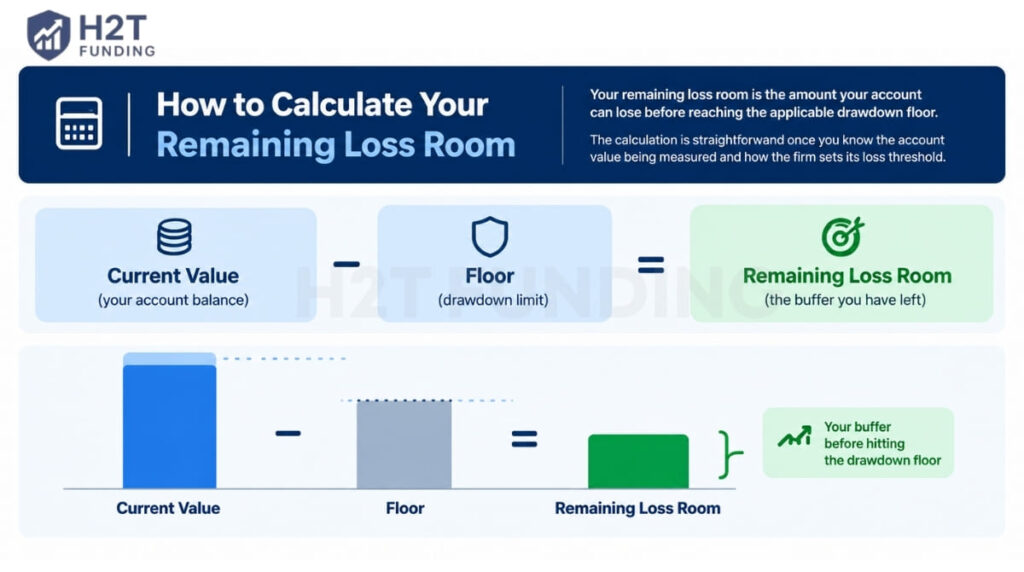
Your remaining loss room is the amount your account can lose before reaching the applicable drawdown floor. The calculation is straightforward once you know the account value being measured and how the firm sets its loss threshold.
4.1. Static Drawdown Example
With static drawdown, the floor remains fixed throughout the account.
Static Drawdown Floor = Starting Balance − Maximum Drawdown
Remaining Loss Room = Current Account Value − Static Drawdown Floor
For example, suppose a $100,000 account has a $10,000 static drawdown, creating a fixed floor of $90,000. If the current account value is $104,000:
$104,000 − $90,000 = $14,000 Remaining Loss Room
The remaining loss room is therefore $14,000.
4.2. Trailing Drawdown Example
Some prop-firm programs use a percentage-based trailing drawdown, where the loss limit is calculated from the account’s high-water mark. For example, OANDA’s current Trading Challenge rules use a 10% trailing Maximum Drawdown on its 500K plan, with the limit calculated against the account’s high-water mark balance.
The formula below illustrates how this type of trailing model can work. It is a simplified example, not a calculation for a specific prop-firm account:
Percentage-Based Trailing Floor = High-Water Mark × (1 − Trailing Drawdown Percentage)
For example, assume a trading account has a $104,000 high-water mark and a 10% percentage-based trailing drawdown.
First, calculate the percentage remaining above the drawdown allowance:
100% − 10% = 90%
Then calculate the trailing floor:
$104,000 × 90% = $93,600
The resulting trailing floor is $93,600.
If the current account value is also $104,000, the remaining loss room would be:
$104,000 − $93,600 = $10,400
This example shows how a percentage-based trailing rule can recalculate the floor as the high-water mark increases.
Important: Percentage-based trailing is only one possible methodology. Prop firms may instead use a fixed-dollar trailing allowance, balance or equity high-water marks, intraday or EOD updates, or a lock level. Always check the specific program’s official rules before calculating your actual loss room.
5. Balance vs. Equity in Drawdown Calculations
Static and trailing describe how the drawdown floor behaves. Balance and equity describe which account value the firm uses to calculate, update, or test that floor.
5.1 What Is Balance?
Balance is the account value based on closed trades and other realized account activity. It does not include unrealized profit or loss from positions that are still open.
For example, if you start with $100,000 and close trades for a $2,000 profit, your balance becomes $102,000. If you then open a position showing another $3,000 in unrealized profit, your balance remains $102,000 until that position is closed.
5.2 What Is Equity?
Equity reflects the account’s current value, including unrealized P&L from open positions, also known as floating P&L.
A simple way to calculate it is:
Equity = Balance + Unrealized P&L
For example, if your balance is $100,000 and an open position is showing a $3,000 unrealized profit, your equity is $103,000. If the position moves against you and the unrealized P&L changes to -$2,000, your equity falls to $98,000 even though your balance remains $100,000.
This means equity can change continuously while you have open positions, while balance normally changes when trades are closed. A firm’s rules may also include commissions, swaps, or other costs when calculating equity.
5.3 How Balance and Equity Affect Drawdown
The important question is not simply whether a firm uses balance or equity. You need to know where each value is used in the drawdown calculation.
A firm can, for example:
- Use balance to establish or update the drawdown floor.
- Use the highest qualifying balance as the high-water mark under a trailing rule.
- Use equity to check whether the account has breached the floor.
This means your balance can remain above the drawdown threshold while your equity falls below it because an open position has moved into a loss.
For example, if a firm’s drawdown floor is $95,000 and your balance is $100,000, you may appear to have $5,000 of room based on balance. But if an open position creates a $6,000 unrealized loss, your equity falls to $94,000. If the firm’s breach rule is equity-based, the account could breach even though the balance is still above $95,000.
5.4 What to Check in the Firm’s Rules
Before trading, check exactly how the firm handles each part of the calculation:
- Floor calculation: What account value establishes the drawdown floor?
- High-water mark: Does a new high come from balance, equity, or another value?
- Update timing: Does the floor update intraday, at the end of the day, or under another schedule?
- Breach test: Is the account tested using balance, equity, or both?
- Floating P&L: Can unrealized profit or loss affect the floor or trigger a breach?
- Fees: Are commissions, swaps, or other costs included?
FTMO provides a clear example of why these details matter. Its current 1-Step Maximum Loss is an end-of-day trailing limit calculated using the highest qualifying account balance, while a breach is assessed using equity, including open-position P&L, swaps, and commissions.
Important:
- Balance vs. equity is not a third drawdown type. The two primary models are static and trailing. Balance and equity describe how the firm’s rules measure account value within those models.
- Maximum drawdown is also different from a daily loss limit. Maximum drawdown generally defines the account’s overall loss boundary, while a daily loss limit restricts losses during a defined trading day. The exact calculation, reference value, and reset rules are firm-specific.
6. Trailing Drawdown: Intraday vs EOD
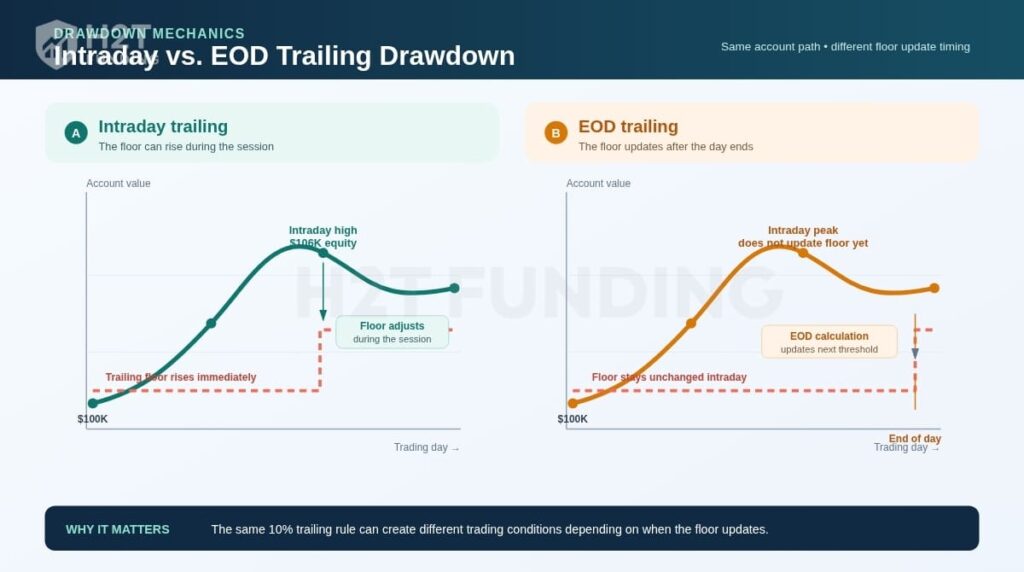
Trailing drawdown can use different update schedules. The two common approaches are intraday trailing and end-of-day (EOD) trailing.
6.1. Intraday Trailing Drawdown
With intraday trailing drawdown, the threshold can move higher during the trading session when the account reaches a new qualifying high.
Depending on the firm’s rules, that high may be based on balance, equity, or another account-value measure. If unrealized profit is included, a temporary gain on an open position can raise the trailing floor before the trade is closed.
For example, suppose a $100,000 account has a $5,000 trailing allowance. If the firm’s rules use intraday equity and the account reaches $106,000 while a position is open, the trailing floor could move higher based on that qualifying high. If the trade later reverses, the floor may remain at the higher level.
This can make intraday trailing more demanding for traders who regularly allow profitable positions to retrace.
6.2. End-of-Day Trailing Drawdown
With end-of-day (EOD) trailing drawdown, the firm updates the trailing threshold according to a defined end-of-day calculation rather than continuously throughout the trading session.
For example, Topstep states that its standard Maximum Loss Limit rises as the account’s end-of-day balance grows and never moves down.
MyFundedFutures also uses different trailing methodologies across its programs. Its Builder plan uses an EOD trailing drawdown that adjusts after the market closes, while its Rapid funded account uses an intraday trailing drawdown.
These examples also show why EOD and intraday should not be treated as synonyms for balance and equity: both update timing and account-value methodology can vary by program.
6.3. Why the Difference Matters
The update schedule can materially change the amount of drawdown room available during a trading session.
Under an intraday trailing model, a qualifying intraday high can raise the floor before the position is closed. Under an EOD trailing model, an intraday peak may not affect the next threshold until the firm’s defined end-of-day calculation occurs.
This is why two programs can advertise the same 10% trailing drawdown but create different trading conditions.
For a real-world example of how EOD and intraday trailing drawdown can create different trading conditions, see our guide to Apex Trader Funding payout rules.
7. Examples of Static and Trailing Drawdown at Prop Firms
Prop firms can use different drawdown structures across their programs. The examples below show how the static and trailing models are currently applied in selected programs.
| Prop Firm | Example Program | Drawdown Model | Key Mechanic |
|---|---|---|---|
| FTMO | 2-Step Challenge | Static | Maximum Loss is fixed at 10% of Initial Simulated Capital. |
| FTMO | 1-Step Challenge | EOD Trailing | Maximum Loss uses an end-of-day trailing calculation based on qualifying account balance; breaches are assessed using equity. |
| Topstep | Standard Trading Combine | EOD Trailing | The Maximum Loss Limit rises with the account’s end-of-day balance and never moves down. |
| Apex Trader Funding | EOD Evaluation | EOD | Drawdown is calculated once per day at market close and the resulting threshold is enforced during the following trading session. |
| MyFundedFutures | Builder | EOD Trailing | The Maximum Loss Limit adjusts after the market closes and trails upward based on qualifying EOD account values. |
| MyFundedFutures | Rapid funded account | Intraday Trailing | The funded Rapid account uses intraday trailing drawdown, which can follow unrealized gains until the trailing threshold locks. |
| FundedNext | Stellar 2-Step | Static | Maximum Loss is fixed at 10% of the initial balance. |
| FundedNext | Stellar Instant | Trailing | Maximum Loss is 6% and uses a trailing methodology that rises with profits. |
These examples show why the drawdown percentage alone is not enough to compare prop-firm accounts. The floor calculation, high-water mark, update timing, and breach method can create very different trading conditions even when two programs advertise a similar drawdown percentage.
Note: These examples are based on the firms’ published rules and illustrate different drawdown structures rather than ranking or recommending the firms. Prop-firm rules can change, so verify the current rules for the specific account before purchasing or trading. Last checked: September 2026.
8. What Happens If You Breach the Drawdown Limit?
A drawdown breach can occur under different circumstances, and its consequences depend on how the firm defines, detects, and manages the violation.
8.1. When Is a Breach Triggered?
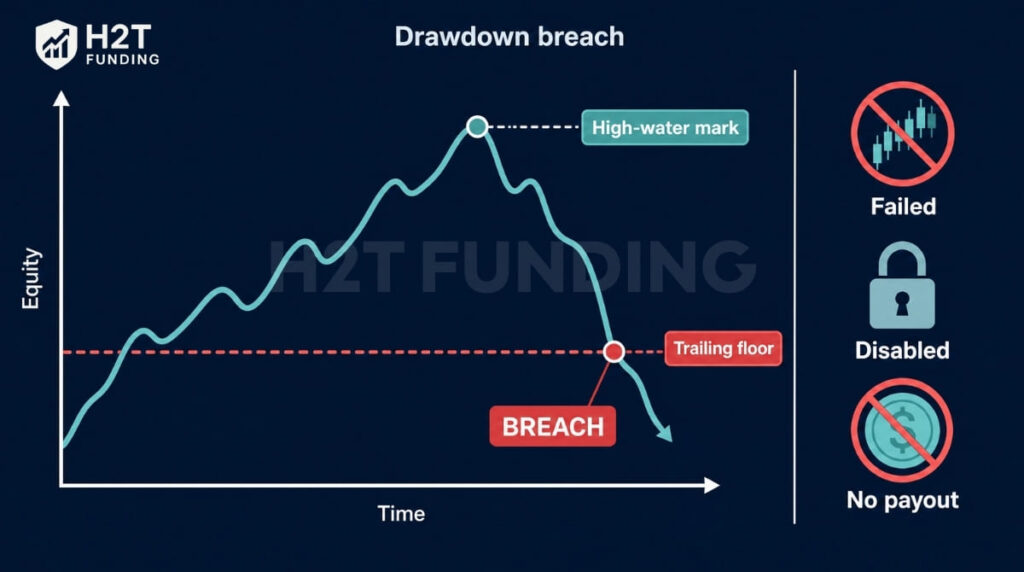
A drawdown breach occurs when the account’s qualifying value reaches or falls below the applicable drawdown floor, based on the firm’s specific calculation methodology.
The value used to determine a breach may be balance, equity, or another defined measure. Some firms also include floating P&L, commissions, swaps, or other trading costs in the calculation. Because the exact trigger varies, traders should follow the firm’s official definition of the drawdown threshold.
8.2. Can You Breach While Still in Profit?
Yes, you can. A trailing drawdown can move higher as your account reaches new highs, so you may still be profitable compared with your starting balance but below the current drawdown floor.
For example, suppose:
- Starting balance: $100,000
- Fixed trailing allowance: $5,000
- High-water mark: $110,000
- Trailing floor: $105,000
If the account later falls to $104,500, the trader has:
- $4,500 profit relative to the original starting balance
- But is $500 below the current trailing floor
Under this simplified example, the account would breach the trailing limit, assuming the program uses these values to determine the violation.
The key point: Being profitable relative to the starting balance does not mean the account is safely above its current trailing drawdown floor.
8.3. What Happens After a Breach?
The consequences of a drawdown breach are firm-specific. Depending on the program, the account may be:
- Marked as failed
- Disabled or terminated
- Have open positions automatically closed
- Become ineligible for further trading or payouts
Not every firm handles a breach in the same way. Before trading, check the firm’s official terms for the breach threshold, detection method, position handling, and account status after a violation.
9. Which Drawdown Model Is Better for Traders?
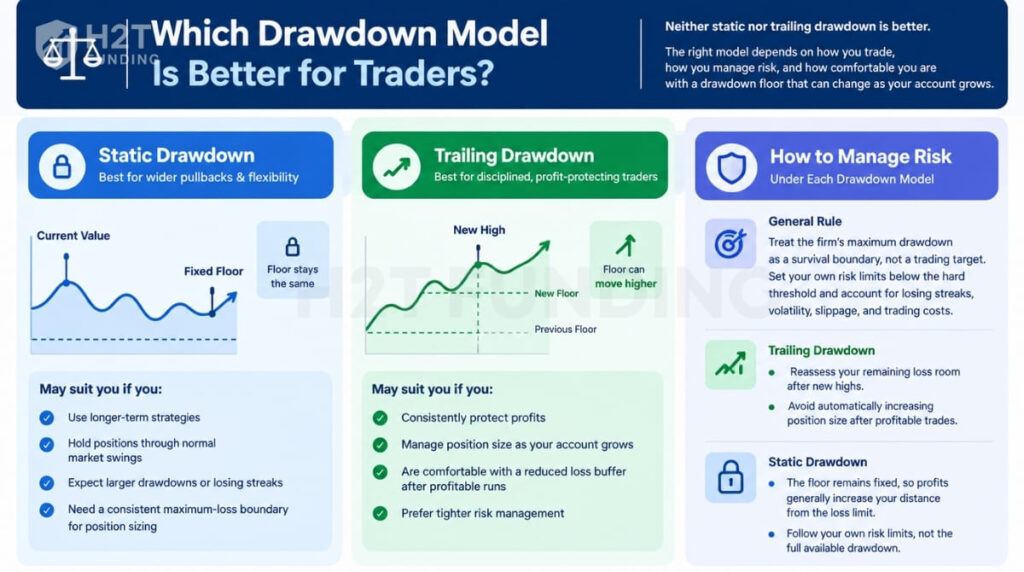
Neither static nor trailing drawdown seems to be better. The more suitable model depends on how you trade, how you manage risk, and how comfortable you are with a drawdown floor that can change as the account grows.
9.1. When Static Drawdown May Be Better
Static drawdown may be a better fit for traders whose strategies regularly experience wider pullbacks or require more flexibility after profitable trades.
This can include traders using longer-term strategies, holding positions through normal market swings, or following systems where losing streaks and drawdowns are expected to vary over time. A fixed floor can make it easier to plan position size around a consistent maximum-loss boundary.
The key question is not whether static drawdown is safer in every situation, but whether a fixed loss boundary matches the way your strategy typically moves between winning and losing periods.
9.2. When Trailing Drawdown May Be Better
Trailing drawdown may suit disciplined traders who consistently protect profits and manage position size as their account grows. However, because the drawdown floor can move higher after new account highs, traders need to account for the reduced loss buffer that can follow a profitable run.
This model may work well for traders who are comfortable with tighter risk management and protecting accumulated gains. Conversely, traders who frequently experience large pullbacks after winning periods may find a trailing floor more restrictive.
If you are a short-term trader, the choice of drawdown structure can have an even greater impact on trading flexibility. See our guide to the best prop firms for scalpers for a comparison of static, trailing, and EOD drawdown models.
9.3. How to Manage Risk Under Each Drawdown Model
Treat the firm’s maximum drawdown as a survival boundary, not a trading target. Set your own risk limits below the firm’s hard threshold and leave room for losing streaks, volatility, slippage, and trading costs.
Under trailing drawdown, reassess your remaining loss room after new qualifying highs because the floor may move higher. Avoid automatically increasing position size after profitable trades.
Under static drawdown, the floor remains fixed, so profits generally increase the distance from the loss limit. Position sizing should still follow your own risk limits rather than the full available drawdown.
For more practical risk-management strategies, see our guide on how to pass a prop firm challenge.
10. Static Drawdown vs Trailing Drawdown: FAQs
Static drawdown is a fixed maximum-loss limit based on the account’s starting value. The drawdown floor does not rise when the account becomes profitable.
Trailing drawdown is a maximum-loss limit that can move higher as the account reaches new qualifying highs. The threshold generally remains at its highest adjusted level after a pullback.
Not universally. Static drawdown may be a better fit for strategies that need a fixed loss boundary or typically experience wider pullbacks. See Section 9.1 for how static drawdown may fit different trading styles.
Profit can increase the trailing floor, but it does not necessarily increase the drawdown amount itself. When the account reaches a new qualifying high, the loss-limit floor may move higher according to the firm’s rules.
Neither is universally better. EOD trailing can prevent some intraday account peaks from immediately moving the floor, while intraday trailing can update the threshold during the session. The better structure depends on how your strategy handles volatility and pullbacks.
11. Conclusion: What should you choose?
Static and trailing drawdown serve the same purpose: limiting account losses, but they create very different risk-management conditions. Static drawdown provides a fixed floor, while trailing drawdown can move higher as the account reaches new highs.
Neither model is universally better or safer. The right choice depends on your trading style, typical drawdown, and how comfortable you are managing a loss limit that can change as your account grows.
You shouldn’t compare drawdown percentages alone. Before choosing a prop firm, check how the floor is calculated, whether it is based on balance or equity, when it updates, and what exactly triggers a breach.
If you are comparing funded accounts, looking at these rules side by side can reveal which model gives you a more suitable risk framework.
Read the firm’s official rules and terms before purchasing a challenge. Knowing the drawdown mechanics in advance can help you avoid a breach caused by a rule you misunderstood.
If you’re ready to compare specific firms, see our guide to the best prop firms in 2026, where you can evaluate different firms based on their trading rules, drawdown structures, and account conditions.