

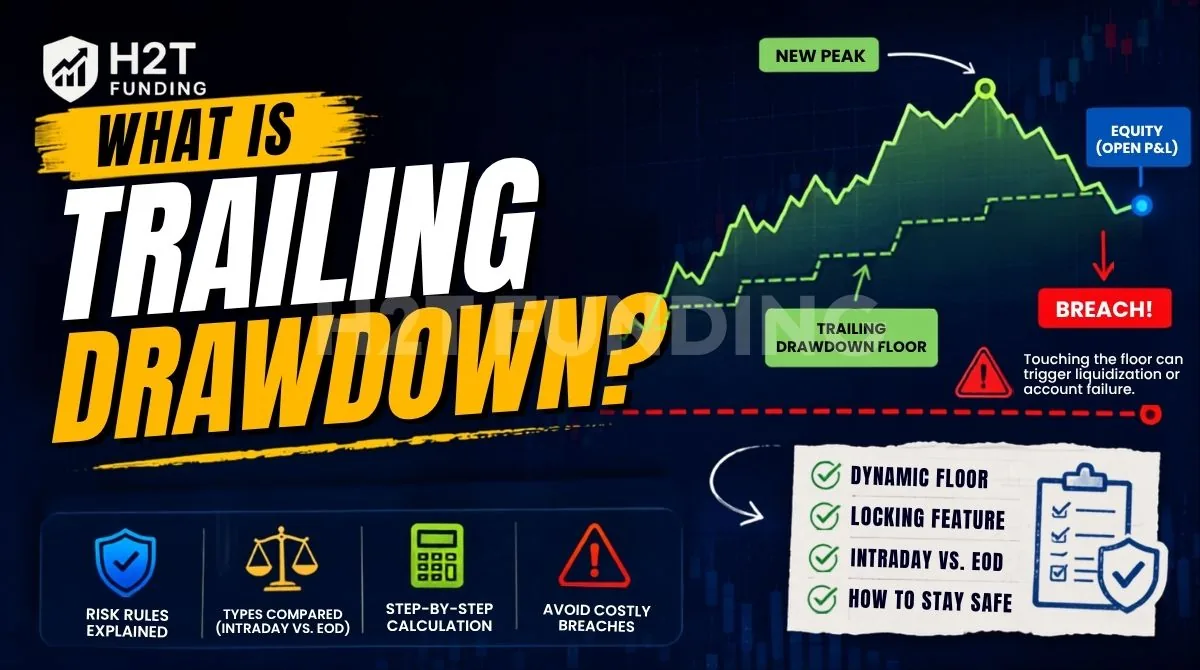
A trailing drawdown is a risk rule that moves an account’s maximum-loss floor upward as the account reaches new highs. The exact high-water mark, such as intraday balance, end-of-day balance, or another firm-defined measure, and whether unrealized P&L affects the threshold vary by prop firm.
A common source of confusion is that an account can remain net profitable while still sitting dangerously close to its loss floor. If your balance or equity touches this threshold at any time, the account fails or liquidates immediately based on the firm’s rules.
Understanding how the floor moves is essential to managing breach risk. This guide covers the core definition, step-by-step calculations, the three main drawdown types, and how trailing drawdown compares to a daily loss limit.
Key takeaway:
- Dynamic floor: The maximum loss threshold rises automatically with peak balance or open equity, locking in higher performance levels.
- One-way movement: Once the trailing floor moves higher, it normally does not move back down during the life of that account.
- Intraday vs. EOD: Intraday trailing updates continuously using open P&L, whereas End-of-Day (EOD) trailing recalculates at session close (but breaches are still enforced in real time) based on closed balance.
- Locking feature: Many firms permanently freeze the loss floor once account equity reaches the initial starting balance or a set safety net.
- Hard breach rule: Touching the applicable floor can trigger immediate liquidation or account failure. The exact consequence depends on the firm’s rules.
1. What is a trailing drawdown?
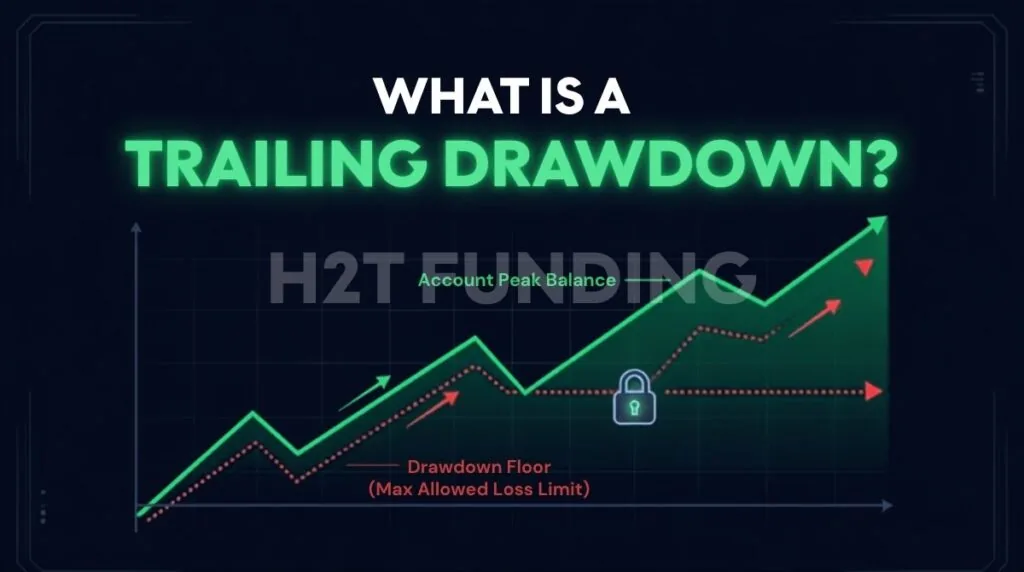
A trailing drawdown is a dynamic risk rule used by proprietary trading firms that sets your maximum loss limit relative to your account’s peak balance, not a fixed starting number. Every time your account reaches a new high, the allowable loss threshold – the “floor” shifts upward to follow it, and once it rises, it doesn’t move back down.
Three core concepts define how this rule operates:
- The floor: The absolute minimum balance or equity level allowed. Reaching the applicable floor can trigger liquidation or account failure, depending on the firm’s rules.
- The peak (high-water mark): The highest recorded balance, which may or may not include unrealized open profit depending on the drawdown type.
- The breach: Reaching the applicable drawdown floor triggers a hard breach, liquidation, or account failure according to the firm’s specific rules.
This firm-enforced rule differs fundamentally from a personal stop-loss. Because the floor follows your highest peak, it can shrink your safety margin even while your account remains net profitable.
2. Trailing drawdown vs. static drawdown: Key differences
A static (fixed) drawdown sets the floor once and never moves it, giving traders more room after building a profit cushion. Conversely, a trailing drawdown tightens the buffer at each new high, which suits traders who take profits frequently and manage open risk closely.
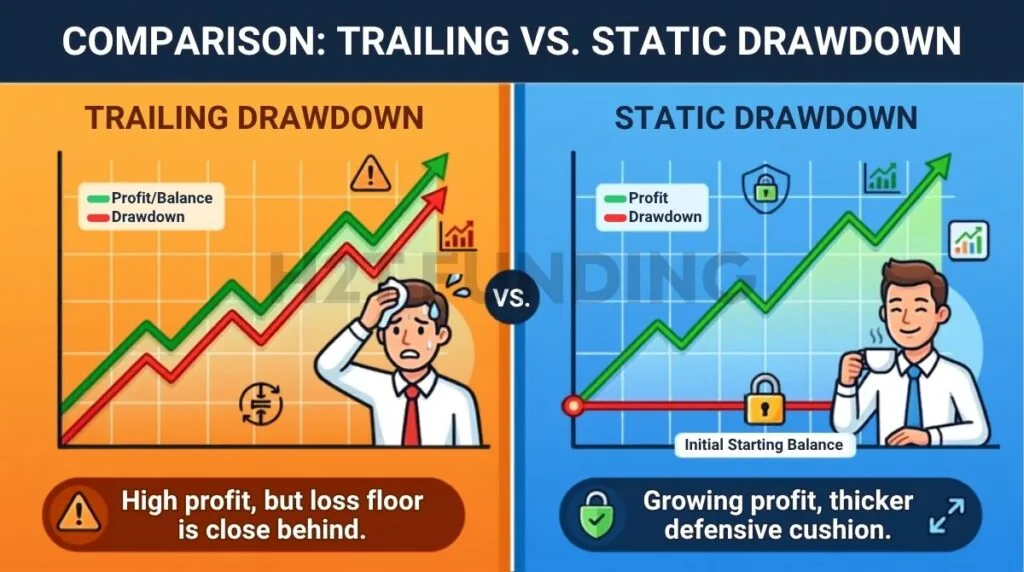
To help you easily compare and choose the model that fits your trading style, we have put together a quick comparison of these two drawdown structures below.
| Criteria | Trailing Drawdown | Static (Fixed) Drawdown |
|---|---|---|
| Does the floor move? | Yes – only upward, following the peak | No – fixed from the starting balance |
| Main risk | Can breach even while profitable, if price pulls back after a new high | Lower risk once in profit, since the floor never tightens |
| Best suited for | Traders who manage open risk closely | Traders who prefer a fixed risk floor |
| Example firms | Apex Trader Funding (Intraday/EOD), Alpha Capital Group – Alpha One | FTMO 2-Step Challenge, Alpha Capital Group – Alpha Pro/Swing/Three |
If you’d like to go deeper into the fixed-dollar and percentage-based floor formulas, along with how to calculate remaining loss room for each model, see our guide to Static Drawdown vs Trailing Drawdown.
3. How does a trailing drawdown work?
To see this in practice, here’s how the calculation plays out step by step.
3.1. Worked example
According to Apex Trader Funding’s Help Center, a $50,000 Evaluation account with a $2,000 intraday trailing drawdown starts with a floor at $48,000 ($50,000 − $2,000).
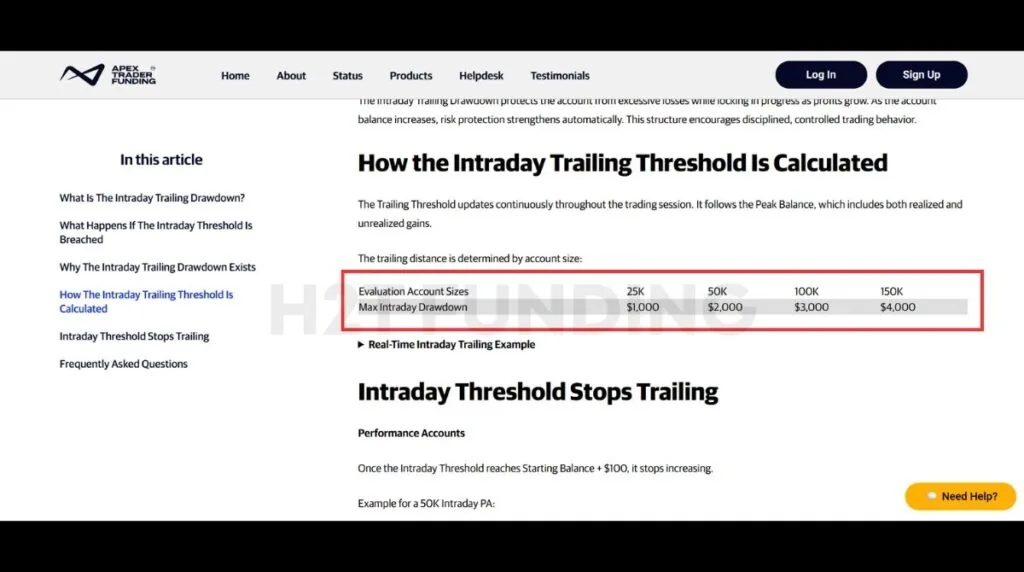
If an open trade raises the account to $50,900, the new peak becomes $50,900, pushing the floor up to $48,900. If the trader then closes the trade at a lower profit, the account can remain profitable while having a smaller buffer against the trailing floor.
3.2. The floor only moves up, never down
Once the trailing floor has moved up, it does not move back down during the normal life of the account.
3.3. Practical example: Intraday vs. EOD in practice
To see how these rules play out under real market conditions, let’s look at how Intraday and EOD models respond to the exact same price action.
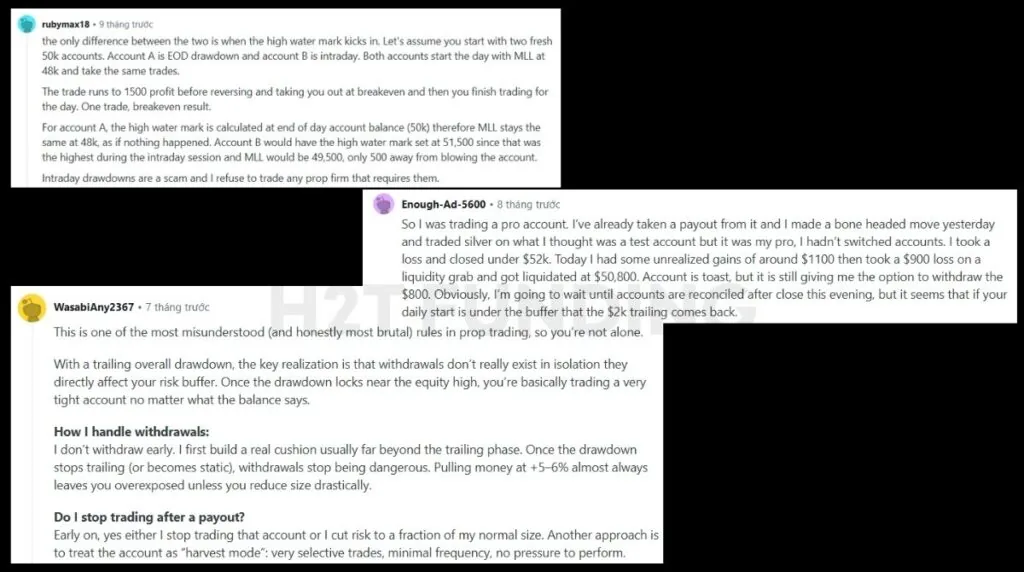
Suppose an NQ trade on an Apex Intraday account reaches +$1,400 in unrealized profit before reversing and closing at a $200 loss. The $1,400 unrealized gain raises the trailing floor, while the $200 loss reduces the account balance.
With a $2,000 initial drawdown, the $1,400 unrealized peak raises the trailing floor by $1,400. After the trade closes at a $200 loss, the trader has a significantly smaller buffer than before, even though the realized loss was only $200.
Now consider the same hypothetical trade on an EOD account such as Tradeify Select. Because the trailing floor is updated using the firm’s end-of-day calculation rather than every intraday equity high, the temporary +$1,400 unrealized peak would not raise the floor in the same way during the session.
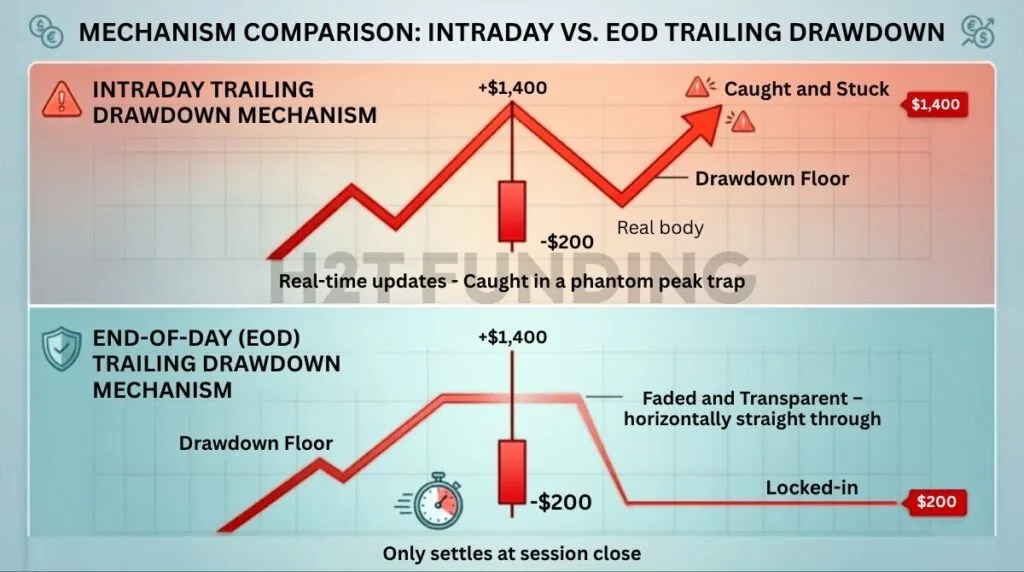
This illustrates the key practical difference: intraday trailing drawdown can respond to unrealized peaks, while EOD trailing drawdown generally bases its update on the firm’s end-of-day calculation.
4. Main types of trailing drawdown in prop trading
Not every trailing drawdown is calculated the same way – this is the detail traders most often miss when comparing firms.
4.1. Intraday (real-time) trailing drawdown
The threshold updates continuously during the session and includes unrealized P&L from open trades. Every new peak – even a temporary, unrealized one – immediately raises the floor.
Risk: a “phantom peak” from an open trade can drag the floor up, and a reversal before you close the position can trigger a breach even though the account never actually banked that profit.
Example: Apex Trader Funding’s Intraday Trailing Drawdown Evaluation, which has no accompanying Daily Loss Limit – risk is controlled entirely through the real-time trailing threshold, according to Apex’s Help Center.
4.2. End-of-day (EOD) trailing drawdown
The threshold is updated based on the firm’s EOD calculation, but the exact treatment of unrealized P&L and intraday enforcement varies by firm.
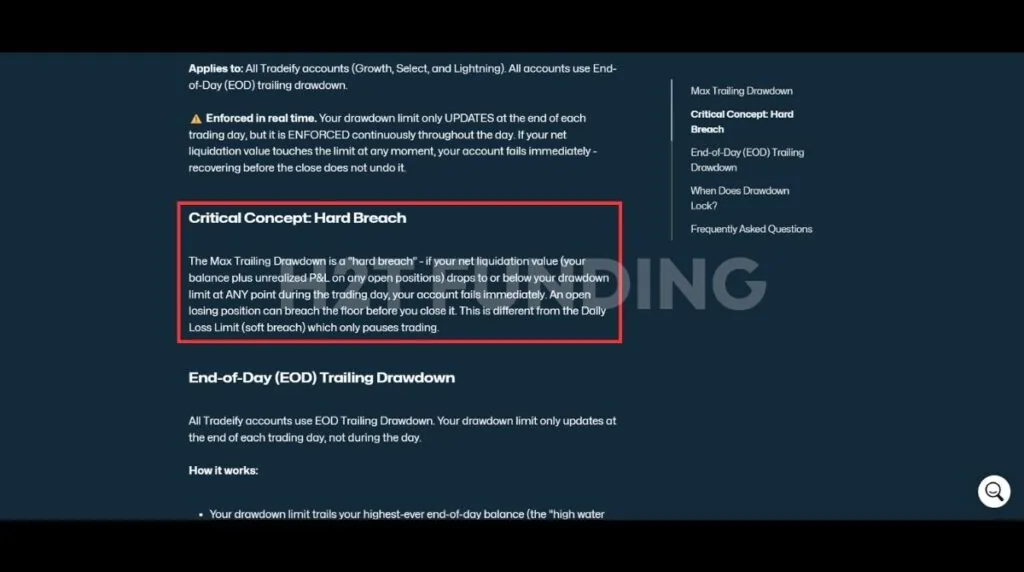
Important nuance: even though it only updates once a day, the floor is still enforced in real time. If balance or equity touches the current floor mid-session, the account breaches immediately – it doesn’t wait until end of day.
Examples, per each firm’s own documentation: Tradeify (all Growth/Select/Lightning products use EOD trailing, with a “Critical Concept: Hard Breach” notice in its Help Center); Topstep (EOD trailing applies across both the Trading Combine and the Express Funded Account, per topstep.com); FTMO’s 1-Step Challenge (EOD trailing, recalculated daily at 00:00 CE(S)T. ).
4.3. Locked-in trailing drawdown
This isn’t a separate calculation method – it’s a lock mechanism that can attach to either an intraday or EOD trailing drawdown. The floor keeps trailing upward until it reaches a fixed point (usually the starting balance, sometimes plus a small buffer), then freezes there permanently.
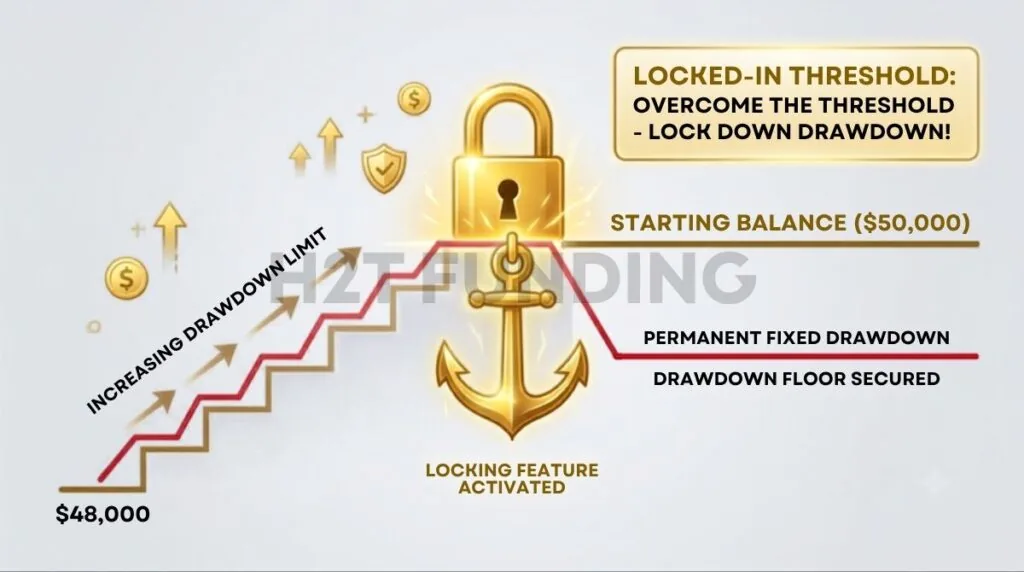
Once locked, the trailing floor stops moving higher and becomes a fixed loss floor. The account can still breach if its balance or equity falls to or below that floor.
Verified lock points by firm:
- Earn2Trade – trailing floor stops increasing once it reaches the starting balance.
- Apex Trader Funding (Performance Account) – PA Intraday Threshold: The trailing threshold stops increasing once it reaches Starting Balance + $100, and stays locked there for the life of the account. This lock point is triggered when peak intraday balance reaches Starting Balance + Max Drawdown + $100.
- Alpha Capital Group (Alpha One) – The trailing floor locks at the initial balance once the account’s high-water mark reaches the applicable trailing drawdown percentage.
- Topstep – Trading Combine: EOD MLL locks at starting balance. XFA: Starts at $0 balance with MLL initially at -$2,000, locks at $0 once balance reaches $2,000.
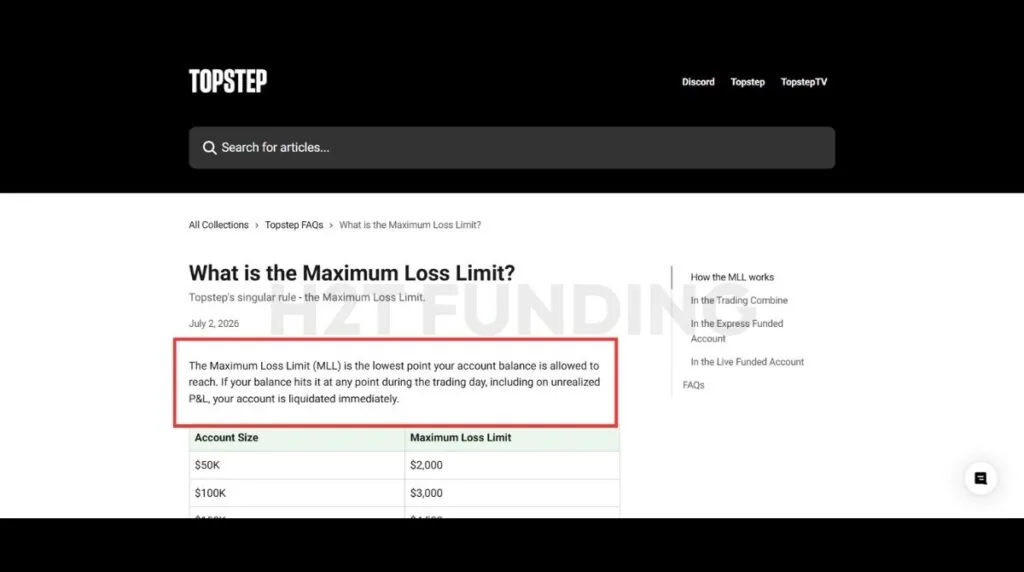
Note that the lock point isn’t identical across firms – some lock exactly at the starting balance (Earn2Trade, Alpha Capital, Topstep), while others add a small buffer above it (Apex +$100). This detail is easy to miss when comparing firms side by side.
4.4. How different prop firms apply each type
The table below breaks down how each firm structures its trailing type and lock point.
| Firm | Trailing Type | Lock Point |
|---|---|---|
| Apex Trader Funding | Both Intraday and EOD (trader’s choice at purchase) | PA: Locks at $100 above starting balance; trigger is starting balance + max DD + $100 |
| Tradeify | EOD across all accounts | Evaluation (Growth/Select): Does NOT lock – continues trailing. Sim Funded (Growth/Select/Lightning): Locks at Starting Balance + $100 when EOD balance reaches Starting Balance + Drawdown + $100 |
| Earn2Trade | EOD (Eval/LiveSim); real-time trailing (Live) | Exactly at Starting Balance |
| Alpha Capital Group | Alpha One: Trailing (4%, 6%, or 8% depending on plan); Alpha Direct: Trailing (5%); Alpha Pro/Swing/Three: Static | Alpha One: Locks at Initial Balance once HWM reaches trailing drawdown percentage (6%, 4%, or 8%). Alpha Direct: Locks at Initial Balance once 5% profit reached |
| Topstep | EOD trailing (both accounts) | Trading Combine: Locks at Starting Balance. Express Funded Account (XFA): Starts at $0 balance with MLL at -$2,000, locks at $0 once balance reaches $2,000 |
| FTMO | 2-Step: static (no trailing). 1-Step: EOD trailing | 1-Step: no separate lock |
Note: Rules can change over time – always confirm current terms in the firm’s official Help Center before purchasing an account.
5. Trailing drawdown vs. daily loss limit
These are two entirely separate rules, and mixing them up is one of the most common (and costly) mistakes traders make.
| Trailing Drawdown | Daily Loss Limit (DLL) | |
|---|---|---|
| Measured against | Peak balance/equity over the account’s whole life | Loss within a single trading session/day |
| Resets? | Normally does not move down during the account’s active life; resets may occur when the account is reset, replaced, or subject to specific payout rules | Typically resets each new trading session |
| Consequence | Usually a hard account breach | Often a soft breach that pauses trading, depending on the firm’s rules |
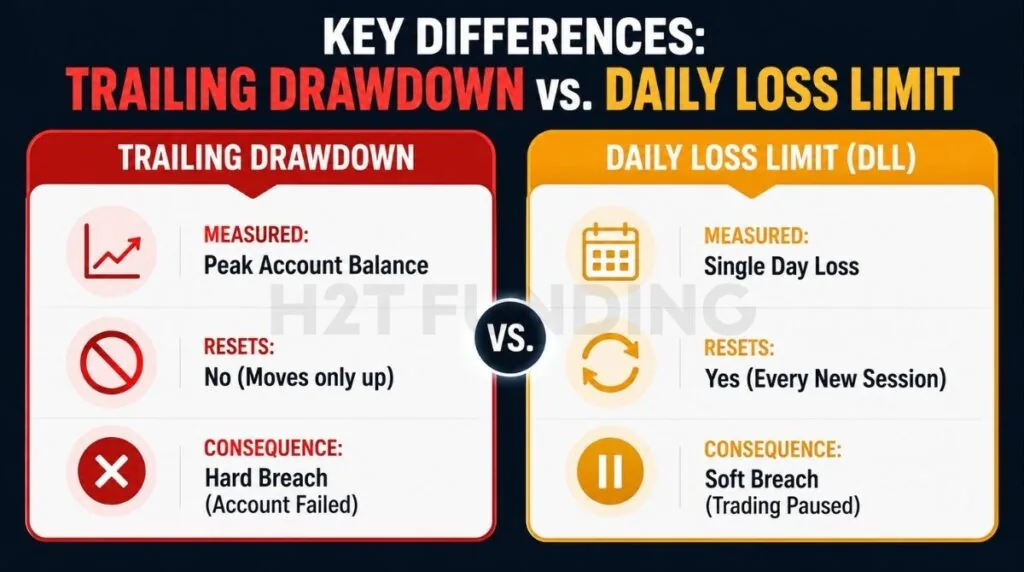
According to Tradeify’s Help Center, a Daily Loss Limit pauses trading for the day without failing the account, while hitting the trailing drawdown fails the account permanently. Apex describes the same contrast using a memorable image: the EOD threshold is a “cliff,” while the DLL is a “speed bump.”
Note: not every account pairs a DLL with a trailing drawdown – Apex’s Intraday Evaluation and Tradeify’s Select Flex, for example, have no DLL at all.
6. Is a trailing drawdown good or bad for traders?
There’s no absolute answer – it’s a two-way risk tool: it protects the firm’s simulated capital, and it tests trader discipline.
6.1. Why prop firms use trailing drawdown
- For firms operating simulated trading programs, trailing drawdown is one way to control the risk parameters of an account.
- Encourages disciplined trading – taking profit regularly instead of letting paper gains balloon and then evaporate.
- Trailing drawdown is used by multiple futures and CFD/forex prop firms, although the exact calculation and enforcement differ by firm.
6.2. The trade-off for retail traders
- Psychological pressure – you can be up on paper and still breach if open trades aren’t managed tightly, especially on intraday accounts.
- Limits “let winners run” strategies on intraday trailing accounts, since unrealized profit pulls the floor up even before a pullback occurs.
- Demands tighter entry/exit discipline than a personal stop-loss, because this rule belongs to the firm, not the trader.
7. Practical strategies: How to avoid a breach under trailing drawdown rules
Avoiding an unnecessary breach requires adjusting your position sizing, profit targets, and daily risk habits to match your account’s specific drawdown model.
7.1. Maintain a strict buffer safety ratio
Never risk your full nominal drawdown allowance on a single trade setup. A conservative approach is to risk only a small portion of your remaining drawdown buffer on each trade.
For example, limiting risk to 15%–20% of the remaining buffer can provide room for several consecutive losses, although this is a risk-management guideline rather than a universal prop firm rule.
If your remaining trailing buffer is $2,500, capping your trade risk at $375 to $500 gives you 5 to 6 consecutive trade attempts. This buffer margin allows you to absorb normal market chop without triggering a panic breach.
7.2. Use micro contracts to mitigate phantom peaks
On intraday trailing accounts, trading full-sized contracts (like NQ or ES) increases the risk of creating a “phantom peak” – a temporary spike in open P&L that instantly raises your floor before price retraces.
Here are position management tactics many disciplined traders use:
- Trade micro contracts (MNQ/MES): Scaling with micros lets you scale out and bank partial profits early, locking in realized balance rather than leaving peak equity exposed.
- Take quick profit targets: Use smaller position sizes and predefined profit targets that fit the instrument’s volatility and your remaining drawdown buffer.
- Protect open P&L: Moving your stop-loss to break-even once a trade achieves 1.5x to 2x your initial risk helps prevent a market reversal from wiping out your newly elevated buffer.
7.3. Leverage locked-in thresholds to secure permanent safety
If your firm offers a lock mechanism (such as Earn2Trade at initial balance or Apex PA after reaching the safety net), your primary goal during the initial phase should be reaching that lock threshold as safely as possible.
Once your drawdown floor freezes permanently at your starting balance, the account converts to a static risk structure. At that point, you can hold trades longer and target larger swings without worrying about an unrealized pullback triggering a breach.
7.4. Establish a real-time tracking routine
Never rely on memory or estimated balance to calculate your distance from the floor.
To track your risk margin accurately:
- Monitor platform risk metrics: Use dashboard tools like Rithmic visual risk limits or Tradovate metrics to check your active floor before entering any trade.
- Maintain a daily floor log: Record your peak balance and updated floor at the end of every trading session.
- Calculate available buffer daily: Subtract your current floor from your balance every morning so you know your exact risk limit before starting your session.
For a deeper look into selecting evaluation models that align with your execution style, check out our comprehensive guide on trading guides and strategies on H2T Funding.
8. How to choose the right drawdown rule for your trading style
There’s no single “best” drawdown type – the right fit depends on a few honest questions:
- Trading style – scalpers or traders who hold positions intraday should weigh an intraday account’s tighter floor carefully; traders who close out by end of day may find EOD or static rules easier to manage.
- Risk tolerance, psychologically – can you handle being profitable and still at risk of a breach (intraday), or do you need the predictability of EOD/static?
- Lock conditions – does the firm offer an early lock, and does it sit exactly at starting balance or above it?
- Daily Loss Limit pairing – is there a DLL, and is it a soft or hard breach? This affects how much room you have on a bad session.
To evaluate how specific rules affect your probability of passing an evaluation, explore our full best prop firms comparison guide.
9. FAQs
-
It’s a maximum-loss rule based on your account’s highest-ever balance rather than its starting balance – the allowed floor rises as your peak rises, but never falls.
-
Normally, no. Once the floor moves higher, it remains at that level or rises further. However, some firms may reset drawdown parameters when an account is reset, replaced, or reaches certain payout conditions.
-
A consistency rule limits how much of your total profit can come from a single day. Apex previously used a 30% Legacy Consistency Rule, which is no longer the current standard. Always verify current rules on Apex’s official Help Center before purchasing.
-
Apex, Tradeify, Topstep, Earn2Trade (Live accounts), Alpha Capital Group (Alpha One and Alpha Direct), FTMO (1-Step Challenge), MyFundedFutures (Builder and Rapid plans), and FundedNext (Stellar Instant).
-
Tradeify (Sim Funded accounts only: Growth/Select/Lightning; Evaluation accounts do not lock), Topstep (Trading Combine and Express Funded Account), Earn2Trade (Eval/LiveSim), FTMO (1-Step), and Apex (as an optional configuration).
10. Conclusion
Understanding what is a trailing drawdown comes down to one core rule: your loss floor rises with peak account equity, but never drops. Managing open equity is just as critical as banking profit to keep your risk buffer intact.
We hope this breakdown helps you protect your account and avoid unnecessary breaches. What drawdown model do you prefer for your trading style? Share your thoughts in the comments below, and explore our trading guides and strategies on H2T Funding to refine your risk management plan today.