

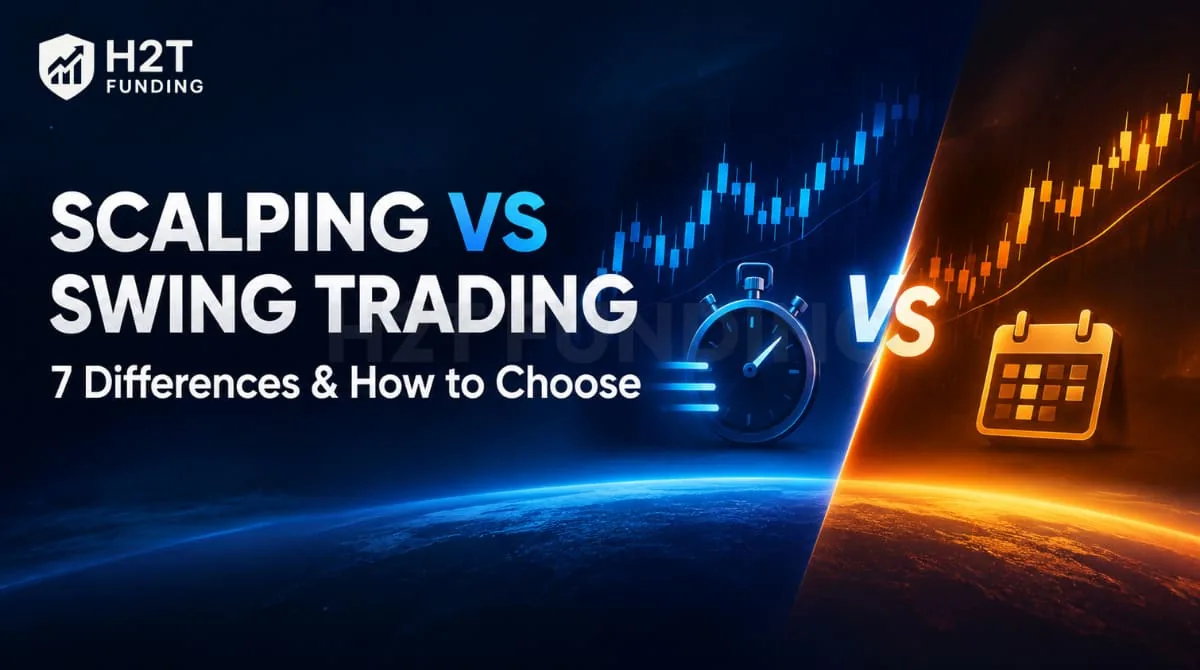
Scalping requires holding trades for a few seconds to a few minutes. Swing trading involves keeping positions open for a few days to a few weeks. There is no universally better option when comparing scalping vs swing trading. Your choice depends directly on your daily schedule, transaction costs, and specific prop firm rules.
This guide covers their exact definitions and seven key differences. It also compares profitability, market conditions, and prop firm requirements to help you choose the right style.
Key Takeaways
- Holding times: Scalping requires holding trades for seconds to minutes and closing them within the same session. Swing trading involves keeping positions open for days to weeks.
- Cost sensitivity: Scalpers face high impact from spreads and commissions due to their trade volume. Swing traders must account for overnight swap fees and weekend price gaps.
- Prop firm restrictions: Specific firm rules dictate your available options. For instance, Topstep prohibits overnight holding, while FundedNext allows swing trading but restricts tick scalping.
- Profitability metrics: Neither style is inherently more profitable. Your net return depends strictly on your break-even win rate, risk-to-reward ratio, and total trading costs.
- Regulatory updates: The $25,000 Pattern Day Trader (PDT) rule strictly governs U.S. stock margin accounts but does not apply to the futures and forex markets. Prop firm traders can scalp without these regulatory capital minimums.
Note: This guide was fact-checked and updated in October 2026. All platform limits, subscription pricing, and proprietary trading firm integrations reflect the most current TradingView policies.
Scalping vs Swing Trading at a Glance
The following table outlines the core operational differences between the two trading styles.
| Criteria | Scalping | Swing Trading |
|---|---|---|
| Holding Time & Timeframes | Seconds to minutes (1-min to 5-min charts) | Days to weeks (4-hour to daily charts) |
| Trade Frequency | High (often 10 to 50+ per day) | Low (often 0 to 3 per week) |
| Profit Targets & Risk | Small profits (typically 0.25% to 1% risk) | Massive targets (typically 1% to 2% risk) |
| Time Commitment | 2 to 4 hours of active screen time | 30 to 60 minutes for daily analysis |
| Cost Sensitivity | High impact from spreads and commissions | High impact from overnight swap fees |
| Overnight Risk | None (flat before session close) | High (subject to weekend price gaps) |
| Psychology & Stress | High-intensity from rapid decision-making | Extreme patience through deep retracements |
You should use these baseline metrics to match a trading style directly to your personal schedule and specific account rules.
1. What Is Scalping?
Scalping is a high-speed trading strategy that involves holding positions for a few seconds to a few minutes. Scalpers execute dozens of trades in a single day to capture tiny price movements and close all positions before the market session ends.
This approach completely eliminates overnight risk but requires intense focus and fast execution.
Key characteristics of this strategy include:
- Specific trade execution: A scalper might buy a position, capture a quick 10-tick price movement within 45 seconds, and exit the market immediately for a small, predefined profit.
- Optimal trading sessions: This strategy requires high volume and tight spreads, making it most effective during peak liquidity periods (such as the London, New York, and overlapping market sessions).
- Preferred instruments: Scalpers focus strictly on highly liquid assets (like major forex pairs, equity indices, and gold) to ensure instant order fills without severe slippage.
- Technical focus: Traders rely heavily on short-term charts (specifically the 1-minute, 3-minute, and 5-minute intervals) rather than long-term fundamental analysis.
2. What Is Swing Trading?
Swing trading is a medium-term trading strategy that involves holding positions for a few days to a few weeks. Swing traders execute a smaller number of trades over a month to capture larger directional price movements and keep all positions open across multiple daily sessions.
This approach completely eliminates the need for constant screen monitoring but exposes your capital to overnight and weekend market gaps.
Key characteristics of this strategy include:
- Specific trade execution: A swing trader might buy a position, capture a broad 150-pip price movement over five days, and exit the market for a larger, predefined profit.
- Optimal trading sessions: This strategy requires identifying broad market trends, making it effective across all standard trading sessions (such as the Asian, London, and New York market hours).
- Preferred instruments: Swing traders focus strictly on steadily trending assets (like major forex pairs, equity indices, and large-cap stocks) to capture sustained directional momentum.
- Technical focus: Traders rely heavily on longer-term charts (specifically the 4-hour, daily, and weekly intervals) rather than reacting to minute-by-minute price action.
3. Scalping vs Swing Trading: 7 Key Differences
The core difference between scalping and swing trading lies in how you manage time, risk, and transaction costs. You must evaluate these seven operational factors to determine which strategy aligns with your capital and daily schedule.
3.1. Holding Time and Timeframes
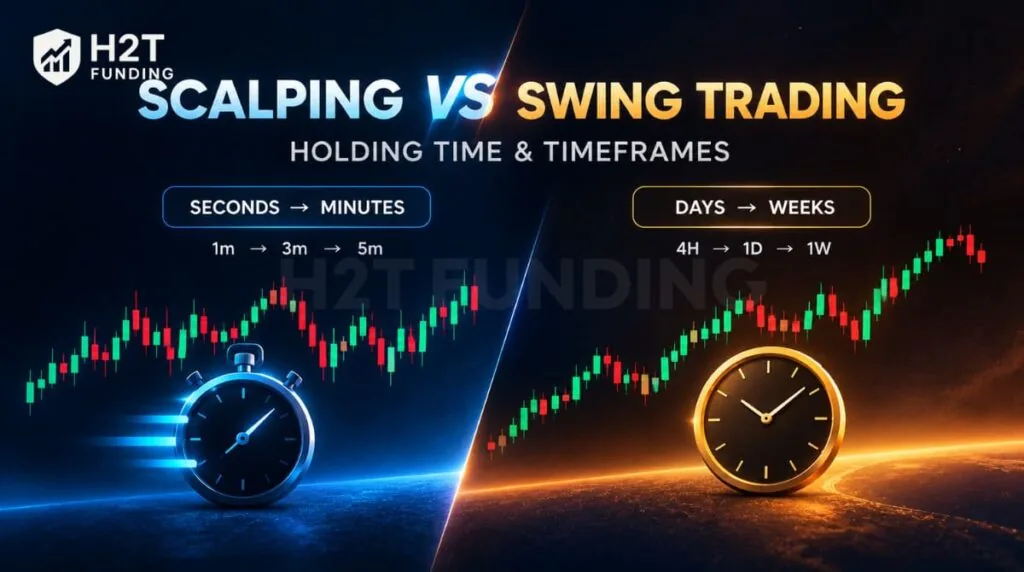
Scalping requires holding trades for seconds to minutes, while swing trading demands holding positions for days to weeks. Scalpers execute rapid entries and exits using 1-minute to 5-minute charts to capture micro-movements. Conversely, swing traders use 4-hour, daily, and weekly charts to ride broader market trends.
3.2. Trade Frequency
Scalpers execute dozens to hundreds of trades per day, whereas swing traders typically open zero to three positions per week. This extreme difference in volume directly impacts your daily routine and market approach.
A scalper constantly scans for immediate setups during active sessions, while a swing trader patiently waits days for a single high-probability entry to form.
3.3. Profit Targets and Risk-Reward
Scalpers target small profits with lower risk-reward ratios, while swing traders aim for massive price targets using higher risk-reward models. Because scalpers capture tiny moves, they often rely on a high win rate to stay profitable.
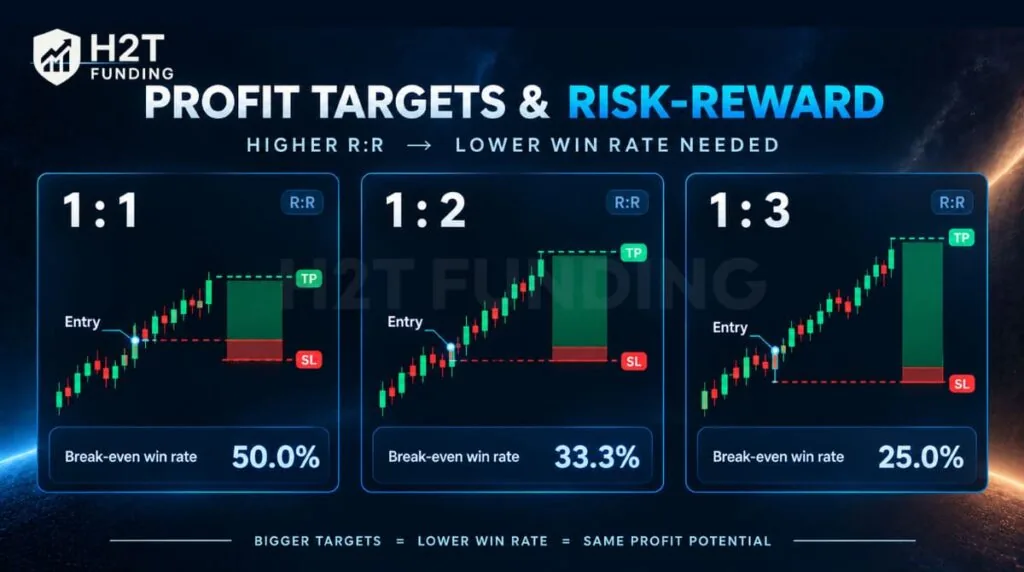
Swing traders can sustain profitability with a much lower win rate because their winning trades cover multiple smaller losses. The table below shows the break-even win rate required for different risk-reward ratios before accounting for trading costs:
| Risk-Reward Ratio (R:R) | Required Break-Even Win Rate |
|---|---|
| 1:1 | 50.0% |
| 1:2 | 33.3% |
| 1:3 | 25.0% |
3.4. Time Commitment
Scalping demands two to four hours of continuous screen time during peak sessions, while swing trading requires only 30 to 60 minutes of daily chart analysis. A scalper must remain glued to the monitor during specific high-volume hours, such as the 8:00 AM to 11:00 AM New York session.
A swing trader simply checks their charts just before the daily close (such as 4:59 PM EST) to adjust stop-losses and manage active positions.
3.5. Costs: Spreads, Commissions, and Swaps
Scalpers lose a significant portion of their profits to spreads and commissions, whereas swing traders face high swap fees for holding positions overnight. Transaction costs act as a silent killer for high-frequency traders.
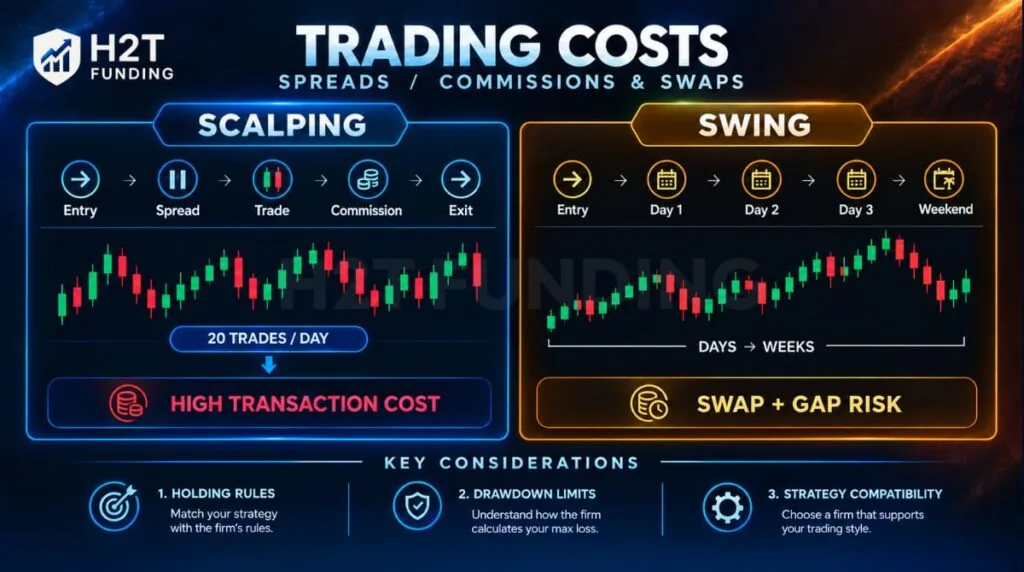
If a scalper executes 20 trades a day (trading 1 lot per trade) with a $3 round-turn commission, they pay $300 across a five-day trading week regardless of profitability. Conversely, a swing trader pays just one round-turn commission but incurs daily rollover (swap) fees for keeping their position open across multiple sessions.
3.6. Overnight and Weekend Risk
Scalpers experience zero overnight risk because they close all positions daily, while swing traders risk massive account drawdowns from weekend price gaps. Global news events or sudden interest rate changes often occur when the market is closed.
A swing trader’s stop-loss cannot protect them if the market opens violently against their position on a Sunday evening. Scalpers sleep without this stress because their capital is safely flat at the end of every session.
3.7. Psychology and Stress
Scalping induces high-intensity stress from rapid decision-making, while swing trading requires extreme patience to hold through deep market retracements. Scalping tests your ability to take a loss instantly and execute the next trade without hesitation.
Swing trading tests your emotional control as you watch an active trade fluctuate in and out of profit over several days without closing it prematurely. Both styles demand strict discipline, but they stress completely different psychological triggers.
4. Which Is More Profitable: Scalping or Swing Trading?
Neither scalping nor swing trading offers a fixed profitability advantage. Your long-term net return depends entirely on your mechanical edge, which consists of your win rate, risk-reward ratio, and strict cost management.
Mandatory risk disclosures enforced by the European Securities and Markets Authority (ESMA) consistently show that between 74% to 89% of retail accounts lose capital. Academic studies highlight that high-frequency retail traders often fail because transaction costs slowly drain their accounts over hundreds of trades.
To survive these statistics, you must understand your break-even math. The table below illustrates how a scalper and a swing trader can achieve profitability using completely different mathematical models:
| Performance Metric | Scalping Example | Swing Trading Example |
|---|---|---|
| Risk-Reward Ratio | 1:1 | 1:3 |
| Required Break-Even | 50.0% | 25.0% |
| Actual Win Rate | 60.0% | 35.0% |
| Primary Profit Driver | High trade volume | Massive directional trends |
| Biggest Threat to Profit | Broker commissions | Weekend price gaps |
A scalper needs a high win rate to overcome daily commission fees, which is why trading with the best prop firms for scalpers that offer raw spreads is critical for profitability. Meanwhile, a swing trader relies on massive winning trades to cover a longer string of small losses.
5. Is Scalping or Swing Trading Better for Beginners?
Most trading guides and industry educators agree that swing trading is better for beginners because it operates at a manageable pace. It is important to note that this is a general consensus based on human psychology, not a strict mathematical fact.
Scalping forces new traders to make split-second decisions, which frequently leads to emotional mistakes and rapid account losses.
Conversely, swing trading gives you the necessary time to analyze daily charts, calculate your exact risk, and execute orders without high-intensity stress. This slower environment allows beginners to build structural discipline. However, this strategy only works safely on evaluation accounts that explicitly permit overnight holding and utilize End-of-Day (EOD) drawdowns.
6. Scalping vs Day Trading vs Swing Trading vs Position Trading
To fully understand where scalping and swing trading fit within the broader market, you must compare them against all four primary trading styles. Retail traders often confuse these categories, which frequently leads to strict prop firm rule violations.
| Trading Style | Holding Period | Primary Timeframes | Overnight Risk |
|---|---|---|---|
| Scalping | Seconds to minutes | 1-min to 5-min | None (Flat before close) |
| Day Trading | Minutes to hours | 5-min to 15-min | None (Flat before close) |
| Swing Trading | Days to weeks | 4-hour to Daily | High (Subject to gaps) |
| Position Trading | Weeks to months | Daily to Weekly | Very High (Macro events) |
Moving up this timeframe hierarchy gradually reduces your required daily screen time but significantly increases your exposure to long-term market volatility.
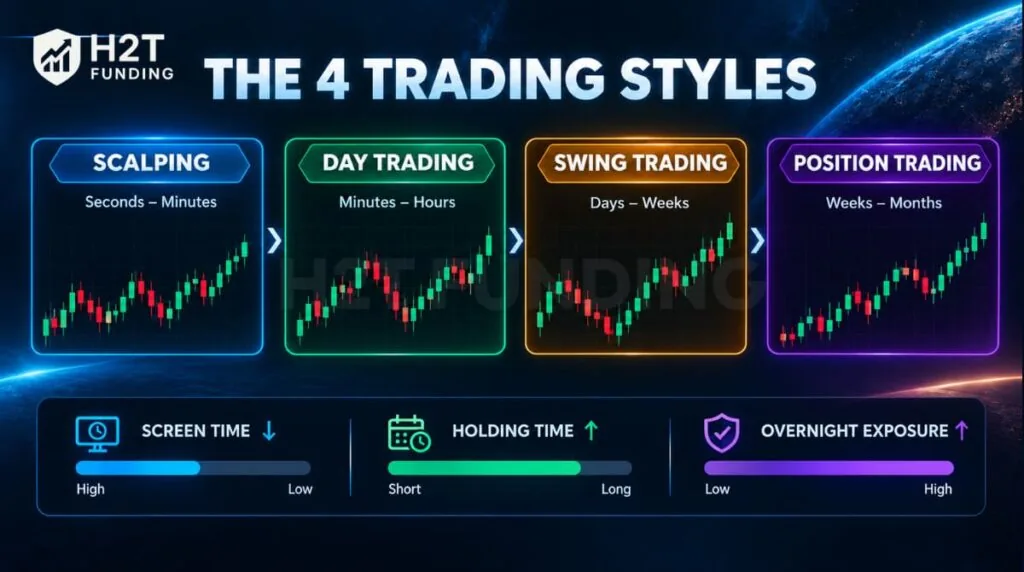
For prop firm traders, the dividing line between day trading and swing trading is the most critical. If an intraday trader accidentally holds a position past the daily market close, they instantly trigger an overnight holding violation and lose their funded account.
7. Scalping vs Swing Trading by Market: Forex, Futures, Gold, and Stocks
The asset class you choose directly dictates your execution costs, liquidity, and regulatory limits. The table below highlights the primary obstacle you must manage for each trading style across different markets.
| Market | Primary Focus for Scalpers | Primary Focus for Swing Traders |
|---|---|---|
| Forex | Tight spreads & session overlaps | Overnight swap interest rates |
| Futures | Fixed tick values & execution speed | Micro contracts for risk sizing |
| Gold & Indices | Managing slippage in extreme volatility | Extremely wide stop-losses |
| Stocks | Capital-restricted by PDT rules | Long-term macroeconomic trends |
You must adapt your trading style to the specific mechanical rules of each market.
7.1. Forex
Forex scalpers rely heavily on tight spreads and peak liquidity during the London and New York session overlaps. Even a one-pip increase in broker spreads can destroy a scalping strategy’s profit margin.
Forex swing traders largely ignore intraday session timing. However, they must carefully calculate overnight swap fees, as holding currency pairs for weeks can incur heavy interest charges depending on the central bank rate differences.
7.2. Futures
Futures markets provide centralized exchange data and fixed tick values, which offers standardized pricing and improves execution transparency for fast-paced scalpers.
Both scalpers and swing traders frequently utilize micro contracts (such as the MES or MNQ). These smaller contract sizes allow scalpers to scale into fast positions safely, while swing traders use them to maintain strict 1% risk parameters alongside very wide stop-losses.
7.3. Gold and Indices
Gold (XAU/USD) and major equity indices (like the Nasdaq 100) are characterized by extreme daily volatility. Scalpers exploit these massive intraday price swings to hit their profit targets in seconds, though they must actively manage slippage.
Swing traders target these specific assets to capture massive, multi-week directional trends. However, surviving this volatility requires exceptionally wide stop-losses, meaning you must drastically reduce your position size to avoid premature liquidation.
7.4. Stocks
Stock scalping in the U.S. traditionally requires a minimum $25,000 balance due to the Pattern Day Trader (PDT) rule for margin accounts. However, the PDT rule does not apply to the futures or forex markets. Proprietary firm traders operating in futures and CFD accounts can scalp or swing trade immediately without facing these strict regulatory capital constraints.
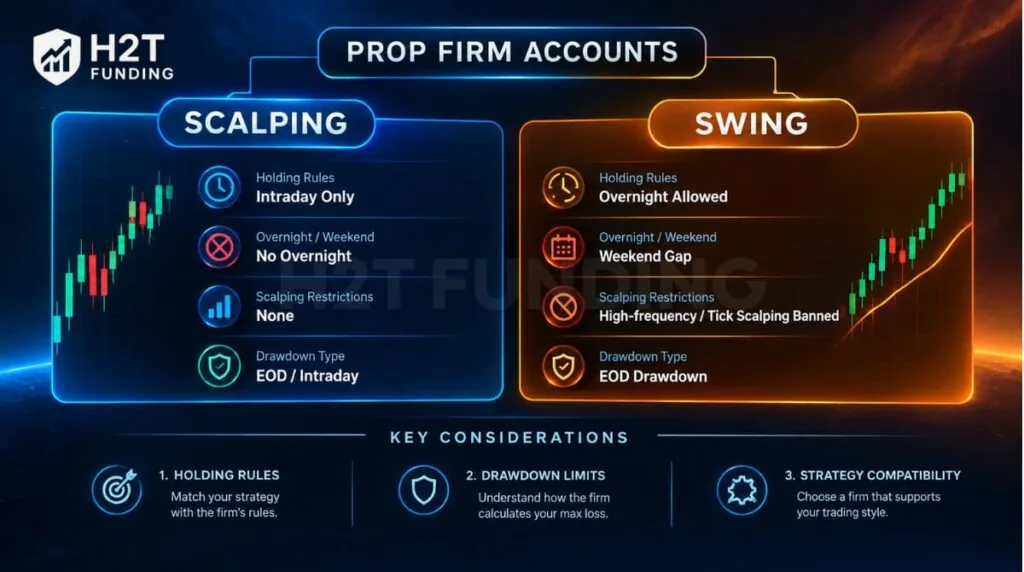
8. Scalping vs Swing Trading in Prop Firm Accounts
Proprietary trading firm impose strict risk parameters that directly dictate whether you can scalp or swing trade. You must select an account type that explicitly permits your specific holding times and execution speed.
| Firm | Intraday-only? | Overnight/Weekend Holding | Scalping Restrictions | Reference Policy |
|---|---|---|---|---|
| Topstep | Yes | Strictly Prohibited (Must close by 3:10 PM CT) | HFT, tick-scalping, and latency arbitrage banned | Topstep FAQ (2026) |
| Apex Trader Funding | Yes | Strictly Prohibited (Must close by 4:59 PM ET) | HFT and latency arbitrage banned | Apex Rules (2026) |
| FundedNext | No | Allowed (Monitor swap fees to avoid daily loss breach) | Tick-scalping and HFT strictly banned | FundedNext ToS (2026) |
| FTMO (Swing Account) | No | Allowed (Unrestricted weekend holding) | HFT, tick-scalping, and arbitrage banned | FTMO Swing Rules (2026) |
You cannot apply a standard retail trading strategy to a prop firm without first evaluating how the firm calculates your maximum drawdown.
8.1. How Daily Loss Limits Affect Your Strategy
Daily loss limits disproportionately threaten swing traders during temporary intraday price pullbacks. If an asset spikes against an open swing position, the unrealized floating loss can breach the firm’s strict daily threshold. Depending on the firm’s specific rules, this breach may lock your account for the remainder of the trading day or instantly terminate your funded status.
While scalpers use extremely tight stop-losses on individual positions, they remain highly vulnerable to daily loss limits during a rapid sequence of losing trades. A scalper who loses emotional discipline can quickly accumulate enough small losses to breach the daily threshold.
8.2. How Trailing Drawdowns Affect Your Strategy
Intraday trailing drawdowns severely penalize swing traders who allow large floating profits to retrace. If a swing trade floats $2,000 in profit but drops back to $500 before hitting its target, an intraday trailing rule registers a $1,500 decline against your maximum allowed limit.
Swing traders must seek firms that offer End-of-Day (EOD) drawdowns, which calculate limits based on the closing balance strictly at 4:59:59 PM EST, ignoring temporary intraday fluctuations.
Scalpers mitigate trailing drawdown risks by securing profits rapidly. Since scalpers do not hold active trades through deep market retracements, they rarely accumulate large floating profits that turn into realized drawdown penalties, allowing their balance and maximum threshold to grow closer together.
9. Tools for Scalping and Swing Trading
Selecting the right scalping swing trading tool is essential because high-frequency execution requires completely different software than long-term technical analysis. You must build a technology stack that specifically supports your chosen timeframe.
9.1. Essential Tools for Scalpers
Scalpers rely entirely on execution speed and market data transparency to secure micro-profits before the market reverses.
- DOM / Price Ladder: Scalpers use the Depth of Market (DOM) on platforms like NinjaTrader or Quantower to view pending limit orders and execute futures trades instantly.
- Low-Latency VPS: A Virtual Private Server (VPS) hosted near the broker’s data center minimizes network latency and helps mitigate costly slippage.
- Direct Access Platforms: High-speed software like cTrader, MetaTrader 5, and TradeLocker provides the rapid one-click execution necessary for manual forex scalping.
9.2. Essential Tools for Swing Traders
Swing traders prioritize deep market analysis and automated notifications over split-second order execution speeds.
- Advanced Charting: Platforms like TradingView or Autochartist offer the professional drawing tools and indicator overlays required for analyzing daily and weekly market trends.
- Automated Price Alerts: Swing traders set mobile or email price alerts at key support and resistance levels, which completely eliminates the need for continuous screen monitoring.
- Performance Journal: Tracking complex metrics, such as accumulated swap fees and multi-week risk-reward ratios, requires a strictly structured trading journal to maintain long-term profitability.
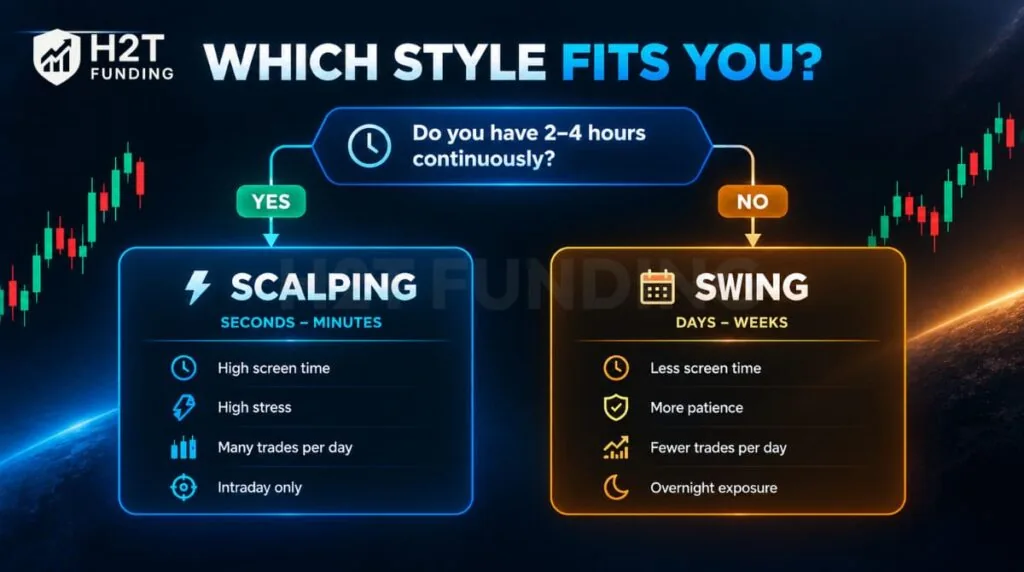
10. Which Style Fits You? A Quick Self-Assessment
You must align your trading style with your actual lifestyle and financial constraints. Use the numerical thresholds below to determine your optimal approach.
| Assessment Criteria | Choose Scalping if you can… | Choose Swing Trading if you have… |
|---|---|---|
| Time Commitment | Dedicate 2 to 4 continuous hours of active screen time during peak sessions. | Only 30 to 60 minutes available per day for chart analysis. |
| Psychology & Volume | Process high stress and accept losses instantly across 10 to 50 trades per day. | The patience to hold a single position for 3 to 14 days through negative drawdowns. |
| Capital & Risk | Strictly risk 0.25% to 1% per trade using very tight stop-losses. | Risk 1% to 2% per trade to absorb exceptionally wide stop-losses. |
| Prop Firm Rules | Trade under strict intraday-only rules that prohibit overnight holding. | A funded account that allows overnight positions and uses EOD drawdowns. |
Can You Combine Both?
Yes, you can combine both styles, but you must execute them in completely separate accounts. Mixing high-frequency scalps and long-term swing trades in a single account destroys your risk-reward tracking and dangerously consumes your available margin.
Professional prop firm traders utilize multiple funded accounts to diversify their strategies. For example, you can use a strictly intraday Topstep account to scalp morning futures while maintaining an FTMO Swing account to capture multi-week forex trends.
However, you must strictly avoid taking opposite positions on the same asset across different accounts, as risk management algorithms actively monitor and ban cross-account hedging strategies.
11. How to Choose a Prop Firm for Your Trading Style
Choosing between scalping and swing trading is only the first step. Your next priority is finding a proprietary trading firm whose specific drawdown rules actually support your execution speed.
Matching your strategy to the best prop firms ensures you do not fail an evaluation on a simple technicality. Scalpers must find firms with zero restrictions on tick-scalping, while beginners should evaluate the best prop firms for swing traders that explicitly allow overnight holding and use End-of-Day drawdowns.
Traders dealing with regional regulatory constraints must also filter for the best prop firms for US traders to guarantee reliable platform access and reliable payouts.
Beyond general rules, you must verify how individual firms calculate your maximum loss limits. Intraday futures scalpers often rely on platforms with End-of-Day drawdowns, detailed in our Topstep review, to protect their fast profits. Meanwhile, long-term forex traders require customized rule sets, such as the specific Swing account parameters outlined in our FTMO review, to safely navigate weekend price gaps.
12. Scalping vs Swing Trading FAQs
-
Neither style guarantees higher profits. Your long-term net return depends entirely on your mechanical edge and strict risk management. Scalpers build profits through a high win rate, while swing traders rely on large risk-reward ratios to overcome a lower win percentage.
-
Industry consensus indicates that scalping is not recommended for beginners. The rapid pace forces split-second decision-making, which frequently causes new traders to make emotional mistakes. Beginners should start with swing trading to develop structural discipline in a lower-stress environment.
-
Scalping carries higher execution risk than standard day trading due to the heavy impact of transaction costs and slippage. Because scalpers target microscopic price movements, minor network latency or sudden spread widening can instantly destroy a trade’s profit margin.
-
The 2% rule is a strict risk management formula stating you must never risk more than 2% of your total equity on a single trade. Swing traders calculate their position size so that if their wide stop-loss is triggered, the account only suffers a mathematically controlled drawdown.
-
Most prop firms allow manual scalping, but they heavily regulate automated execution methods. Firms actively monitor and ban high-frequency trading (HFT) algorithms, tick-scalping, and latency arbitrage to prevent traders from exploiting simulated market data feeds.
-
Yes, but replacing an income requires substantial capital or access to a funded prop firm account. Because regulatory data shows that up to 89% of retail accounts lose capital, you must belong to the small percentile that treats trading as a strict, rule-based business rather than gambling.
-
No, manual scalp trading is legal across all major financial markets. While U.S. retail stock traders must navigate Pattern Day Trader (PDT) balance requirements, scalping in the futures and forex markets remains unrestricted by these initial account size limits.
13. Conclusion
The decision between scalping vs swing trading ultimately comes down to your daily availability and psychological tolerance for stress. Scalping demands intense focus and rapid execution, while swing trading requires the patience to hold positions through multi-day market volatility.
Regardless of your choice, your long-term profitability depends on strictly managing your risk within a prop firm’s specific parameters. You must always align your execution style with the firm’s daily drawdown limits and overnight holding rules to protect your funded account.
To master your specific approach, continue exploring the Trading Guides & Strategies section at H2T Funding. We provide the exact technical frameworks and risk management blueprints you need to pass your evaluations and maintain consistent payouts.
Risk Disclaimer: Trading forex, futures, stocks, and CFD products on margin carries a high level of risk and may not be suitable for all investors. The high degree of leverage can work against you as well as for you. Before deciding to trade or participate in a proprietary trading firm evaluation, you should carefully consider your investment objectives, level of experience, and risk appetite. You could sustain a loss of some or all of your initial capital. All information provided in this article is for educational purposes only and does not constitute direct financial advice.