


A firm genuinely suited to swing trading has to clear 4 filters: weekend holding allowed, drawdown calculated from the starting balance rather than floating equity, no restrictive news-trading rules, and no fixed evaluation deadline.
Using these criteria, along with trader feedback and hands-on research, H2T Funding identified 7 prop firms across the CFD/forex and futures markets that genuinely support swing trading:
- Audacity Capital (Best Overall for CFD Swing Trading): 75%-90% profit split, static balance-based drawdown, no evaluation deadline, and unrestricted weekend holding across every program.
- The5ers (Best for Long-Term Position Holding): 50%-100% profit split with a scaling plan built for multi-week holds and no evaluation time limit.
- E8 Markets (Best for News-Unrestricted Swing): 80% profit split on E8 Pro with static drawdown, zero news restrictions at the funded stage, and daily payout eligibility.
- Goat Funded Trader (Best Payout Speed for CFD Swing): Up to 100% profit split, 2-business-day payouts backed by a $1,000 delay guarantee, and static drawdown on all evaluation models.
- FTMO Swing (Most Established Brand for CFD Swing): Up to 90% profit split with a dedicated Swing account removing all overnight, weekend, and news restrictions at the funded stage. Available on the $10,000 account only.
- Phidias Prop Firm Premium (Best Futures Prop Firm for Swing): 75%-100% profit split, overnight and weekend holding on CME contracts, and payouts every 5 trading days with an EOD drawdown that eventually locks static.
- Elite Trader Funding (Best Low-Cost Futures Entry): Up to 100% profit split, overnight and weekend holds with no evaluation deadline, 48-hour payout guarantee, and unlimited $47 resets.
The best choice is not necessarily the prop firm with the largest account size or the highest profit split. Swing traders should prioritize firms whose rules align with multi-day trading strategies, allowing positions enough time to reach their intended targets without unnecessary restrictions.
1. Why 90% of Prop Firms Are a Nightmare for Swing Traders
Most prop firms are designed for day traders. Their evaluation rules, drawdown models, and position management requirements all assume you open and close trades within a single session. When a swing trader tries to operate inside that framework, the rules actively work against the strategy rather than supporting it.
Here is why standard prop firm rules consistently disadvantage swing traders:
1.1. Forced Position Closures
The biggest obstacle is being forced to close positions before the trade has finished playing out. Many futures prop firms require traders to flatten every position before the daily session ends, while some Forex and CFD firms restrict weekend holding. A trade may still have a valid setup, but you’re required to exit before the market has a chance to reach your target.
1.2. Trailing Drawdown Works Against Multi-Day Holds
Most prop firm evaluations use a trailing drawdown: the maximum loss floor rises automatically as your account balance increases. For swing traders holding positions over several sessions, this creates a risk unrelated to being wrong on the trade.
- The drawdown trap: A position with $1,500 in floating profit can raise the minimum balance floor. If it retraces $1,600, a normal swing pullback, the account may breach despite the initial risk being acceptable.
- Equity-based calculations: Some firms calculate the drawdown floor from live floating equity rather than the closed balance. A temporary $500 unrealized loss can violate rules before a swing trade has time to recover.
1.3. Short Evaluation Deadlines and Consistency Rules
Swing traders take fewer trades than day traders by design. Standard evaluation windows and consistency rules are built around higher trade frequency.
- Calendar deadlines: Many evaluations allow only 30-60 days to reach the profit target, forcing swing traders to take lower-quality setups instead of waiting for the best opportunities.
- Consistency rules: Some firms limit how much a single trade can contribute to total profits, often 30-40%. One strong swing trade may therefore be insufficient to pass an evaluation or qualify for a payout, despite generating most of the account’s gains.
The firms that work for swing traders solve all three problems at once: weekend holding permitted, drawdown calculated from the starting balance rather than floating equity, and evaluation periods long enough for a low-frequency strategy to build a track record. The firms listed in this guide meet all three conditions.
2. 4 Non-Negotiable Rules When Choosing a Swing Prop Firm
The 4 non-negotiable rules for choosing a swing prop firm are allowing weekend holds, using balance-based drawdowns, permitting news trading, and offering unlimited evaluation time. Applying these four filters, you can execute multi-day setups without rule interference, arbitrary account violations, or forced closures.

2.1. Overnight and Weekend Holding Allowance
A prop firm that does not allow overnight or weekend holding is rarely suitable for swing trading. Since swing traders aim to capture multi-day market moves, positions often need to remain open across several trading sessions.
Forced Friday closures can cut profitable trades short, while restrictions on overnight positions may prevent traders from fully executing higher-timeframe setups. Checking holding policies should be the first step when evaluating any prop firm for swing trading.
Some firms also offer dedicated swing accounts with different trading conditions. Before purchasing a challenge, confirm whether overnight and weekend holding are allowed during both the evaluation and funded stages.
2.2. Static or End-of-Day (EOD) Drawdown Instead of Intraday Trailing Drawdown
Drawdown rules often have a greater impact on swing traders than profit targets do. A restrictive drawdown model can invalidate an otherwise profitable strategy by penalizing normal market fluctuations. Static drawdown remains fixed, while End-of-Day (EOD) drawdown adjusts only after the trading day closes. Both approaches generally provide more room for trades to develop compared with intraday trailing drawdown.
By contrast, trailing drawdown follows account performance in real time. For traders holding positions over multiple days, temporary pullbacks can become account violations even when the broader trade idea remains intact.
Before purchasing any challenge, confirm exactly which drawdown type applies and whether it tracks live floating equity or only realized balance; that single distinction determines whether your swing strategy can survive a normal retracement.
2.3. No Restrictive News Trading Rules
Swing traders absolutely need a firm that allows holding positions through major macroeconomic events without forced closures. Since your setups span several days or weeks, unavoidable exposure to news like CPI or NFP is a normal part of the process.
Many firms restrict opening or closing trades within a brief 2-minute or 3-minute window around high-impact releases. This specific limitation rarely affects swing strategies, as you do not need to execute manual orders during sudden market volatility.
However, the real hidden danger lies in the sudden spread widening that triggers your automated Stop Loss during that restricted timeframe. Some strict brokers treat these passive SL hits during news as hard violations, which can instantly terminate your funded account.
H2T Funding always advises verifying a firm’s exact policy on passive executions before buying a challenge. To survive temporary market whipsaws, slightly widening your stop loss before a scheduled central bank decision is a smart risk management tactic.
2.4. Evaluation Flexibility and No Time Limits
Short evaluation deadlines often work against the natural rhythm of swing trading. Unlike day traders, swing traders may wait several days for a high-quality setup before entering a position.A 30-day evaluation window can create unnecessary pressure to trade more frequently than the strategy requires. This often leads to lower-quality entries and avoidable risk.
Prop firms with unlimited evaluation periods or flexible timelines allow traders to focus on execution quality rather than racing against a deadline. For many swing traders, that flexibility is just as important as the account size itself.
3. Quick Comparison: CFD vs. Futures Prop Firms for Swing Trading
This table compares CFD & Forex and futures prop firms for swing trading based on key account features, including drawdown type, weekend holding, profit split, payout speed, and overall suitability. The comparison is compiled by H2T Funding through analysis of publicly available prop firm rules, helping traders quickly identify firms that better match multi-day trading requirements.
3.1. CFD & Forex Prop Firms for Swing Traders
| Rank | Prop Firm | Drawdown Type | Weekend Hold | Profit Split | Payout Speed |
|---|---|---|---|---|---|
| 1 | Audacity Capital | Static | Yes – all programs | 75% – 90% | Biweekly |
| 2 | The5ers | Equity-based (grows with profits) | Yes – all programs | 50% – 100% | 5-8 business days |
| 3 | Goat Funded Trader | Static (evaluation models) | Yes – all models | 80% – 100% | 2 business days |
| 4 | E8 Markets | Static (Pro) / Dynamic (One) | Yes – Pro & One only | 80% | ~24 hours |
| 5 | FTMO | Static (Equity-based) | Yes – Swing account only | Up to 90% | Biweekly |
3.2. Futures Prop Firms for Swing Traders (CME)
| Rank | Prop Firm | Drawdown Type | Weekend Hold | Profit Split | Payout Speed |
|---|---|---|---|---|---|
| 1 | Phidias | EOD Trailing -> locks static | Yes – Premium only | 75% – 100% | Every 5 trading days |
| 2 | Elite Trader Funding | EOD Trailing -> locks static (Diamond Hands) / Static (100K DTF) | Yes – Diamond Hands & DTF only | Up to 100% | 48-hour guarantee |
Disclaimer: Prop firm rules, fees, payout policies, and account conditions can change over time. Always verify the latest terms directly with each firm before purchasing a challenge or funded account. This comparison reflects publicly available rules at the time of review and focuses specifically on suitability for swing traders.
4. Top 5 CFD & Forex Prop Firms for Swing Traders
The best CFD and forex prop firms for swing traders are Audacity Capital, The5ers, E8 Markets, Goat Funded Trader, and FTMO Swing. We selected these firms by applying the four swing-trading criteria outlined above, then comparing how consistently each one supports multi-day trading in real-world conditions.
Audacity Capital
#1

Account Types
1-step, 2-step and instant funding
Trading Platforms
MT5, DXTrade
Profit Target
5% – 10%
Our take on Audacity Capital
Audacity Capital suits swing traders because none of its core rules punish multi-day holds. Both the Ability Challenge (2-step) and Ability One (1-step) allow weekend holding and set no evaluation deadline, so traders who take a few trades per month can still pass at their own pace.
The static drawdown model gives swing positions room to develop. Risk limits track the starting balance or rollover equity, not intraday floating profit, which removes the pressure of a real-time trailing drawdown. The one rule to watch is the 3-minute news execution window: any order filled inside it, including an automatic stop loss or take profit, can count as a violation, so manage open positions around major economic releases.
| 💳 Challenge Fee | $49 – $2,399 |
| 👥 Account Types | 1-step, 2-step and instant funding |
| 💰 Profit Split | 50% – 90% |
| 💵 Account Size | $3K – $240K |
| ⏱️ Time Limit | No time limit |
| 🎯 Profit Target | 5% – 10% |
| 📊 Trading Platforms | MT5, DXTrade |
| 🛍️ Asset Types | Forex, Indices, Commodities, Metals, Crypto |
Verdict: Audacity Capital combines weekend holding, a non-trailing drawdown, profit splits scaling from 75% to 90%, and funding growth up to $2.56 million, making it a strong fit for patient swing traders focused on long-term growth. The main trade-off is the 3-minute news restriction; if your strategy relies on holding through major news without adjustments, FTMO Swing offers greater flexibility.
The5ers
#2

Account Types
1-step, 2-step, 3-step
Trading Platforms
MT5, cTrader
Profit Target
5% – 10%
Our take on The5ers
The5ers impose no holding limits that conflict with swing strategies. Every program: High Stakes, Hyper-Growth, Bootcamp, and ProGrowth, allows overnight and weekend holding with no evaluation deadline, and the firm leaves swap costs, spread, and liquidity risk in the trader’s hands. Accounts simply need activity at least once every 30 days. One cost deserves attention: Crude Oil carries a -$20 swap fee that multiplies tenfold over the weekend, so late-week oil positions eat into profit fast.
Its equity-based drawdown becomes more flexible as the account grows, giving profitable traders a larger drawdown buffer over time. High Stakes accounts restrict new order execution within two minutes before and after high-impact news, while Hyper Growth and Bootcamp allow news trading but prohibit bracketing strategies (placing simultaneous buy stop and sell stop orders around a release).

| 💳 Challenge Fee | $19 – $850 |
| 👥 Account Types | 1-step, 2-step, 3-step |
| 💰 Profit Split | 50% – 100% |
| 💵 Account Size | $2.5K – $250K |
| ⏱️ Time Limit | No time limit |
| 🎯 Profit Target | 5% – 10% |
| 📊 Trading Platforms | MT5, cTrader |
| 🛍️ Asset Types | Forex / CFD |
Verdict: The5ers suits swing traders who compound within the account, because the drawdown buffer expands as profits accumulate, a structure that favors letting multi-week positions mature. Just factor in the 14-day first payout, biweekly withdrawals, 3.5% payout fee, and avoid trading within the 2-minute news restriction on High Stakes.
E8 Funding
#3

Account Types
1-step
Trading Platforms
MT5, cTrader, Match Trader, TradeLocker
Profit Target
6% – 9%
Our take on E8 Funding
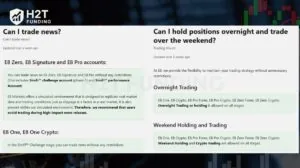
E8 Markets can be a strong choice for swing traders, but only if you pick the right account. E8 One and E8 Pro both allow overnight and weekend holding throughout the evaluation and funded stages, while E8 Signature automatically closes all positions at 23:00 server time every day, making it unsuitable for multi-day trading. For news trading, E8 Pro has no restrictions, whereas E8 One bans any execution, including SL or TP fills, within 5 minutes of high-impact news on funded accounts, with profits from violating trades removed at payout.
The drawdown model is another key advantage. E8 One uses a dynamic drawdown based on the highest closed balance, so floating profits never tighten your loss limit while a trade is still open. E8 Pro instead uses a static drawdown, which many swing traders find easier to manage. Both accounts also include a 4% daily drawdown reset at 00:00 server time, so overnight and weekend positions should always be sized with that daily limit in mind.
| 💳 Challenge Fee | $38 – $2,998 |
| 👥 Account Types | 1-step |
| 💰 Profit Split | 80% – 100% |
| 💵 Account Size | $5K – $500K |
| ⏱️ Time Limit | No time limit |
| 🎯 Profit Target | 6% – 9% |
| 📊 Trading Platforms | MT5, cTrader, Match Trader, TradeLocker |
| 🛍️ Asset Types | Forex, Commodities, Indices, Crypto, Energy, and Futures |
Verdict: E8 Pro is the clear choice for swing traders. It combines static drawdown, unrestricted news trading, overnight and weekend holding, and daily payout eligibility, creating the firm’s most swing-friendly account. E8 One is still a solid alternative if you prefer its configurable dynamic drawdown, but you’ll need to avoid the funded-stage news window – just never buy Signature for this style.
Goat Funded Trader
#4

Account Types
1-step, 2-step, 3-step, and instant funding
Trading Platforms
MT5, Match Trader, TradeLocker, Volumetricatrading
Profit Target
6% – 10%
Our take on Goat Funded Trader
Goat Funded Trader allows weekend holding on every model, but the model you pick decides whether the drawdown works for or against a swing strategy. The 1-Step, 2-Step Standard, GOAT, and 3-Step challenges all use static drawdown, allowing traders to hold multi-day positions without trailing risk. By contrast, Instant Funding and Blitz accounts use trailing drawdown with a 2% floating loss limit, making them less suitable for longer-term swing trades.
Two profit-adjustment rules shape how you enter and exit. The weekend gap rule reviews trades opened during the last three market hours on Friday and closed within the first three hours on Monday, removing any resulting profits without treating them as a rule violation. High-impact news trades are also reviewed, with profits capped at 1% of the initial balance if a position is opened or closed, including automatic SL or TP execution, within the restricted five-minute window.

| 💳 Challenge Fee | $36 – $3,048 |
| 👥 Account Types | 1-step, 2-step, 3-step, and instant funding |
| 💰 Profit Split | 80% – 100% |
| 💵 Account Size | $2.5K – $400K |
| ⏱️ Time Limit | No time limit |
| 🎯 Profit Target | 6% – 10% |
| 📊 Trading Platforms | MT5, Match Trader, TradeLocker, Volumetricatrading |
| 🛍️ Asset Types | Forex, Commodities, Indices, Crypto, Metals, Energy, Stocks |
Verdict: Goat Funded Trader offers one of the strongest swing trading setups, combining static drawdown, flexible holding rules, profit splits of up to 100%, and fast payouts (2 days). The main trade-off is that each payout cycle requires three qualifying days with at least 0.5% profit, while Instant Funding is not suitable for swing trading.
FTMO
#5

Account Types
2-step
Trading Platforms
MT4, MT5, cTrader, DXTrade
Profit Target
5% – 10%
Our take on FTMO
FTMO splits its rules by account stage, and this is what most swing traders miss: during the evaluation, both 2-step Standard and Swing accounts allow overnight holding, weekend holding, and trading through news. Once funded, however, Standard accounts must close positions before weekends and avoid opening or closing trades within the restricted news window, while the Swing account removes both limitations.
The Swing account is available only through the 2-Step Challenge and must be selected when purchasing the challenge. It cannot be added after funding, although traders may switch from Swing to Standard before a new payout cycle. The only notable trade-off is lower leverage (1:30 instead of 1:100), which forces smaller position sizing but aligns with how most multi-day strategies size positions anyway.
Note: At checkout, Swing is only selectable on the $10,000 account (€89). Every larger size, from $25,000 to $200,000, locks to the Standard type.
| 💳 Challenge Fee | €89 – €1,080 |
| 👥 Account Types | 2-step |
| 💰 Profit Split | 80% – 90% |
| 💵 Account Size | $10K – $200K |
| ⏱️ Time Limit | No time limit |
| 🎯 Profit Target | 5% – 10% |
| 📊 Trading Platforms | MT4, MT5, cTrader, DXTrade |
| 🛍️ Asset Types | Forex, Commodities, Indices, Stocks, Crypto |
Verdict: FTMO Swing remains one of the best-established prop firms for swing traders, offering no time limit, unrestricted overnight, weekend, and news trading, a refundable challenge fee, and profit splits of up to 90%. However, with a maximum starting account size of $10,000, traders seeking larger swing-friendly capital from day one may prefer other firms.
Our Top CFD Recommendation
Audacity Capital ranks first among the most CFD swing traders. It is the only firm on this list where every program, not just one specific account type, combines static drawdown, weekend holding, and no evaluation deadline, with funding that scales to $2.56 million. Each firm below it earns a place through a different strength:
- Choose Audacity Capital if you want swing-friendly rules on any program you buy, with no account-type traps and no time pressure.
- Choose The5ers if you compound within the account: the drawdown buffer expands as profits accumulate, and scaling reaches $4 million with splits up to 100%.
- Choose Goat Funded Trader if payout speed drives your decision – withdrawals land in 2 business days, backed by a $1,000 delay guarantee.
- Choose E8 Markets (E8 Pro) if you refuse any news restriction: E8 Pro trades through every release with daily payout eligibility, as long as you avoid the Signature product.
- Choose FTMO Swing if brand tenure and a refundable €89 fee outweigh starting capital, since the Swing type exists only on the $10,000 account.
If your strategy holds through high-impact news regularly, start with E8 Pro or FTMO Swing; the other three all apply some form of news-window rule. For everyone else, Audacity Capital’s combination of freedom and scale is the hardest to beat.
5. 2 Futures Prop Firms for Swing Traders (CME Market)
Phidias ranks as our best futures prop firm for swing traders, while Elite Trader Funding offers a more affordable path through lower-cost evaluations and instant funding accounts. Both firms allow overnight and weekend holding, but their drawdown models, payout rules, and account structures are designed for different trading styles.
Phidias Prop Firm
#1

Account Types
1-step
Trading Platforms
Sierra Chart, Quantower, Bookmap, MotiveWave, ATAS, DeepCharts, Rithmic, Tradovate, TradingView, NinjaTrader
Profit Target
3.5% – 8%
Our take on Phidias Prop Firm
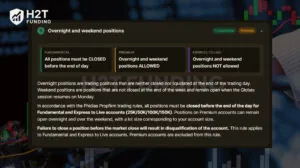
Phidias reserves swing trading for one account type: Premium. The Premium accounts allow overnight and weekend holding, require only one trading day to pass the evaluation, and remove any consistency rule during the challenge. By comparison, Fundamental accounts require all positions to be closed daily, while Express to Live is designed for faster funding rather than multi-day holding.
Combined with unrestricted news trading, payouts every five trading days, and a profit split that scales from 75% to 100%, Premium stands out as Phidias’ strongest option for swing traders. The account also includes a one-time funded account reset, providing an additional safety net that is not available on other Phidias models.
| 💳 Challenge Fee | $66 – $1,125 |
| 👥 Account Types | 1-step |
| 💰 Profit Split | 75% – 80% |
| 💵 Account Size | $10K – $150K |
| ⏱️ Time Limit | No time limit |
| 🎯 Profit Target | 3.5% – 8% |
| 📊 Trading Platforms | Sierra Chart, Quantower, Bookmap, MotiveWave, ATAS, DeepCharts, Rithmic, Tradovate, TradingView, NinjaTrader |
| 🛍️ Asset Types | Futures Contracts |
Verdict: If your strategy depends on holding CME positions for several sessions, Phidias Premium removes many of the restrictions that typically work against swing traders. The account gradually increases the profit split to 100% while offering payouts every five trading days, a $2,500-per-period withdrawal cap, and the +$200 valid-day rule favors steady compounders over traders landing occasional large winners.
Elite Trader Funding
#2

Account Types
Static, 1-step
Trading Platforms
Tradovate, Rithmic, NinjaTrader 8, TradingView
Profit Target
6% – 10%
Our take on Elite Trader Funding
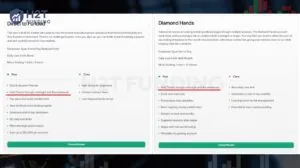
Elite Trader Funding supports swing trading through Diamond Hands and Direct to Funded (DTF) only. Diamond Hands is a one-step evaluation with overnight, weekend, holiday, and unrestricted news trading, while DTF skips the evaluation entirely for traders who want funded capital immediately. Among the two, the 100K DTF stands out with a fully static drawdown, whereas Diamond Hands and 50K DTF use end-of-day trailing drawdowns.
Diamond Hands follows only the highest realized end-of-day balance, so floating profits never tighten your drawdown during the session. Once realized gains exceed the maximum drawdown by $100, the trailing stop locks permanently into a static level. By comparison, the 100K DTF removes that concern with a static drawdown and no daily loss limit, making it the firm’s simplest risk model for swing traders.
| 💳 Challenge Fee | $57 – $697 |
| 👥 Account Types | Static, 1-step |
| 💰 Profit Split | 90% – 100% |
| 💵 Account Size | $10K – $250K |
| ⏱️ Time Limit | No time limit |
| 🎯 Profit Target | 6% – 10% |
| 📊 Trading Platforms | Tradovate, Rithmic, NinjaTrader 8, TradingView |
| 🛍️ Asset Types | Futures Markets |
Verdict: Diamond Hands gives futures swing traders the flexibility to hold positions across multiple sessions without time pressure, but success depends on managing the daily loss limit before the drawdown locks. The payout structure is stronger than that of many competitors, although the account requires at least one trade each week to remain active. Traders who prefer a simpler risk model may find Phidias Premium easier to manage over longer holding periods.
Our Top Futures Recommendation
Phidias Premium is our top choice for most futures swing traders because its rules stay out of the way of the strategy. Overnight and weekend holding, unrestricted news trading, no consistency rule during evaluation, and a drawdown that eventually behaves like a static limit make it easier to focus on trade execution instead of account management.
- Choose Phidias Premium if you want the simplest swing-friendly rule set, with overnight and weekend holding, an EOD drawdown that eventually becomes static, and progressive profit splits up to 100%.
- Choose Elite Trader Funding if faster payouts matter more. Diamond Hands offers a lower-cost evaluation with a 48-hour payout guarantee, while the 100K Direct to Funded account provides an immediately funded account with a static drawdown.
Both firms support genuine swing trading, so the decision is about how you prefer to manage risk. For most traders, Phidias offers a smoother learning curve, while Elite Trader Funding provides more flexibility for those willing to work within a more structured rule set.
6. Survival Guide: How to Protect Your Prop Account from Weekend Gaps
The best way to protect a prop account from weekend gaps is to reduce risk before the market closes. A stop loss cannot guarantee your exit price if the market reopens with a gap, so your position size and your firm’s drawdown rules matter far more than trying to predict Monday’s price action.

6.1. Leave a Buffer Below Your Daily Loss Limit
Before holding a position over the weekend, calculate how much room you have before reaching your firm’s Maximum Daily Loss or Max Drawdown.
A simple rule is: Available Risk Buffer = Daily Loss Limit − Worst-Case Weekend Loss
For example, if your account has a $2,500 daily loss limit and a realistic weekend gap could increase your open loss to $1,400, you have only $1,100 of remaining protection. If Monday opens beyond that level, your account can breach immediately before you have a chance to react.
6.2. Reduce Position Size Before Friday’s Close
Many experienced swing traders scale down exposure before the weekend instead of carrying a full-sized position into an uncertain market open. A common approach is to reduce position size by around 50%, secure part of the existing profit if available, and leave a smaller position running. Smaller size, smaller damage.
6.3. Match Your Strategy to Your Firm’s Drawdown Rules
Static and end-of-day drawdowns generally provide more room for multi-day trades because floating profits do not tighten the loss limit during the session. By contrast, real-time trailing or equity-based models can leave much less margin for an adverse gap.
Before carrying any position into Monday, confirm:
- Whether overnight and weekend holding is allowed.
- How the daily loss and maximum drawdown are calculated.
- Whether news or weekend-specific restrictions apply.
The wrong drawdown model makes every weekend gap a potential account breach.
6.4. Avoid Concentrated Risk
Holding several highly correlated positions can magnify the impact of a single weekend event. Multiple USD pairs or several equity indices may all move sharply in the same direction after major geopolitical or economic news. One event, multiple positions hit – the damage compounds fast. Instead of stacking correlated trades, consider reducing exposure, taking partial profits, or avoiding setups that all depend on the same market theme.
6.5. Know When Closing Is the Better Decision
If the remaining profit potential is small compared with the risk of a large gap, closing the trade may protect both your gains and your funded account. Missing part of a move is far less costly than breaching a drawdown rule over a weekend. Sometimes the best trade management decision is no position at all.
7. Other Crucial Factors to Check Before Buying a Challenge
Most swing traders compare profit splits and account sizes before buying a challenge, but the rules that end accounts rarely appear in marketing copy. Three categories deserve a close read before any purchase.
- Consistency Rule: Some firms require that no single trading day accounts for more than a set percentage (typically 30-40%) of your total profits at payout time. For swing traders, this rule can block a withdrawal even when the account is well in profit. Check whether the rule applies to both the evaluation and funded stages, and whether your natural trade distribution passes it without forcing extra trades.
- News Trading Policy on Passive Executions: Many firms publish a news-trading window, but not all explain how automatic stop-loss or take-profit executions are treated. Some remove the profit, others count it as a rule breach, while a few restrict only manually opened trades. This distinction matters for swing traders who may hold positions through major news releases.
- Hidden Payout Costs and Withdrawal Mechanics: A 90% profit split sounds strong until a 3.5% withdrawal fee, a per-cycle withdrawal cap, or a minimum qualifying-day requirement reduces the effective return. Total up the realistic return per withdrawal cycle across the firms you are comparing, not just the headline split.
- Swap Costs on Extended Holds: Holding trades overnight means paying swap fees. While usually modest, certain instruments, especially Crude Oil or indices around triple-swap days, can generate meaningful costs over several days. Review the swap schedule for the markets you trade before choosing a prop firm.
Three questions to answer: Does a consistency rule apply to your trading pattern? Does an automated SL fill inside the news window count as a violation? What does each payout actually cost after fees? If any answer is unclear from the firm’s public documentation, contact support before purchasing.
8. Which Prop Firm is Right For You? (Personalized Match)
The best swing prop firm depends on three factors: your market, your starting account size, and the rule you value most. Some traders need the widest drawdown buffer, while others care more about fast payouts or a lower upfront cost. The three profiles below match the most common swing trading situations.
Case 1: You Trade Forex/CFDs with a $25k – $50k Budget (Prioritizing Drawdown Comfort)
Audacity Capital is the strongest fit for this profile. Its static drawdown never follows floating profits, keeping the loss limit anchored to the starting balance regardless of intraday movement. Combined with unlimited weekend holding and no evaluation deadline, the rules match the pace of most swing strategies without forcing position management decisions around arbitrary risk windows.
Case 2: You Trade Futures with a $50k – $150k Budget (Prioritizing Fast Payouts)
Phidias Premium is the top pick for this budget range. The firm allows overnight and weekend holding, the EOD trailing drawdown only moves after realized profits and eventually locks into a static floor, and traders can request payouts every 5 trading days. The profit split climbs from 75% to 100% over time, rewarding traders who compound steadily rather than withdraw immediately.
Case 3: You Trade Forex with a Sub-$25k Budget (Prioritizing Balance of Payout & Price)
Goat Funded Trader offers the best balance of price and swing-friendly rules below $25k. Standard 1-Step and 2-Step accounts start at $36 for a $5K challenge, use static drawdown, allow weekend holding, and process payouts within 2 business days.
The only condition to plan for is the payout requirement of three profitable trading days, with at least 0.5% profit on each qualifying day. That requirement is manageable for most swing traders, but the Instant Funding and Blitz accounts remain poor choices because their trailing drawdown and 2% floating loss cap leave little room for multi-day positions.
9. FAQs
Yes, but only a small number of futures prop firms support true swing trading. While most firms require positions to be closed before the session ends, Phidias Premium and Elite Trader Funding’s Diamond Hands allow overnight and weekend holding, making them suitable for multi-day strategies. Prioritize firms that pair these holding rules with an EOD or static drawdown model instead of an intraday trailing drawdown.
Yes, but only on the FTMO Swing account. This account allows traders to keep positions open through weekends and major economic releases. However, it comes with lower leverage than the Standard account, so check the account type before purchasing your challenge.
Reduce position size and maintain a wider risk buffer. With Equity-Based Drawdown, unrealized losses count toward your breach limit, so normal pullbacks can trigger a violation before the trend resumes. For swing trading, limit risk to 0.5%-1% per trade, avoid stacking correlated positions, and leave sufficient buffer before holding trades overnight or through the weekend.
Many leading prop firms refund your challenge fee after you become funded or receive your first payout. Firms such as FTMO, Goat Funded Trader, and Phidias also offer policies that reduce upfront risk, including fee refunds after successful funding or free retries under certain conditions. If keeping your initial cost as low as possible is a priority, explore our guide to free prop firm challenges, where we compare firms offering refundable fees, free retries, and other trader-friendly incentives.
Choose a 1-Step evaluation if you’re an experienced swing trader who wants faster funding and can patiently wait for high-quality setups. Choose a 2-Step evaluation if you prefer a more gradual evaluation with lower profit targets in each phase and a steadier path to funding. If you’re deciding between providers, explore our best one-step prop firm challenges guide to compare the most swing-friendly 1-Step accounts and their key differences.
For Forex/CFD traders, the Audacity Capital $50K Ability Challenge is our top pick, thanks to its static drawdown, unlimited evaluation period, and unrestricted weekend holding. For futures traders, choose the Phidias Premium 50K account. It supports overnight and weekend positions, uses an EOD trailing drawdown that eventually becomes static, and offers payouts every five trading days.
Usually, yes, the challenge fee is non-refundable if you fail the evaluation. However, many firms reduce that risk through free retries, discounted resets, or by refunding the original challenge fee after you successfully become funded. To improve your odds, choose firms with no evaluation time limit, swing-friendly drawdown rules, and trader-friendly refund policies.
10. Conclusion: Which Prop Firm Should You Choose?
The best prop firm for swing traders is not the one with the highest profit split or the largest account size. It is the one whose rules do not interfere with how you actually trade.
Three questions determine the right choice:
- Do you trade Forex or CFDs? Start with Audacity Capital for the cleanest rule set across every program, or Goat Funded Trader if payout speed and entry cost matter more than anything else.
- Do you trade futures on CME? Phidias Premium is the most swing-friendly option available today, with an EOD drawdown that eventually locks static, unrestricted news trading and no consistency rule during the evaluation.
- Is your budget below $25k? Goat Funded Trader’s static drawdown, 2-business-day payouts, and challenge fees starting at $36 offer the best value at smaller account sizes.
One practical step before purchasing any challenge: read the firm’s exact policy on passive SL and TP executions during news windows, confirm the drawdown type on the specific account you intend to buy, and calculate the realistic payout after fees and withdrawal caps. The headline rules rarely tell the full story.
If you are still comparing options, explore more in-depth reviews and rankings from H2T Funding’s Best Prop Firms category. These guides break down each firm’s rules, pricing, payout structure, and trader suitability to help you compare accounts based on your strategy rather than marketing claims.