


E8 Markets, FTMO, FundedNext, and The5ers stand out among the 9 best prop firms for EA trading in 2026, each controlling automation through a different mechanism rather than simply allowing more or less EA usage.
- The5ers: holds the highest Trustpilot rating in this group at 4.9, and requires source-code ownership for any EA, ruling out rented or commercial black-box bots.
- FTMO: allows EA use across both evaluation and funded stages with no pre-approval, controlled by a clear 2,000-server-request daily cap rather than a subjective rule.
- FundedNext: has the largest review base by far at 76,500+, and supports multi-account EA automation through copy trading between a trader’s own accounts.
- E8 Markets: places no named strategy ban, including martingale and grid, making it the most permissive option here.
To identify these firms, H2T Funding evaluated core EA factors: automation permission, strategy restrictions, execution limits, copy-trading rules, EA ownership requirements, and compliance risk.
The table below compares EA policy, supported platforms, and copy-trading rules for all 9 firms, so you can shortlist by control mechanism before checking each firm’s platform restrictions.
| Firm | EAs / Bots | Profit Split | Coupon Code | Actions |
|---|---|---|---|---|

4.4
(3,200+ reviews)
|
Allowed (including martingale & grid) |
80% – 100%
|
H2T01
|
Open an account |

4.8
(53,770+ reviews)
|
Allowed on Evaluation & Funded |
90%
|
No code
|
Visit Official Website |

4.5
(2,600+ reviews)
|
Allowed, no pre-approval |
80% – 100%
|
H2tmedia
|
Open an account |

3.6
(1,300+ reviews)
|
Trade management, strategy-based & algorithmic EAs |
80% – 100%
|
No code
|
Open an account |

4.5
(78,300+ reviews)
|
Allowed on MT4/MT5 (additional EA fee) |
80% – 95%
|
No code
|
Visit Official Website |

3.7
(1,600+ reviews)
|
⚠️ Self-developed & trade-assistance EAs only |
80% – 90%
|
No code
|
Open an account |

4.9
(35,600+ reviews)
|
Allowed (source-code ownership required) |
50% – 100%
|
NAXW1ULCR
|
Open an account |

4.7
(21,500+ reviews)
|
⚠️ Trade-assistance EAs only (pre-approval required) |
80%
|
H2T
|
Open an account |
3.3
(6,100+ reviews)
|
Allowed on 1-, 2-, & 3-Phase Evaluation (pre-approval required) |
80% – 100%
|
No code
|
Visit Official Website |
Note: This comparison reflects each firm’s EA policy as of August 2026. Since prop firms regularly update their rules, supported platforms, and account conditions, you should always verify the latest EA policy with the firm before purchasing a challenge or funded account.
*US traders have platform limitations at E8 Markets, The5ers, FT+, and FXIFY.
All 9 firms support some form of EA usage, but the actual trading conditions vary sharply depending on which of these four mechanisms a firm relies on: operational limits, ownership requirements, pre-approval, or strategy scope. An “EA allowed” policy does not guarantee that every automated strategy will be accepted.
Some firms prioritize maximum automation freedom, while others focus on compliance through approval processes or stricter execution rules. The best EA-friendly prop firm depends less on whether EAs are allowed and more on how much flexibility your strategy requires.
1. What Does “EA Allowed” Actually Mean at a Prop Firm?
“EA Allowed” means a firm permits automated trade execution through an Expert Advisor on a supported platform. It does not mean the firm accepts any EA a trader wants to run. The permission covers the method, not every strategy built on that method, and the gap between those two things is where most account terminations start.
Before purchasing a challenge, it’s worth checking how the firm’s EA policy applies to your specific situation. In most cases, the scope of “EA Allowed” depends on the following factors:
- The account or funding program: EA support may differ between evaluation accounts, instant funding programs, and funded accounts. A firm may allow automation on one product while restricting it on another because each follows a different risk model.
- The supported trading platform: Most Expert Advisors are designed for MT4 and MT5 using MQL4 or MQL5. If a firm offers cTrader, DXtrade, Match-Trader, or TradeLocker, automation support may vary depending on each platform’s capabilities.
- The firm’s trading rules: Allowing EAs does not create a separate rulebook for automated trading. Your EA must still comply with the same drawdown limits, news trading policies, position limits, trading hours, and other account conditions that apply to manual traders.
- The firm’s published automation policy: Some firms summarize their stance with a simple “EA Allowed” label, while others provide additional requirements in their FAQs, prohibited trading practices, or support documentation. Reading those documents helps clarify what the firm actually permits before you deploy an algorithm.
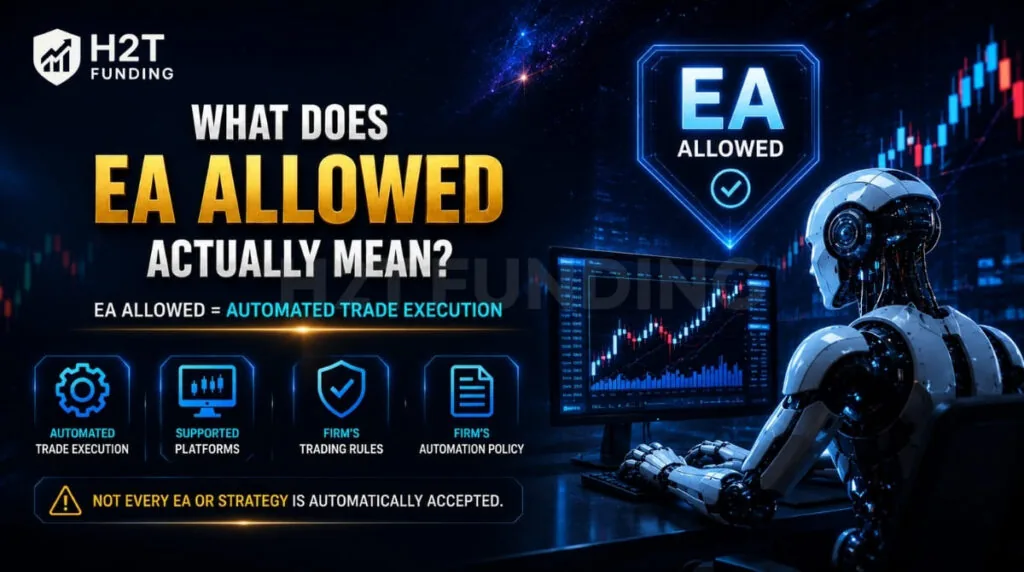
Not that every Expert Advisor or every automated trading approach is automatically accepted. The specific behaviors that can still trigger account reviews or violations are covered in the next section.
2. Detailed Reviews 9 Prop Firms That Allow EA Trading
Each of the 9 firms below is reviewed against the same EA factors covered in the comparison above, so you can see exactly which control mechanism applies and what it means for your strategy. The reviews follow the same order as the table, starting with E8 Markets, the firm with the fewest named strategy restrictions on this list.
E8 Funding
#1
Account Types
1-step
Trading Platforms
MT5, cTrader, Match Trader, TradeLocker
Profit Target
6% – 9%
Our take on E8 Funding
E8 Markets allows EAs, bots, algorithms, and indicators across its accounts without banning specific strategy types. Martingale, grid, and other automated approaches are permitted, but compliance depends more on execution behavior than the strategy itself. The main risk for EA traders comes from identical trading patterns across multiple users, which may lead to account termination.
Instead of strategy restrictions, E8 applies operational limits that automated systems must stay within:
- Daily server requests: Maximum 2,000 requests per account.
- Daily positions: Maximum 2,000 opened positions per day.
- Open orders: Maximum 100 active orders at the same time.
- Trade size: Up to 50 lots on most symbols and 20 lots on gold.
These limits are the main consideration for high-volume EAs. A strategy may be allowed by E8, but excessive execution frequency or oversized positions can still create compliance issues.
EA traders need to consider both account rules and platform compatibility when choosing E8. Drawdown models vary by account type: E8 Pro’s static drawdown suits EAs built around fixed risk limits, while E8 One and Signature require systems that can adapt to changing thresholds. Platform access also matters, as US traders are limited to TradeLocker and MatchTrader, which may affect compatibility with traditional MT4/MT5-based EAs.
| 💳 Challenge Fee | $38 – $2,998 |
| 👥 Account Types | 1-step |
| 💰 Profit Split | 80% – 100% |
| 💵 Account Size | $5K – $500K |
| ⏱️ Time Limit | No time limit |
| 🎯 Profit Target | 6% – 9% |
| 📊 Trading Platforms | MT5, cTrader, Match Trader, TradeLocker |
| 🛍️ Asset Types | Forex, Commodities, Indices, Crypto, Energy, and Futures |
Verdict: E8 Markets fits a trader who wants freedom over strategy type, including martingale or grid-based EAs, but who can keep that EA unique enough to avoid looking like shared code across the platform’s user base. US traders should confirm EA compatibility with TradeLocker or MatchTrader, while account selection matters because drawdown models differ between E8 Pro, One, and Signature. For automated traders, keeping execution volume and trading patterns within E8’s limits is the key to long-term compliance.
FTMO
#2
Account Types
1-Step Challenge, 2-Step Challenge
Trading Platforms
MT4, MT5, cTrader, TradingView
Profit Target
10% – 15%
Our take on FTMO
FTMO remains one of the most practical prop firms for EA traders because it supports automation from the evaluation stage through the funded account, without requiring manual trading at any point. The firm also supports MT4, MT5, and cTrader, giving traders broad compatibility with custom and commercial Expert Advisors, while VPN/VPS hosting is permitted for stable 24/7 execution.
FTMO separates ordinary algorithmic execution from a specific list of practices it treats as manipulation, and that distinction decides whether an EA trader stays compliant or gets flagged. FTMO explicitly prohibits EAs that push a simulated account past a 2,000 server-request daily cap, designed to prevent bots that constantly open, modify, or cancel orders. Standard swing, breakout, trend-following, or mean reversion EAs generally operate well within this limit, while ultra-high-frequency, latency-based, or tick scalping systems are unlikely to remain compliant.
For traders planning to scale, risk-model compatibility matters more than EA permission itself. The 2-Step Challenge runs on a static maximum loss, while the 1-Step Challenge applies a trailing end-of-day drawdown, so the same EA risk settings will not necessarily work across both. FTMO also monitors coordinated trading between related accounts, so running identical EA configurations across multiple linked accounts calls for extra caution.
| 💳 Challenge Fee | €89 – €1,080 |
| 👥 Account Types | 1-Step Challenge, 2-Step Challenge |
| 💰 Profit Split | 90% |
| 💵 Account Size | $10K – $200K |
| ⏱️ Time Limit | No time limit |
| 🎯 Profit Target | 10% – 15% |
| 📊 Trading Platforms | MT4, MT5, cTrader, TradingView |
| 🛍️ Asset Types | Forex, Commodities, Indices, Stocks |
Verdict: FTMO suits traders running structured, rule-based EAs with clear risk controls such as trend-following, breakout, swing, or portfolio-based automation, rather than execution-heavy systems. However, traders relying on HFT models, aggressive grid strategies, martingale systems, or extensive multi-account replication may face operational and compliance challenges regardless of the strategy’s profitability.
A comment from a trader in the FTMO Trader’s Community on Facebook illustrates how some users interpret FTMO’s EA rules. While this is only an individual trader’s view, it reflects the broader distinction FTMO makes between permitted automation and prohibited trading behaviors.
“Allowed bro 👍 just ensure the EA respects FTMO rules and isn’t doing high‑frequency or crazy grid/martingale trading.” – Ngugi Paul KD
Funded Trading Plus
#3
Account Types
1-Step, 2-Step, and Instant Funding
Trading Platforms
MT5, cTrader, Match Trader, DXTrade
Profit Target
7% – 10%
Our take on Funded Trading Plus
Funded Trading Plus takes an open approach to EAs, algos, and bots, permitting any strategy or automated style across its simulated-live environment, subject to the same abuse restrictions that apply to manual trading: no arbitrage, grid trading, tick scalping, or other exploitation of the demo environment.
FT+ states directly that it cannot offer support for EAs, algos, or bots, since these remain third-party applications and the trader’s own responsibility. That distinction matters for a trader weighing this firm against one that pre-approves EA files before use: FT+ places the compliance burden entirely on the trader to read the Terms and Conditions and self-police, rather than reviewing and clearing each EA in advance.
Copy trading and hedging rules are more restrictive than they first appear. While traders may use copy-trading tools for their own accounts, using an EA to copy trades or hedge across multiple FT+ accounts owned by the same trader is prohibited. Hedging is only allowed within a single account, and overlapping positions across different traders’ accounts may also trigger copy-trading reviews.
Platform access narrows for US-based traders specifically. FT+ offers MT5 and Match-Trader, but MT5 is not available in the US, which limits US traders to Match-Trader for any EA built around that platform’s automation framework.
| 💳 Challenge Fee | $89 – $4,499 |
| 👥 Account Types | 1-Step, 2-Step, and Instant Funding |
| 💰 Profit Split | 80% – 100% |
| 💵 Account Size | $5K – $200K |
| ⏱️ Time Limit | No time limit |
| 🎯 Profit Target | 7% – 10% |
| 📊 Trading Platforms | MT5, cTrader, Match Trader, DXTrade |
| 🛍️ Asset Types | Forex, Indices, Commodities, Metals, Crypto |
Verdict: Funded Trading Plus is well suited to traders who want maximum freedom to run their own EAs without a pre-approval process. The trade-off is that compliance and troubleshooting are entirely the trader’s responsibility. Its biggest limitation is the strict prohibition on using EAs to copy trade or hedge across multiple FT+ accounts, making the firm a better fit for single-account automation than for traders managing the same strategy across a portfolio of funded accounts.
Atlas Funded
#4
Account Types
1-step, 2-step, 3-step, and instant funding
Trading Platforms
MT5, TradeLocker, Match Trader
Profit Target
4% – 11%
Our take on Atlas Funded
Atlas Funded allows EAs and automated strategies on both Evaluation and Funded accounts. Unlike many prop firms, it explicitly permits three types of automation:
- Trade management EAs (stop-loss, trailing stop, position sizing)
- Strategy-based EAs using technical or fundamental signals
- Algorithmic systems built around predefined risk rules
The only EA category explicitly banned is High-Frequency Trading (HFT), particularly bots that place large numbers of orders within milliseconds, as these create execution and liquidity issues for the firm’s brokers. Atlas Funded also enforces several clear quantitative rules that automated strategies must follow:
- Minimum holding time: Every trade must remain open for at least 3 minutes. Repeated short-duration trades used to reach profit targets or minimum trading days are not allowed.
- Single-instrument risk cap (Funded only): Total risk on one instrument cannot exceed 50% of the account’s daily drawdown limit, including stop-loss exposure, floating drawdown, and realized losses.
News trading is fully allowed during Evaluation, including overnight and weekend positions. On Funded accounts, however, profits from trades opened or closed within 5 minutes of a high-impact news release (effective September 4, 2025) may be removed, although the account itself will not be breached. Positions opened before the news event are not affected.
For platform support, Atlas Funded offers MT5, TradeLocker, and MatchTrader, giving traders access to MetaTrader-based automation alongside two web-based alternatives across desktop, web, and mobile devices.
| 💳 Challenge Fee | $5 – $900 |
| 👥 Account Types | 1-step, 2-step, 3-step, and instant funding |
| 💰 Profit Split | 80% – 100% |
| 💵 Account Size | $5K – $400K |
| ⏱️ Time Limit | No time limit |
| 🎯 Profit Target | 4% – 11% |
| 📊 Trading Platforms | MT5, TradeLocker, Match Trader |
| 🛍️ Asset Types | Forex, Indices, Commodities, Crypto |
Verdict: Atlas Funded is a better option for a trader running a strategy-based or risk-managed EA with trades that naturally hold longer than 3 minutes and position sizing that respects the 50% single-instrument risk cap on funded accounts. The firm’s willingness to quantify its rules gives an EA developer concrete parameters to code around, rather than a general prohibition to interpret.
However, HFT and ultra-short-term EAs are not supported, and funded traders should avoid opening or closing trades within 5 minutes of high-impact news if they want to protect their profits.
FundedNext
#5
Account Types
1-step, 2-step, and Instant Funding
Trading Platforms
MT4, MT5, cTrader, Match Trader
Profit Target
4% – 10%
Our take on FundedNext
FundedNext allows EA usage on MT4 and MT5, with an added EA usage fee attached to the account, but draws a hard line at the platform level: cTrader and Match-Trader carry no automated trading support at all, since both are built specifically for manual execution. This makes platform choice the first decision an EA trader has to get right at FundedNext, not an afterthought.
Where FTMO polices EA behavior mainly through a server-request cap, FundedNext polices it through customization and strategy uniqueness. Traders must configure their EA to their own trading style rather than run it in default form, and each EA has to run a distinct strategy rather than duplicate trades across accounts. The firm goes further than most competitors by naming specific banned EAs outright, including bots built purely to pass the challenge, such as:
- The Prop Pilot EA
- PropEA – Fxblood Capital
- Gold OneShot EA MT5
- Forex Flex EA
- X Pass Bot
FundedNext also enforces a consistency rule that catches a failure mode other firms describe more loosely: a trader cannot pass the Challenge manually and switch to an EA on the funded account, or the reverse. So a trader who passes evaluation on low-risk forex pairs and then jumps to high-margin gold trades on the funded account faces the same scrutiny as a manual-to-EA switch. Tick scalping, HFT, arbitrage, grid trading, and latency trading are named directly on FundedNext’s restricted strategy list, removing several automation styles some EA traders rely on elsewhere.
| 💳 Challenge Fee | $32.99 – $1,099.99 |
| 👥 Account Types | 1-step, 2-step, and Instant Funding |
| 💰 Profit Split | 80% – 95% |
| 💵 Account Size | $2K – $200K |
| ⏱️ Time Limit | No time limit |
| 🎯 Profit Target | 4% – 10% |
| 📊 Trading Platforms | MT4, MT5, cTrader, Match Trader |
| 🛍️ Asset Types | Forex, Indices, Commodities, Crypto, CFDs |
Verdict: FundedNext works best for traders running one customized, MT4 or MT5-based EA with a consistent strategy from the Challenge stage straight through to the funded account. The tradeoff is limited platform flexibility. Traders using cTrader or Match-Trader cannot combine those platforms with EA automation, while funded traders may face restrictions when changing strategies due to the consistency rule.
Blueberry Funded
#6
Account Types
1-step, 2-step, and instant funding
Trading Platforms
MT4, MT5, DXTrade, TradeLocker
Profit Target
5% – 10%
Our take on Blueberry Funded
Blueberry Funded evaluates EAs based on who makes the trading decision, not simply whether the strategy is automated. EAs that assist manually executed trades, such as position sizing, risk calculation, or trade management, are allowed. Self-developed EAs are also permitted, provided you can prove ownership of the source code.
However, fully autonomous EAs that generate signals or execute trades independently are prohibited. The firm also makes it clear that changing the settings of a commercial EA does not count as ownership, so configurable third-party bots remain ineligible.
A major policy change took effect on March 12, 2026. For accounts purchased after this date, Blueberry Funded removed restrictions on:
- Martingale strategies
- Grid trading
- Position stacking
- Excessive scalping
This gives traders significantly more flexibility than many competitors. However, the firm still permanently prohibits:
- Latency arbitrage
- HFT and tick scalping
- Toxic trading flow
- Third-party copy trading
- External hedging or hedge arbitrage
Blueberry Funded also applies a clear “your own accounts only” policy. Hedging is permitted within a single account, including correlated instruments, while hedging between multiple Blueberry Funded accounts or against an external broker is treated as a hard breach.
| 💳 Challenge Fee | $30 – $1,240 |
| 👥 Account Types | 1-step, 2-step, and instant funding |
| 💰 Profit Split | 80% – 90% |
| 💵 Account Size | $1,25K – $200K |
| ⏱️ Time Limit | No time limit |
| 🎯 Profit Target | 5% – 10% |
| 📊 Trading Platforms | MT4, MT5, DXTrade, TradeLocker |
| 🛍️ Asset Types | Forex, Indices, Commodities, Crypto, Stocks, Futures |
Verdict: Blueberry Funded fits a trader who builds and controls their own EAs rather than relying on commercial trading bots. Its policy focuses on code ownership and decision-making control, allowing self-developed automation while prohibiting EAs that generate trades independently. The March 2026 rule update also makes Blueberry Funded one of the more flexible firms for strategies involving grid trading, martingale, and position stacking.
The5ers
#7
Account Types
1-step, 2-step, 3-step
Trading Platforms
MT5, cTrader
Profit Target
5% – 10%
Our take on The5ers
The5ers supports Expert Advisors, but its EA policy is one of the most restrictive and transparent in the industry. The firm requires traders to own the EA source code and keep a visible stop-loss on every trade, effectively banning stealth-stop EAs. These requirements help verify that the strategy belongs to the trader and that risk controls remain auditable.
Beyond standard restrictions such as HFT and latency arbitrage, The5ers also prohibits several EA behaviors that many firms only mention vaguely:
- Commercial EAs that generate identical trades across multiple traders.
- Rollover scalping EAs designed to exploit pricing around market rollover.
- News bracketing, where buy-stop and sell-stop orders are placed on both sides of a high-impact news event.
- Bulk trading, one-sided betting, and coordinated trading across accounts or different prop firms.
The firm allows copying trades between your own accounts, but Bootcamp accounts must use a different strategy for each account. This effectively prevents traders from running the same EA across multiple Bootcamp accounts, making The5ers stricter than many competitors on multi-account automation.
Platform choice narrows automation options more than at most competitors. Non-US traders get MT5, cTrader, and TradingView, with cTrader carrying a flat $10 add-on fee. US-based traders currently have TradingView only, a platform not built around the MQL-based EA framework that MT4/MT5 and cTrader’s cAlgo support. That effectively puts most conventional EA setups out of reach for US traders on The5ers until MT5 or cTrader becomes available to that region.
| 💳 Challenge Fee | $19 – $850 |
| 👥 Account Types | 1-step, 2-step, 3-step |
| 💰 Profit Split | 50% – 100% |
| 💵 Account Size | $2.5K – $250K |
| ⏱️ Time Limit | No time limit |
| 🎯 Profit Target | 5% – 10% |
| 📊 Trading Platforms | MT5, cTrader |
| 🛍️ Asset Types | Forex / CFD |
Verdict: The5ers suits a trader running a self-built EA they can prove ownership of, with visible risk controls and a strategy that holds up under real market conditions rather than one built to exploit rollover spreads or platform mechanics. The firm’s prohibited-practices list is unusually specific, which works in a trader’s favor for compliance clarity, but it also closes off tactics some other firms tolerate in a gray zone, rollover-night scalping and unmodified third-party EAs among them.
Alpha Capital Group
#8
Account Types
1-step, 2-step, 3-step
Trading Platforms
MT5, cTrader, DXTrade, TradeLocker
Profit Target
4% – 10%
Our take on Alpha Capital Group
Alpha Capital Group takes one of the strictest approaches to EA trading among major prop firms. While EAs are supported on MT5, they are limited to risk management and trade assistance rather than fully automated trading.
Permitted EA functions include:
- Lot size calculation
- Stop-loss and take-profit management
- Break-even automation
- Virtual or hidden stop-loss/take-profit levels
However, fully automated EAs that open and manage trades without manual entry are prohibited. This restriction also covers third-party bots, high-frequency trading (HFT), and latency arbitrage, making Alpha Capital better suited to discretionary traders who use EAs as execution tools rather than autonomous trading systems.
Besides, every EA also needs pre-approval before use: traders submit the EX5 file, and the MQ5 source code where available, to support@alphacapitalgroup.uk, and must select “Enable EA” at checkout before contacting support to complete activation. Skipping pre-approval, or running an EA outside the approved risk-management category, results in immediate disqualification or account termination, not a soft breach.
Alpha Capital also publishes clear rules on hedging and stacking. Both are permitted under normal trading conditions, but the following remain prohibited:
- Hedging to exploit price or spread arbitrage
- Cross-account hedging between Alpha Capital accounts, including correlated instruments
These rules make Alpha Capital one of the least suitable choices for traders seeking fully automated EA trading, but a practical option for traders who only use EAs to manage manually executed positions.
| 💳 Challenge Fee | $40 – $1,097 |
| 👥 Account Types | 1-step, 2-step, 3-step |
| 💰 Profit Split | 80% |
| 💵 Account Size | $5K – $200K |
| ⏱️ Time Limit | No time limit |
| 🎯 Profit Target | 4% – 10% |
| 📊 Trading Platforms | MT5, cTrader, DXTrade, TradeLocker |
| 🛍️ Asset Types | Forex, Metals, Commodities, Indices |
Verdict: Alpha Capital Group is designed for discretionary traders who use EAs to support manually executed trades rather than fully automate them. EAs that handle position sizing, stop-loss placement, or break-even management after manual entry fall within the firm’s approved use cases. By contrast, strategies that rely on an EA to open and close trades independently are not permitted. Although the mandatory pre-approval process introduces an extra step, it gives traders clear confirmation that their EA complies before live trading begins.
FXIFY
#9
Account Types
1-step, 2-step, 3-step, and Instant Funding
Trading Platforms
MT4, MT5, DXTrade, TradingView
Profit Target
4% – 10%
Our take on FXIFY
FXIFY allows EAs, but only on its 1-Phase, 2-Phase, and 3-Phase Programs. Instant Funding, Lightning accounts, and all DXtrade accounts do not support EAs. To verify the policy, H2T Funding contacted FXIFY’s support team directly, which confirmed these account-specific restrictions that are not clearly explained in the public FAQ.
Unlike firms that let traders deploy compliant EAs immediately, every EA must be pre-approved before trading. The review requires details such as:
- Trading strategy and timeframe
- Average holding time
- Trading pairs
- Take-profit target
- Whether the EA uses HFT or latency arbitrage
Running an EA without prior approval is considered a rule violation, regardless of how the strategy actually performs.
Platform access adds a second filter beyond account type. While FXIFY supports MT4, MT5, and DXtrade, DXtrade does not support trading bots, and both MT4 and MT5 are unavailable to US traders. As a result, US-based traders currently have no supported platform for running EAs on FXIFY, even if they choose an eligible Evaluation Program.
FXIFY also permits copy trading between a trader’s own accounts, while prohibiting third-party copy trading, herd trading, HFT, latency arbitrage, and order-book manipulation. Using the same commercial EA as other FXIFY traders may also trigger a compliance review if it creates matching trading behavior.
| 💳 Challenge Fee | $19 – $4,249 |
| 👥 Account Types | 1-step, 2-step, 3-step, and Instant Funding |
| 💰 Profit Split | 80% – 100% |
| 💵 Account Size | $1K – $400K |
| ⏱️ Time Limit | No time limit |
| 🎯 Profit Target | 4% – 10% |
| 📊 Trading Platforms | MT4, MT5, DXTrade, TradingView |
| 🛍️ Asset Types | Forex, Metals, Equities, Crypto, Commodities, Stocks, Indies |
Verdict: FXIFY suits a trader running a disclosed, rules-based EA on one of the Evaluation Programs, provided they’re willing to submit it for review before trading rather than deploy first and ask later. The tradeoff is flexibility: a trader who wants FXIFY’s fastest funding routes will need to trade manually to get there, and running the same commercial EA as other FXIFY traders carries real risk of a herd-trading flag regardless of the strategy’s underlying quality.
3. The Real Restrictions Behind “EA Allowed” (What Actually Gets Accounts Closed)
Firms close EA accounts because of how the bot trades, not because it is automated. Most restrictions fall into four areas: strategy originality, execution behavior, consistency, and risk management.
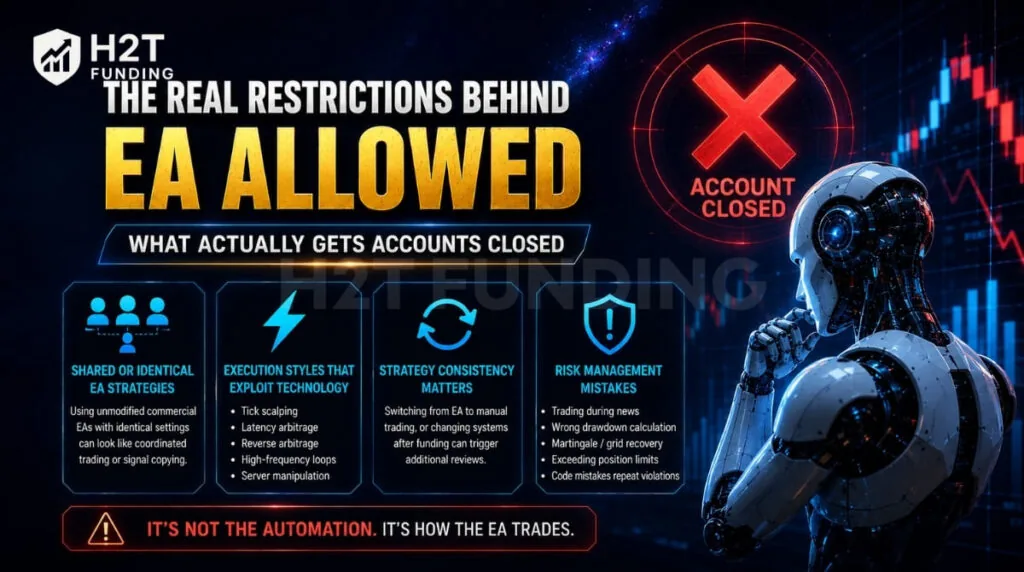
3.1. Shared or identical EA strategies
One of the fastest ways to attract a compliance review is using an unmodified commercial EA that thousands of traders run with the same settings. When multiple funded accounts consistently open identical positions within milliseconds of each other, firms may classify the activity as shared strategy, coordinated trading, or unauthorized signal distribution.
This does not mean every commercial EA is banned. The issue arises when the execution pattern is indistinguishable from large-scale copy trading rather than independent decision-making. You can customize entry filters, risk parameters, and trade management to help demonstrate independent execution.
3.2. Execution styles that exploit the firm’s technology
Many firms advertise EA compatibility while simultaneously banning execution methods designed to profit from simulator imperfections instead of market movement.
Common examples include:
| Restricted execution | Why firms prohibit it |
|---|---|
| Tick scalping | Relies on tiny price movements and simulator fills that cannot be replicated in live markets. |
| Latency arbitrage | Exploits delayed price feeds between different liquidity sources. |
| Reverse arbitrage | Takes advantage of execution timing differences rather than market analysis. |
| High-frequency execution loops | Generates excessive order traffic that stresses the trading infrastructure. |
| Server manipulation | Attempts to exploit platform behavior instead of trading price action. |
These strategies often produce unrealistic fill quality that cannot be copied in real liquidity, making them incompatible with most prop firms’ business models.
3.3. Strategy consistency matters more than automation
Some firms, such as FundedNext, also monitor whether you maintain the same trading approach throughout the account lifecycle. Passing an evaluation with an EA and switching to manual trading, or replacing one algorithm with a completely different system after funding, may trigger additional reviews where consistency policies apply.
3.4. Risk management mistakes can trigger breaches
Even a legitimate EA can breach account rules if it is programmed incorrectly. Common issues include trading during restricted news windows, calculating drawdown from the wrong server time, using unrestricted Martingale or grid recovery logic, or exceeding position limits after multiple recovery trades.
Because an EA follows its code exactly, a single programming mistake can repeatedly violate trading rules before you have an opportunity to intervene.
4. How to Verify a Prop Firm’s EA Policy Before You Pay
Many prop firms advertise that they allow EAs, but the actual rules are often buried in the Terms & Conditions or vary by account type, platform, and funding model. To evaluate every prop firm in this guide, H2T Funding followed the verification process below, combining official documentation with direct confirmation from support whenever the published rules were unclear. We recommend doing the same before purchasing any challenge.
4.1. Read the official trading rules, not just the FAQ
Start with the Forbidden Trading Practices or Terms & Conditions page rather than relying on the FAQ. Pay attention to:
- Restricted strategies such as HFT, grid trading, martingale, latency arbitrage, or tick scalping.
- Whether commercial EAs are allowed or only self-developed bots.
- Whether the firm requires EA pre-approval before trading.
- Whether the rules differ between Evaluation and Funded accounts.
Many important restrictions only appear in the official rulebook. For example, FTMO’s server request limit and FundedNext’s prohibited EA list are documented there instead of the general FAQ.
4.2. Ask support about your exact EA
Don’t ask a generic question like “Are EAs allowed?” Instead, describe exactly how your EA works and keep the written response for future reference. Include details such as:
- Trading strategy
- Timeframe
- Average holding time
- Trading pairs
- Whether it uses grid, martingale, HFT, or latency arbitrage
4.3. Verify the rule for your account type and platform
Many traders assume an entire prop firm shares one EA policy. In reality, the rules often vary by account. For example:
- FXIFY allows EAs on Evaluation Programs, but not on Instant Funding, Lightning, or DXtrade accounts.
- E8 Markets applies different news trading rules depending on the funded account model.
- FTMO uses different drawdown structures between its 1-Step and 2-Step Challenges, which may require different EA risk settings.
Always verify the exact account and platform you’re purchasing instead of relying on the firm’s overall marketing message.
4.4. Look for real trader experiences
Before buying, search independent communities such as Trustpilot, Reddit, or major trading forums. Search phrases like:
- “[Firm Name] EA banned”
- “[Firm Name] automated payout”
- “[Firm Name] EA review”
One complaint doesn’t necessarily indicate a problem, but repeated reports about the same EA restriction or payout issue deserve attention.
5. Do You Need a VPS to Run an EA on a Funded Account?
No, you don’t need a VPS to run an EA. You can install MetaTrader on your own computer and let your EA trade normally. However, for most funded traders, a VPS is one of the simplest upgrades you can make because it helps eliminate technical issues that could violate a prop firm’s risk rules.
A VPS (Virtual Private Server) is simply a remote Windows computer that runs 24/5 in a professional data center. Instead of depending on your home PC, your trading platform stays online even if your computer is turned off.
The biggest advantages include:
- 24/5 uptime, reducing the risk of missed trades caused by power or internet outages.
- Lower latency when the VPS is located close to your broker or prop firm’s trading servers.
- Better stability, avoiding Windows updates, sleep mode, or hardware failures that can interrupt your EA.
- Reliable execution when running multiple charts or several EAs simultaneously.
Without a VPS, unexpected events such as internet disconnections, power failures, automatic Windows restarts, or computer crashes can leave positions unmanaged. On a personal account, this may simply reduce profits. On a funded account, it can lead to drawdown breaches or missed stop-loss management.
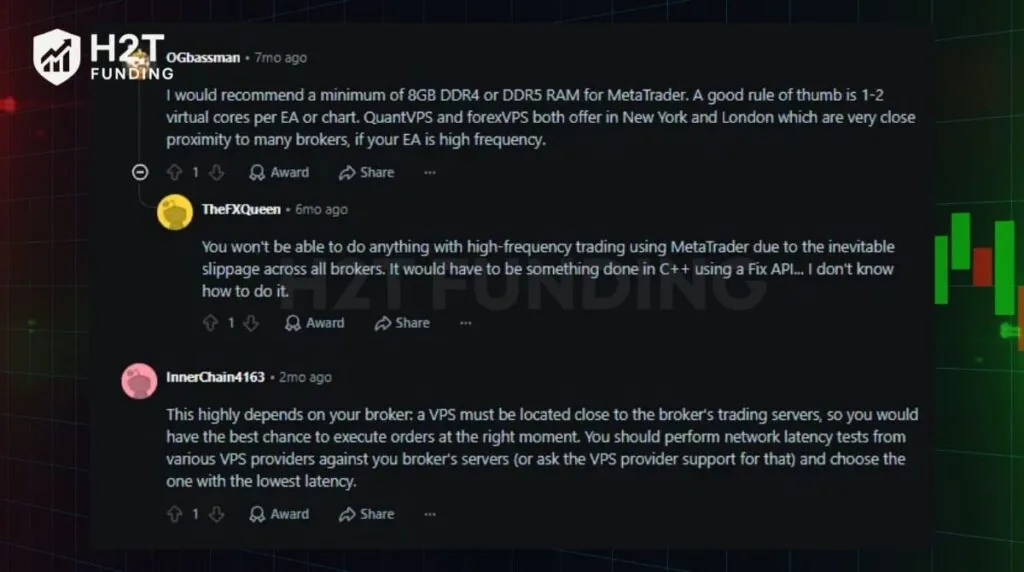
During our research, we also reviewed discussions from experienced EA traders. One trader recommended:
“I would recommend a minimum of 8GB DDR4 or DDR5 RAM… 1-2 virtual cores per EA or chart. QuantVPS and ForexVPS both offer servers in New York and London, which are very close to many brokers.”
If you only run an EA occasionally while actively monitoring your computer, you may not need a VPS. But for serious automated trading on a funded account, a reliable VPS is one of the simplest ways to reduce avoidable technical risks.
6. Which Prop Firm Fits Your EA Strategy?
A firm that broadly “allows EAs” doesn’t automatically fit your specific bot. The right match depends on what your EA does, how often it trades, and whether you plan to run it across multiple accounts.
| Use Case | Best Fit | Why |
|---|---|---|
| Scalping-tolerant / high-frequency-adjacent EA | E8 Markets, FTMO | No named strategy ban at E8; FTMO’s 2,000 server-request cap still allows frequent execution. |
| Swing / trend-following EA | FTMO (Swing Account), Atlas Funded, FundedNext | All three remove news or weekend-closure restrictions for overnight and multi-day holding. |
| Martingale / grid-based EA | E8 Markets, Blueberry Funded | Neither firm restricts these strategies; Blueberry lifted its ban for accounts bought after March 2026. |
| Multi-account / correlated EA | FundedNext, Atlas Funded, Alpha Capital Group | Copy trading allowed between a trader’s own accounts, with Alpha Capital requiring formal verification. |
| Self-developed / source-code-owned EA | The5ers, Blueberry Funded | Both require proof of code ownership, ruling out rented or black-box bots. |
| Trade-management / assistive EA only | Alpha Capital Group, Blueberry Funded | EAs limited to stop-loss, lot sizing, and similar assistive functions, not full automation. |
| Compliance-focused / pre-approval EA | Alpha Capital Group, FXIFY | Both require EA submission and approval before it can trade. |
| No pre-approval / fast deployment | E8 Markets, FTMO, Funded Trading Plus, FundedNext, Atlas Funded | None require review before running an EA, if the strategy avoids named restrictions. |
No firm in this guide accepts true tick scalping or millisecond-level HFT; that restriction holds across all nine reviews. The right firm ultimately comes down to matching your EA’s actual trading behavior, not its label, to the rules covered in each review.
If swing or weekend-holding is your primary style rather than EA automation specifically, our best prop firms for swing traders guide covers the broader picture beyond EA support alone.
7. FAQs
-
No. Some prop firms fully support EAs, while others only allow them on specific account types, platforms, or after pre-approval. Even firms that advertise “EA allowed” often restrict strategies such as HFT, latency arbitrage, or grid trading, so always check the rules for your specific program before purchasing.
-
The most commonly prohibited strategies include high-frequency trading (HFT), latency arbitrage, grid trading, martingale, tick scalping, and trade copying that violates the firm’s policy. Some firms also restrict identical trading patterns across multiple accounts or traders, even if the EA itself is permitted.
-
No, but it is highly recommended. A VPS keeps your trading platform running 24/5, reduces latency, and helps prevent interruptions caused by internet outages, power failures, or Windows updates that could affect a funded account.
-
It depends on the prop firm. FundedNext, Atlas Funded, and Alpha Capital Group all allow traders to use the same EA across their own funded accounts, although copy trading and account ownership rules still apply. Always verify each firm’s copy trading and multi-account policy before deploying the same EA.
-
No. Using an EA does not normally change your profit split or payout schedule. However, profits may be denied or removed if the EA violates the firm’s trading rules, such as using prohibited strategies or trading on an account where EAs are not allowed.
-
Several leading prop firms allow bot trading, including FTMO, E8 Markets, Funded Trading Plus, FundedNext, Atlas Funded, FXIFY, Blueberry Funded, The5ers, and Alpha Capital Group. However, each firm has different rules regarding EA approval, supported platforms, prohibited strategies, and copy trading, so the best choice depends on how your bot trades rather than whether it is automated.
8. Conclusion: Which EA-Friendly Prop Firm Should You Choose?
No single prop firm is the best choice for every algorithm. A firm that works well for a low-frequency trend-following EA may be a poor fit for a high-frequency scalping bot, even if both advertise “EA Allowed.”
- Best overall for most EA traders: FTMO supports automation from evaluation through the funded account with no pre-approval process, making it suitable for most swing, breakout, trend-following, and systematic strategies.
- Best for maximum EA flexibility: E8 Markets and Funded Trading Plus both allow a wide range of strategies, including martingale and grid, without a pre-approval step.
- Best for advanced or fully custom EAs: The5ers is the best choice for proprietary EA developers because it requires traders to own the EA’s source code, excluding rented or black-box bots. Blueberry Funded is a strong alternative, allowing self-developed martingale and grid EAs under its March 2026 policy update.
- Best for risk-managed, quantified rules: Atlas Funded and FundedNext provide clear rules that are easy to code into an EA. Atlas Funded enforces a 3-minute minimum holding time and a 50% single-instrument risk cap, while FundedNext applies defined consistency and allocation rules.
- Best for compliance-focused or trade-assistance EAs: Alpha Capital Group and FXIFY both require EA pre-approval before trading, making them better suited to traders willing to submit documentation upfront in exchange for clearer compliance confirmation.
Before purchasing any challenge, confirm which account types support EAs, which platforms are compatible with your algorithm, and whether your strategy complies with the firm’s rules on copy trading, execution methods, and multi-account trading. These factors usually have a greater impact on long-term success than the advertised account size or profit split.
If you’re still exploring your options, browse more comparisons and in-depth reviews in H2T Funding’s Best Prop Firms category. Whether you’re looking for futures prop firms, forex prop firms, or beginner-friendly programs. We regularly review prop firms based on trading rules, platform support, payout structures, and trader suitability to help you find the best fit for your strategy.