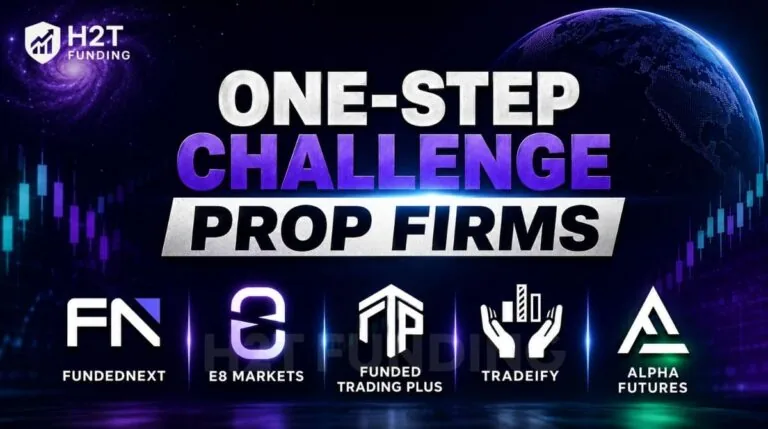



Below is the full list of 10 prop firms that allow copy trading, grouped by instrument:
Forex & CFD Prop Firms:
- E8 Markets: Most flexible for multi-account scaling, up to 100% profit split
- AquaFunded: Allows copying to external personal accounts, ideal for EA/algo traders
- FunderPro: Clear ownership-based policy, straightforward compliance rules
- FundedNext: Features one of the most detailed copy-trading policy frameworks among forex prop firms.
- The5ers: Well-known for long-term scaling plans and a strong focus on risk management
- FXIFY: Self-copy allowed; external accounts require extra ownership verification
Futures Prop Firms:
- Tradeify: A futures-focused prop firm designed for active traders seeking account scalability and multi-account management.
- TradeFundrr: Allows self-copy trading across personally owned accounts while offering multiple funding options for futures traders.
- Topstep: One of the most established futures prop firms, with deep integration into the futures trading ecosystem and a native trade copier within TopstepX.
- Apex Trader Funding: Copy trading allowed, capped at 20 active PA accounts
Across all 10 firms, self-copy trading between accounts owned by the same trader is generally permitted, while third-party copy trading – including signal services and account management arrangements – remains universally prohibited and can trigger payout denials or account bans.
To map these differences accurately, H2T Funding reviewed the official Help Centers, Terms of Service, and copy-trading documentation of each firm. Before connecting any trade copier, confirm that every linked account belongs to the same verified owner and check the firm’s current policy to avoid compliance issues and payout disputes.
1. Quick Comparison Table
Below is a quick overview of the market’s leading prop firms, sorted from the most copy-trading friendly to those with stricter conditional rules.
1.1. Forex & CFD Prop Firms
| Firm | Copy Trading Status | Instrument | Profit Split | Challenge Fee | Best For |
|---|---|---|---|---|---|
| E8 Markets | Friendly | Forex, CFDs | Up to 100% | $40 – $4,460 | Traders scaling across multiple personal accounts |
| AquaFunded | Friendly | Forex, CFDs | Up to 100% | $39 – $2,449 | Algorithmic traders and EA users |
| FunderPro | Friendly | Forex, CFDs | 80% – 90% | $69 – $1,121 | Multi-account traders seeking simple compliance rules |
| FundedNext | Conditional | Forex, CFDs | Up to 95% | $32 – $1,099 | Compliance-focused multi-account traders |
| The5ers | Conditional | Forex, CFDs | 50% – 100% | $22 – $850 | Forex traders focused on long-term scaling |
| FXIFY | Conditional | Forex, CFDs | 80% – 100% | $39 – $4,249 | Forex traders seeking flexible account scaling |
Note: Information in this table was researched and reviewed by H2T Funding in July 2026 based on official Help Center articles, Terms of Service, FAQ pages, and publicly available policy documents from each prop firm. Because copy-trading rules, account limits, and platform restrictions can change over time, traders should verify the latest requirements directly on the firm’s official website before purchasing a challenge or funded account.
1.2. Futures Prop Firms
| Firm | Copy Trading Status | Instrument | Profit Split | Challenge Fee | Best For |
|---|---|---|---|---|---|
| Tradeify | Friendly | Futures | Up to 80% | $139 – $759 | Active futures traders |
| TradeFundrr | Friendly | Futures, Forex | 80% – 90% | $99 – $1,499 | Futures traders using self-copy systems |
| Topstep | Conditional | Futures | Up to 100% | $49 – $149 | Futures traders using native copy-trading tools |
| Apex Trader Funding | Conditional | Futures | Up to 100% | $199 – $799 | High-volume futures account scalers |
2. Detailed Reviews: Forex / CFD Prop Firms for Copy Trading
E8 Funding
#1

Account Types
1-step
Trading Platforms
MT5, cTrader, Match Trader, TradeLocker
Profit Target
6% – 9%
Our take on E8 Funding
E8 Markets is one of the more flexible prop firms for traders who use copy-trading tools. The firm allows traders to copy trades between accounts they personally own, including evaluation accounts, funded accounts, and personal trading accounts. However, copy trading between different individuals, signal services, and team trading arrangements are prohibited.
Key Rule to Know: E8 allows self-copy trading, but all copied accounts must belong to the same trader. Signal services and copying trades from other traders are prohibited.
E8 Markets is one of the strongest choices for traders who rely heavily on self-copy trading. Its relatively flexible approach toward trade copiers and multi-account management makes it particularly attractive for experienced traders looking to scale across several accounts while maintaining a consistent strategy.
| 💳 Challenge Fee | $38 – $2,998 |
| 👥 Account Types | 1-step |
| 💰 Profit Split | 80% – 100% |
| 💵 Account Size | $5K – $500K |
| ⏱️ Time Limit | No time limit |
| 🎯 Profit Target | 6% – 9% |
| 📊 Trading Platforms | MT5, cTrader, Match Trader, TradeLocker |
| 🛍️ Asset Types | Forex, Commodities, Indices, Crypto, Energy, and Futures |
AquaFunded
#2

Account Types
1-step, 2-step, 3-step, and Instant Funding
Trading Platforms
MT5, TradeLocker, Match Trader, cTrader
Profit Target
5% – 10%
Our take on AquaFunded
AquaFunded maintains a highly flexible policy regarding automation and copy trading. Traders are authorized to replicate positions across their various AquaFunded accounts, including moves between Evaluation and Funded stages, and may even sync trades with outside personal accounts. Furthermore, the use of EAs and third-party trade copiers is allowed, as long as these tools are integrated into the trader’s individual strategy.
Key Rule to Know: AquaFunded allows copy trading and trade copiers, but only when the accounts involved are legally owned and controlled by the same trader. External signal services are not permitted.
AquaFunded is a strong choice for traders who use automation, EAs, and trade copiers as part of their workflow. The firm’s flexibility regarding self-copy trading and external personal accounts makes it appealing to traders seeking greater operational freedom.
| 💳 Challenge Fee | $29 – 2,099 |
| 👥 Account Types | 1-step, 2-step, 3-step, and Instant Funding |
| 💰 Profit Split | 90% – 100% |
| 💵 Account Size | $2,5K – $400K |
| ⏱️ Time Limit | No time limit |
| 🎯 Profit Target | 5% – 10% |
| 📊 Trading Platforms | MT5, TradeLocker, Match Trader, cTrader |
| 🛍️ Asset Types | Forex, Indices, Commodities, Crypto |
FunderPro
#3

Account Types
1-step and 2-step
Trading Platforms
MT5, TradeLocker, cTrader
Profit Target
5% – 10%
Our take on FunderPro
FunderPro permits copy trading between accounts owned and controlled by the same trader. The firm’s policies place significant emphasis on account ownership and strategy originality rather than the software itself. Traders may use trade copiers to manage their own accounts, but copying signals from other traders or joining copy-trading networks is prohibited.
Key Rule to Know: FunderPro allows copy trading only between accounts that you personally own and control. Copying trades from external traders or signal providers constitutes a violation of the firm’s rules.
FunderPro is best suited for disciplined traders who want to scale through self-copy trading while remaining within clearly defined compliance rules. The firm’s emphasis on account ownership and trading integrity helps create a more controlled trading environment.
| 💳 Challenge Fee | $69 – $1,319 |
| 👥 Account Types | 1-step and 2-step |
| 💰 Profit Split | 60% – 90% |
| 💵 Account Size | $5K – $200K |
| ⏱️ Time Limit | No time limit |
| 🎯 Profit Target | 5% – 10% |
| 📊 Trading Platforms | MT5, TradeLocker, cTrader |
| 🛍️ Asset Types | Forex, Indices, Crypto, Stocks, Metals, Energies, Futures |
FundedNext
#4

Account Types
1-step, 2-step, and Instant Funding
Trading Platforms
MT4, MT5, cTrader, Match Trader
Profit Target
4% – 10%
Our take on FundedNext
FundedNext maintains one of the most detailed copy-trading policies in the prop-firm industry. The company permits self-copy trading between Challenge Accounts owned by the same trader, provided all ownership and allocation requirements are met. At the same time, the firm places clear restrictions on third-party copying and certain cloud-based copier solutions.
Key Rule to Know: FundedNext permits self-copy trading between eligible accounts owned by the same trader, but traders must comply with ownership verification and allocation limits.
FundedNext offers one of the clearest and most structured copy-trading policies among forex prop firms. Traders who value transparency and detailed rule documentation will likely appreciate the firm’s approach to self-copy trading.
| 💳 Challenge Fee | $32.99 – $1,099.99 |
| 👥 Account Types | 1-step, 2-step, and Instant Funding |
| 💰 Profit Split | 80% – 95% |
| 💵 Account Size | $2K – $200K |
| ⏱️ Time Limit | No time limit |
| 🎯 Profit Target | 4% – 10% |
| 📊 Trading Platforms | MT4, MT5, cTrader, Match Trader |
| 🛍️ Asset Types | Forex, Indices, Commodities, Crypto, CFDs |
The5ers
#5

Account Types
1-step, 2-step, 3-step
Trading Platforms
MT5, cTrader
Profit Target
5% – 10%
Our take on The5ers
The5ers takes a stricter compliance-focused approach to copy trading than many competitors. While traders may use their own Expert Advisors and automated systems, the firm prohibits coordinated trading, signal sharing, account management services, and third-party EAs that generate identical trades across multiple users. The focus is on ensuring that each trader operates an independent strategy.
Key Rule to Know: The5ers prohibits coordinated trading, signal copying, account management services, and third-party EAs that create identical trading activity across multiple traders. Traders must operate their own independent strategy.
The5ers is a strong fit for traders focused on long-term growth and risk management. While the firm takes a stricter stance on coordinated trading and third-party signals, traders with independent strategies can benefit from its scaling opportunities.
| 💳 Challenge Fee | $19 – $850 |
| 👥 Account Types | 1-step, 2-step, 3-step |
| 💰 Profit Split | 50% – 100% |
| 💵 Account Size | $2.5K – $250K |
| ⏱️ Time Limit | No time limit |
| 🎯 Profit Target | 5% – 10% |
| 📊 Trading Platforms | MT5, cTrader |
| 🛍️ Asset Types | Forex / CFD |
FXIFY
#6
Account Types
1-step, 2-step, 3-step, and Instant Funding
Trading Platforms
MT4, MT5, DXTrade, TradingView
Profit Target
4% – 10%
Our take on FXIFY
FXIFY supports self-copy trading and provides one of the more detailed approval processes for traders who wish to copy trades from external personal accounts. Traders may copy between their own FXIFY accounts and from FXIFY accounts to other accounts. However, documentation may be required when importing trades from external master accounts.
Key Rule to Know: FXIFY allows copy trading between accounts owned by the same trader. If trades originate from an external account, the firm may require account statements or additional documentation to verify ownership.
FXIFY offers a balanced approach to copy trading by allowing self-copy trading while maintaining oversight through ownership verification procedures. It is a suitable choice for traders who want flexibility without sacrificing compliance standards.
| 💳 Challenge Fee | $19 – $4,249 |
| 👥 Account Types | 1-step, 2-step, 3-step, and Instant Funding |
| 💰 Profit Split | 80% – 100% |
| 💵 Account Size | $1K – $400K |
| ⏱️ Time Limit | No time limit |
| 🎯 Profit Target | 4% – 10% |
| 📊 Trading Platforms | MT4, MT5, DXTrade, TradingView |
| 🛍️ Asset Types | Forex, Metals, Equities, Crypto, Commodities, Stocks, Indies |
3. Detailed Reviews: Futures Prop Firms for Copy Trading
Tradeify
#1

Account Types
1-step and instant funding
Trading Platforms
Tradovate, TradingView, NinjaTrader, WealthCharts, Rithmic, Tradesea, Quantower
Profit Target
6%
Our take on Tradeify
Tradeify stands out as a highly accommodating choice for futures traders interested in copy trading. The firm provides explicit authorization for traders to utilize copy-trading tools across all of their personally managed accounts. Beyond supporting Tradovate’s Group Trading features, Tradeify further simplifies multi-account management for active participants by offering integrated copy-trading functionality through its own Tradesea platform.
Key Rule to Know: Tradeify allows copy trading only between accounts that you personally own and manage. Copying another trader’s strategy or participating in group trading with other individuals is prohibited.
Tradeify stands out as a solid option for futures traders who want built-in support for managing multiple accounts. If your primary focus is futures trading and account scaling, Tradeify offers one of the more straightforward copy-trading environments available.
| 💳 Challenge Fee | $99 – $796 |
| 👥 Account Types | 1-step and instant funding |
| 💰 Profit Split | 90% |
| 💵 Account Size | $25K – $150K |
| ⏱️ Time Limit | No time limit |
| 🎯 Profit Target | 6% |
| 📊 Trading Platforms | Tradovate, TradingView, NinjaTrader, WealthCharts, Rithmic, Tradesea, Quantower |
| 🛍️ Asset Types | Futures Contracts |
TradeFundrr
#2

Account Types
Incubator, Instant Funding, Pro Trader
Trading Platforms
ATAS, Quantower, TradingView, Tradovate, NinjaTrader, Sterling Trader Pro, TradeFundrr Trader
Profit Target
6%
Our take on TradeFundrr
TradeFundrr permits the use of trade copiers across accounts owned and controlled by the same trader. According to the firm’s published policy, traders may copy trades between their own accounts, but copying trades from another individual or signal provider is prohibited. This makes TradeFundrr a viable option for traders who use self-copying to manage multiple accounts while remaining compliant with firm rules.
Key Rule to Know:TradeFundrr allows trade copiers only when all linked accounts belong to the same individual. Copying trades from another trader, signal provider, or account-management service is not permitted.
TradeFundrr is a solid choice for traders who rely on self-copy trading. While it may not offer as much public documentation as some larger prop firms, its policy on self-copying is straightforward: copying between your own accounts is allowed, while copying another trader’s activity is prohibited.
| 💳 Challenge Fee | $99 – $1,499 |
| 👥 Account Types | Incubator, Instant Funding, Pro Trader |
| 💰 Profit Split | 80% – 90% |
| 💵 Account Size | $25,000 – $20,000,000 |
| ⏱️ Time Limit | No time limit |
| 🎯 Profit Target | 6% |
| 📊 Trading Platforms | ATAS, Quantower, TradingView, Tradovate, NinjaTrader, Sterling Trader Pro, TradeFundrr Trader |
| 🛍️ Asset Types | Futures, Stocks, Options |
Topstep
#3

Account Types
2-step
Trading Platforms
TopstepX
Profit Target
6%
Our take on Topstep
Topstep approaches copy trading differently from most prop firms by providing a built-in Trade Copier directly within the TopstepX platform. Traders can use the copier to mirror trades from a Lead Account to one or more Follower Accounts. Based on Topstep’s published documentation reviewed in June 2026, this functionality is available for Trading Combine and Express Funded Accounts. The Trade Copier is not supported on Live Funded Accounts.
This distinction is important because copier eligibility depends on the account type being used. Traders planning to scale across multiple Topstep accounts should review the firm’s current copier rules before progressing to a different funding stage.
Key Rule to Know: Topstep’s Trade Copier uses a Lead-and-Follower structure, and the lead account must meet platform requirements before trades can be mirrored to follower accounts.
Topstep is one of the most attractive options for futures traders thanks to its native Trade Copier within TopstepX. Traders who prefer an integrated solution rather than relying on third-party software may find Topstep particularly appealing.
| 💳 Challenge Fee | $49 – $229 |
| 👥 Account Types | 2-step |
| 💰 Profit Split | 90% – 100% |
| 💵 Account Size | $50K – $150K |
| ⏱️ Time Limit | No time limit |
| 🎯 Profit Target | 6% |
| 📊 Trading Platforms | TopstepX |
| 🛍️ Asset Types | Futures Contracts |
Apex Trader Funding
#4

Account Types
1-step
Trading Platforms
Tradovate, Rithmic, WealthCharts
Profit Target
6%
Our take on Apex Trader Funding
Apex Trader Funding stands as a prominent name in the futures proprietary trading industry, frequently utilized by those who oversee multiple trading accounts. The firm allows for copy trading between accounts held by a single trader and facilitates account grouping when using platforms like Tradovate. Nonetheless, users are required to strictly adhere to the company’s anti-hedging policies and established account limits.
Key Rule to Know: Apex allows copy trading across your own accounts, but all positions must remain directional. Hedging between accounts or taking opposite positions in correlated markets is prohibited.
Apex Trader Funding remains one of the most popular choices for large-scale futures traders. Its support for multi-account trading and generous account limits make it a compelling option for traders seeking to maximize capital efficiency.
| 💳 Challenge Fee | $199 – $799 |
| 👥 Account Types | 1-step |
| 💰 Profit Split | 100% |
| 💵 Account Size | $25K – $150K |
| ⏱️ Time Limit | 30 days |
| 🎯 Profit Target | 6% |
| 📊 Trading Platforms | Tradovate, Rithmic, WealthCharts |
| 🛍️ Asset Types | Futures Contracts |
4. Prop Firm Copy Trading Rules: Full Policy Comparison Table (2026)
Self-copy trading between accounts owned by the same trader is generally permitted across the prop firms reviewed in this guide. Most firms also allow traders to use trade copier software to mirror positions between their own accounts during both evaluation and funded stages, provided all accounts remain under the same ownership.
What remains universally prohibited is third-party copy trading. Copying signals from another trader, participating in account management services, or mirroring trades from accounts you do not own can result in account breaches, payout denials, or permanent bans.
Where firms actually differ is in account caps, platform restrictions, phase eligibility, and program-specific limitations. These details determine whether a particular copy-trading setup remains compliant.
| Firm | Key Restriction to Know | Primary Platform / Environment |
|---|---|---|
| E8 Markets | Copy trading is limited to personally owned accounts; third-party copying is prohibited | MT5 and supported platforms |
| Tradeify | Copy trading permitted only across accounts owned and managed by the same trader | Tradovate, WealthCharts |
| AquaFunded | Cross-copying is permitted only between accounts owned by the same trader | MT5 and supported platforms |
| FunderPro | Third-party signals and account management services are prohibited | MT5 and supported platforms |
| TradeFundrr | Trade copiers are permitted only across accounts owned by the same trader | TradeFundrr-supported platforms |
| Topstep | Trade Copier available for Trading Combine and Express Funded Accounts only; not supported on Live Funded Accounts | TopstepX |
| Apex Trader Funding | Maximum of 20 active PA accounts when scaling through copied execution | Tradovate ecosystem |
| FundedNext | Self-copying subject to allocation limits; additional verification may apply in certain cases | MT5 and supported platforms |
| The5ers | Additional restrictions may apply depending on program type, including Bootcamp accounts | MT5 and supported platforms |
| FXIFY | Copy trading restrictions apply to certain Instant Funding account tiers, including LITE accounts | MT4, MT5, Match-Trader and supported platforms |
While most firms allow self-copy trading in some form, traders should pay close attention to platform-specific limitations, allocation caps, and account-type restrictions. Topstep, Apex Trader Funding, and FundedNext have some of the most notable requirements due to platform eligibility rules, account limits, or allocation controls, making policy review especially important before scaling across multiple accounts.
5. Self-Copy vs Third-Party Copy: What Prop Firms Actually Allow
Understanding the difference between self-copy trading and third-party copy trading can help traders avoid compliance issues and better understand prop firm policies.
- Self-Copy Trading: Self-copy trading involves placing trades on one account and automatically replicating them across other accounts owned and operated by the same trader. Many prop firms permit this practice, although account limits and allocation rules may apply.
- Third-Party Copy Trading: Third-party copy trading involves replicating trades from an external signal provider, mentor, trading group, or account management service. Many firms restrict or prohibit this activity because it may conflict with their evaluation requirements.
Gray Areas Traders Should Understand
- Account Management Services: Allowing another person to trade or control your account is often restricted and may lead to compliance reviews.
- Public Expert Advisors (EAs): Some firms allow EAs, while others impose restrictions on certain automated strategies. Always verify the firm’s policy before using a commercially available EA.
- Cross-Firm Copy Trading: Copying trades between accounts at different prop firms may be permitted in some cases, but restrictions vary. Traders should review each firm’s policy individually.
| Generally Allowed | Often Restricted or Prohibited |
|---|---|
| Self-copy trading between personal accounts | Third-party signal copying |
| Approved trade copier software | Account management services |
| Personal account scaling | Unauthorized group trading |
| Firm-approved automated tools | Prohibited trading strategies |
Because copy-trading policies differ between firms, reviewing the latest Help Center documentation is essential before connecting any accounts through a copier.
6. Copy Trading Rules You Should Know
Before connecting multiple accounts through a trade copier, it’s important to understand that every prop firm applies its own copy-trading policy. While the details vary, several common principles appear across many firms.
6.1. Verify Account Ownership Requirements
Many prop firms only allow copy trading between accounts owned and operated by the same verified trader. Before using a copier, confirm that all accounts meet the firm’s identity-verification requirements.
6.2. Understand Third-Party Copying Restrictions
Self-copy trading is often permitted, but copying signals from external traders, signal groups, or account management services is frequently restricted. Review the firm’s policy before connecting any third-party source.
6.3. Check Allocation and Account Limits
Some firms impose limits on the total capital allocation, number of accounts, or scaling structure that can participate in a copy-trading setup. Exceeding these limits may trigger compliance reviews.
6.4. Maintain Consistent Trading Activity
Prop firms may monitor trading behavior to identify prohibited activities such as coordinated group trading or unauthorized signal copying. Maintaining clear account ownership and consistent trading records can help avoid compliance issues.
6.5. Use Reliable Trade Copier Software
A stable trade copier can reduce execution differences between accounts and improve consistency. Before going live, test your setup thoroughly to ensure trades are copied accurately across all connected accounts.
7. How Prop Firms Detect Copy Trading
Most prop firms do not publicly disclose the exact methods they use to detect copy trading or policy violations. However, firms may review trading activity during evaluations, funded stages, and payout requests to ensure compliance with their rules.
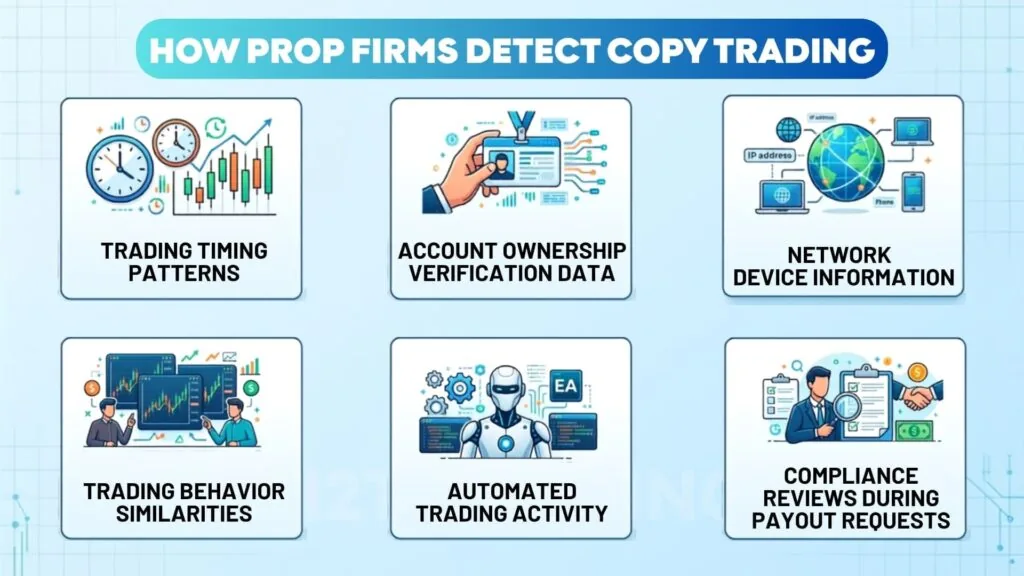
While detection systems vary, the following factors are commonly believed to be reviewed during compliance investigations:
- Trading Timing Patterns: Accounts that consistently enter and exit positions at nearly identical times may receive additional review, particularly when account ownership cannot be clearly verified.
- Account Ownership and Verification Data: Firms may compare account registration details, identity verification records, and other compliance information to confirm that accounts belong to the same trader when self-copy trading is permitted.
- Network and Device Information: Some firms may review location, device, or network-related data as part of broader compliance investigations.
- Trading Behavior Similarities: Highly synchronized risk management, position sizing, and execution patterns across multiple accounts can attract additional scrutiny.
- Automated Trading Activity: Certain trade copier tools and automated systems may create identifiable execution patterns that help firms review trading activity more effectively.
- Compliance Reviews During Payout Requests: Payout requests often involve additional account reviews to verify compliance with the firm’s trading rules and risk policies.
Because detection procedures vary between firms, traders should focus on following documented policies rather than attempting to predict how compliance systems operate.
8. Real Payout Denial Cases: What Copy Trading Violations Look Like
Case 1: Copying External Signals Instead of Trading Independently
A trader relied on a third-party signal group to pass a funded challenge. Every trade was copied directly from the provider without independent analysis.
- Violation: Several prop firms, including FundedNext Futures, explicitly prohibit copying signals from external providers because traders are expected to demonstrate their own decision-making and risk-management skills.
- Outcome: Accounts suspected of signal copying may undergo compliance reviews, and firms can reject payouts or terminate accounts if they determine the trader violated copy-trading policies.
Lesson: Always verify whether signal services are permitted. A strategy that works on a personal account may violate the rules of a funded account.
Case 2: Network-Sharing and Account Ownership Reviews
A trader reported having a payout request denied after the firm flagged “network sharing.” The trader claimed to be trading alone through a personal computer connected via a mobile hotspot.
- Violation: The firm suspected account-sharing or coordinated trading activity because of overlapping network information.
- Outcome: The payout request was rejected while additional verification was requested. According to the trader, no evidence of copy trading was provided publicly.
Lesson: Shared infrastructure, VPNs, VPS services, and dynamic IP addresses can sometimes create compliance questions. Traders should maintain clear ownership records and be prepared for additional verification if requested.
Case 3: Coordinated Trading Allegations During a Payout Review
A trader publicly claimed that a payout request of approximately $40,000 was denied after being accused of “coordinated trading” and hedging. The trader stated that only one account had been traded and denied any involvement in copy trading.
- Violation: The firm reportedly identified suspicious trading patterns during its internal review process.
- Outcome: The payout was denied and the account was closed, according to the trader’s statement. The firm did not publicly release detailed evidence of the investigation.
Lesson: Many firms perform deeper compliance reviews when large payout requests are submitted. Maintaining detailed trading records can help traders respond if questions arise regarding account activity.
Most copy-trading payout disputes are not caused by the copier software itself. Instead, they typically arise when firms believe a trader is copying signals from others, participating in coordinated trading, or violating account-ownership requirements. Before requesting a payout, review the firm’s latest copy-trading policy and keep records that demonstrate independent trading activity.
9. Copy Trading Compliance Checklist
Before connecting your accounts, run through these 10 practical steps:
- Confirm that self-copy trading is permitted by the firm.
- Verify that all accounts belong to the same approved trader.
- Review the firm’s copy-trading, signal-sharing, and account-management policies.
- Check current account-allocation and scaling limits.
- Review any restrictions on third-party signals or account management services.
- Confirm that your trade copier software is compatible with the firm’s platform and rules.
- Verify whether automated trading tools or EAs are permitted.
- Ensure your trading setup complies with any hedging restrictions that may apply.
- Keep records of account ownership and verification documents.
- Take a screenshot of the firm’s copy-trading policy when purchasing a challenge for future reference.
10. FAQ about Prop Firm that allow Copy Trading
Many prop firms allow self-copy trading between accounts owned by the same trader. However, restrictions on third-party signals, account management services, and external trade copying vary by firm.
Some firms permit trade copier software, while others impose restrictions. Always review the firm’s latest copy-trading policy before connecting accounts.
A trade copier replicates trades from one account to another. An Expert Advisor (EA) is an automated trading system that generates and executes trades based on programmed rules.
Some firms allow cross-firm copy trading, while others restrict it. Review each firm’s policy individually before linking accounts.
Traders are generally responsible for account performance, even when using third-party software. A technical issue that causes a drawdown violation may still result in account failure.
Traders who rely on copy trading should prioritize firms with transparent copier policies, consistent rule enforcement, and support for multi-account management. If you’re comparing multiple firms, read our guide on How To Choose A Prop Firm In 2026 – 10 Expert Tips to evaluate payout structures, risk rules, platform support, and copy-trading compatibility before making a decision.
Review the firm’s official FAQ, trading rules, and prohibited strategies section. If the policy is unclear, contact support before connecting any copier software to avoid accidental violations.
Before activating any copier, verify the firm’s copy-trading policy, test the software on a demo account, and confirm that risk settings match your funded account requirements. This helps prevent avoidable rule violations.
11. Conclusion
The best prop firms that allow copy trading generally support self-copy trading between accounts owned by the same trader, but most firms prohibit third-party signal copying, account management services, and coordinated trading activity. While the exact rules vary from one firm to another, the safest approach is to use copy-trading tools only for accounts you personally own and control.
Before using a trade copier, always review the firm’s latest policies regarding account ownership, allocation limits, automation, and payout eligibility. Taking a few minutes to verify the rules can help you avoid unnecessary compliance reviews and payout disputes.
At H2T Funding, we provide in-depth prop firm reviews, trading rule comparisons, and educational resources designed to help traders make informed funding decisions. If you’re still evaluating your options, explore our Best Prop Firms guide to compare funding programs, profit splits, scaling opportunities, and trading conditions across today’s leading prop firms.