


H2T Funding reviewed each firm’s current trading rules, platform setup, and hedging restrictions to identify 12 prop firms that allow same-account hedging, current as of August 2026, cross-checked against verified Trustpilot ratings.
Among the 12 firms compared, four stand out for different reasons:
- FXIFY (4.4, 6,100+ reviews): carries the fewest added restrictions of any firm on this list, with no blackout window around news events and no consistency rule limiting hedge usage.
- BrightFunded (4.5, 550+ reviews): matches FXIFY on flexibility, adding no consistency rule and no profit cap at any stage, on top of a first-violation Soft Breach warning instead of instant account closure.
- Alpha Capital Group (4.7, 21,500+ reviews): allows same-account hedging generally, but bans one specific form, spread-arbitrage hedging, even within a single account.
- Falcon Funded (4.3, 580+ reviews): also allows hedging, but only manually. EAs are strictly banned, so the strategy can’t run on automation.
The two highest-rated firms overall, The5ers (4.9) and FTMO (4.8), still carry hedging-specific limits: The5ers bans news-bracket strategies, and FTMO’s Best Day Rule restricts spreading profit across days outside its FTMO US hedging mode.
The table below compares same-account hedging status, news-trading rules, overnight/weekend holding, and the key limiting rule for all 12 firms, so you can check which restrictions affect your strategy before opening an account.
| Firm | Same-Account Hedging | Profit Split | Coupon Code | Actions |
|---|---|---|---|---|
3.3
(6,100+ reviews)
|
Confirmed, no restriction |
80% – 100%
|
No code
|
Visit Official Website |

3.8
(1,500+ reviews)
|
Allowed outright |
80% – 95%
|
h2t
|
Open an account |

4.5
(550+ reviews)
|
Explicitly permitted |
80% – 100%
|
No code
|
Open an account |

4.5
(78,300+ reviews)
|
Allowed, no lot cap |
80% – 95%
|
No code
|
Visit Official Website |

4.8
(53,770+ reviews)
|
Allowed; FTMO US runs true hedging mode |
90%
|
No code
|
Visit Official Website |

4.9
(35,600+ reviews)
|
Not on the prohibited list |
50% – 100%
|
NAXW1ULCR
|
Open an account |

4.4
(3,200+ reviews)
|
Allowed on Forex and Crypto |
80% – 100%
|
H2T01
|
Open an account |

3.7
(1,600+ reviews)
|
llowed, covers correlated instruments |
80% – 90%
|
No code
|
Open an account |

3.9
(1,100+ reviews)
|
Allowed, with Martingale |
90% – 100%
|
No code
|
Open an account |

4.7
(21,500+ reviews)
|
Allowed |
80%
|
H2T
|
Open an account |

4.5
(2,600+ reviews)
|
Allowed on every program |
80% – 100%
|
H2tmedia
|
Open an account |

4.3
(580+ reviews)
|
85% – 90%
|
No code
|
Open an account |
Disclaimer: The information in this guide was reviewed and updated in August 2026 based on the latest available prop firm rules and account conditions at the time of writing. Trading rules can change without notice and may differ by account type, platform, or trader location. Always confirm the firm’s current hedging policy with its official support team before opening an account or placing hedged positions.
1. What Is Prop Firm Hedging?
Prop firm hedging is the practice of opening offsetting positions to reduce trading risk on a trading account. In most cases, using a hedge within the same account is considered a legitimate risk management strategy, while opening opposite positions across multiple accounts to eliminate evaluation risk or manipulate results is usually prohibited.
For example, if you buy (go long) EUR/USD and later open an equally sized sell (short) position on the same pair, gains from one trade largely offset losses from the other. The objective is to reduce market exposure, not to increase profits. Traders use this same logic to sit through a news release or hold a position over the weekend without closing it outright.
2. The 4 Types of Prop Firm Hedging (and How Firms Treat Each)
Prop firms generally divide hedging into four types: same-account, cross-account, cross-firm, and copy-trading or group hedging. Only the first is commonly accepted because it manages risk within a single account. The other three are viewed as attempts to bypass evaluation rules or manipulate funded account outcomes.
| Hedging Type | What It Means | Typical Prop Firm Position | Main Risk |
|---|---|---|---|
| Same-account hedging | Long and short the same instrument inside one account | ✅ Usually allowed | Locks P&L but not spread or swap cost |
| Cross-account hedging | Long on Account A, short on Account B at the same firm | ❌ Prohibited | Both accounts closed, profit forfeited |
| Cross-firm hedging | Long at Firm A, short at Firm B | ❌ Prohibited by most firms | Harder to detect, but flagged as inter-firm data sharing expands |
| Copy-trading / group hedging | Copiers or EAs mirror opposite trades across accounts, even by accident | ❌ Prohibited | Same penalty as cross-account, harder to defend |
2.1. Same-Account Hedging
Same-account hedging means opening opposing long and short positions inside a single trading account. This is the only form of hedging that most forex and CFD prop firms accept because your profit, loss, and drawdown remain tied to one account.
Typical examples include:
- Locking an open profit before a high-impact news release
- Temporarily reducing exposure without closing the original trade
- Hedging correlated positions as part of a discretionary trading strategy
From a firm’s perspective, you still assume genuine market risk. Spreads, commissions, swaps, and slippage apply to both positions, and your account remains subject to the same drawdown rules. The evaluation still measures your ability to manage risk rather than allowing you to eliminate it.
The one condition that matters is platform mode. On MT5 accounts running netting mode, opening an opposite position simply reduces or closes the existing trade instead of creating two separate positions. True same-account hedging is only possible on accounts with hedging mode enabled.
2.2. Cross-Account / Multi-Account Hedging
Cross-account hedging means running two accounts at the same firm, long on one and short on the other. For example, you buy two challenge accounts, go long EUR/USD on one account and short EUR/USD on the other.
This approach removes much of the uncertainty from the evaluation process. Instead of demonstrating consistent trading skill, the trader attempts to improve the odds by treating multiple accounts as a single combined position. For that reason, nearly every prop firm classifies cross-account hedging as an abuse of its evaluation model.
One point often misunderstood is that multiple accounts do not mean opposite trades are allowed. Many firms let traders purchase several evaluations or funded accounts, but each account must operate independently. Running mirrored long and short positions between them remains prohibited.
2.3. Cross-Firm Hedging
Cross-firm hedging uses the same strategy across different prop firms instead of within one provider. A trader may go long at Firm A and short at Firm B, expecting one evaluation to succeed while the other fails.
Many firms now state explicitly that cross-firm hedging violates their trading policies. While enforcement remains more difficult than detecting activity within a single provider, compliance teams increasingly rely on broader risk intelligence during payout reviews. The next section, we will explain exactly how that detection works.
2.4. Copy-Trading / Group Hedging
Copy-trading or group hedging occurs when opposite trades are mirrored automatically across multiple accounts or traders. This commonly happens through:
- Trade copier software
- Expert Advisors (EAs)
- Signal services
- Coordinated trading groups
Because the positions are synchronized, firms generally treat this as a combination of two prohibited practices: multi-account hedging and unauthorized coordinated trading.
An overlooked risk is that violations do not always require deliberate intent. For example, a trader may operate multiple accounts using copy software. If latency causes one account to close a position while another account briefly opens the opposite side, the system may create a temporary hedge across accounts. Compliance teams often evaluate the execution itself rather than whether the trader intended to create the overlap.
For that reason, you remain responsible for every order generated by your automation tools. Using a copier, EA, or VPS does not exempt trades from the firm’s hedging or copy-trading policies.
3. Which Prop Firms Allow Hedging?
12 firms on this list allow hedging within a single account, but “allowed” covers a wide range in practice. FXIFY comes out as the most flexible of the group: same-account hedging stands confirmed, news trading carries no restriction at all on Phase accounts, and Martingale, grid, and EA strategies all run alongside it without a blackout window. Most other firms permit the hedge itself but attach a cost, a news-profit cut, a risk cap, or an auto-close trigger once the position actually needs to do its job.
Which firm fits which trader
- News or event-driven trader: FXIFY or FundedNext, neither blocks trading around a release the way most firms do once an account goes live.
- Swing trader hedging into the weekend: FTMO Swing, The5ers, or Blue Guardian; all three drop weekend restrictions entirely rather than requiring a paid add-on.
- Correlated-pair hedger (gold against silver, a basket of index futures): Blueberry Funded, though the 1.5% shared risk cap needs modeling before sizing both legs.
- Trader managing multiple accounts through a copier: AquaFunded; its copy trading reaches external accounts, not just internal ones.
- Trader who wants zero ambiguity and doesn’t mind trading manually: Falcon Funded; its group-hedging definition is the clearest of the twelve, at the cost of banning EAs outright.
If your trading style goes beyond hedging, you may also want to explore our guides to the best prop firms for swing traders and prop firms that allow copy trading. They cover additional firms and explain which account rules matter most for each approach.
FXIFY
#1
Account Types
1-step, 2-step, 3-step, and Instant Funding
Trading Platforms
MT4, MT5, DXTrade, TradingView
Profit Target
4% – 10%
Our take on FXIFY
FXIFY’s own rulebook does not list a same-account hedging ban. What it does ban by name is Reverse Hedging (opening a long on one account and an equal short on a second account within FXIFY) and Group Hedging. FXIFY confirmed directly, through an official statement, that hedging on a single account is allowed, alongside Martingale, EA use, news trading, and grid strategies; only cross-account setups and latency arbitrage stay off-limits.
Other key rules affect your hedging strategy:
- News trading: Open with no restriction on 1, 2, and 3-Phase accounts, useful for a hedge built around a release. Heavy leverage on those trades can still get flagged as gambling behavior.
- Copy trading: Allowed between a trader’s own FXIFY accounts, but blocked entirely on Instant Funding LITE, Instant Funding, 2 Phase PRO, and Lightning Plan.
- Overnight holding: Allowed on 1, 2, and 3-Phase accounts, though spreads widen during rollover near 5 PM EST.
- Herd trading: Using the same EA as another customer counts as coordinated trading, a detail worth checking before running a shared hedge script
| 💳 Challenge Fee | $19 – $4,249 |
| 👥 Account Types | 1-step, 2-step, 3-step, and Instant Funding |
| 💰 Profit Split | 80% – 100% |
| 💵 Account Size | $1K – $400K |
| ⏱️ Time Limit | No time limit |
| 🎯 Profit Target | 4% – 10% |
| 📊 Trading Platforms | MT4, MT5, DXTrade, TradingView |
| 🛍️ Asset Types | Forex, Metals, Equities, Crypto, Commodities, Stocks, Indies |
Verdict: FXIFY combines unrestricted same-account hedging with news trading, making it a strong option for event-driven traders. The trade-off is that copy trading depends on the account type, with support limited to Phase Evaluation accounts rather than Instant Funding or Lightning.
Blue Guardian
#2
Account Types
1-step, 2-step, 3-step, and instant funding
Trading Platforms
MT5, TradeLocker, Match Trader, TradingView
Profit Target
4% – 10%
Our take on Blue Guardian
Blue Guardian allows hedging outright, one of the few firms that states it directly rather than leaving it implied. The line drawn sits at the account boundary: hedging between separate accounts is strictly prohibited, grouped with hedge arbitrage and trade emulators under the firm’s cheating policy. This rule holds across every model, from 1-Step Standard to Instant Starter.
Other key rules affect your hedging strategy:
- Cross-account hedging: Banned as cheating, alongside hedge arbitrage and trade emulators.
- Gambling rule: Margin usage above 80% on any running trade gets classified as gambling, a limit worth watching when sizing a hedge leg.
- Guardian Shield: Auto-closes a losing position at 2% floating loss on standard funded accounts (1% on Instant accounts), which can unwind one leg of a hedge without warning.
- News trading: Open during the challenge phase; funded accounts restrict new orders 5 minutes before and after high-impact news.
- Overnight and weekend holding: Allowed on every account type, a fit for hedges built to sit through a gap.
| 💳 Challenge Fee | $27 – $1,070 |
| 👥 Account Types | 1-step, 2-step, 3-step, and instant funding |
| 💰 Profit Split | 80% – 95% |
| 💵 Account Size | $5K – $200K |
| ⏱️ Time Limit | No time limit |
| 🎯 Profit Target | 4% – 10% |
| 📊 Trading Platforms | MT5, TradeLocker, Match Trader, TradingView |
| 🛍️ Asset Types | Forex, Indices, Commodities, Crypto |
Verdict: Blue Guardian’s rules are most favorable for same-account hedging, as long as traders keep margin usage below the 80% threshold. The account grows to match that approach too, with a Scaling Plan up to $4,000,000 and a 24-hour payout guarantee backed by a 10% profit share bonus on any delay. Guardian Shield remains the one variable to plan around, since its floating-loss auto-close can step in and exit a leg before the trader decides to.
Bright Funded
#3
Account Types
2-step
Trading Platforms
cTrader, DXTrade, MT5
Profit Target
5% – 8%
Our take on Bright Funded
BrightFunded permits same-account hedging directly, allowing a trader to hold both a buy and a sell position on the same instrument inside one account to manage risk. Hedging across two or more accounts, across different prop firms, or across different trading platforms tied to the same profile is strictly prohibited, but the firm applies a one-time Soft Breach warning before a permanent closure, a buffer most competitors skip.
Other key rules affect your hedging strategy:
- Soft Breach policy: The first cross-account hedging violation receives a warning, and all open positions are closed. A second violation results in a permanent Hard Breach.
- Multi-trade violations: If the first detection involves multiple hedged positions, BrightFunded skips the warning and applies an immediate Hard Breach.
- Cross-platform & copy trading: Hedging across different trading platforms under the same profile or copying hedge positions between accounts is treated as prohibited cross-account hedging.
- News trading: Allowed during both evaluation phases. On Funded Accounts, profits from trades executed within 5 minutes before or after high-impact news are removed, unless the position was opened at least 48 hours earlier.
- Overnight & weekend holding: Fully allowed, with an optional Swap-Free Add-on for traders who want to avoid overnight financing costs.
| 💳 Challenge Fee | €55 – €975 |
| 👥 Account Types | 2-step |
| 💰 Profit Split | 80% – 100% |
| 💵 Account Size | $5K – $200K |
| ⏱️ Time Limit | No time limit |
| 🎯 Profit Target | 5% – 8% |
| 📊 Trading Platforms | cTrader, DXTrade, MT5 |
| 🛍️ Asset Types | Forex, Commodities, Indices, Crypto |
Verdict: BrightFunded is one of the most transparent prop firms for hedging, backed by a 15% evaluation profit reward, up to 100% profit split, and weekly payouts on capital managed up to $400K. Traders using multiple platforms or copy-trading systems should be cautious, as BrightFunded classifies both as prohibited forms of cross-account hedging.
FundedNext
#4
Account Types
1-step, 2-step, and Instant Funding
Trading Platforms
MT4, MT5, cTrader, Match Trader
Profit Target
4% – 10%
Our take on FundedNext
FundedNext allows hedging only within the same account. Traders can open a buy and a sell order on the same asset, in the same account, with no maximum lot size cap. This rule applies identically at the Challenge stage and on a live FundedNext Account. Hedging across two or more accounts, known internally as group hedging, is banned outright and treated as a prohibited trading strategy.
Other key rules affect your hedging strategy:
- Large single-trade risk: Using most or all of the daily loss limit on one trade may be flagged as suspected multi-account hedging and trigger a manual review.
- News trading: Allowed on all account types. However, on Funded Accounts, only 40% of profits from trades opened within 5 minutes before or after a high-impact news event count toward Performance Rewards.
- Overnight & weekend holding: Allowed across all Stellar account types, making FundedNext suitable for longer-term hedging strategies.
- EA & algorithmic hedging: Permitted, but traders must keep the same trading approach from the Challenge to the Funded stage. Switching between manual trading and an EA is not allowed.
- Flexible trading conditions: No time limit on Challenges; Performance Rewards processed within 24 hours; plus a $1,000 compensation guarantee for delays, giving traders more flexibility than many competing prop firms.
| 💳 Challenge Fee | $32.99 – $1,099.99 |
| 👥 Account Types | 1-step, 2-step, and Instant Funding |
| 💰 Profit Split | 80% – 95% |
| 💵 Account Size | $2K – $200K |
| ⏱️ Time Limit | No time limit |
| 🎯 Profit Target | 4% – 10% |
| 📊 Trading Platforms | MT4, MT5, cTrader, Match Trader |
| 🛍️ Asset Types | Forex, Indices, Commodities, Crypto, CFDs |
Verdict: FundedNext fits a trader who keeps every hedge inside one account, particularly for locking in an open profit before a news release or holding a position through the weekend without closing it. The unlimited lot size on Challenge and Funded accounts gives real flexibility for sizing offsetting legs.
FTMO
#5
Account Types
1-Step Challenge, 2-Step Challenge
Trading Platforms
MT4, MT5, cTrader, TradingView
Profit Target
10% – 15%
Our take on FTMO
FTMO allows same-account hedging across its products, while cross-account or cross-firm hedging remains strictly prohibited. The key difference is the account structure. FTMO Global follows a traditional netting environment, whereas FTMO US uses a dedicated Hedging account structure. This allows traders to hold multiple independent long and short positions on the same instrument, set separate stop-loss and take-profit levels for each trade, and close positions in any order without FIFO restrictions.
Other key rules affect your hedging strategy:
- Best Day Rule: Closing opposite or correlated positions on different days to artificially spread profits violates FTMO’s consistency requirements.
- News trading: Fully allowed during the Evaluation. On a live Rewards Account, Swing accounts have no news restrictions, while Standard accounts cannot open new trades 2 minutes before or after selected high-impact events.
- Overnight & weekend holding: Allowed throughout the Evaluation. On live accounts, Swing permits overnight and weekend holding, while Standard requires positions to be closed before the weekend or extended market closures.
- Exposure & EA limits: Position size limits apply by instrument and asset class, while EAs are limited to 200 pending orders and approximately 2,000 server requests per day.
| 💳 Challenge Fee | €89 – €1,080 |
| 👥 Account Types | 1-Step Challenge, 2-Step Challenge |
| 💰 Profit Split | 90% |
| 💵 Account Size | $10K – $200K |
| ⏱️ Time Limit | No time limit |
| 🎯 Profit Target | 10% – 15% |
| 📊 Trading Platforms | MT4, MT5, cTrader, TradingView |
| 🛍️ Asset Types | Forex, Commodities, Indices, Stocks |
Verdict: FTMO is one of the few prop firms that offers two different trading environments for hedgers. Traders who need same-account hedging can use either product, but FTMO US provides greater flexibility through its dedicated Hedging account structure, with independent long and short positions, separate SL/TP levels, and no FIFO requirement. Traders using FTMO Global should instead pay closer attention to the account’s netting behavior and the Best Day Rule when managing correlated hedge positions.
The5ers
#6
Account Types
1-step, 2-step, 3-step
Trading Platforms
MT5, cTrader
Profit Target
5% – 10%
Our take on The5ers
The5ers allows same-account hedging but prohibits hedging across multiple accounts or different prop firms. Traders may hold offsetting long and short positions within a single trading account, as this is not listed as a prohibited practice.
However, Hedge Arbitrage Trading (opening opposite positions on different The5ers accounts) and cross-operator coordinated trading (mirroring opposite trades between The5ers and another prop firm) are both prohibited. These restrictions apply throughout both the evaluation and funded stages.
- News-bracket hedging: Buy-stop and sell-stop straddles around high-impact news are prohibited on Instant Funding and Bootcamp accounts.
- News trading restrictions: High Stakes accounts block new orders from 2 minutes before to 2 minutes after high-impact news. Profits earned during this window are removed, while losses remain.
- Multi-day hedge management: Closing one side of a hedge on different days to artificially increase profitable trading days is considered a rule violation.
- EA-based hedging: Allowed, provided the EA is trader-owned and does not use hedge arbitrage, latency arbitrage, HFT, or tick scalping. Stop-loss orders must remain visible.
- Overnight & weekend holding: Allowed across all programs, making The5ers suitable for longer-term hedging strategies. Standard overnight swap fees still apply.
- Flexible scaling: Traders can scale funded capital up to $4 million, making The5ers attractive for traders planning to grow longer-term hedging strategies.
| 💳 Challenge Fee | $19 – $850 |
| 👥 Account Types | 1-step, 2-step, 3-step |
| 💰 Profit Split | 50% – 100% |
| 💵 Account Size | $2.5K – $250K |
| ⏱️ Time Limit | No time limit |
| 🎯 Profit Target | 5% – 10% |
| 📊 Trading Platforms | MT5, cTrader |
| 🛍️ Asset Types | Forex / CFD |
Verdict: The5ers supports most legitimate hedging strategies within a single account, especially those built around longer holding periods instead of short-term news volatility. The biggest limitations are its strict ban on hedge arbitrage and restrictions on news-bracket trading, making it a weaker choice for traders who rely on event-driven hedging.
E8 Funding
#7
Account Types
1-step
Trading Platforms
MT5, cTrader, Match Trader, TradeLocker
Profit Target
6% – 9%
Our take on E8 Funding
E8 Markets allows hedging within a single account on Forex and Crypto products. The platform runs on a hedging system, so a buy and a sell on the same instrument stay open together in one account. Hedging across multiple accounts, even two accounts owned by the same trader, is strictly prohibited.
Other key rules affect your hedging strategy:
- News trading: E8 Zero, Signature, and Pro carry no restriction at any stage. E8 One and E8 One Crypto block trading 5 minutes each side of high-impact news once in the Performance stage.
- All-or-nothing rule: Risking most of the daily drawdown on one trade can draw a risk team review, worth noting when sizing a large hedge leg.
- Lot size caps: 50 lots on most symbols, 20 lots on gold, split across multiple tickets for more exposure.
- Overnight and weekend holding: Allowed on every account type at every stage.
| 💳 Challenge Fee | $38 – $2,998 |
| 👥 Account Types | 1-step |
| 💰 Profit Split | 80% – 100% |
| 💵 Account Size | $5K – $500K |
| ⏱️ Time Limit | No time limit |
| 🎯 Profit Target | 6% – 9% |
| 📊 Trading Platforms | MT5, cTrader, Match Trader, TradeLocker |
| 🛍️ Asset Types | Forex, Commodities, Indices, Crypto, Energy, and Futures |
Verdict: E8 Markets fits a trader hedging inside one Forex or Crypto account, especially on E8 Zero or Pro, where news restrictions never apply at any stage. Payout On Demand on E8 One products adds flexibility once eligibility conditions are met, since there is no fixed payout schedule to wait on. A Futures trader should look elsewhere, since the netting system removes same-account hedging as an option entirely.
Blueberry Funded
#8
Account Types
1-step, 2-step, and instant funding
Trading Platforms
MT4, MT5, DXTrade, TradeLocker
Profit Target
5% – 10%
Our take on Blueberry Funded
Blueberry Funded permits hedging within a single account, including hedges built on correlated instruments, not only the exact same asset. Hedging across two Blueberry Funded accounts, or hedging a Blueberry Funded position with an external broker or platform, is strictly prohibited and stays banned no matter when the account was purchased.
Other key rules affect your hedging strategy:
- Correlated instrument clusters: FX majors, XAUUSD/XAGUSD, US indices, and BTC/ETH each count as one trade idea, so a hedge built on related pairs shares the same risk cap.
- 1.5% Risk Per Trade Idea: A Funded account (purchased after March 12, 2026) can lose no more than 1.5% of its starting balance on one trade idea, including a hedge split across positions.
- 10-minute re-entry rule: Reopening a position in the same direction within 10 minutes of a loss folds into that same 1.5% cap, worth checking before adding a hedge leg fast.
- News trading: Blocked only inside a 2-minute window before and after high-impact news. A position opened 6 or more hours earlier stays exempt, even if its stop-loss triggers during that window.
- Weekend and overnight holding: Allowed on every account type, plus 24/7 crypto trading.
- Copy trading: Allowed between a trader’s own Blueberry Funded accounts, a rule most competitors ban outright.
| 💳 Challenge Fee | $30 – $1,240 |
| 👥 Account Types | 1-step, 2-step, and instant funding |
| 💰 Profit Split | 80% – 90% |
| 💵 Account Size | $1,25K – $200K |
| ⏱️ Time Limit | No time limit |
| 🎯 Profit Target | 5% – 10% |
| 📊 Trading Platforms | MT4, MT5, DXTrade, TradeLocker |
| 🛍️ Asset Types | Forex, Indices, Commodities, Crypto, Stocks, Futures |
Verdict: Blueberry Funded fits a trader who hedges with correlated pairs inside one account and sizes each leg to stay well under the 1.5% cap, since gold against silver or a basket of FX majors count as a single trade idea on Funded accounts. 24/7 crypto trading and copy trading between a trader’s own accounts add flexibility most firms don’t offer, but the correlated-cluster rule is the one to model out before running a multi-leg hedge on a funded account opened after March 2026.
AquaFunded
#9
Account Types
1-step, 2-step, 3-step, and Instant Funding
Trading Platforms
MT5, TradeLocker, Match Trader, cTrader
Profit Target
5% – 10%
Our take on AquaFunded
AquaFunded confirms three things together in one answer: hedging within the same account is allowed, Martingale is allowed, and a stop loss is never required. The catch sits in a separate rule. Hedge arbitrage and trade emulators are banned as cheating strategies, grouped with tick scalping and latency arbitrage rather than treated as part of the hedging answer itself.
Other key rules affect your hedging strategy:
- Maximum Loss Per Trade Policy: Combined floating loss across every open position, not each trade separately, closes the account permanently once it drops below -2% of the starting balance (-1% on $300K and $400K accounts).
- Copy trading: Extends between AquaFunded accounts, between evaluation and funded stages, and even to and from external accounts, wider than most firms on this list.
- News trading: Profit from trades inside the 5-minute news window is capped at 0.5% of account balance per payout cycle, replacing the older outright ban on funded accounts.
- Consistency rule: Ranges from 15% on Instant Pro and AquaMan up to 25% on One and Two Step Pro, relevant if a hedge closes both legs on the same trading day.
- Overnight and weekend holding: Allowed with no restriction, and crypto trades around the clock.
| 💳 Challenge Fee | $29 – 2,099 |
| 👥 Account Types | 1-step, 2-step, 3-step, and Instant Funding |
| 💰 Profit Split | 90% – 100% |
| 💵 Account Size | $2,5K – $400K |
| ⏱️ Time Limit | No time limit |
| 🎯 Profit Target | 5% – 10% |
| 📊 Trading Platforms | MT5, TradeLocker, Match Trader, cTrader |
| 🛍️ Asset Types | Forex, Indices, Commodities, Crypto |
Verdict: AquaFunded combines same-account hedging with the ability to copy trades to a personal account, making it a compelling option for traders managing multiple portfolios. The primary limitation is the -2% combined floating loss cap, which can interrupt an otherwise valid hedging strategy if one side of the position moves too far before the offsetting leg responds.
Alpha Capital Group
#10
Account Types
1-step, 2-step, 3-step
Trading Platforms
MT5, cTrader, DXTrade, TradeLocker
Profit Target
4% – 10%
Our take on Alpha Capital Group
Alpha Capital allows same-account hedging, defined as holding both a long and a short position in the same instrument at the same time in one account. Hedging across two Alpha Capital accounts is banned, and the firm treats correlated instruments the same way when reviewing a cross-account hedge. Hedging aimed at locking in a price through spread arbitrage is also banned outright, even inside one account, and leads to account closure.
Other key rules affect your hedging strategy:
- Spread-arbitrage hedging: Banned even in a single account if the goal is locking in a price this way.
- Weekend holding: Depends on the plan. Allowed on Swing, One, and Three at every stage, and on Pro during evaluation; not allowed on Direct or the funded Pro Qualified account.
- News trading: Open during evaluation; funded accounts can’t open or close trades in a 10-minute window around major news, except Swing, which only needs the trade to last over 2 minutes if opened close to a release.
- 2-minute average trade rule: At least half of total profit must come from trades lasting over 2 minutes; applies to every account.
- Overnight holding: Allowed on every plan, swap fees apply.
| 💳 Challenge Fee | $40 – $1,097 |
| 👥 Account Types | 1-step, 2-step, 3-step |
| 💰 Profit Split | 80% |
| 💵 Account Size | $5K – $200K |
| ⏱️ Time Limit | No time limit |
| 🎯 Profit Target | 4% – 10% |
| 📊 Trading Platforms | MT5, cTrader, DXTrade, TradeLocker |
| 🛍️ Asset Types | Forex, Metals, Commodities, Indices |
Verdict: Alpha Capital works best for a trader who picks the right plan up front. Swing, One, or Three fit a hedge that needs to sit through a weekend, backed by a Qualified Account up to $200,000. Direct is the plan to avoid for hedging, since it drops weekend holding entirely, and the spread-arbitrage ban means a same-account hedge built purely to lock in a price still crosses the line.
Funded Trading Plus
#11
Account Types
1-Step, 2-Step, and Instant Funding
Trading Platforms
MT5, cTrader, Match Trader, DXTrade
Profit Target
7% – 10%
Our take on Funded Trading Plus
FT+ allows hedging within the same account across both the Challenge and Funded stages, so a buy and a sell on the same instrument can sit open together in one account throughout. Hedging across two or more FT+ accounts is strictly prohibited, with no exception by program.
Other key rules affect your hedging strategy:
- Symbol Loss Limit (2-Step Classic): Every trade on one instrument, including both legs of a hedge, shares a single 3% loss cap. Crossing it is a Hard Breach.
- Consistency Rule (2-Step Classic): 35% in the challenge phases, 50% on the funded account. No single day’s profit can exceed that share of the total, worth watching if a hedge closes both legs on the same day.
- Weekend holding: Allowed on 1-Step Express and 2-Step Classic, but the Instant Program forces every position closed by 4:30 PM EST each Friday.
- Copy trading: Allowed only between a trader’s own accounts. Mirrored trades across different traders get flagged even without matching open or close times.
- Swap-free trading: 2-Step Classic runs with no swap cost, cutting the price of holding both hedge legs overnight.
| 💳 Challenge Fee | $89 – $4,499 |
| 👥 Account Types | 1-Step, 2-Step, and Instant Funding |
| 💰 Profit Split | 80% – 100% |
| 💵 Account Size | $5K – $200K |
| ⏱️ Time Limit | No time limit |
| 🎯 Profit Target | 7% – 10% |
| 📊 Trading Platforms | MT5, cTrader, Match Trader, DXTrade |
| 🛍️ Asset Types | Forex, Indices, Commodities, Metals, Crypto |
Verdict: FT+ is a better choice for a trader who keeps the hedge inside one account on 1-Step Express or 2-Step Classic, where weekend holding and swap-free trading support a position built to sit through a gap. The Instant Program is a weak fit for that same hedge, since forced Friday closures remove the point of holding a position into the weekend in the first place.
Falcon Funded
#12
Account Types
1-step, 2-step
Trading Platforms
MT5, TradeLocker, TradingView
Profit Target
7.5%
Our take on Falcon Funded
A few rules shape what that hedge looks like in practice:
- EAs strictly prohibited: Every account, challenge or funded, must trade fully manually. A hedge can’t run through automation here, unlike most firms on this list.
- Weekend holding: Requires the paid Weekend Trading Add-on; without it, every position must close before the market shuts at 21:00 UTC on Friday.
- News trading: Requires the paid News Trading Add-on, only available on Regular challenges. Without it, a 10-minute buffer before and after major releases is expected.
- Minimum holding time: 5 minutes under the Quick Strike Method rule, so closing a hedge leg too fast can get flagged.
- No stacking: Multiple positions in the same direction on one instrument aren’t allowed, worth checking when sizing a hedge leg through several entries.
| 💳 Challenge Fee | $70 – $939 |
| 👥 Account Types | 1-step, 2-step |
| 💰 Profit Split | 85% – 90% |
| 💵 Account Size | $20K – $200K |
| ⏱️ Time Limit | — |
| 🎯 Profit Target | 7.5% |
| 📊 Trading Platforms | MT5, TradeLocker, TradingView |
| 🛍️ Asset Types | Forex, Metals, Indices, Cryptocurrencies |
Verdict: Falcon Funded suits a manual trader who hedges intraday and closes both legs before the weekend, or budgets for the Weekend Trading Add-on if the position needs to sit through a gap. The 4% daily drawdown and 11% max loss rank among the easier risk limits covered here, but the ban on EAs rules this firm out for anyone planning to automate the hedge itself.
4. Forex vs. Futures – Why Hedging Rules Are Completely Different
Forex and CFD accounts typically use hedging mode, most commonly on MT5, allowing buy and sell positions on the same instrument to remain open separately. Futures accounts typically use netting mode, the same one CME-style platforms and evaluators like TopstepX use, where an opposite order reduces or closes the existing position instead. This platform difference changes how hedging works across prop firms and markets.
Unlike the 12 firms above, these 5 futures firms ban hedging outright:
| Firm | Same-underlying hedge | Mini + Micro opposing | Correlated spread (e.g., ES/NQ) | Note |
|---|---|---|---|---|
| Apex Trader Funding | Banned | Banned | Banned | One-Direction Rule: all accounts trade one way only. Violation closes the account. |
| My Funded Futures | Banned | Banned | Allowed only if a genuinely unrelated asset | E-mini and Micro NQ count as the same underlying, so hedging between them is fully banned; offsetting with an unrelated market is the sole exception. |
| Tradeify | Banned | Allowed together in the same direction | Banned within the same Product Group | Holding mini and micro at once is fine now; the violation is opposing directions, on the same instrument or a correlated one. Automated detection only flags a hedge held over 10 seconds with over $250 profit. |
| Topstep | Banned | Banned | Banned | Tracked at the trader level, not just the account, so opening a new account doesn’t reset the check. |
| Lucid Trading | Banned, even in one account | Allowed within one account only | Banned across accounts | The one firm here that bans hedging on an identical contract even inside a single account; a mini-versus-micro split is the only same-account exception. |
If you run a hedging or spread-based strategy, a futures prop firm is the wrong fit. Stay with a forex or CFD firm instead, FTMO, FundedNext, The5ers, or Blue Guardian, where holding opposing positions in one account is part of the platform’s design rather than a rule violation waiting to trigger.
5. How Prop Firms Detect Hedging Violations
Prop firms detect prohibited hedging by combining identity verification, technical fingerprinting, and algorithmic trade analysis. Instead of looking for a single rule violation, risk systems evaluate multiple signals that collectively indicate coordinated trading across accounts or firms.
Technical Tracking & Fingerprinting
- IP and device monitoring: Flags accounts that log in from the same IP address or matching hardware fingerprint, even across different account names.
- Inter-firm data sharing: Cross-references execution patterns and flagged trader profiles across shared risk networks and third-party vendor databases.
- KYC and payment matching: Links accounts opened under different names once billing details, payment methods, or identification data overlap.
Algorithmic Trade Analysis
- Timestamp matching: Detects opposite positions opened or closed within seconds of each other across separate accounts.
- Correlation scans: Catch a hedge built on related instruments instead of the same one, such as long ES against short MES.
- Position sizing checks: Flag lot sizes or risk percentages precise enough to cancel out net exposure between two accounts.
A firm’s risk team builds a case from several of these markers together, and a matching device plus a mirrored trade timestamp carries far more weight than either signal alone.
6. What Happens If You Get Caught Hedging
Getting caught on a banned hedge usually means a Hard Breach: the account closes immediately and any profit sitting in it, paid or pending, gets forfeited. Most firms apply this with no warning and no appeal.
Common consequences of a hedging violation
- Account closure: The firm shuts the account down right away, evaluation or funded stage alike.
- Profit forfeiture: Any balance or pending payout tied to the account is void.
- No warning, no appeal: A confirmed violation is final. There is no dispute process once the system flags it.
- Permanent ban: A closed account cannot be reopened, reset, or reinstated.
Why the penalty is this severe
A same-account hedge still carries real market risk, so a mistake there gets a lighter response. Cross-account and cross-firm hedging remove that risk entirely; one side is designed to lose so the other can pass, which turns the firm’s payout pool into a guaranteed payout scheme rather than a reward for skill. That is why firms treat it as a Hard Breach instead of a warning-first offense.
Enforcement is not identical everywhere
Most firms on this list go straight to closure on the first confirmed violation. FundedNext, for example, treats an oversized single-trade risk near the daily loss limit as a red flag for suspected multi-account hedging and reviews it manually before acting.
BrightFunded stands out as the exception: a first-time cross-account violation gets a Soft Breach, a warning plus closure of open trades, with the account still active. A second violation, or a first violation involving multiple hedged trades, moves straight to a permanent Hard Breach, the same outcome every other firm applies on the first offense.
A real case: How thin the line can be
At H2T Funding, we’ve seen how quickly a correlated-position hedge can turn into a rule violation. In one case involving a $50K funded account in The Legends Trading, the system flagged +2 MNQU6 (Micro Nasdaq) against -1 YMU6 (Micro Dow) held in opposite directions for roughly 3 minutes and 20 seconds. The account was closed and the payout denied for a Hedging Violation.
The trader disputed the decision, explaining that the overlap came from closing an existing position, rather than intentionally opening a hedge. That distinction matters because a few seconds of overlapping orders can look very different from a deliberate hedge from the firm’s perspective.
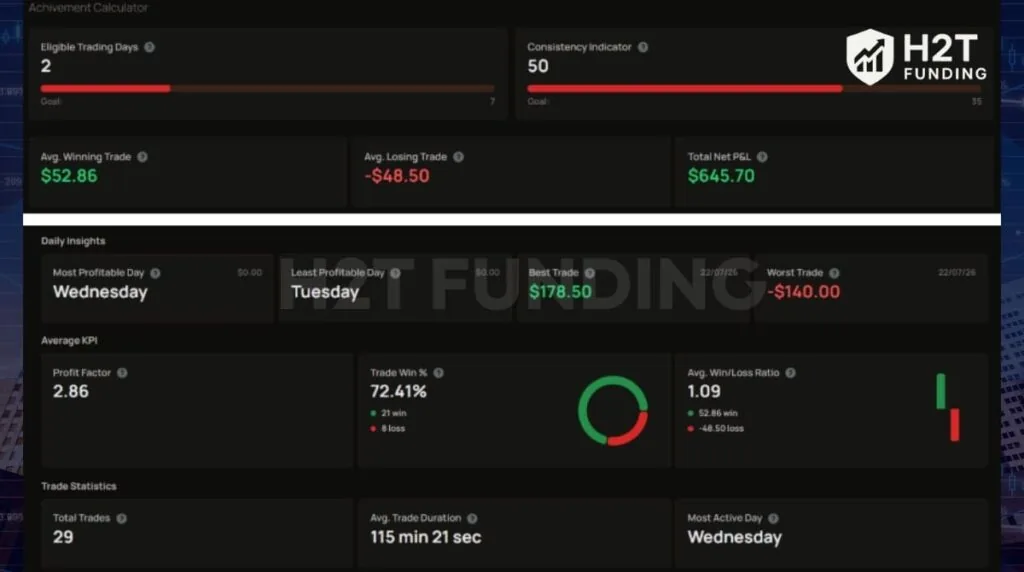
The lesson holds regardless of how the dispute resolves: a hedge does not have to remain open for hours or days to attract attention. Even short-lived positions in correlated instruments can trigger a review, and firms differ significantly in how they define, detect, and penalize this behavior. Before using correlated positions as a hedge, we recommend checking the firm’s exact rules and making sure your execution does not create an unintended hedging pattern.
7. How to Hedge Legitimately on a Prop Firm Account
Legitimate hedging comes down to one rule: keep it inside a single account, on a firm that allows it, and use it as a temporary tool, not a full-time strategy. Anything spread across two accounts, two firms, or an automated mirroring tool crosses into banned territory and risks a Hard Breach.
A 5-step checklist before you hedge
- Confirm hedging or netting mode. Check the account type before opening a second position. A hedging-mode account, MT5 on most forex firms, lets a buy and a sell sit open together on the same instrument. A netting account, common on futures products like Topstep, simply closes or reduces the first position instead. Opening a “hedge” on a netting account does nothing.
- Identify why you’re hedging. A real hedge protects a specific risk: an open profit before a data release, a position held into the weekend, or exposure on a correlated pair. No clear reason beyond “reduce challenge fee risk” means it’s not a hedge; it’s an exploit.
- Use a valid reason, not a workaround. Stick to the three legitimate cases: locking in profit before news, protecting a weekend hold, or offsetting a correlated pair like gold against silver. FundedNext supports this well, since overnight and weekend holding stay open on every Stellar account type, both Challenge and Funded.
- Watch what your copy-trading tools are doing. An EA or copier syncing trades across your own accounts can create an accidental cross-account hedge through lag alone. Blueberry Funded allows copy trading between a trader’s own accounts, but still groups correlated instruments like FX majors or XAUUSD/XAGUSD into one trade idea under its 1.5% risk cap, so a hedge built through a copier still has to respect that shared limit.
- Treat hedging as the exception, not the strategy. A firm reviewing your account expects hedges around specific events, not as the backbone of every trade. Constant hedging starts to look like managing evaluation risk instead of market risk, and that pattern alone can trigger a review even without a rule violation.
Trying to build an edge by offsetting risk across separate accounts costs more in commissions and slippage than it saves, and detection systems catch it more often than not. The version of hedging worth using is the boring one: same account, clear reason, closed once the risk has passed.
8. FAQs
-
Yes, at most forex and CFD prop firms. FXIFY, Blue Guardian, BrightFunded, and all firms above permit holding a buy and a sell on the same instrument inside one account. The account still needs to run in hedging mode, most commonly MT5, since a netting account behaves the way we described above, collapsing the second order into the first rather than opening it separately.
-
No. Every firm covered in this guide bans hedging across accounts, whether both accounts sit with the same firm or two different firms. This gets treated as an evaluation exploit, not a trading style, because one account is set up to lose so the other can pass without demonstrating real skill.
-
Same-account hedging on its own won’t. Cross-account, cross-firm, or copy-trading hedging will, almost always with no warning. Most firms move straight to a Hard Breach on the first confirmed violation. BrightFunded is the one exception here, issuing a Soft Breach warning on a first-time cross-account violation before a second offense triggers permanent closure.
-
Hedging mode lets a buy and a sell on the same instrument stay open as two separate positions, the standard setup on MT5 forex accounts. Netting mode, common on futures platforms like TopstepX, merges an opposite order into the existing position instead of creating a second one, so true hedging isn’t possible there in the first place.
-
BrightFunded is the clearest case among the firms above: no consistency rule and no profit cap at any stage, funded or evaluation. For a full breakdown of firms that skip this rule entirely, see our guide to prop firms with no consistency rule.
-
Same-account hedging can reduce temporary market exposure, but it does not remove the risk, cost, or drawdown rules of a prop firm challenge. Cross-account hedging may improve the apparent odds of passing one account while violating the firm’s rules, so it should not be treated as a legitimate challenge strategy.
-
Yes, on most firms, as long as the EA or copier only runs within a single account. The risk sits in multi-account setups: a copier syncing trades across two of your own accounts can create an accidental cross-account hedge through execution lag alone, and firms hold the trader responsible for whatever the automation does, intentional or not.
-
On most firms, yes: FTMO Swing, The5ers, Blue Guardian, FundedNext, and Blueberry Funded all allow overnight and weekend holding with no restriction. A few require a paid add-on instead; Falcon Funded needs its Weekend Trading Add-on, or forces a closure by Friday, as with Funded Trading Plus’s Instant Program.
9. Final Verdict: Which Prop Firm Is Best for Hedging?
The best prop firm for hedging depends on how you actually use the strategy, not just whether hedging is technically allowed. All 12 firms in this guide permit same-account hedging, but they diverge sharply on 4 things that matter most in practice: automation, holding period, position structure, and how forgiving the firm is on a first mistake.
For a quick match:
- If you hedge with automation (EAs, grid, Martingale): FXIFY and AquaFunded are the most permissive, supporting Martingale and grid strategies without a blackout window. Falcon Funded sits at the opposite end, banning EAs entirely, so any hedge there must be placed manually.
- If you hold hedges overnight or through the weekend: Blue Guardian, The5ers, and E8 Markets all allow it, though Blue Guardian’s Guardian Shield can auto-close a position once floating loss hits its threshold, worth checking before relying on it for swing setups.
- If your hedge involves correlated instruments or larger size: Blueberry Funded treats correlated positions as one trade idea under a 1.5% risk cap, and FundedNext places no lot-size cap on same-account hedging, the most flexible option here for position sizing.
- If you want the most forgiving rulebook or the most “real” hedging structure: BrightFunded issues a Soft Breach warning instead of instant closure on a first cross-account violation, and FTMO US runs a dedicated hedging account with independent SL/TP per leg, the closest to true two-sided hedging on this list.
None of this replaces reading a firm’s current rulebook before buying a challenge, since hedging terms shift as firms update their policies. For a broader look at how these firms stack up outside of hedging, profit split, payout speed, scaling ceilings, and overall trust, visit H2T Funding’s full guide to the best prop firms.