

Navigating modern financial markets often feels like a constant battle against noise, emotion, and excessive screen time. Day traders routinely spend six to eight hours glued to minute charts, second-guessing every tick and falling victim to emotional burnout.
Having analyzed market behavior and risk parameters across prop firm trading for over a decade, I have observed that high execution frequency rarely correlates with long-term profitability. For many traders, the relentless pursuit of intraday fluctuations leads directly to account breach.
Key Takeaway:
- End-of-Day (EOD) trading is an execution strategy where market analysis and order placement occur near or at the daily candlestick close.
- By focusing exclusively on daily settlement prices, traders eliminate intraday noise.
- Align their positions with institutional Smart Money flows.
- Drastically reduce screen-time demands.
1. What Is End-of-Day (EOD) Trading?
End-of-Day trading refers to a structured methodology where traders evaluate markets and execute positions during the final minutes of the daily trading session or immediately following the daily close.
Unlike scalp trading or rapid intra-session trading, EOD strategies rely heavily on higher timeframes. The core philosophy assumes that intraday price swings represent uncoordinated retail noise, whereas the daily settlement price reflects the true consensus value calculated by institutional market participants.
To execute this strategy cleanly, it is vital to understand the difference between execution models and data structures.
1.1. Crucial Distinction: EOD Trading vs. EOD Data
A common point of confusion among retail traders is mixing up the behavioral act of EOD trading with historical EOD data sets.
While these concepts are closely related, they serve fundamentally different functions in trading system development:
- EOD Trading: An active trading approach characterized by executing entries, exits, or order modifications near or at the market close.
- EOD Data: Historical pricing information composed of Open, High, Low, Close (OHLC) values and daily volume metrics, primarily utilized for backtesting and technical chart evaluation.
Using daily data points allows traders to eliminate thousands of lower-timeframe price anomalies, creating cleaner statistical models for strategy evaluation.
1.2. How EOD Orders Execute (Market, Limit, Stop, GTC)
Executing positions effectively during the closing window requires a firm understanding of structural order types. Depending on your platform and broker, specific conditional orders streamline EOD execution:
- Market-on-Close (MOC): An order submitted to execute as close as possible to the official daily closing price.
- Limit Orders: Orders set at a specific price level or better, often placed near key support or resistance levels right before market close.
- Stop Orders: Conditional orders triggered once price crosses a predetermined threshold, useful for entering confirmed momentum breakouts.
- Good ‘Til Canceled (GTC): Pending orders that remain active across multiple trading sessions until explicitly fulfilled or canceled by the trader.
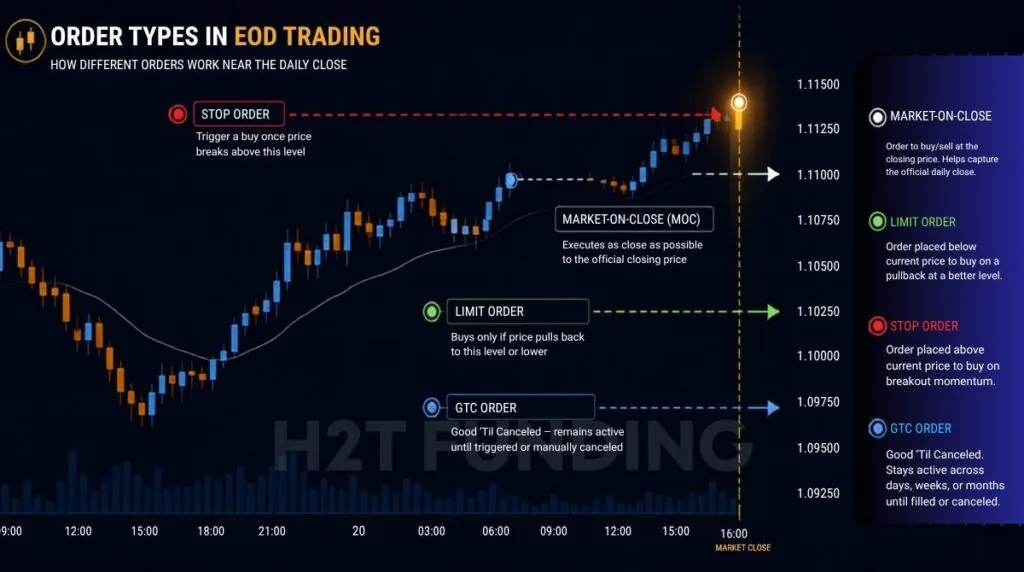
The selection of these order types impacts execution slippage, especially during high-volatility closing auctions.
| Order Type | Primary Use Case in EOD Trading | Key Advantage | Main Drawback |
|---|---|---|---|
| Market-on-Close (MOC) | Guaranteeing execution at final settlement price | Captures precise daily closing value | Vulnerable to sudden spread widening |
| Limit Order | Entering on minor daily pullbacks | Prevents negative slippage | Risk of non-execution if price moves away |
| Stop Order | Buying confirmed breakout closes | Confirms daily closing momentum | Potential execution slippage on gap opens |
| Good ‘Til Canceled (GTC) | Managing multi-day swing targets and stops | Automates exit levels across sessions | Exposes position to overnight news events |
2. Market Hours: When Exactly Is The “End of Day”?
The phrase “end of day” is not a single, universal timestamp. Because financial markets operate under distinct institutional clearing schedules, the exact cutoff window varies across asset classes.
2.1. Stock Market (NYSE/NASDAQ)
In equity markets such as the New York Stock Exchange (NYSE) and NASDAQ, the trading session concludes at 4:00 PM EST.
The final 30 to 60 minutes of the session, commonly labeled the Power Hour, experiences massive institutional rebalancing. During this window, index funds, hedge funds, and pension managers finalize their daily order allocations, generating deep liquidity and sharp price direction.
2.2. Forex & Crypto (24/5 vs. 24/7 Cutoffs)
Foreign exchange markets trade continuously 24 hours a day during the business week. However, the official daily rollover occurs at 5:00 PM EST (New York close).
This time represents the global standard for daily candlestick calculation and rollover swap rate debiting.
Conversely, cryptocurrency markets run continuously 24/7. The widely accepted benchmark for daily candlestick closing in crypto technical analysis is 12:00 AM UTC.
2.3. Futures Markets
Futures traded on major exchanges like the Chicago Mercantile Exchange (CME) feature distinct daily session halts.
For stock index futures like the E-mini S&P 500 (ES) and Nasdaq 100 (NQ), a mandatory daily market halt occurs at 4:15 PM EST, resuming at 4:30 PM EST, with a full session shutdown occurring at 5:00 PM EST.
Understanding these brief pauses is essential for prop firm traders to prevent accidental rule violations regarding position holding limits.
3. EOD Trading vs. Day Trading vs. Swing Trading
To select the ideal methodology for your routine, you must compare execution frequencies, holding periods, and operational demands.
Day trading demands real-time monitoring throughout the active floor session to capitalize on intraday volatility spikes.
Swing trading captures multi-day moves, relying on continuous risk assessment over longer horizons.
EOD trading sits comfortably at the intersection: it utilizes daily candle closes to make decisions, functioning either as an efficient form of day trading or as the primary timing engine for swing trading.
| Feature | Day Trading | EOD Trading | Traditional Swing Trading |
|---|---|---|---|
| Holding Period | Minutes to hours (flattened daily) | Overnight to multiple days | Days to several weeks |
| Screen Time | 4 to 8 hours per day | 15 to 30 minutes per day | 1 to 2 hours per day |
| Primary Timeframe | 1-minute to 15-minute charts | Daily (D1) charts | 4-hour to Daily charts |
| Execution Focus | Real-time order flow & momentum | Daily closing candle confirmation | Structural support & resistance |
| Overnight Risk | None | Low to Moderate | Moderate to High |
How EOD Swing Trading Helps You Avoid the PDT Rule
For retail traders operating equity margin accounts in the United States, regulatory capital constraints present a major hurdle.
Under historic Financial Industry Regulatory Authority (FINRA) standards under Rule 4210, a trader executing four or more day trades within five business days in a margin account is classified as a Pattern Day Trader (PDT).
This designation traditionally required accounts to maintain a minimum equity balance of $25,000.
While regulatory modernizations introduced by FINRA transition brokerage margin frameworks toward real-time intraday risk management standards, day trading rules remain restrictive for small-capitalization accounts.
EOD swing trading naturally avoids these restrictions:
- Overnight Holding: Purchasing an asset near the closing bell today and liquidating it after tomorrow’s open counts as a swing trade, not an intraday trade.
- Capital Efficiency: Traders do not need to lock up substantial capital simply to navigate trade-count limits.
- Execution Quality: Trades are executed into deep closing liquidity rather than forced intraday entries.
4. Benefits & Drawbacks of EOD Trading
EOD trading offers massive time savings and removes intraday noise, but exposes your capital to overnight gaps. Here is the exact breakdown:
Pros & Cons Analysis
Pros
- Massive Time Saving: Requires only 15 to 30 minutes of daily chart evaluation near the market close, freeing up time for other work or commitments.
- Higher Technical Reliability: Daily candlesticks synthesize thousands of transactions, dramatically reducing false signals caused by intraday noise.
- Reduced Psychological Stress: Eliminates the urge to overtrade, micro-manage open trades, or react emotionally to temporary price swings.
- Lower Transaction Overhead: Executing fewer high-conviction trades reduces total spread costs, commissions, and execution drag over time.
Cons
- Overnight Gap Risk: Positions held overnight are exposed to sudden earnings reports, geopolitical events, and macroeconomic announcements.
- Financing Swap Costs: Forex and leveraged instruments incur daily rollover swap fees when positions cross the 5:00 PM EST threshold.
- Wider Stop Loss Requirements: Higher timeframe structural invalidations demand wider stop loss distances, requiring smaller position sizing.
5. The Edge: What Does Academic Research Say About EOD Trading?
The validity of EOD execution is strongly backed by empirical financial research. Academic studies in market microstructure consistently highlight distinct patterns in intraday volume and volatility distribution.
Financial literature published by researchers such as Biais, Hillion, and Spatt (1995), alongside market structure reviews by Ozenbas (2008), confirms that intraday market volume follows a distinct U-shaped pattern (or reverse J-shape depending on the region).
Trading volume and liquidity spike sharply during the market open, drop substantially during mid-day hours, and accelerate again into the daily close.
This end-of-day volume surge occurs because institutional market participants—such as index trackers, mutual funds, and algorithmic liquidity pools—execute large block orders near settlement to match baseline index prices.
As a result, trading near the close grants retail traders access to the highest market liquidity of the entire session, often resulting in tighter effective spreads and superior order execution quality.
Real-World Case Study: Larry Williams (1987)
The legendary performance of Larry Williams in the 1987 Robbins World Cup Championship of Futures Trading stands as one of the most famous market anecdotes supporting daily chart focus.
Williams officially turned an initial balance of $10,000 into over $1.1 million within 12 months, achieving a return exceeding 11,000%.
While his strategy relied on dynamic position sizing and volatility expansion models, the analytical engine was built around daily price structures, volatility breakout points, and daily closing confirmations rather than intraday noise.
Market historians view this legendary campaign not as an everyday expectation, but as proof that daily market structures reflect true institutional price discovery.
6. How to Build a Winning End-of-Day Trading Strategy
Building a systematic EOD strategy involves combining market direction, precise entry triggers, and strict operational cutoffs.
Below are two actionable frameworks tailored for daily close execution.
6.1. The Breakout Strategy (And How to Spot False Breakouts)
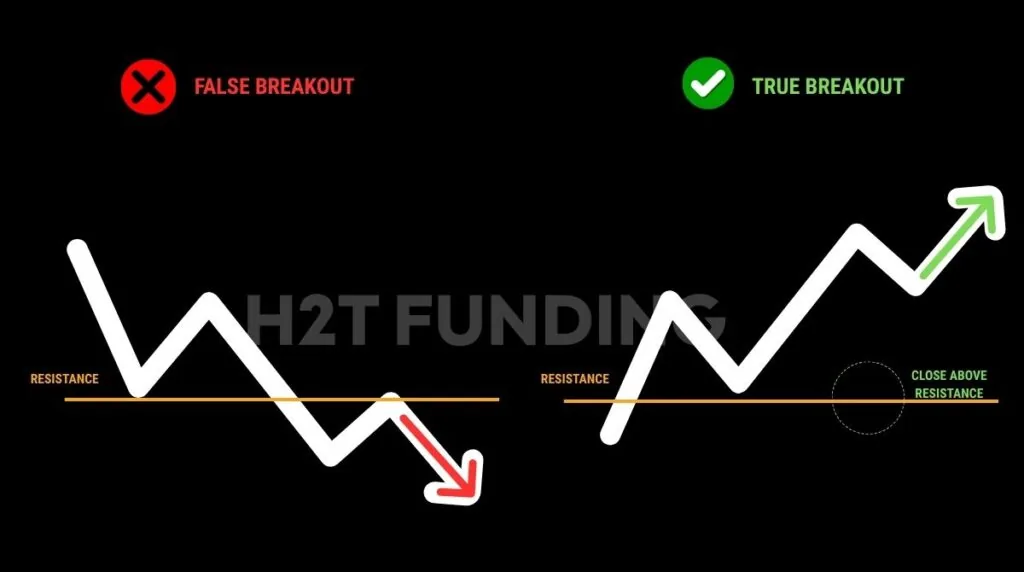
Standard intraday breakouts are notorious for generating false signals. Market makers frequently push prices beyond key support or resistance levels during the session to sweep retail liquidity, only to reverse sharply before the close.
An EOD breakout framework neutralizes this trap by requiring price to sustain its move through the daily close:
- Identify Structure: Mark clean horizontal resistance levels tested at least twice on the daily timeframe.
- Filter Intra-Session Sweeps: Ignore price wicks that cross the boundary during mid-day trading hours.
- Confirm Candle Close: Evaluate the asset in the final 15 minutes of the session. Enter only if the daily candlestick body closes beyond the structural level.
- Invalidation: Position the stop loss just beneath the low of the breakout candlestick.
By demanding a valid closing price above key levels, you automatically filter out temporary intraday liquidity traps.
6.2. Trend-Following at the Close
Trend-following models capitalize on sustained directional momentum. When an asset displays strong buying or selling pressure, the daily candle often closes near its extreme high or low.
As a trading guideline:
- Bullish Momentum: If an asset is trading above its 20-day Exponential Moving Average (EMA) and the daily candle is closing within the top 10% of its total daily range, institutional buyers are driving the move.
- Execution: Place a Market-on-Close order, anticipating continuation into the following morning’s open.
- Risk Control: Set a trailing stop beneath the previous day’s swing low.
6.3. When to Set Your Daily Cutoff
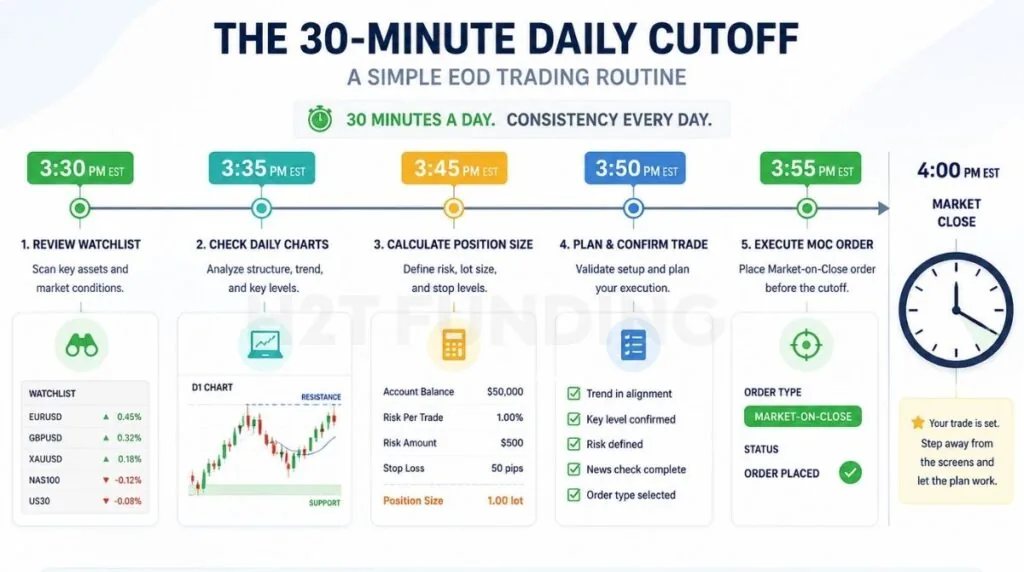
To maintain a disciplined routine without falling back into screens-staring habits, establish a strict 30-minute operational window:
- Equities: Log into your trading workstation at 3:30 PM EST. Review watchlist assets, verify daily candlestick structures, calculate position sizing, and queue Market-on-Close orders before 3:55 PM EST.
- Forex: Conduct market scans at 4:30 PM EST, right before the 5:00 PM EST New York candle close and rollover phase.
- Futures: Assess open positions at 3:45 PM EST to ensure full compliance with exchange halts and prop firm liquidation rules.
Avoid placing new EOD trades immediately before major scheduled events such as FOMC meetings or Non-Farm Payrolls. While EOD strategies reduce intraday noise, overnight gaps following high-impact news can still invalidate otherwise strong technical setups.
7. Can You Trade End-of-Day on a Funded Prop Firm Account?
Transitioning an EOD strategy to a funded prop firm account is a practical path to scaling capital. However, funded accounts operate under strict risk parameters that directly impact overnight and swing strategies.
Understanding these firm-specific rules ensures your trading edge remains compliant and profitable.
7.1. Flatten-by-Close Rules Explained
Many futures prop trading firms enforce a strict mandatory position liquidation rule, often referred to as the flatten-by-close policy.
Under these terms, traders must close all open positions prior to 4:59 PM EST (or 4:15 PM EST depending on the instrument) to prevent holding contracts across the exchange clearing halt.
If you trade futures with prop firms maintaining these rules, classic multi-day EOD swing trading cannot be executed directly. Instead, you must utilize EOD concepts strictly for intraday setups, exiting all positions right before the daily halt.
Conversely, most Forex and Contract for Difference (CFD) prop firms permit overnight position holding, provided traders account for daily rollover swap costs.
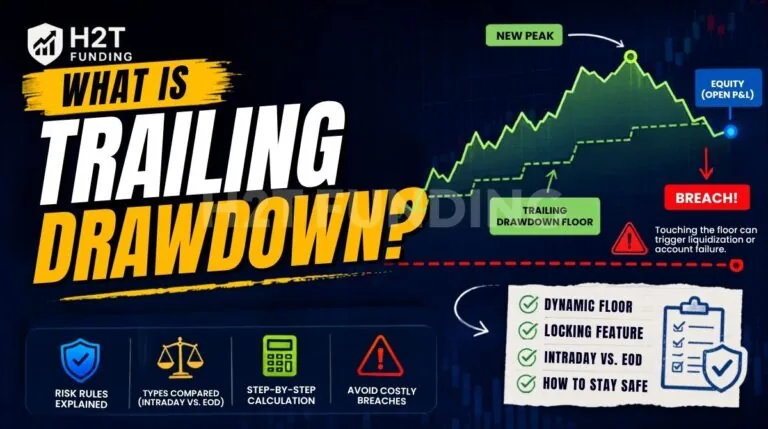
7.2. EOD Drawdown vs. Trailing Drawdown: The Critical Difference
The single most critical rule factor for EOD traders in prop firm environments is the drawdown calculation engine. Prop firms generally employ one of two evaluation metrics:
- Trailing Intraday Drawdown (Tick-by-Tick): The maximum allowable loss threshold trails your account balance based on unrealized high-water mark profits in real-time. If your open trade moves up $2,000 and then retraces $1,500 before the daily close, your trailing drawdown limit moves up with the peak floating equity, severely trapping your account.
- End-of-Day (EOD) Drawdown: The maximum loss threshold updates only once per day, calculated precisely at the official session close (typically 5:00 PM EST).
For swing and EOD traders, EOD Drawdown accounts are vastly superior.
They allow open trades the necessary breathing room to handle intraday pullbacks without artificially dragging the drawdown floor higher based on temporary, unrealized floating gains.
7.3. Which Prop Firms Are Best for EOD/Swing Traders?
Selecting the right evaluation partner depends on choosing prop firms whose rules support higher-timeframe strategies. When reviewing firms, prioritize the following attributes:
- Overnight and Weekend Holding Granted: Ensure the evaluation terms explicitly allow open trades across daily session closes and weekend news breaks.
- Stateless EOD Drawdown Parameters: Opt for programs where risk limits update at the daily closing bell rather than tracking live unrealized equity peaks.
- No Restrictive Volume Consistency Rules: Confirm that the firm does not penalize traders for lower execution frequency across sessions.
8. Frequently Asked Questions (FAQ)
-
End-of-Day trading evaluation typically begins 30 to 45 minutes prior to the official market close.
For U.S. equities, this execution window runs from 3:30 PM to 4:00 PM EST. For Forex, market analysis is usually conducted between 4:15 PM and 5:00 PM EST.
-
Yes, EOD trading is highly suited for beginner traders.
Executing positions on daily chart closes removes high-frequency intraday noise, reduces execution stress, prevents overtrading, and provides ample time to calculate risk parameters cleanly.
-
Holding trades overnight depends on the specific asset class and prop firm terms.
Most Forex prop firms permit overnight holding. However, many equity and futures prop firms enforce a mandatory flatten-by-close rule at 4:59 PM EST, requiring positions to be closed before the session halt. Always verify your firm’s specific trading rules.
-
Manage overnight gap risk by reducing individual position sizes, placing structural stop loss orders, and avoiding new trade entries immediately prior to high-impact economic calendar releases like Non-Farm Payrolls (NFP) or Consumer Price Index (CPI) announcements.
-
Before executing live capital, you should define your technical rules, secure clean historical daily data, and conduct backtesting across historical market cycles.
To structure your research effectively, review our detailed guide on how to backtest a trading strategy step-by-step.
-
Yes, EOD strategies can be easily automated using platform expert advisors, custom scripts, or webhook alerts connected from analytical mapping tools directly to your broker’s execution API.
-
Top-tier prop firms offering explicit End-of-Day drawdown structures include platforms like Tradeify and select swing-focused Forex accounts.
9. Conclusion
End-of-Day trading offers a structured, sustainable alternative to the high-stress environment of day trading. By shifting your execution focus to daily settlement prices, you align your strategy with institutional liquidity flows, eliminate intraday noise, and take back control of your trading routine.
Success with EOD strategies requires matching your operational routine with the right trading environment.
If you plan to execute EOD strategies within a funded prop account, make sure to choose programs that feature End-of-Day Drawdown calculations and permit overnight holding.
Ready to scale your strategy with institutional capital? Explore our detailed prop firm comparisons and evaluation guides on H2T Funding to find the right funded account model for your trading style today.