

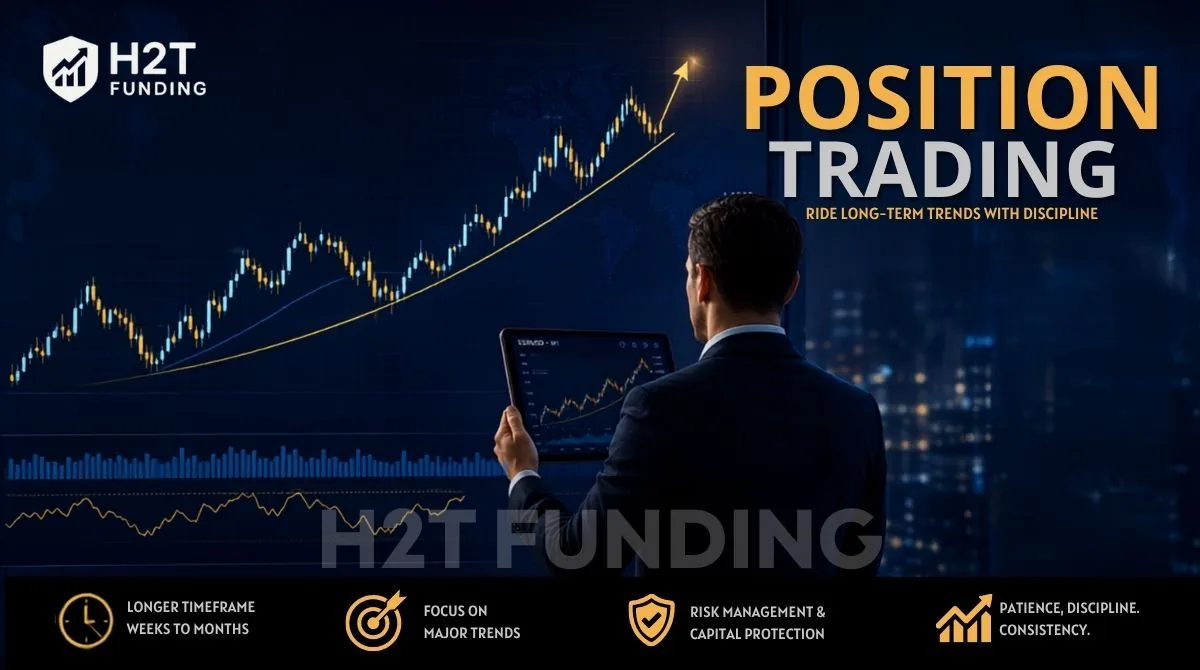
Position trading is a long-term strategy where traders hold positions for weeks to months to capture major trend moves driven by macroeconomic cycles, monetary policy shifts, and fundamental factors rather than short-term price fluctuations.
Quick Take:
- Definition: A long-term trading methodology focused on riding major macroeconomic market trends.
- Average Holding Period: Several weeks, months, or even years depending on economic cycles.
- Ideal Trader Profile: Patient individuals, busy 9-to-5 professionals, and macro-focused analysts.
- Prop Firm Compatibility: Feasible with low leverage and strict drawdown calculation adjustments.
As a professional trader with over a decade in macro markets, I must emphasize that position trading requires ironclad emotional discipline and proper capital management. It is not designed for individuals seeking instant financial gratification or quick scalp profits.
1. What is position trading?
Position trading represents the longest timeframe strategy within active financial speculation. Unlike intraday traders who react to immediate price spikes, position traders identify macro market shifts and ride long-term trends to maximum expansion.
This approach relies heavily on identifying structural imbalances in financial markets. Position traders place less emphasis on short-term price fluctuations, focusing instead on underlying economic fundamentals that drive sustained directional momentum over extended periods.

1.1. What is a position trader?
A position trader is a strategic market participant who operates with extreme emotional composure. They remain unaffected by daily green or red market candles, understanding that structural macroeconomic trends require weeks or months to develop fully.
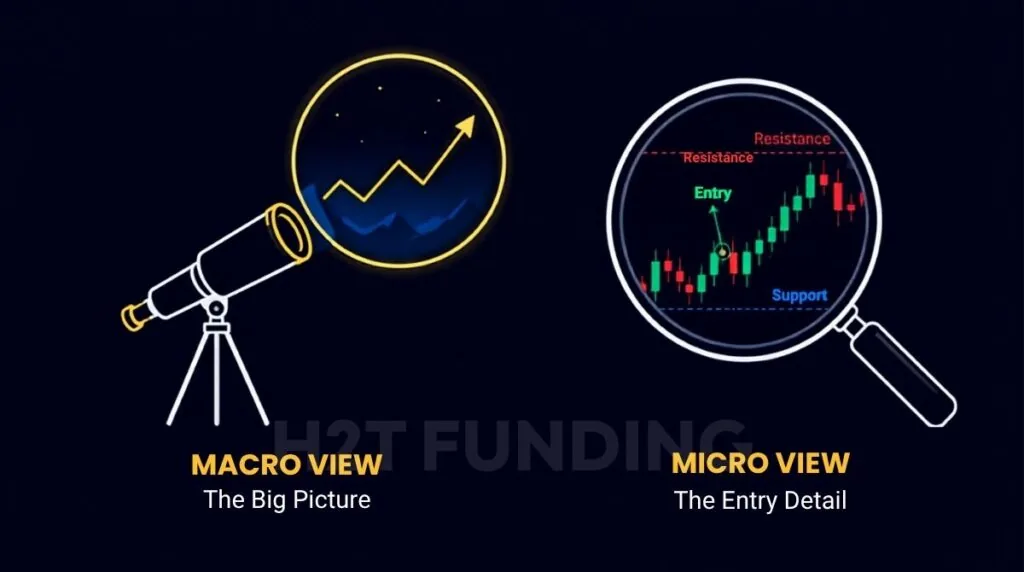
To succeed, a position trader combines Fundamental Analysis (FA) to determine what to trade with Technical Analysis (TA) to determine when to enter.
While central bank rate decisions or geopolitical events dictate market direction, monthly and weekly technical charts provide structural confirmation for entries.
1.2. “Trading position” terminology & mini-glossary
Before diving deeper into system design, traders must understand fundamental industry terminology:
- Going Long: Refers to buying an asset with the expectation that its market price will rise over time.
- Going Short: involves selling a borrowed asset or derivative contract to profit from an anticipated decline in valuation.
- Being Flat: means maintaining zero open market positions, protecting capital in cash during times of high market uncertainty.
- Market Exposure: represents the total financial risk and equity percentage currently deployed across active market trades.
1.3. The crucial difference: Position trading vs. Buy-and-Hold
Buy-and-Hold is a passive investment strategy where assets are held indefinitely regardless of market conditions. In contrast, position trading is an active strategy utilizing defined stop-loss orders, profit targets, and structural exit triggers when macroeconomic fundamentals shift.
Furthermore, traditional Buy-and-Hold investors only profit during bull markets. Position traders actively open Short positions during multi-month bear markets, capitalizing on structural downturns across global assets.
2. Position trading vs. Swing trading vs. Day trading
Selecting the right trading style depends on personal availability, risk tolerance, and psychological compatibility. The comparison below highlights key structural differences across timeframes.
| Evaluation Criteria | Position Trading | Swing Trading | Day Trading |
|---|---|---|---|
| Holding Period | Weeks, months, or years | A few days to several weeks | Minutes to hours (closed daily) |
| Screen Time | Low: 1–2 hours per week | Moderate: Daily market checks | High: Continuous chart monitoring |
| Analysis Focus | Fundamental & Technical combo | Primary Technical, short news | Pure Technical & Price Action |
| Trade Frequency & Fees | Very low: Minimal spread/commission | Moderate entry frequency | High: Execution costs add up |
| Emotional Pressure | Low intraday stress | Moderate reversal stress | High pressure & fast decisions |
If you work a traditional 9-to-5 job or manage a business, position trading or swing trading provides an ideal lifestyle fit. If you prefer high adrenaline, fast feedback, and full-time screen interaction, day trading may suit your routine better.
3. Core tools & strategies for position traders
Position traders do not rely on single indicators. Instead, they build multidimensional trading frameworks that combine macroeconomic data with structural chart setups.
3.1. The fundamental & technical analysis combo
Relying exclusively on Technical Analysis for long-term trading often leads to false breakouts during macroeconomic shifts. Conversely, relying purely on macro economic data without precise chart timing can result in massive drawdowns before a trend begins.
For instance, Fundamental Analysis (FA) reveals long-term policy divergences, such as interest rate hikes by the Federal Reserve (FED).
Simultaneously, Technical Analysis (TA) identifies key support zones or moving average retests, giving traders low-risk entry points aligned with macro drivers.
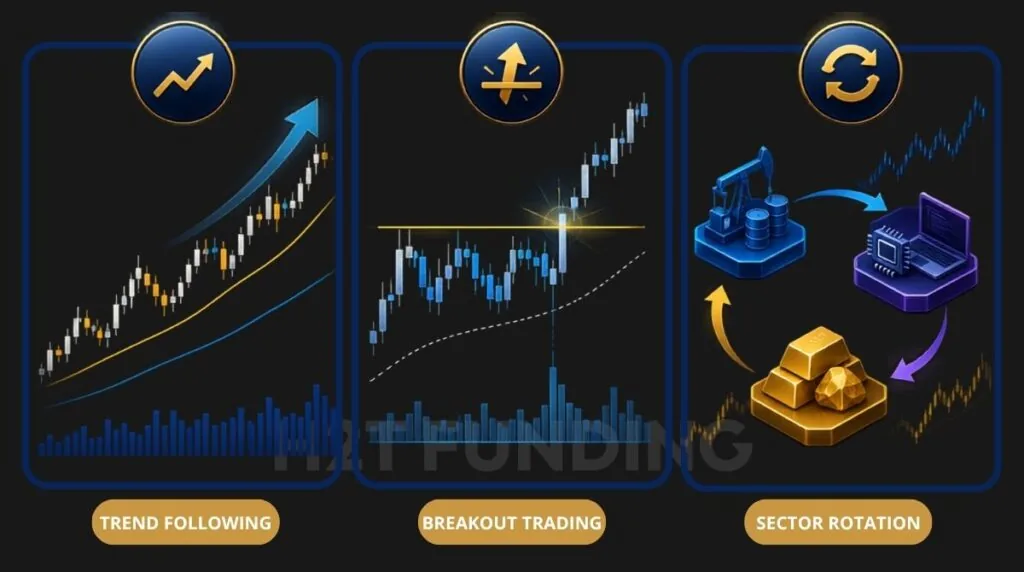
3.2. 3 core position trading strategies
Successful long-term market participants typically deploy one of three core strategies:
- Trend Following: Traders utilize high-period moving averages, such as the 50-day and 200-day Simple Moving Averages (SMA), to identify and ride established market trends on Daily (D1) and Weekly (W1) timeframes.
- Breakout Trading: This setup occurs when price breaks beyond multi-year accumulation or distribution channels on high-timeframe charts. When supported by strong fundamental momentum, these breakouts often yield trend extensions lasting several months.
- Sector Rotation: Commonly applied in equity and commodity futures markets, sector rotation tracks capital movement across industries based on broader economic cycles. Capital flows out of defensive sectors into tech during economic expansion, and moves into energy or gold during inflationary periods.
4. How to build a position trading system (A Step-by-Step Setup)
- Step 1 — Market Context: Evaluate central bank interest rate policies, Consumer Price Index (CPI) inflation metrics, and Gross Domestic Product (GDP) reports to determine the dominant macroeconomic trend.
- Step 2 — Chart Setup & Zones: Open Daily (D1) and Weekly (W1) charts to mark key multi-month Support and Resistance zones.
- Step 3 — Entry Triggers: Wait for high-timeframe candlestick price action signals, such as Weekly Pinbars or Engulfing candles, at major technical levels.
- Step 4 — Position Sizing & Risk Management: Calculate lot sizing based on wider Stop-Loss requirements (often 100 to 500 pips) while risking no more than 1% to 2% of total account capital.
- Step 5 — Exit Strategy & Review: Implement Trailing Stops behind major weekly swing structures or exit manually when central bank monetary policy shifts direction.
Real-world case study: A position trade on Forex/Futures
During early 2022, the Federal Reserve embarked on an aggressive monetary tightening cycle to combat rising domestic inflation. In contrast, the European Central Bank (ECB) delayed rate increases due to regional energy vulnerabilities.
This fundamental divergence created a long-term bearish outlook for the EUR/USD currency pair.
A position trader analyzing this macro environment could have identified a short entry near 1.1350 in January 2022 following a weekly bearish rejection candle below key technical resistance.
- Entry Point: 1.1350 (EUR/USD short position)
- Stop-Loss: 1.1650 (300 pips risk above macro resistance)
- Take-Profit / Exit: 0.9600 (September 2022 exit near historical lows)
- Total Gain: ~1,750 pips over an 8-month holding period
- Risk-to-Reward Ratio (R:R): ~1:5.8
By risking 1.5% of equity on this single macro trade setup, a position trader achieved a net portfolio return exceeding 8.7% while spending under two hours per week reviewing price charts.
5. Pros, cons, and the hidden risks
Pros & Cons Analysis
Pros
- Requires minimal daily screen time, reducing operational fatigue.
- Low trading frequency substantially cuts overall spread and commission expenses.
- Higher Risk-to-Reward potential per trade compared to short-term scalping.
- Eliminates intraday market noise and false price spikes.
Cons
- Requires substantial account capital to withstand wider stop-loss parameters.
- Lower total trade frequency means fewer trading opportunities per year.
- Demands long periods of patience during sideways consolidation phases.
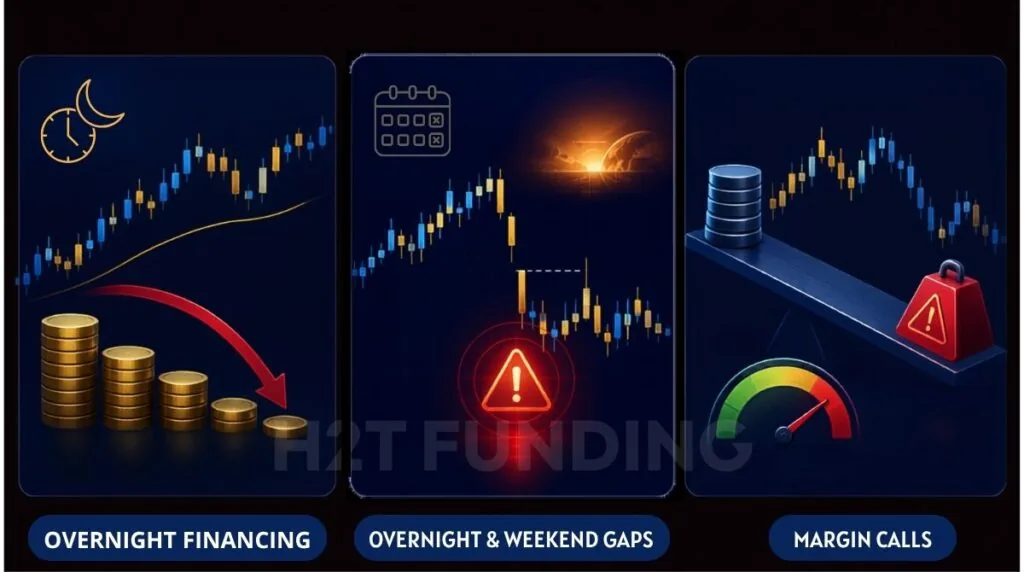
The hidden risks (What retail traders must know)
In addition to standard price risks, position traders must account for specific structural market costs:
- Swap Fees (Overnight Financing): Holding leveraged Forex or CFD trades across weeks or months incurs daily rollover swap charges. Negative carry swaps can erode accumulated trade profits significantly over long holding periods.
- Overnight and Weekend Gaps: Geopolitical events or unexpected news announcements over weekends can cause market prices to gap dramatically past defined stop-loss orders, resulting in slippage.
- Margin Calls: Setting wide stop-losses without adjusting lot sizes can quickly over-leverage an account. A sudden counter-trend retracement can trigger a margin call before the broader macro trend resumes.
6. Position trading on a Funded / prop trading account: Is it feasible?
Proprietary trading firms (prop firms) provide talented traders access to funded accounts ranging from $50,000 to $200,000 or more.
However, applying a long-term position trading strategy within modern prop firm risk rules requires careful planning.
6.1. Navigating overnight & weekend holding policies
Many traditional prop firms prohibit holding open positions over weekends or across major news releases to mitigate gap risk.
Position traders must select firms that explicitly allow weekend holding or opt for dedicated swing/position evaluation accounts.
Additionally, evaluating whether a firm offers Swap-Free accounts or fair overnight fee structures is essential when positions remain active for months.
6.2. Position sizing under max drawdown / Daily Loss Limits
The primary hurdle for position traders on prop firm accounts is managing wide stop-loss distances within tight maximum drawdown rules.
For example, if a evaluation account allows a Maximum Daily Loss of 5% and a Total Trailing Drawdown of 10%, a trader cannot afford a single 300-pip stop-loss that risks 3% of capital.
To adapt position trading to prop firm evaluation rules, traders must dramatically reduce contract lot sizing:
By reducing risk per trade to 0.25% or 0.50%, position traders can accommodate 300 to 500 pip stop-losses without risking daily drawdown violations.
If you are evaluating different capital funding programs, review our comprehensive analysis of the top evaluated funded account options to compare overnight rules, commission structures, and maximum drawdown limits across leading evaluation firms.

7. Is Position trading tight for you? (Next Steps)
Before adopting position trading as your primary market approach, evaluate your personal profile against this quick checklist:
- Do you have the patience to sit on cash for weeks without forcing low-quality trades?
- Can you maintain composure during 200-pip price retracements against an open position?
- Are you genuinely interested in macroeconomics, central bank decisions, and global market trends?
- Do you prefer spending less time in front of charts while focusing on long-term strategy?
If you answered yes to most of these questions, position trading offers a strategic path to market participation.
8. FAQs
-
To position trade personal capital effectively, account balances between $5,000 and $10,000 are recommended due to wider stop-loss distances. Alternatively, traders can use smaller personal funds to secure funded prop firm accounts offering $50,000+ in trading equity.
-
Yes, position trading on funded accounts is entirely feasible. However, traders must select prop firms that permit overnight and weekend holding while drastically reducing lot sizes to remain compliant with daily drawdown limits.
-
The most reliable indicators for long-term position trading include high-period simple moving averages (50 SMA and 200 SMA), Weekly Support and Resistance levels, and macro indicators like central bank interest rate differentials and inflation metrics.
-
Position trading can be highly suitable for beginners because it eliminates fast-paced intraday pressure and overtrading temptations. However, beginners must master macroeconomic principles and position sizing math before risking real capital.
-
Position trading actively uses strict risk management tools, such as stop-loss orders and macro profit targets, and includes trading Short during market downturns. Buy-and-Hold is a passive, long-only investment strategy without predefined exit boundaries.
9. Conclusion
Position trading remains one of the most effective and low-stress trading strategies for riding long-term macroeconomic trends. By combining fundamental analysis with high-timeframe technical entries, traders can achieve substantial risk-to-reward ratios without spending endless hours in front of price charts.
When applied to funded prop firm accounts, position trading demands strict lot-size reductions to navigate daily drawdown limits successfully. With proper risk management, ironclad discipline, and systematic execution, long-term market trends offer sustained opportunities for professional growth.
Explore the Trading Guides & Strategies section on H2T Funding to learn more about position trading, swing trading, day trading, risk management, and funded account best practices. Whether you’re just getting started or preparing for a prop firm challenge, these resources will help you build a more consistent and sustainable trading approach.