

Manual trading requires you to analyze the market and place every order yourself, while an Expert Advisor (EA) is a software program running on MetaTrader 4 (MT4) or MetaTrader 5 (MT5) that executes or manages trades based on strict pre-programmed rules.
You must choose between manual trading vs EA/bot trading based on your personal psychological profile, available daily screen time, and the specific automation rules enforced by your proprietary trading firm.
As of October 2026, prop firms set their own specific rules for automated strategies. This guide breaks down the seven core differences, how to spot trading bot scams, and how to navigate prop firm automation policies to protect your funded account.
Key Takeaways
- Execution control: Manual trading requires human execution, while Expert Advisors (EAs) fully automate trades on MT4 or MT5 using strict code.
- Prop firm restrictions: Prop firm restrictions: As of October 2026, prop firms set their own EA rules based on factors like account size, platform, and software ownership.
- Profitability limits: EAs cannot guarantee profits. Backtests can differ from live results due to real-world spreads and slippage.
- Regulatory warnings: The CFTC actively warns against fraudulent vendor bots. Avoid any EA promising guaranteed returns or lacking verified live data.
- Hybrid approach: You can enter trades manually and use an EA strictly for risk management, provided your prop firm explicitly allows it.
- No method is best for everyone. For a prop firm challenge, check the firm’s EA rule first, then choose manual, hybrid, or EA based on your experience and available time.
Note: This guide was fact-checked and updated in October 2026. All platform limits, subscription pricing, and proprietary trading firm integrations reflect the most current TradingView policies.
1. What Is Manual Trading, and What Is an EA Bot?
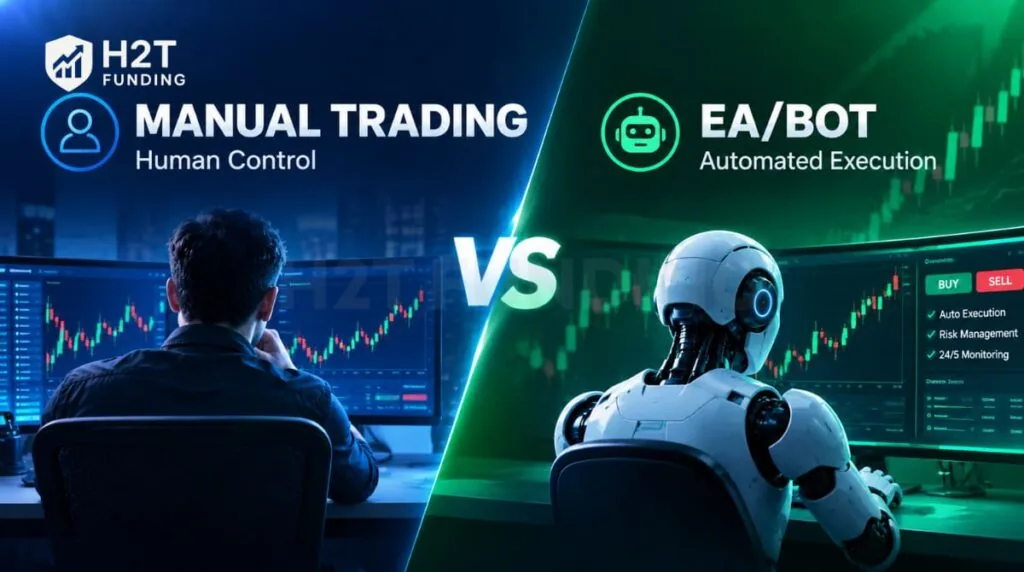
Manual trading relies entirely on human analysis and physical execution, whereas an EA bot is a coded software algorithm that executes or manages trades automatically on your behalf. Understanding the exact technical distinction between these two methods is critical before you select a platform for a prop firm challenge.
1.1. Manual (discretionary) trading vs systematic rules
Manual trading requires a human to physically monitor the charts, calculate position sizes, and click the buy or sell buttons for every transaction. Traders who operate manually typically divide into two categories: discretionary and systematic.
Discretionary manual traders rely on real-time judgment and market context. For example, a discretionary trader might decide to cancel a planned trade because they notice irregular price action just minutes before a major central bank announcement.
Systematic manual traders follow a strict set of predefined criteria, but the human still executes the order. A systematic trader will only click “buy” when their specific setup occurs, but they retain the physical control to override the trade if necessary.
1.2. How an Expert Advisor works on MT4 and MT5
An Expert Advisor (EA) is an automated trading script coded in MQL4 or MQL5 that continuously scans the market and executes actions without human intervention. EAs are natively built for the MetaTrader 4 (MT4) and MetaTrader 5 (MT5) platforms.
If you trade on cTrader, these automated algorithms are programmed differently and are referred to as cBots. Conversely, modern web-based platforms like Match-Trader currently do not support automated EA integration. You must verify platform compatibility before purchasing a prop firm evaluation if you intend to use automation.
EAs follow exact, unbending logic. For example, an EA can be programmed to:
- Automatically open a 1-lot short position the exact millisecond the Relative Strength Index (RSI) crosses below 70.
- Automatically trail a stop-loss by 10 pips once an open trade reaches $500 in floating profit.
- Automatically close all open positions across the entire account at exactly 4:55 PM EST on Friday to prevent weekend gap exposure.
2. Manual Trading vs EA/Bot Trading: 7 Key Differences
The core difference between manual and automated trading lies in how you manage execution speed, operational costs, and firm restrictions. The table below outlines the seven primary differences between these two approaches to help you evaluate which method fits your lifestyle.
| Feature | Manual Trading | EA Trading (Bot) |
|---|---|---|
| Execution Speed | Slower; relies entirely on human reaction time and physical clicking. | Instantaneous; executes orders in milliseconds once programmed conditions are met. |
| Emotion & Discipline | Highly susceptible to emotional interference, such as revenge trading or hesitating on entries. | Removes hesitation during order execution, but shifts emotional pressure to how you manage, pause, or manually override the system. |
| Time Commitment | Requires active screen monitoring during specific high-volume market sessions. | Scans the market continuously, operating 24 hours a day, 5 days a week in the forex market. |
| Adaptability to News | Highly adaptable; a human can instantly pause trading during unexpected macroeconomic events. | Rigid; the bot will execute blindly into extreme volatility unless explicitly programmed with a news filter. |
| Testing Methods | Relies on slow forward testing (live demo trading) and manual journal tracking over months. | Allows for rapid historical backtesting, though flawless past data often fails to match live market conditions. |
| Operational Costs | Base costs are limited to standard broker spreads and commissions. | Incurs additional fees for purchasing the EA, monthly VPS hosting, and extreme sensitivity to spread widening. |
| Prop Firm Compliance | The standard accepted method across all programs, though specific strategies like news trading or tick scalping may still be restricted. | Heavily restricted; strictly governed by account size, platform choice, and specific firm regulations. |
You must weigh these seven operational factors against your available capital and your chosen prop firm’s specific evaluation rules before committing to an automated strategy.
3. Pros and Cons of Manual Trading
Manual trading places the entire burden of success on your own psychology and physical execution. While it grants you total control, it also exposes your funded account to human error.
Pros & Cons Analysis
Pros
- Ensures universal prop firm compliance, provided you do not violate standard daily drawdown limits.
- Adapts instantly to unexpected news events, assuming you actively monitor macroeconomic calendars to pause your trading.
- Avoids low-probability market setups if you correctly interpret real-time price action context that a rigid algorithm might miss.
- Eliminates third-party software costs, as long as you execute directly through your standard broker platform without purchasing a VPS.
- Builds long-term market intuition, provided you maintain a strict daily trading journal to track and correct your mechanical errors.
Cons
- Triggers destructive emotional mistakes, especially when you face consecutive losses and attempt to revenge trade to recover capital.
- Demands heavy daily screen time, meaning you must commit several continuous hours if you trade the volatile New York session.
- Suffers from slower physical execution, which costs you critical pips when you attempt to enter high-speed momentum breakouts.
- Exposes your account to discipline failures whenever you hesitate to manually close a losing position at your defined stop-loss.
- Causes physical and mental fatigue, particularly if you monitor 1-minute intraday charts across multiple overlapping market sessions.
4. Pros and Cons of EA Trading
EA trading removes emotion from individual order execution, but your psychological discipline simply shifts to how you manage or override the software. While automation saves time, it introduces complex technical risks and demands constant monitoring.
Pros & Cons Analysis
Pros
- Executes trades instantaneously, provided the market conditions perfectly match the coded parameters without network latency.
- Eliminates emotional interference, assuming you do not manually override the algorithm to close trades prematurely.
- Operates 24 hours a day, 5 days a week in the forex market, allowing you to capture setups across all global sessions while you sleep.
- Allows for rapid historical backtesting, provided you possess high-quality tick data to accurately simulate past market environments.
- Maintains absolute mathematical discipline, ensuring your position sizing and risk parameters remain strictly consistent on every entry.
Cons
- Risks severe prop firm violations, because many firms strictly prohibit third-party bots or specific high-frequency strategies.
- Fails during unexpected news volatility, especially if the algorithm lacks a fundamental filter to halt trading during major central bank announcements.
- Incurs ongoing operational costs, requiring you to purchase the software and maintain a dedicated VPS for an uninterrupted connection.
- Suffers from historical overfitting, where developers optimize the code so tightly to past data that it fails in live trading.
- Demands continuous technical oversight, proving that a completely hands-off approach will eventually breach your account drawdown limits.
4.1. Overfitting and backtests that fail live
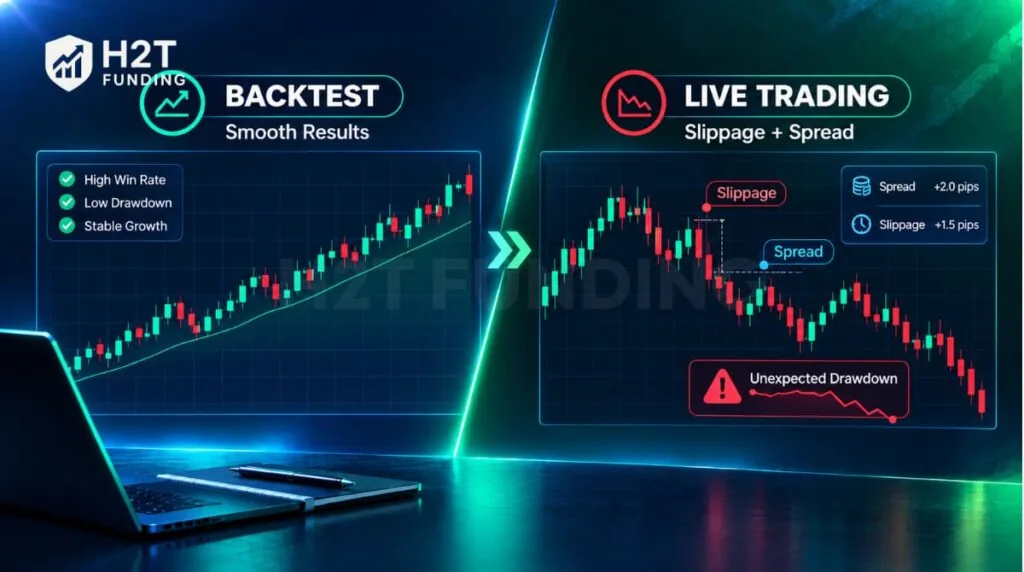
A flawless historical backtest rarely guarantees live profitability because developers frequently overfit their algorithms to past market data. Overfitting, or curve-fitting, occurs when a coder manipulates an EA’s parameters specifically to win previous trades.
While the bot looks mathematically perfect on a simulation from 2024, it lacks the flexibility to survive a shifted market cycle in 2026. A curve-fitted EA will aggressively execute losing trades in a new macroeconomic environment because its rigid code cannot recognize that the market context has changed.
4.2. Slippage, spread, and why ‘set and forget’ is a myth
The “set and forget” strategy is a dangerous myth because live transaction costs, network latency, and daily drawdown limits require your continuous oversight. Simulated backtests execute orders with zero slippage and fixed spreads, creating an illusion of guaranteed profit.
In a live environment, a sudden spread widening during a session rollover can trigger your stop-loss, causing a loss the backtest never predicted. Furthermore, an unsupervised EA can execute a rapid string of losing trades during a choppy, ranging market.
This automated losing streak can instantly breach your prop firm’s strict daily loss limit before you even check your monitor. You must actively track and adjust your bot’s risk parameters to survive live trading conditions.
5. Is EA Trading Profitable?
EA trading can be profitable, but your net return depends entirely on your specific strategy, strict risk management, and live transaction costs. Despite vendor claims of near-perfect win rates, there are no independent, aggregated statistics to confirm the overall success rate of automated retail trading.
A bot’s profitability fluctuates constantly with market cycles. An algorithm that secures high returns during a strong trending market will frequently incur deep drawdowns during a ranging phase. You must ignore vendor win rates because they are almost exclusively based on optimized historical backtests rather than live, forward-tested market data.
Consequently, long-term profitability requires human intervention to monitor and adjust the code based on current macroeconomic conditions. You cannot buy a retail EA, attach it to a chart, and expect it to generate consistent monthly payouts without active technical oversight.
6. How to Spot a Trading Bot Scam
While legitimate algorithmic trading exists, the retail market is saturated with fraudulent software vendors. The Commodity Futures Trading Commission (CFTC) frequently issues fraud advisories specifically targeting automated forex and commodity trading systems sold on the internet.
You must understand that not every EA is a scam, but you should instantly avoid any vendor that displays the following five warning signs:
- Guaranteed returns: Financial markets are inherently unpredictable. Any vendor promising a fixed daily or monthly profit percentage is displaying a major warning sign of potential fraud.
- Loss insurance: The CFTC charged the ROFX platform (Press Release 8486-22) in a $58 million fraud case that falsely advertised an automated trading robot with a “guarantee of no losses” to lure investors. Legitimate software cannot insure against market risk.
- Hypothetical backtests only: Scammers frequently sell bots based entirely on flawless historical simulations. Backtests only prove the code worked in the past, not that it can survive current live conditions.
- No verified live account: If a vendor cannot provide a third-party verified live trading link demonstrating months of actual performance, they do not trust their own software. In CFTC Press Release 7469-16, the commission prosecuted a vendor selling a “robot” system who never actually traded live with the advertised product.
- Mandatory system or broker bundles: Questionable vendors often force you to buy their robot while simultaneously requiring you to deposit funds into a specific, unregulated offshore broker. This structure exposes your capital to extreme counterparty risk and is a common warning sign of a deposit scam.
7. Manual vs EA Trading on a Prop Firm Challenge
Passing an evaluation relies on understanding that prop firms dictate your trading method, overriding any personal preference. You cannot simply connect a retail bot to a challenge account. You must verify exactly what your chosen firm permits before starting.
7.1. Which prop firm rules decide your method
Before purchasing an evaluation, check the firm’s Help Center. You must verify if they restrict automation based on account size, platform, or software ownership.
Always check the respective firm’s Help Center before buying, as policies change frequently.
| Firm Rule & Restriction | Who It Affects | Help Center Link | Status |
|---|---|---|---|
| FundedNext: Permits EAs on MT4/MT5 for accounts under $50,000 (with an add-on fee). Accounts $50,000 and above require strict manual trading. Total ban on EAs for cTrader and Match-Trader platforms. | Traders targeting large capital allocations or those avoiding MetaTrader platforms. | FundedNext Help Center | As of October 2026 |
| FundingPips: Third-party EAs are strictly limited to trade or risk management functions. Full automation requires a personal EA with verifiable proof of ownership. | Traders attempting to pass using off-the-shelf commercial bots. | FundingPips Help Center | As of October 2026 |
| FTMO: Permits all trading styles, including EAs. However, utilizing a popular third-party EA risks account rejection if that specific strategy exceeds the firm’s maximum capital allocation limit. | Traders utilizing mass-market bots shared among thousands of users. | FTMO Help Center | As of October 2026 |
7.2. What an EA changes, and what it does not
An EA changes how you enter and exit the market, but it does not alter the core evaluation parameters. Your algorithm remains completely bound by the firm’s daily loss limit, maximum drawdown, and minimum trading days.
Note: The following numbers are illustrative, not any firm’s actual rule.
If a firm enforces a strict 5% daily loss limit, an automated grid bot executing 10 rapid losing trades risking 0.6% each will instantly fail your challenge. The bot’s coding cannot bypass a firm’s hard limits.
Furthermore, if a firm enforces a consistency rule (for example, a 30% to 40% daily profit cap), a bot generating one massive winning trade followed by tiny automated scalps will still result in a payout denial.
7.3. VPS, VPN, and add-on fees: where guides and firm rules conflict
General retail trading guides frequently advise purchasing a Virtual Private Server (VPS) for zero-latency execution. However, this advice severely conflicts with specific prop firm security protocols.
Prop firms actively monitor IP addresses to detect prohibited account management services. You must distinguish between a VPN (used for location-masking) and a VPS (a remote server used for hosting EAs). Many firms strictly restrict logging into your account via VPNs to prevent IP spoofing, and some actively ban unauthorized VPS connections. Logging in through a prohibited server triggers an automatic security breach.
Conversely, firms that permit automation often monetize it. Some programs require you to purchase specific “EA add-ons” during checkout. These add-on fees are generally non-refundable even if you never activate the bot, so you must confirm your technical setup beforehand.
8. Hybrid Trading: Manual Entries with EA Management
Hybrid trading combines human market context with algorithmic precision. You rely on human intuition to read price action and manually enter the trade, but you utilize a specialized EA to manage the risk parameters.
Instead of executing orders blindly, a trade management EA automatically calculates your exact lot size based on your current account balance. Once you physically click buy, the software instantly sets your stop-loss and take-profit targets.
However, you must read firm rules carefully before using these management tools. For example, FundedNext strictly classifies any software that automatically modifies a stop-loss, take-profit, or lot size as a full Expert Advisor.
If you use a simple risk manager on a $100,000 account restricted to manual trading, you will instantly trigger a severe rule violation. Depending on the firm’s strictness, this can result in an automated warning, the immediate auto-closure of your open positions, or a permanent account termination. You must always confirm exactly how your specific prop firm defines “automation” before attaching any script to your charts. You must always confirm exactly how your specific prop firm defines “automation.”
9. Manual or EA: Which Should You Choose?
Choosing between manual execution and automated algorithms depends entirely on your experience level and daily schedule. You must align your technical skills with the reality of live market environments.
9.1. Beginner, intermediate, and time-limited traders
If you are a beginner trader, you must trade manually. Relying on an algorithm before understanding basic price action creates a dangerous dependency and hides fundamental market mechanics.
Intermediate traders should explore hybrid systems. You can manually identify high-probability setups, but utilize a trade manager EA to enforce strict mathematical discipline on your position sizing and stop-losses.
If you are a time-limited trader with a demanding full-time job, a fully automated EA is practical. However, you must possess the technical competence to manage a VPS and continuously monitor the bot’s daily risk parameters.
If you are a time-limited trader with a demanding full-time job, a fully automated EA can reduce your active screen time during market hours. However, because “set and forget” is a myth, you must still allocate specific times daily to review the bot’s risk parameters. Furthermore, you can only pursue this route if your prop firm permits full automation on your specific account size and explicitly allows the necessary infrastructure, such as an authorized VPS.
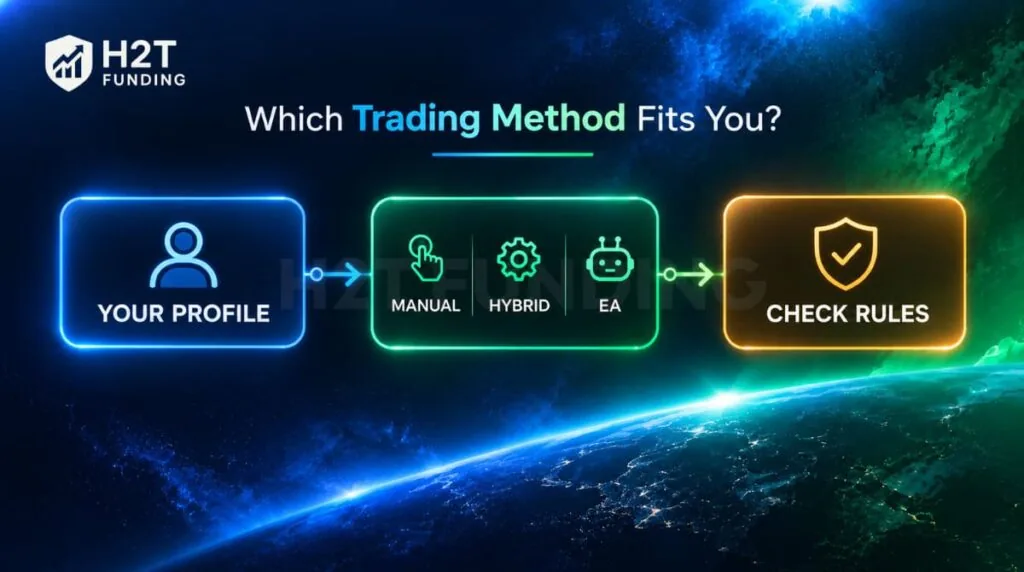
9.2. Decision flow: your profile, then the firm’s EA rule
You must lock in your trading strategy before you purchase a prop firm challenge. Do not buy an evaluation first and then attempt to force an incompatible bot into a firm’s restrictive rules.
Always define your personal profile, select your required software, and then filter the prop firms that explicitly allow your chosen method.
10. How to Choose a Prop Firm That Fits Your Trading Method
Once you lock in your strategy, you must evaluate firms based on three strict criteria: EA rules, platform availability, and maximum account size. Failing to align your algorithm with these specific parameters will result in an immediate evaluation failure.
Rather than guessing which program accepts your bot, you should compare the best prop firms directly. A side-by-side comparison reveals which companies force you onto unsupported web platforms or heavily restrict maximum capital for automated traders.
For example, traders seeking a more accommodating environment for algorithmic strategies on large accounts often consult our FTMO evaluation review, while remaining mindful of their capital allocation limits.
Conversely, if you specifically require a MetaTrader platform for your script, our FundedNext breakdown explains exactly how to navigate their EA add-on fees and capital limits.
11. FAQs: Manual Trading vs EA/Bot
-
Neither method is objectively superior. EA trading provides instantaneous execution and eliminates human emotion, while manual trading offers superior adaptability to news and sudden market shifts. Your choice depends entirely on your available screen time and technical software skills.
-
It can be profitable, but there are no guaranteed returns. Your net profit depends strictly on your live transaction costs, hard risk parameters, and your ability to continuously adjust the algorithm for shifting macroeconomic cycles.
-
An Expert Advisor (EA) is a coded software algorithm that automatically executes trades on platforms like MetaTrader 4 or MetaTrader 5. It uses pre-programmed mathematical rules to determine exact entry points, position sizing, and stop-loss targets without human intervention.
-
Yes, but it is heavily restricted. Firms like FTMO allow them broadly, while others like FundedNext strictly ban them on large account sizes or specific platforms like cTrader. You must read the firm’s specific Help Center rules before purchasing an evaluation.
-
Beginners should avoid fully automated trading. Relying on an algorithm before you understand basic price action creates a dangerous dependency and prevents you from learning fundamental market mechanics.
-
Yes, the “set and forget” bot is a dangerous myth. You must continuously monitor your software to pause it during major macroeconomic news and prevent automated losing streaks from breaching your daily loss limits.
-
While the act of algorithmic trading is generally permitted in most jurisdictions, the retail vendor market is saturated with fraudulent schemes that falsely label basic EAs as advanced “AI.” The CFTC frequently warns against vendors promising guaranteed daily profits or selling unverified bots. You should always verify the legal status of algorithmic trading in your specific country before purchasing any software.
-
In a prop firm challenge, the firm supplies the platform and broker, so the firm’s specific EA rules decide what you can run (see the restrictions for FundedNext, FundingPips, and FTMO above). If you trade your own personal account instead, always check your broker’s terms, because some brokers heavily restrict high-frequency trading (HFT) or latency-arbitrage strategies.
12. Conclusion
Deciding between manual trading and EA trading is not about finding an effortless shortcut to profits. While an algorithm provides unmatched execution speed and emotional detachment, manual execution preserves your critical ability to navigate unexpected market shifts and high-impact news events.
For anyone tackling a prop firm challenge, the firm’s strict drawdown rules will always dictate your ultimate results. Before purchasing an evaluation, you should consult the firm rules with the date H2T Funding checked them, platform restrictions, and capital allocation limits.
Long-term survival on funded accounts requires mastering your risk parameters and testing your strategies under live market conditions. For detailed tutorials on managing drawdowns, building custom algorithms, and navigating news volatility, visit our dedicated Trading Guides & Strategies section.
Disclaimer: Trading forex, CFDs, and futures involves substantial risk of loss and is not suitable for every investor. The high degree of leverage can work against you as well as for you. Past performance of any manual system or Expert Advisor (EA), whether live or backtested, does not guarantee future results.The content on this website is published solely for informational and educational purposes and does not constitute financial, investment, legal, or trading advice. You should carefully consider your investment objectives, level of experience, and risk appetite before participating in any evaluation or live trading environment. Only risk capital you can afford to lose.