



Daily drawdown is the maximum amount a trader can lose within a single trading day before violating a prop firm’s risk limit. The exact calculation varies by firm and may depend on balance, equity, floating P&L, commissions, swaps, and the daily reset time.
H2T Funding often see traders breach this rule because they assume daily drawdown works the same way at every firm. It doesn’t.
This guide explains how daily drawdown works, how to calculate it, when it resets, and how the rule varies across prop firms, so you can understand your remaining loss limit before you trade.
Key Takeaways:
- No universal formula: Daily drawdown varies by prop firm. Check the reference value, monitored value, and reset method rather than relying only on the advertised percentage.
- The reset matters: The daily loss threshold can change when the trading day resets, especially when you hold positions overnight.
- Daily drawdown ≠ maximum drawdown: Staying within the daily loss limit does not mean you are safe from the account’s overall loss limit.
- Account types can differ: Even the same firm can use different daily loss percentages and calculation methods. For example, FTMO 2-Step uses 5%, while FTMO 1-Step uses 3%.
Important:
To make this guide practical, we reviewed the published drawdown rules for 12 selected prop-firm programs across seven firms. We also checked two programs marketed without a separate daily loss limit.
For each program, we recorded four variables: the advertised daily drawdown percentage, reference value, monitored account metric, and reset time or method. This allows us to compare not just the headline percentage, but how the daily loss limit actually works in practice.
This is a focused sample, not a comprehensive database of the prop-firm market. Because firms can change their rules, always verify the official program page before trading.
1. What Is Daily Drawdown?
Daily drawdown, also called the daily loss limit or maximum daily loss, is the maximum amount a trader can lose within a single trading day before breaching a prop firm’s risk rule. It limits how far your balance or equity can fall from the firm’s defined reference point.
Losing money is not the same as breaching the limit. A trader can have a losing day and still remain within the rule. A breach occurs only when the loss reaches the firm’s specified threshold, after which the account may be disqualified or closed.
Prop firms use daily drawdown to limit losses within a single trading day. Because the reference point, calculation method, and loss threshold can vary between firms, traders need to know their exact daily loss limit before trading.
2. How Does Daily Drawdown Work?
Daily drawdown is usually defined by a loss threshold that applies during a specific trading day. The exact threshold depends on how the prop firm determines its reference value, whether it uses balance, equity, or both, and when the daily calculation resets.
This matters because two firms can advertise the same daily drawdown percentage but use different calculation methods. An equity-based rule, for example, may count floating losses from open positions, while a balance-based rule may treat them differently.
Before trading, check four things: the daily loss percentage, the reference value, whether floating P&L counts, and the daily reset time.
3. How Is Daily Drawdown Calculated?
There is no single formula for daily drawdown across all prop firms. However, two common approaches are a fixed reference method and a start-of-day balance or equity method.
The key difference is the value used to set the daily loss threshold. Some firms keep the reference tied to the initial account balance, while others determine the reference at the start of each trading day based on the account’s balance or equity.
3.1. Fixed Reference: Based on the Initial Balance
Under this method, the daily loss amount is calculated from a fixed reference value, usually the initial account balance. The firm may then monitor balance or equity against the resulting threshold, depending on its rules.
For example, assume a $100,000 account has a 5% daily loss limit:
$100,000 × 5% = $5,000
The daily loss allowance is $5,000. If the firm’s rules monitor equity, the account must stay above the applicable $95,000 threshold.
If the account grows to $105,000, the daily loss allowance remains $5,000 because it is still based on the original $100,000 balance.
This gives traders a fixed dollar loss allowance, making the daily limit easier to track as the account grows.
3.2. Balance or Equity-Based: Based on the Start of the Day
Under this approach, the daily drawdown reference is determined from the balance or equity recorded at the start of the trading day, according to the firm’s rules.
Some firms use the higher of the starting balance or equity as the reference. In this case, whether the two values are the same or different can affect the following day’s threshold.
3.2.1. When Balance and Equity Are the Same
If balance and equity are equal, there is no floating P&L from open positions affecting the account at the reset.
For example, on a $100,000 account with a 5% daily loss limit:
- Balance: $100,000
- Equity: $100,000
- Reference value: $100,000
$100,000 × 5% = $5,000
The daily drawdown threshold is therefore $95,000.
3.2.2. When Balance and Equity Are Different
Balance and equity can differ when you carry an open position into the next trading day.
If equity is higher than balance, the higher equity value becomes the reference under this method.
For example:
- Balance: $100,000
- Equity: $105,000
- Daily loss limit: 5%
- Reference value: $105,000
$105,000 × 5% = $5,250
The daily drawdown threshold becomes $99,750.
If balance is higher than equity, the balance becomes the reference instead. For example, with a $100,000 balance and $98,000 equity, the reference remains $100,000, producing a $95,000 threshold.
| Starting Condition | Balance | Equity | Reference | 5% Daily Threshold |
|---|---|---|---|---|
| Balance = Equity | $100,000 | $100,000 | $100,000 | $95,000 |
| Equity > Balance | $100,000 | $105,000 | $105,000 | $99,750 |
| Balance > Equity | $100,000 | $98,000 | $100,000 | $95,000 |
This is why floating P&L matters when a firm’s rules use equity or the higher of balance and equity at the daily reset. A profitable open position can raise the reference value, while a floating loss can leave the balance as the applicable reference.
Important: Not every prop firm uses the higher of balance or equity. Some use the initial balance or another firm-defined reference. Two firms can advertise the same 5% daily loss limit but produce different thresholds. Always check the specific account’s rules before trading.
4. When Does Daily Drawdown Reset?
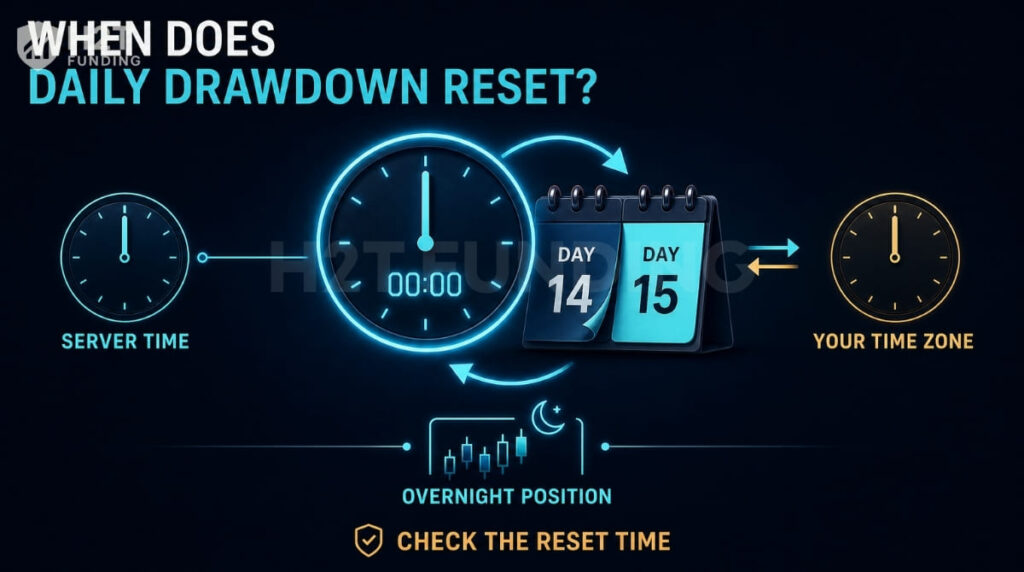
Most prop firms reset their daily drawdown calculation at a specific time each trading day, but the exact reset time varies by program. A “midnight reset” does not necessarily mean midnight in your local time. It usually refers to the firm’s server time or designated time zone.
4.1. Why Does the Reset Time Matter?
The reset time is especially important if you hold positions overnight. A position that remains open when the new trading day begins may still have an impact on your available loss room, depending on the firm’s rules.
The key things traders should check are:
- Reset time – when the firm’s new trading day begins
- Time zone – which clock the firm uses for the reset
- Open positions – whether floating P&L at the reset affects the new day’s calculation
For example, if a firm resets its daily drawdown at 00:00 CE(S)T, a trader in another time zone needs to convert that time to their local clock. This is particularly important when holding positions across the reset, as the daily loss calculation may change when the new trading day begins.
Our tip: Convert the firm’s official reset time to your own time zone and keep it visible while trading. This is especially useful for swing traders and anyone holding positions overnight.
5. Daily Drawdown vs. Maximum Drawdown
Daily drawdown and maximum drawdown are separate risk limits. Daily drawdown controls how much an account can lose within a single trading day, while maximum drawdown limits how far the account can fall over the entire challenge or funded period.
To understand the broader concept of drawdown and how it is measured, see our guide to what is drawdown in trading.
| Rule | Daily Drawdown | Maximum/Overall Drawdown |
|---|---|---|
| Scope | One trading day | Entire account duration |
| Reset | Recalculated according to the firm’s daily reset schedule | Usually does not reset |
| Purpose | Limits losses within a single trading day | Limits total account losses |
| Reference | Firm-specific daily reference value | Firm-specific overall drawdown level |
| Breach | Daily loss limit is exceeded | Overall loss limit is exceeded |
The two rules can apply at the same time. Staying below your daily drawdown limit does not mean your account is safe from the maximum drawdown rule.
For example, suppose a $100,000 account has a 5% daily drawdown limit and a 10% maximum drawdown limit. A trader could lose $3,000 on Monday, $3,000 on Tuesday, and $3,000 on Wednesday without exceeding the $5,000 daily limit on any single day. However, the account would be down $9,000 overall, leaving only $1,000 before reaching the $10,000 maximum drawdown limit.
This is why traders should track both remaining daily loss room and overall drawdown room. A daily loss limit resets according to the firm’s schedule, but losses that remain within that daily limit can still accumulate toward the account’s maximum drawdown.
6. Pros and Cons of Daily Drawdown
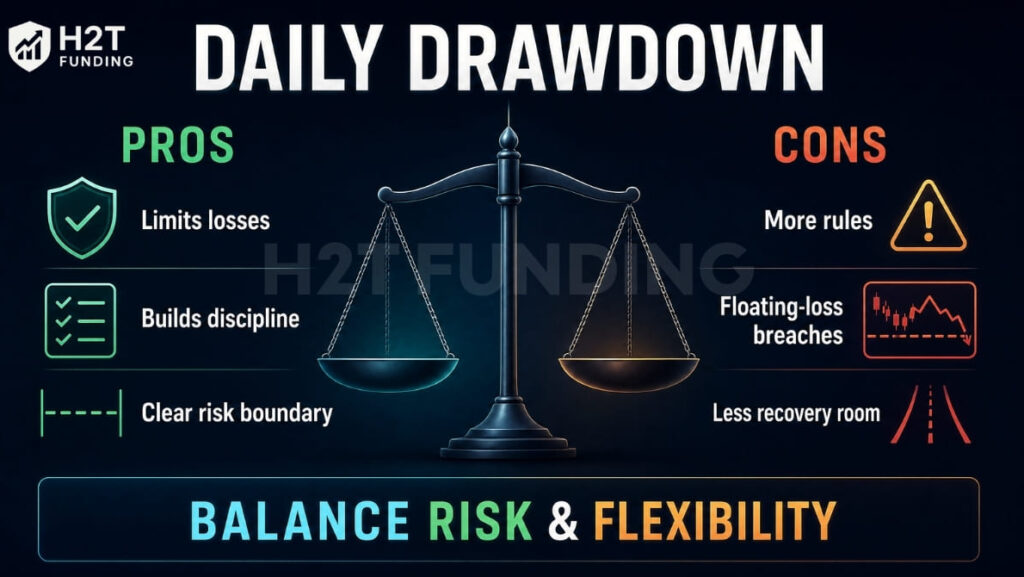
Daily drawdown gives prop firms a way to control short-term risk, but it also creates a trading constraint that can affect how traders manage positions. Understanding both sides helps you choose an account whose rules fit your trading style.
| Pros | Cons |
|---|---|
| Limits daily losses: Prevents a single trading session from causing excessive damage to the account. | Adds another rule to monitor: Traders must track both daily and overall drawdown limits. |
| Encourages risk management: A daily loss cap can discourage oversized positions and revenge trading. | Can cause unexpected breaches: Floating P&L, commissions, swaps, and the firm’s reset method may affect the available loss room. |
| Provides a clear risk boundary: Traders know the maximum loss allowed for the day under the firm’s rules. | Restricts recovery after losses: Once a trader approaches the daily limit, continuing to trade may not be practical even if good opportunities remain. |
| Helps protect trading capital: Limiting losses within each day can reduce the impact of a bad trading session. | Can affect overnight strategies: Positions held through the daily reset may interact with the firm’s calculation method. |
7. How Daily Drawdown Rules Differ Between Prop Firms
The basic concept is similar across prop firms, but the calculation method can vary significantly. The table below compares the daily drawdown percentage and reference method used by several popular programs.
Important: Always verify the current rules on the firm’s official website before trading, as prop firm conditions can change. (Last updated: August 21, 2026)
| Prop Firm / Program | Daily Drawdown | Reference / Method |
|---|---|---|
| FTMO – 2-Step | 5% | 5% of Initial Simulated Capital; the daily threshold is recalculated at 00:00 CE(S)T using the account balance at that time |
| FTMO – 1-Step | 3% | 3% of Initial Simulated Capital; the daily threshold is recalculated at 00:00 CE(S)T using the account balance at that time |
| The5ers – High Stakes | 5% | Previous-day closing balance or equity at 00:00 UTC+3 |
| Funded Trading Plus – Prestige Lite | 3% | Higher of balance or equity at 16:59 EST |
| E8 Markets – E8 One | 4% | 4% of initial balance converted to a fixed amount; Loss Level resets daily based on the new day’s starting balance |
As the comparison shows, the percentage alone does not tell the full story. The reference value and reset methodology can materially change how much room a trader has during the day.
For a detailed example, FTMO is particularly useful because its 1-Step and 2-Step programs use different daily loss mechanics.
8. FTMO Daily Drawdown Example: How the Limit Works
FTMO is a useful case study because its 2-Step and 1-Step accounts use different daily loss mechanics. The percentage alone does not tell you how much loss you can actually take during the day.
8.1. Standard FTMO Challenge (2-Step)
The Maximum Daily Loss is 5% of the Initial Simulated Capital. The daily threshold is recalculated at 00:00 CE(S)T using the account balance recorded at that time. The limit then remains in effect until the next daily recalculation.
For a $100,000 account:
- Initial Simulated Capital: $100,000
- Maximum Daily Loss Amount: 5% = $5,000
- Day 1 threshold: $100,000 − $5,000 = $95,000
If the account balance is $102,000 at the next 00:00 CE(S)T reset, the new threshold becomes:
$102,000 − $5,000 = $97,000
The important distinction is that the $5,000 daily loss amount remains tied to the initial capital, while the daily threshold can change because it is recalculated from the account balance at the reset.
8.2. FTMO Challenge: 1-Step
The Maximum Daily Loss is 3% of the Initial Simulated Capital. Like the 2-Step model, the limit is recalculated at 00:00 CE(S)T using the account balance recorded at that time.
For a $100,000 account:
- Initial Simulated Capital: $100,000
- Maximum Daily Loss Amount: 3% = $3,000
- Day 1 threshold: $100,000 − $3,000 = $97,000
If the balance reaches $102,000 at the next daily reset, the new threshold becomes:
$102,000 − $3,000 = $99,000
In both models, equity is what FTMO monitors for the breach. Equity includes the balance, open-position P&L, swaps, and commissions. Therefore, an open position can cause a Maximum Daily Loss breach even when the trade has not been closed.
If you want to see how FTMO’s rules, drawdown mechanics, pricing, and overall trading conditions work in practice, read our FTMO review.
Important: FTMO’s rules can change over time, so traders should always check the current Maximum Daily Loss conditions for the specific account type before trading.
9. How to Avoid Breaching Your Daily Drawdown Limit
Understanding the formula is only the first step. Traders also need to manage their positions so they do not unintentionally reach the firm’s daily loss threshold.
9.1. Set a personal daily loss limit below the firm’s limit
Do not treat the firm’s maximum as your personal trading target.
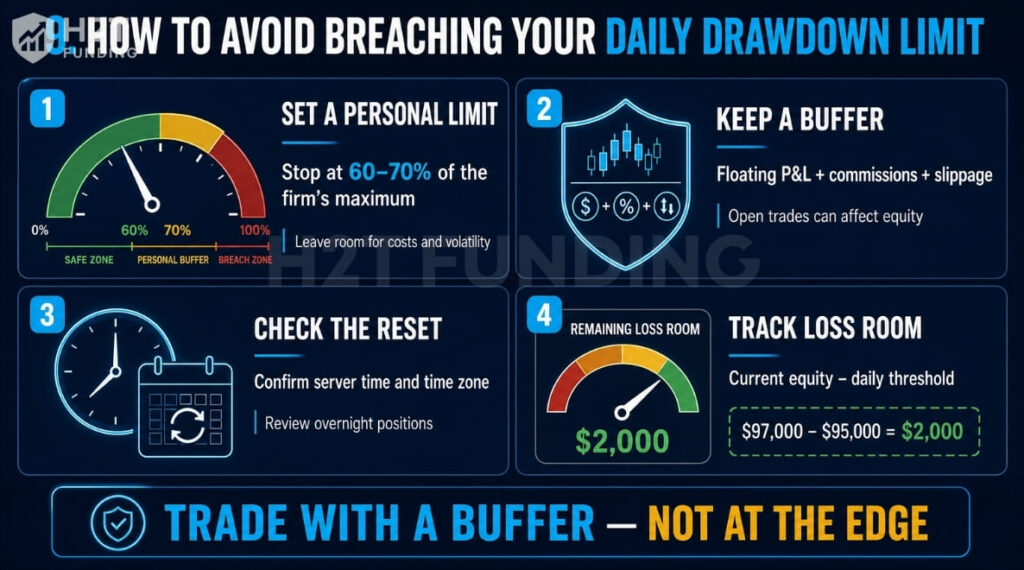
For example, if the firm allows a maximum daily loss of $5,000, you could set your own stop-trading limit at 60-70% of that amount. This gives you a buffer for:
- Spread costs
- Commissions
- Slippage
- Floating losses
- Unexpected market volatility
A personal loss limit can also help prevent revenge trading after a losing position.
9.2. Leave a buffer for floating losses and trading costs
If the firm’s calculation is equity-based, open positions matter even when they have not been closed.
For example, a trader with a $5,000 daily loss allowance should not assume that exactly $5,000 of closed losses is always safe. A remaining open position with floating losses, combined with commissions or other trading costs, can push equity below the firm’s threshold.
Keep enough room between your current equity and the firm’s daily loss limit.
9.3. Check the reset time before holding positions overnight
The daily reset is particularly important for traders who keep positions open overnight.
Do not assume that “midnight” means midnight in your local time. The firm may use a specific server time or time zone.
Before holding a position through the reset:
- Identify the firm’s exact reset time.
- Convert it to your local time.
- Check whether open positions affect the reset calculation.
- Confirm the applicable balance or equity reference.
A position that is within the limit before the reset may interact differently with the new day’s calculation.
9.4. Track your remaining daily loss room
The safest approach is to monitor the firm’s live drawdown metric rather than relying entirely on a manual calculation.
Conceptually:
Remaining loss room = Current equity − Applicable daily loss threshold
For example, if the applicable threshold is $95,000 and current equity is $97,000:
$97,000 − $95,000 = $2,000 remaining loss room
The exact calculation and displayed metric depend on the prop firm’s rules and platform.
10. Prop Firms With No Daily Drawdown
Not every prop firm or program uses a separate daily drawdown or daily loss limit. Some programs remove the daily cap and instead manage account risk through other drawdown rules.
For example, MyFundedFutures Rapid has no Daily Loss Limit in either the evaluation or funded stage. The program instead uses an EOD drawdown as its main loss constraint.
E8 Zero is another example. E8’s official product comparison lists no daily limit for E8 Zero. The program instead uses an EOD Dynamic Drawdown, which is based on the highest end-of-day balance and can later become static under its rules.
However, no daily drawdown does not mean no risk limit. These programs can still have other account rules, such as maximum or trailing drawdown, position restrictions, consistency requirements, or payout conditions.
The key takeaway is simple: removing the daily loss limit removes one type of breach, not the account’s overall risk controls. A trader can avoid a separate daily-loss breach and still lose the account by reaching its applicable drawdown threshold.
If you’re comparing prop firm programs with different drawdown structures, our guide to the best one-step prop firms provides additional options to consider.
11. Frequently Asked Questions
What happens if I breach the daily drawdown limit?
The account is typically considered in breach and may be closed or disqualified, depending on the firm’s rules. Some firms may offer resets or other options, while others permanently close the account. Always check the specific program’s breach policy before trading.
Does daily drawdown include open (floating) trades?
It depends on the firm. Equity-based rules, like FTMO’s, include floating P&L on open positions. Balance-based rules only count closed results until you exit the trade.
Can I recover from a daily drawdown breach?
Once the specific day’s limit is breached, that breach is generally final for the account – even if the market moves back in your favor later the same day. This is different from a losing day that stays within the limit, which resets normally.
Is daily drawdown the same at every prop firm?
No. The reference value, monitoring value, treatment of floating P&L and trading costs, reset time, and loss percentage can all differ – even between account types at the same firm, as shown in the FTMO example above.
Does daily drawdown reset if I don’t trade?
Yes, in most cases. The reset is time-based, not activity-based – it applies whether or not you placed a trade that day. Confirm this with your specific firm, since methodology can vary.
What’s a safe daily loss limit to set for myself?
There’s no universal number, but many traders cap themselves well below the firm’s maximum – for example, stopping after using 50-70% of the daily allowance – to leave room for costs, slippage, and one unplanned losing trade.
12. Conclusion
Now that you understand what daily drawdown is, how it’s calculated, and why the rule changes from firm to firm, you’re in a better position to read a prop firm’s rulebook accurately instead of assuming a percentage tells you everything.
At H2T Funding, we’re committed to helping traders make informed decisions with practical education and unbiased market insights. To continue learning, explore our Trading Guides & Strategies for more in-depth articles on trading strategies, prop firms, and risk management – or check our Best Prop Firms list and our All Prop Firms Review to see how daily drawdown rules apply in practice before you choose an account.