


My Funded Futures no longer runs a profit-based scaling system on any active plan. Builder, Rapid, Rapid EOD, and Pro each lock in one fixed contract limit per account size from your first funded trade onward. The plan that used to scale, Flex, was pulled from sale on August 5, 2026. The exact limit still depends on your plan and account size.
This H2T Funding guide breaks down every contract limit across Builder, Rapid, Rapid EOD, and Pro, covers what changed with Flex, and shows what happens if you exceed your limit.
Key takeaways
- Flex was discontinued on August 5, 2026. It was the only MFFU plan where contract limits stepped up with profit; no current plan does this anymore. Builder, Rapid, Rapid EOD, and Pro all use one fixed max contract size per account size, set the moment you’re funded.
- Scaling only applies after Sim-Funded, not during evaluation. Contract limits at My Funded Futures (MFFU) evaluation stage are fixed and identical for every trader on a plan.
- My Funded Futures and “Funded Futures Family” are two separate firms. Google search results often mix them together, so double-check the domain before trusting any scaling data.
- Mixing minis and micros beyond your limit is a breach, even if the order fills. MFFU calls this Cross-Instrument Policy.
- Rapid Plan contract limits differ from several third-party listings. Based on current help center data, Rapid 100K allows 8 minis / 80 micros, and Rapid 150K allows 10 minis / 100 micros, lower than some outdated comparison sites report.
- Rapid EOD is a new, limited-time plan. Launched at $50,000 only, it holds a fixed 3 mini / 30 micro cap and keeps end-of-day trailing drawdown through both evaluation and Sim-Funded stages, unlike standard Rapid, which switches to intraday trailing once funded.
- Brand confusion warning: My Funded Futures (MFFU) is a completely separate company from “Funded Futures Family.” Ensure you are applying these rules to the correct firm.
1. How does the scaling rule work at My Funded Futures?
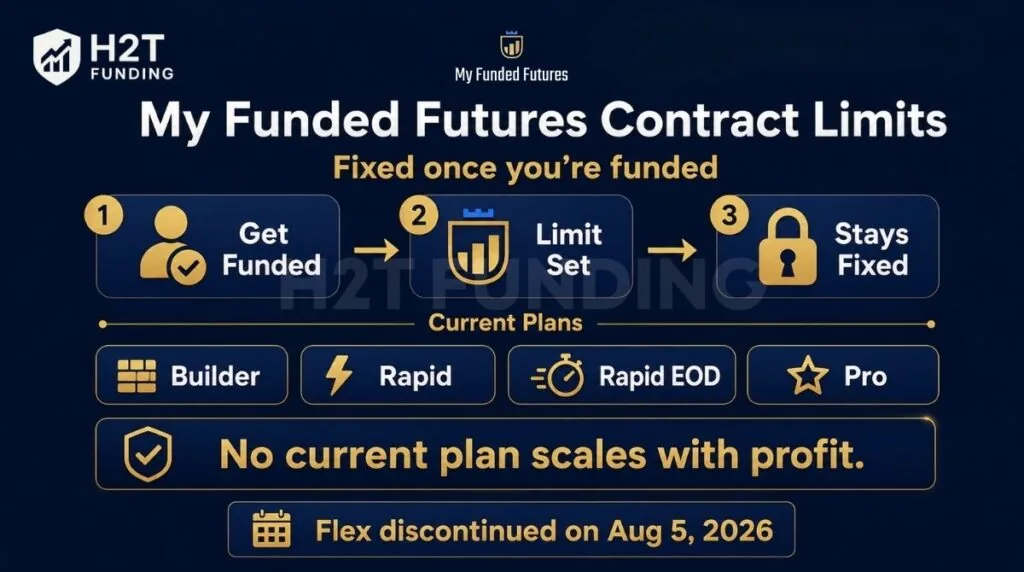
At My Funded Futures, your contract limit is set the moment you’re funded, and on every current plan, it stays fixed from that point on. Builder, Rapid, Rapid EOD, and Pro all follow this model. The plan that once scaled with profit, Flex, was discontinued on August 5, 2026.
Evaluation vs. Sim-Funded Stage
- Evaluation Stage: There is no profit-based scaling while you are taking the test. You are given a fixed contract cap (e.g., 5 mins) from day one, which remains static whether your profit is $0 or $2,900.
- Sim-Funded Stage: Once funded, your contract limit locks in immediately. Builder, Rapid, Rapid EOD, and Pro all hold this limit fixed from your first funded trade onward. No current plan adjusts contract size based on account balance.
How Flex Used to Scale (Discontinued)
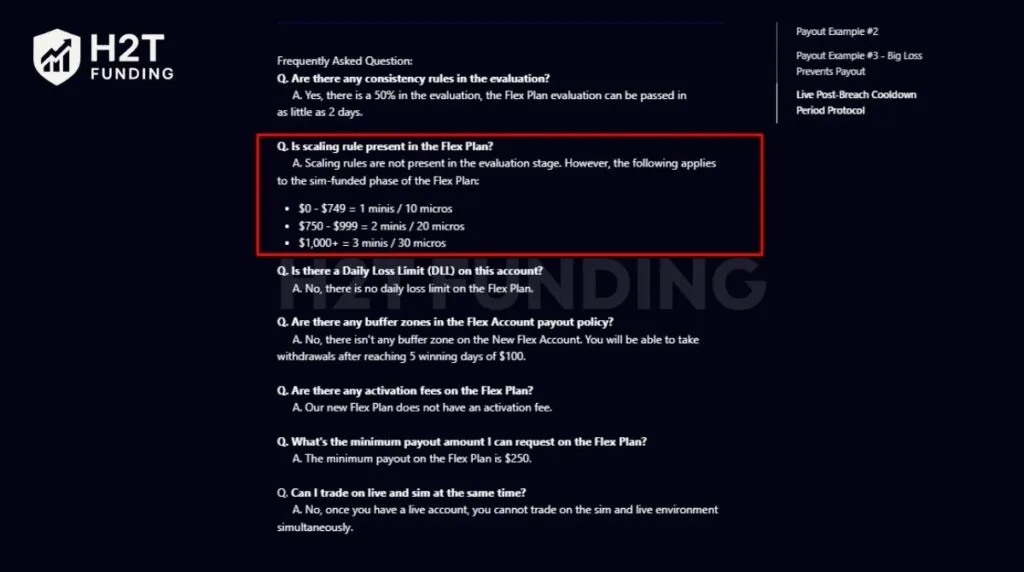
Before August 5, 2026, Flex was MFFU’s only balance-based scaling plan. Lower balance tiers carried a smaller contract cap, such as 1 mini or 10 micros at the lowest bracket. Higher balance tiers unlocked a larger cap automatically, up to 2 to 3 minis or 20 to 30 micros. This mechanism no longer applies to any current MFFU plan; full details on Flex’s last published rules sit in Section 2.5 below.
Ultimately, MFFU’s current model favors simplicity over gradual scaling. Every active plan, Builder, Rapid, Rapid EOD, and Pro, gives you one fixed limit from your first funded trade. The unified comparison table below breaks down these exact numbers.
2. Contract limit comparison: Max contracts by plan and account size
Contract limits range from 2 minis on a $25K Builder account up to 15 minis on a $150K Pro account. The unified table below breaks down the exact Sim-Funded limit for every current plan and account size.
| Account Size | Builder (Sim-Funded) | Rapid (Sim-Funded) | Rapid EOD (Sim-Funded) | Pro (Sim-Funded) |
|---|---|---|---|---|
| $25,000 | 2 minis / 20 micros | 3 minis / 30 micros | Not offered | Not offered |
| $50,000 | 4 minis / 40 micros | 5 minis / 50 micros | 3 minis / 30 micros | 5 minis / 5 micros* |
| $100,000 | Not offered | 8 minis / 80 micros | Not offered | 10 minis / 10 micros* |
| $150,000 | Not offered | 10 minis / 100 micros | Not offered | 15 minis / 15 micros* |
*Pro Plan lists its micro contract allowance at the same number as its mini allowance (for example, 5 minis / 5 micros on the $50K account), unlike every other plan, where the micro count is roughly ten times the mini count. This matches the current official help center table, so treat it as intentional rather than a typo.
Builder is only sold at $25K and $50K. Rapid covers all four account sizes. Rapid EOD is a limited-time offer at $50K only. Pro starts at $50K and goes up to $150K, with no $25K option.
Evaluation stage: Max contracts by plan and account size
| Account Size | Builder (Evaluation) | Rapid (Evaluation) | Rapid EOD (Evaluation) | Pro (Evaluation) |
|---|---|---|---|---|
| $25,000 | 2 minis / 20 micros | 3 minis / 30 micros | Not offered | Not offered |
| $50,000 | 4 minis / 40 micros | 5 minis / 50 micros | 3 minis / 30 micros | Not published* |
| $100,000 | Not offered | 8 minis / 80 micros | Not offered | Not published* |
| $150,000 | Not offered | 10 minis / 100 micros | Not offered | Not published* |
*MFFU’s official Pro Plan documentation, both the help center and the plans page, confirms no profit-based scaling applies during evaluation but does not publish a specific mini/micro figure for this stage. Confirm with support before trading.
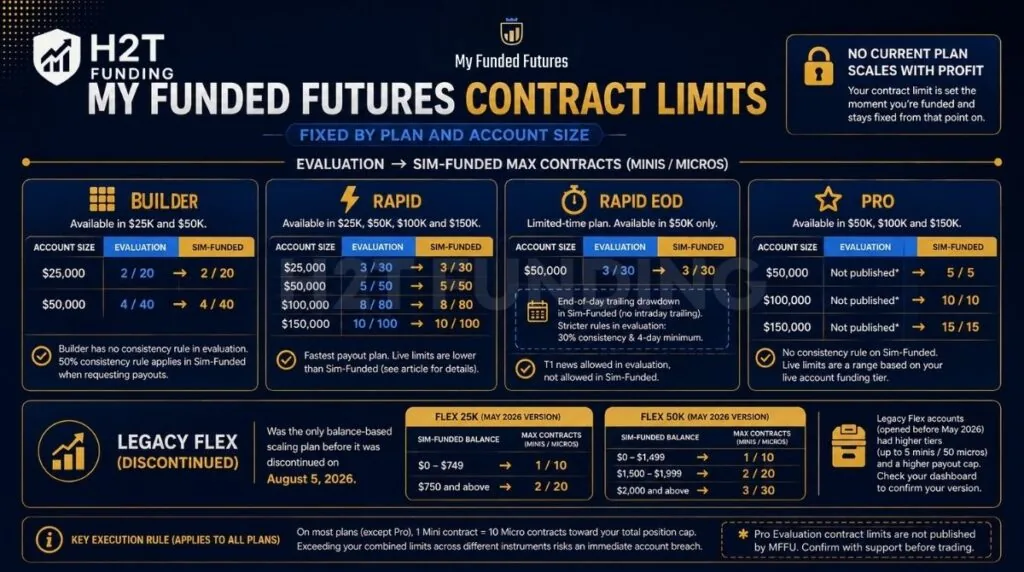
While the two tables above give a quick overview, each MFFU plan handles contract limits slightly differently across evaluation, Sim-Funded, and Live stages. Here is the detailed breakdown for Builder, Rapid, Rapid EOD, and Pro, followed by what to know if you’re on a legacy Flex account.
2.1. Builder plan
Builder is a fixed-limit plan available at $25K and $50K, with a default and lower-cost Add-On option at $50K (the Add-On has a smaller drawdown cushion, not a different contract limit).
| Account | Evaluation Max Contracts | Sim-Funded Max Contracts |
|---|---|---|
| Builder 25K | 2 minis / 20 micros | 2 minis / 20 micros |
| Builder 50K | 4 minis / 40 micros | 4 minis / 40 micros |
MFFU’s official Builder guides don’t publish a specific Live mini/micro table; Live parameters focus on drawdown and payout cadence instead. Confirm exact Live contract sizing with support before trading.
Builder has no consistency rule during evaluation, but a 50% consistency rule applies once you start requesting Sim-Funded payouts. The number of active Sim-Funded accounts allowed varies by size: one per user on Builder 50K, up to two on Builder 25K.
2.2. Rapid plan
Rapid is MFFU’s fastest payout plan, available across all four account sizes, with a fixed Sim-Funded contract limit and a separate, lower limit once you transition to a live account.
| Account | Evaluation Max Contracts | Sim-Funded Max Contracts | Live Max Contracts |
|---|---|---|---|
| Rapid 25K | 3 minis / 30 micros | 3 minis / 30 micros | 2 minis / 20 micros |
| Rapid 50K | 5 minis / 50 micros | 5 minis / 50 micros | 4 minis / 40 micros |
| Rapid 100K | 8 minis / 80 micros | 8 minis / 80 micros | 6 minis / 60 micros |
| Rapid 150K | 10 minis / 100 micros | 10 minis / 100 micros | 8 minis / 80 micros |
Note that Rapid’s live contract limit is lower than its Sim-Funded limit at every account size. Several third-party comparison sites list higher Rapid contract figures for the 100K and 150K accounts; the numbers above reflect MFFU’s current official help center data.
2.3. Rapid EOD plan
Rapid EOD is a limited-time $50,000 plan built for traders who want Rapid’s daily payout structure without the intraday trailing drawdown. It carries one fixed contract limit across both evaluation and Sim-Funded stages.
| Stage | Max Contracts |
|---|---|
| Evaluation | 3 minis / 30 micros |
| Sim-Funded | 3 minis / 30 micros |
Unlike standard Rapid, Rapid EOD keeps end-of-day trailing drawdown through the Sim-Funded stage instead of switching to intraday trailing. The evaluation carries a 30% consistency rule and a four-day minimum, both stricter than standard Rapid’s 50% rule and two-day minimum.
T1 news trading is allowed during evaluation but not during Sim-Funded. Live transition on Rapid EOD 50K follows the same rules as standard Rapid 50K, including the same Live limit of 4 minis / 40 micros. Because Rapid EOD is a limited-time offer, confirm it’s still on sale at checkout before planning around it.
2.4. Pro plan
Pro targets experienced traders with larger accounts, no daily loss limit, and a fixed Sim-Funded contract allowance that does not scale with profit.
| Account | Sim-Funded Max Contracts | Live Max Contracts Range |
|---|---|---|
| Pro 50K | 5 minis / 5 micros | 2 to 4 |
| Pro 100K | 10 minis / 10 micros | 3 to 5 |
| Pro 150K | 15 minis / 15 micros | 4 to 6 |
Pro’s live contract range widens or narrows based on your live account funding tier, which itself depends on payout history. There is no consistency rule on Pro’s standard Sim-Funded stage (the One-Day Add-On version also removes the daily loss limit and profit target floor).
2.5. Flex plan (discontinued)
Flex was MFFU’s only balance-based scaling plan before it was discontinued on August 5, 2026. It’s no longer available for new evaluations. Traders who already hold a Flex account keep their existing terms; the figures below are for reference only. MFFU last updated Flex’s rules on May 14, 2026, lowering both the contract tiers and the payout cap from the earlier Legacy version.
Flex 25K:
| Sim-Funded Balance | Max Contracts |
|---|---|
| $0 – $749 | 1 mini / 10 micros |
| $750 and above | 2 minis / 20 micros |
Flex 50K:
| Sim-Funded Balance | Max Contracts |
|---|---|
| $0 – $1,499 | 1 mini / 10 micros |
| $1,500 – $1,999 | 2 minis / 20 micros |
| $2,000 and above | 3 minis / 30 micros |
Legacy Flex accounts (opened before the May 2026 update) run on higher tiers and a higher payout cap; for example, Legacy Flex 50K allowed up to 5 minis / 50 micros at the top tier, against 3 minis / 30 micros today. If you are unsure which version your account uses, check your account dashboard rather than relying on an older blog post.
Key execution rules across all plans
- Mini vs. Micro Equivalence: On most plans (except Pro), one Mini contract equals ten Micro contracts toward your total position cap. Exceeding your combined limits across different instruments risks an immediate account breach.
- Evaluation vs. Funded: No current plan applies profit-based scaling at any stage. Balance-based growth tiers were unique to Flex before its discontinuation and no longer apply to any active plan.
3. What happens if you exceed your contract limit?
At My Funded Futures, exceeding your contract limit results in automatic order rejections for single instruments or a strict account breach if you bypass the system using unpermitted cross-instrument combinations.
MFFU enforces these rules strictly to maintain a compliant and risk-managed trading environment.
3.1. Single instrument limit
- Auto-rejection: Orders that go over your maximum allowed contract size for a single instrument (e.g., trying to buy 6 minis on a 5-mini Rapid 50K account) are instantly rejected by the trading platform.
- No breach if blocked: Because the platform actively blocks the excess single-instrument order from filling, this mistake does not cause a rule violation or an account breach. You simply cannot enter the trade.
3.2. Cross-instrument and total limits
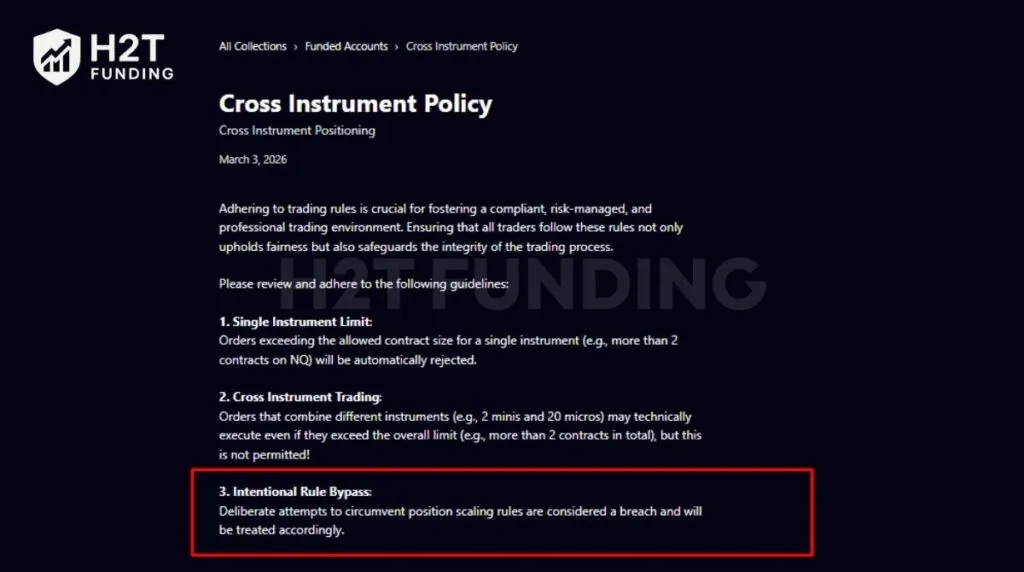
- Technical execution: Mixing different instruments can sometimes technically execute even if your total combined limit is crossed. For example, if your limit is 5 minis / 50 micros, placing 5 minis on ES and 50 micros on MES might bypass the platform’s auto-reject feature because neither order individually breaks the limit.
- Account breach: My Funded Futures strictly prohibits this practice under their Cross Instrument Policy. Combining instruments to exceed your overall position cap will lead to a direct account breach.
“Deliberate attempts to circumvent position scaling rules are considered a breach and will be treated accordingly.” – Cross Instrument Policy, My Funded Futures
3.3. Account status aftermath
Once a Sim-Funded account is breached due to a contract limit violation, the account is permanently closed, and any accumulated profits are forfeited.
To resume trading, you must purchase a new evaluation or activate a different eligible account. Furthermore, MFFU enforces activation delays for certain plans; for instance, on the Builder Plan, if an active Sim-Funded account closes, a new one may only be activated the following trading day.
If you are a trader who likes splitting sizes across correlated assets, you must manually calculate your total open exposure. Exceeding the combined equivalent limit guarantees the loss of your funded account.
4. How scaling connects to your Live Funded account
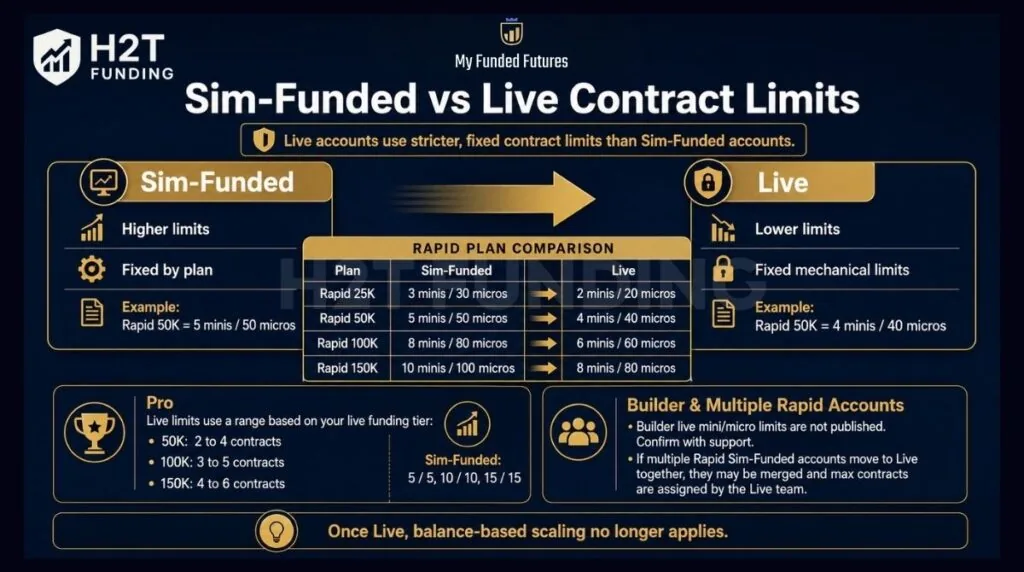
When you transition from Sim-Funded to Live, My Funded Futures replaces its Sim-Funded scaling rules with fixed live trading limits, which are typically lower and set per plan.
4.1. Simulated vs. Live contract limits
Transitioning from a Sim-Funded to a Live account fundamentally changes how your position sizes are enforced. Because you are now trading real capital, MFFU applies stricter, fixed parameters to protect the firm’s downside. Here is exactly how your contract limits shift during this transition:
- Reduced Risk Parameters: Live account contract limits are generally lower than Sim-Funded limits. For example, a Rapid 50K account allows 5 minis on Sim-Funded, but only 4 minis on Live.
- Static Live Limits: The dynamic, profit-based scaling tiers (like those in the Flex Plan) stop applying. Once Live, you operate under a fixed mechanical limit based on your specific plan and funding allocation.
- Multiple Account Merging: If you transition multiple Rapid Sim-Funded accounts to Live simultaneously, parameters are combined into one Live account. In this specific scenario, your new Max Contracts will be directly discussed with and assigned by the Live team.
4.2. Managing live account milestones & risks
Unlike the Sim-Funded stage, the Live stage introduces specific performance milestones and strict cooldown penalties.
- Rapid Reserve Program: Upon Live transition, up to $5,000 of Sim-Funded profit is held in Reserve. This is unlocked as a Performance Bonus only after you achieve 20 profitable Live trading days and $10,000 in cumulative Live payouts.
- Pro Allocation Unlocking: On Pro Live accounts, your initial balance is locked. You can only withdraw it down to a max of $140 after completing 20 winning days (min. 4% profit each) and receiving 3 payouts.
- 21-Day Cooldown Protocol: If your Live account breaches its Maximum Loss Limit, MFFU initiates a strict 21-day cooldown period. During this time, all Sim-Funded trading is prohibited, and you cannot purchase new evaluations.
By understanding these parameters, you can prepare for the transition without being caught off guard by reduced contract sizes or locked reserve funds.
5. My Funded Futures contract limits compared to alternatives
Unlike Topstep and Tradeify, every current My Funded Futures plan now grants your full contract limit from day one of funding, with no ramp-up mechanism. This direct comparison shows exactly how MFFU’s fixed-limit approach differs from its industry alternatives.
5.1. Competitor scaling comparisons
- My Funded Futures (Fixed-Limit Approach): Every current MFFU plan, Builder, Rapid, Rapid EOD, and Pro, unlocks your maximum contract limit from day one of being funded. The plan that once offered balance-based scaling, Flex, was discontinued on August 5, 2026, and is no longer available to new traders.
- Topstep (Session-Based Scaling): Unlike MFFU’s Rapid/Pro plans, Topstep enforces a strict Scaling Plan during its Express Funded Account (XFA) stage. Your buying power starts low at a $0 balance and only grows as you accumulate profit. Crucially, Topstep’s rules state that max contracts do not increase mid-session; if you hit a profit threshold, you must wait for the next trading session to unlock more buying power.
- Tradeify (End-of-Day Scaling): Tradeify allows full limits immediately on evaluations and certain funded accounts (like Growth). However, if you choose their Funded Select accounts, Tradeify applies an End-of-Day (EOD) Scaling Plan. You start with reduced limits (e.g., 2 minis on a 50K account), and the system only increases your limit for the next trading day if your closing balance hits specific equity triggers.
5.2. Scaling mechanics: At a glance
The table below summarizes how these three leading prop firms handle contract limits once you pass the evaluation.
| Prop Firm | Funded Stage Scaling Mechanic | Key Characteristics |
|---|---|---|
| My Funded Futures | Fixed from day one | Builder, Rapid, Rapid EOD, and Pro all grant full contract limits immediately on funding. No current plan scales with balance. |
| Topstep | Strict Scaling Plan | Starts with low buying power. Limit increases require accumulated profit and only update for the next trading session. |
| Tradeify | End-of-Day (EOD) Scaling | Select accounts start with reduced limits. Upgrades to your contract limits are calibrated based on your daily closing balance. |
If you want your full position size the moment you’re funded, MFFU’s current lineup, Builder, Rapid, Rapid EOD, and Pro, fits that goal on every plan. If you’d rather build up to full size gradually, Topstep‘s XFA or Tradeify‘s Funded Select suit that preference better; MFFU no longer offers that path since Flex was discontinued.
6. FAQs
-
No. My Funded Futures (myfundedfutures.com) and Funded Futures Family (fundedfuturesfamily.com) are separate, completely unrelated prop firms. Their names look almost identical, and Google search results often blend the two together.
Funded Futures Family runs its own scaling plan with different profit tiers and a different rule set. None of the contract limits in this article apply to that firm. This guide strictly covers My Funded Futures (MFFU).
-
The 2% Price Limit Rule blocks new trading when a futures contract is within 2% of its CME price limit, on both Sim-Funded and Live accounts. It is a volatility-protection rule, unrelated to the scaling/contract-limit rule covered above.
“At MyFunded Futures, we prioritize protecting our traders from high volatility and hazardous market conditions.” – 2% Price Limit Rule Guidelines, My Funded Futures
-
Yes, but it varies by plan. A 50% consistency rule applies to evaluations on Rapid and Pro (the Pro One-Day Add-On is the exception), meaning no single day’s profit can exceed 50% of your total evaluation profit. Rapid EOD uses a stricter 30% threshold during evaluation. Builder has no consistency rule in evaluation, but applies a 50% rule once you request Sim-Funded payouts.
-
MFFU’s public documentation does not list a rule under this specific name. The closest related policies are the Cross-Instrument Policy (covering how mini and micro contracts combine) and the general Consistent Trading Policy referenced for Pro accounts, which discourages excessive contract flipping.
-
The Consistency Rule limits how much of your total profit can come from one single day. The Scaling Rule limits how many contracts you can hold at once. They are separate mechanics that both apply during different stages of the same account.
-
Every current plan grants its full contract limit immediately on funding, so none require building up size over time. Pro offers the largest raw contract count at higher account sizes, up to 15 minis at $150K. Rapid offers the highest limit relative to account size on its 100K and 150K tiers. A full side-by-side plan comparison is available on H2T Funding’s My Funded Futures review, and you can compare MFFU against other futures prop firms here.
-
No. MFFU discontinued Flex on August 5, 2026, and it’s no longer purchasable at checkout. Traders who already hold a Flex account keep their existing terms and continue trading under their original rules; there is no new-purchase path for Flex going forward.
-
No, not as of August 2026. The contract limit sets the maximum number of contracts you can trade once your account reaches Sim-Funded status. On every current plan, Builder, Rapid, Rapid EOD, and Pro, this limit is fixed based on your account size and never changes with profit. Flex, the plan that used to scale contract size with balance, was discontinued on August 5, 2026.
-
The Scale Plan is a legacy account type no longer offered by My Funded Futures. Its current lineup consists of four active plans: Builder, Rapid, Rapid EOD, and Pro, each with its own payout structure covered in this guide. Flex is also legacy now, discontinued on August 5, 2026. Traders with an existing Scale or Flex account should contact MFFU support directly for current parameters.
7. Conclusion
Choosing the right My Funded Futures plan no longer comes down to scaling preference, since no active plan scales with profit anymore. Builder, Rapid, Rapid EOD, and Pro all grant your full contract limit from day one of funding.
Instead, the choice between Builder, Rapid, Rapid EOD, and Pro comes down to payout speed, profit split, drawdown model, and account size. Rapid remains the strongest fit for the fastest, most frequent payouts. Rapid EOD or Pro suit traders who’d rather avoid intraday trailing drawdown at the Sim-Funded stage. Builder suits traders who want the lowest entry cost and the fastest path to a first payout.
Regardless of your plan, always monitor your total market exposure. Violating the Cross-Instrument Policy by mixing minis and micros beyond your combined limit guarantees an immediate account breach.
Equipping yourself with accurate, verified rule data is the best way to protect your trading capital. For more in-depth analysis on payout policies, drawdown models, and direct comparisons of leading platforms, explore H2T Funding’s Prop Firm Guides category.
Disclaimer: Prop firm rules, including contract limits, payout structures, and plan availability, can change without notice. MFFU discontinued the Flex plan on August 5, 2026, and introduced the Rapid EOD plan as a limited-time offer. The figures in this article reflect My Funded Futures’ official help center content and live checkout data as of August 18, 2026. Always confirm current terms directly at help.myfundedfutures.com before trading.