


Yes, prop firm trading is generally legal in India for retail traders. No specific Indian law prohibits residents from purchasing offshore-funded challenges or receiving profit splits. However, participation is only lawful when you comply with RBI foreign remittance rules, FEMA regulations, and applicable Indian tax obligations.
Rather than operating under a dedicated licensing framework, most offshore prop firms fall into a regulatory grey area. That means legality depends more on how you fund your account, receive payouts, and report income than simply joining a prop firm.
This guide explains the difference between domestic proprietary trading desks and offshore funded-challenge prop firms, clarifies what the RBI Alert List actually means, outlines how prop firm payouts are taxed in India, and provides a practical checklist to help you evaluate a firm before paying a challenge fee.
Key takeaways:
- Legal Status (Service vs. Broker): Offshore prop firms are generally legal for Indian residents. Because the challenge fee pays for a service, not a securities investment, this falls outside standard SEBI brokerage regulations.
- FEMA Compliance ($250,000 LRS limit): You can lawfully pay challenge fees abroad under the Liberalised Remittance Scheme. Your bank will require a completed Form A2 to authorize the transaction properly.
- Taxation Rules (Schedule FA): The Income Tax Department treats profit splits as foreign-source income. Standard payouts are usually taxed at your income slab rate, while crypto payouts (USDT/USDC) face a strict 30% flat tax.
- RBI Alert List (Risk Warning): Sending money to platforms explicitly named on the RBI Alert List is illegal. However, a firm’s absence from this list does not mean the RBI has approved it.
1. Is prop firm trading legal in India?
Prop firm trading is legal for Indian residents. No statute in India bans a resident from paying an evaluation fee to a foreign prop firm or from receiving a profit payout in return. SEBI does not license the firms themselves; RBI and FEMA govern how the money moves in and out of India, and the Income Tax Department taxes whatever profit share a trader receives.
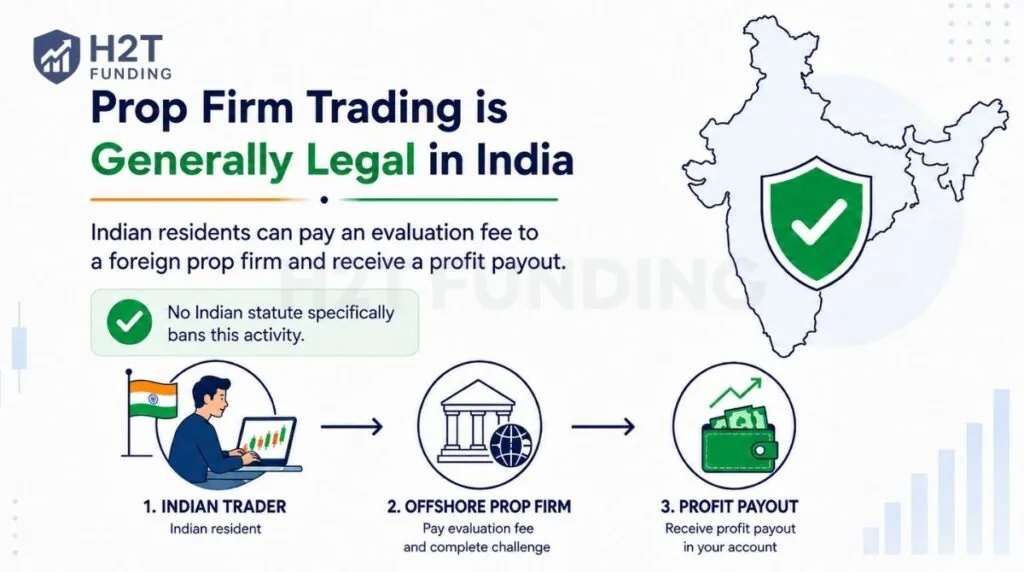
Legal does not mean risk-free. A trader can lawfully pay a challenge fee to a firm that later turns out to withhold payouts, change rules mid-evaluation, or restrict Indian applicants entirely. Legality and firm reliability are separate questions, covered later in this guide.
This framing matches how traders who actually do this describe it. In an r/IndianStockMarket thread asking whether funded trading is legal in India, one commenter who said they trade with a prop firm summarized the position in plain terms: “it’s in grey zone area, you have to pay tax” – Gaurav_patel_, Reddit.

2. Prop firm means two different things in India
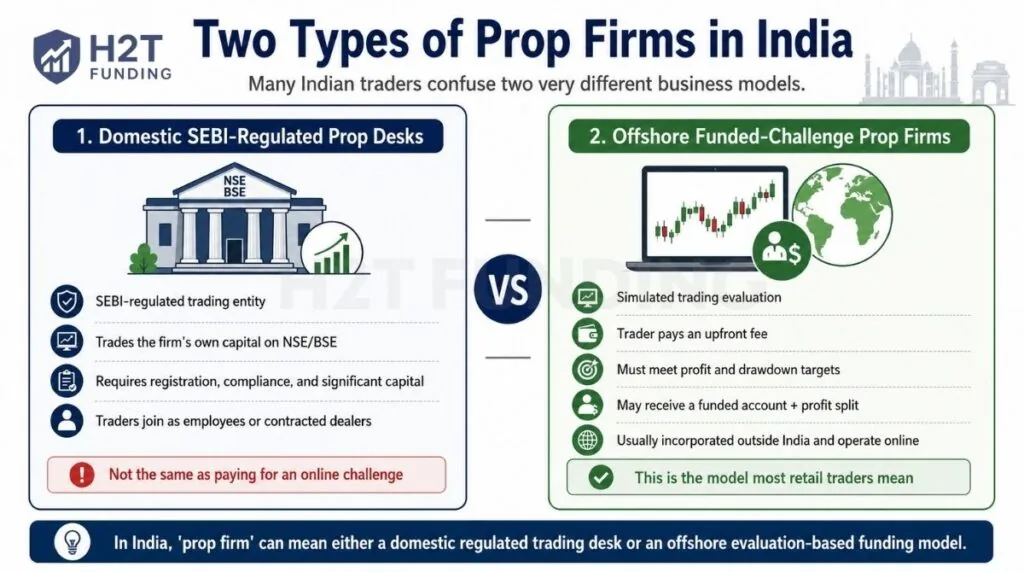
Indian traders searching this topic usually mean one of two very different businesses, and mixing them up explains most of the confusion on forums like Reddit and Quora.
2.1. Domestic SEBI-regulated proprietary trading desks
A domestic prop desk is a SEBI-registered trading entity that trades the firm’s own institutional capital directly on NSE and BSE, usually through an Alpha membership or an omnibus structure with a registered broker. Setting one up requires formal registration, compliance infrastructure, and significant capital – it is closer to running a licensed brokerage than to buying an online evaluation.
Traders join these desks as employees or contracted dealers, not as retail customers who pay a fee upfront. This is a different business model from what most people mean when they search “is prop firm trading legal in India.”
2.2. Offshore funded-challenge prop firms
An offshore funded-challenge firm sells a simulated trading evaluation – a “challenge” – usually run on a demo account. A trader pays an upfront fee, meets profit and drawdown targets on that demo account, then gets access to a funded account backed by the firm’s capital and keeps a share of the simulated profits.
These firms are typically incorporated outside India (UK, Malta, Gibraltar, and similar jurisdictions), operate purely online, and do not hold Indian client deposits or intermediate trades on Indian exchanges. This model, not the domestic prop desk, is what the rest of this guide addresses.
3. Why SEBI doesn’t directly regulate offshore fund-challenge firms
SEBI’s mandate covers brokers, investment advisers, portfolio managers, and market intermediaries that operate on Indian exchanges or offer regulated investment products to Indian residents. Offshore funded-challenge firms fall outside that definition on two counts: they hold no Indian corporate presence, and they do not intermediate securities trades on NSE or BSE.
The firms themselves frame the challenge fee as payment for a service – a skill assessment or simulated-trading product – rather than an investment of capital into a security. That framing comes from the firms’ own terms of service, not from a published SEBI ruling on the model, so treat it as the industry’s working interpretation rather than a settled legal precedent.
Because the demo account never touches real Indian market infrastructure, SEBI has no direct supervisory basis to audit or license these platforms the way it licenses a domestic broker.
4. How RBI and FEMA apply to your challenge fee and payouts
RBI and FEMA regulate how Indian traders send challenge fees abroad and receive prop firm payouts back into India. While SEBI does not oversee offshore prop firms, every cross-border payment must comply with FEMA and RBI remittance rules.
4.1. The Liberalised Remittance Scheme (LRS) and the $250,000 limit
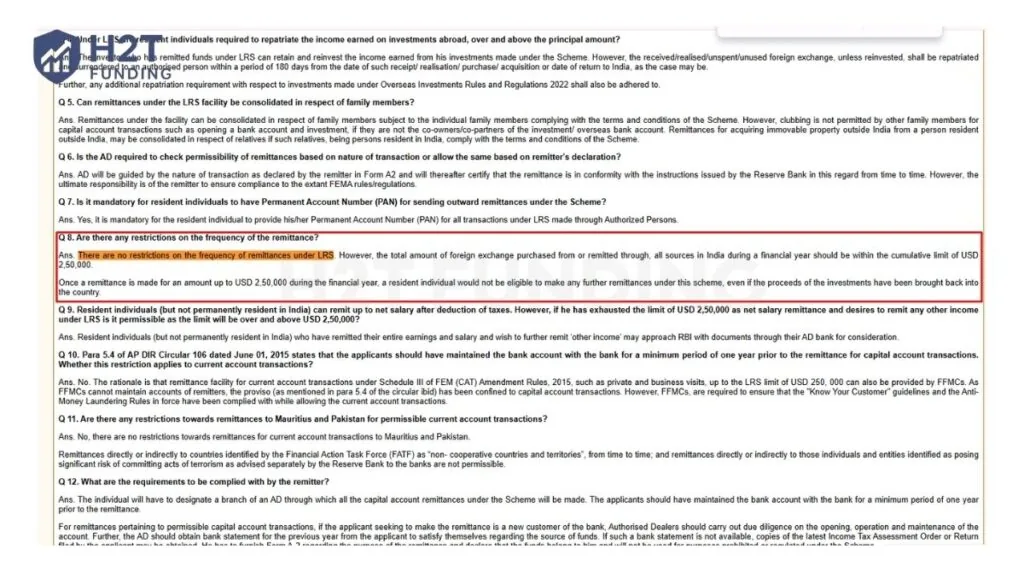
The Liberalised Remittance Scheme lets a resident individual remit up to $250,000 per financial year for permitted current account transactions, and paying for an evaluation challenge falls within that category as a payment for services.
The remittance must route through an Authorised Dealer (AD) Category-I bank – not an informal transfer channel. “There are no restrictions on the frequency of remittances under LRS.” – FAQ page, Reserve Bank of India.
At current exchange rates, $250,000 converts to roughly ₹2.1 crore (21 million rupees), which comfortably covers the fee for even the largest challenge account most traders would realistically buy.
4.2. Filing form A2 with your bank
When you send a challenge fee abroad, your bank requires you to complete Form A2, declaring the purpose of the remittance under FEMA’s current account rules. The bank assigns the applicable purpose code for the transaction based on that declaration.
On the payout side, funds coming back into India should be accompanied by a Foreign Inward Remittance Certificate (FIRC) from your bank. Keep this document; it is your primary proof that the money entered India through a legitimate banking channel, and you will need it for both compliance checks and tax filing.
5. Understanding the RBI Alert List: What it does and doesn’t mean
The RBI maintains a public Alert List naming forex trading platforms and electronic trading platforms that are not authorised to deal in foreign exchange with Indian residents under FEMA.
As of the list’s November 19, 2025, update, which includes some widely recognized international names, FTMO and FundedNext both appear on the current Alert List.
Their inclusion does not necessarily mean the platforms are fraudulent; it means RBI does not currently authorise them to deal in forex or operate an electronic trading platform for Indian residents under FEMA. Traders should treat this as a serious factor in deciding whether to fund a challenge with either firm from India.
This inclusion has already sparked debate among traders. In one r/CryptoIndia discussion on prop firm legality, a self-described funded trader pushed back on the classification, arguing “FTMO is not a broker, they legit pay” – tradingfido, Reddit.

That view is a trader’s personal opinion, not a regulatory finding, and it does not change the firm’s current Alert List status – but it shows the classification is actively contested within the trading community, not a settled fact everyone agrees with.
What the list does not confirm is equally important. The Alert List is not exhaustive, and a platform’s absence from it is not the same as RBI approval or endorsement. The RBI’s own Alert List document states this directly: “This list is not exhaustive.” – Alert List, Reserve Bank of India.
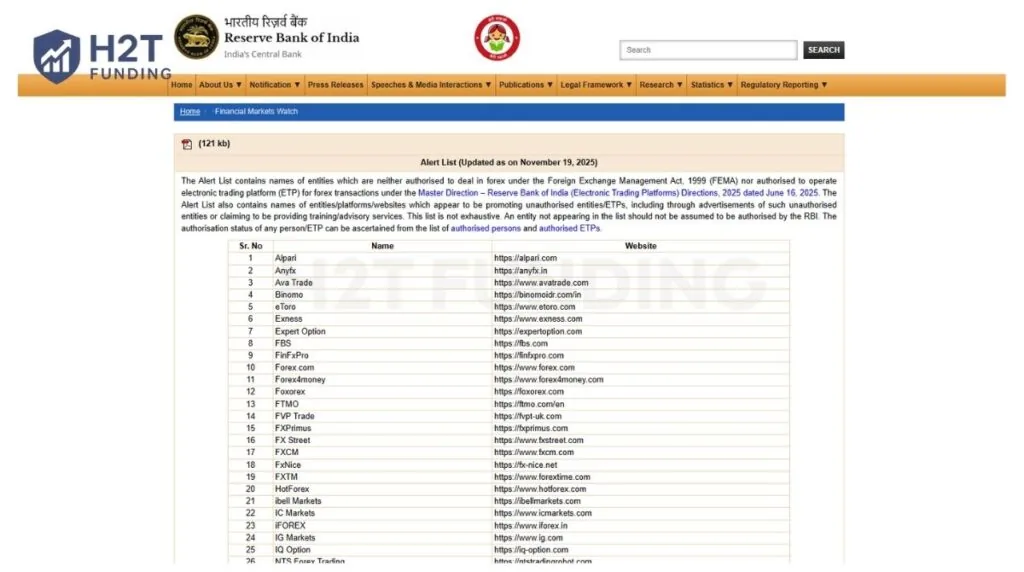
Traders need to verify a firm’s legitimacy independently rather than treating “not on the list” as a green light – the verification checklist further down in this guide covers how.
6. How prop firm payouts are taxed in India
A profit payout from a foreign prop firm is income, and the Income Tax Department expects it to be declared regardless of how it reaches you.
6.1. Business vs speculative vs other-source income
Most chartered accountants classify prop firm payouts as business or professional income under Profits and Gains from Business or Profession (PGBP), because the trader is being compensated under a service agreement with the firm rather than through direct securities ownership. This differs from “speculative business income,” a narrower tax category under Section 43(5) that applies to intraday trades in securities the trader actually owns, not to a simulated account.
| Income type | When it typically applies | Tax treatment |
|---|---|---|
| Business/professional income (PGBP) | Profit split paid under a prop firm service agreement | Taxed at slab rate; some traders use presumptive schemes under Section 44AD/44ADA |
| Speculative business income | Intraday trading of securities that the trader owns directly | Taxed at slab rate, losses ring-fenced separately |
| Other-sources income | Occasional, non-recurring receipts with no clear business character | Taxed at a slab rate, fewer deductions available |
Because the paying firm sits outside India, the payout also counts as foreign-source income, which most tax professionals require reporting on Schedule FA of the income tax return alongside the regular income schedule.
6.2. GST treatment of payouts
Under CBIC Circular 161/17/2021, a service supplied to a recipient located outside India and paid for in convertible foreign exchange can qualify as an export of service, which is typically zero-rated for GST.
Whether a specific prop firm payout meets every condition of that classification, registration status, place-of-supply rules, and documentation depends on the trader’s individual setup, so confirm this with a GST-registered CA before assuming no GST applies.
6.3. Crypto payouts (USDT/USDC) and the 30% VDA tax rule
If a prop firm pays out in a Virtual Digital Asset such as USDT or USDC, that payout falls under India’s VDA tax regime introduced in 2022: a flat 30% tax on gains plus a 1% TDS on qualifying transfers, with almost no deductions allowed beyond the cost of acquisition. This rate applies regardless of how long the crypto was held, unlike the holding-period rules that apply to other asset classes.
7. How to verify a prop firm is legitimate before you pay
Before paying a challenge fee, verify the prop firm’s business registration, payout history, trading rules, customer reviews, and support responsiveness. These checks help reduce the risk of scams or payout disputes. Legality at the country level does not guarantee that any single firm is trustworthy; the checks below cover what a legal framework can’t.
Company background and team
- Confirm the firm has a real business registration number, verifiable through a registry such as Companies House if it is UK-incorporated.
- Check that leadership names appear on public profiles such as LinkedIn, not just marketing pages.
- Treat anonymous staff pages or a virtual P.O. box address as a warning sign.
Payout and rule transparency
- Look for unedited payout proof – transaction hashes or redacted bank statements, rather than screenshots that could be staged.
- Read the full terms and conditions for hidden drawdown traps or rules that changed after traders had already paid.
- Cross-check independent reviews on a platform such as Trustpilot for how the firm handles complaints.
Direct testing
- Message support with a specific rules question before paying, and judge the response speed and accuracy.
- Start with the smallest, cheapest evaluation tier if you want to test execution and support before committing to a larger challenge.
Real trader accounts back up why these checks matter. In an r/Trading thread on getting started with prop firms, one commenter described how they document a payout for their bank, saying “you have to mention profits as reaserch analyst fee” – Rebel_2905, Reddit.

Other traders in the same community describe firms that deny payouts once a trader passes evaluation, the exact scenario the checklist above is designed to catch, before you pay.
8. Common misconceptions about prop firm legality in India
Many traders mistakenly believe offshore prop firms must be SEBI-registered, that challenge fees violate FEMA, that foreign payouts go untaxed, or that firms absent from the RBI Alert List are automatically approved. None of these assumptions is correct. The table below sets the record straight on each one.
| Misconception | Reality |
|---|---|
| Prop firms must be registered with SEBI to operate legally | Offshore evaluation-based firms sit outside SEBI’s brokerage licensing regime because they sell simulated assessments, not Indian securities products |
| Paying a challenge fee abroad automatically violates FEMA | The Liberalised Remittance Scheme permits it as a current account transaction, up to $250,000 per financial year, through proper banking channels |
| A payout from a foreign firm is untaxed because it is “outside India” | The payout is foreign-source income and must be declared on your Indian tax return, typically under Schedule FA |
| A firm not on the RBI Alert List is automatically safe to join | Absence from the list means the firm has not been flagged – it does not mean RBI has reviewed or approved it |
Most of these misconceptions share the same root cause: treating one piece of the framework, SEBI, FEMA, taxation, or the Alert List as if it covered the whole picture on its own. None of them do. A trader who understands all four pieces together is in a far better position to judge a specific firm than one relying on a single rule of thumb. The next section applies that same standard to a related but separate question: which firms currently restrict Indian traders altogether.
9. Which prop firms currently restrict Indian traders’ rights?
Restrictions on Indian traders are business decisions made by individual firms, not a blanket legal ban imposed by Indian or foreign regulators. Firms adjust their onboarding rules for reasons ranging from payment-processor risk policies to regional compliance reviews, and these decisions shift over time.
This eligibility question is separate from the Alert List question covered earlier in this guide, and traders should check both, not one in place of the other. A firm can choose not to accept Indian applicants for purely commercial reasons while still holding no flags from any regulator.
A firm can also accept Indian applicants freely while still appearing on the RBI’s Alert List, as FTMO and FundedNext currently do. Onboarding availability tells you whether a firm will take your money; the Alert List tells you whether RBI currently authorises that firm to deal in forex with Indian residents.
As of July 2026, aggregator data tracking dozens of active prop firms shows only a small minority restricting Indian applicants outright – Hola Prime and Fintokei are commonly cited examples, based on their published terms at the time of writing. Because eligibility rules change without much notice, confirm a firm’s current stance on Indian traders directly on its website before starting a challenge.
For a maintained, comparative view of which firms currently accept Indian traders and on what terms, see the best prop firms comparison.
10. How to choose a prop firm as an Indian trader
Once legality and remittance mechanics are clear, the practical decision comes down to firm-specific fit. Indian traders should prioritize payout rails that avoid international wire delays – crypto payouts in USDT/USDC or transfer services like Rise and Deel tend to settle faster than a traditional SWIFT wire.
Confirm the firm’s KYC process accepts standard Indian identification, such as Aadhaar and PAN, ideally verified through a recognized third-party provider rather than a manual, slow review. On the trading side, check whether the drawdown rule is end-of-day trailing rather than intraday balance trailing, since the latter is far less forgiving during volatile sessions, and confirm the firm’s stance on news trading and overnight holding before you commit capital to a specific strategy.
Profit split is the last major filter – established firms increasingly offer splits starting at 80% and rising toward 90%+ for the trader as account size or consistency improves. The Best prop firms for Indian traders page tracks current splits, payout speed, and India-specific onboarding status across active firms.
11. FAQ
-
Yes. No Indian law bans a resident from paying a challenge fee to a foreign prop firm or receiving a payout from one, though the activity is not directly licensed by any single regulator.
-
No. SEBI registration applies to brokers, advisers, and market intermediaries operating on Indian exchanges- offshore-funded challenge firms fall outside that category because they sell simulated evaluations, not Indian securities products.
-
Through your bank under the Liberalised Remittance Scheme, using an Authorised Dealer Category-I bank, and a completed Form A2 declaring the purpose of the payment.
-
Yes. Most tax professionals treat payouts as business or professional income, reportable as foreign-source income on Schedule FA, with crypto payouts taxed separately under the 30% VDA regime.
-
No. A prop firm challenge involves a simulated demo account and a service agreement with a foreign firm, while forex trading through an Indian broker involves direct participation in currency markets under SEBI/RBI-regulated instruments.
-
Two firms currently publish India as a restricted market: Hola Prime and Fintokei. Restriction here means the firm itself declines Indian applicants at onboarding, not a regulatory ban.
This restriction is separate from RBI’s Alert List, covered earlier in this guide; a firm can decline Indian applicants for business reasons alone, with no regulatory flag involved, and a firm can accept Indian applicants while still appearing on the Alert List.
-
Yes, but it is a different undertaking entirely; it requires SEBI-aligned registration, an Alpha membership or omnibus arrangement with a broker, and institutional-level capital, unlike buying an evaluation challenge from an offshore firm.
-
Legality applies to the activity, not to a specific list of approved firms – no regulator publishes a “legal firms” whitelist for India. What varies firm to firm is whether it currently onboards Indian applicants and whether it appears on the RBI’s Alert List, both covered earlier in this guide. For a side-by-side view of current terms across active firms, see H2T Funding’s compare prop firms.
-
Yes. Keeping a profit split from a foreign prop firm is legal for an Indian resident, provided the money moves through proper banking channels and gets declared as income. The legal risk sits in how the money is remitted and reported, not in the act of earning itself.
-
Yes. Indian residents can legally participate in funded trading evaluations and keep the resulting profit split, as long as the challenge fee and payout move through proper banking channels and are declared for tax. This applies to the funded-trading model in general, not to any single named platform – always verify the specific firm you’re considering using the checklist earlier in this guide.
-
Yes, in two forms. International platforms such as Funding Pips, The5ers, and FundedNext accept traders remotely from India, while hybrid operations like FundedStock register locally and offer payouts through UPI or bank transfer. Either way, participation is generally legal since these are skill-based evaluations rather than SEBI-regulated brokerage services.
12. Conclusion
Is prop firm trading legal in India? Yes, no Indian law bans a resident from paying a challenge fee to a foreign prop firm or from keeping the profit split that comes back. The activity sits in a regulatory grey area rather than under one dedicated licensing regime, governed piece by piece through SEBI’s silence, RBI and FEMA’s remittance rules, and the Income Tax Department’s reporting requirements.
Staying compliant comes down to four habits: remit challenge fees through proper banking channels under the LRS, declare every payout as foreign-source income, check a firm’s current standing against the RBI Alert List rather than assuming its absence means approval, and verify the firm itself before you pay, since legality at the country level says nothing about whether a specific platform pays out on time.
Prop firm rules, evaluation structures, and payout mechanics vary widely from one firm to the next, even where the underlying legal framework stays the same. For a deeper look at how specific programs handle drawdown, scaling, and payouts, browse H2T Funding’s Prop Firm Guides for the details that shape which account actually fits your trading style.
This article is for general information and does not constitute legal, tax, or financial advice. Consult a chartered accountant or legal professional for guidance specific to your situation. Last updated: July 2026.