

Prop firm passing services are third-party providers that trade your evaluation account for a fee, so you skip the challenge and go straight to a funded account. The concept is simple, the appeal is obvious, and the risks are often glossed over by the services themselves.
In this guide, H2T Funding breaks down exactly how these services work, what they actually cost, and why most traders who use them end up back at square one, including a smarter alternative for traders who just want a realistic path to getting funded. Read on to get the full picture.
Key Takeaways:
- Prop firm passing services are third-party providers who trade your evaluation account for a fee, typically $150–$1,500+, depending on account size.
- Most major prop firms, including FTMO, explicitly prohibit account sharing and third-party trading. Getting caught can result in a permanent ban.
- The core problem isn’t your trading ability; it’s often the wrong firm with the wrong evaluation structure for your current level.
- Scam risk is high in this space: some providers take upfront fees, blow the account, then disappear.
- A smarter path: choose a beginner-friendly prop firm with realistic targets instead of paying to bypass the evaluation process.
1. What is a prop firm passing service?
A prop firm passing service is a third-party provider, either a professional trader or an automated algorithm that takes over your evaluation account and completes the challenge on your behalf, in exchange for a fee.
The concept is straightforward: you purchase a prop firm evaluation, hand over your login credentials, and the service trades the account until the profit target is hit while staying within the firm’s drawdown limits. Once passed, you receive the funded account in your name.
These services target traders who have struggled to pass evaluations on their own, and given that pass rates at major prop firms are estimated between 10–20% depending on the firm and market conditions – a figure widely cited across trading communities, including r/PropFirms and r/Forex, the demand is real.
Prop firm evaluations are designed to be difficult. A typical two-phase challenge requires hitting a 10% profit target in Phase 1 and 5% in Phase 2, while keeping daily losses under 5% and total drawdown under 10% all within a 30-day window.
For many traders, the rules aren’t the problem. The pressure is.
Traders who perform consistently on demo accounts often find that evaluation conditions change their behavior. Positions they would normally take without hesitation become second-guessed. One losing day triggers tighter sizing, then overcompensation the next. The evaluation format itself, which is timed, high-stakes, and rule-heavy, introduces a psychological layer that demo trading never does.
Add to that the cost of repeated failures. A $100K FTMO evaluation costs around $540 per attempt. Traders who fail three, four, or five times are looking at $1,500–$2,500 spent with nothing to show for it. At that point, paying $300–$500 for a passing service starts to feel rational.
That’s the real reason these services exist, not because traders can’t trade, but because the evaluation format filters out a lot of skilled traders for reasons that have nothing to do with long-term profitability.
2. How do prop firm passing services work?
The process is fairly standardized across most providers:
- Step 1: Purchase your evaluation. You buy the challenge directly from the prop firm of your choice, FTMO, FundedNext, The5ers, or whichever firm you’re targeting. The evaluation account is in your name.
- Step 2: Pay the service fee. You pay for the passing service separately. Fees vary by account size, typically ranging from $200 for smaller accounts up to $500 or more for $100K+ evaluations.
- Step 3: Share your credentials. You provide the service with your account login. Their trader, or in some cases an automated bot, begins trading the account.
- Step 4: Monitor and receive. The service works through Phase 1 and Phase 2. Reputable providers offer progress tracking so you can follow along. Once both phases are cleared, you take over the funded account.
On paper, the process is clean. The reality is that execution quality varies significantly between providers, and that gap is where most of the risk lives.
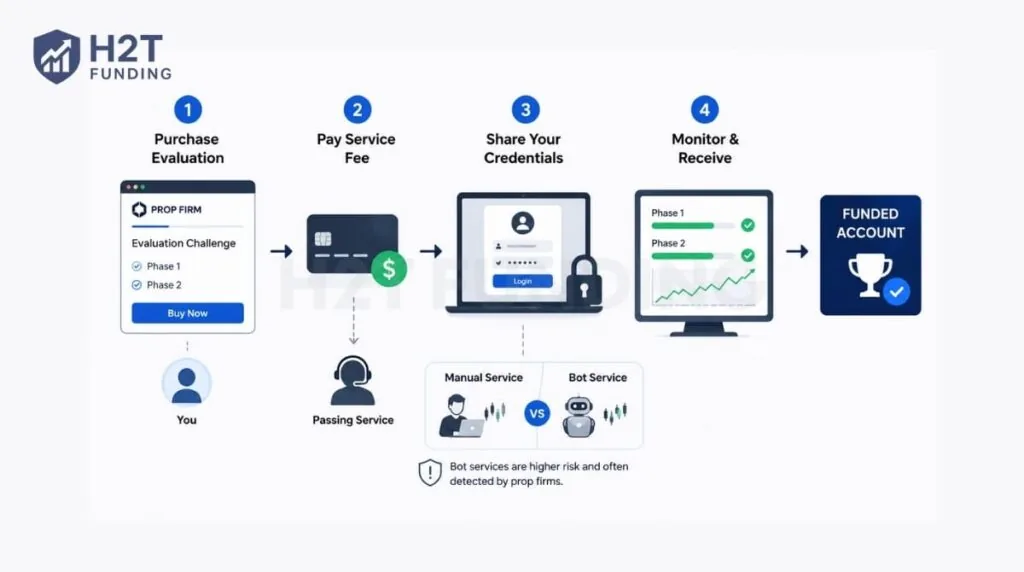
Manual and bot-based services carry different risk profiles. Manual services use real traders who follow the firm’s rules and trade during standard market hours. Bot-based services use automated systems, which most major prop firms explicitly detect and flag, making them a considerably higher-risk option regardless of how the service markets itself.
3. How much do prop firm passing services actually cost?
Pricing across the market typically follows account size:
| Account Size | Typical Service Fee |
|---|---|
| $5K – $20K | $150 – $200 |
| $25K – $50K | $250 – $350 |
| $100K – $200K | $400 – $600 |
| $300K+ | $800 – $1,500+ |
Note: Pricing estimates based on publicly advertised rates discussed across r/Forex, r/PropFirms, and Forex Factory as of June 2026. Fees vary by provider and are subject to change.
Some providers charge a one-time flat fee. Others operate on a monthly subscription model, which means if the challenge takes longer than expected, you keep paying.
Most legitimate providers advertise a money-back guarantee or free retest if they fail the challenge. Whether those guarantees actually hold up when claimed is a separate question and one worth researching carefully before committing.
The total cost calculation also needs to include the original evaluation fee you paid to the prop firm. For a $100K FTMO challenge, you’re looking at roughly $540 (evaluation) + $500 (service fee) = ~$1,040 before you’ve made a single dollar in profit. That’s the real number to weigh.
4. Do passing services violate prop firm rules?
Yes, in most cases. The terms of service at most major prop firms explicitly prohibit account sharing, third-party trading, and the use of automated bots or external algorithms. This isn’t buried in fine print; it’s documented prominently in each firm’s official guidelines. The three firms cited below are among the most established in the industry, collectively holding over 150,000 Trustpilot reviews: FTMO (4.8/5, 45K reviews), The5ers (4.7/5, 32K reviews), and FundedNext (4.5/5, 73K reviews).
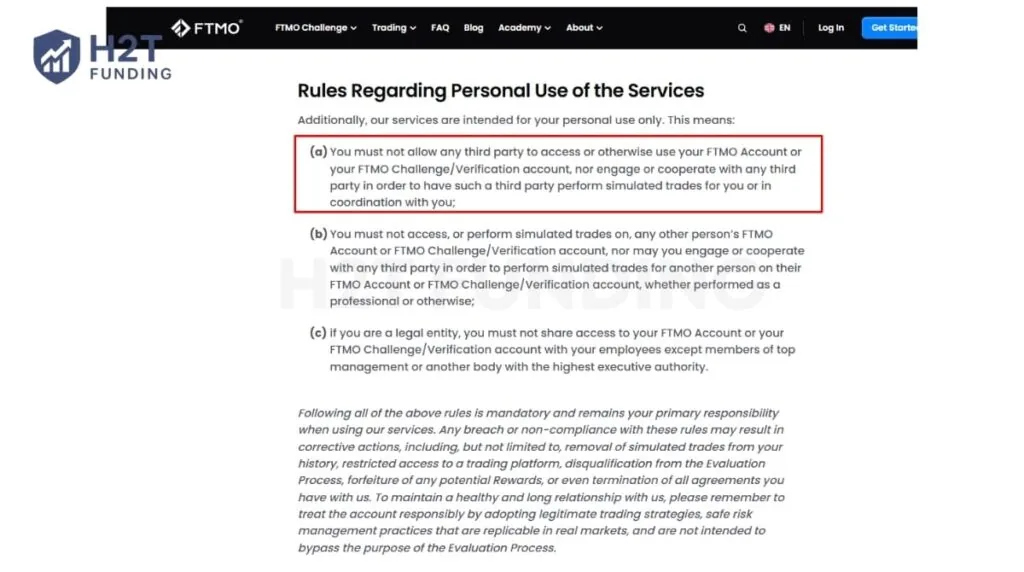
FTMO’s Forbidden Trading Practices page states directly under “Rules Regarding Personal Use of the Services” – note that FTMO operates in a simulated trading environment, so “simulated trades” refers to all trading activity on both evaluation and funded accounts:
“You must not allow any third party to access or otherwise use your FTMO Account or your FTMO Challenge/Verification account, nor engage or cooperate with any third party in order to have such a third party perform simulated trades for you.”
The5ers is even more explicit. Its Prohibited Trading Practices page calls out passing services by name:
“Account Management Services ‘Pass your Challenge’ is also prohibited – a service to manage other individuals’ challenge accounts, promising to pass the evaluation phase and gain funding on their behalf.”
FundedNext’s restricted trading strategies documentation is equally direct:
“‘Pass Your Challenge’, ‘Copy Trading Services’ or ‘Signal Services’ are also strictly prohibited, resulting in the denial of any FundedNext Accounts and a permanent ban from all FundedNext services.”
The pattern is consistent across the industry: prop firms treat passing services as a direct violation, not a gray area.
Some traders rationalize this risk by pointing out that prop firms can’t always prove account sharing. That may be true in isolated cases. But the detection methods have improved significantly, and the firms have a financial incentive to enforce their rules, particularly for accounts approaching large payouts.
The risk isn’t theoretical. It’s a documented outcome that traders regularly report across forums and trading communities.
If you suspect your account is under review or has been closed due to a passing service, here are the practical steps to take:
- Stop trading immediately: Do not attempt to open new positions or request a payout while a review is active; further activity can be used as additional evidence against your account.
- Contact the prop firm’s support directly: Request a written explanation of the termination reason. Some decisions are reversible if the violation was minor or unintentional, but only if you engage proactively.
- Do not attempt to re-register under a different identity: Most firms flag by payment method, device fingerprint, and IP history, not just name or email. A new account created to bypass a ban is grounds for permanent exclusion across the firm’s entire network.
- Reassess before your next evaluation: Use the gap period to identify what caused the original evaluation failures. The underlying issue, whether it’s psychological pressure, risk management, or strategy fit, is still there and will affect your next attempt regardless of which firm you choose.
5. How prop firms detect third-party trading
Prop firms don’t rely on self-reporting to catch passing service users. Detection is active, algorithmic, and increasingly accurate. Most firms use four overlapping methods.
- Trade data and execution matching: Every trade generates a data trail entry and exit timestamps, lot sizes, instruments, stop-loss, and take-profit placements. When a passing service operates across multiple client accounts simultaneously, the execution patterns become statistically identical: same symbol, same lot size, same millisecond timestamp across dozens of unrelated accounts. No group of independent traders produces this naturally. Firms with large account databases identify these clusters and flag all associated accounts in a single review sweep.
- IP address and device fingerprinting: Every login is logged with IP address, device type, browser fingerprint, and geographic location. When a passing service accesses your account from a different country or device, the mismatch triggers an automatic flag. Sudden mid-challenge IP changes, or two logins from different countries within hours of each other, are among the clearest signals a firm can act on.
- Behavioral inconsistencies between phases: Passing services typically use aggressive or high-frequency strategies to hit profit targets quickly during the evaluation. Once the account is handed back to the trader, the trading style shifts dramatically to different instruments, different risk sizing, and different session timing. Prop firms track behavioral consistency across the full account lifecycle. A sharp discontinuity between Phase 1 and the funded stage is a known detection trigger.
- KYC and payment tracing: To prevent multi-account exploitation, most firms cross-reference payout details at the withdrawal stage. If multiple funded accounts request payouts to the same bank account, cryptocurrency wallet, or payment method, the firm flags them for identity review. Advanced KYC checks also verify that the person trading the account matches the registered account holder, catching cases where passing services operate under shared infrastructure across many clients.
Detection methods have improved significantly since 2022, and prop firms have a direct financial incentive to enforce them, particularly for accounts approaching large payouts. The question isn’t whether firms can catch passing service users. For most accounts, it’s a matter of when.
6. Passing services vs. buying the challenge yourself
Most traders who consider passing services frame it as a cost-saving shortcut. The math looks simple: pay $500, get a $100K funded account, skip months of failed attempts. But that calculation only works if the account survives and the survival rate is lower than the services advertise.
Here’s what the full cost picture looks like across three paths:
| Self-attempt (FTMO $100K) | Passing service | Beginner-friendly firm | |
|---|---|---|---|
| Evaluation fee | ~$540 per attempt | ~$540 (you still pay) | $19–$491 depending on firm |
| Service fee | – | ~$500 | – |
| Total upfront | ~$540 | ~$1,040 | $19–$491 |
| Ban risk | None | High if detected | None |
| Skill development | Yes | No | Yes |
| Account survival likelihood | Depends on the trader | Low if a skill gap exists | Higher with the right firm fit |
The passing service column is the only one where you pay twice, once to the prop firm, once to the service, and still carry the highest risk of losing everything. A ban doesn’t just cost you the challenge fee. It costs you the service fee, any profits earned before detection, and your standing with that firm permanently.
The more honest comparison isn’t passing service vs. self-attempt at the same firm. It’s passing service vs. choosing a firm whose evaluation was actually built for your current level. A beginner-friendly firm with a $19–$100 entry fee and an unlimited trading period gives you more attempts, more room to develop consistency, and zero ban risk for a fraction of the combined cost.
7. Passing services vs. legitimate trading automation
Not all third-party tools are banned. The distinction matters because traders often conflate passing services with other forms of automation that are either permitted or tolerated by most prop firms.
7.1. Passing services (account sharing and managed challenges)
Passing services are third-party providers, human traders, or bots hired to complete your evaluation account on your behalf. The defining characteristic is credential sharing: someone else logs into your account and trades it directly.
7.2. Legitimate trading automation (self-directed EAs and algorithms)
Legitimate automation means deploying your own custom algorithms, Expert Advisors (EAs), or rule-based systems to execute trades where you remain the sole account holder and the strategy is entirely your own.
Permitted and supported at most firms, provided the automation adheres to the firm’s risk parameters and does not exploit latency, price feed errors, or other prohibited practices.
The risks here are different: using “black box” automated systems or off-the-shelf EAs built by others introduces uncertainty. If the EA engages in prohibited practices, such as tick scalping, latency arbitrage, or toxic order flow, your account can still be terminated even if you weren’t aware of the violation.
One grey area worth flagging: commercially sold EAs marketed specifically as “prop firm challenge passers” often run the same bot across hundreds of client accounts simultaneously. Even if you run the EA yourself, the trade pattern correlation is identical to what firms look for when detecting passing services. Several traders have reported account reviews triggered by popular off-the-shelf challenge EAs, not because they shared credentials, but because the execution fingerprint matched a known bot pattern.
Verification is also a meaningful difference between the two. Legitimate automation can be validated through a publicly available track record on platforms, demonstrating real performance and drawdown history. Passing services, by contrast, rarely provide independently verifiable proof of results.
The safest rule: if someone else controls your account, or if your EA’s trade pattern is indistinguishable from a bot running across dozens of other accounts, the risk of detection is real regardless of how the tool is marketed.
8. The real risks of using a passing service
Beyond the ToS issue, there are four distinct risks worth understanding before spending money on one of these services. Based on H2T Funding’s ongoing review of trader feedback, community forums, and passing service activity since 2022, these are the patterns that come up most consistently.
- Scam risk is high and underreported. The passing service industry is largely unregulated. Some providers take the upfront fee, trade the account aggressively to hit targets fast, blow past the drawdown limit, and then go silent. With no regulatory body governing these services, recovery is nearly impossible. Searching through trading forums will surface dozens of accounts from traders who lost both their evaluation fee and the service fee with no recourse.
- You still have to trade the funded account yourself. Passing the evaluation is only the first gate. Once you have a funded account, you are responsible for managing it profitably and within the firm’s rules every single day. If the reason you sought a passing service was a genuine skill gap, that gap doesn’t disappear once the account is funded. Traders in this situation frequently blow their funded accounts within the first few weeks.
- The skill gap problem compounds. Every time you bypass the evaluation, you miss the feedback that the evaluation was designed to provide. Prop firm challenges, frustrating as they are, do identify real weaknesses: overleveraging, poor risk management, and revenge trading under pressure. Using a service to skip that process means entering the funded stage without having addressed those weaknesses.
- No standardized verification. Most passing services claim high success rates 90%, 94%, 98% with little verifiable evidence. Screenshots can be fabricated. Myfxbook links can be gated or selectively shared. Without independent third-party verification, there’s no reliable way to assess a provider’s actual track record before paying them.
9. Prop firm passing service on Reddit
The trading community’s view on passing services is more divided than you might expect, but the skepticism runs deep.
On Reddit’s r/Forex, a widely-upvoted thread titled “Prop Firm Passing Service – What’s the catch?” (March 2023) cuts to the core of the issue. One top-voted comment read:
“First of all if they lose your challenge, they have nothing to lose. Only you lose your money. If they win the challenge, what are you going to do next – let them use your account for profit split? Or use it yourself? If you use it yourself and you don’t have the skills to manage risk and be profitable consistently, you will lose the account anyways. Then there is no point in even getting the account.” – u/som1sumwr, r/Forex, March 2023
Another commenter in the same thread raised the detection risk directly:
“Most online prop firms ban the use of HFT bots, FTMO and MFF included. My immediate thoughts about these services are that they pass and then you’d get your account revoked after you attempt to receive a payout, or shortly after you pass the challenge for breaking the prop firm’s rules.” – u/idonthaveanamehelp, r/Forex, March 2023
A more measured take acknowledged that some services do work but pointed to the broader issue:
“The big issue is, what’s the point of a service like that? You need to pay the prop firm fees plus the passing company fees. And if you can’t really trade, you will blow up your account soon anyway.” – u/whitewanderer75, r/Forex, March 2023
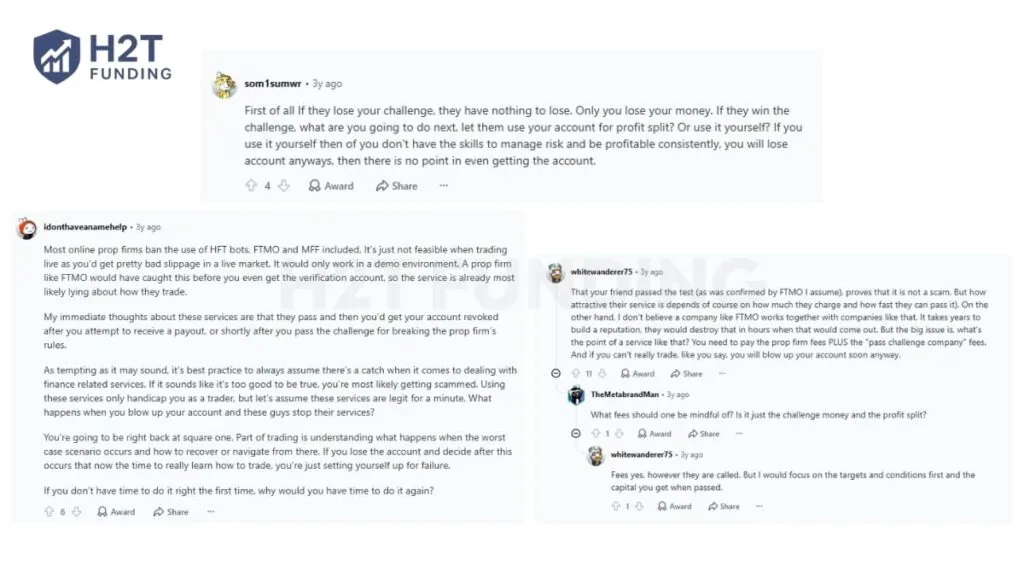
The pattern that emerges from community discussions is consistent: traders who used passing services and couldn’t sustain the funded account themselves ended up right back at square one, except with less capital and more frustration than before.
10. How to actually pass a prop firm challenge yourself
Passing a prop firm challenge without outside help is more achievable than most failed attempts suggest. The issue is usually an approach, not an ability.
- Start with risk management, not profit targets: Most traders fail evaluations by focusing on hitting the profit target instead of protecting the drawdown limit. A simple rule: risk no more than 1–2% of the account per trade, and maintain a minimum 1:2 risk-to-reward ratio. At this sizing, a string of losses won’t end your evaluation, and a few good trades will move you toward the target naturally.
- Demo trade the evaluation rules before you pay: Run through at least two weeks of demo trading under the exact conditions of your target firm, same lot sizes, same daily loss limits, same profit target. If you can’t hit the target consistently in demo, paying for a real challenge (or a passing service) won’t change the outcome.
- Choose the right firm before you start: Not all evaluations are equally difficult. Firms with unlimited time limits, lower profit targets, and wider drawdown allowances give you significantly more room to trade your natural style without pressure-induced mistakes.
The full breakdown, including specific strategies, risk frameworks, and which firms suit which trading styles, is covered in detail in the How to pass a prop firm challenge guide.
11. A better alternative: Choose the right prop firm first
The frustration that drives traders toward passing services is legitimate. But in most cases, it’s a symptom of a fixable problem: the wrong firm for the trader’s current level.
Not all prop firms use the same evaluation structure. Some were designed for experienced traders with high profit targets, strict consistency rules, and short time windows. Others are structured specifically to give traders more room for higher drawdown allowances, longer evaluation periods, or simpler one-phase challenges.
If you’ve failed multiple evaluations at firms like FTMO or FundedNext, it doesn’t necessarily mean you can’t trade. It may mean the evaluation model doesn’t fit how you actually trade.
Consider the difference:
| Factor | Strict Evaluation Firms | Beginner-Friendly Firms |
|---|---|---|
| Profit Target | 8–10% Phase 1 | 5–8% Phase 1 |
| Max Drawdown | 10% | 10–12% |
| Daily Loss Limit | 5% | 5–6% |
| Evaluation Phases | 2 phases | 1–2 phases |
| Time Limit | 30 days | 30–60 days or unlimited |
| Consistency Rule | Often required | Often not required |
Choosing a firm whose evaluation structure matches your trading style, position trading, lower frequency, and slower target accumulation is a fundamentally different approach than trying to conform your strategy to an evaluation that wasn’t built for how you trade.
It’s also considerably cheaper. One evaluation fee at a beginner-friendly firm is less than the combined cost of a passing service plus evaluation fee, and the funded account you earn is one you actually know how to manage.
If you’re not sure which firms give new traders the most realistic path to a funded account, the guide below covers the options in detail. See the Best Prop Firms for Beginners
12. FAQs
Some are legitimate in the sense that they do pass evaluations, but “legitimate” doesn’t mean risk-free. Even genuine providers operate in a legal gray area, since most prop firm terms of service explicitly prohibit account sharing. Using one puts your account and all fees paid at risk of termination if the firm detects it.
Fees typically range from $150–$200 for smaller accounts ($5K–$20K) up to $500–$600 for $100K–$200K evaluations. This is on top of the evaluation fee you already paid to the prop firm, so the total upfront cost is higher than most traders initially calculate.
Yes. FTMO and most major prop firms monitor IP addresses, login patterns, and trading behavior. Accounts traded from unrecognized locations or with patterns inconsistent with the registered trader’s history are flagged for review. Detection has become more reliable as firms have updated their compliance processes in 2025 and 2026.
Most providers advertise a refund or free retest policy. In practice, enforcement of these guarantees varies. If the service is a low-quality operator, recovering fees after a failed challenge is difficult. Always verify the provider’s refund terms in writing before paying.
For most traders, not for two reasons. First, the risk of account termination is real. Second, and more importantly, passing the evaluation doesn’t address whatever caused the failures in the first place. Traders who can’t sustain a funded account after paying for a pass end up spending more overall than if they had kept attempting the challenge themselves.
Several firms are structured to be more beginner-friendly than FTMO or FundedNext. The5ers’ 2-Step High Stakes starts at $22 with an 8%/5% profit target and unlimited trading period. FundingPips’ Zero challenge removes the profit target entirely; just stay within drawdown limits for 7 days, starting at $60. Other accessible options include Goat Funded Trader, Tradeify, TakeProfit Trader, Apex Trader Funding, and Topstep.
Most do. All major firms, including FTMO, FundedNext, The5ers, Apex Trader Funding, and Topstep, explicitly prohibit account sharing and third-party trading in their terms of service. A small number of lesser-known firms do not address it directly, but using a passing service at any firm carries the risk of account termination if trading patterns are flagged as inconsistent.
No. If a prop firm terminates your account for a ToS violation, the evaluation fee is forfeited. Most firms classify passing service use as fraud, which disqualifies you from any refund policy. The passing service fee is also non-recoverable in most cases, particularly if the provider’s terms exclude ToS-related bans from their refund guarantee.
A signal service sends trade ideas for you to execute yourself; you remain in control of your account at all times. Copy trading replicates another trader’s positions on your own account, which some firms allow within defined rules. A passing service involves handing your login credentials to a third party who trades your account directly. This is account sharing, which is explicitly banned at virtually every major prop firm regardless of how the service markets itself.
13. Conclusion
Prop firm passing services exist because prop firm evaluations are genuinely hard, and the frustration behind them is real. But the solution they offer is built on a foundation with serious cracks: ToS violations that can erase everything, scam operators with no accountability, and a skill gap that persists whether you pass the evaluation or not.
The traders who build sustainable funded accounts aren’t the ones who found a shortcut past the evaluation. They’re the ones who found an evaluation built for where they actually are as traders.
If you’ve been failing challenges, the question worth asking isn’t “how do I get someone else to pass this?” It’s “Am I at the right firm for my current level?” That’s a much cheaper problem to solve.
Want to go deeper? H2T Funding’s Prop Firm Guides covers everything from evaluation rules to payout strategies written for traders who want to build funded accounts the right way.
Disclaimer: Prop firm rules, terms of service, and evaluation structures can change without notice. The information in this article, including quotes from FTMO, The5ers, and FundedNext, was verified against each firm’s official documentation as of June 2026. Always check the current terms directly on each firm’s website before making any decisions.
Affiliate Disclosure: Some links on this page, including links to prop firm sign-up pages, may be affiliate links. H2T Funding may earn a commission if you sign up through these links, at no additional cost to you. This does not influence our editorial recommendations.