


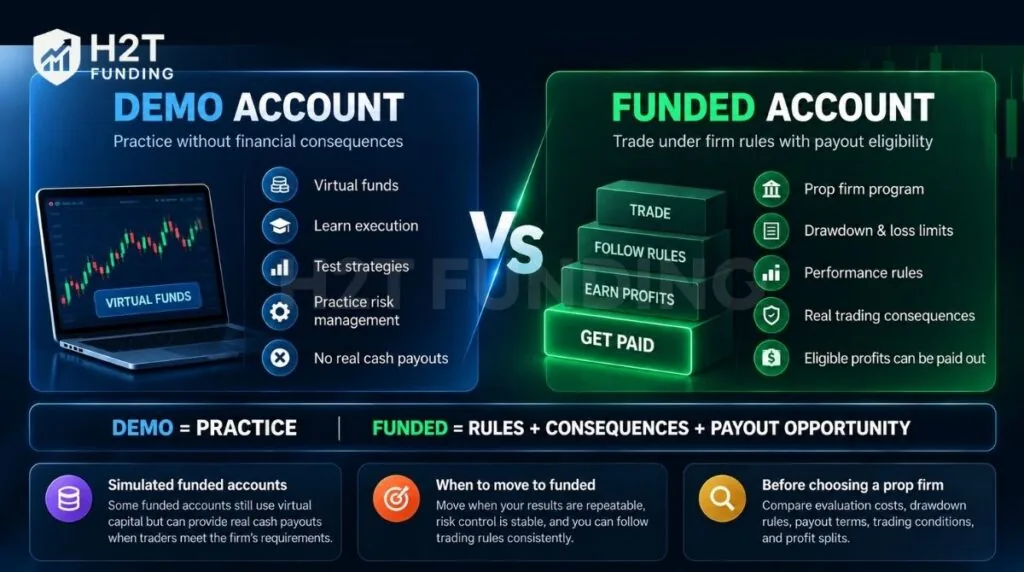
A funded account vs demo account differs mainly in financial consequences, trading rules, and payouts. A demo account uses virtual funds for risk-free practice, while a funded account requires you to meet a prop firm’s evaluation standards and follow rules such as drawdown, daily loss, and consistency limits before earning eligible profits.
The distinction is not always as simple as “virtual money versus real money,” because some funded programs continue to operate in a simulated environment while still offering real payouts. Read this H2T Funding guide to understand how demo, simulated funded, and live funded accounts work, and which option fits your current trading stage.
Key takeaways
- Funded account vs demo account: A demo account uses virtual funds for practice, while a funded account adds firm-enforced rules, payout eligibility, and real financial consequences.
- Demo account: A demo account helps traders learn execution, test strategies, and practice risk management without risking personal capital.
- Funded account: A funded account operates within a prop firm program and requires traders to follow rules such as drawdown limits, daily loss limits, and payout conditions.
- Simulated funded account: Some funded accounts still use virtual capital but can provide real cash payouts when traders meet the firm’s requirements.
- Funded readiness: Traders should move from demo to funded only when their results are repeatable, risk control is stable, and they can follow trading rules consistently.
- Prop firm selection: Traders should compare evaluation costs, drawdown rules, payout terms, trading conditions, and profit splits before choosing a firm.
1. What is a demo trading account?
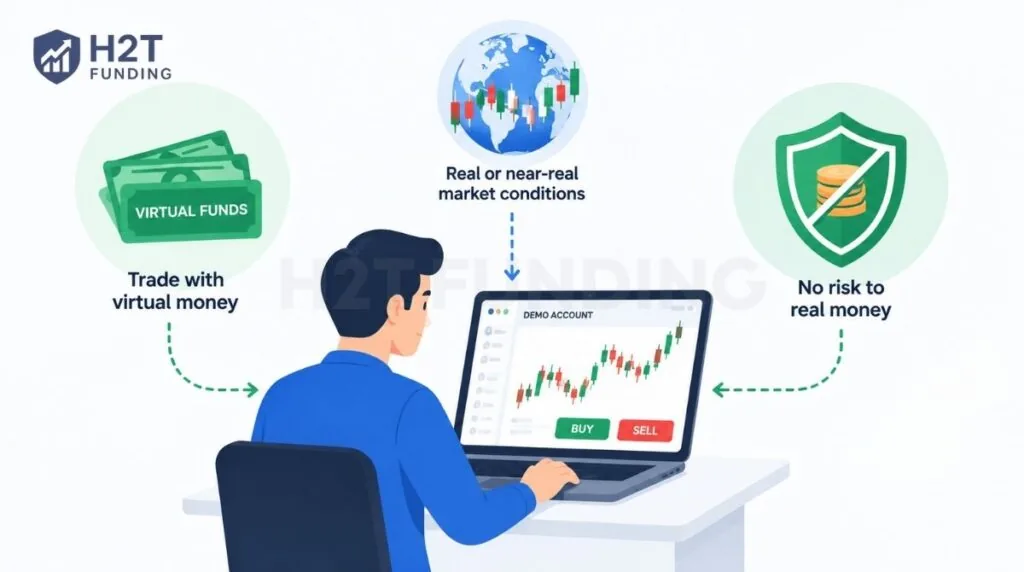
A demo trading account is a practice account that uses virtual funds to simulate trading under real or near-real market conditions without exposing your own money to market losses. It allows you to learn a platform, place orders, test strategies, and observe price movements before risking capital.
Most demo accounts include three core features:
- Virtual funds: You trade with simulated money instead of your own cash.
- Market-based pricing: Charts and prices usually reflect live or delayed market data, depending on the provider.
- No real payout: Profits and losses remain simulated, so demo gains cannot normally be withdrawn.
A free broker demo account is different from a prop firm demo or evaluation account. Broker demos are mainly designed for open-ended practice, while prop firm evaluations use simulated trading conditions but add specific rules such as profit targets, drawdown limits, daily loss limits, or minimum trading requirements.
In short, a demo account is best used to build execution skills and test consistency before financial consequences or prop firm rules come into play.
2. What is a funded trading account?
A funded trading account gives a trader access to a prop firm’s funded trading program under its qualification or funding requirements. Depending on the firm, the account may use simulated or live capital and may provide eligible traders with real payouts.
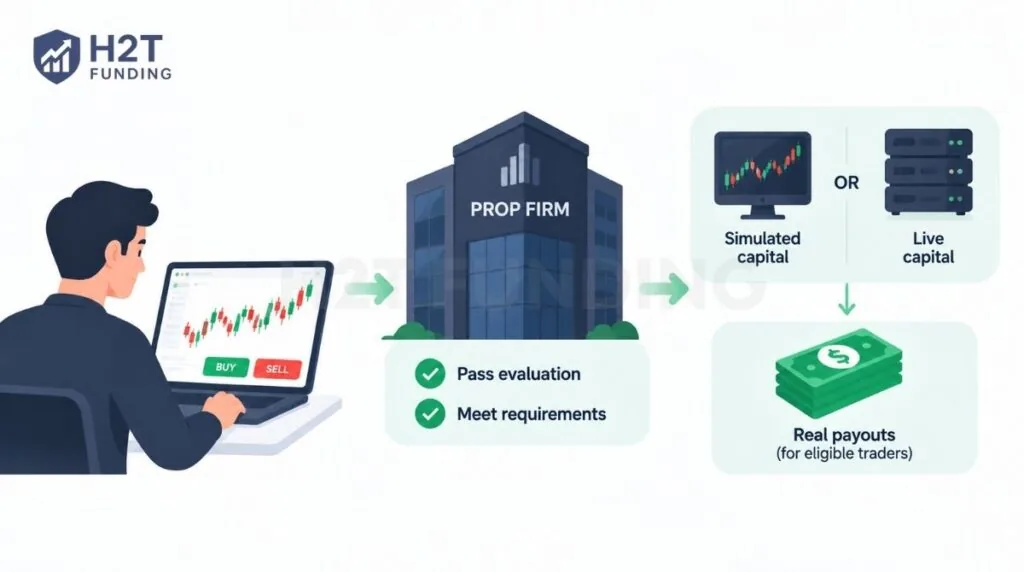
Unlike a standard demo account, a funded account comes with defined risk limits, payout eligibility, and performance rules that determine whether the trader can maintain funded status.
Funded accounts usually follow three basic mechanics:
- Qualification: Traders typically pass an evaluation or challenge before receiving funded status, although some firms also offer instant funding models.
- Trading rules: Funded traders must follow limits such as maximum drawdown, daily loss rules, position limits, or consistency requirements set by the firm.
- Profit sharing: Eligible profits are divided between the trader and the prop firm. Many popular programs offer traders around 80%–90% of eligible profits, although the exact split depends on the firm and account model.
The term “funded” does not always mean the trader is directly placing orders with live firm capital. Some funded programs remain simulated while still paying traders real cash based on eligible performance. This distinction is covered separately in the simulated funded account section below.
3. Demo account vs funded account: Side-by-side comparison
A demo account is built for practice with virtual funds, while a funded account adds qualification requirements, enforceable risk rules, and eligibility for real payouts. The biggest differences appear in financial exposure, trading restrictions, psychology, and profit withdrawals.
The table below compares the two account types across the four factors that matter most to traders:
| Factor | Demo Account | Funded Account |
|---|---|---|
| Financial Risk | Uses virtual funds, so trading losses do not reduce your personal capital. Standard broker demos are typically free to use. | Usually involves an evaluation, activation, or program fee, depending on the prop firm. Breaking account rules can also result in losing funded status. |
| Trading Rules | Mainly designed for practice, with few consequences for exceeding normal risk limits or resetting the account. | Requires compliance with maximum drawdown, daily loss limits, position limits, consistency rules, or other firm-specific conditions. |
| Psychology | Creates limited financial pressure because losses and profits are simulated. | Adds performance pressure and payout consequences, which can affect discipline, position sizing, and decision-making. |
| Payouts | Simulated profits cannot normally be withdrawn as cash. | Eligible profits can produce real cash payouts, while profit splits vary by provider and account model. |
| Typical Costs | Standard broker demos are usually free, although platform or market-data fees may vary. | Evaluation, activation, reset, data, or program fees may apply depending on the prop firm and account model. |
The key distinction is therefore not simply “virtual money versus real money.” A funded account changes the consequences of your trading: rules matter, account access can be lost, and eligible performance can lead to real payouts even when the underlying trading environment is simulated.
Demo trading tests how you execute without financial consequences, while funded trading tests whether you can execute consistently under rules and payout conditions.
Read more:
4. The hidden third category: Simulated funded accounts
A simulated funded account uses virtual capital but applies real prop firm rules and can still produce real cash payouts. This makes simulated funded accounts a useful third model to distinguish from standard demo and live-funded accounts.
A simulated funded account usually works in three stages:
- Evaluation: You first trade in a simulated environment under profit targets and drawdown rules.
- Funded status: After qualifying, you may continue trading on a simulated funded account rather than a live brokerage account.
- Payout eligibility: The firm pays eligible rewards based on your performance and its stated payout policy.
The key difference from a normal demo is that trading decisions carry real consequences. A standard demo has no payout eligibility and few lasting penalties, while a simulated funded account ties performance to account retention, trading rules, and real cash payouts.
For comparison purposes, the table below separates demo accounts, simulated funded accounts, and live-funded accounts, although firms may use different terminology.
| Feature | Demo Account | Simulated Funded Account | Live-Funded Account |
|---|---|---|---|
| Capital | Virtual | Virtual | Real firm capital |
| Trading Rules | Usually limited | Strict and firm-defined | Firm-specific |
| Evaluation | Usually none | Often required | Varies by firm |
| Payouts | No real payout | Real payouts may be available | Real payouts may be available |
| Account Risk | No personal trading loss | Usually limited to fees and account status | Depends on the firm’s structure |
Simulated funded accounts therefore sit between demo and live-funded models by combining virtual execution with real payout eligibility and firm-enforced rules.
FTMO provides a clear example of how a simulated funded model can work:
“An FTMO Account is an account with fully fictitious funds, however, with real market quotes from liquidity providers.” – FTMO, Official FAQ
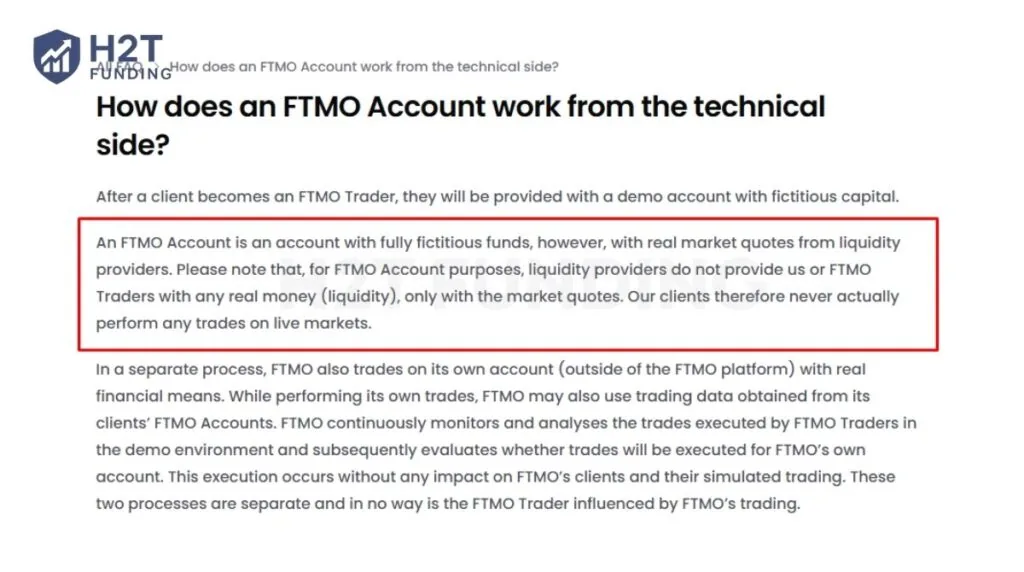
FTMO also states that traders using simulated capital can receive real-money rewards after generating eligible profits. This illustrates why funded status does not necessarily mean direct access to live firm capital.
Not every prop firm uses the same model, and “funded” does not automatically mean your orders are sent directly to the live market with firm capital. The underlying account structure should therefore be verified from each firm’s current terms rather than inferred from the word “funded” alone.
5. Why the psychological gap matters more than the technical one
The psychological gap matters more because funded trading adds real consequences to decisions that feel low-risk on a demo account. The charts, order types, and platform may look similar, but funded trading adds evaluation costs, drawdown limits, account-loss risk, and payout pressure.
The biggest differences appear in four areas:
- No real pain on demo: Losing virtual funds does not create the same pressure as reducing your funded-account drawdown buffer.
- Bad habits can last longer: Overtrading, oversized positions, or ignoring risk limits may feel harmless when a demo account can be reset.
- False confidence: Strong demo results do not always prove that a trader can follow the same plan under funded-account pressure.
- Real pressure on funded accounts: Fear of losing the account can trigger hesitation, revenge trading, overtrading, or rule violations.
You can narrow this gap by practicing with funded-style limits before paying for an evaluation:
- Use fixed position sizing: Trade the same risk per position that you plan to use later.
- Respect loss limits: Practice within a daily loss cap and maximum drawdown instead of relying on resets.
- Follow one routine: Use the same entry, stop-loss, exit, and review process across multiple sessions.
In short, demo trading tests your strategy in a low-pressure environment, while funded trading tests whether your discipline survives real consequences.
6. When should you move from demo to a funded account?
You should move from demo trading to a funded account when your results are repeatable, your risk control is stable, and you can follow a trading plan under firm-style limits without relying on resets. A few profitable sessions are not enough to prove that you are ready for evaluation fees, drawdown rules, and payout pressure.
The clearest signs of readiness are:
- Consistent results: Your strategy remains profitable across a meaningful sample of trades rather than one strong week.
- Controlled risk: You use fixed position sizing, respect stop-losses, and keep losses within predefined limits.
- Rule discipline: You can trade within daily loss and maximum drawdown limits without forcing trades to reach a target.
- Reliable execution: You place, manage, and close positions without frequent sizing or platform errors.
- Documented performance: Your journal shows how the strategy performs across winning, losing, and flat periods.
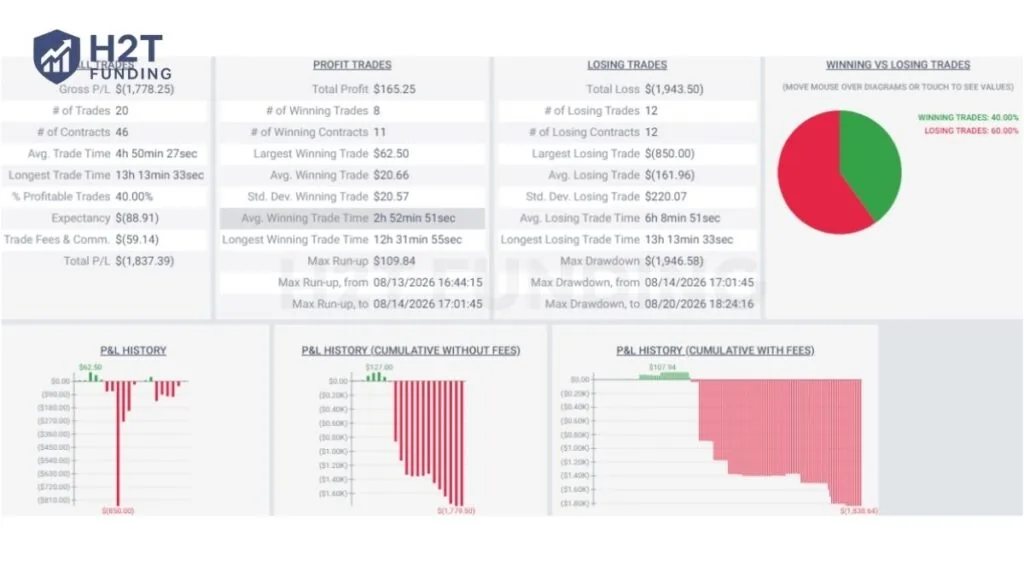
H2T Funding experience: Our $50,000 Finotive Futures 1-Step Challenge test showed why risk discipline matters before attempting a prop firm evaluation. Across 20 closed trades, the account recorded a 40% win rate and a net loss of $1,837.39 after fees. The main issues were position sizing errors, holding losing trades too long, and trading under pressure to pass the evaluation quickly.
The account also showed why advertised account size and actual drawdown capacity are different. Despite the $50,000 account size, its $2,000 EOD trailing maximum drawdown left only $54.67 of remaining buffer near the end of the test period. This reinforced a practical lesson: funded-account readiness depends on disciplined risk control, not simply on demo profitability.
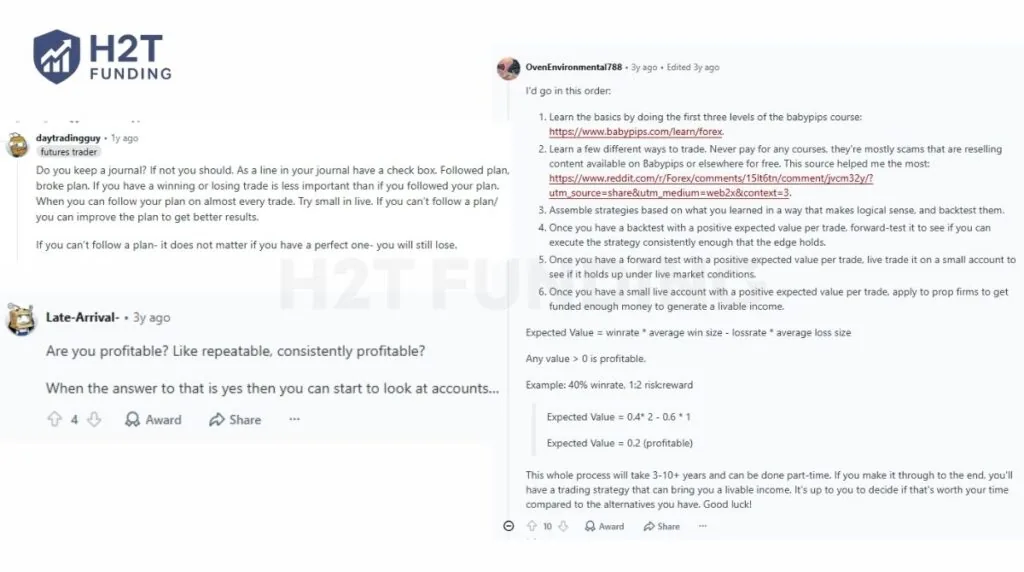
Community discussions reinforce the same point: repeatable execution matters more than a short profitable streak. Traders often focus on whether a strategy keeps its edge through testing, whether results stay consistent, and whether the trading plan is followed under pressure.
“Once you have a forward test with a positive expected value per trade, live trade it on a small account…” – u/OvenEnvironmental788, r/Forex
“Are you profitable? Like repeatable, consistently profitable?” – u/Late-Arrival-, r/Forex
“If you have a winning or losing trade is less important than if you followed your plan.” – u/daytradingguy, r/Daytrading
Moving too early can turn weaknesses that feel harmless on demo into real costs:
- Evaluation fees can add up: Repeated failures can make challenge fees a recurring expense.
- Weak habits get exposed: Overleveraging, moving stop-losses, or revenge trading become more damaging under prop firm rules.
- Unproven performance creates false confidence: A short profitable demo streak may not reflect how your strategy performs across different market conditions or under funded-account pressure.
Move to a funded account when your process is proven, not just when your P&L looks good. Consistent execution, controlled risk, and rule discipline are stronger readiness signals than one profitable month.
7. Which option works best for new traders?
A demo account works best for most new traders because it allows you to learn execution, test strategies, and practice risk control without risking personal capital or paying evaluation fees. A funded account becomes more suitable after your trading process is consistent and you can follow strict rules under pressure.
For beginners, a demo account offers four practical advantages:
- Zero financial risk: You trade with virtual funds while learning how markets and platforms work.
- Platform practice: You can learn order placement, stop-losses, position sizing, and chart tools without costly mistakes.
- Strategy testing: You can test setups and trading ideas before putting money at risk.
- Lower pressure: You can focus on building a repeatable process without payout targets or account-loss consequences.
A funded account usually makes more sense later because it introduces evaluation costs, stricter risk limits, and greater psychological pressure. These conditions can expose weak habits quickly when a trader has not yet built consistent execution.
The5ers founder Gil Ben Hur similarly emphasizes the role of discipline in prop trading:
“For a beginner, a prop firm isn’t just a funding source; it’s the ultimate training ground for discipline.” – Gil Ben Hur, Founder of The5ers
This supports the idea that beginners should first build a stable trading process, rather than treating funded capital as a shortcut around learning.
That does not mean every beginner must stay on demo for a fixed number of months. Readiness depends more on repeatable performance and rule discipline than on time alone. Once you reach that stage, you can compare the best prop firms for beginners based on simpler rules, evaluation structure, costs, and payout conditions.
8. Common misconceptions about funded accounts
Common misconceptions about funded accounts usually come from assuming that funded always means live capital, advertised account size equals usable risk, or passing an evaluation guarantees easy payouts. In practice, funded programs vary widely in account structure, execution model, and payout rules.
- Real capital: A $50K funded account does not always mean the trader directly controls $50,000 of live firm capital. Many programs use simulated trading environments, while still paying eligible rewards based on performance.
- Advertised buying power: The headline account size is not the same as the amount you can realistically lose. Your usable risk is limited by drawdown rules, daily loss limits, and other firm-specific restrictions.
- Easy payouts: Passing an evaluation does not guarantee regular withdrawals. Payout eligibility still depends on following trading rules, meeting payout conditions, and maintaining the account within required limits.
- Evaluation equals live trading: Completing a challenge does not always move you into a live brokerage account. Some traders remain on simulated funded accounts after qualification.
- Scam assumptions: A simulated model does not automatically make a prop firm illegitimate. The more important factors are transparent rules, payout history, business practices, and whether the firm honors its stated terms.
Note: “Funded account” describes a status within a prop firm’s program rather than a standardized industry account type. It does not necessarily describe the underlying execution model or the amount of live capital behind each trade.
9. How to choose the right prop firm once you’re ready
Choose a prop firm by matching drawdown rules, evaluation costs, payout terms, trading conditions, and profit splits to your proven trading process. The cheapest or largest account is not automatically the best fit.
Before paying for an evaluation, check five factors:
- Drawdown rules: Confirm daily and maximum loss limits, including whether drawdown is static, trailing, or end-of-day based.
- Evaluation costs: Compare challenge fees, activation fees, reset costs, and any recurring charges.
- Payout terms: Review payout frequency, eligibility requirements, minimum withdrawals, and consistency rules.
- Trading conditions: Check news trading, overnight holding, weekend positions, supported markets, and platform access.
- Firm reliability: Look for clear terms, documented payout history, accessible support, and a stable operating record.
Topstep describes its own evaluation process this way:
“Our $50 Trading Combine isn’t just a test; it’s a training ground where you develop the exact risk management and consistency skills you’ll need in your Funded Account.” – Topstep, Official Blog

The broader lesson is that a prop firm’s rules should support your risk-management process rather than force you to change it simply to reach a profit target.
For a broader shortlist, compare the best prop firms based on account structure, trading rules, payouts, and trader fit.
10. FAQ
Not always. Many prop firms place traders on simulated funded accounts rather than giving them direct control of live firm capital. However, eligible profits can still result in real cash payouts under the firm’s payout rules.
A $50,000 funded account does not have a standard industry-wide price. Depending on the prop firm and evaluation model, a 50K program can cost from roughly $50 per month to more than $200 as an upfront evaluation fee. Activation fees, reset fees, market data, or instant funding can increase the total cost.
No, a standard demo account does not generate withdrawable profit because it uses virtual funds. Demo trading is mainly used to practice execution, test strategies, and build consistency before moving to a live or funded environment.
There is no fixed number of weeks or months that applies to every trader. Move forward when your strategy shows repeatable results, your risk management is stable, and you can follow firm-style rules consistently. You can also review our guide on how to pass a prop firm challenge before attempting an evaluation.
Yes, funded accounts can be legitimate when they are offered by established prop firms with clear rules and reliable payout practices. Firms such as The5ers, FTMO, Topstep, and Maven Trading are examples of recognized names in the prop trading industry. Always verify current terms, payout policies, and account structure before paying for an evaluation.
If you breach a funded account’s maximum loss, daily loss, or other critical rules, the firm usually closes or disables the account, and you lose funded status. For a simulated funded account, you generally do not repay the firm for simulated trading losses, but evaluation, activation, or reset fees may be non-refundable.
11. Conclusion
The funded account vs demo account decision comes down to your trading readiness, risk discipline, and ability to perform under real rules and payout conditions. Demo accounts are best for building skills and testing consistency, while funded accounts are better suited to traders who can follow strict drawdown limits, protect capital, and execute a proven strategy under pressure.
There is no need to rush the transition. A repeatable process matters more than a short profitable streak. Once your trading is consistent, the next step is choosing a prop firm whose rules, costs, and payout structure match your strategy.
For more practical guidance, explore the Prop Firm Guides on H2T Funding to learn how prop firms work, compare funding models, understand trading rules, and prepare for funded account evaluations.
Disclaimer: This content is for educational and informational purposes only and does not constitute financial, investment, or trading advice. Prop firm rules, fees, account models, and payout terms can change, so always verify the latest information directly with the firm before purchasing an evaluation or funded account. Trading involves risk, and past performance does not guarantee future results.