


Neither a prop firm nor a personal account is automatically better. A prop firm generally fits traders with limited capital who want access to a larger account size, while a personal account fits traders with sufficient capital who want full control and no profit split.
A prop firm may give you access to a $10,000 – $500,000+ funded or simulated account after an evaluation, but you must follow firm-specific rules. A personal account uses your own deposited capital and has no prop-firm profit split.
Read the full article below from H2T Funding to see how capital access, drawdown rules, taxes, and payout structure actually compare, and which model fits your situation right now.
Key takeaways
- Prop firm = funded or simulated account; personal account = your own capital. Many online prop firms use simulated accounts, while personal accounts use money you deposit with a broker.
- $10,000 – $500,000+ capital (prop firm) vs. your own deposit (personal account): prop firms unlock large buying power through evaluation; personal accounts cap it at what you deposit.
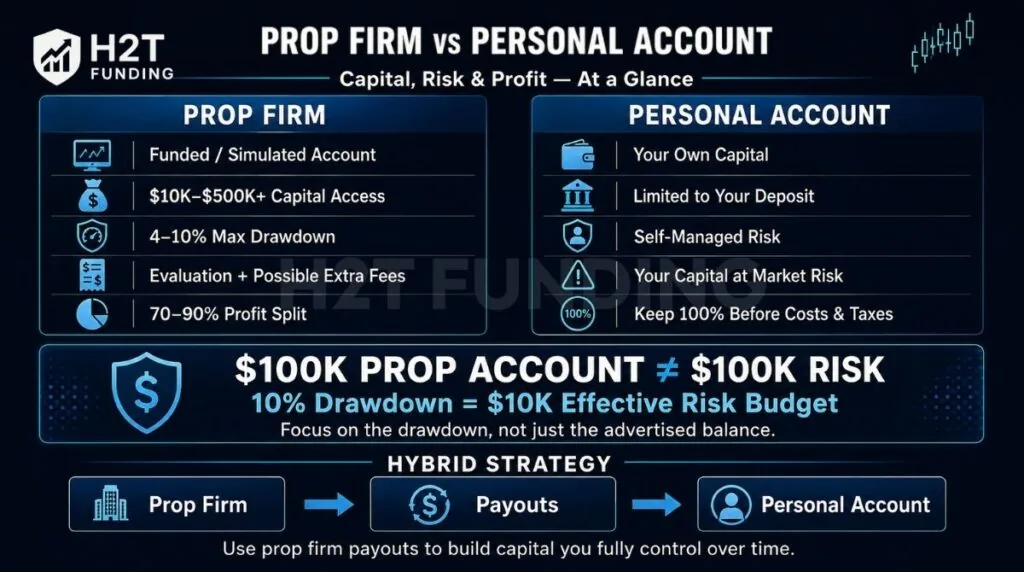
- 4-10% max drawdown = your real risk budget, not the advertised balance. A $100,000 funded account with 10% drawdown gives you $10,000 of actual risk room.
- Lower upfront risk vs. deposited capital at risk: prop firms start with an evaluation fee, but extra fees can add up. Personal accounts put your deposited capital at market risk.
- Profit split (prop firm) vs. no split (personal account): prop firms often pay traders 70–90%, while personal accounts keep all trading profits before costs and taxes.
- The hybrid strategy: many traders use prop firm payouts to fund and scale a personal account over time, instead of picking just one.
1. Prop firm vs personal account: the core difference
The core difference is how capital, risk, and account rules are structured. Many online prop firms give traders access to funded or simulated accounts under firm-specific rules, while a personal account uses money you deposit yourself. Prop firm costs can include evaluation, reset, subscription, or platform fees, while personal-account losses directly affect your own capital.
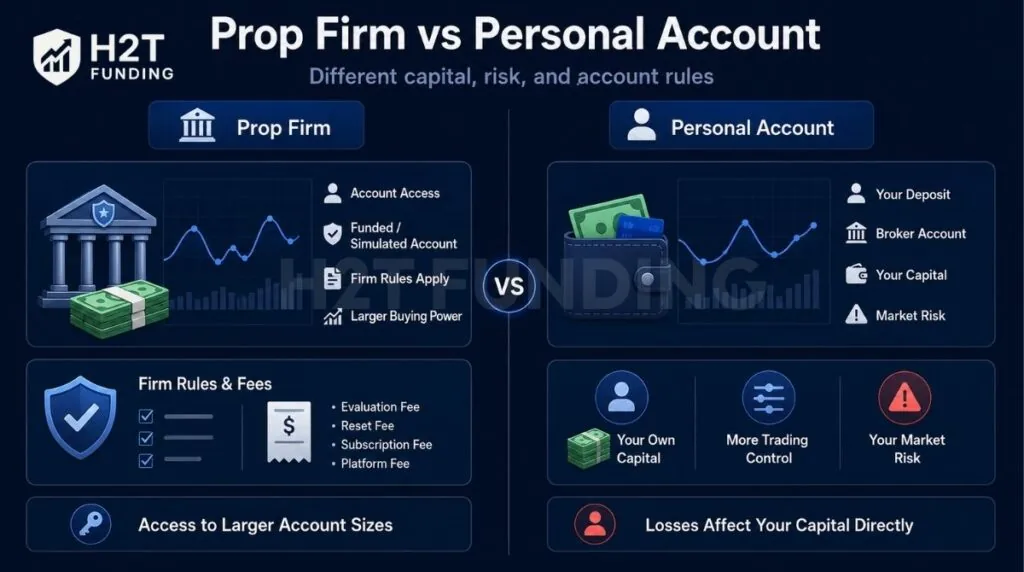
Here is how these two models contrast across the metrics that matter most:
- Capital and risk: Prop firms can provide access to larger funded or simulated account sizes for an upfront fee, but repeated attempts and other fees can increase your total cost. Personal accounts use your own deposited capital, which remains exposed to market losses.
- Rules and freedom: Prop firms may enforce drawdown limits, daily loss limits, or consistency rules. Personal accounts offer more trading freedom but remain subject to broker risk controls.
- Profits and costs: Prop firms keep a meaningful share of every payout in exchange for the capital they provide. Personal accounts have no prop-firm profit split, although broker costs and taxes still apply.
A prop firm is not the same as a brokerage account. A traditional broker executes trades using your deposited capital and generally does not impose prop-firm-style profit targets or consistency rules. However, brokers can still enforce margin, leverage, liquidation, position, and product-specific limits.
Quick comparison table
| Criteria | Prop firm | Personal account |
|---|---|---|
| Capital source | Funded or simulated account, depending on the firm | Your own deposit |
| Starting cost | $50-$1,000+ evaluation fee | The deposit amount you choose |
| Profit split | Varies by firm and program; 70–90% is common among many online firms | 100% to trader |
| Loss exposure | Evaluation and other applicable fees; account access can be lost after a rule breach | Deposited capital is exposed to market loss |
| Trading rules | Firm-specific drawdown, loss, payout, or consistency rules | None from a third party |
| Capital ceiling | $10,000-$500,000+ (Typical advertised account sizes) | Limited to your deposit |
| Time to access profits | Subject to evaluation, funded-stage, and payout rules | Subject to broker settlement and withdrawal rules |
Data verified as of August 2026.
2. How much trading capital can you actually access?
The trading capital you can access depends entirely on the funding model you choose. Many online prop firms offer access to larger funded or simulated account sizes through an evaluation. Personal accounts restrict your baseline capital to your actual cash deposits, though broker leverage can multiply that amount.
Prop firm accounts:
- Headline size: Depending on the firm, an evaluation can provide access to a funded or simulated account much larger than your upfront fee.
- Cost of access: You do not need to save tens of thousands of dollars. You pay an upfront evaluation fee, typically $50 to a few hundred dollars.
- Scaling mechanics: Capital growth is governed by the firm’s scaling plans, or by your ability to manage multiple funded accounts at once, each with its own recurring cost.
Personal accounts:
- Headline size: Your account balance equals the funds you personally deposit.
- Broker leverage: Regulated brokers often offer margin leverage, such as 4:1 on equities, letting a smaller deposit control a larger position.
- Cost of access: You fund the account entirely out of pocket, with no evaluation fee required to start.
Prop firms solve a specific problem: They remove the barrier of needing a large bankroll before you can trade meaningful size. Community discussions on trading forums highlight a critical caveat, though.
Access to a $100,000 funded tier does not mean you actually have $100,000 to lose. That headline number is restricted by firm-specific drawdown rules, which vary significantly by program. Together, these rules shrink your real risk parameters far below the advertised figure.
3. What your “advertised balance” really means: nominal capital vs. effective risk budget
The advertised balance on a funded account is not the amount you can actually risk. A $100,000 funded account with a 10% maximum drawdown limit gives you a real risk budget of $10,000, not $100,000. Breach that $10,000 limit, and the account closes, regardless of the headline number on your dashboard.
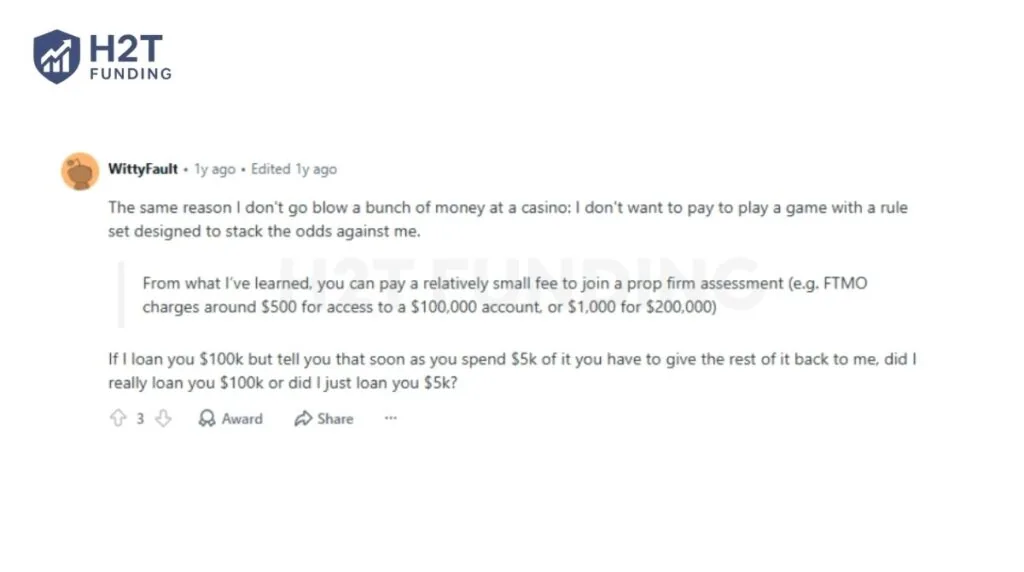
Think of it this way: if a lender hands you $100,000 but takes the rest back the moment you spend $5,000, the real loan was $5,000. The same logic applies to a funded account. The size that matters is the drawdown limit, not the number printed on the balance. One trader put the same idea more bluntly in a discussion about prop firm capital:
“Did I really loan you $100k or did I just loan you $5k?” – u/WittyFault, r/Daytrading
A personal account does not have the same firm-imposed drawdown gap. Your full deposited balance is ultimately exposed to market loss, but your actual risk budget should be set through position sizing, stop-loss levels, and your own risk-management plan.
Size trades based on the effective risk budget, not the advertised balance. A $100,000 funded account with a $10,000 drawdown limit should be managed like a $10,000 personal account. Always check the drawdown rule before comparing funded account sizes.
4. Risk management and trading rules: drawdown types, daily limits, consistency rules
Prop firm accounts can add several layers of firm-imposed risk control that personal accounts do not use.
Drawdown types:
- Trailing drawdown: the loss limit rises with your highest account balance or open equity, sometimes called a high-water mark. Even unrealized floating profit can push this ceiling higher.
- Static (balance) drawdown: the maximum loss stays fixed at a set percentage below your starting balance, regardless of peak floating profit.
- Broker and margin limits (personal account): no prop-firm drawdown rule applies, but your positions are still subject to account equity, margin requirements, leverage limits, and broker liquidation rules.
Daily limits: many prop firms impose a daily loss limit, but the percentage and calculation method vary by firm and program. Personal accounts generally have no prop-firm-style daily loss rule, although broker margin and liquidation controls still apply.
Consistency rules: some prop firms limit how much of your total profit can come from one trading day, with thresholds varying by program. Personal accounts generally do not have this type of payout-related consistency rule.
5. Profit split vs. 100% profit retention: the real dollar math
A personal account has no prop-firm profit split, so you keep your trading profits before broker costs and taxes. Many prop firms share profits with traders, often around 70-90% depending on the program, in exchange for access to a larger funded or simulated account. The real dollar math depends on capital scaling, not just the split percentage.
The example below uses a modest 2% monthly return purely to illustrate the math. It is not a typical or guaranteed result, since actual returns vary by trader, strategy, and market conditions.
$5,000 personal account:
- Gross monthly profit: $100
- Profit retention: 100% = $100 take-home
- Minus broker spreads and commissions: roughly $80-$95 net
$100,000 prop firm account (80/20 split):
- Gross monthly profit: $2,000
- Profit split: trader keeps 80% ($1,600), firm keeps 20% ($400)
- Minus a monthly platform or data fee, where applicable: roughly $1,550-$1,590 net
Even after giving up a share of gross earnings, the net take-home on a funded account can far exceed a small personal account, purely because of the difference in baseline buying power. Capital size can matter more than the profit-split percentage when comparing the two models.
Compounding speed is the key difference. Growing $5,000 to $100,000 can take years, while a prop firm gives you access to larger capital much faster. In return, you pay an evaluation fee and share part of the profit.
Evaluation cost can compound too. If a trader does not pass an evaluation on the first attempt, each additional attempt adds another fee to the real cost of reaching a funded account. That running total is worth tracking before comparing prop firm costs to a personal account’s zero entry fee.
6. Simulated vs. live capital: what’s actually behind your “funded account”?
Many modern online prop firms use simulated accounts rather than giving traders direct access to a live brokerage account. FTMO, for example, states in its terms that its client accounts use fictitious funds:
“All accounts we provide to our clients are demo accounts with fictitious funds.” – FTMO, Terms and Conditions
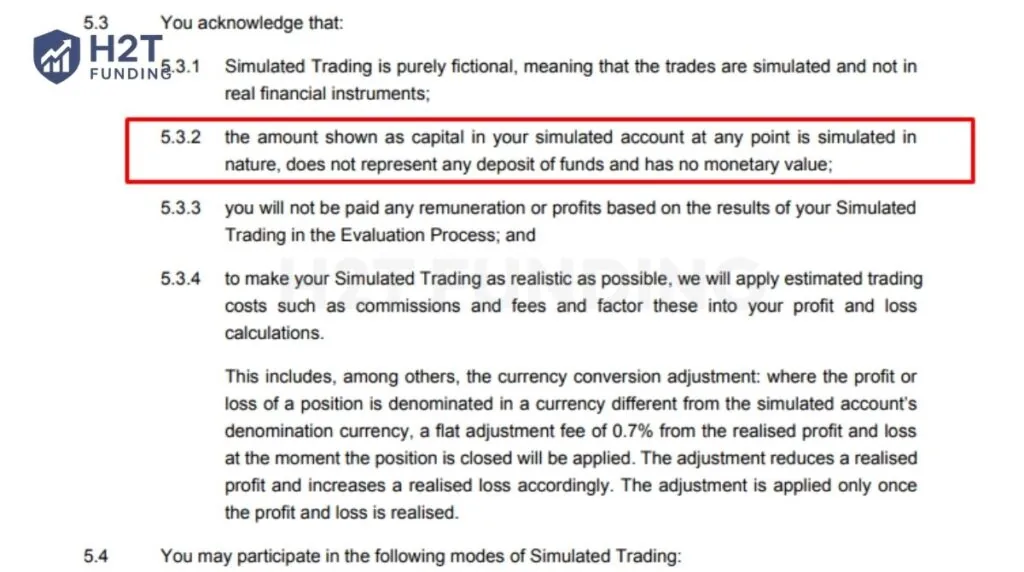
FundedNext’s Challenge Terms go further, addressing what happens to the profit itself before it becomes a payout:
“Simulated profits… have no monetary value… unless expressly converted into a Performance Reward.” – FundedNext, CFD Challenge Terms, Section 1.7
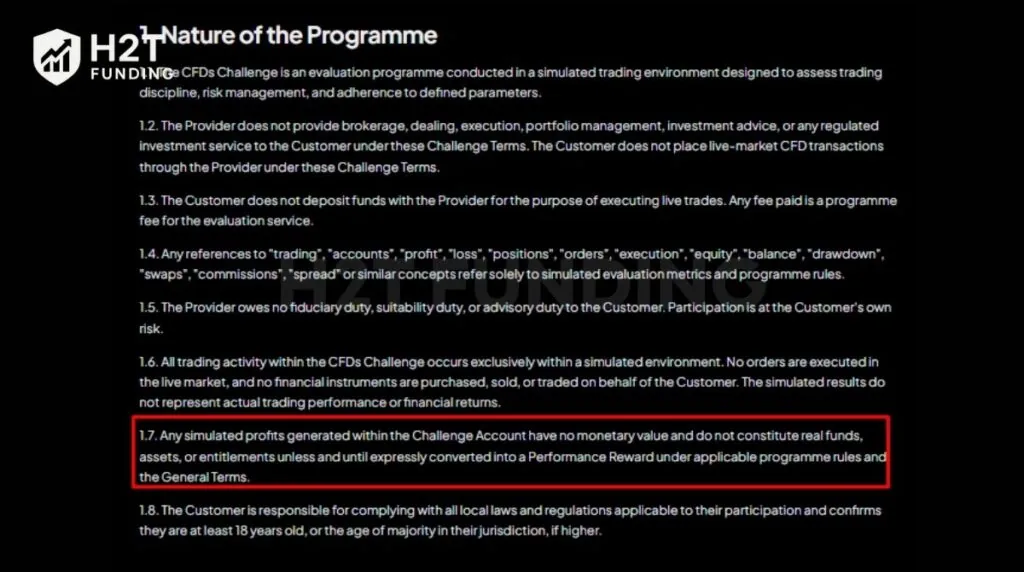
Simulated trading can still use market data and conditions designed to resemble live trading. However, execution, liquidity, slippage, and pricing can differ from a live brokerage environment. A simulated profit only becomes withdrawable money when the firm approves and pays the trader’s reward under its payout rules.
A personal account skips this conversion step entirely. Profit and loss post directly to your broker balance the instant a trade closes, because the capital was always yours.
How a prop firm finances trader rewards depends on its business model and internal risk structure. Traders should check the firm’s own disclosures rather than assume that evaluation fees directly fund payouts.
7. Costs and fees compared: challenge fees vs. your own capital at risk
Prop firm costs can include evaluation fees, resets, subscriptions, platform fees, and market-data charges, while personal accounts require your own deposit plus normal trading costs such as spreads, commissions, and swaps. A prop firm may require less upfront trading capital, but repeated fees can increase its total cost over time.
Cost structure breakdown
| Cost factor | Prop firm challenge ($100K account) | Personal capital ($5,000 account) |
|---|---|---|
| Upfront cost | $50-$1,000+ evaluation fee | Full deposit ($5,000) |
| Maximum downside | Evaluation and other fees paid; account access may be lost after a rule breach | Full deposit, exposed to live market loss |
| Recurring costs | Monthly data fees, platform subscriptions, and reset fees if rules are breached | Spreads, commissions, and overnight swap fees |
| Profit retention | 70-90%, paid by the firm | 100%, minus broker fees |
Data verified as of August 2026.
- Fee-to-drawdown comparison: A $500 evaluation fee for a $100,000 challenge with a 10% maximum drawdown gives you a $10,000 drawdown allowance. That creates a 20:1 ratio between the drawdown allowance and the evaluation fee, but it is not the same as financial leverage.
- The reset trap: Breaking a drawdown rule may require a paid reset. Repeated breaches can turn several successful evaluations into ongoing costs without a payout. A personal account has no reset fee, and profits stay in your account.
- Futures data costs: Both prop firm and personal futures accounts may require separate market-data subscriptions. Fees vary by exchange, platform, data package, and professional classification, so traders should verify current rates with their provider.
- Margin is not the same as safe trading capital: Some brokers offer very low intraday margin requirements for Micro E-mini futures, but these amounts vary and can change. The minimum margin needed to open a position is not the same as the account equity needed to manage losses and normal market volatility.
8. The psychological difference: trading someone else’s money vs. your own
The psychological pressure is different rather than automatically lower. Personal accounts create pressure from risking your own money, while prop firms shift more of that pressure toward drawdown breaches, rule compliance, and losing account access.
Trading your own money:
- Fear of loss: Every drop in balance registers as a direct hit to money you already own.
- Overthinking: Traders often close winning trades too early, driven by fear of giving profit back.
- Ego threat: A loss on personal capital feels like a personal failure in a way that losing simulated capital does not.
- High stress: Self-worth can become tied to short-term financial results.
Trading a prop firm’s capital:
- Different loss pressure: A funded-account loss does not directly reduce your deposited trading capital, but it can cost you account access.
- Potential risk-taking bias: Some traders may take larger risks when the capital feels less personal, a behavioral pattern linked to the house money effect.
- Emotional detachment: The balance can feel more like a number on a screen than real savings.
- Rule-based pressure: Passing an evaluation and keeping an account funded creates its own form of stress, closer to keeping a job than protecting personal wealth.
The pressure changes shape; it does not disappear. Prop firm traders face drawdown and consistency rules, while personal account traders face the full emotional impact of losing their own money. Discipline built under either model can carry over to the other.
A trader still building consistency benefits from testing that discipline on a small personal account first. A trader who already trades with steady discipline is better positioned to handle the rule-based pressure a funded account adds on top.
Read more:
9. Regulatory protection and counterparty risk: what’s actually different
A personal account with a regulated broker generally provides clearer legal ownership of deposited funds, but the exact protections depend on the broker, product, and jurisdiction.
Many online prop-firm accounts do not receive the same brokerage protections because the firm may operate as an evaluation or software company rather than a registered broker-dealer.
This gap matters most at the point of payout. In a personal account, your profit posts directly to your own broker balance. In a prop firm relationship, the firm remains the sole party responsible for paying out your reward, and if the firm changes its terms or runs into financial trouble, recourse can be limited.
Regulatory exposure also depends heavily on where you live, not just which model you choose. India is a clear example. The Reserve Bank of India (RBI) addressed this directly in an official clarification:
“…is not permitted under the Foreign Exchange Management Act (FEMA), 1999.” – Reserve Bank of India, “No Permission for Forex Trading Overseas”
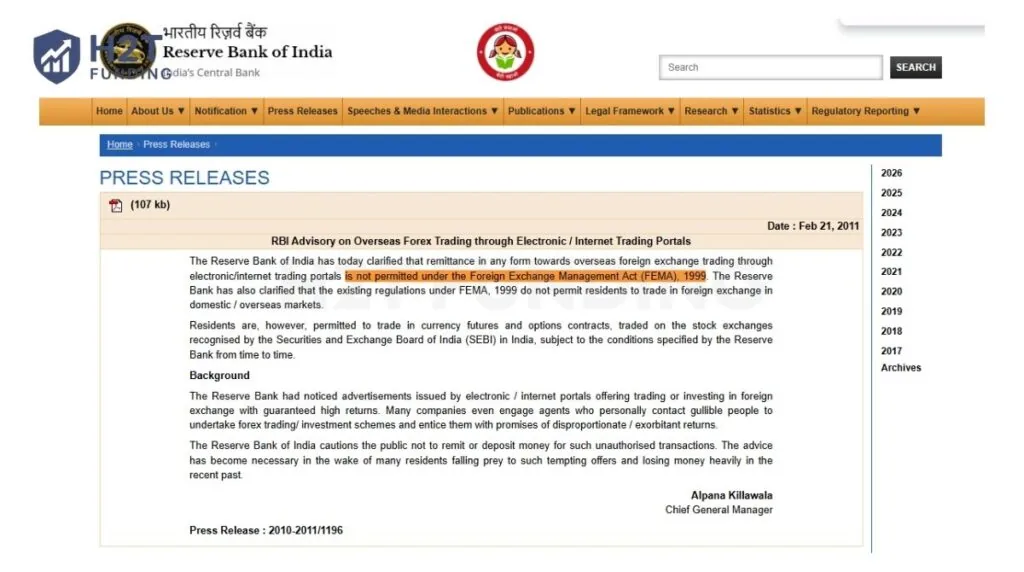
RBI has separately clarified that its Liberalised Remittance Scheme, which allows residents to send up to $250,000 abroad each year for approved purposes, excludes margin or leveraged foreign exchange trading from those approved purposes.
Indian residents should verify current RBI and FEMA rules before sending money for offshore forex-related activities. Rules for margin remittances, broker funding, and prop-firm evaluation fees may not be identical, so each payment type should be checked separately. Using an authorized domestic provider can reduce cross-border regulatory exposure.
10. How are prop firm payouts taxed vs. personal trading profits?
In the U.S., prop firm payouts may be treated differently from profits earned in a personal brokerage account. A prop firm payout may be reported as nonemployee compensation, such as on Form 1099-NEC, when the payment is treated as compensation for services. Self-employment tax may also apply depending on the taxpayer’s circumstances and how the income is classified.
Personal trading profits follow different tax rules depending on the asset and contract type. Short-term capital gains are generally taxed at ordinary income tax rates, while eligible Section 1256 contracts may receive 60% long-term and 40% short-term capital-gain treatment. Forex taxation can follow different rules depending on the instrument and tax election.
Tax treatment varies by trader, entity structure, instrument, and jurisdiction. Confirm your specific situation with a qualified tax professional before filing. Trader discussions also show that this tax distinction often causes confusion, but community comments should not be treated as tax guidance.
“Prop firm gives out 1099 NEC, which is considered earned income.” – trader comment, r/Daytrading

Always confirm the current rule with a licensed tax professional in your country before filing, since prop firm payout structures and tax codes both change.
11. Which one fits you? A practical decision framework (not just “it depends”)
A prop firm generally fits traders with limited capital who want access to a larger account size, while a personal account fits traders with sufficient capital who prioritize control, no prop-firm profit split, and fewer external trading rules. Use this table to match your situation to the model that fits.
| If your situation is… | You may fit better with… |
|---|---|
| Very limited starting capital (under a few hundred dollars) | Prop firm evaluation or a cent account, since a personal account this small leaves little room for real risk management |
| Moderate capital, proven discipline, want full profit retention | Personal account |
| Moderate capital, still building consistency | Personal account first, to build discipline with real but limited stakes |
| Want to scale capital fast without saving for years | Prop firm evaluation |
| Cannot tolerate losing personal savings | Prop firm evaluation, since loss exposure caps at the fee paid |
| Want zero external rules on strategy, hours, or holding positions | Personal account |
A trader with very little capital available gains more from a low-cost prop firm evaluation or a cent account, a broker account type that lets you trade in cents instead of full dollars to keep your absolute risk small, than from a personal account too small to absorb normal drawdowns. Traders discussing this exact scenario in prop firm communities tend to agree:
“A personal account gives very limited room for risk management.” – Freya Louise, FTMO Trader’s Community
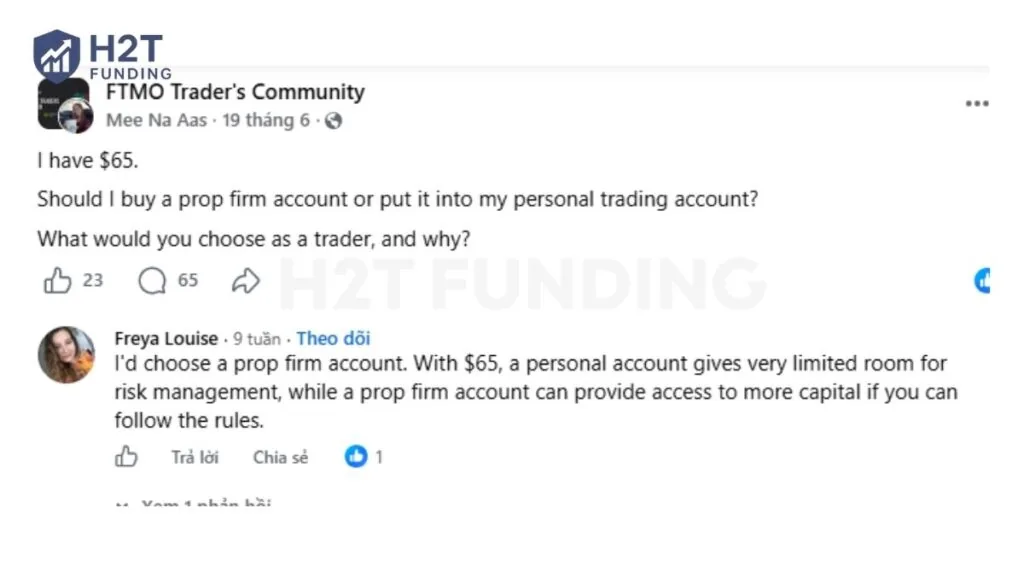
A trader with steady capital and proven discipline usually gains more from full profit retention on a personal account.
12. The hybrid approach: how to actually sequence a prop firm and a personal account
A practical hybrid strategy is to use a prop firm for capital access, then direct part of successful payouts into a personal account over time. After establishing a consistent payout history, you can use a portion of each payout to build capital that you fully control without prop-firm drawdown rules.
Traders in prop firm communities describe this exact sequencing, independently of one another:
“Use those payouts to fund your own account.” – u/daytradingguy, r/Daytrading
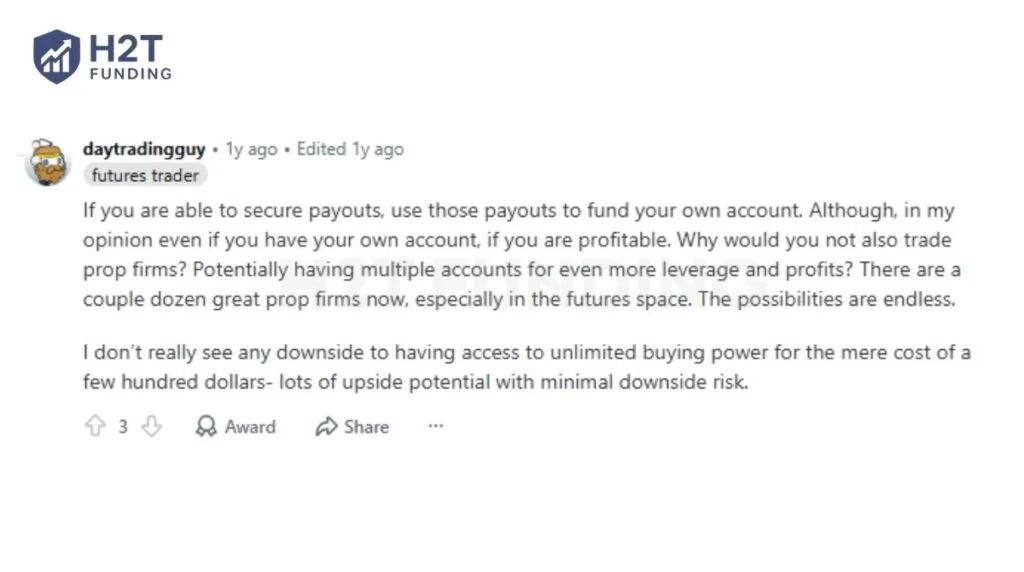
This sequencing works because it separates two different jobs: the prop firm handles capital access while you are still under-capitalized, and the personal account becomes the long-term asset you fully own once payouts start compounding.
13. How to choose a prop firm if you go that route
Choose a prop firm by comparing its drawdown model, payout terms, consistency rules, fees, and account structure. Before paying any evaluation fee, verify these points directly on the firm’s own terms page:
- Drawdown type: static or trailing, and the exact percentage.
- Consistency rule: percentage cap and whether it applies during evaluation, funded stage, or both.
- Payout method and minimum withdrawal: confirm both before funding.
- Reset fee: cost and conditions if you breach a rule.
- Simulated vs. live language: read the terms section that states whether funds are simulated.
Some traders in community forums have raised concerns about payout denials and unclear rule enforcement at certain firms, which is exactly why checking the official terms directly, rather than relying on marketing pages or affiliate reviews, matters before paying an evaluation fee.
For a full side-by-side breakdown of firm-specific rules, see the best prop firms comparison. If you want to see how a specific firm handles these rules in practice, our FTMO, The5ers, and FundedNext reviews cover each firm’s current terms in detail.
14. FAQ
-
A funded account is an account a trader receives after meeting a prop firm’s requirements. Many modern online prop firms use simulated funded accounts rather than live brokerage accounts, but the exact structure varies by firm and program.
-
The main disadvantages are profit splits, firm-specific drawdown rules, payout conditions, and the pressure of maintaining account eligibility. A personal account avoids all three but caps your buying power at your own deposit.
-
Neither wins outright. A prop firm is the better fit when your available capital is too small to trade meaningful size and you can accept its rules. A personal account is the better fit once you have enough capital and want full control without prop-firm drawdown rules.
-
Yes. You can use a funded account for capital access while building a personal account in parallel, including by allocating part of your prop-firm payouts to personal trading capital.
-
In the U.S., prop firm payouts may be treated as compensation for services, while personal trading profits follow tax rules based on the asset and contract type. Self-employment tax may apply to some prop-firm income, while eligible Section 1256 contracts can receive 60/40 treatment. Confirm your specific tax treatment with a qualified professional.
-
No. A brokerage account uses your own deposited capital, while a prop firm gives you access to an account under its own rules. Many modern online prop firms use simulated balances, although some proprietary trading models can involve live capital.
-
Start with whichever matches your current capital. If your available funds are too small to manage risk properly on a personal account, start with a prop firm evaluation. If you already have workable capital and proven discipline, open a personal account first. For a step-by-step walkthrough of passing an evaluation, see our guide to passing a prop firm challenge.
15. Final thoughts
The prop firm vs personal account choice comes down to capital access, risk, and control. A prop firm can provide access to a larger funded or simulated account under firm-specific rules, while a personal account uses your own capital and has no prop-firm profit split.
Limited capital may make a prop firm evaluation more practical, while sufficient capital and a preference for full control may favor a personal account. A hybrid approach can also use prop-firm payouts to gradually build personal trading capital.
For more guides on evaluation rules, payout structures, and firm-specific comparisons, browse the Prop Firm Guides category on H2T Funding.
Disclaimer: Prop firm rules, fees, and payout structures change frequently. Tax and foreign exchange regulations vary by country and change over time. Always verify current terms directly on the official website of any firm mentioned, and consult a licensed tax or legal professional for advice specific to your situation. This article does not constitute financial, tax, or legal advice.