











📋 Last Updated: April 2026. Firm data – including profit splits, payout speeds, max funding, and challenge types – is sourced from each firm’s official website and verified at time of publication. Figures may change; always confirm current terms directly with the firm before purchasing a challenge.
How do we rank these Prop Firms?
The 8 firms in this guide were selected from a pool of 40+ active prop firms and evaluated across 7 criteria. Each criterion is weighted based on how directly it affects a trader’s funded account experience – not based on affiliate fee or brand size.
| Criterion | What We Measured | Data Source |
|---|---|---|
| Trust score | Trustpilot rating, high review volume, years in operation | Trustpilot, firm website |
| Payout speed | Average and maximum processing time, documented by traders | Firm disclosure, community data |
| Profit split | Minimum and maximum split across all account tiers | Firm pricing pages |
| Scaling potential | Maximum capital ceiling, milestone structure, fees to scale | Firm website |
| Rule flexibility | News trading, EA, weekend hold, consistency rule, time limit | Firm terms and conditions |
| Asset coverage | Instruments available on funded accounts | Firm instrument list |
| Dashboard quality | Analytics features, data access, performance tracking tools | Platform review |
All firm data was verified directly from each firm’s official website in April 2026. Where firm disclosures were ambiguous, we defaulted to the more conservative interpretation. Figures – including profit splits, payout speeds, and challenge fees – change frequently. Confirm current terms on the firm’s website before purchasing a challenge.
How to choose the best prop firms
Our evaluation process goes far beyond the headline-grabbing funding amounts and high profit splits. We focus on the details hidden in their rules and trading environment, because that’s what determines a trader’s real chance of success. Our entire framework is built on a few non-negotiable pillars.
Here are the key factors we evaluate before making a decision.
- Reputation and trustworthiness: We start by analyzing a firm’s history and real community feedback, like Trustpilot, Reddit, and Discord. A long, proven track record of consistent and on-time payouts is the absolute baseline for any consideration.
- Evaluation rules: This is where most traders fail. We will scrutinize these three core metrics:
- Profit target: Is it realistic and achievable within the strategy?
- Maximum drawdown: Understand if it’s based on initial balance or equity (a trailing drawdown is much harder to manage).
- Daily drawdown: Check how it’s calculated. Some firms use balance, others use equity, which can impact your risk management.
- Profit split and scaling plan: We prioritize firms with competitive profit splits and clear scaling paths that reward consistent performance.
- Trading conditions and allowed strategies: A firm should not force a trader to change a winning strategy. We look for flexibility on news trading, weekend holding, and EA use.
- Payout system: A firm’s reliability is proven when it’s time to pay its traders. We prioritize firms with a history of fast, consistent withdrawals, as this is a key indicator of their financial health and trustworthiness.
- Customer support: Finally, no firm makes the list without its support channels being tested. A professional, knowledgeable, and responsive team is a non-negotiable sign of a well-run operation.
This framework allows us to filter out the noise and identify the firms that offer a balanced, fair, and supportive environment. The best prop firm for you is one that provides a genuine opportunity for a disciplined trader to build a successful career.
How to become a prop trader
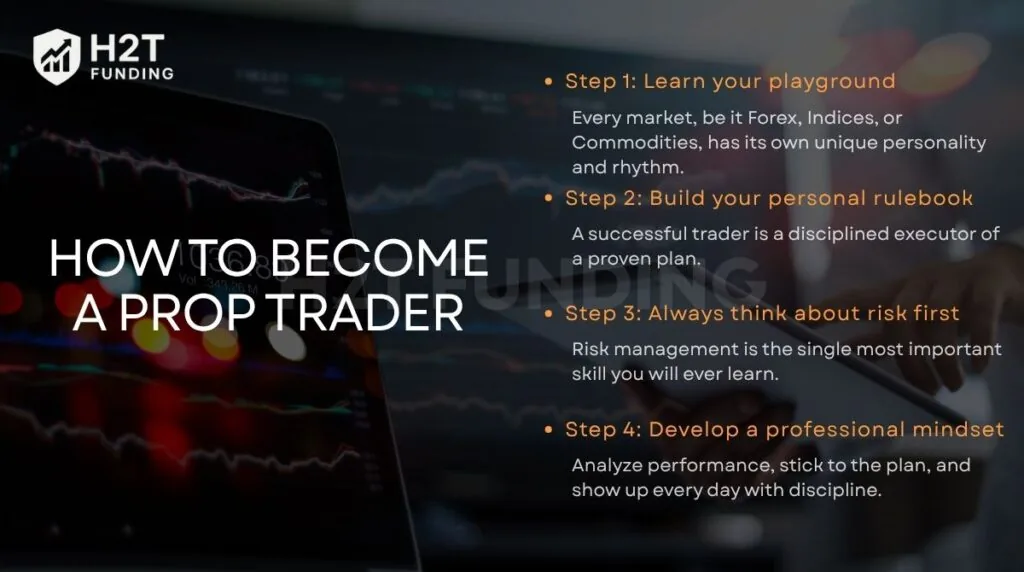
Before you ever think about passing a challenge, you have to focus on building a trader who is actually capable of winning. This isn’t about finding shortcuts or the perfect firm. It’s about forging the skills and the mindset that make you a valuable asset. What that foundational journey will look like:
- Step 1: Learn your playground
- Step 2: Build your personal rulebook
- Step 3: Think about risk first
- Step 4: Develop a professional mindset
Dive into each step and see what becoming a real prop trader truly requires.
Step 1: Learn your playground
Every market, be it Forex, Indices, or Commodities, has its own unique personality and rhythm. Your first job is to pick one and get to know it intimately. Understand what makes it move, when it’s most active, and what news events cause it to react. Don’t try to trade everything. Become a specialist in one area first.
Step 2: Build your personal rulebook
A successful trader is a disciplined executor of a proven plan. You must develop your own trading strategy with crystal-clear rules:
- What is your exact entry signal?
- Where do you place your stop loss?
- What are your conditions for taking profit?
Write these rules down. A strategy that only exists in your head is not a strategy; it’s just an idea.
Step 3: Always think about risk first
New traders are obsessed with making money. Professionals are obsessed with not losing it. Risk management is the single most important skill you will ever learn. Before entering any trade, you must know exactly how much you are willing to lose. This isn’t just about placing a stop loss; it’s about developing a deep respect for your capital.
Step 4: Develop a professional mindset
This is the internal game, and it’s where most people fail. You must learn to separate your emotions from your trading outcomes. A winning trade doesn’t make you a genius, and a losing trade doesn’t make you a failure. Treat your trading like a business: analyze performance, stick to the plan, and show up every day with discipline, regardless of how you feel.
Becoming a prop trader is less about the final act of getting funded and more about the daily process of becoming a professional. A clear strategy, an obsession with risk management, and a disciplined mindset will make the difference. When you have these, passing a challenge is simply the next step.
Step-by-step guide to joining and succeeding with prop firms
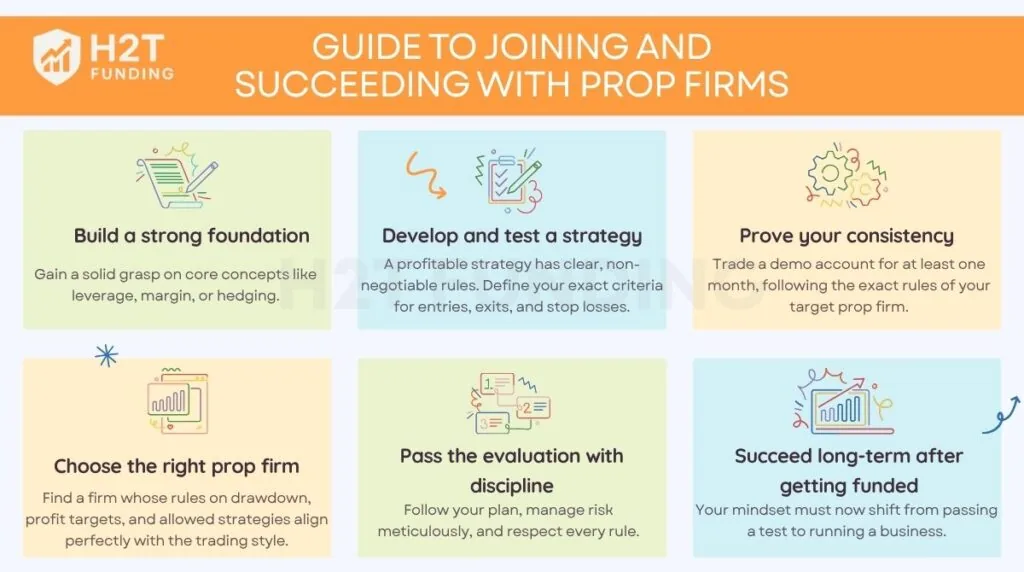
Becoming a prop trader is a clear, skill-based path, not a lottery ticket. This journey transforms you from an aspiring trader into a disciplined professional capable of managing significant capital. The process is straightforward and focuses on proving your ability through consistent action. Here are the essential steps to get funded:
- Step 1: Build a strong foundation
- Step 2: Develop and test a trading strategy
- Step 3: Prove your consistency
- Step 4: Choose the right prop firm
- Step 5: Pass the evaluation with discipline
- Step 6: Succeed long-term after getting funded
Let’s break down each step so you can follow the path with clarity.
Step 1: Build a strong foundation
First things first, you have to learn the language of the markets. Gain a solid grasp on core concepts like leverage, margin, or hedging. More importantly, make risk management your obsession from day one. This knowledge is the bedrock of your entire trading career; without it, nothing else matters.
Step 2: Develop and test a trading strategy
A profitable strategy has clear, non-negotiable rules. You need to define your exact criteria for entries, exits, and stop losses. Once you have your rules, test them relentlessly. Start with backtesting on historical data, then move to a demo account to prove it works in today’s live market conditions.
Step 3: Prove your consistency
This is the step most aspiring traders skip, and it’s a critical mistake. Before you even think about paying for a challenge, prove to yourself that you can win. Trade a demo account for at least one month, following the exact rules of your target prop firm (e.g., 5% daily drawdown, 10% max drawdown). That builds the discipline you’ll need under pressure and confirms your strategy is truly ready.
Step 4: Choose the right prop firm
Once you’re hitting your goals consistently in a demo environment, it’s time to choose your partner. Revisit the criteria we discussed earlier. Find a firm whose rules on drawdown, profit targets, and allowed strategies align perfectly with the trading style you’ve just proven to be successful.
Step 5: Pass the evaluation with discipline
Think of this as your final exam. Your one and only job is to execute the proven strategy you’ve been practicing. This is not the time to get creative or chase the profit target. Just follow your plan, manage risk meticulously, and respect every rule. Your disciplined demo trading was the dress rehearsal for this moment.
Step 6: Succeed long-term after getting funded
Passing the challenge is the starting line, not the finish. Your mindset must now shift from passing a test to running a business. Your number one job is capital preservation. Focus on trading safely to secure your first payout; this is a huge psychological milestone that builds confidence.
Once you are profitable, the real career-building begins. This is where a good prop firm becomes a powerful partner:
- Focus on scaling: Your consistent performance is the key to unlocking larger capital. Follow the firm’s scaling plan methodically. This is how you turn steady gains into a significant, professional-level income.
- Leverage the community: Don’t trade in isolation. Engage with the firm’s community on Discord or forums. Sharing insights with other funded traders is one of the best ways to stay sharp, motivated, and adapt to new market conditions.
- Use their tools: Top firms provide more than just capital. Take advantage of their performance analytics, educational webinars, and support systems. Use these resources to constantly refine your edge and treat your trading like a professional enterprise.
Remember, the entire journey is a marathon, not a sprint. Each step builds on the last, from your initial education to maintaining discipline with a live account. True success comes from treating this as a professional career, where consistent execution and disciplined risk management always win over shortcuts.
What are the risks of prop trading?
Prop trading may appear to offer access to large capital with minimal personal financial risk, but the reality is far more complex. The biggest dangers aren’t in the market itself, but in the prop firm model. Understanding these risks is key to protecting yourself and your investment.
- The challenge fee cycle: This is the most common trap. Your biggest financial risk isn’t a bad trade; it’s the cycle of buying and failing challenges. Many firms make most of their money from these fees. If you’re not fully prepared, you can end up spending hundreds or thousands of dollars with nothing to show for it.
- The hidden partner risk: You are placing your trust in an unregulated company. The firm could suddenly change its rules, delay payouts, or even shut down overnight, leaving you with nothing. This is why choosing a firm with a long, stable reputation is so important.
- The psychological pressure: Trading with strict rules like a 5% daily drawdown is incredibly stressful. The fear of breaking a rule can cause you to make bad decisions, like closing winning trades too early or being too scared to take a valid setup. This pressure can wreck a perfectly good trading strategy.
- Complex rules designed to fail you: Some firms use confusing rules that are easy to break by accident. A “trailing drawdown” on your equity is a classic example. It moves up with your profits, making it much harder to manage than a fixed drawdown. Always read the fine print carefully.
- Performance-based survival: You are not an employee; you are a contractor. This means there is no job security. Your access to the firm’s capital depends entirely on your consistent performance. A few bad months could mean you’re out, and you have to start the whole process over again.
These risks aren’t meant to discourage you, but to empower you. Being aware of them changes how you approach the industry. It forces you to do your homework, manage your personal finances carefully, and treat this like a serious business. Success isn’t just about good trading; it’s about navigating these challenges wisely.
Common mistakes when choosing a prop firm
We’ve seen traders with solid strategies fail simply because they picked the wrong partner. Your success truly starts with choosing the right firm. Getting this decision right is half the battle, and it begins with sidestepping a few common yet critical mistakes.
Mistake 1: Chasing the highest profit split
A 95% profit split may appear highly appealing, but it’s often a marketing tactic to distract you from what really matters. Instead of being drawn in by that single number, you should focus on the entire package. A standard 80% split from a firm with fair, realistic drawdown rules and a great reputation is always a much better and safer deal.
Mistake 2: Ignoring the firm’s real reputation
Don’t just trust the ads or a slick website. In an unregulated industry, a firm’s track record is everything. The smart move is to dig deeper yourself. Spend time on Trustpilot, Reddit, and the firm’s Discord channel to see what real traders are saying, especially about the speed and reliability of payouts. A long, positive track record is worth far more than any flashy promotion.
Mistake 3: Picking a firm that fights your trading style
A huge mistake is trying to change your strategy to fit a firm’s rules; this rarely works. Instead, you must find a firm that fits you. Before you even start looking, make a short checklist of your non-negotiable needs (e.g., I must be able to hold trades over the weekend). This allows you to quickly eliminate any firm whose rules conflict with your proven style.
Mistake 4: Not understanding the drawdown rules
This is probably the most expensive mistake you can make. Many traders assume all drawdown rules are the same, but they are not. To protect yourself, you must read the FAQ until you find the exact definition.
If you’re not 100% sure how a trailing drawdown works versus a static one, ask their support for a clear example. Never pay for a challenge until you understand precisely how you can fail.
Choosing a prop firm is like choosing a business partner. You’re not looking for the one with the flashiest promises. You’re looking for a reliable, trustworthy partner whose rules align with your own strategy. A little extra research up front will save you a massive amount of money and frustration down the road.
Tips to succeed with prop firms
Getting the funded account is an amazing feeling, but it’s just the starting line. The real challenge, and the real opportunity, is keeping that account and growing it. We have noticed that successfully funded traders share a few core habits, including:
- Trade to survive, not to get rich quickly: Your number one job is no longer to hit a profit target. It’s to protect the firm’s capital. Think of yourself as a risk manager first and a trader second. Focus on small, consistent gains. The big money in prop trading comes from scaling your account over time, not from one heroic trade.
- Secure your first payout: This is a huge psychological milestone. Aim to get your first withdrawal as soon as you’re eligible, even if it’s not a massive amount. The act of getting paid proves to your brain that the process is real. That reduces pressure and helps you trade with a clearer, more confident mindset.
- Master one strategy, one setup: Don’t try to be a jack-of-all-trades. The most consistently profitable traders are masters of one or two specific setups. They know their strategy inside and out and patiently wait for their perfect opportunity. Consistency comes from repeating what works, not from chasing every market move.
- Keep a trading journal like a pro: This is non-negotiable. You must track your trades. Write down your reason for entry, your exit, and how you felt. Reviewing your journal at the end of the week is the fastest way to see your real-world mistakes and strengths. It turns trading from a guessing game into a performance-based skill you can actively improve.
Success with a prop firm boils down to professionalism. It’s about shifting your mindset from passing a test to running a business. Focusing on capital preservation, building confidence with early wins, and mastering your craft through disciplined review, you build a foundation for a long and profitable trading career.
Final Verdict: Which Prop Firm Should You Choose in 2026?
There’s no single best prop firm for every trader. The right choice depends on your experience level, the instruments you trade, your budget, and what matters most to you – speed, flexibility, or upside.
Use this as your decision framework:
- Choose FTMO if you’re new to prop trading and want forgiving evaluation parameters plus strong educational support.
- Choose FundedNext if you trade forex and want raw spreads, zero commissions, and native MetaTrader/cTrader access – it’s also the top pick if you need freedom from consistency rules or want the fastest payouts.
- Choose Alpha Futures if you trade futures and want CME-regulated capital with a clear scaling path.
- Choose Atlas Funded if challenge cost is your main constraint – it currently offers the most budget-friendly entry fees we track.
- Choose Funding Pips if you want to skip the evaluation entirely and get funded almost immediately.
- Choose The5ers if you’re chasing the highest profit split, or if you prefer to trade at your own pace with no fixed time limit.
Trading from outside the US? Filter by your location using our region-specific rankings (US, UK, India, Australia, Singapore, and more) – payment infrastructure and regulatory access vary by country.
Whichever firm fits your profile, don’t skip the fundamentals: confirm whether the drawdown is static or trailing, check real payout history on Trustpilot and Reddit before paying for a challenge, and never chase a headline profit split without reading the rules behind it.
Before purchasing any challenge, check the H2T Funding offers page for the latest discount codes and promotions.
H2T Funding covers prop firm reviews, comparisons, and challenge guides across 60+ firms. If none of the picks above fit your profile, use the full firm directory to filter by asset class, location, drawdown type, and challenge model.