

Prop firm scaling plans automatically increase your funded allocation or contract limits after you hit specific profit targets. These built-in upgrades let you trade larger accounts and earn higher payouts without buying a new evaluation challenge.
This guide explains how these growth mechanisms operate. H2T Funding breaks down the structural differences between Forex balance scaling and futures contract scaling. Read on to compare top firm policies, analyze drawdown adjustments, and choose the right plan.
Key Takeaways
- Scaling requires consistency: You must meet strict profit targets and maintain profitability across multiple review cycles to qualify for an upgrade.
- Forex and futures scale differently: Forex firms add simulated capital to your balance. Futures firms increase your maximum allowed contract size.
- Ceilings are not starting balances: Do not confuse a firm’s maximum scaling ceiling with your initial funded allocation.
- Growth is usually linear: Most plans add a fixed percentage of your original balance per cycle. They do not compound your newly scaled balance.
- Scaling affects withdrawals: Many firms require you to leave a portion of your profits inside the account to absorb future drawdowns after your capital limit increases.
1. What Is a Scaling Plan in a Prop Firm?
A prop firm scaling plan is a structured growth program that increases your simulated capital allocation or contract limits after you prove consistent profitability. Instead of paying for a larger evaluation, the firm rewards steady performance and tests your trading discipline under higher monetary pressure. This system allows you to earn larger payouts over time using the same strategy.
1.1. Scaling plan vs scaling into a trade vs adding more accounts
You must clearly separate official built-in scaling plans from position sizing strategies and multi-account trade copying. Because traders use the word “scaling” differently, you should understand these three distinct concepts:
- Built-in scaling plans: The firm officially increases your account balance or maximum contracts after you hit specific performance milestones.
- Adding more accounts: You purchase multiple separate evaluation accounts and use trade copier software to multiply your total trade volume.
- Scaling into a trade: You manually add more volume to a winning position on your chart. This is a personal risk management strategy, not a firm-provided account upgrade.
1.2. Is the scaled balance real capital? (Simulated vs live)
Most scaled account balances remain simulated funds in a demo environment rather than actual live capital. Companies like Hola Prime and The5ers explicitly state in their official disclosures that funded traders operate on simulated accounts. The firm pays out your profit splits based on the data your simulated trades generate.
Futures prop firms often separate their scaling rules between simulated and live environments. For example, as of July 2026, Topstep’s standard Scaling Plan applies only to the simulated Express Funded Account (XFA). If you advance to a true live funded account, Topstep uses a different system called Dynamic Live Risk Expansion instead.
2. How Do Prop Firm Scaling Plans Work?
Prop firm scaling plans work by evaluating your trading performance against specific growth metrics over a set review cycle. Once you meet all predetermined milestones, the company adjusts your account limits for the next trading period.
2.1. Typical requirements to qualify for an upgrade
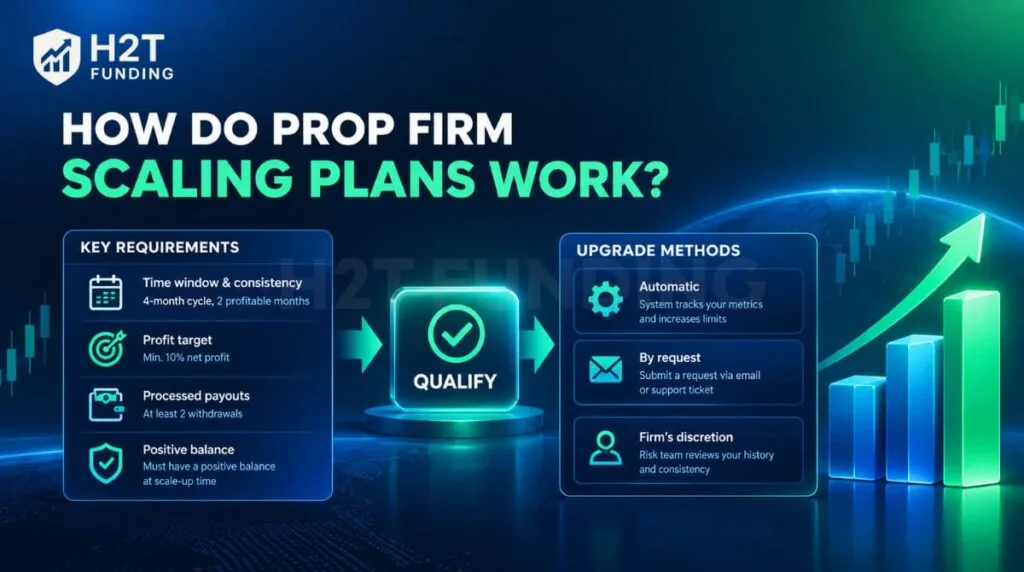
You must satisfy specific profitability and withdrawal conditions to trigger an account upgrade. While exact rules vary by company, some scaling programs require these core milestones:
- Time window & consistency: You must trade over a designated period, typically a four-month review cycle, and record at least two profitable months.
- Profit target: You must generate a minimum total net profit, often set at 10%, across the active review period.
- Processed payouts: You must successfully complete a minimum number of withdrawals, usually requiring at least two processed payouts before qualifying.
- Positive profit balance: Your account balance must remain strictly higher than your initial starting allocation at the exact time of the scale-up review.
2.2. Automatic, by request, or at the firm’s discretion
Funding companies execute account upgrades either automatically or through a manual review process. Some trading dashboards track your metrics and automatically increase your capital limits the moment you qualify.
Other platforms process upgrades during a manual review. For example, FTMO evaluates your eligibility and applies the scale-up during your standard payout request at the end of the four-month cycle. In these review-based systems, the upgrade occurs entirely at the firm’s discretion after they verify your trading logs.
The risk management team will evaluate your trade history to ensure you did not violate any consistency rules before approving the larger allocation.
3. What Are the Two Types of Scaling: Account Size and Contract Limit?
Prop firm scaling plans fall into two distinct categories based on your asset class: Forex account-size scaling and futures contract-limit scaling. While Forex firms increase your simulated dollar balance, futures firms increase the maximum number of contracts you can hold simultaneously.
Quick Comparison: Forex vs. Futures Scaling
| Feature | Forex Balance Scaling | Futures Contract Scaling |
|---|---|---|
| What increases | Total simulated account balance | Maximum Position Size (contract limit) |
| Primary benefit | Wider buffer to absorb drawdowns | Ability to trade heavier volume |
| Firm examples | FTMO, The5ers, Hola Prime | Topstep, Apex Trader Funding, The5ers Futures (Hybrid). |
3.1. Account-size scaling (Forex)
Forex proprietary trading firms scale by increasing your total simulated account balance. When you hit a profit milestone, the firm injects more virtual capital into your trading dashboard.
This larger capital allocation gives you more margin to execute trades and a wider mathematical buffer to absorb drawdowns. Leading Forex funding programs, such as FTMO, Hola Prime, and the standard Forex evaluations at The5ers, operate on this balance-increase model.
3.2. Contract-limit scaling (Futures)
Futures prop firms typically scale by increasing your maximum position size, meaning the total number of contracts you can trade at one time. However, exact methodologies vary by firm.
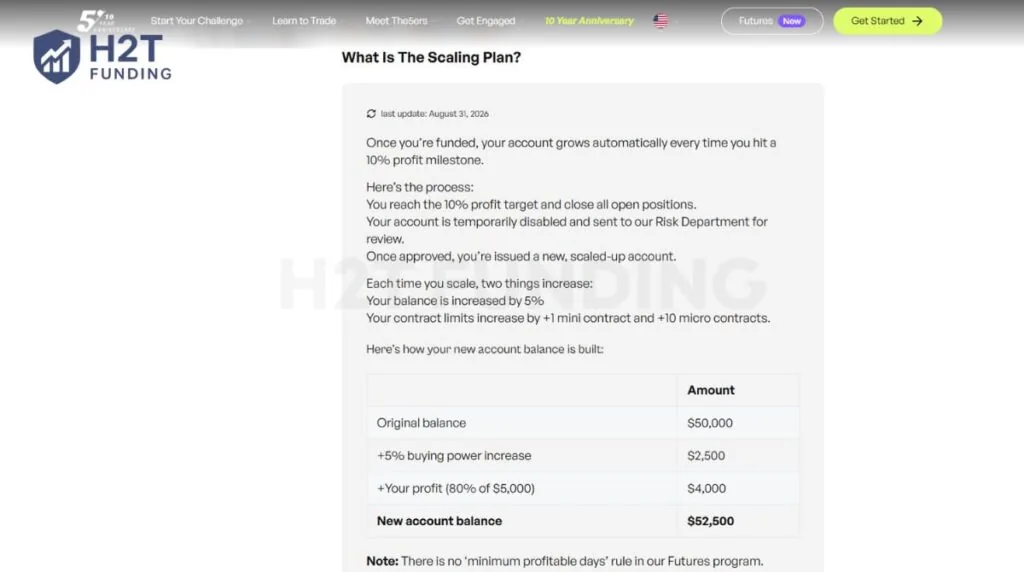
As of July 2026, the Topstep Express Funded Account (XFA) evaluates your account size based on your End-of-Day (EOD) balance, unlocking higher contract tiers without adding base capital. Conversely, The5ers Futures utilizes a hybrid model. Every time you hit a 10% profit milestone, The5ers automatically adds a 5% buying power increase to your baseline balance while simultaneously increasing your limits by +1 mini and +10 micro contracts.
4. Which Prop Firms Have Scaling Plans?
Top proprietary trading firms offer structured scaling programs that reward consistent traders with increased capital balances or expanded contract limits. However, their review cycles, profit milestones, and maximum allocation limits differ significantly between Forex and futures providers.
The comparison table below details the official scaling structures, qualifying milestones, and maximum ceilings across leading prop firms.
Prop Firm Scaling Plans Comparison (2026)
| Firm (Asset & Type) | Trigger Requirements | Step Increase | Base → Max Cap | Profit Split Upgrade |
|---|---|---|---|---|
| FTMO(Forex – Balance) | 10% net profit across 4 months, ≥ 2 profitable months, and ≥ 2 processed payouts | +25% of initial balance (linear) | $400K → $2,000,000 | Scales from 80% to 90% |
| The5ers(Forex – Balance) | Hit target milestone (e.g., 10% net profit on Hyper Growth); no time limit | 2x (doubles) per milestone | $40K → $4,000,000 (Hyper Growth) | Up to 100% |
| The5ers Futures(Futures – Hybrid) | Hit a 10% profit milestone (no minimum profitable days required) | +5% balance AND +1 mini / +10 micro contracts | $50K → $500,000 | 100% of first $8K, then 90% |
| Hola Prime(Forex – Balance) | 10% net profit over 4 months, ≥ 2 profitable months, and ≥ 2 completed payouts | +25% to +50% of initial account size | $200K → $4,000,000 | Maintains up to 90% |
| Topstep(Futures – Contract) | Reach designated End-of-Day (EOD) profit balance tiers in your XFA account | Unlocks higher contract tiers (e.g., up to 15 contracts) | $150K → Uncapped | 100% of first $10K, then 90% |
| Apex Trader Funding(Futures – Tier System) | End-of-day balance threshold met at market close (4:59:59 PM ET) | Unlocks higher max position size and updates Daily Loss Limit (DLL) | $300K → Uncapped | 100% of first $25K, then 90% |
Note: Firm policies change frequently. Always verify the latest Trustpilot scores and check community forums for recent 30-day payout delay reports before committing to an evaluation.
4.1. Forex prop firms with scaling plans compared
Forex prop firms focus primarily on simulated balance increases that expand your drawdown capacity over time. For example, FTMO adds 25% of your baseline capital every four months, rewarding you with an upgraded 90% profit split once you scale.

Meanwhile, The5ers Hyper Growth doubles your account balance every time you hit a 10% profit target without time constraints. For a $40,000 account, your balance doubles six times to reach $2.56 million before your final scale-up is capped at the $4 million absolute limit.
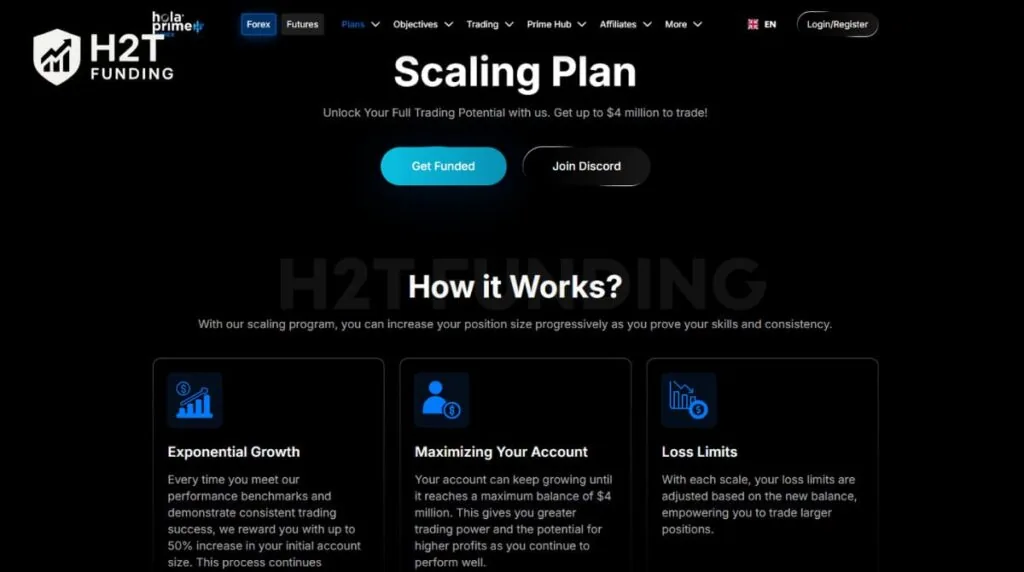
However, you must note that their High Stakes and Pro Growth programs cap scaling at only $500,000. Hola Prime follows a standard linear tier, providing capital upgrades of up to 50% for consistent traders.
4.2. Futures prop firms with scaling plans compared
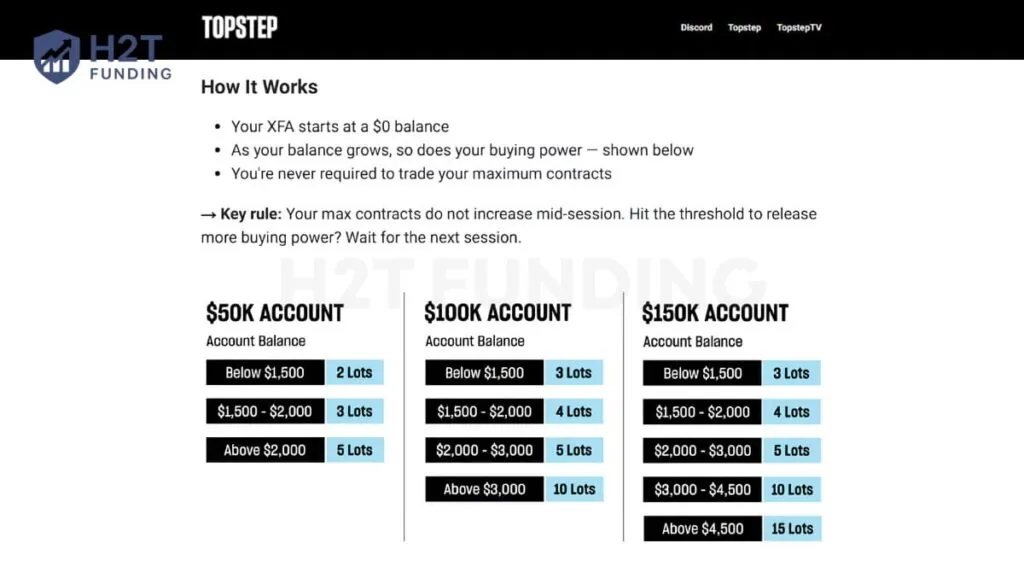
Futures firms primarily scale your buying power through tiered contract limits, though some combine this with balance increases. Topstep evaluates your Express Funded Account (XFA) balance at the end of each trading day, allowing you to trade larger contract sizes, such as moving from from 3 contracts to 15 contracts on a $150K account, only after banking profits.
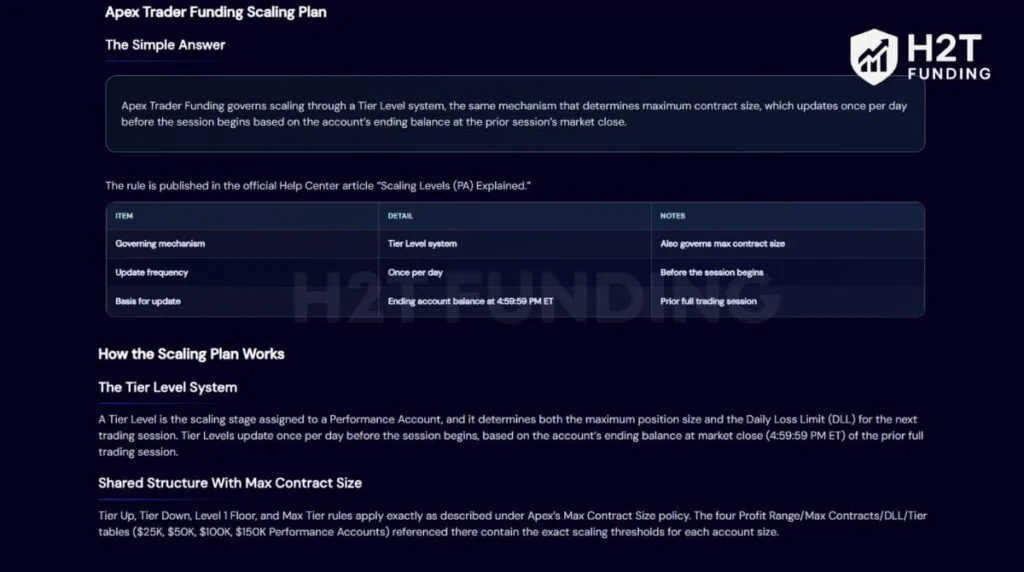
Similarly, Apex Trader Funding updates your tier level once per day before the session begins, basing the upgrade on your prior session’s closing balance at exactly 4:59:59 PM ET. This Apex scale-up increases both your maximum contract size and your Daily Loss Limit (DLL).
Alternatively, The5ers Futures hybrid program automatically scales both your available balance by 5% and your specific contract limits immediately after you clear a 10% profit milestone.
5. Why a High Scaling Ceiling Can Mislead
Marketing materials often highlight scaling ceilings that confuse traders about their actual starting capital. Many directories list multi-million dollar limits without explaining the strict timelines and exact profit targets required to reach them. You must read the fine print to set realistic growth expectations.
5.1. Starting allocation vs scaling ceiling
A starting allocation is your initial funded balance, while a scaling ceiling is the absolute maximum limit you can reach after multiple upgrades. You cannot buy the maximum ceiling immediately after passing an evaluation.
For example, FTMO advertises a $2 million scaling ceiling on its official website. However, your maximum starting allocation before scaling is capped at $400,000. You must trade that initial balance profitably across multiple review periods to slowly build toward the $2 million cap.
5.2. Linear vs compounding scaling
Most prop firm scaling plans use linear growth, adding a fixed percentage of your original balance rather than compounding your new total. Traders often incorrectly assume their accounts will grow exponentially.
For instance, FTMO adds exactly 25% of your initial baseline capital every four months. It does not calculate 25% based on your newly upgraded balance. If it were true compounding, a $400,000 account would grow to $500,000, then $625,000, and eventually hit $976,000 after 16 months. In reality, linear scaling is much slower.
The table below illustrates a realistic linear scaling trajectory using FTMO’s 25% rule.
- Assumption: You start with a $400,000 account and hit the 10% profit target, maintain 2 profitable months, and process 2 payouts every single 4-month cycle without fail.
| Review Cycle | Starting Balance | Linear Upgrade (+25% of Base) | New Scaled Balance |
|---|---|---|---|
| Months 1–4 | $400,000 | +$100,000 | $500,000 |
| Months 5–8 | $500,000 | +$100,000 | $600,000 |
| Months 9–12 | $600,000 | +$100,000 | $700,000 |
| Months 13–16 | $700,000 | +$100,000 | $800,000 |
Note: As the table shows, it takes a minimum of 16 months of uninterrupted profitability without a single rule violation just to double your initial $400,000 allocation under a linear model.
6. What Happens After You Scale?
Scaling an account changes more than just your buying power. It directly affects your risk limits, payout ratios, and future withdrawal strategies. You must understand these mathematical adjustments to protect your upgraded account.
6.1. Does the loss limit increase after scaling?
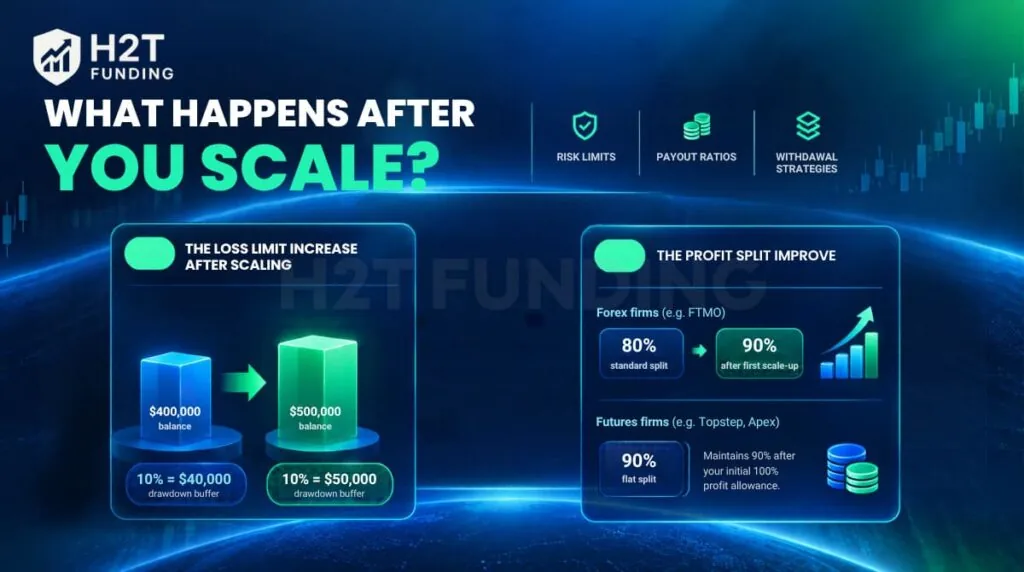
Yes, the absolute dollar value of your drawdown buffer increases when your Forex account balance scales. While the firm keeps the maximum loss percentage the same, that calculation now applies to your new, larger capital base.
For example, a 10% maximum loss on a $400,000 account provides a $40,000 buffer. When the firm scales your balance to $500,000, your 10% limit mathematically expands to a $50,000 drawdown buffer. This gives your trading strategy significantly more room to breathe.
6.2. Does the profit split improve?
Many funding companies permanently increase your profit split percentage as a reward for scaling. For instance, FTMO upgrades your payout ratio from the standard 80% up to 90% upon your first successful scale-up.
However, futures firms treat profit splits differently. Companies like Topstep and Apex Trader Funding maintain a flat 90% split after you withdraw your initial 100% profit allowance, regardless of how many contract tiers you unlock.
6.3. Do payouts and consistency rules affect the next scale-up?
Your withdrawal strategy and trading consistency directly dictate your eligibility for future upgrades. Most firms require your account to maintain a balance above your initial funding allocation when the review cycle concludes. If you withdraw 100% of your available profits right before the review cycle ends, the firm will deny the capital upgrade.
Furthermore, risk management teams review your trade logs and payout history to verify consistency before approving a scale-up. They will verify that you did not violate any consistency rules, ensuring you built your profits through steady trading rather than a single lucky news event.
7. How to Choose a Prop Firm Scaling Plan
Selecting the right growth program requires matching the firm’s rules with your financial goals. You must compare the scaling policies offered by the best scaling prop firm to find a system that fits your exact risk tolerance.
7.1. 5 key evaluation criteria
You should evaluate a firm’s scaling structure using these five core criteria:
- Transparency: Does the firm clearly publish its profit targets, consistency rules, and review timeframes?
- Frequency: How often does the risk team review your account (e.g., every four months versus immediately upon hitting a milestone)?
- Ceiling limit: What is the absolute maximum scaling cap, and is the mathematical path to reach it realistic?
- Split upgrade: Does the firm reward your scale-up with a permanently higher profit split percentage?
- Sustainability: Does the scaling plan allow you to withdraw regular payouts without resetting your growth progress?
7.2. Which plan fits which trading style
Your chosen asset class and holding period dictate the most effective scaling model for your strategy.
- Day traders: If you execute multiple short-term trades, you benefit most from futures contract scaling. This model unlocks higher position sizes for tight intraday setups.
- Swing traders: If you hold positions overnight, you need wider mathematical buffers to survive market pullbacks. You should choose Forex balance scaling because the larger virtual capital absorbs wider price fluctuations.
- High-volume traders: If your strategy requires massive position sizes, linking multiple active accounts via trade copiers multiplies your total trade volume. However, copying the same setup magnifies your trading risk instead of distributing it.
- Warning: You must verify individual firm policies, as many prop firms strictly prohibit third-party copy trading software or executing trades during high-impact macroeconomic news.
8. Common Scaling Mistakes and When Scaling Is Not Worth It
Many traders lose their upgraded accounts by immediately abandoning their proven risk management rules. You must understand that scaling introduces new psychological pressures and hidden financial drawbacks. Sometimes, chasing an account upgrade may not fit every trader.
8.1. The most common scaling mistakes
Traders frequently lose their funded status shortly after receiving a capital upgrade. You must avoid these three errors when pursuing or managing a scaled account:
- Overleveraging: Increasing your lot size too aggressively because you feel protected by a larger buffer drawdown.
- Forcing trades: Abandoning your proven strategy and overtrading just to hit the 10% profit target before the review cycle ends.
- Zeroing the balance: Withdrawing 100% of your available profits, leaving your account balance below the initial funding allocation, which disqualifies you from the scale-up trigger.
8.2. When scaling is not worth the effort
Chasing a scale-up requires leaving your hard-earned profits inside a simulated account for months. If a severe losing streak breaches your maximum drawdown limit before the review cycle completes, you instantly lose the funded account and all unwithdrawn profits.
More importantly, keeping funds inside a prop firm exposes you to counterparty risk. Proprietary trading firms are not regulated banks. If the company suddenly shuts down or changes its payout rules, you will lose your retained profits. For many consistently profitable traders, withdrawing maximum payouts to fund a personal live brokerage account offers far better long-term security than chasing a simulated scaling ceiling.
9. Scaling Plan vs. Larger Challenge vs. Multiple Accounts
Expanding your trading volume does not strictly require waiting for a built-in scaling plan. You can instantly access larger capital by purchasing a higher-tier evaluation or trading multiple accounts simultaneously. You must weigh the upfront financial costs against the time required to scale organically.
Quick Comparison: Pathways to Larger Capital
| Strategy | Upfront Cost | Speed to Max Capital | Primary Drawback |
|---|---|---|---|
| Built-in Scaling | Zero (Performance-based) | Slow (Months/Years) | Requires leaving profits in the account; counterparty risk |
| Larger Challenge | High | Fast (After one evaluation) | Massive upfront loss if you fail the challenge |
| Multiple Accounts | Moderate | Fast (Multiplied volume) | Technical overhead; requires trade copier software |
9.1. Built-in scaling plans (Organic growth)
Relying on a firm’s official scaling plan requires zero additional upfront capital because you earn the upgrade through performance. You pay for your initial evaluation and let your trading consistency unlock higher limits.
However, this method demands trading across multiple four-month review cycles. You must wait through lengthy four-month review cycles and leave profits inside the platform to qualify, which exposes you to prolonged counterparty risk.
9.2. Buying a larger challenge (Instant capital)
Purchasing a massive $200,000 evaluation grants you immediate access to a larger drawdown buffer. You bypass the four-month review cycles and 10% profit targets.
The primary drawback is the high upfront evaluation fee. If you fail the challenge, you lose a significantly larger investment. This path suits well-capitalized traders who want maximum leverage from day one and can handle the psychological pressure of managing a larger initial account.
9.3. Trading multiple accounts (Volume multiplier)
High-volume traders often link multiple active accounts to bypass lengthy review cycles and instantly multiply their trade volume. Operating simultaneous accounts across firms like Apex Trader Funding or Tradeify also distributes counterparty risk, protecting your trading business if one firm shuts down.
However, you must manage two critical risks:
- Magnified trading risk: Copying identical setups multiplies your financial exposure. A single losing trade hits every connected account simultaneously.
- Rule violations: Many prop firms strictly prohibit third-party trade copier software or enforce automatic bans for high-volume news trading. Always verify individual policies before linking accounts.
10. FAQs
-
A scaling plan is a firm-provided growth program that increases your account balance or maximum contract limits after you prove consistent profitability. It rewards steady traders with more buying power without requiring them to purchase a new evaluation.
-
Scaling is either automatic or processed during withdrawals. Dashboards at Topstep and The5ers automatically upgrade your limits upon hitting profit milestones. Conversely, FTMO applies scale-ups during your regular payout review. No separate email is required, but the risk team must approve the upgrade.
-
Most industry-standard Forex firms allow you to scale your account once every four months. Conversely, futures firms like Topstep evaluate your balance daily and can scale your contract limits at the end of any profitable trading day.
-
Yes, the absolute dollar value of your drawdown buffer increases. Because the firm applies the same maximum loss percentage to your newly upgraded capital base, you receive a larger financial safety net.
-
Yes, and many programs actually require you to successfully process payouts to qualify. However, you cannot withdraw 100% of your earnings; your account must retain a balance strictly greater than your initial starting allocation at the exact time of the review to trigger the scale-up.
-
Breaching a hard rule instantly terminates your account and permanently erases all scaling progress. If you purchase a new evaluation, you must start the organic scaling journey over from the very beginning.
-
No, not all proprietary trading firms offer scaling programs. Some companies prefer a straightforward model where you strictly trade your initial allocation, forcing you to buy larger evaluations or use multiple accounts to increase your trade volume.
-
In the United States, prop firm payouts are generally classified as independent contractor compensation and taxed as ordinary income subject to self-employment tax. Disclaimer: We are not certified CPAs; you must consult a licensed tax professional regarding your specific financial obligations.
11. Conclusion
Prop firm scaling plans offer a structured path to increase your trading capital. However, reaching massive advertised ceilings requires passing at least four consecutive review cycles. You must weigh this slow linear growth against the risk of leaving unwithdrawn profits inside a simulated account.
Always prioritize securing actual payouts over chasing theoretical limits. While purchasing a larger evaluation or linking accounts bypasses the slow organic scaling process, these methods demand higher upfront capital and magnify your trading risk. You must choose a growth strategy that protects your realized profits.
At H2T Funding, we deliver objective data to help you navigate these rules safely. Explore our Prop Firm Guides section for honest reviews, technical breakdowns, and data-driven funding strategies.
Disclaimer: Proprietary trading evaluations operate in a simulated environment. This content is strictly for educational purposes and does not constitute financial, investment, or tax advice. Firm policies change frequently. You must always verify the most current scaling rules directly at the provider’s official Help Center.