

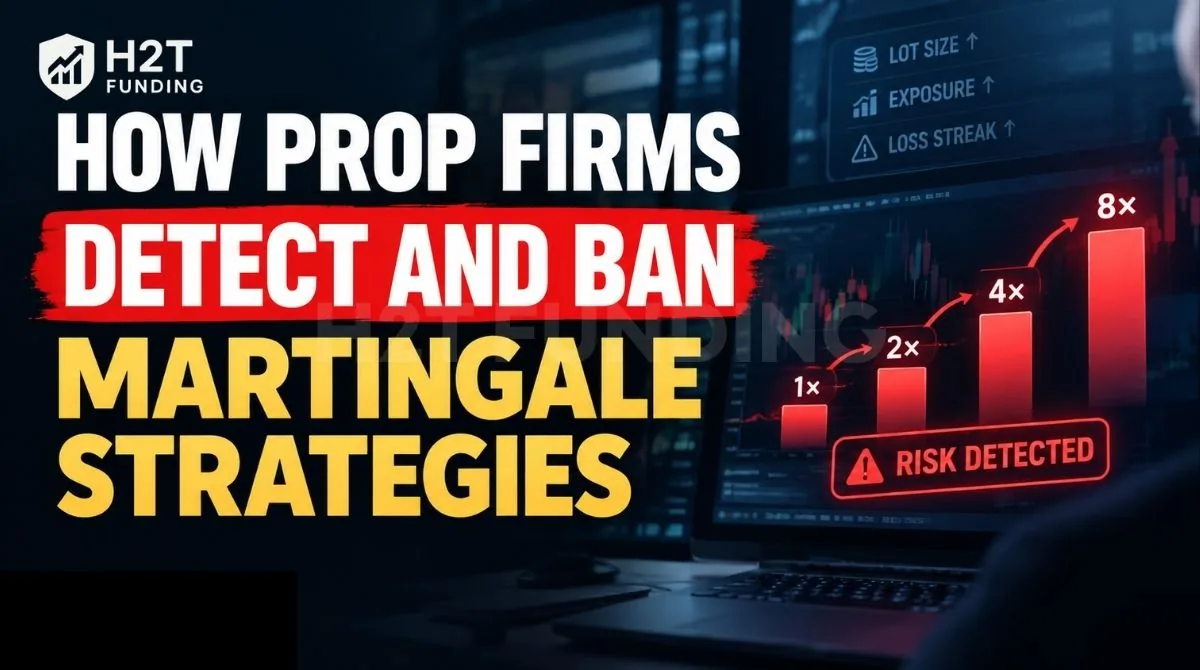
Prop firms detect martingale strategies by tracking how your position size behaves after a loss. Their risk engines log every trade and flag lot sizes that repeatedly jump after losing trades or exposure that escalates faster than normal during a losing streak. Rules vary by firm: some prohibit martingale outright, while others allow it under specific conditions.
Here is what you need to know: how martingale escalates $100 of risk into $12,800 over seven losses, key detection triggers (lot-size variance, exposure spikes, and account reviews), and how FTMO, FundedNext, Top One Trader, and Goat Funded Trader enforce violations – plus safer position-sizing alternatives.
Disclaimer: Martingale policy and detection methods vary by firm and change frequently. Always verify current Terms & Conditions directly with your chosen firm before purchasing a challenge. Different phases (evaluation vs. funded) and different account types may have different rules. This article is educational only and not financial or trading advice.
Key takeaways
- What martingale is: Martingale is a position-sizing method that increases trade size, usually by doubling, after every loss, hoping one win recovers everything.
- Why firms ban it: A normal losing streak can push exposure past the daily loss limit or max drawdown. Doubling a $100 risk over seven losses already means a $12,800 trade, so some firms ban it and others allow it only under conditions.
- How detection works: Risk engines compare lot sizes trade by trade, measure how fast exposure grows during a losing streak, and flag repeated additions to a losing trade or layered grid orders.
- Disguising it is risky: Changing the multiplier changes how fast exposure grows, not whether it grows, and some firms also ban commercial or masked EAs.
- Rules are not universal: Top One Trader and Goat Funded Trader ban it, FTMO regulates it through general risk rules, and FundedNext and Funded Trader Markets allow it with conditions.
- Enforcement can come at payout: Firms also review full account history before paying out, so an old martingale sequence can surface months later. Penalties range from removed trades or a retake to termination and forfeited profit, and a warning is not guaranteed.
- Safer options exist: Fixed fractional sizing (about 1% of equity per trade) and a daily stop after a set number of losses limit risk without exponential growth.
- Before you buy: Read the firm’s current terms, check whether evaluation and funded rules differ, and confirm the exact daily loss and max drawdown numbers.
1. What is martingale, and how is it different from grid trading?
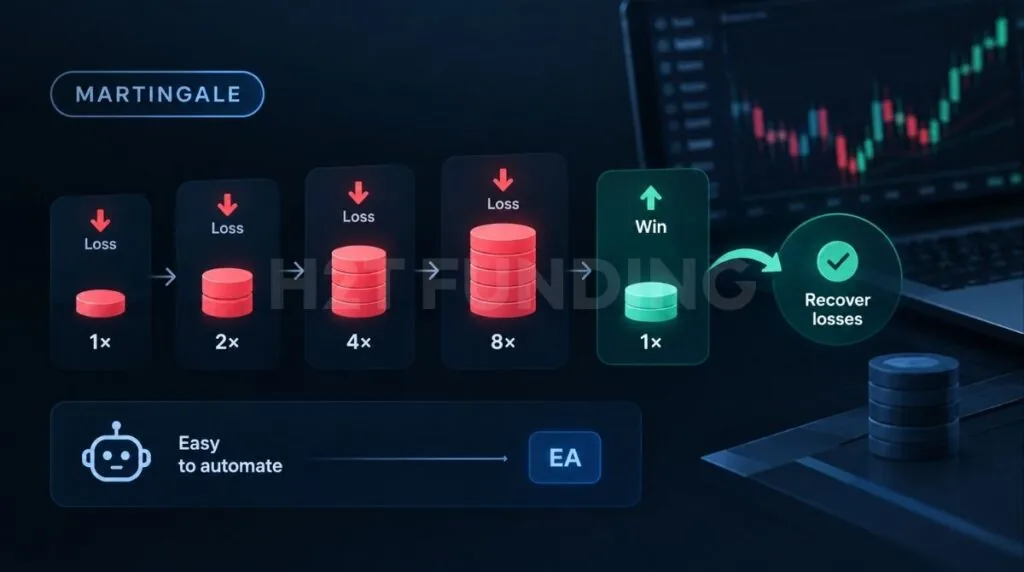
Martingale is a position-sizing method. You double the size of your next trade after each loss, expecting one win to recover everything plus a small profit. It is easy to automate in an EA.
| Trade | Risk | Cumulative loss if it loses |
|---|---|---|
| 1 | $10 | $10 |
| 2 | $20 | $30 |
| 3 | $40 | $70 |
| 4 | $80 | $150 |
| 5 | $160 | $310 |
| 6 | $320 | $630 |
| 7 | $640 | $1,270 |
The core flaw is in the payoff. After six losses you are down $630. A win on the seventh trade at $640 nets only $10, the same as your first stake. The method also assumes unlimited position size, but real accounts have lot limits, margin limits, spreads and slippage.
Martingale is often mixed up with two other terms. Prop firm rulebooks treat them separately, so the difference matters.
| Martingale | Grid trading | Anti-martingale | |
|---|---|---|---|
| Entry logic | Size goes up after a loss | Orders placed at fixed price intervals | Size goes up after a win |
| What triggers more exposure | A losing trade | Price movement | A winning trade |
| Main risk | Exponential exposure in a losing streak | Over-leverage as price moves through levels | A big loss right after a winning streak |
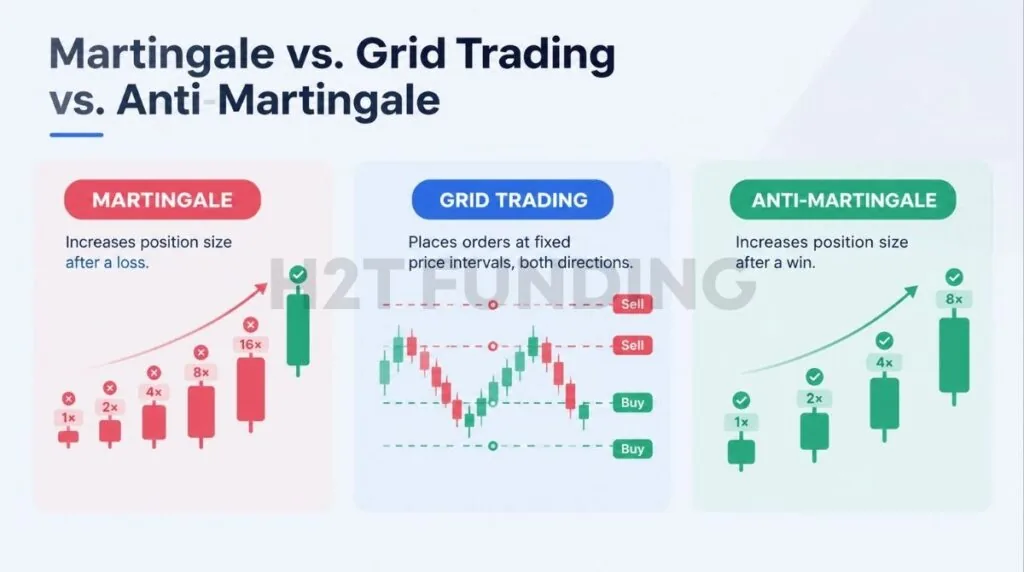
Grid trading does not need a loss to add exposure. Many EAs combine both, so firms usually check for both.
2. Why do prop firms ban martingale?
Firms usually give two reasons. Martingale looks more like gambling than a repeatable edge, and it pushes exposure toward the two limits every account has. The daily loss limit caps how much you can lose in one day, typically 3% to 5%. Max drawdown caps your total loss, typically 8% to 12%.
The math shows the problem. Start with $100 risk and double after every loss: $100, $200, $400, $800, $1,600, $3,200, $6,400. After seven losses you have lost $12,700. The eighth trade must risk $12,800 just to net $100.
Long losing streaks are not rare. Using standard run-length probability for independent trades (our calculation, not from a firm), a 200-trade sample gives:
- 50% win rate: about 54% chance of at least one 7-loss streak.
- 60% win rate: about 17.5% chance of at least one 7-loss streak.
Now apply it to a $100,000 account with a 5% daily limit and 12% max drawdown. A 1% base risk ($1,000) under martingale loses $1,000, $2,000 and $4,000, which is 7% after three trades. That breaches the daily limit. A fourth loss of $8,000 brings the total to 15% and breaches max drawdown.
With fixed 1% risk, you need six losses in one day to pass 5% (5.85%). Seven losses leave you down about 6.8%, still inside a 12% max drawdown.
3. How do prop firms detect martingale?
Detection combines automated monitoring with human review. The signals below are based on For Traders’ description of its own risk desk and on each firm’s published rules. Methods differ by firm, and no firm publishes its exact thresholds.
3.1. Lot-size and trade-timing signals
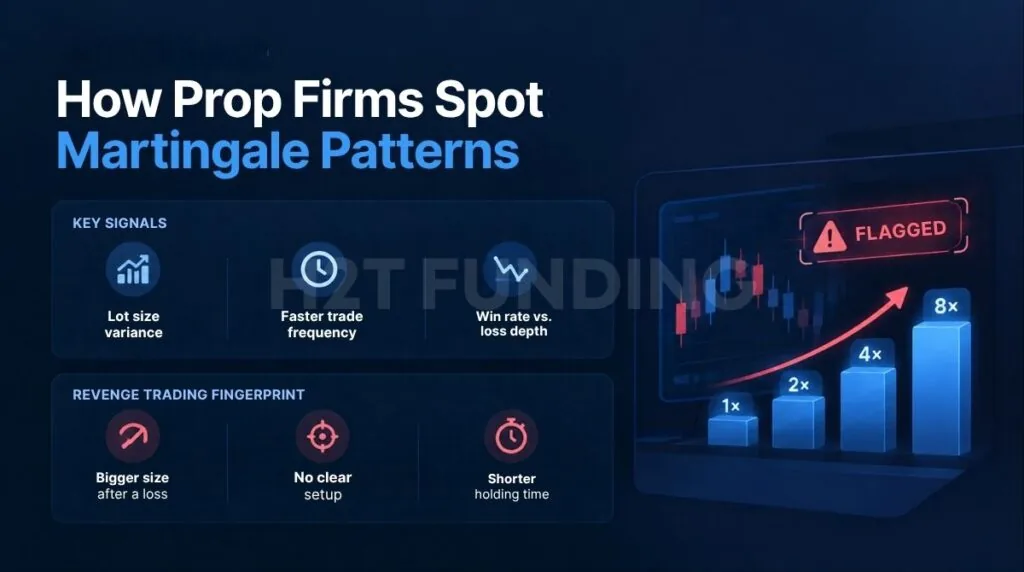
Risk desks track several metrics at once. For Traders names three:
- Lot-size standard deviation: a spike when you suddenly double size after losses.
- Time between trades: trades that bunch closer together.
- Win rate vs. average loss: a gap between how often you win and how deep your losses are.
Revenge-sizing has its own pattern: lot size rises right after a loss, entries have no clear setup, and holding time gets shorter. Reviewers do not need to see your strategy to flag it. The size pattern is enough, and it covers both common variants: sizing up on the next trade, and adding to an open losing trade.
3.2. Real-time exposure growth
Risk engines recalculate equity and floating exposure on every price tick, not at the end of the day. Your floating loss can cross the daily limit before you close the trade. Closing in profit a few seconds later does not undo a breach the system has already logged.
How fast floating exposure grows during consecutive losses is a key signal. Each doubled position adds to floating drawdown immediately.
3.3. EAs, averaging down and layered orders
Changing the multiplier from 2x to 1.5x changes how fast exposure grows, not whether it grows. Firms judge behavior, not whether an EA or a person placed the trade.
Some firms also restrict the tool itself. Top One Trader bans commercially available EAs and masked EAs. Goat Funded Trader allows only EAs you developed yourself. FTMO warns that a popular third-party EA can run into its maximum capital allocation rule, because many traders run the same strategy.
Risk software vendors sell this detection as a feature. FXPropTech, for example, says its risk engine flags grid and martingale patterns using behavioral models, and can disable trading or freeze an account. Repeated pending orders at fixed price intervals also look like a grid, which many firms ban on its own.
4. Which prop firms ban or allow martingale?
Policies vary widely. The table shows what each firm’s published rules say as of October, 2026.
| Firm | Martingale | Key condition | Stated consequence |
|---|---|---|---|
| Top One Trader | Banned | Grid, commercially available EAs and masked EAs are also prohibited | Challenge phase: retake or full breach, depending on severity. Exploiting the rules: breach, forfeited gains, possible global blacklisting |
| Goat Funded Trader | Banned on all accounts | Covers any lot or volume increase after a loss, and similar grid-based recovery. Only self-developed EAs are allowed | Termination; profits or pending payouts not paid; fee not refunded, with one stated exception |
| For Traders | Banned | Classed as gambling; the firm says escalating lot sizes will be detected | Not stated for martingale on its rules page |
| FTMO | Not named | Do not open substantially larger positions than your other trades, or repeat activity that raises risk per trade idea | Trades removed, platform access restricted, disqualification, reward forfeiture or termination |
| The5ers | Not named | Prohibits position sizes substantially larger or smaller than your typical activity, and gambling-like trading | Termination, access blocked, no refund or profit, permanent ban |
| E8 Markets | Allowed | Must be executable on a live market feed; third-party EAs allowed only as trade or risk managers; a custom EA may need its source code shared | Other third-party EAs lead to account closure |
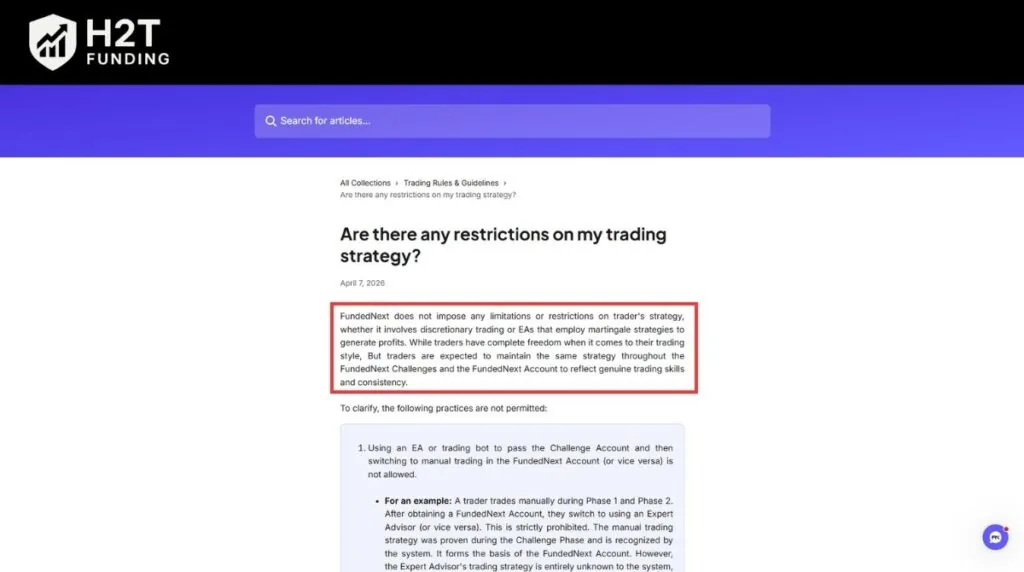
| FundedNext | Allowed | Same strategy in challenge and funded account; grid banned; no big jump in risk or asset class after funding; one-sided betting may bring a 1% Risk Rule | Termination, reward denial or permanent ban for prohibited practices |
| Funded Trader Markets | Allowed in one account | Across accounts, the same pair can be opened only within a 5-minute window, or after the first trade is fully closed (sequential trading rule) | Profit from violating trades is not eligible; challenge redo if it exceeds 20% of the total challenge profit target |
| Sure Funding | Depends on phase | Allowed in the Two Step evaluation, banned on funded accounts | Breach of risk guidelines; may terminate account |
No reviewed firm gives a number for how much size can rise after a loss before it counts as martingale. The line is wherever your firm’s definition puts it. Goat Funded Trader’s is the broadest, and FundedNext’s is the most permissive.
For firm-by-firm rules, see the prop firm reviews hub on H2T Funding. If you want firms with fewer restrictions overall, start with the easiest prop firms to pass.
Rule check: terms change without notice. Check the firm’s own terms page right before you pay for a challenge, and again before your first payout request.
Before you buy, also confirm:
- Whether evaluation and funded accounts follow different rules.
- Whether grid is banned separately from martingale.
- How the firm treats third-party EAs.
- The exact daily loss and max drawdown numbers.
5. What happens if you get flagged for martingale?
Penalties depend on the firm’s written terms, the pattern, and the account stage. There is no industry standard.
5.1. Automatic limits vs. manual review
Firms enforce through two routes. An automatic hard limit blocks trading the moment your account crosses a number, such as 12% max drawdown. No human is involved.
A behavioral review applies when your lot-size pattern looks like martingale but no limit is breached. A risk analyst looks at the account, often before payout. For Traders describes this escalation:
- Soft alert at about 50% of the daily limit.
- Warning to the trader.
- Read-only mode, where you can close but not open trades.
- Auto-close of all positions at the hard limit.
- Account status change.
- Manual review by a risk manager.
Other firms may skip steps. FTMO says traders may be notified first to adjust, but account termination can happen immediately if terms are breached. A warning is not guaranteed. Outcomes in the firm rules above range from removed trades and retakes to termination and forfeited profit.
5.2. Payout-time review
Many firms also review your full trading history when you request a withdrawal. A martingale sequence from your first month can come up months later, even if it passed every live check. Passing the evaluation does not exempt a funded account.
A public case illustrates the friction surrounding funded compliance. In a December 2025 Trustpilot review, a trader reported that Trade4U Prop denied a $4,500 withdrawal and closed his account over an alleged contract limit violation, which he disputed.
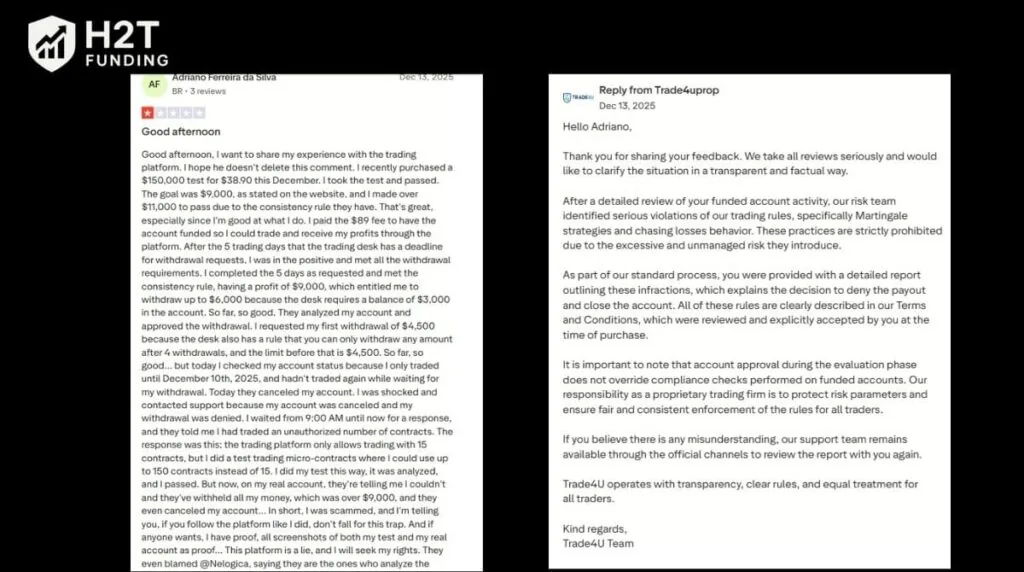
In response, the firm stated that its risk desk flagged martingale and loss-chasing behavior strictly prohibited in the purchase terms, emphasizing that passing an evaluation does not waive compliance checks on funded accounts. Neither claim is independently verified.
6. Can a normal trade be flagged as martingale?
Yes. Lot size changes for many valid reasons, and a pattern-based system can misread them. Know which of your habits look like martingale, and keep proof of your plan.
6.1. Valid reasons your lot size changes
| Situation | Why lot size changes | Why it is not martingale | Keep as evidence |
|---|---|---|---|
| Risk-based sizing | A shorter stop lets you trade a larger lot for the same 1% risk | Dollar risk stays flat | Lot-size calculator screenshot, stop distance |
| Equity growth | 1% of a bigger balance is a bigger lot | Size follows balance, not the last result | Balance and risk % in your journal |
| Partial close and re-entry | You close half, then re-enter the same direction | Total size never exceeds the plan | Order history with planned size |
| Pyramiding | You add to a winning trade | Size rises after a win (anti-martingale) | Entry reasons, stop moved to break-even |
6.2. The gray zone: averaging down
Adding to a losing trade is where valid scaling ends and martingale begins. Many firms that ban martingale also watch averaging down. Under Goat Funded Trader’s definition, any lot or volume increase after a loss to recover counts. If you scale in, set the total size and total risk before the first entry, and keep the combined risk inside your normal 1%.
6.3. What to do if you are flagged
- Stop the flagged pattern right away.
- Ask the firm for the exact rule clause and the trades it classified as martingale.
- Compare the notice with the terms you accepted at purchase.
- Reply in writing with your journal and sizing plan, and keep all messages and trade logs.
7. Safer alternatives to martingale
If your system has losing streaks, use sizing that does not grow after losses. The table assumes a $100,000 account, 1% base risk, and losses on the same trading day. For anti-martingale, it assumes size has already reached its 1.5% cap after a winning streak.
| Method | Loss after 3 losses | Loss after 7 losses | Breaches 5% daily limit | Breaches 12% max drawdown |
|---|---|---|---|---|
| Martingale (2x after loss) | 7.0% | Account already gone | At loss 3 | At loss 4 (15%) |
| Fixed 1% of equity | 2.97% | 6.79% | At loss 6 (5.85%) | After about 13 losses |
| Anti-martingale (1.5% cap) | 4.43% | 10.04% | At loss 4 (5.87%) | Not reached after 7 losses |
| Fixed 1% plus stop after 2 losses a day | 1.99% max per day | 1.99% max per day | Not reached (1.99% cap) | Not reached in one day (1.99% max) |
Fixed fractional sizing risks a constant percentage of equity per trade, while anti-martingale scales up after wins to minimize losing streaks – though the first loss post-streak is larger. Adding a loss-streak circuit breaker further protects capital by automatically reducing size or pausing trading after a set sequence of losses.
For most challenge traders, risking 0.5% to 1% per trade with a mandatory daily stop offers the simplest setup. Make sure to document this framework inside your written trading plan before executing your first order.
8. FAQs
-
It depends on the firm. Top One Trader and Goat Funded Trader ban it, while FundedNext and Funded Trader Markets allow it under conditions. Check the prop firm rules and the firm’s current terms before you buy.
-
Yes. Firms watch trading behavior, not who placed the trade. Lot-size jumps after losing trades are the main red flag. If you plan to use an EA, see the easiest prop firms to pass for firms that allow them.
-
Outcomes range from removed trades and a retake to termination and forfeited profit. A warning is not guaranteed, and some cases surface only at payout review.
-
Not reliably. It trades many small wins for rare, very large losses. A long enough losing streak breaches the loss limits and ends the account.
9. Conclusion
Prop firms detect martingale by tracking position size increases after a loss against daily loss and maximum drawdown limits. This screening runs in real time and during payout audits; because policies vary, an automated EA permitted on one platform can trigger account termination on another.
When managing a drawdown, reducing exposure or stepping away remains far safer than sizing up into adverse moves. If you want to trade with peace of mind, compare the best prop firms to identify which programs explicitly accommodate your strategy and automated setups.
Have you ever encountered a martingale restriction that felt ambiguous? Share your experience in the comments below, and find more actionable risk management guides at H2T Funding.