



A three-phase prop firm challenge (or 3 step challenge) splits the evaluation into three stages, usually with a lower profit target in each phase. This can reduce the return you need to make at one time, but you must pass three separate checkpoints before reaching the funded stage.
This guide clarifies how three-phase challenges work, the rules that apply in each stage, real program examples, the main trade-offs, and which traders this model typically suits.
Disclaimer: This article is educational and is not financial advice. Prop firm rules, fees and country access change. Confirm all terms at each firm’s official Help Center before you buy a challenge.
Methodology
We research 9 prop firms that offer or have offered three-step challenges, using their official program pages, help centers, and published rules where available. We also drew on the practical experience of traders on the H2T team to explain how the rules can affect different trading styles.
Some firm-specific figures in this article are included as real-world examples of how three-phase challenges work. They are not presented as universal industry standards.
Key Takeaways
- Three separate evaluations: You must pass Phase 1, Phase 2, and Phase 3 in order; reaching the target in one phase does not count toward the next.
- Phase 3 is still an evaluation-not mentorship: It is another assessment against the firm’s stated objectives and risk rules, not automatically a coaching or mentoring stage.
- Smaller targets do not mean lower risk: Daily loss limits, maximum drawdown, minimum trading days, and other rules can make a challenge difficult even when each target is relatively modest.
- Funding terms vary by firm: Passing Phase 3 may be followed by identity verification, contract or account setup, and a different set of funded-stage rules. Some firms use simulated accounts, so check the specific terms.
1. What Is a Three-Phase Prop Firm Challenge?
A three-phase prop firm challenge is an evaluation with three stages. You pass each stage by reaching its profit target while you stay inside the daily loss and maximum loss limits.
Firms use “three-phase”, “three-step” and “3-step” for the same format. FXIFY calls it Three Phase. Maven, Orion and The5ers call it 3-Step.
The format sits next to the one-step and two-step challenges. Its main feature is a lower profit target per phase.
2. How Does a Three-Phase Challenge Work, Step by Step?
A three-phase challenge moves you through three evaluation stages, then into the funded stage.

- Phase 1 (Evaluation). Reach the first profit target without breaching a loss limit.
- Phase 2 (Verification). Repeat the test. Some firms describe this stage as proof that your Phase 1 result was not luck
- Phase 3 (Final Verification). Pass the test a third time. This is typically the last step before funding
After Phase 3, the firm opens the funded stage. For example, At The5ers, you reach each new level up to 48 hours after you complete the previous one.
3. What Are the Rules in Each Phase?
Most multi-phase challenges share the same structure: you must clear a profit target in every phase while respecting daily loss, maximum loss, and minimum trading days. The difference lies in how the firm sets those numbers across phases.
3.1. Profit Targets: Same, Decreasing, or Progressive
Firms use three common patterns:
- Same target (e.g. FXIFY Three Phase): 5% → 5% → 5%. Each phase is identical. The psychological load stays constant, but the total profit required compounds (15% overall).
- Decreasing target (mainly in 2-phase Standard): 10% → 5%. Phase 1 is harder; Phase 2 is lighter once you have momentum.
- Progressive / increasing target (mainly in some 2-Step Classic or Pro models): 5% → 10% or 4% → 8%. The firm raises the bar later, testing whether you can scale performance under tighter relative pressure.
Same-target designs look “easier” on paper because no single phase is large. In practice they demand three separate successful runs instead of one or two.
3.2. Daily Loss, Max Loss, and Minimum Trading Days
These three rules work together:
- Daily loss resets every day (usually from the previous day’s closing balance). It stops a single bad session from ending the account.
- Max loss is the hard floor. On Three Phase it is usually static (fixed from starting balance). On many 1-phase and 2-phase Standard accounts it trails.
- Minimum trading days forces you to spread activity. Most phased challenges require 5 trading days per phase. You cannot pass by making the entire target in one or two sessions.
When daily loss and max loss are the same percentage (both 5%), the daily limit effectively becomes the binding constraint on most days.
Daily loss, max loss, and minimum trading days decide most failed phases, and each firm sets them differently. Check the prop firm guide for the common terms before you compare programs.
3.3. Why Three Targets Compound the Risk: The Math
A single 10% target with a 6–10% max loss is one clear hurdle. Three successive 5% targets change the math.
Assume a 60% chance of clearing any single 5% phase without breaching (optimistic for many traders). The probability of clearing all three becomes:
0.60 × 0.60 × 0.60 = 21.6%
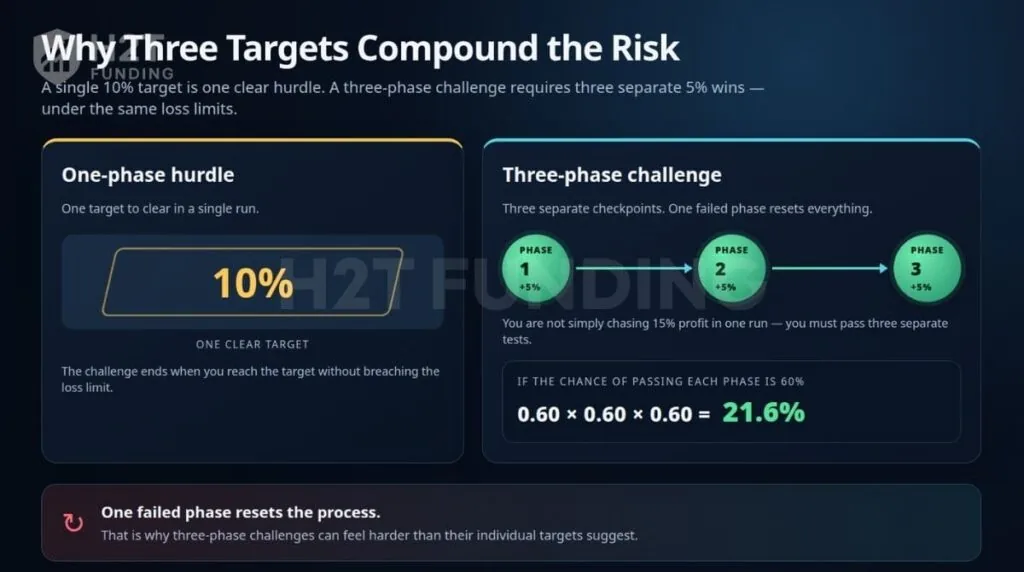
Even at 70% per phase, the joint probability only reaches ~34%. One failed phase resets everything. You are not chasing 15% total profit in one run – you must deliver three separate, successful 5% runs under the same tight risk limits. That is why three-phase challenges often feel harder than their individual targets suggest.
4. 3-step Challenge Example: FXIFY Three Phase $50K
To see how a three-phase challenge works in practice, consider the FXIFY Three Phase $50K account:
| Rule | Detail |
|---|---|
| Account size | $50,000 |
| List price | $249 |
| Profit target | 5% per phase ($2,500 per phase) |
| Daily loss limit | 5% ($2,500) |
| Maximum loss | 5% static ($2,500; equity floor at $47,500) |
| Minimum trading days | 5 days per phase |
| Time limit | Unlimited |
| Profit split (funded) | Up to 90% with add-on |
| Fee refund | 100% with first payout, on request |
How it works in practice
- You need to make $2,500 in each of the three phases. Profit from one phase does not count toward the target in the next phase.
- Your account cannot fall below $47,500, because the 5% maximum loss is static.
- Your daily loss cannot exceed $2,500.
- You must trade for at least 5 days in each phase before moving to the next one.
- There is no time limit, so you can take as long as needed to meet each phase’s requirements.
After passing all three phases and completing any required verification, you can move to the funded stage. FXIFY states that the challenge fee can be refunded with the first payout, on request.
This example shows the core trade-off of a three-phase structure: the target is lower in each phase, but you must meet it three separate times while staying within the same loss limits.
5. Three-Phase vs Two-Phase vs One-Phase Challenges: Key Differences
Prop firm evaluations differ mainly in how many stages you must pass before funding. A one-phase challenge puts everything into a single stage, while two- and three-phase challenges split the evaluation into more steps.
| Feature | One-Phase | Two-Phase | Three-Phase |
|---|---|---|---|
| Number of stages | 1 stage | 2 stages | 3 stages |
| Path to funding | Fastest | Moderate | Slowest |
| Profit targets | One higher target, typically 8%–10%(FundedNext Stellar 1-Step: 10%) | Step-down targets (e.g., 10% → 5%)(FundedNext Stellar 2-Step: 8% → 5%) | Smaller targets, commonly 2%–8% per phase, but varies more by firm(FXIFY: 5% → 5% → 5%) |
| Maximum loss | Often around 5%–6%, sometimes trailing | Often around 8%–10%, commonly static | Can range from about 3%–10%, depending heavily on the program |
| Main trade-off | Higher target in one phase, with less room for error | More stages but usually more drawdown room | Lower per-phase targets, but more checkpoints and a longer path |
A three-phase challenge is not automatically easier because each target is smaller. You still need to pass three separate evaluations, and some programs apply tight daily or maximum-loss limits. The main advantage is that the profit target is spread across more checkpoints rather than concentrated in one stage.
Key differences include:
- Lower entry fee: Some firms price their three-step plans lower than comparable one-step or two-step plans for the same account size. Our list of the cheapest prop firms shows how other firms price entry-level accounts.
- Lower profit target per phase: A three-step challenge may require around 5% in each phase, rather than a single 8%–10% target in one evaluation stage. This can reduce the pressure to make large gains quickly, although total targets vary by program.
- Risk limits still matter: A lower target does not automatically make the challenge easier. A tight maximum loss can still make the evaluation difficult for some strategies.
- Longer path to funding: Traders must pass three phases, and each phase may involve a separate review. This can extend the time it takes to reach the funded stage.
6. What Happens After Phase 3: KYC Verification and Entering the Funded Stage
After you pass Phase 3, you usually need to complete KYC verification before entering the funded stage.
6.1. KYC and Funded-Stage Rules
Once you pass Phase 3, most firms move you into the final setup stage before the funded account becomes active. This usually involves two steps.
- First, you must complete KYC verification. Firms typically ask for a valid ID or passport plus proof of address. The funded account will not be activated until this process is approved.
- Second, the rules can change. The profit target, daily loss limit, maximum loss, and payout conditions on the funded account are often different from the evaluation phases. Always review the funded-stage rules carefully before you start trading.
6.2. Payout Examples
As of October 2026, payout terms vary by firm:
- Orion: 80% profit split, with payouts processed within 48 hours.
- FXIFY: First payout on demand. Later payouts are every 30 days, or every 14 days with an optional add-on.
- The5ers: First payout 14 days after funded account activation, then every 2 weeks.
6.3. Simulated vs. Live Capital
Passing a challenge does not always mean your trades will be executed in live markets. Check the funded-stage terms before assuming you will trade live capital.
- Maven Trading: Its 3-Step Challenge page explicitly describes the funded account as simulated.
- Orion Funded: Both evaluation and Orion Trader Accounts use simulated capital and real market data. No live orders are placed on your behalf; eligible rewards are paid in real money based on simulated profits.
- The5ers: Evaluation trading is simulated. After passing and completing verification, you may be offered Professional User status to trade with the firm’s capital. The terms state that The5ers monitors positions and may decide whether to execute suggested trades.
- FXIFY: Its current Three-Phase page describes payouts and profit splits on live accounts, including a first payout after a trade on the live account closes. Confirm the account-specific terms before purchasing.
Passing Phase 3 may still require verification before you can start the funded stage. Complete KYC, review the applicable trading and payout rules, and confirm how your account will be operated before trading.
7. Which Prop Firms Offer Three-Phase Challenges? (Cost, and Is It Refundable?)
Four firms with an official three-phase program page are below. Check country access on the firm’s site before you pay.
| Firm | Fee (list price) | Targets | Daily / Max Loss | Profit Split | Refundable? |
|---|---|---|---|---|---|
| FXIFY (Three Phase) | From $39 (5K) to $1,599 (400K) | 5% / 5% / 5% | 5% / 5% static | Up to 90% with add-on | Yes – 100% refund with first payout (on request) for 1/2/3-Phase |
| Maven (Standard 3-Step) | From $13 (2K) to $299 (100K) | 3% / 3% / 3% | 2% / 3% static | 80% | Yes – 100% refund on 3rd successful withdrawal |
| Orion Funded (Select 3-Step) | From $59 (5K) to $739 (200K) | 5% / 5% / 5% | 5% / 5% static | 80% | Yes – 100% refund after 4 reward splits |
| The5ers (Bootcamp 3-Step) | From ~$95 entry (path to $100K funded). Total cost higher due to activation fee after passing. | 6% / 6% / 6% | No daily loss in eval / 5% max (eval); funded 3% daily pause + 4% max | Up to 100% with scaling | Limited. 14-day refund only if no trades are placed. Once trading starts, the entry fee is non-refundable (only Hub credits in some cases). |
Figures are examples as of late October 2026 and can change.
How These Three-Phase Challenges Compare:
- FXIFY: Offers a 100% fee refund with the first payout upon request, with 5% profit targets in all three phases.
- Maven Trading: Has the lowest entry fee at $13 and lower profit targets of 3% per phase. The fee is refunded after the third successful withdrawal.
- Orion Funded: Requires 5% profit targets per phase and refunds the fee after four reward splits.
- The5ers: Has the highest profit targets at 6% per phase. Its Bootcamp uses a split-fee model, requiring an additional activation fee after passing Phase 3; refunds are limited to specific conditions.
These four firms are the ones with an official three-phase program page. For firms that run one-step and two-step programs, see our ranking of the best prop firms.
8. Who Should Use a 3-Step Challenge?
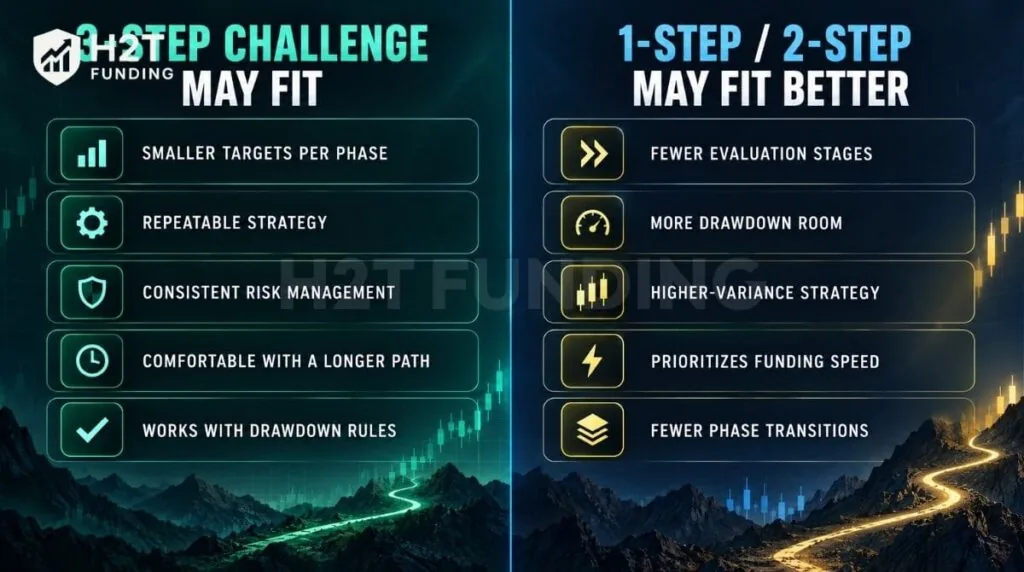
A 3-step challenge can suit traders whose strategy can produce relatively consistent returns without relying on a small number of large winning trades. It can also suit traders who are comfortable with a longer evaluation path in exchange for smaller targets at each stage.
8.1. Who May Prefer a 3-Step Challenge
A 3-step challenge may fit you if you:
- Prefer smaller targets per phase: You would rather work toward several smaller targets than one larger target.
- Have a repeatable strategy: Your results do not depend heavily on a few unusually large winning trades.
- Manage risk consistently: You can keep position sizing and risk within the firm’s loss limits across multiple phases.
- Are comfortable with a longer path to funding: Reaching the funded stage quickly is less important than having smaller targets at each stage.
- Can work within the program’s drawdown rules: Your strategy can operate within the maximum and daily loss limits without requiring large swings in account equity.
A 3-step structure may be less suitable if your strategy has high return variance, depends on occasional large winners, or requires wide drawdown to accommodate normal fluctuations.
If this is your first challenge and you are still choosing a firm, see the best prop firms for beginners list for firms that suit first-time challenge buyers.
8.2. Who Should Consider One-Phase or Two-Phase Challenges
A 1-step or 2-step challenge may fit you better if you:
- Want fewer evaluation stages: You prefer a shorter route with fewer phase transitions.
- Need more drawdown room: Some programs offer higher maximum-loss limits than the 3-step examples above.
- Have a higher-variance strategy: Your trading model may rely on fewer but larger winning trades.
- Prioritize funding speed: You want to reach the funded stage without completing three separate evaluation phases.
- Prefer fewer phase-specific requirements: You want to manage fewer transitions between evaluation stages.
The better choice depends on how your strategy’s expected returns, drawdown, and risk per trade fit the firm’s actual rules. No challenge structure is universally easier.
9. FAQ
-
A prop firm challenge is a paid evaluation in which you must meet specific trading requirements, usually including a profit target and loss limits. If you pass, you can move to the firm’s funded program and potentially receive a share of eligible profits.
-
You complete Phase 1 → Phase 2 → Phase 3 in order. Each phase has its own requirements, which can include a profit target, daily loss limit, maximum loss, minimum trading days, and time limit. You must meet the requirements before moving to the next stage.
-
The funded stage comes after you pass the final evaluation phase and complete any required verification. The firm then gives you access to its funded program, where you can receive a share of eligible profits under the firm’s payout rules.
The funded account may have different rules from the evaluation, so do not assume that passing Phase 3 means the rules remain unchanged.
-
Neither by default. A three-phase challenge gives you more stages to pass, but the target at each stage may be lower. Drawdown can also differ significantly between programs.
For example, FXIFY’s Three Phase has a 5% maximum loss, while its Two Phase has a 10% maximum loss. The better comparison is the full combination of profit target, maximum loss, daily loss, minimum trading days, and time limit.
-
Some are, and some are not. For example, Maven refunds the fee on the third withdrawal, FXIFY refunds it with the first payout, while The5ers Bootcamp does not refund the challenge fee.
Always check the refund condition because the timing can differ between programs.
-
Not every firm accepts US traders. FXIFY lists the United States as a restricted country. Check the best prop firms for US traders list for firms that accept US residents, and confirm current country restrictions on each firm’s site before you buy.
10. Conclusion
A three-phase challenge can suit traders who prefer smaller targets, steady progress, and clear checkpoints. The trade-off is a longer path to the funded stage and, in some programs, tighter maximum-loss limits.
Before choosing one, compare prop firms by profit target, maximum loss, daily loss, minimum trading days, time limit, fee, and funded-stage rules. The number of phases alone does not tell you whether a challenge is easier or harder. If three phases feel too long, instant funding prop firms skip the evaluation stage.