

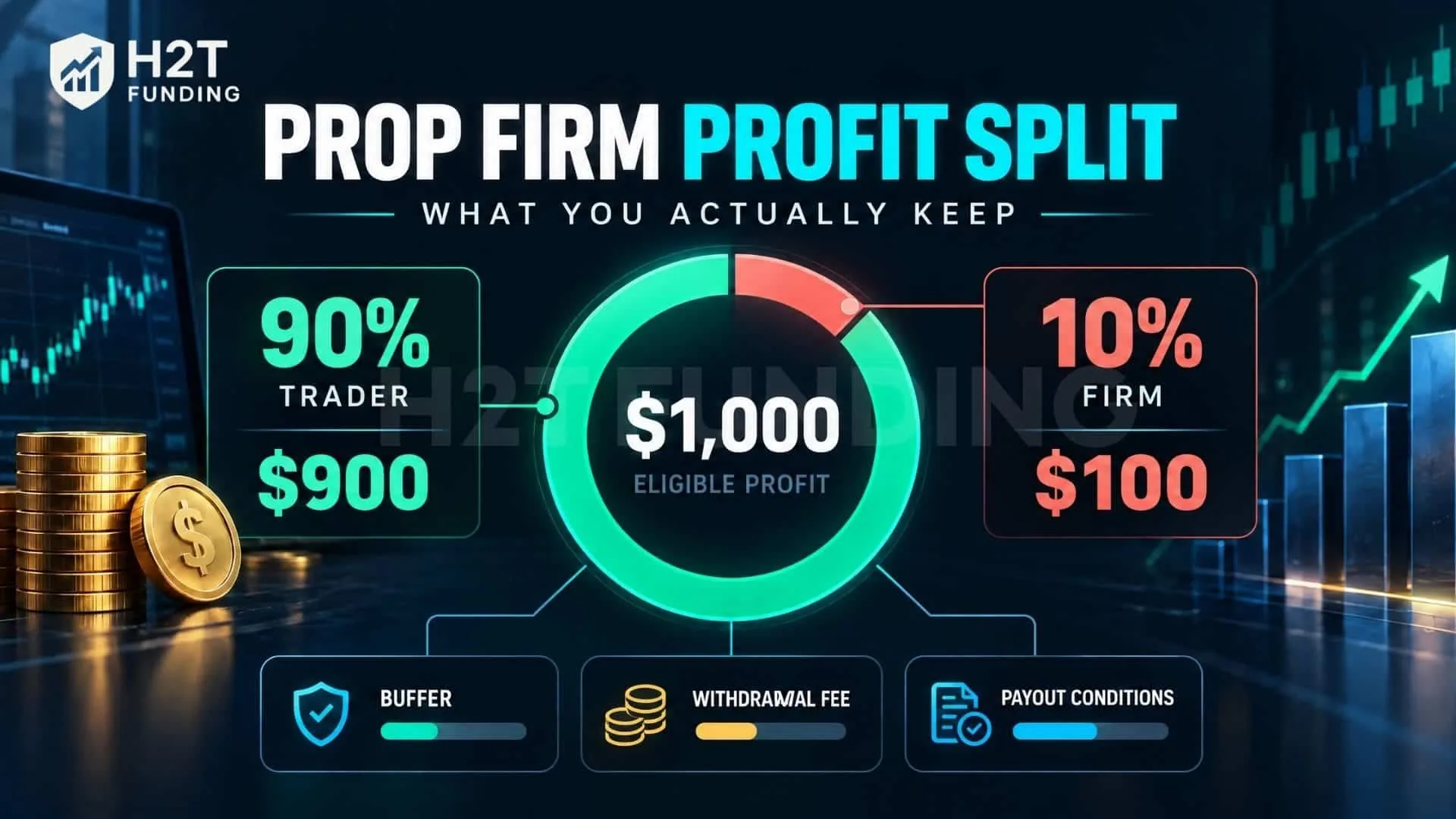
A prop firm profit split is the percentage of eligible trading profit a trader keeps from a funded account. With a 90/10 split, a hypothetical $1,000 in eligible profit gives the trader $900 and the firm $100, before any applicable buffer, withdrawal fee, or other payout adjustment. The percentage applies to eligible profit, not the account’s nominal size.
In this guide, we explain how prop firm profit splits work-what percentage of eligible profits you keep, how a 90/10 split looks in real numbers, and the key adjustments (buffers, fees, payout rules) that decide your actual take-home. The split applies to eligible profit, not account size.
Disclaimer: This article is educational and is not financial advice. Prop firm rules change. Verify current terms in the firm’s official Help Center before you buy a challenge.
Key Takeaways
- The split applies to profit, not account size. A $100,000 account does not generate a $90,000 payout under a 90% split. The percentage applies to eligible profit.
- Many firms publish splits between 80% and 90%. Offers above 90% or 100% usually come with conditions, although some programs (such as Apex Account 4.0) provide a true flat 100% split on every approved payout.
- Split structures differ. Flat splits stay constant, scaling splits change at defined milestones, and conditional splits depend on choices or requirements such as paid add-ons or payout schedules.
- A higher split does not always mean a higher payout. Buffers, withdrawal fees, minimum payout thresholds, and eligibility rules can reduce the amount you receive. In the worked example below, a 90% split with a buffer pays almost the same as a flat 80% split.
- Check the current rules before buying. Profit-sharing policies can change. Verify the relevant program’s official payout rules and note the date.
1. What Is a Prop Firm Profit Split?
A prop firm profit split is the agreement that divides funded-account profit between the trader and the firm. The first number is the trader’s share. The second is the firm’s share. A 90/10 split means the trader keeps 90% and the firm keeps 10%.
You will also see the terms prop trading profit split and prop firm profit share. They mean the same thing. Firms often say “trader share” and “firm share”.
The firm takes its share when it approves a payout. The split applies to the profit you request, not to the money in the account.
2. How the split works on a $10,000 profit (90/10, 80/20)
Take a hypothetical trader with a $100,000 funded account and $10,000 of payout-eligible profit. The split decides who receives what. The $100,000 balance plays no role.
| Split | Trader receives | Firm keeps | Calculation |
|---|---|---|---|
| 90/10 | $9,000 | $1,000 | $10,000 × 90% |
| 80/20 | $8,000 | $2,000 | $10,000 × 80% |
| Difference | $1,000 | $1,000 | 10 points × $10,000 |
Note: Hypothetical example. No fees, buffers, or other deductions applied.
Ten points of split are worth $1,000 on a $10,000 profit. That is the baseline. Later sections show how fees, buffers, and rules shift the real number.
3. What Are Typical Profit Split Percentages?
Many firms publish splits between 80% and 90%. Some headline offers go higher: 100% on a first slice of profit, or “up to 95%” at the top of a ladder. Those figures carry conditions. Sections 4 and 7 explain the conditional splits, while Section 6.1 covers the calculation.
A higher number is not automatically better. A 90% split with a buffer and strict payout conditions can pay about the same as an 80% split with none. Section 5 shows the math.
3.1. Why splits differ between firms
A firm sets its split together with its fees, drawdown rules, and payout rules. Three factors usually explain the differences:
- Evaluation structure. The cost and difficulty of the challenge feed into what the firm needs to earn back.
- Market type. Forex and futures programs use different fee and risk models, so their splits are not directly comparable.
- Risk policy. Drawdown limits, consistency rules, and scaling plans change how much risk the firm carries.
Treat the split as one part of a package. Compare the package, not the percentage.
4. Flat vs. Scaling vs. Conditional Profit Splits
Prop firms may offer a fixed split, a split that increases after certain milestones, or a higher split tied to specific conditions.
4.1. Flat split
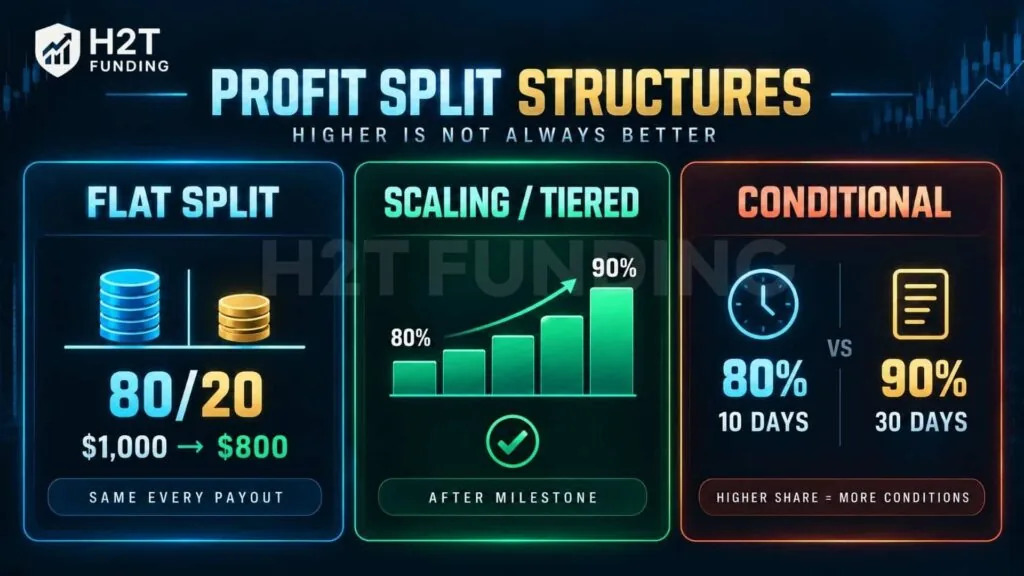
A flat split stays the same for every eligible payout. For example, with an 80/20 split, you receive $800 from $1,000 in eligible profit, before fees or other adjustments. The percentage does not increase as you withdraw more profit.
4.2. Scaling or tiered split
A scaling split increases when you meet specific milestones. For example, a hypothetical program may start at 80% and rise to 90% after you meet a defined payout or performance requirement.
Before choosing this structure, check what triggers the increase, whether you must meet additional conditions, and whether you keep the higher tier if you change accounts or lose access to the program.
4.3. Conditional split
A conditional split gives you a higher percentage only if you accept specific terms, such as paying for an add-on or choosing a different payout schedule.
For example, one hypothetical program may offer an 80% split with payouts every 10 days, while another offers 90% with payouts every 30 days. The second option gives you a larger share of eligible profit, but you may wait longer to withdraw it.
Compare the extra amount you could receive with the cost, waiting period, and risk of leaving profits in the account longer. Do not assume the higher split is automatically the better deal.
5. What Matters Besides the Percentage?
Three items decide how much of the split you can actually withdraw: the buffer, the definition of profit, and the payout conditions.
5.1. Buffer or safety net
A buffer or safety net is an amount you may need to leave in your account before requesting a payout. The exact calculation depends on the firm’s rules. It may represent a minimum balance you must maintain rather than a fee deducted from your profits.
For example, assume your account has $10,000 in profit and the program requires you to maintain a $1,000 buffer. If the rules allow you to withdraw only the profit above that buffer, $9,000 remains eligible for the split. At 90%, your share would be $8,100 before withdrawal fees.
This is a simplified example, not a universal payout formula. The amount you cannot withdraw may also remain exposed to trading losses.
For related risk rules, see our guide on what is drawdown in trading and the detailed explanation of trailing drawdown.
5.2. Realized vs floating profit
The profit shown on your dashboard may not equal the amount you can withdraw. Three figures matter:
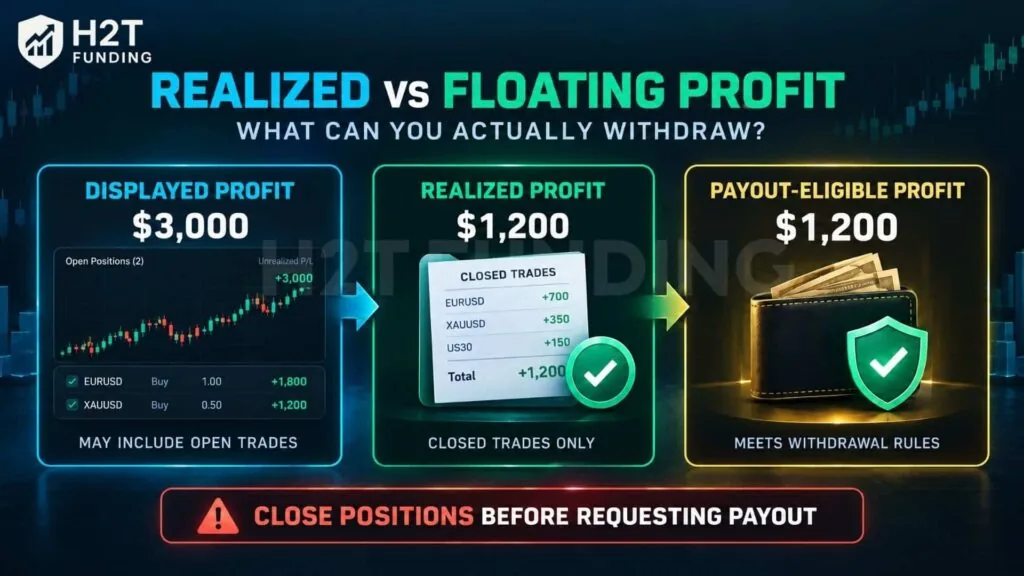
- Displayed profit: The profit shown by the platform, which may include unrealized gains or losses.
- Realized profit: Profit or loss from closed trades.
- Payout-eligible profit: The amount that meets the firm’s withdrawal rules after applicable adjustments and restrictions.
For example, your dashboard may show $3,000 in profit, including gains from open positions. If the firm requires positions to be closed before a payout request, you may need to close those trades first. The amount approved for withdrawal can still depend on the firm’s other payout rules.
5.3. Payout cycle, minimum payout, and other conditions
Your profit split tells you how profits are divided, but payout rules determine when and how much you can withdraw. Check these conditions before choosing a program:
- Payout cycle: When can you submit your first request, and how often can you request another payout?
- Minimum payout: Is there a minimum amount you must reach before requesting a withdrawal?
- Trading or winning days: Must you complete a minimum number of trading days or profitable days?
- Consistency and drawdown rules: Can these rules delay a payout or make some profits ineligible?
- Fees and payout caps: Are withdrawals subject to fees or a maximum amount per request?
For programs that allow daily or on-demand withdrawals, review our roundup of daily payout prop firms.
6. How to Calculate What You Take Home
Your take-home payout depends on the profit eligible for withdrawal, the profit split, and any applicable fees.
Use this formula as a simplified estimate:
Take-home payout = (profit eligible for the split × trader’s split) − withdrawal fees
If commissions or other charges reduce the profit eligible for payout, account for them according to the firm’s rules. Apply any buffer or minimum-balance requirement separately unless the firm explicitly defines it as a deduction from eligible profit.
6.1. Worked example table
The table runs one $10,000 profit through four hypothetical setups. Every row uses the same profit and the same $30 withdrawal fee.
| Scenario | Profit used in calculation | Trader’s share before fee | Take-home | Effective share |
|---|---|---|---|---|
| A. Flat 80% | $10,000 | $8,000 | $7,970 | 79.7% |
| B. Flat 90% | $10,000 | $9,000 | $8,970 | 89.7% |
| C. 90% with $1,000 buffer | $9,000 | $8,100 | $8,070 | 80.7% |
| D. 100% on first $5,000, then 90% | $10,000 | $9,500 | $9,470 | 94.7% |
Note: Hypothetical example. Assumes $10,000 displayed profit, no commissions, a flat $30 withdrawal fee, a buffer that stays in the account, and a first payout for scenario D. These are not any firm’s real terms.
6.2. Effective share of profit
Effective share = take-home payout ÷ displayed profit × 100
The effective share shows what you actually receive as a percentage of the profit displayed before the modeled payout adjustments.
Scenario C illustrates why the headline percentage can be misleading. Its 90% split is 10 percentage points higher than scenario A’s 80% split, but the take-home amount is only $100 higher: $8,070 versus $7,970. The $1,000 buffer remains in the account rather than being included in the modeled payout.
You do not need a dedicated calculator to compare these scenarios. A simple spreadsheet using the same assumptions for each firm can estimate your take-home payout. Always adjust the formula to match the firm’s actual payout rules.
7. How to Read a 100% Profit Split Claim
A 100% profit split does not automatically mean you keep 100% of all profits under every condition. Ask five questions before you count on it:
- 100% of what amount? Often it applies only to a first slice of profit.
- From which milestone? Some tiers start only after earlier payouts.
- For how long? Check whether it applies once, or each cycle.
- Is there a cap? Many offers limit the amount paid at 100%.
- What other conditions apply? Look for longer payout cycles, add-on fees, and minimum days.
Example. As of October 2026, Topstep’s Payout FAQs state that eligible traders under its prior policy keep 100% of their first $10,000 in profits, then receive a 90/10 split. This is a legacy arrangement, so verify your eligibility under the current official rules.
On the first $10,000, the 100% tier pays $1,000 more than a 90/10 split. This advantage applies only to the eligible profit covered by the tier, not to all future payouts.
Note: If you want to see which firms currently offer the top splits, our list of prop firms with the highest profit split compares them side by side, including the conditions behind each headline number.
8. Profit Split Examples at Prop Firms
The table compares firms that offer $50K products and accept US traders. Splits are taken first from each firm’s Help Center or official pages, then cross-checked with secondary sources. Data is current as of October 13, 2026.
Hypothetical example only: a $50K account earns $5,000 in gross profit. Figures ignore fees, buffers, consistency rules, safety nets, and per-request payout caps.
| Firm and $50K product | Starting split | Path to a higher split | Trader receives on $5,000 |
|---|---|---|---|
| Topstep (Futures): Trading Combine → Express Funded Account | 90/10 for traders who joined the new dashboard on or after January 12, 2026 | None. Traders who joined before that date keep 100% of the first $10,000 in lifetime profits, then 90/10 | $4,500 |
| Apex (Futures): Account 4.0 (EOD or Intraday Performance Account) | 100% of each approved payout | None | $5,000 |
| Apex Legacy: Legacy Performance Account | 100% of the first $25,000 per account, then 90% | None | $5,000 (the $5,000 sits inside the first $25,000) |
| FTMO (Forex/CFD): 1-Step | 90% from the start | Not needed | $4,500 |
| FTMO: 2-Step | 80% | 90% via Scaling Plan or Prime / Premium status (typically after 4 months, 10% net profit, and two processed rewards) | $4,000 (rising to $4,500) |
| FundedNext (CFD): Stellar 2-Step (standard cycle) | 80% | Scale-Up / FundedNext Pro to 90%. Lifetime add-on available for 95% | $4,000 (rising to $4,500 or $4,750) |
Notes
- These are illustrative calculations only. Actual amounts depend on approved payout eligibility, consistency rules, safety nets, minimum balances, and any per-request caps.
- Terms change. Always verify the current split, eligibility rules, and any grandfathering provisions directly on the firm’s official Help Center or dashboard before purchasing.
- Topstep and Apex are futures-only. FTMO and FundedNext are primarily Forex/CFD (with FTMO also offering Futures products under separate rules).
The table covers firms that accept US traders. For a wider shortlist with fees and rules, see our guide to the best prop firms for US traders.
9. FAQs
-
Most prop firms that offer fee refunds tie them to a payout or a specific milestone. Others do not refund the fee. Check whether the refund is paid separately from your profit share or included in the payout.
-
No. Most prop firms apply profit splits to eligible profits from funded accounts, not evaluation gains. Check your program’s rules for exceptions.
-
A completed payout is generally separate from the profit remaining in your account. However, a breach can put unpaid profits at risk, and some firms may have specific adjustment or reversal terms. Check your firm’s payout and drawdown rules. See our [drawdown guide](URL to be added).
-
Start with the firm’s official payout rules, then review recent payout evidence and independent user reviews. These can help you assess a firm’s track record but cannot guarantee future payments.
-
Most payouts require a processing period after you submit a request, with additional time depending on the payment method.
Check the firm’s stated processing window and any eligibility requirements. Delays or extra reviews may occur in some cases. See our [How Prop Firm Payouts Work guide](URL to be added).
-
Tax treatment depends on your country and how the income is classified. Keep records of your payouts and related expenses, and consult a qualified tax professional.
10. Conclusion
A prop firm’s profit split tells you what percentage of eligible profit you receive, but it does not determine your take-home payout on its own. Buffers, payout limits, eligibility requirements, fees, and withdrawal timing can all affect the amount you receive.
Before buying a challenge, calculate the payout under the firm’s actual rules. You can also explore our full list of best prop firms or explore our full prop firm reviews hub to match the right program based on split, fees, and payout conditions.