

When choosing between Rithmic and Tradovate on Apex Trader Funding, the decision comes down to your trading style, technical needs, and how you prefer to execute trades. Both platforms are fully supported by Apex, but they serve very different types of traders.
- Rithmic is built for traders who prioritize execution speed, low-latency data, and advanced tools. It is commonly used with platforms like NinjaTrader and suits scalpers, algo traders, and those trading larger sizes.
- Tradovate is a cloud-based, all-in-one platform focused on simplicity and accessibility. It runs on web, mobile, and Mac, includes built-in charting with TradingView integration, and is easier to set up.
This article, H2T Funding, breaks down the real differences between Apex Rithmic vs Tradovate, including costs, execution, and the new updates.
Which to choose?
- Choose Rithmic if: You trade scalping or high-frequency strategies, need low-latency execution and better fill control, use NinjaTrader or algorithmic systems, or trade larger position sizes where execution quality matters more.
- Choose Tradovate if: You want a simple, no-setup experience, trade on Mac or mobile devices, focus on discretionary or swing trading, or prefer a smoother workflow with fewer technical barriers.
Quick Comparison Overview
| Feature | Rithmic | Tradovate |
|---|---|---|
| Platform Type | Execution engine (via NinjaTrader) | All-in-one cloud platform |
| Platform Access | Windows only (NinjaTrader) | Any device (Web, Mac, Mobile) |
| Execution Speed | Low-latency, execution-focused | Standard real-time execution |
| Charting & Tools | Advanced (depends on platform) | Built-in + TradingView integration |
| Mobile Trading | ❌ Not supported | ✅ Fully supported |
| Best For | Scalpers, algo, advanced traders | Beginners, discretionary traders |
1. What are Rithmic and Tradovate at Apex?
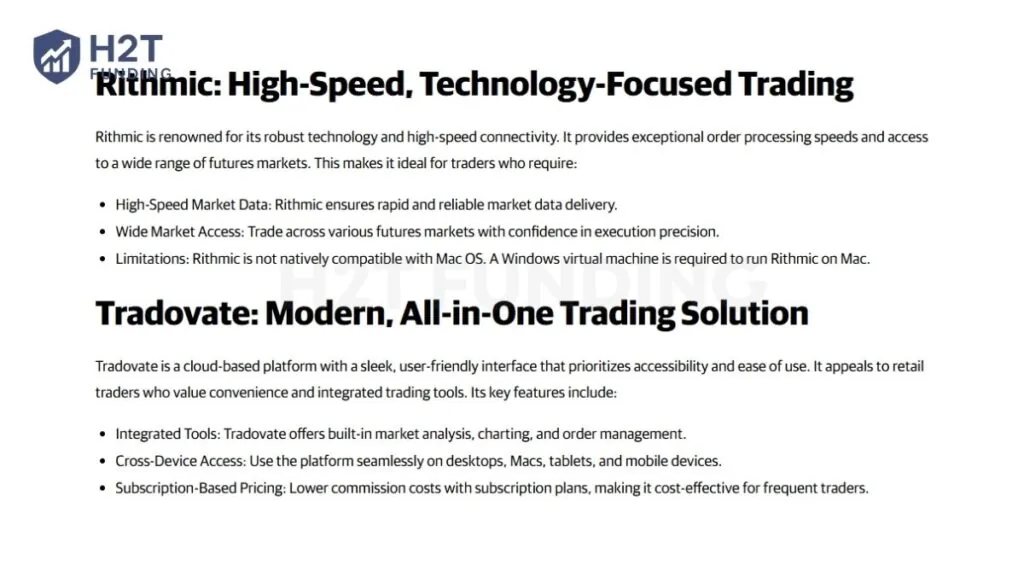
Rithmic is a high-speed execution and data infrastructure used by traders on Apex. It is not a full platform but a backend engine that connects to tools like NinjaTrader. It delivers ultra-low latency, fast order routing, and precise fills, making it ideal for scalpers and advanced traders.
Tradovate is a cloud-based, all-in-one trading platform built for simplicity and accessibility. It includes charting, order execution, and account management in one interface. Traders can access it on the web, desktop, or mobile without any setup.
Rithmic vs. Tradovate Apex: Full detailed comparison
| Feature | Rithmic | Tradovate |
|---|---|---|
| Platform Type | Execution engine (requires a third-party platform like NinjaTrader) | All-in-one cloud trading platform |
| Execution Speed | Ultra-low latency | Real-time execution, but not ultra-low latency |
| Market Data | Direct exchange-level data feed | CME data bundle (aggregated, real-time) |
| Charting & Tools | Depends on platform (e.g., NinjaTrader = advanced) | Built-in charting, analysis, and order tools |
| Ease of Setup | More complex (software install + configuration) | Very easy (browser login, no install required) |
| Device Compatibility | Primarily Windows (no native Mac/mobile) | Web, Mac, Windows, iOS, Android |
| NinjaTrader ($75 value) | ✅ Included | ✅ Included |
| Real-Time Data ($55 value) | ✅ Included | ✅ Included |
| Tradovate License | ❌ Not included | ✅ Included |
| TradingView Compatible | ❌ Native | ✅ Yes |
| Best For | Scalpers, algo traders, high-frequency trading | Beginners, discretionary traders, day/ swing trading |
| Flexibility | Highly customizable via third-party platforms | Streamlined, but less customizable |
| Learning Curve | Steep (technical setup required) | Beginner-friendly |
Important: You cannot switch platforms after signing up
Rithmic and Tradovate each require a dedicated account. Account setups, data routing, and fee structures are incompatible. If you decide to switch, you must purchase a new plan from scratch. Choose carefully before you pay.
2. What Apex includes with each platform (Subscription fees, licenses, and true costs)
At Apex Trader Funding, evaluation subscription fees are the same across all platforms. Whether you choose Rithmic or Tradovate, the cost is based on account size, not the platform itself. This means your real cost difference comes from what each platform includes and how you trade.
Rithmic includes NinjaTrader and real-time data fees in the subscription. However, it does not include a full trading interface, so you rely on third-party platforms. There is also no browser, mobile, or Mac access, which can add friction depending on your setup.
Tradovate offers a more complete all-in-one package. It includes NinjaTrader, real-time data, and the Tradovate platform license, plus access on browser, mobile, and Mac. You are essentially getting a full trading system bundled into one subscription.
Commission rates – The hidden cost difference
While subscription fees are identical, commissions vary by platform and directly affect your bottom line.
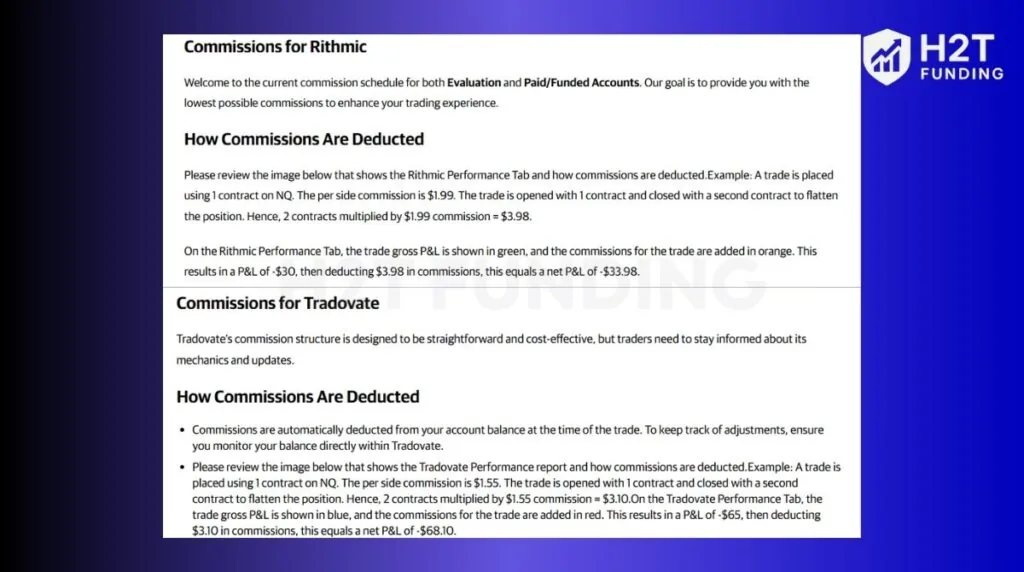
On Rithmic, the same NQ trade costs around $1.99 per side ($3.98 round turn). The difference is small per trade, but significant over time.
If you trade 20 times per day:
- Tradovate ≈ $62/day
- Rithmic ≈ $79.6/day -> You pay ~$17 more per day on Rithmic
With micro contracts like MNQ or MES, commissions are nearly identical (~$0.50 per side). In this case, cost differences are minimal, and platform choice should depend on workflow instead.
Commissions on Tradovate are generally lower. For example, trading 1 NQ contract costs about $1.55 per side ($3.10 round turn). This makes it more cost-efficient for active traders.
So, which platform is more cost-efficient?
- High-frequency traders (scalping NQ, ES) -> Tradovate is cheaper due to lower commissions.
- Micro contract traders (MNQ, MES) -> Cost difference is minimal.
- Execution-focused traders -> Rithmic may justify higher fees with better fills.
3. Data handling and execution speed: Rithmic vs. Tradovate for Apex accounts
Execution speed matters when it matters. For most Apex traders using micro contracts, the practical difference between the two platforms is smaller than most articles suggest.
| Metric | Rithmic | Tradovate |
|---|---|---|
| Latency | Generally low-latency and execution-focused | Real-time, cloud-based workflow |
| Data Source | Market data and routing built for active futures trading | CME Group bundle (CME, CBOT, NYMEX, COMEX) |
| DOM Data | Depth-oriented workflow | Standard real-time DOM/order entry |
| Fill Quality | Can be attractive for fast trading conditions, but depends on the setup and market conditions | Usually sufficient for most retail and micro-contract trading |
| API Access | Yes, popular for algo and third-party integrations | Yes, via a third party, often through external tools |
| Multi-firm Use | Risk of data conflict | Cloud-isolated, no conflict |
Rithmic is generally better suited for traders who care about speed, especially scalpers, active futures traders, and algo traders. It is commonly positioned as a low-latency platform for market data and order routing.
Tradovate is a cloud-based platform that uses CME Group market data coverage across CME, CBOT, NYMEX, and COMEX. For most Apex traders using micro contracts such as MNQ and MES, the day-to-day difference between Tradovate and Rithmic is often small under normal market conditions. However, Rithmic may feel more responsive for very short-term trading, faster order placement, or workflows that depend heavily on execution speed.
In practical terms, the difference is usually not dramatic for smaller sizes or less aggressive strategies. It becomes more noticeable when trading larger sizes, using very short holding periods, or dealing with products where liquidity and order-book behavior matter more, such as CL or GC at certain times of day. DOM, fill quality, and execution speed still depend on your connection, order type, and real-time market conditions.
Note: Rithmic accounts can sometimes conflict when running multiple prop firm accounts simultaneously, especially on platforms like NinjaTrader. This is mainly a connection issue, not a guaranteed problem in every setup. Tradovate is easier to manage across multiple accounts because it runs on a cloud-based system.
4. Setup and accessibility: Which platform gets you trading faster?
Setting up friction directly impacts your performance. Time spent troubleshooting platform issues is time taken away from actual trading. During evaluation, this difference is often more significant than most traders expect.
| Setup Factor | Rithmic | Tradovate |
|---|---|---|
| Operating System | Windows (via NinjaTrader) | Windows, Mac, iOS, Android |
| Setup Time | 10-30 minutes | Under 5 minutes |
| Installation Required | Yes, NinjaTrader download | No, runs in browser |
| Mobile Trading | Not available | iOS & Android apps |
| Technical Skill | Intermediate – Advanced | Beginner – Advanced |
Mac users have only one option: Tradovate. NinjaTrader (used with Rithmic) does not run natively on Mac. You would need a workaround like a Windows VM. Mobile access follows the same logic. Tradovate allows full monitoring and order management on mobile. Rithmic does not support mobile trading.
Practical Insight: A large portion of evaluation failures comes from setup issues, not trading mistakes. Connection errors, data permission problems, and platform configuration can slow you down. Tradovate minimizes this entirely for most users, allowing you to focus on trading from day one.
5. Trading tools and charting: Rithmic vs Tradovate compared
Both Rithmic and Tradovate offer strong trading tools, but they serve different workflows. Rithmic (via NinjaTrader) focuses on power, customization, and execution precision, while Tradovate prioritizes simplicity and an all-in-one experience.
5.1. Rithmic + NinjaTrader: The professional stack
Rithmic, paired with NinjaTrader, provides a powerful, professional-grade setup. It supports advanced charting, backtesting, custom indicators, and full DOM (Depth of Market) visibility.
This setup is ideal for scalpers and systematic traders who rely on precise execution and custom workflows. The Rithmic API also enables automation and algorithmic trading strategies.
However, the trade-off is complexity. Setup and configuration take time, and the learning curve is steep. Many traders spend significant time configuring templates and connections before they can trade efficiently.
5.2. Tradovate: Integrated charting with TradingView
Tradovate offers a clean, all-in-one experience with built-in tools. It includes advanced charts, DOM, bracket orders, and native TradingView integration. There is no need for third-party connectors. Traders can analyze and execute trades within the same platform, making the workflow faster and simpler.
This makes Tradovate ideal for traders who want speed, simplicity, and minimal setup, without sacrificing essential charting features.
Common hybrid setup: Many traders don’t rely on just one platform; they combine multiple tools into a single workflow. TradingView or WealthCharts for shared analysis, NinjaTrader + Rithmic for precise execution on Rithmic accounts, and Tradovate mobile for monitoring Tradovate accounts. Each account locks to one platform, so you need both types to mix tools effectively.
6. The 50% consistency rule: What it means and how each platform helps you track it
Apex applies a 50% Consistency Rule to payout requests. No single trading day’s profit can exceed 50% of your total cumulative balance at the time of payout. This rule applies equally to Rithmic and Tradovate accounts; platform choice does not change the rule itself.
The difference is in tracking:
- Tradovate makes tracking easier. Its built-in dashboard clearly displays daily P&L, allowing traders to calculate the 50% threshold directly within the platform.
- Rithmic (via NinjaTrader) does not provide a simple daily summary by default. Traders often need to rely on Apex’s dashboard or external tools to monitor consistency accurately.
Important update: From March, 2026, the consistency rule was recently adjusted from 30% to 50%. This change allows a single strong trading day to account for a larger portion of total profits without violating payout rules. This is especially beneficial for EOD Drawdown accounts and swing traders, where profits may come from fewer but larger winning days.
Recommendation: Always use the Apex account dashboard to verify consistency before requesting a payout. Do not rely solely on platform-level P&L displays for this calculation.
7. How to choose between Rithmic and Tradovate
The right platform is the one that matches your device, trading frequency, and account type. Use the framework below to make a clear decision and move forward with confidence.
Choose Rithmic on Apex if you are:
- Scalper / Algo trader using DOM real-time
- Intraday Drawdown, trading >5 contracts
Choose Tradovate on Apex if you are:
- Beginner or new to futures trading
- Mac. mobile user
- Running multi-firm Rithmic accounts, Tradovate avoids data conflict
- EOD Drawdown account holder
- Want an all-in-one, frictionless setup
CRITICAL: Each Apex account locks permanently to one platform; no switching allowed after purchase. Buy both Rithmic + Tradovate accounts if you want flexibility across strategies and devices.
8. Rithmic vs Tradovate Reddit: What real Apex traders are saying
Discussions across trading communities like /r/Daytrading and related Reddit threads give a clearer view of how Apex traders actually use Rithmic and Tradovate in real conditions.
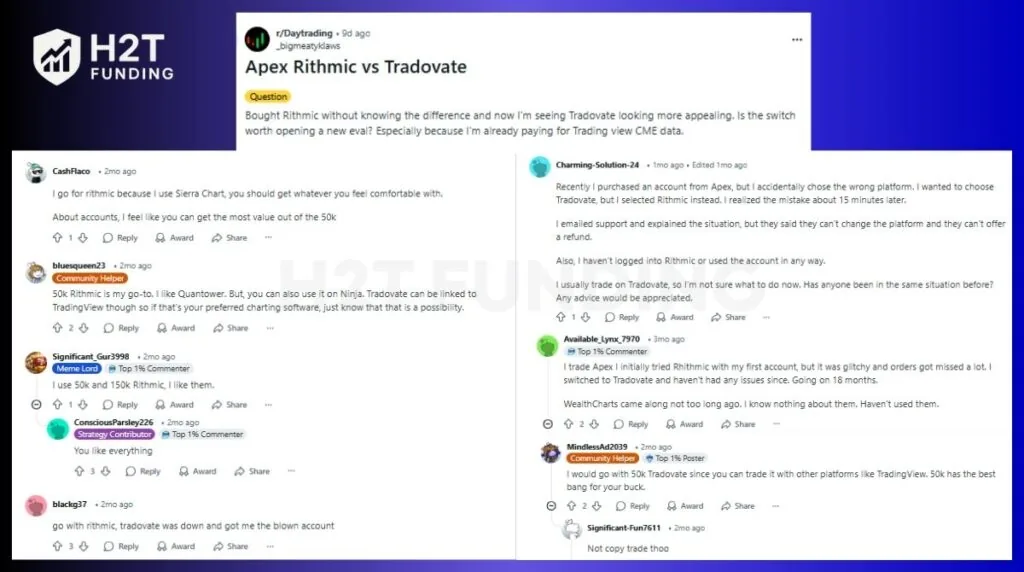
Many traders who chose Rithmic highlight its strong compatibility with professional tools such as NinjaTrader, Sierra Chart, and Quantower. It is often preferred for execution-focused setups and advanced charting flexibility. However, Reddit users also point out a steeper learning curve and occasional technical issues, especially when handling multiple accounts or dealing with data feeds.
“I trade Apex. I initially tried Rithmic with my first account, but it was glitchy, and orders got missed a lot. I switched to Tradovate and haven’t had any issues since.” – u/Available_Lynx_7970, /r/Daytrading
On the other hand, Tradovate is consistently praised for its simplicity and stability. Traders frequently mention that it is easier to set up, integrates smoothly with TradingView, and requires minimal configuration. This makes it especially attractive for evaluation accounts and day trading workflows where reliability matters more than customization.
“I would go with 50k Tradovate since you can trade it with other platforms like TradingView. 50k has the best bang for your buck.” – u/MindlessAd2039, /r/Daytrading
Another recurring insight from Reddit discussions is that many traders don’t rely on a single platform. Instead, they build a hybrid workflow, using TradingView or other charting tools for analysis, then executing trades on their preferred platform. In this setup, Tradovate is often favored due to its accessibility and smoother integration experience.
9. FAQs
-
Rithmic is a backend execution engine that provides lower latency and direct market access, typically used with platforms like NinjaTrader. In contrast, Tradovate is a cloud-based, all-in-one platform with built-in charts, order tools, and cross-device access, making it simpler to use.
-
Tradovate accounts include a full bundle: NinjaTrader, Tradovate license, real-time data, and TradingView compatibility, along with access on browser, mobile, and Mac. By comparison, Rithmic accounts only include NinjaTrader and real-time data, requiring additional setup.
-
Apex introduced two new account types in 2026. EOD Drawdown accounts calculate drawdown at the end of the day, while Intraday Drawdown accounts track drawdown in real time during the session. Both account types support Rithmic and Tradovate, so platform choice remains flexible.
-
Yes, Legacy accounts are unchanged. They remain active, can still be renewed, and continue to qualify for funded status. Apex has not modified the rules for these accounts.
-
The rule itself does not change across platforms, but how you track it does. Tradovate makes it easier with a clear built-in P&L dashboard, while Rithmic setups typically require using Apex’s dashboard or external tools for accurate tracking.
-
The choice depends on how you trade. EOD accounts work well with Tradovate because of its simple monitoring and mobile access. Intraday accounts, especially with larger position sizes, benefit from Rithmic’s faster execution. However, if you trade micro contracts, both platforms perform similarly well.
-
Only Tradovate works natively on Mac. It runs in a browser on any operating system, including Mac and Windows. Rithmic (via NinjaTrader) does not support Mac, unless you use a workaround like a Windows virtual machine.
-
It can cause data conflicts. Running multiple Rithmic accounts across different prop firms simultaneously may prevent data from loading correctly. Tradovate does not have this issue, as each account is cloud-isolated and runs independently.
-
No. You cannot switch between Rithmic, Tradovate, and WealthCharts once your account is created. Each platform uses a different setup, data routing, and fee structure. If you want to use another platform, you must create a new account and subscribe to that platform separately.
-
Tradovate is the best choice for beginners. It requires no installation, works on any device, and includes built-in charting with TradingView integration. In contrast, Rithmic requires more technical setup and experience, making it better suited for advanced traders.
-
Tradovate is the better starting point for most traders because it is easier to set up, works on any device, and requires no technical configuration. Rithmic is better suited for advanced traders who prioritize execution speed, use DOM trading, or rely on tools like NinjaTrader and automated strategies.
-
No. They are separate systems, and each Apex account can only use one platform. To use both, you need separate accounts.
10. Conclusion
Choosing between Apex Rithmic vs Tradovate is not about which platform is “better,” but which one fits your trading style, workflow, and environment. Rithmic delivers speed, precision, and flexibility for advanced traders, while Tradovate offers a simpler, all-in-one experience that works across any device.
The key takeaway is this: you cannot switch platforms after purchase, so your decision should be intentional. If you value ease of use, mobility, and lower overall friction, Tradovate is the safer starting point. If your edge depends on execution speed, DOM trading, or algorithmic strategies, Rithmic may be worth the added complexity and cost.
To build a more complete trading approach, explore other guides in the Prop Firm Guides category at H2T Funding. You can learn how Apex’s EOD and Intraday accounts work, and discover practical strategies to pass evaluations and manage risk more effectively. These resources will help you go beyond platform selection and develop a trading system that is consistent, scalable, and aligned with your goals.