


What is forex trading? Forex trading is the act of buying one currency while simultaneously selling another, with the goal of profiting from exchange rate changes.
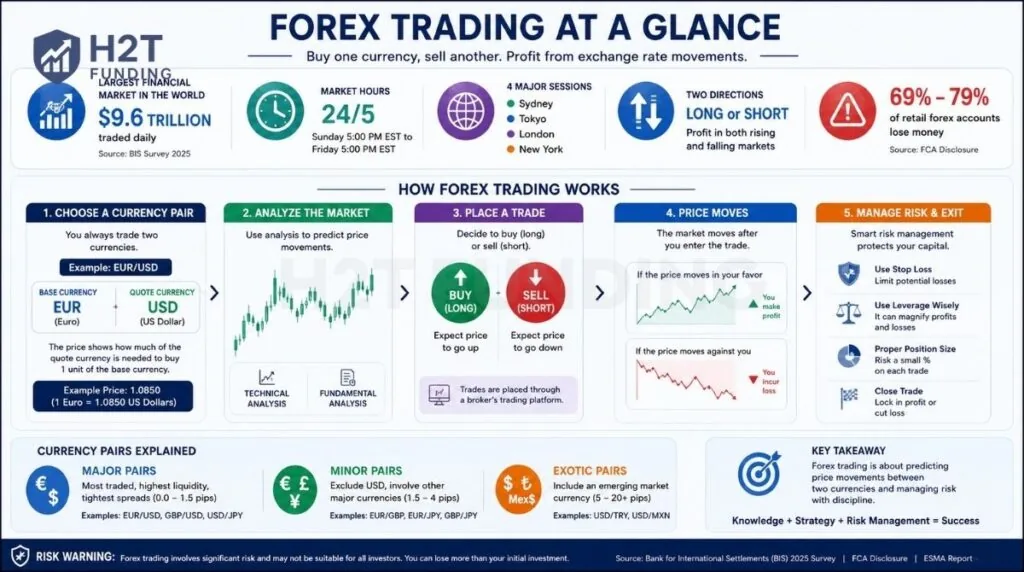
The forex market trades over $9.6 trillion per day, runs 24 hours a day, 5 days a week across four global sessions: Sydney, Tokyo, London, and New York, with no central exchange and no closing bell.
Read H2T Funding’s full guide to understand how each trade works in practice, what capital you actually need, and how prop firms change the math for retail traders.
Key Takeaways
- Forex trading = buying one currency while simultaneously selling another: Profit comes from exchange rate movements. You never own a physical asset – you speculate on relative value between two currencies.
- $9.6 trillion traded daily: The largest financial market in the world, dwarfing all major stock exchanges combined. High volume means tight spreads and fast execution.
- 24/5 market, no central exchange: Runs Sunday 5:00 PM to Friday 5:00 PM EST across 4 sessions – Sydney, Tokyo, London, New York. No closing bell. All trades happen electronically.
- Always two currencies, always two directions: Every trade involves a pair (e.g., EUR/USD). You can go long (buy) or go short (sell) – profit in both rising and falling markets.
- 69-79% of retail forex accounts lose money: Legally mandated FCA disclosure. Primary causes: overleveraging, no stop loss, and trading through major news events.
1. What is forex trading?
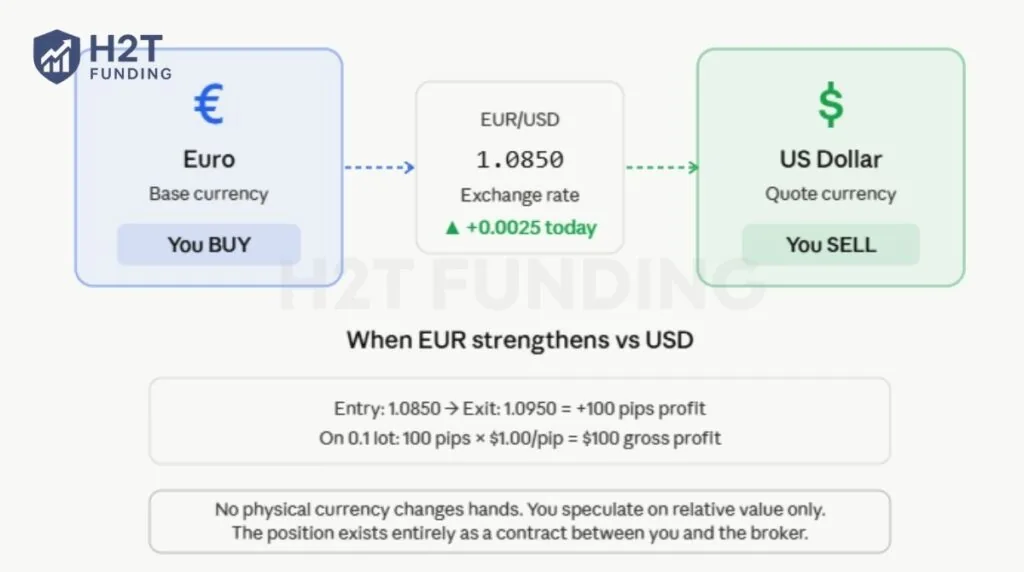
Forex trading is the simultaneous buying of one currency and selling of another to profit from changes in exchange rates. The word “forex” is short for foreign exchange. When you trade forex, you are not buying a physical asset – you are speculating on whether one currency will strengthen or weaken relative to another.
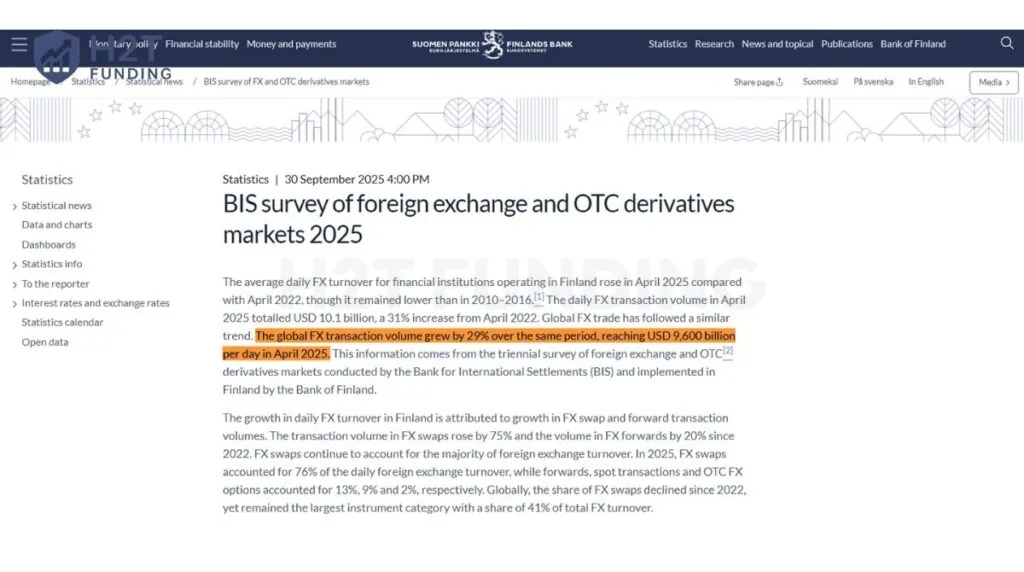
The forex market is the largest financial market in the world. It processes over $9.6 trillion in daily trading volume, according to the Bank for International Settlements 2025 Triennial Survey.
That figure dwarfs all major stock exchanges combined; the NYSE typically processes well over $100 billion on an average trading day, yet that remains a fraction of what forex moves globally. The sheer size means the market is extremely liquid – large orders execute quickly at predictable prices.
“The global FX transaction volume grew by 29% over the same period, reaching USD 9,600 billion per day in April 2025.” – Bank of Finland, BIS Survey of Foreign Exchange and OTC Derivatives Markets 2025
Unlike stock exchanges, forex has no central location. Trading happens electronically between banks, institutions, corporations, and individual traders across a global network. This is called an over-the-counter (OTC) market.
The market runs from Sunday 5:00 PM EST when Sydney opens, through Friday 5:00 PM EST when New York closes. That’s 24 hours a day, 5 days a week, across four major financial centers: Sydney, Tokyo, London, and New York.
For a full breakdown of session open and close times across all four financial centers – including GMT, EST, and your local time zone – see our what time does the forex market open guide.
2. How does forex trading work?
Forex trading works by placing buy or sell orders on currency pairs through a broker’s trading platform. Each trade involves two currencies, one you buy and one you sell simultaneously. Your profit or loss depends on how the exchange rate moves after you enter the trade.
2.1. Currency pairs explained
Currencies in forex are always traded in pairs because you are always comparing the value of one currency against another. Each pair has two components: the base currency (listed first) and the quote currency (listed second).
Take EUR/USD as an example. EUR is the base currency. USD is the quote currency. If the price shows 1.0850, it means 1 euro buys 1.0850 US dollars. When EUR/USD rises from 1.0850 to 1.0950, the euro has strengthened against the dollar by 100 pips.
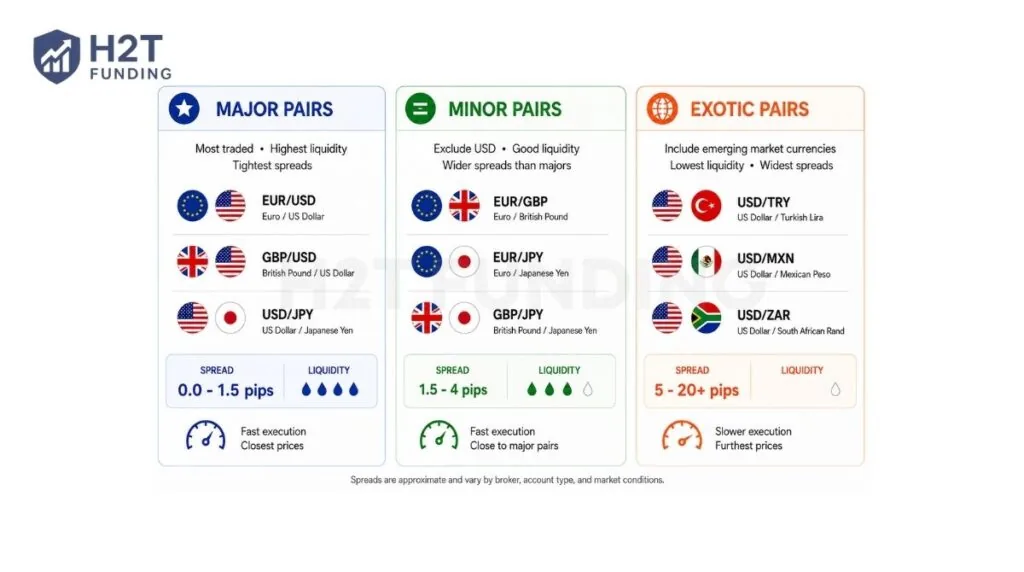
Forex pairs fall into three categories:
- Major pairs include the most actively traded currencies globally, such as EUR/USD, GBP/USD, and USD/JPY. These pairs carry the highest liquidity and the tightest spreads, typically between 0.0 and 1.5 pips for EUR/USD, depending on broker type and account. ECN accounts often offer raw spreads near zero with a separate commission, while standard accounts typically show 0.8 to 1.5 pips built into the price. High liquidity means trades execute faster and at closer prices to what you see on screen.
- Minor pairs exclude the US dollar but involve other major currencies, such as EUR/GBP, EUR/JPY, or GBP/JPY. Spreads are typically wider than majors, ranging from 1.5 to 4 pips.
- Exotic pairs combine a major currency with an emerging market currency, such as USD/TRY (US dollar vs Turkish lira) or USD/MXN (US dollar vs Mexican peso). These pairs carry significantly wider spreads than majors – ranging from around 5 pips on liquid exotics like USD/MXN to 20 pips or more on less liquid pairs like USD/TRY. Spreads vary considerably by broker. Exotic pairs can also move sharply on local political events, making them less predictable than major pairs.
For beginners, EUR/USD is the most practical starting point. It has the highest daily volume, the most analyst coverage, and the most predictable technical behavior.
2.2. Going long vs going short
One feature that makes forex different from traditional investing is the ability to profit in both directions when prices rise and when they fall.
- Going long means buying the base currency. You go long EUR/USD when you believe the euro will strengthen against the dollar. If EUR/USD moves from 1.0850 to 1.0950, you profit from the 100-pip increase.
- Going short means selling the base currency. You go short EUR/USD when you believe the euro will weaken. If EUR/USD drops from 1.0850 to 1.0750, you profit from the 100-pip decline.
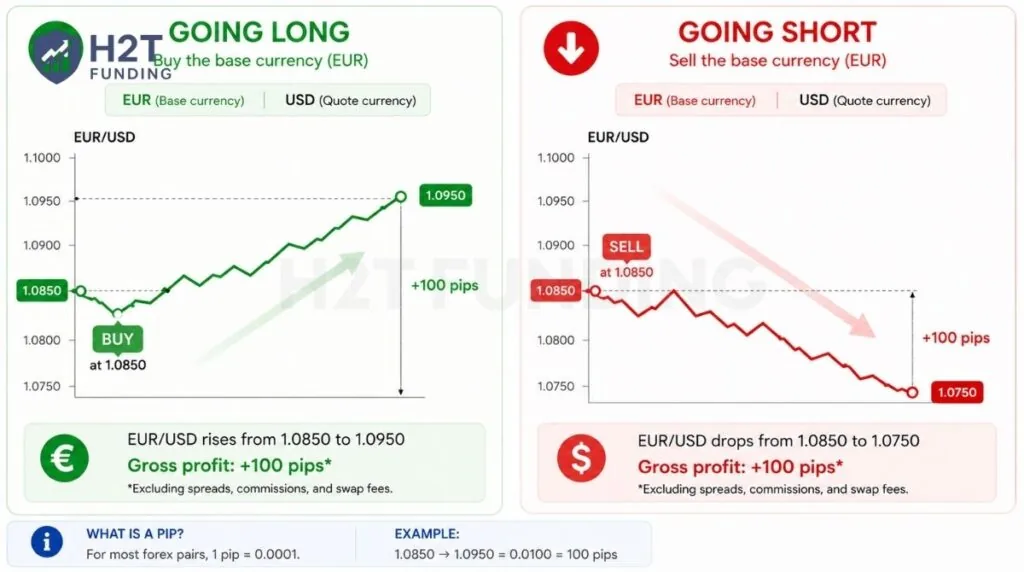
This bidirectional flexibility matters. In stocks, you generally profit only when prices rise. In forex, you can build a strategy that works in rising or falling markets – as long as your direction is correct.
2.3. What moves forex prices?
Four primary forces move currency prices, each with a different time horizon and impact magnitude.
Interest rate decisions from central banks are the single biggest driver of long-term currency trends. When the US Federal Reserve raises rates, US dollar assets become more attractive to foreign investors seeking higher yields. Capital flows into the USD, strengthening it. The Bank of England, European Central Bank, Bank of Japan, and Reserve Bank of Australia make similar decisions that move GBP, EUR, JPY, and AUD, respectively.
A single unexpected rate decision can trigger moves of dozens to several hundred pips within minutes – the size of the move depends on how much the decision deviates from what markets had already priced in.
Economic data releases include indicators such as the Non-Farm Payrolls (NFP) report in the US, Consumer Price Index (CPI) inflation data, GDP growth figures, and unemployment rates. These reports tell markets how healthy an economy is and influence expectations about future rate decisions.
The US NFP, released the first Friday of every month at 8:30 AM EST, can trigger price moves ranging from several dozen to well over 100 pips depending on how much the result surprises market expectations. In-line results produce modest moves; significant surprises can move USD pairs sharply within seconds.
Political and geopolitical events, elections, trade policy changes, military conflicts, and sanctions can rapidly shift confidence in a currency. The British pound fell around 8-10% within hours on June 24, 2016, when the Brexit referendum result was announced, one of the largest single-day moves in a major currency pair in modern history.
Market sentiment describes the collective mood of traders. During periods of global uncertainty, traders tend to move money into perceived “safe haven” currencies, historically the US dollar, Swiss franc, and Japanese yen. Understanding sentiment helps explain why a currency moves on days when no major data is released.
3. A real forex trade – Step by step
Here is a practical example of how a single EUR/USD trade can be structured, from entry to exit, including position sizing, risk management, and trading costs.
Setup:
- Account size: $5,000
- Currency pair: EUR/USD
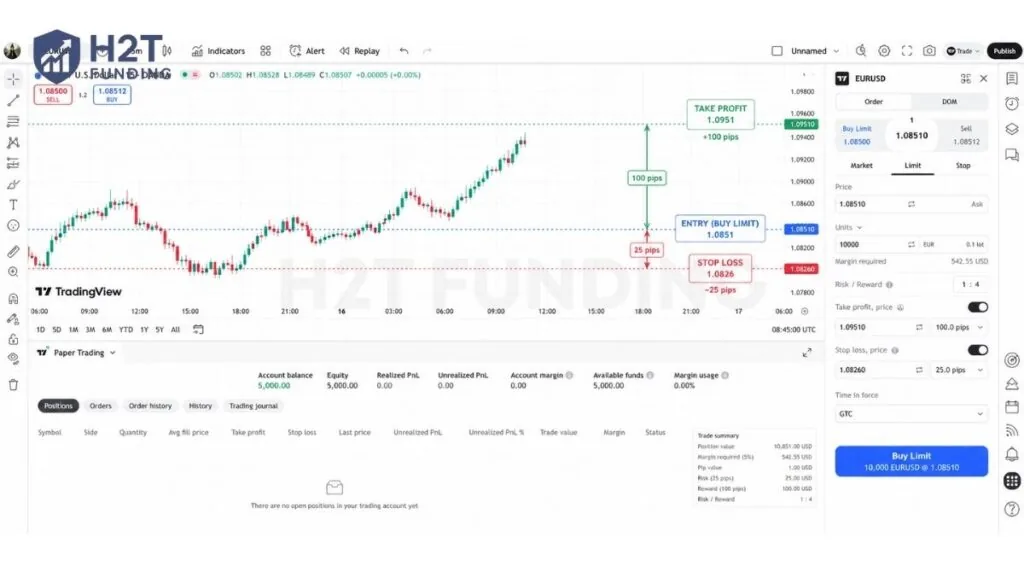
- Position size: 0.1 lot (10,000 units)
- Leverage: 1:20 (margin requirement: 5%)
- Margin required: $542.55 (5% of the $10,851 position value)
- Broker spread: 1.2 pips
The trade:
You analyze the market and believe EUR/USD will rise from 1.0850. You decide to open a long position at 1.0851, which represents the ask price after accounting for the spread.
Your stop loss is placed at 1.0826, which is 25 pips below the entry price. Your profit target is set at 1.0951, which is 100 pips above the entry price.
This creates a risk-to-reward ratio of 1:4, meaning you are risking 25 pips to potentially gain 100 pips.
Pip value calculation:
With a 0.1 lot EUR/USD position, each pip is worth approximately $1.00.
Therefore:
- Maximum loss if the stop loss is triggered:
25 pips × $1.00 = $25.00
This represents 0.5% of a $5,000 account balance. - Maximum profit if the target is reached:
100 pips × $1.00 = $100.00
Trading costs:
The 1.2-pip spread creates an immediate transaction cost when the trade is opened.
Spread cost: 1.2 pips × $1.00 = $1.20
If the position is held overnight, swap fees may apply depending on the broker’s rollover rates and the interest rate difference between the euro and US dollar. For illustration purposes, assume the long EUR/USD position incurs a swap cost of around 0.5 to 1.5 pips per night.
Estimated swap cost over 2 nights: approximately $3.00
Outcome:
Two days later, EUR/USD reached the profit target at 1.0951. You close the position with a gross profit of:
100 pips × $1.00 = $100.00
After subtracting trading costs:
- Gross profit: +$100.00
- Spread cost: -$1.20
- Swap cost: -$3.00
Estimated net profit: $95.80
This example shows how a forex trade is planned before execution. Traders define their entry, position size, potential risk, expected reward, and trading costs before opening a position.
For a full breakdown of pip value calculations: How to Calculate Pips in Forex: Formula and Examples
4. Key forex terms every trader needs to know
Forex has 6 core terms that appear in every trade, every platform, and every broker‘s interface. You will encounter all 6 before you place your first order. The table below defines each term with a concrete number-based example so the concept connects to a real trading situation, not just a dictionary definition.
| Term | Definition | Real Example |
|---|---|---|
| Pip | The smallest standard price movement in a currency pair; for most pairs, 1 pip = 0.0001 | EUR/USD moves from 1.0850 to 1.0860 = 10 pips |
| Lot | The standard unit of trade size: 1 standard lot = 100,000 units of base currency | 1 standard lot EUR/USD controls €100,000 |
| Spread | The difference between the buy (ask) price and sell (bid) price; this is the broker’s primary fee | EUR/USD bid 1.0849 / ask 1.0851 = 2-pip spread |
| Leverage | The ratio of your total position size to your margin deposit | 1:20 leverage means $500 controls a $10,000 position |
| Margin | The funds required in your account to open and maintain a leveraged position | 5% margin requirement on EUR/USD = $500 to open a $10,000 trade |
| Swap | The overnight interest charge or credit is applied when you hold a position past market close (typically 5:00 PM EST) | Long USD/JPY earns a positive swap when USD rates exceed JPY rates |
5. How much do you actually need?
This is the question most forex education content refuses to answer directly. Here is the math.
Pip value depends on your position size (lot size). The table below shows pip values for EUR/USD at each lot tier, plus the minimum recommended account size using a 2% risk rule with a 25-pip stop loss.
| Lot Type | Position Size | Pip Value (EUR/USD) | 25-pip SL Risk | Min Account (2% rule) |
|---|---|---|---|---|
| Standard | 100,000 units | $10.00/pip | $250 per trade | $12,500 |
| Mini | 10,000 units | $1.00/pip | $25 per trade | $1,250 |
| Micro | 1,000 units | $0.10/pip | $2.50 per trade | $125 |
| Nano | 100 units | $0.01/pip | $0.25 per trade | $12.50 |
Now apply this to a realistic trading scenario. A trader with a $500 account uses micro lots. Risk per trade at 2%: $10. With a 25-pip stop loss, that means 0.4 micro lots per trade, or a pip value of $0.40.
If this trader achieves a 50% win rate with a 1:2 risk/reward ratio, which is considered decent for an intermediate trader, the expected monthly return on 20 trades is approximately $40 to $60 gross, before spread costs. That is 8-12% monthly on a $500 account. The dollar amount is $40 to $60 per month.
That ceiling is the capital problem. The trading skill may be there. The math simply limits output when the account is small.
Trade the same strategy on a $100,000 funded account: the same 8-12% monthly return produces $8,000 to $12,000 gross. With an 80% profit split, the trader keeps $6,400 to $9,600.
This is why capital size is not just a convenience issue; it is the primary variable that separates trading as a learning exercise from trading as a viable income source.
6. Forex vs stocks vs crypto – Practical comparison
Forex, stocks, and crypto are three distinct markets with different mechanics, different hours, and different risk profiles. Choosing the wrong market for your trading style is one of the most common reasons traders struggle early.
The 8 criteria below cover what actually matters in practice – not marketing copy, but the variables that affect your daily trading decisions and your ability to pass a prop firm challenge.
| Feature | Forex | Stocks | Crypto |
|---|---|---|---|
| Trading hours | 24/5 (Sun 5 PM – Fri 5 PM EST) | ~6.5 hours/day (exchange-dependent) | 24/7, no close |
| Daily global volume | $9.6 trillion | $100B+ (NYSE, varies by day) | ~$100 billion |
| Max retail leverage (US) | 50:1 on major pairs (CFTC limit) | 4:1 for day traders (FINRA limit) | 2:1 to 10:1 (varies by exchange) |
| Typical volatility | Moderate (1-2% daily on majors) | Moderate (varies by stock) | High (5-20%+ daily moves common) |
| Prop firm availability | Very high – most prop firms support forex | Limited – few prop firms offer equities | Growing – some firms now offer crypto |
| Number of instruments | 50-80 major, minor, and exotic pairs | Thousands of individual stocks | Thousands of coins and tokens |
| Primary analysis method | Macroeconomic + technical | Fundamental + technical | Sentiment + technical |
| Main challenge for traders | Understanding macro drivers | Earnings research per company | High volatility and 24/7 monitoring |
Forex suits traders who prefer a smaller, well-defined set of instruments, macroeconomic analysis, and round-the-clock access. Stocks suit traders who want to analyze individual companies. Crypto suits traders who accept high volatility and can monitor markets outside standard hours.
For prop firm trading specifically, forex is the most widely supported asset class. The majority of evaluation challenges are designed around forex pairs, particularly EUR/USD, GBP/USD, USD/JPY, and USD/CAD.
7. The real risks of forex trading
Forex trading carries significant financial risk. According to FCA-mandated disclosures from UK-regulated brokers, between 69% and 79% of retail CFD accounts lose money. This is not an industry rumor; it is a figure brokers are legally required to display on their websites under FCA Consumer Duty rules.
“NCAs’ analyses on CFD trading across different EU jurisdictions show that 74-89% of retail accounts typically lose money on their investments, with average losses per client ranging from €1,600 to €29,000.” – European Securities and Markets Authority (ESMA), Product Intervention Measures on CFDs and Binary Options, March 2018
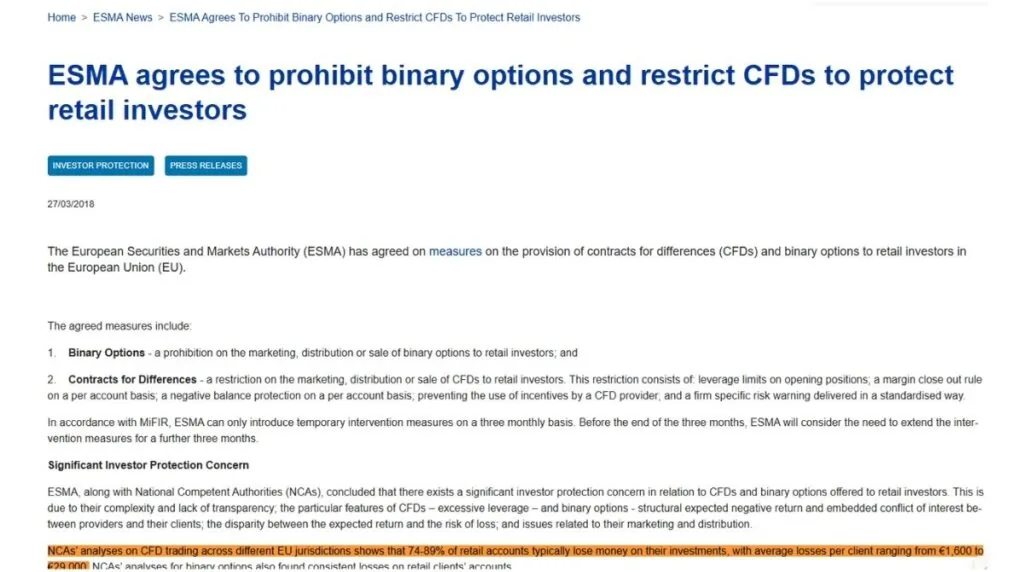
This data formed the regulatory basis for mandatory risk warnings that EU and UK brokers are still required to display today.
Five risks account for the majority of trader losses:
- Leverage magnification: Leverage cuts in both directions. At 1:50 leverage, a $1,000 account controls a $50,000 position. A 2% adverse move = a $1,000 loss – your entire deposit. A trader using maximum leverage with no stop loss can lose their full account on a single trade.
- News event spikes: The US Non-Farm Payrolls report, FOMC rate decisions, and ECB press conferences can trigger price moves ranging from several dozen to well over 100 pips, depending on how much the result surprises the market. During these spikes, brokers widen spreads, and slippage is common. Your stop loss may not execute at the price you set – during highly volatile news events, prices may gap beyond stop-loss levels, meaning the market skips past your intended exit price and your actual loss is larger than planned.
- Swap accumulation on multi-day positions: Holding EUR/USD long for 10 days when the Fed rate exceeds the ECB rate costs approximately 0.5 to 1.5 pips per night. On the 0.1 lot example above, that is $0.50 to $1.50 per night – manageable. Scale up to a 1.0 standard lot position, and the same rate becomes $5 to $15 per night, or $50 to $150 over 10 nights. Traders who hold positions for weeks without accounting for swap costs find their profits eroded by this silent fee.
- Emotional overtrading after a loss streak: A trader loses 4 trades in a row at 2% risk each. Total loss: 8% of the account. The instinct is to increase position size on the next trade to recover faster. This is the single most common pattern in trader account blow-ups. The correct response is the opposite – reduce size or pause trading entirely.
- Spread cost accumulation: With a 1.2-pip spread on EUR/USD and 20 trades per month at 0.1 lot, the monthly spread cost is $24. Over a year: $288. On a $1,000 account, that is 28.8% of your capital in transaction costs before any trading losses. Position sizing must account for this.
8. 5 mistakes new forex traders make
Most early forex losses come from the same 5 behavioral patterns, not from bad strategy, and not from bad luck. Each mistake below includes a specific scenario with numbers so you can recognize the pattern before it costs you capital.
8.1. Mistake 1: Using leverage above 1:20 before achieving 3 months of consistent demo results
A trader opens a $500 live account and sets leverage to 1:100, the maximum their broker allows. With 1:100 leverage, a single 1% adverse move on a full-size position wipes the account. Most brokers default to maximum leverage on account creation. Most new traders do not change it. The fix: set leverage to 1:10 or 1:20 manually in your account settings before placing a single trade.
8.2. Mistake 2: Not placing a stop loss “because the price will come back”
In January 2015, the Swiss National Bank removed its EUR/CHF currency cap without warning. EUR/CHF dropped 1,800 pips in 4 minutes. Traders holding long EUR/CHF positions with no stop loss did not just lose their accounts; many went into negative balance.
Brokers absorbed those losses in some cases, but some traders received margin calls for amounts exceeding their deposits. A stop loss is not optional. It is the only mechanism that defines your maximum loss before the market decides it for you.
8.3. Mistake 3: Following Telegram signal groups without understanding the trade logic
Signal groups tell you what to buy, where to set stop losses, and where to take profits. They do not teach you why. After 3 months of following signals, a trader still cannot read a chart, still cannot evaluate a setup independently, and still cannot manage an open trade when the signal provider goes offline.
The result: dependency without skill development. Use signals to learn by reverse-engineering the logic, not as a substitute for analysis.
8.4. Mistake 4: Trading through major news events before understanding how they behave
The US Non-Farm Payrolls report is released the first Friday of every month at 8:30 AM EST. In the 5 minutes surrounding the release, broker spreads on EUR/USD expand from 1.2 pips to 8-20 pips. Slippage of 10-30 pips is common.
Stop losses fail to execute at target prices. A trader holding an open position through NFP with a 25-pip stop loss may find their actual exit was 45 pips away. The fix: close open positions 15 minutes before major news releases until you have 6+ months of experience trading news intentionally.
8.5. Mistake 5: Targeting 10% account growth per week from the first month
A trader with a 50% win rate and a 1:1.5 risk/reward ratio running at 2% risk per trade can expect approximately 3-4% monthly return in expectancy terms over large sample sizes. 10% per week means 40% monthly compounding.
To achieve that, a trader must either dramatically increase risk per trade, which destroys accounts on losing streaks, or maintain an unusually high win rate above 70%, which takes years to develop. Realistic targets for the first 6 months: consistent win rate above 45% with positive risk-to-reward, and no account blow-ups.
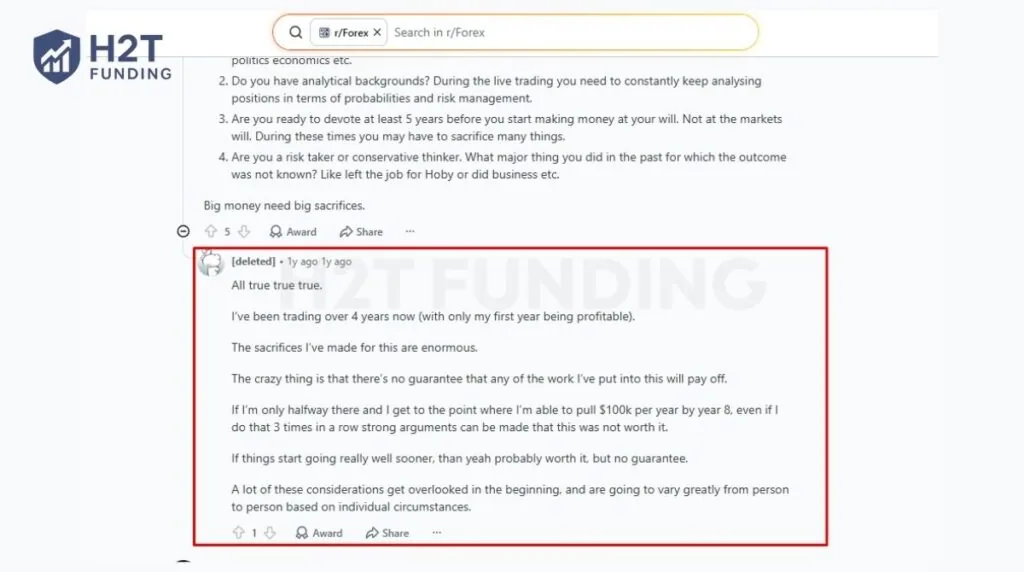
“I’ve been trading over 4 years now with only my first year being profitable. The sacrifices I’ve made for this are enormous. The crazy thing is that there’s no guarantee that any of the work I’ve put into this will pay off. A lot of these considerations get overlooked in the beginning.” – u/[deleted], r/Forex, 2024
9. The Forex Session Guide
The forex market runs 24 hours a day because the four major financial centers – Sydney, Tokyo, London, and New York operate in overlapping time zones. Each session has a distinct volume profile, volatility character, and set of currency pairs that move most actively.
| Session | Open (GMT) | Close (GMT) | Open (EST) | Close (EST) | Volatility | Most Active Pairs |
|---|---|---|---|---|---|---|
| Sydney | 22:00 | 07:00 | 17:00 | 02:00 | Low | AUD/USD, NZD/USD, AUD/JPY |
| Tokyo | 00:00 | 09:00 | 19:00 | 04:00 | Low-Medium | USD/JPY, EUR/JPY, AUD/JPY |
| London | 08:00 | 17:00 | 03:00 | 12:00 | High | EUR/USD, GBP/USD, EUR/GBP |
| New York | 13:00 | 22:00 | 08:00 | 17:00 | High | USD/CAD, USD/CHF, EUR/USD |
The London session generates approximately 38% of total daily forex volume, according to the BIS 2025 Triennial Survey. The New York session generates approximately 17%. The overlap period between London and New York – 13:00 to 17:00 GMT (08:00 to 12:00 EST) – is the highest-volume, highest-volatility window of the entire trading day.
Which session works best for prop firm traders?
The London-New York overlap is technically the best time to find high-quality setups with strong momentum and clean price action. But it also carries the highest risk of sharp, unexpected moves, particularly around 8:30 AM EST when US economic data releases hit the market.
For traders subject to prop firm daily drawdown rules, typically a 4-5% daily loss limit, the London-New York overlap requires tighter risk management. A single bad trade during NFP or FOMC can consume your entire daily loss allowance in minutes.
The Tokyo session offers a different environment. Lower volatility, tighter ranges, and fewer news events make it suitable for traders who prefer defined technical setups without the noise of major news. Scalpers working USD/JPY often prefer Tokyo hours for this reason.
The Sydney session is the quietest. It suits traders who want to place positions overnight and review them at the London open, rather than actively monitor markets.
The safest approach for prop firm traders during the first 60 to 90 days: trade the London session only, avoid the 30-minute window before and after major US data releases, and close all positions before the New York close.
10. Is forex trading right for you?
Forex trading is not a guaranteed income source. It is a skill-based activity with a measurable learning curve and a high early failure rate. The honest question is not “can I trade forex?” – almost anyone can open an account. The right question is “Am I prepared for what it actually requires?”
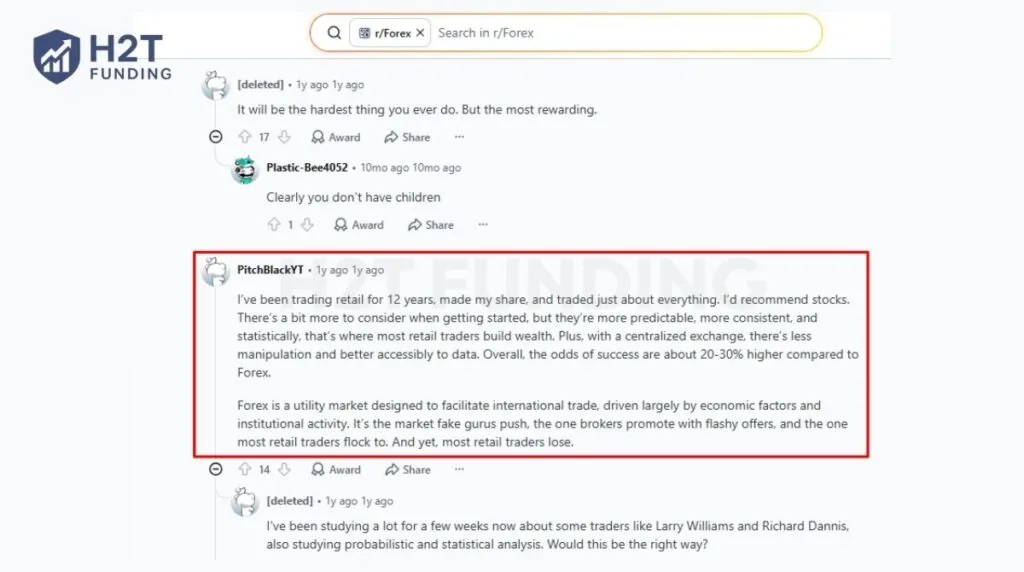
“Forex is a utility market designed to facilitate international trade, driven largely by economic factors and institutional activity. It’s the market fake gurus push, the one brokers promote with flashy offers, and the one most retail traders flock to. And yet, most retail traders lose.” – u/PitchBlackYT, r/Forex, 2024
5 signs you are suited for forex trading:
- You can accept losing months sometimes, 2 or 3 in a row, without abandoning your strategy
- You have 1-2 hours per day available to study charts, review trades, and keep a trading journal
- You do not need this income to pay bills in the first 6-12 months
- You find macroeconomics and global markets genuinely interesting, not just as a means to profit
- You can close a losing trade at your stop loss without second-guessing it or moving the stop further away
3 signs forex may not be the right fit right now:
- You need to generate income within 30-60 days of starting
- You feel physically stressed watching open positions fluctuate
- Your primary motivation is a social media account showing someone’s trading profits
None of these disqualifies you permanently. The second and third can be addressed with time and structured practice. The first is a capital timing issue, not a character issue, and is where funded accounts become a practical alternative.
11. How prop firms change the forex equation
The fundamental problem with retail forex trading is not strategy; it is mathematics. A skilled trader operating on a $1,000 personal account, managing risk correctly at 2% per trade, generates $50 to $120 per month in realistic expectancy. That figure does not change the trajectory of anyone’s financial life.
Prop firms solve this problem by providing capital. The model works like this: a trader pays an evaluation fee, typically $100 to $600, depending on account size, and completes a challenge phase demonstrating consistent risk management.
Pass the challenge, and the firm funds an account ranging from $10,000 to $200,000. The trader keeps 70% to 90% of all profits, pays nothing back on losses beyond the original challenge fee, and never risks personal trading capital beyond that initial fee.
The math changes completely:
| Scenario | Account Size | Monthly Return at 6% | Trader Keeps |
|---|---|---|---|
| Retail (personal funds) | $1,000 | $60 | $60 (100%) |
| Prop firm – standard | $50,000 | $3,000 | $2,400 (80% split) |
| Prop firm – scaled | $100,000 | $6,000 | $4,800 (80% split) |
| Prop firm – large | $200,000 | $12,000 | $9,600 (80% split) |
The trading skill required is identical. The capital doing the work is not your own.
For a trader who has already developed a consistent strategy proven over 3 to 6 months on a demo account or small live account, a prop firm-funded account is a direct path to applying that skill at a scale that produces meaningful income.
Choosing the right prop firm depends on matching your trading style to a firm’s specific rules: drawdown type (static vs trailing), news trading policy, allowed instruments, and payout schedule. The best prop firms for forex guide covers these criteria across the top-rated firms in detail.
12. How to choose a forex broker
Choosing a forex broker comes down to five criteria: regulation status, spread and commission structure, account types, platform support, and withdrawal reliability. Skipping any one of these checks is the most common reason traders end up with a broker that costs them money before they place a single trade.
12.1. Check 1: Regulation first
A regulated broker is legally required to segregate client funds, submit to regular audits, and display the percentage of retail accounts that lose money. The regulators that matter most for retail forex traders are the FCA (UK), CFTC and NFA (US), ASIC (Australia), and CySEC (Cyprus/Europe).
In the US, the CFTC caps leverage at 50:1 on major pairs – significantly lower than offshore brokers offering 500:1. That cap exists because high leverage is the primary driver of retail account losses, as covered in the risks section above.
12.2. Check 2: Spread and commission structure
Brokers price their services in two ways. Standard accounts build the spread into the price; EUR/USD typically shows 0.8 to 1.5 pips with no separate commission. ECN accounts offer raw spreads near zero but charge a commission per lot, typically $3 to $7 per standard lot round-turn.
For a trader placing 20 trades per month at 0.1 lot, a 1.2-pip standard spread costs $24 in monthly transaction costs, the same figure calculated in the real trade example above. An ECN account at $0.50 commission per 0.1 lot costs $10 for the same 20 trades. The math favors ECN for active traders and standard accounts for beginners who want simplicity.
12.3. Check 3: Account types and execution model
ECN and STP brokers route orders directly to the interbank market with no dealing desk; execution is faster, and there is no conflict of interest between the broker and the trader. Market makers take the other side of your trade internally, which is legal and common, but means the broker profits when you lose.
For beginners, either model works. For traders pursuing prop firm challenges where execution speed and slippage matter, ECN or STP execution is preferable.
12.4. Check 4: Platform support
MetaTrader 4 (MT4), MetaTrader 5 (MT5), and cTrader are the three industry-standard platforms. Most prop firms run their evaluation challenges on MT4 or MT5. Choosing a broker that supports the same platform you plan to use for a prop firm challenge means your workflow, indicators, and trade execution habits transfer directly without relearning a new interface.
12.5. Check 5: Withdrawal process before depositing
Check independent review platforms: Trustpilot and Reddit are the two most commonly referenced for withdrawal complaints specifically. A broker with strong marketing but slow or disputed withdrawals is a risk that no spread advantage compensates for. Before depositing significant capital, test the withdrawal process with a small amount first.
What we consistently observe is that traders who spend time debating ECN versus market maker, or chasing the broker with the lowest advertised spread, are often using that research as a substitute for the harder work of building a consistent strategy.
A well-regulated broker with standard spreads and MT4 or MT5 support is enough to start. Once your approach is proven over 60 to 90 days with documented results, the capital constraint becomes the real bottleneck, and that is where a prop firm-funded account changes the equation more than any broker selection ever could.
13. FAQs
-
Forex trading can be profitable, but most retail traders lose money. FCA-mandated disclosures from UK brokers show that the majority of retail CFD clients, between 69% and 79%, end up with a net loss over time.
Traders who become consistently profitable typically spend 6-12 months developing and testing a strategy before achieving stable returns. Profitability depends on risk management discipline, realistic return targets, and trading with adequate capital.
-
Forex trading is legal in most countries, with regulatory frameworks that vary by jurisdiction. In the United States, retail forex is regulated by the Commodity Futures Trading Commission (CFTC) and the National Futures Association (NFA).
In the United Kingdom, forex brokers must be authorized by the Financial Conduct Authority (FCA). The European Union regulates forex under European Securities and Markets Authority (ESMA) rules, which cap retail leverage at 30:1 for major pairs. Always verify a broker’s regulatory status before depositing funds.
-
$100 is enough to open a live account and learn, but not enough to trade with proper risk management. At $100, a 2% risk rule limits you to $2 per trade, which means trading nano lots only.
The skill development is the same at any account size, but the capital constraints at $100 make it difficult to practice realistic position sizing. Most experienced traders recommend at least $500 to $1,000 for meaningful live practice, or using a prop firm-funded account to access $25,000 to $200,000 in capital after passing an evaluation challenge.
-
Forex trading is not gambling by definition, but it functions like gambling without a structured edge. Gambling relies entirely on chance – no skill influences the outcome. Forex trading, like poker, involves probability, skill, and decision-making under uncertainty.
A trader with a positive expected value strategy, for example, a 50% win rate with a 1:2 risk/reward ratio, profits over a large sample of trades by mathematical necessity. Without a tested edge, risk management rules, and emotional discipline, the outcome approaches random, which is functionally similar to gambling.
-
Yes, beginners can trade forex, but starting directly on a live account with real capital before spending 60 to 90 days on a demo account is one of the most common causes of early losses. A demo account lets you learn order types, practice position sizing, experience real market volatility, and test a strategy, all without financial risk. Most brokers offer unlimited free demo access.
-
Teaching yourself forex trading works through three sequential phases. First, learn the mechanics: currency pairs, how pip value is calculated, what leverage and margin mean, and how to place and manage orders.
Second, focus on one analysis method, either price action (chart patterns, support, and resistance) or a technical indicator system, and study it exclusively for 60 days. Third, forward-test your strategy on a demo account for 2 to 3 months, tracking every trade in a journal. Only move to live trading once your demo results show consistency over at least 50 trades.
-
EUR/USD is the best currency pair for beginners. It carries the tightest spread among all pairs, typically 0.0 to 1.5 pips depending on broker type, with ECN accounts offering raw spreads near zero and standard accounts typically showing 0.8 to 1.5 pips, the highest daily volume of any forex pair, the most widely available fundamental analysis, and the most consistent technical behavior.
USD/JPY and GBP/USD are the next most suitable for beginners. Exotic pairs with wider spreads and lower volume are not recommended until you have at least 6 months of consistent trading history.
-
The foundation of forex risk management is the 1-2% rule: never risk more than 1-2% of your total account balance on a single trade. Combined with a minimum 1:1.5 risk/reward ratio, this structure means you can sustain 6 consecutive losses and recover with 4 winning trades.
Three additional practices reinforce the 1-2% rule: always set a stop loss before entering a trade, calculate your position size based on pip distance to stop loss rather than an arbitrary lot size, and never move a stop loss further away from your entry to avoid being stopped out.
-
A forex prop firm (proprietary trading firm) provides traders with funded accounts – typically $25,000 to $200,000 – in exchange for a share of profits, usually 70-90%. Traders first complete an evaluation challenge to demonstrate consistent risk management over a defined period – typically 20 to 30 trading days.
Once funded, traders keep the majority of profits without risking personal capital beyond the initial challenge fee. The what is a prop firm guide explains the full model, including how evaluations work and what firms look for in funded traders.
-
Choosing a prop firm for forex trading requires comparing five criteria: profit split percentage, drawdown rules, challenge cost, allowed trading sessions, and payout speed. Drawdown rules matter most – some firms use a trailing drawdown (maximum loss calculated from your highest balance, not your starting balance), while others use a static drawdown (fixed from the starting balance). Trailing drawdown is harder to manage but more common among larger firms.
-
The first step is to achieve consistent, documented results on a demo account before applying for any prop firm evaluation. Specifically: trade a demo account for at least 60 days, targeting a 5-8% return with a maximum drawdown under 5%, with every trade logged in a journal. This is essentially what a prop firm challenge requires, so practicing the same conditions beforehand dramatically increases your pass rate.
Once your demo results are consistent, compare prop firm challenges that match your trading style, focusing on daily drawdown limits, news trading policy, and minimum trading days. For a complete breakdown of rules, risk targets, and common failure points across the top-rated firms, see our how to pass a prop firm challenge guide.
-
AI tools can support forex trading through algorithmic bots, sentiment analysis, and pattern recognition, but cannot replace a trader’s strategy and risk management. Most prop firm evaluations prohibit or restrict fully automated trading because the challenge assesses trader decision-making, not bot execution. AI is best used as a research and analysis tool, not a standalone trading system.
-
Forex runs 24/5 OTC with flexible sizing down to $0.10 per pip. Futures trade on centralized exchanges like the CME with fixed contract sizes and set hours. Forex prop firms (FTMO, MyFundedFX) are more numerous; futures prop firms (Apex Trader Funding, Topstep) are more specialized. Neither is objectively better – the right choice depends on your trading style and which prop firm structure fits your risk rules.
-
Standard forex accounts generate overnight swap fees based on interest rate differentials, which most Islamic scholars classify as riba and therefore impermissible. Most major brokers offer Islamic swap-free accounts that replace swap fees with fixed administrative fees, though whether those fees are permissible also varies by scholarly opinion. Consult a qualified Islamic finance scholar and verify the specific terms of any swap-free account with your broker directly.
-
XAU/USD is the price of one troy ounce of gold quoted in US dollars, traded as a CFD on standard forex platforms, not physical gold. It is significantly more volatile than major currency pairs, with daily moves of $15 to $30 per ounce common.
Gold reacts strongly to real interest rates, USD strength, and geopolitical events. In prop firm evaluations, XAU/USD is permitted by most firms, but its volatility makes it high-risk relative to daily drawdown limits; most traders size down considerably compared to currency pair positions.
14. Conclusion
So, what is forex trading? It’s not just about buying and selling currencies; it’s a global market where pricing, timing, and risk management all work together to create opportunity. But understanding the concept is only the beginning. The real difference comes from how you apply it in real trading situations.
To continue building your foundation, explore more in-depth breakdowns, strategies, and practical guides inside the “Trading Guides & Strategies” section at H2T Funding.
These resources are designed to help you move from basic understanding to structured trading execution with real consistency.
Risk Warning: Forex trading involves a substantial risk of loss and is not appropriate for all investors. The high degree of leverage available in forex trading can work against you as well as for you. Before deciding to trade forex, carefully consider your investment objectives, experience level, and risk tolerance. You could lose some or all of your initial investment. Do not invest money you cannot afford to lose.