


MT5 is the better choice for most new traders because it supports more markets, more order types, deeper analysis, and stronger strategy testing, while MT4 still suits Forex traders who already rely on MQL4 EAs, indicators, or an established setup. If you are starting from scratch, MT5 offers more room to grow; if your current MT4 workflow already works well and your broker or prop firm still supports it, there may be little reason to switch.
This MT4 vs MT5 comparison covers features, supported markets, charting, order types, backtesting, system requirements, prop firm availability, and real trader feedback to help you choose the platform that fits your trading style.
Key takeaways
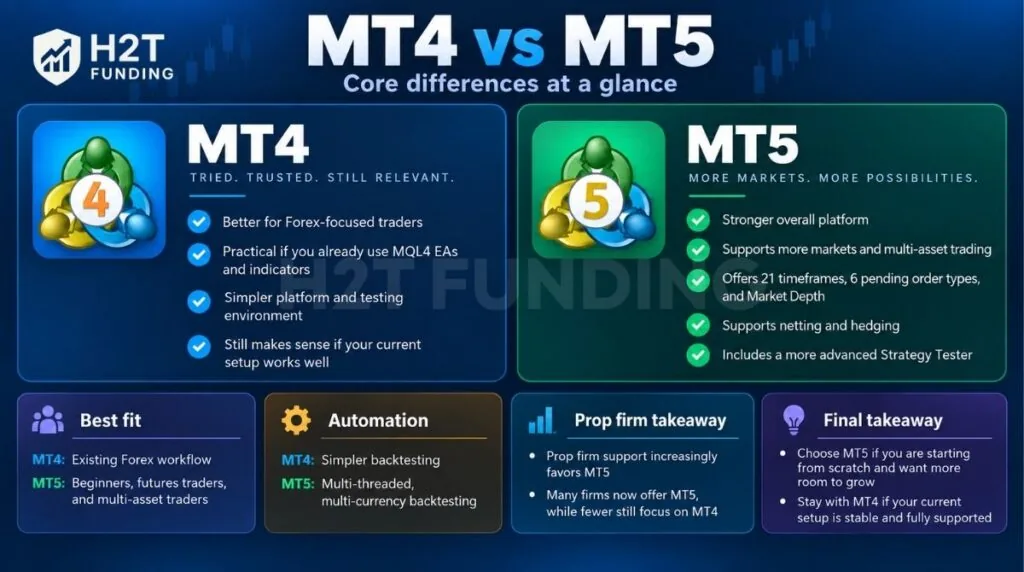
- MT5 is the stronger overall platform: It supports more markets, 21 timeframes, 6 pending order types, Market Depth, netting and hedging, and a more advanced Strategy Tester.
- MT4 still fits Forex-focused traders: It remains practical if you already use MQL4 EAs, indicators, or a broker or prop firm that supports MT4.
- MT5 is usually better for beginners: New traders get a broader toolset without needing to migrate later.
- MT5 is much stronger for futures and multi-asset trading: MT4 is mainly centered on Forex and broker-provided CFD products.
- Automation is a major difference: MT5 offers multi-threaded, multi-currency backtesting, while MT4 uses a simpler testing environment.
- Prop firm support increasingly favors MT5: In the firms reviewed here, every firm still offering MT4 also offers MT5, while many MT5 firms no longer list MT4.
- There is no need to switch just because MT5 is newer: If your MT4 setup is stable and fully supported, staying with MT4 can still make sense.
1. MT4 vs MT5: Full feature comparison table
MT5 has the broader feature set, with more order types, timeframes, analytical tools, supported markets, and a more advanced Strategy Tester. MT4 remains a forex-focused platform with fewer built-in tools and a simpler testing system.
| Feature | MetaTrader 4 (MT4) | MetaTrader 5 (MT5) |
|---|---|---|
| Supported markets | Forex | Forex, futures, options, stocks, bonds |
| Execution modes | 3 | 4 |
| Pending order types | 4 | 6 |
| Order fill policies | Fill or Kill | Fill or Kill, Immediate or Cancel, Return |
| Partial order filling | Not supported | Supported |
| Depth of Market | No | Yes |
| Technical indicators | 30 | 38 |
| Analytical objects | 31 | 44 |
| Timeframes | 9 | 21 |
| Economic calendar | No | Built in |
| Position accounting | Hedging | Netting and hedging |
| Strategy Tester | Single-threaded | Multi-threaded, multi-currency, real ticks |
| Symbols | Up to 1,024 | Unlimited |
| Exchange trading | No | Yes |
In practice, these differences matter most when your trading style requires broader market access, more flexible position management, or heavier EA testing. For a straightforward Forex workflow, many of MT5’s additional features may not be essential.
2. MT4 vs MT5 for beginners: Which should you learn first?
Most beginners should learn MT5 first because it offers more markets, more built-in analysis tools, more order options, and a more advanced Strategy Tester. MT4 still makes sense if your broker or existing trading tools specifically require it.
2.1. Why MT5 is usually better for beginners
- More markets: MT5 supports Forex, futures, stocks, bonds, and options, while MT4 is primarily Forex-focused.
- More charting tools: MT5 provides 21 timeframes, 38 technical indicators, and 44 analytical objects, compared with MT4’s 9 timeframes, 30 indicators, and 31 analytical objects.
- More order flexibility: MT5 includes 6 pending order types, while MT4 has 4.
- Better strategy testing: MT5 uses a multi-threaded, multi-currency Strategy Tester with real ticks, while MT4 uses a single-threaded tester.
- More position-management choice: MT5 supports both netting and hedging, while MT4 supports hedging.
2.2. When MT4 still makes sense
Choose MT4 instead if you already depend on an MT4-only broker, Expert Advisor, indicator, or MQL4 workflow. MQL4 and MQL5 are different languages, so existing MT4 tools cannot simply be moved to MT5 without adaptation.
For a beginner starting from scratch, MT5 is generally the better platform to learn first; MT4 is mainly worth learning when your existing trading setup requires it.
3. MT4 vs MT5 by instrument: Forex, gold, indices & futures
MT4 is still a strong choice for Forex and simple CFD trading, while MT5 is better for traders who want deeper market tools, more order flexibility, or access to futures and other exchange-traded markets. The difference becomes more noticeable as your trading moves beyond basic Forex and CFD execution.
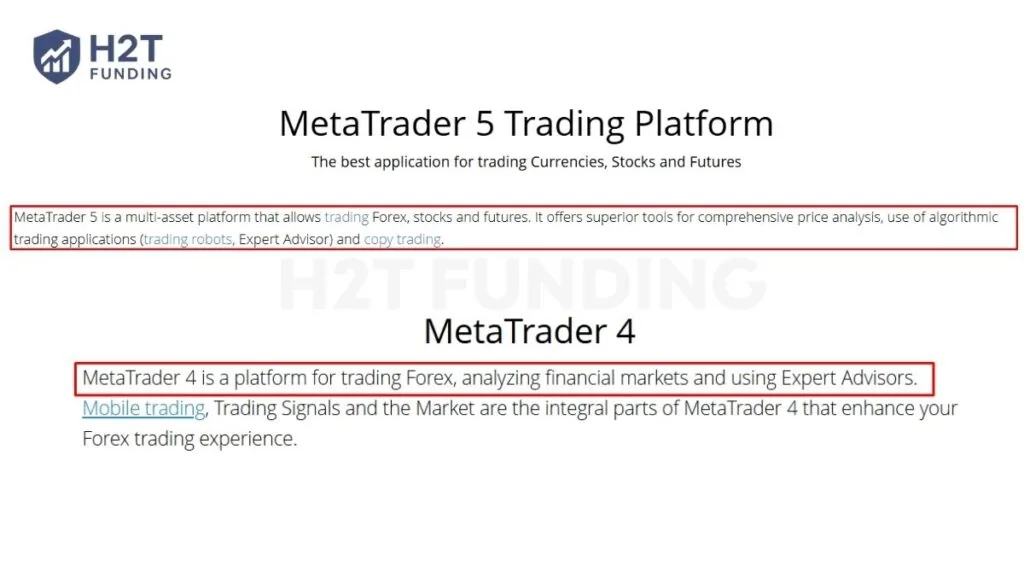
“MetaTrader 5 is a multi-asset platform that allows trading Forex, stocks and futures.” – Trading Platform page, MetaTrader 5
“MetaTrader 4 is a platform for trading Forex, analyzing financial markets and using Expert Advisors.” – Homepage, MetaTrader 4
3.1. Forex
Best fit: MT4 is enough for most manual Forex traders, while MT5 is better for traders using more advanced order management, analysis, or automation.
- MT4: Well suited to straightforward Forex trading. It supports hedging, 4 pending order types, 9 timeframes, and the familiar MQL4/EA ecosystem many Forex traders still use.
- MT5: Better if you want more flexibility. It supports hedging and netting, 6 pending order types, 21 timeframes, Market Depth, and more advanced strategy testing.
3.2. Gold
Best fit: MT4 is perfectly capable for basic XAU/USD trading, but MT5 is more useful if you scalp gold, test EAs, or need more detailed execution tools.
- MT4: Works well for trading broker-provided gold products such as XAU/USD, especially if your setup mainly relies on standard indicators, manual entries, or existing MQL4 EAs.
- MT5: Gives gold traders more control through additional timeframes, more pending order types, Market Depth where available, and stronger backtesting tools.
3.3. Indices
Best fit: MT4 is fine for simple index CFD trading; MT5 is better if indices are part of a wider multi-asset strategy or you need more advanced execution tools.
- MT4: Handles broker-provided index products well for normal chart-based CFD trading.
- MT5: Has the advantage when you want a more detailed trading workflow, with 21 timeframes, Market Depth, netting support, and broader multi-asset functionality.
3.4. Futures
Best fit: MT5 is clearly the better platform for futures traders, especially if you need exchange-style execution, order-book data, or multi-asset access.
- MT4: Not designed as a native multi-asset exchange platform. In practice, MT4 users are mainly trading Forex and broker-created CFD products rather than exchange-traded futures.
- MT5: Built for Forex, Futures, Options, Stocks, and Bonds. It also supports exchange trading, Market Depth, netting, Time & Sales, and multi-currency strategy testing, which makes it much more suitable for futures trading.
In practice, the choice is simple: MT4 still works very well for Forex, gold, and index CFD trading, while MT5 becomes the stronger option once you need futures, deeper execution tools, or a broader multi-asset workflow.
4. System requirements: RAM, CPU & VPS for funded accounts
Both MT4 and MT5 can run comfortably on a normal modern trading PC, but MT5 can demand more resources when you run multiple charts, EAs, or heavy backtests. For funded accounts, stability matters more than chasing the lowest possible RAM or CPU specification.
4.1. RAM and CPU
- MT4: Usually lighter for simple Forex setups with a few charts, indicators, and EAs.
- MT5: Better suited to heavier workflows such as multi-threaded backtesting, multi-currency testing, multiple charts, and more complex EAs, so resource usage can rise faster as the setup grows.
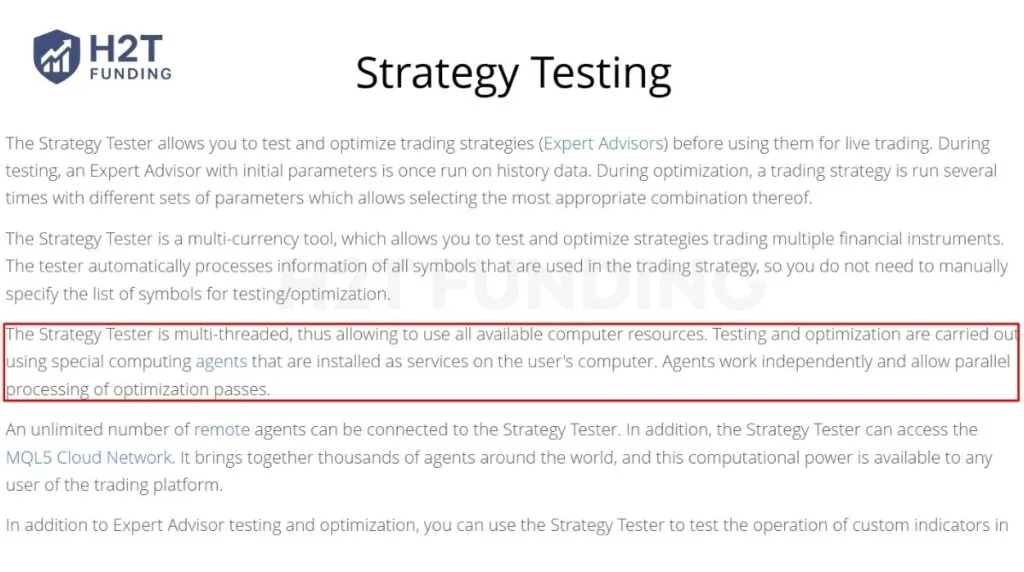
“The Strategy Tester is multi-threaded, thus allowing to use all available computer resources.” – Strategy Testing, MetaTrader 5 Help
Practical impact: If you only trade manually on one funded account, either platform should run well on a typical modern computer. If you run several terminals, EAs, or strategy tests at the same time, MT5 benefits more from additional RAM and CPU capacity.
4.2. VPS for funded accounts
Both MT4 and MT5 offer built-in Virtual Hosting for running trading robots and signal subscriptions 24/7, even when your computer is turned off. The virtual server can be located close to the broker’s trading server to help reduce network latency.
A VPS is especially useful when you:
- run an EA continuously;
- use MetaTrader Signals or permitted signal-copying tools;
- manage multiple trading terminals;
- need the platform to stay online while your computer is turned off.
For manual trading on a single funded account, a VPS is usually optional. For automation-heavy setups, it can become an important part of the trading infrastructure.
Important: Always check the prop firm’s rules before using a VPS, EA, or copy-trading tool, because permissions can differ by firm and account type.
5. MT4 vs MT5 Reddit: What do traders actually prefer?
MT5 is usually preferred for newer features and algorithmic trading, while MT4 remains popular because many traders already have established indicators, EAs, and broker setups. Recent discussions also show that platform choice is often decided by broker or account availability rather than features alone.
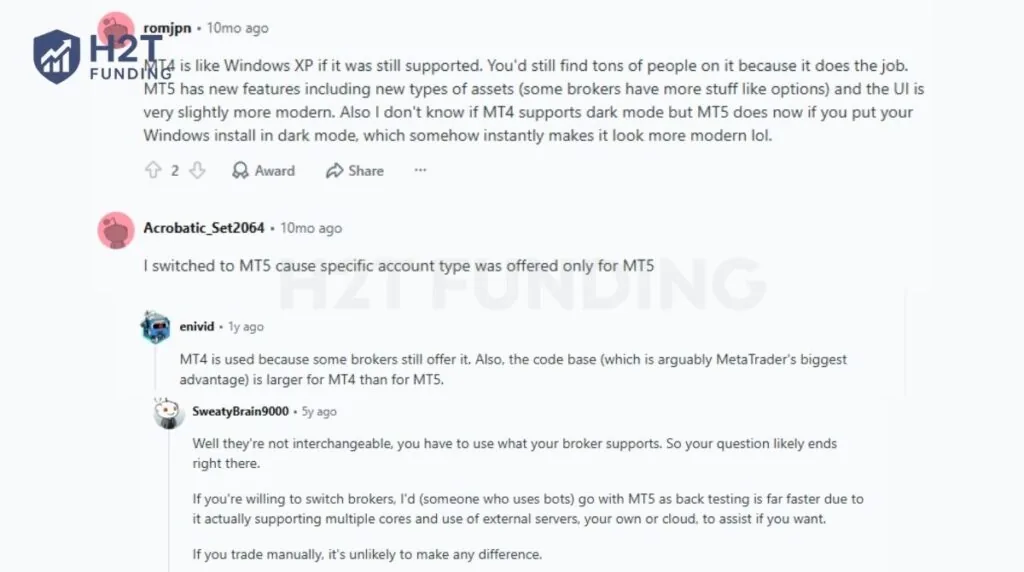
“MT4 is like Windows XP if it was still supported. You’d still find tons of people on it because it does the job.” – u/romjpn, r/Forex, 2025
This reflects one of the strongest reasons traders still use MT4: it remains familiar and sufficient for existing workflows, even when MT5 offers more features.
“I switched to MT5 cause specific account type was offered only for MT5.” – u/Acrobatic_Set2064, r/Forex, 2025
This is especially relevant for prop firm traders. In practice, your broker or prop firm may decide the platform for you because some programs or account types are only available on MT5.
“MT4 is used because some brokers still offer it. Also, the code base … is larger for MT4 than for MT5.” – u/enivid, r/Forex, 2025
The user clarified that this includes free indicators, EAs, and scripts. This explains why some traders stay on MT4 even when MT5 is technically more capable: migrating an established setup can create extra work.
“If you’re willing to switch brokers, I’d … go with MT5 as back testing is far faster due to it actually supporting multiple cores…” – u/SweatyBrain9000, r/Forex
Although this comment is older, it remains highly relevant because it highlights a practical difference confirmed by MetaQuotes: MT5 is much better suited to EA testing and optimization, while manual traders may notice a smaller difference.
Overall, Reddit feedback is broadly consistent with H2T Funding’s experience after using both platforms: choose MT5 if you are starting fresh or rely heavily on automation and backtesting; keep MT4 if your existing setup already works well and your broker or prop firm still supports it.
6. MT4 vs MT5: Which is better overall?
MT5 is the better overall platform for most traders today because it supports more markets, more order types, deeper analysis, and more advanced strategy testing. MT4 still makes sense for traders who mainly trade Forex and already rely on an established MQL4 setup.
Key differences that matter most
- Markets: MT4 is mainly focused on Forex, while MT5 supports Forex, Futures, Options, Stocks, and Bonds.
- Charting: MT4 has 9 timeframes, while MT5 expands this to 21 timeframes.
- Order types: MT4 supports 4 pending order types; MT5 supports 6, including Buy Stop Limit and Sell Stop Limit.
- Position management: MT4 uses hedging, while MT5 supports both hedging and netting.
- Market Depth: MT5 includes Depth of Market, giving traders more visibility into available buy and sell levels where supported.
- Strategy testing: MT5 has a multi-threaded, multi-currency Strategy Tester with real ticks, making it much better suited to EA testing and optimization.
Which should you choose?
- Choose MT4 if you mainly trade Forex and already depend on MQL4 indicators, scripts, or Expert Advisors.
- Choose MT5 if you want broader market access, more advanced order management, stronger backtesting, or a platform that gives you more room to expand later.
7. Which prop firms support MT4, and which support MT5?
MT5 is currently supported by more of the prop firms in this comparison. In fact, every firm in this list that still offers MT4 also offers MT5, while many MT5-supported firms no longer list MT4 in their current platform offering. Platform availability can still vary by region, account type, and program.
Prop firms supporting both MT4 and MT5
- FundedNext: Supports both MT4 and MT5. U.S. traders are limited to Match-Trader.
- FTMO: Supports both MT4 and MT5.
- FXIFY: Supports both MT4 and MT5.
- Hola Prime: Supports both MT4 and MT5.
- Blueberry Funded: Supports both MT4 and MT5.
Prop firms supporting MT5: The following firms currently support MT5 but do not list MT4 in their current platform offering:
- The5ers
- Alpha Capital Group
- E8 Markets
- Goat Funded Trader
- BrightFunded
- Blue Guardian
- AquaFunded
- City Traders Imperium
- Finotive Funding
- Audacity Capital
Some of these firms also impose regional restrictions. For example, The5ers offers MetaTrader 5 and cTrader to non-U.S. clients, while platform availability for U.S. traders depends on the firm’s current regional offering. E8 Markets, Goat Funded Trader, BrightFunded, Funded Trading Plus, and Blue Guardian also apply regional restrictions to MT5 under their current setups.
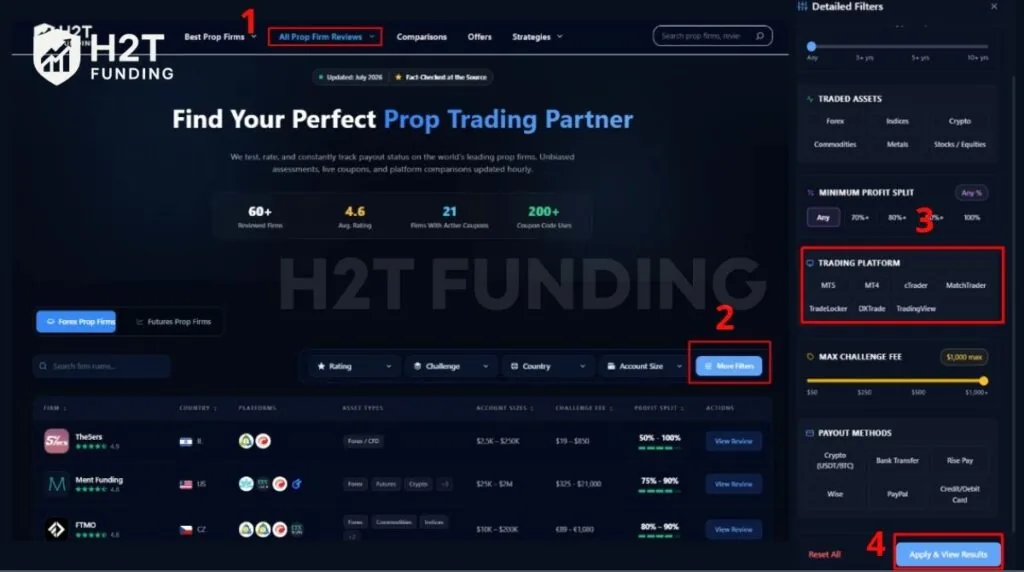
Tip: Want the most up-to-date list? Go to our All Prop Firm Reviews page, select More Filters → Trading Platform → MT4 or MT5, then click Apply & View Results. You can also combine this with filters for country, account size, profit split, and traded assets.
8. How to choose a prop firm based on platform support
Choose the prop firm first based on its rules, drawdown, payout terms, and reliability, then use platform support as a filter. If you already depend on a specific MT4 EA, MT5 EA, indicator, or trading workflow, platform availability becomes more important. Before buying a challenge, confirm:
- the exact platform available for that account;
- whether EAs are allowed;
- whether the same platform remains available after passing;
- whether platform availability differs by region or program.
For most traders, the practical order is: prop firm first → trading rules → platform fit. You can compare firms by rules, platforms, account sizes, and other key factors in our Best Prop Firms directory.
9. FAQs
MT4 is primarily built for Forex trading, while MT5 is a newer multi-asset platform with broader trading and analysis tools. MT5 supports 21 timeframes, 6 pending order types, netting and hedging, Market Depth, and a multi-threaded Strategy Tester, while MT4 uses 9 timeframes, 4 pending order types, and a simpler testing environment.
MT4 has not been officially discontinued, but MT5 is clearly receiving more new development from MetaQuotes. MT4 still receives compatibility, security, and performance updates, and brokers can continue supporting it. However, most major new platform features and development are centered on MT5.
Usually not unless the prop firm specifically allows it. A challenge account is normally created on a specific trading platform, so switching from MT4 to MT5 may require a new account or approval from the firm.
If you use automated trading, also remember that MT4 EAs are written in MQL4 and MT5 EAs use MQL5, so an MT4 EA cannot simply be moved to MT5 without adapting or rebuilding the code.
MT5 is the better overall platform for most new traders because it offers more markets, order types, analytical tools, and stronger strategy testing. MT4 still makes sense if your broker or prop firm supports it and your trading setup already depends on MQL4 indicators or Expert Advisors.
MT5 is generally the better platform to learn first if you are starting from scratch. It gives you access to newer tools, 21 timeframes, Market Depth, both netting and hedging, and the wider MQL5 ecosystem. MT4 can still be practical if you specifically need an existing MQL4 EA or a broker that only supports MT4.
MetaTrader 5 itself is legal software to use in the United States. However, whether you can trade a particular product through MT5 depends on the broker, its regulatory permissions, and the financial instruments it is allowed to offer in your jurisdiction. MetaQuotes provides the trading software; it does not itself provide brokerage or investment services.
You can download and explore MT5 without depositing real money, but actual trading requires connection to a trading server. MetaTrader 5 supports demo accounts for practice, while real-money trading must be provided through a brokerage company.
A prop firm may offer both MT4 and MT5, but that does not usually mean one trading account can run on both platforms interchangeably. The platform is normally selected when the account is created, so check the exact program and account type before purchasing.
Not directly. MQL4 and MQL5 are different programming environments, so an MT4 Expert Advisor normally needs to be adapted or rewritten before it can run correctly on MT5.
For simple EAs, migration may be relatively straightforward. More complex systems that depend on MT4-specific order handling or functions can require substantial redevelopment and testing.
Not directly; drawdown limits are set by the prop firm, while netting and hedging determine how positions are recorded and managed. However, the accounting mode can change your total exposure and how multiple trades on the same symbol are handled, which can indirectly affect your risk and drawdown.
With netting, multiple trades on the same symbol are combined into one net position. With hedging, separate long and short positions can remain open independently.
Switch to MT5 before the challenge if the firm supports it and you want to use MT5-specific tools such as MQL5 EAs, Market Depth, advanced backtesting, or its broader order system. If your strategy already works reliably on MT4 and the firm still supports MT4, there is no need to switch just for the sake of using the newer platform.
Most importantly, choose and test your platform before starting the challenge rather than changing your trading workflow during the evaluation.
10. Conclusion
In the MT4 vs MT5 comparison, MT5 is the stronger overall choice for traders who want broader market access, more advanced order management, and better strategy testing, while MT4 still makes sense for Forex traders with an established MQL4 setup. The best platform ultimately depends on your trading style, existing tools, and the broker or prop firm you plan to use.
If you trade with funded accounts, explore more practical comparisons, platform guides, trading rules, and evaluation tips in H2T Funding’s Prop Firm Guides section.