
 Dubai
Dubai NinjaTrader
 Tradovate
 TradingView
 DeepCharts
 ATAS
ATAS Quantower
In this review, we go beyond Finotive Futures’ published rules to assess how the program works in practice. We look at its trading rules, drawdown structure, platform experience, execution, and the practical considerations traders should understand before choosing a program.
Because Finotive Futures is still a new futures product, its payout history and user-generated evidence remain more limited than those of established futures prop firms. This review therefore separates official information from our own trading observations and available public evidence.
1. Our Take on Finotive Futures
For this review, we went beyond the published rules. We tested a $50,000 Finotive Futures 1-Step Challenge from August 13, 2026 to August 21, 2026, using the account to evaluate the trading environment, platform experience, execution, drawdown mechanics, and day-to-day usability.
1.1. What We Liked
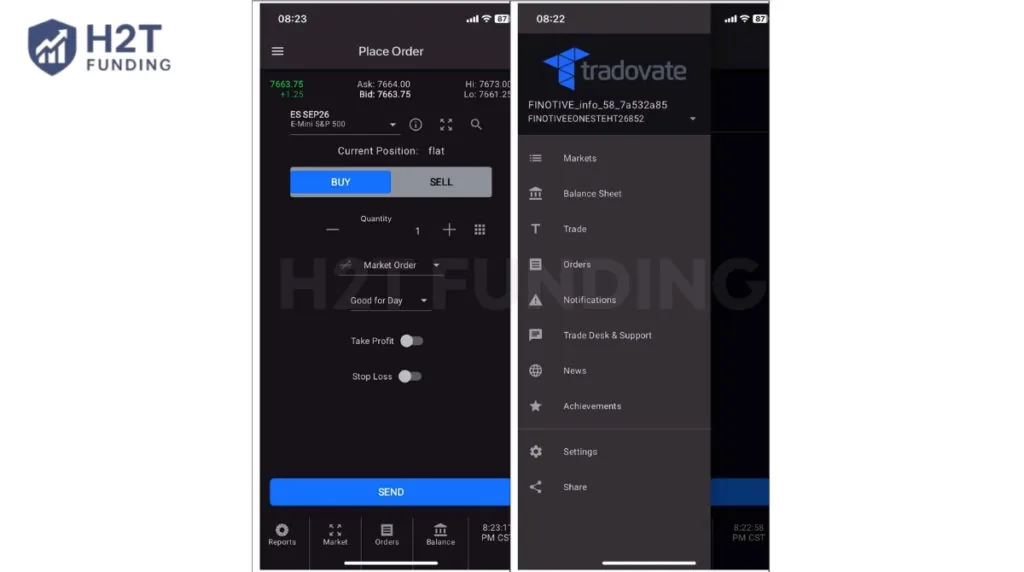
Our experience with the Challenge was positive. The account setup was straightforward, the trading environment was functional, and we did not encounter abnormal execution issues during testing. Tradovate also provided a practical environment for managing trades, although some aspects of the platform experience could still be improved.
Overall, Finotive Futures offers a futures-focused trading environment with flexible program and platform options. Its clear evaluation structure and support for micro contracts also make it more suitable for traders who prefer a disciplined intraday approach.
1.2. What We Didn’t Like
The main consideration is drawdown management. EOD and intraday trailing drawdown models are common across futures prop programs, with mechanics varying by account type. In our experience, available risk room can tighten when positions are held for too long, position size increases, or a trade moves against you. This makes disciplined position sizing and intraday risk management important.
There are also some platform limitations, including P/L visibility and occasional re-login issues. Finotive Futures has fewer reviews and less publicly documented payout history than some established futures prop firms, although this is partly offset by Finotive’s broader track record and backing.
Pros & Cons Analysis
Pros
- Two program options: 1-Step Challenge and Instant Account
- One-time fee structure: No recurring subscription or activation fee
- EOD drawdown on 1-Step: Less sensitive to intraday unrealized equity peaks
- Profit Buffer can lock the drawdown at the initial balance once the required level is reached
- Up to 90% profit split for traders
- 6 platform options: Tradovate, NinjaTrader, TradingView,
- Quantower, DeepCharts, and ATAS
- Up to $1 million in total funded capital across accounts
- Futures-focused trading environment with support for major CME Group markets
- Suitable for disciplined intraday and micro-contract trading
Cons
- Some rules require careful monitoring, including consistency and profitable-day requirements
- Some platform usability limitations include Limited P/L visibility for pending orders, occasional re-login issues, and a mobile app better suited to monitoring than detailed trading.
- Certain trading restrictions apply at the funded stage, including news and short-duration trading rules
- Less public review and payout history than some established futures prop firms
- Additional funded-stage conditions apply before profits can be withdrawn
- Payout caps apply to eligible withdrawals
1.3. OUR RATING
The overall rating is based on our experts’ review, combining official program information, firsthand trading experience, and available independent evidence.
Finotive Futures appears better suited to disciplined intraday and micro-contract traders than swing traders. The requirement to close positions before the daily cutoff also makes it less suitable for traders who rely on overnight or multi-day positions.
2. About Finotive Futures: Is it related to Finotive Funding?
2.1. About Finotive Futures
Finotive Futures is a futures-focused proprietary trading program within the wider Finotive ecosystem. It offers simulated accounts for trading futures across major exchanges, including CME, CBOT, COMEX, and NYMEX.
The program currently offers two account types: 1-Step Challenge and Instant Account, with access through six platforms: NinjaTrader, Tradovate, TradingView, DeepCharts, ATAS, and Quantower.
Finotive Futures operates under Finotive Futures Technologies Limited in the Dubai International Financial Centre (DIFC). Like other simulated prop firms, traders use virtual capital and can receive real-money payouts based on eligible simulated trading profits.
2.2. Is it related to Finotive Funding?
While Finotive Futures and Finotive Funding are distinct programs, both operate under the same overarching Finotive ecosystem. According to the group’s corporate site, Finotive Funding was established in 2021 as the flagship forex and CFD funding provider, whereas Finotive Futures was launched in 2026 to serve as the group’s dedicated futures arm.
3. Finotive Futures Programs, Pricing & Exclusive Discounts: Save Up to 50%
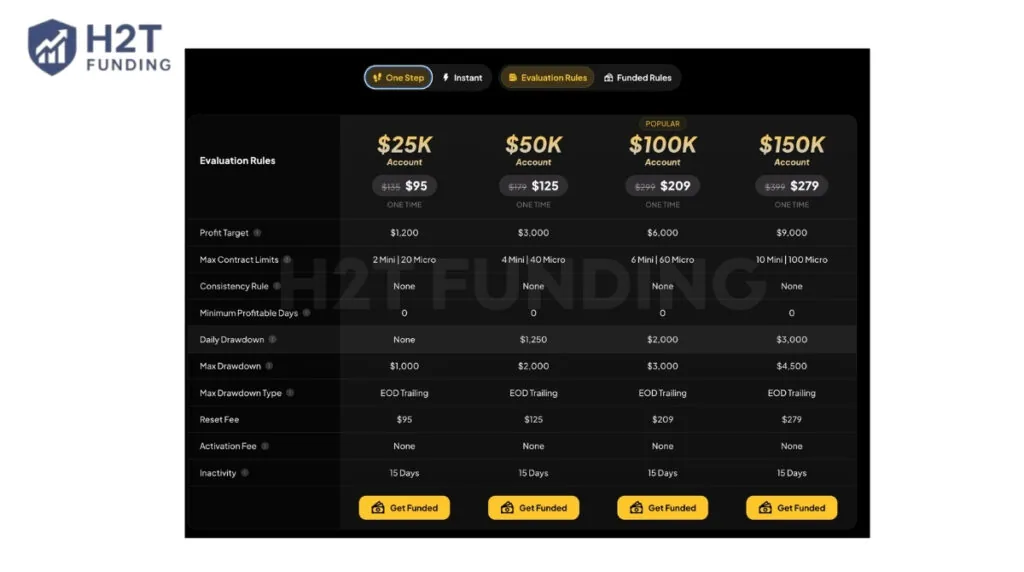
Finotive Futures currently offers two program types: the 1-Step Challenge and Instant Account. Both are available in four account sizes, ranging from $25,000 to $150,000. The 1-Step Challenge requires traders to complete an evaluation, while the Instant Account provides access without an evaluation. You can use discount code H2T at checkout to save on either program, with discounts of up to 50%.
3.1. Finotive Futures Discount Code: Save up to 40% With Our Best Of All time Code H2T
The current Finotive Futures discount code is H2T, offering off eligible challenges, with the exact savings depending on the program and account size. We last verified the code on September 4, 2026.
For example, a 50K 1-Step Challenge account costs $179 at the regular price. Applying H2T (50% off) reduces the price to $89.50, saving you $89.50 upfront. Meanwhile, a 50K Instant Account costs $549 regularly; applying H2T (50% off) drops the price to $274.50, saving you $274.50 upfront.
| 50K Account | 1-Step Challenge | Instant Account |
|---|---|---|
| Regular price | $179 | $549 |
| H2T discount | -$89.50 (50% OFF) | -$274.50 (50% OFF) |
| Price after H2T | $89.50 | $274.50 |
| You save | $89.50 | $274.50 |
Up to 50%
1 Step Challenge 40% Off & Instant Accounts 50% Off
Before completing your purchase, enter H2T at checkout and confirm that the discounted price appears. Finotive Futures pricing and promotional terms may change, and only one promo code can be applied per purchase.
Affiliate Disclaimer: H2T Funding operates as an affiliate partner for Finotive Futures. When you purchase a challenge using our promo code, we earn a commission at no additional cost to you. This supports our website and allows us to continue tracking and verifying active prop firm discounts.
3.2. 1-Step Challenge
The 1-Step Challenge is Finotive Futures’ evaluation-based program. Traders who want to see how this structure compares across the industry can review other one-step challenge prop firms, especially for differences in profit targets, trailing drawdown and payout access.
| Account Size | Regular Price | Price After Discount (H2T: 40% OFF) | You Save |
|---|---|---|---|
| $25,000 | $135 | $81.00 | $54.00 |
| $50,000 | $179 | $107.40 | $71.60 |
| $100,000 | $299 | $179.40 | $119.60 |
| $150,000 | $399 | $239.40 | $159.60 |
The fee is a one-time payment, with no recurring subscription or activation fee listed. With code H2T, you can save $54.00 to $159.60 depending on the account size.
3.3. Instant Account
The Instant Account skips the evaluation stage and gives traders access from day one after purchase and KYC. It is available in the same four account sizes but carries a higher upfront fee because traders do not need to complete an evaluation first.
For traders who prefer to skip an evaluation, our guide to best instant funding prop firms compares the trade-off between immediate access, higher upfront fees and tighter ongoing rules.
| Account Size | Regular Price | Price After Discount (H2T: 50% OFF) | You Save |
|---|---|---|---|
| $25,000 | $349 | $174.50 | $174.50 |
| $50,000 | $549 | $274.50 | $274.50 |
| $100,000 | $899 | $449.50 | $449.50 |
| $150,000 | $1,249 | $624.50 | $624.50 |
Like the 1-Step Challenge, the Instant Account uses a one-time fee with no activation fee listed. Finotive Futures currently advertises a 90% reward split.
Pricing note: Prices shown were checked on September 4, 2026 and may change with promotions.
3.4. Which Account Size Offers the Best Value?
Choosing the right account size depends on your budget and pass conditions. A lower entry price does not necessarily mean better value, while a larger account may require only a slightly higher upfront cost.
3.4.1. Which Finotive Futures Account Is The Easiest to Pass?
The $25K 1-Step Challenge may be the easiest account to pass based on its profit target relative to the available drawdown. The account requires a $1,200 profit target with a $1,000 drawdown, giving it a 1.2 target-to-drawdown ratio.
| Account | Profit Target | Drawdown | Target/Drawdown |
|---|---|---|---|
| $25K | $1,200 | $1,000 | 1.20 |
| $50K | $3,000 | $2,000 | 1.50 |
| $100K | $6,000 | $3,000 | 2 |
| $150K | $9,000 | $4,500 | 2 |
This makes the $25K account the most favorable on a target-to-drawdown basis. However, the lower entry price does not make it the most cost-efficient option because traders receive less account size for the fee.
3.4.2. Which Finotive Futures Account Is Most Worth It?
The $50K 1-Step Challenge offers the best value for traders who can afford a slightly higher upfront cost. At the regular price, it costs $179, compared with $135 for the $25K account – a difference of $44.
With the H2T discount, the difference becomes even smaller. The $25K account costs $94.50, while the $50K account costs $125.30. That is only $30.80 more for twice the account size, increasing from $25,000 to $50,000.
| Category | $25K | $50K |
|---|---|---|
| Regular Price | $135 | $179 |
| H2T Price | $94.50 | $125.30 |
| You Save | $40.50 | $53.70 |
| Account Size | $25,000 | $50,000 |
| Profit Target | $1,200 | $3,000 |
| Drawdown | $1,000 | $2,000 |
| Profit Target/ Drawdown | 1.2 | 1.5 |
For traders focused on easier pass conditions, the $25K is the stronger choice. For traders focused on account size relative to the fee, the $50K offers better value.
4. Finotive Futures Trading Rules & Restricted Countries
Finotive Futures applies different rules to its 1-Step Challenge and Instant Account. Since drawdown, consistency and profitable-day requirements vary significantly across providers, readers may also want to review the broader guide to prop firm trading rules
The rules below are based primarily on Finotive Futures’ Terms & Conditions, with the Help Center used to clarify specific requirements.
4.1. Finotive Futures Trading Rules
| Rule | 1-Step Challenge | Instant Account |
|---|---|---|
| Profit Target | Required during evaluation | None |
| Daily Drawdown | Applies by account size; $25K has none | Applies |
| Maximum Drawdown | EOD trailing | Intraday trailing |
| Contract Limits | 2–10 Mini / 20–100 Micro | 2–8 Mini / 20–80 Micro |
| Consistency Rule | None in evaluation; 40% when funded | 20% |
| Minimum Profitable Days | 3 when funded | 5 per payout cycle |
4.1.1. Profit Target
The 1-Step Challenge requires traders to reach a fixed profit target based on account size. Finotive Futures’ Terms & Conditions list targets of $1,200, $3,000, $6,000, and $9,000 for the $25K, $50K, $100K, and $150K accounts. There is no consistency rule or minimum profitable-day requirement during the evaluation stage.
The Instant Account has no evaluation phase and no traditional profit target. Traders can begin trading after purchase and the required KYC process, subject to the applicable account rules and payout conditions.
4.1.2. Payout Mechanics & Payout Cap
For the 1-Step Challenge, Finotive Futures uses a Profit Buffer system before traders can request payouts. The required buffer varies by account size, and traders must then generate additional profit before becoming eligible for a payout.
| Account Size | Profit Buffer | Minimum New Profit | Total Profit Required |
|---|---|---|---|
| $25K | $1,000 | $250 | $1,250 |
| $50K | $2,000 | $500 | $2,500 |
| $100K | $3,000 | $1,000 | $4,000 |
| $150K | $4,500 | $1,500 | $6,000 |
The Profit Buffer also plays an important role in the drawdown structure. Once the account reaches the required buffer, the Max Drawdown floor is locked at the initial account balance rather than continuing to trail upward. This gives traders more room to operate after reaching the payout threshold.
4.1.3. Daily Drawdown
Finotive Futures defines Daily Drawdown as a soft breach. A breach does not immediately terminate the account; instead, it can trigger the applicable trading restriction for that day. The specific Daily Drawdown amount varies by account size and program.
The $25,000 1-Step Challenge does not have a Daily Drawdown limit, while the larger 1-Step accounts and Instant Accounts have defined daily limits.
4.1.4. Maximum Drawdown
The two programs use different drawdown mechanisms:
- 1-Step Challenge: uses an EOD Trailing Drawdown, which is calculated from the highest end-of-day balance. Once the drawdown floor reaches the initial account balance, it locks at that level.
- Instant Account: uses an Intraday Trailing Drawdown, which follows the highest intraday equity, including unrealized profit. The threshold only moves upward and eventually locks at the initial account balance.
Finotive Futures classifies Maximum Drawdown as a hard breach. If the account’s equity or balance reaches the applicable drawdown level, the account is closed.
4.1.5. Contract Limits
Each account size has a maximum number of Mini and Micro futures contracts that may be held open simultaneously.
| Account Size | 1-Step Mini / Micro | Instant Mini / Micro |
|---|---|---|
| $25,000 | 2 / 20 | 2 / 20 |
| $50,000 | 4 / 40 | 4 / 40 |
| $100,000 | 6 / 60 | 6 / 60 |
| $150,000 | 10 / 100 | 8 / 80 |
According to the Terms & Conditions, a first contract-limit breach results in a formal warning, while a second breach places the account under review.
4.1.6. Consistency Rule
The 1-Step Challenge has no consistency rule during the evaluation stage. Once funded, however, the rule limits any single trading day’s profit to 40% of total profit in the relevant payout cycle.
For Instant Accounts, the limit is stricter: no single trading day can contribute more than 20% of total payout-cycle profit. Finotive Futures does not impose a fixed dollar cap on daily profit; the restriction is based on the proportion of total cycle profit.
4.1.7. Minimum Profitable Days
Minimum Profitable Days apply when traders become eligible for payouts:
- 1-Step Funded: 3 profitable days per payout cycle
- Instant Account: 5 profitable days per payout cycle
A qualifying profitable day requires net realised profit of at least 0.25% of the initial account balance.
4.2. Restricted Countries & Eligibility
Finotive Futures restricts access to certain countries and regions for its simulated trading programs. The restrictions vary depending on the trading platform used.
| Platform | Restricted Jurisdictions |
|---|---|
| Volumetrica | Belarus, Cuba, Iran, Iraq, North Korea, Russia, Syria |
| NinjaTrader | Cuba, North Korea, certain regions of Ukraine, Syria, Iran |
These restrictions can affect more than trading access. Depending on the applicable restriction, traders may be unable to register, purchase an account, complete KYC, access the trading platform or Dashboard, use Finotive Pay, request payouts, or continue using the account.
Because Finotive Futures can update its restricted-country policy, traders should check the latest official policy before purchasing an account, if they are based in a restricted or regulated jurisdiction.
5. Finotive Futures Drawdown: What We Learned From Trading
This section combines Finotive Futures’ published drawdown rules with our own $50,000 account data to show how the drawdown mechanism behaves in actual trading.
5.1. How EOD Trailing Drawdown Works
The EOD trailing drawdown is recalculated after each trading day based on the account’s highest end-of-day balance. The drawdown floor moves upward as the account reaches new closing-balance highs and stops trailing once it reaches the initial account balance.
For example, on a $50,000 account with a $2,000 maximum drawdown, the initial drawdown floor is $48,000. If the account closes the day at $52,000, the floor moves up to $50,000 and locks at the initial account balance.
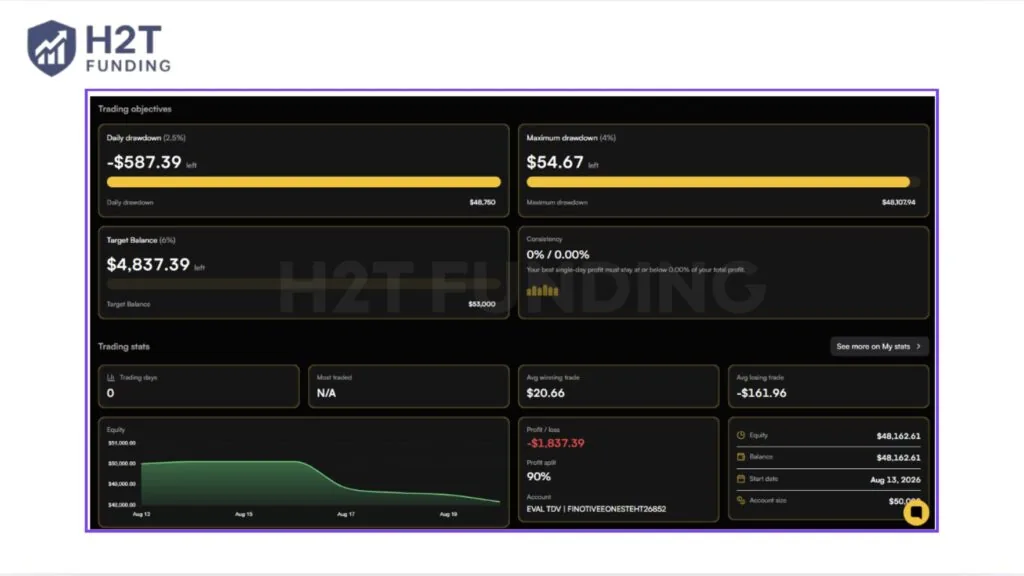
5.2. Our $50,000 Account: Drawdown in Practice
The following figures come directly from our Finotive Futures account dashboard on August 21, 2026:
| Metric | Value |
|---|---|
| Starting balance | $50,000.00 |
| Equity at reporting time | $48,162.61 |
| Maximum drawdown floor | $48,107.94 |
| Remaining room to hard breach | $54.67 |
| Daily Drawdown floor | $48,750.00 |
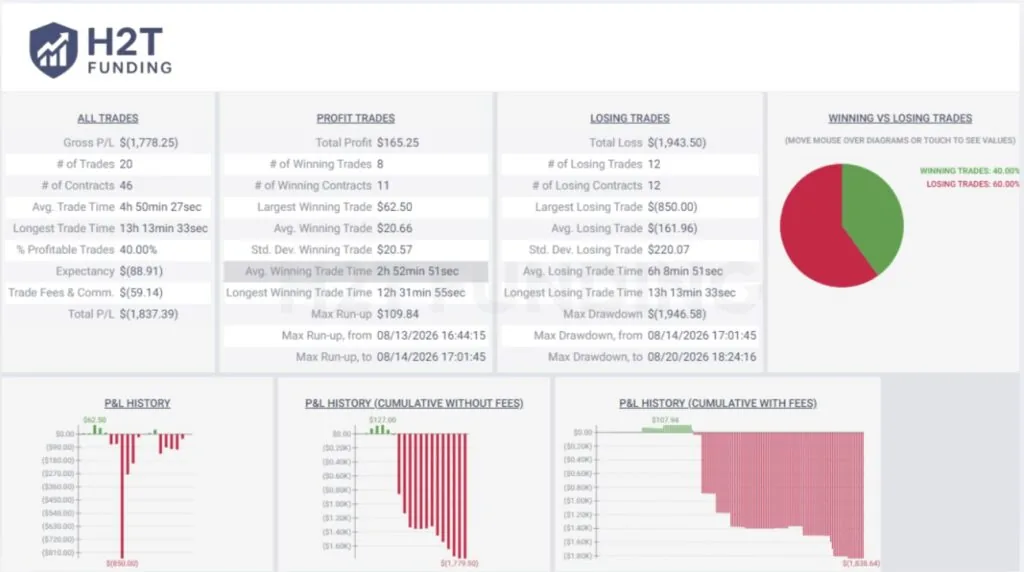
At the time of reporting, the account had 20 closed positions, with 8 wins and 12 losses. Equity had moved close to the maximum drawdown floor, leaving only $54.67 of remaining room.
This is firsthand evidence from our account, not a representation of typical trader performance.
5.3. What Caused the Drawdown?
Our trading log points to three main contributors to the losses:
- Holding losing positions too long, including one $850 loss held for more than 12 hours.
- Adding positions in the same direction while an existing group of trades was already losing.
- Increasing position exposure relative to the remaining risk buffer during a volatile trading week.
For our account, the drawdown was associated with holding losing positions too long and adding exposure while a losing cluster was already open. Our trading behavior was therefore a more direct driver of the losses than micro-contract usage or commission costs.
6. Finotive Futures Platforms & Trading Experience
Finotive Futures supports several futures trading platforms across the NinjaTrader and Volumetrica ecosystems, giving traders multiple options for execution, charting, and analysis. We tested a $50,000 account on Tradovate to evaluate the practical trading experience.
6.1. Supported Platforms & Markets
| Trading Platforms | Futures Exchanges |
|---|---|
| NinjaTrader, Tradovate, TradingView, DeepCharts, ATAS, Quantower | CME, CBOT, COMEX, NYMEX |
The available platform may depend on the account and trading environment, so traders should confirm platform availability before purchasing.
6.2. Our Tradovate Trading Experience
We traded our $50,000 Finotive Futures account through Tradovate during the testing period. Order entry and basic execution worked as expected across the trades we placed.
Execution conditions varied with market liquidity and trading session, but we did not observe abnormal slippage across our 20 closed trades.
6.3. Execution & Slippage
Based on our testing:
- Execution: Order entry and fills performed as expected during the testing period.
- Slippage: We did not record abnormal slippage across 20 closed trades.
- Liquidity: Execution conditions varied between sessions and contracts, consistent with the underlying futures market.
These observations reflect our specific testing period and trade sample, rather than a guarantee of execution quality for all traders or market conditions.
6.4. Platform Limitations We Encountered
Our testing also revealed several practical limitations:
- Pending limit orders: Expected P&L was not clearly displayed, requiring manual calculation before confirming some orders.
- Session persistence: The platform occasionally required a fresh login after switching browser tabs or turning off the screen.
- Mobile experience: The mobile app was useful for monitoring and closing positions but less suitable for detailed chart analysis or precise order entry.
Tradovate provided a functional execution environment for our test, but some workflow and usability limitations are worth considering-particularly for traders who rely heavily on mobile trading, advanced order planning, or detailed pre-trade P&L calculations.
7. Finotive Futures Trading Restrictions
Finotive Futures allows several common trading strategies, but traders must follow specific restrictions covering news events, position holding, copy trading, automation, hedging, and account management. The rules differ in some cases between the evaluation and funded stages, so passing the challenge does not mean every trading strategy remains unrestricted.
| Restriction | What Finotive Futures Says |
|---|---|
| News trading | Allowed during the evaluation stage. On funded accounts, a 2-minute restriction applies before and after high-impact news. Traders cannot open, close, or trigger pending orders during this window. Profits generated from restricted activity may be removed at payout, while losses remain on the account. |
| Copy trading | Allowed only between accounts that the trader personally owns and controls. Copying signals, positions, or trades from third parties is prohibited. |
| Automated trading | Automated trading is addressed separately in Finotive Futures’ trading rules. Strategies must not exploit platform, pricing, or data-feed vulnerabilities. |
| Hedging | Hedging or coordinated positions across accounts intended to offset risk can trigger an investigation. Finotive specifically monitors for abusive or fraudulent cross-account hedging. |
| Overnight trading | Positions must be closed before the applicable trading session ends. |
| Weekend holding | Positions cannot be carried through the weekend. |
| Contract limits | Each account size has a maximum number of mini and micro contracts. The applicable limit depends on the account type and size. |
| VPN / VPS | Account access and location restrictions apply under Finotive Futures’ policies. Traders should check the current rules before using VPN/VPS services. |
| Other prohibited strategies | Strategies that exploit the trading environment, data feeds, execution systems, or account rules may be prohibited even if they are technically possible on the platform. |
Note: Finotive Futures’ rules can change, and its Help Center is the appropriate source to check before trading.
8. Finotive Futures Reviews, UGC & Trustpilot
Finotive Futures currently has a limited review footprint compared with the broader Finotive Funding brand. At the time of our research, we did not identify a substantial dedicated Trustpilot profile or enough Finotive Futures-specific Reddit, forum, or payout evidence to assess long-term customer experience.
9. Finotive Futures Customer Support & User Experience
9.1. Account Onboarding
Registration is free and does not require a purchase upfront. Traders create a Dashboard profile, browse available plans, then complete KYC and checkout when ready to buy a challenge. Credentials for the chosen platform are issued after payment confirmation.
9.2. Documentation
Finotive Futures publishes detailed rule tables for both the 1-Step Challenge and Instant Account directly in its Help Center, alongside step-by-step guides on drawdown mechanics, contract limits, and payout eligibility. Documentation was clear and specific enough to verify every official rule cited in this review.
9.3. Dashboard & Account Experience
Our tested dashboard displayed live equity, remaining Daily Drawdown, and remaining Max Drawdown throughout the evaluation. This matched the account state we could independently confirm through Tradovate’s own account reports.
10. Finotive Futures Competitor Comparison
The $50K account is a useful benchmark because it is a common account size among futures prop traders and allows a more direct comparison of fees, profit targets, drawdown, trading requirements, payouts, and platform options.
For this comparison, we focus specifically on Finotive Futures, Lucid Trading, MyFundedFutures, and Apex Trader Funding using their respective $50K programs.
| Feature | Finotive Futures1-Step $50K | Lucid TradingLucidPro $50K | MyFundedFuturesRapid EOD $50K | Apex Trader Funding50K EOD |
|---|---|---|---|---|
| Fee Structure | One-time fee | One-time fee | Monthly subscription | One-time fee / 30-day access |
| Activation Fee | $0 | $0 | $0 | $0 |
| Profit Target | $3,000 (6%) | $3,000 (6%) | $3,000 (6%) | $3,000 (6%) |
| Drawdown | EOD trailing; locks at $50K after buffer | EOD trailing; locks at $50,100 after buffer | EOD trailing | EOD trailing; locks at $50,100 after Safety Net |
| Daily Loss Limit | $1,250 (2.5%) | $1,200 (2.4%) | None | $1,000 (2.0%) |
| Minimum Trading Days | 0 days | 1 day | 4 days | 0 days |
| Consistency | Evaluation: NoneFunded: 40% | Evaluation: NoneFunded: 40% | Evaluation: 30%Funded: None | Evaluation: NonePA: 50% |
| Profit Split | 90/10 | 90/10 | 90/10 | 100% up to $10K, then 90/10 |
| Payout | Buffer + $500 minimum profit1st: max $2,0002nd+: max $2,500 | Buffer + $500 minimum profit1st: max $2,0002nd+: max $2,500 | Daily payouts; no stated cap | Safety Net + 5 profitable daysMax $2,000/payout in months 1–3 |
| Platforms | 6 options | 4 options | 3 options | 4 options |
Important: Because these firms have changed their programs during 2026, this table should be treated as a current-terms comparison, not a historical comparison. Apex, for example, distinguishes its new products from legacy accounts purchased before March 1, 2026.
10.1. How Does Finotive Futures Compare at $50K?
At the $50K level, Finotive Futures is competitive on several core program terms. Its $3,000 profit target, EOD trailing drawdown, zero minimum trading days, and 90% profit split put it broadly in line with Lucid Trading and other established futures prop programs.
Its biggest advantage in this comparison is platform choice. Finotive Futures offers six platform options, giving traders more flexibility than Lucid Trading, MyFundedFutures, and Apex.
The main trade-off is the payout structure. Finotive Futures requires traders to build the applicable Profit Buffer and then generate additional profit before requesting a payout. Payout amounts are also capped, whereas MyFundedFutures’ Rapid EOD program offers daily payouts with no stated cap in this comparison. Apex uses a different reward structure, offering 100% of the first $10,000 in requested rewards before moving to a 90/10 split.
Finotive Futures also has a shorter futures track record and less publicly documented payout history than Apex and MyFundedFutures. This is an important consideration for traders who place a high value on established payout evidence.
10.2. Is Finotive Futures $50K Better Than the Alternatives?
There is no clear winner across every category. The better choice depends on what matters most to the trader:
- Finotive Futures: Better suited to traders who want EOD drawdown, no minimum trading days, six platform options, and a one-time fee.
- Lucid Trading: Similar core $50K structure, with a 90/10 split and EOD drawdown, but fewer platform choices.
- My Funded Futures: More attractive for traders who prioritize frequent payouts, with Rapid EOD offering daily payouts and no stated cap in this comparison.
- Apex Trader Funding: More attractive to traders who value its 100% reward structure on the first $10,000, although its payout conditions and product structure differ from Finotive Futures.
Finotive Futures is a competitive $50K option, particularly for traders who prioritize platform flexibility and EOD drawdown. Its main weaknesses are the payout caps and its relatively limited futures-specific payout history.
11. Who Is Finotive Futures Best For?
Finotive Futures is primarily suited to intraday futures traders who can manage tight drawdown limits and do not need to hold positions overnight or over the weekend. The choice between its two programs ultimately depends on whether you prefer to complete an evaluation first or start with an Instant Account.
11.1. Finotive Futures May Be a Good Fit If You
Finotive Futures may be worth considering if you:
- Trade intraday and close positions before the session ends.
- Prefer micro contracts for more precise position sizing.
- Are comfortable managing risk under an EOD trailing drawdown.
- Do not need to hold trades overnight or over the weekend.
- Value having multiple trading platforms to choose from.
- Are comfortable with a newer futures prop firm and its shorter public track record.
11.2. Finotive Futures May Not Be a Good Fit If You
It may be less suitable if you:
- Trade swing or multi-day strategies that require overnight positions.
- Need a wider drawdown buffer to accommodate larger fluctuations.
- Prefer a firm with a long, independently verifiable payout history.
- Want a large, established trader community and extensive independent reviews.
11.3. One-Step vs. Instant: Which Should You Choose?
The 1-Step Challenge is the better fit for traders who want a lower-cost entry and are comfortable proving their performance through an evaluation. Its EOD trailing drawdown may also be preferable to an intraday model.
The Instant Account is better suited to traders who want to skip the evaluation and start with a funded account immediately. However, the intraday trailing drawdown and 20% consistency rule require tighter risk management.
12. Finotive Futures FAQs
-
Finotive Futures is an operating simulated-trading program under Finotive Futures Technologies Limited, part of the Finotive One group. It is not a broker and does not accept deposits. Legitimacy in this industry means transparent, published rules and a working evaluation process, which we confirmed firsthand. Independent long-term reputation evidence is still building.
-
You buy a simulated account, trade under the published rules, and request a payout once you meet the eligibility conditions for your account type.
-
One Step requires hitting a profit target before funding. Instant skips the evaluation and funds the account immediately, with a tighter intraday drawdown and stricter consistency rule.
-
90% to the trader, 10% retained by Finotive Futures, across both account types.
-
Yes, on every account size except the $25,000 1-Step evaluation account, which has no daily drawdown limit.
-
The drawdown floor recalculates once per day from the highest closing balance, only moves upward, and locks permanently once it reaches the initial account balance.
-
No. All positions must be flat before the session closes.
-
Yes during the evaluation stage. Funded and Instant accounts restrict trading for 2 minutes before and after high-impact news events.
-
Yes, subject to the restricted-jurisdiction list published in the Terms & Conditions, which applies separately to simulated accounts and to Live Account eligibility.
-
They are separate programs in the same group. Finotive Futures covers CME-listed futures; Finotive Funding covers forex and CFDs and has a longer operating history.
13. Conclusion: Is Finotive Futures Legit?
Finotive Futures offers a clear futures-focused setup with one-time fees, a 90% reward split, multiple trading platforms, and flexible account options. Our $50,000 1-Step test was positive, particularly for intraday trading and micro contracts, while the EOD trailing drawdown rewards disciplined risk management.
We have not yet reached the funded and payout stages, so those parts remain to be tested firsthand. We will continue trading the account and update this review as we progress through the next stages.
Based on what we have tested so far, Finotive Futures may suit disciplined intraday and micro-contract traders, but the right choice depends on how each trader weighs drawdown, platform access, payout conditions and account cost. Before committing, use H2T Funding’s compare prop firms resource to review alternative programs side by side