



In this comparison, we look at each program’s static max loss, daily loss limit, profit target, minimum trading days, pricing, payout rules, and trading conditions to help you choose the right option.
Key takeaways
- Forex & CFD: Notable static drawdown options include FundingPips, FTMO, BrightFunded, The5ers, Alpha Capital Group, FXIFY, Blue Guardian, E8 Markets, and EverFunded. Among these, FundingPips offers up to a 12% static max loss, while FTMO 2-Step uses a 10% fixed Maximum Loss.
- Futures: Current static drawdown options include DayTraders Static, Phidias Express to Live, and Elite Trader Funding Static Evaluations. DayTraders offers a dedicated static model, Phidias keeps the static structure through its E2L path, and Elite Trader Funding provides dedicated Static Evaluations.
Last Verified: October 10, 2026. Prop firm rules, pricing, and account availability may change. Check each firm’s official website for the latest information before purchasing.
| Firm | Markets Offered | Account Types | Static Max Loss | Profit Split | Coupon Code | Actions |
|---|---|---|---|---|---|---|

4.5
(66,300+ reviews)
|
Forex / CFDs |
1-step, 2-step, and Instant Funding |
6% – 12% |
80% – 100%
|
30a78cd4
|
Open an account |

4.8
(53,770+ reviews)
|
Forex / CFDs |
1-Step Challenge, 2-Step Challenge |
10% |
90%
|
No code
|
Visit Official Website |

4.4
(570+ reviews)
|
Futures Contracts, Forex / CFDs |
1-Step, 2-Step Bright, 2-Step Classic |
8% – 10% |
80%
|
No code
|
Visit Official Website |

4.9
(35,600+ reviews)
|
Forex / CFD |
1-step, 2-step, 3-step |
8% – 10% |
50% – 100%
|
NAXW1ULCR
|
Open an account |

4.7
(21,500+ reviews)
|
Forex / CFDs |
1-step, 2-step, 3-step |
6% – 10% |
80%
|
No code
|
Open an account |
3.3
(6,100+ reviews)
|
Forex / CFDs |
1-step, 2-step, 3-step, and Instant Funding |
5% – 10% |
80% – 100%
|
No code
|
Visit Official Website |

3.8
(1,500+ reviews)
|
Futures Contracts, Forex / CFDs |
1-step, 2-step, 3-step, and instant funding |
8% – 10% |
80% – 95%
|
h2t
|
Open an account |

4.4
(3,200+ reviews)
|
Futures Contracts, Forex / CFDs |
1-step |
8%* |
80% – 100%
|
H2T01
|
Open an account |

3.8
(2+ reviews)
|
Forex / CFDs |
Flash 7.77, 1-Step, 2-Step, Instant Account |
6% – 10% |
80% – 100%
|
No code
|
Open an account |

4.6
(480+ reviews)
|
CME Futures |
Trail, EOD, Static, S2F, S2L |
$750 – $1,750 |
Up to 100%
|
HCPICKIK
|
Open an account |

3.8
(320+ reviews)
|
Futures Contracts |
1-step |
$500 – $1,000 |
75% – 80%
|
H2T
|
Open an account |

3.7
|
Futures Markets |
Static, 1-step |
$500 – $2,000 |
90% – 100%
|
No code
|
Open an account |
*E8 Markets: the 8% static max loss applies before the first payout. After the first payout, the loss floor moves up to the initial balance.
Best For
- Funding Pips: Flexible static drawdown options
- FTMO: Most established
- BrightFunded: Swing traders
- The5ers: High stakes flexibility
- Alpha Capital Group: Widest buffer on Alpha Pro 10%
- FXIFY: Global traders (not available to U.S. residents)
- Blue Guardian: Simple funded rules (Standard: no consistency rule)
- E8 Markets: No consistency rule or payout cap
- EverFunded: No consistency rule during the Challenge
- DayTraders: Pure static futures
- Phidias: Static-to-live path
- Elite Trader Funding: Dedicated static evaluation alternative
1. What Is Static Drawdown in a Prop Firm?
A static drawdown is a fixed maximum loss limit based on the account’s starting balance. The loss floor is set when the account begins and does not move higher when the account makes a profit.
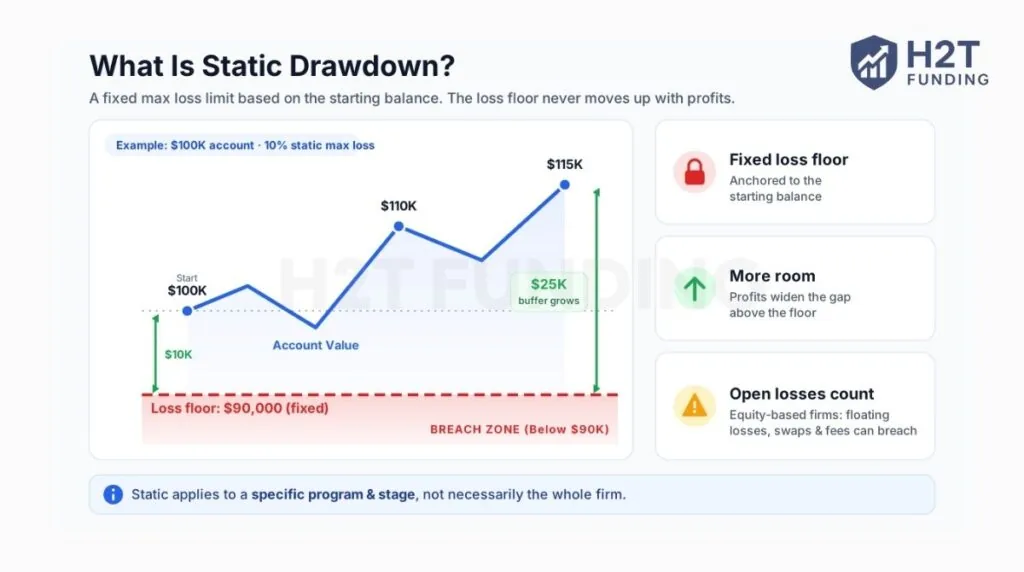
For example, if a $100,000 account has a 10% static maximum loss, the loss floor is $90,000. If the account later grows to $110,000 or $115,000, the floor still stays at $90,000.
The main characteristics are:
- Fixed loss floor: the maximum loss level stays anchored to the initial balance.
- More room as profits grow: profits increase the distance between the current account value and the fixed floor.
- Open losses may still matter: some firms monitor equity, so floating losses, commissions, or swaps can trigger a breach even when the closed balance remains above the floor.
One important point is that static drawdown applies to a specific program and stage, not necessarily to the entire prop firm. A firm may offer one static program alongside another that uses a different drawdown model.
The sections below therefore compare each program separately, including its maximum loss, daily loss limit, evaluation stage, funded-stage rules, and other key conditions.
2. How We Picked These Static Drawdown Prop Firms
We only include programs where the maximum loss stays fixed from the starting balance and does not trail upward as profits grow. EOD trailing and intraday trailing models are not counted as static.
We verify each program using the firm’s official Help Center, program pages, Terms, and pricing pages as of October 2026. We also consider the real trading experience of the H2T Funding team when assessing how clear and practical the rules are.
Our ranking focuses on:
- Static drawdown: size of the fixed loss buffer and where it applies.
- Trading rules: daily loss, consistency, minimum days, news, and holding rules.
- Cost: regular evaluation or challenge prices, excluding temporary discounts.
- Payouts: timing, profit split, payout caps, and eligibility requirements.
- Availability: account sizes, platforms.
- Reliability: how clearly and consistently the firm publishes its rules.
Note: Prop firm rules can change, so we update the list when material changes are found. Some links may be affiliate links, but this does not affect our rankings or evaluation.
3. Best Prop Firms with Static Drawdown for Forex & CFD Traders
3.1. FundingPips – Best for Flexible Static Drawdown Options
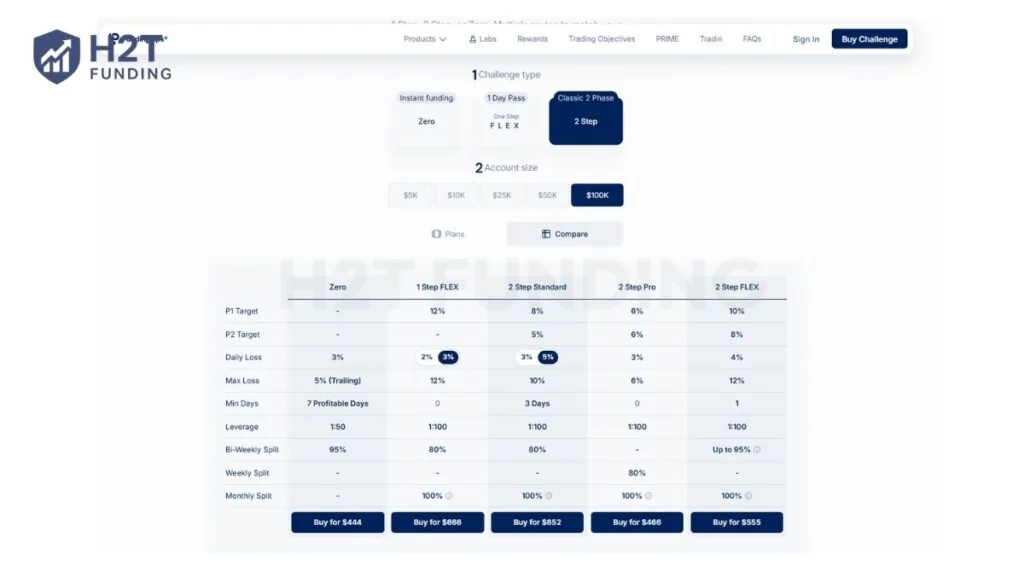
FundingPips offers four current evaluation programs with static maximum loss limits. Among them, 1 Step Flex and 2 Step Flex provide the widest buffer at 12% static max loss. 2 Step Flex stands out because it combines a 12% fixed loss floor with account sizes ranging from $5K to $100K, while costing less than 1 Step Flex at the same account size.
| Program | Profit Target | Daily Loss | Max Loss | Min. Trading Days | Regular Price($5K to $100K) |
|---|---|---|---|---|---|
| 1 Step Flex | 12% | 2% / 3% | 12% Static | 0 | $74-$666 |
| 2 Step Standard | 8% / 5% | 3% / 5% | 10% Static | 3 days/phase | $44-$652 |
| 2 Step Flex | 10% / 8% | 4% | 12% Static | 1 day/phase | $39-$555 |
| 2 Step Pro | 6% / 6% | 3% | 6% Static | 0 | $33-$466 |
On a $100,000 2 Step Flex account, the 12% static max loss sets the floor at $88,000. That floor does not move higher as the account grows. FundingPips also checks both balance and equity, so floating losses can still cause a breach.
Not every FundingPips program is static. Zero uses a 5% trailing maximum loss, so it is excluded from this comparison.
Note: Minimum trading day requirements may vary by program and account stage. Traders should confirm the latest requirements on FundingPips’ official website before purchasing a challenge.
Funding Pips
#1
Account Types
1-step, 2-step, and Instant Funding
Trading Platforms
MT5, cTrader, Match Trader
Profit Target
5% – 10%
Our take on Funding Pips
FundingPips stands out for its range of static-drawdown evaluation programs, offering four models with fixed maximum loss limits from 6% to 12%. The 2 Step Flex provides the widest buffer at 12%, alongside a 10% / 8% profit target, 4% daily loss limit, and pricing from $39 to $555 across $5K-$100K accounts.
The main trade-offs are daily loss limits as low as 2% on certain programs and additional consistency or profitable-day requirements tied to some reward options. Traders should review the specific conditions of their chosen program before purchasing.
| 💳 Challenge Fee | $29 – $888 |
| 👥 Account Types | 1-step, 2-step, and Instant Funding |
| 💰 Profit Split | 80% – 100% |
| 💵 Account Size | $5K – $100K |
| ⏱️ Time Limit | No time limit |
| 🎯 Profit Target | 5% – 10% |
| 📊 Trading Platforms | MT5, cTrader, Match Trader |
| 🛍️ Asset Types | Forex / CFDs |
3.2. FTMO – Most Established
FTMO’s 2-Step Challenge uses a 10% static Maximum Loss. On a $100,000 account, the loss floor stays fixed at $90,000 and does not move higher as profits grow. Open losses, swaps, and commissions also count because FTMO monitors account equity.
| Program | Profit Target | Daily Loss | Max Loss | Min. Trading Days | Regular Price($10K-$200K) |
|---|---|---|---|---|---|
| FTMO 2-Step | 10% / 5% | 5% | 10% Static | 4 days/phase | €89-€1,080 ($100-$1,209) |
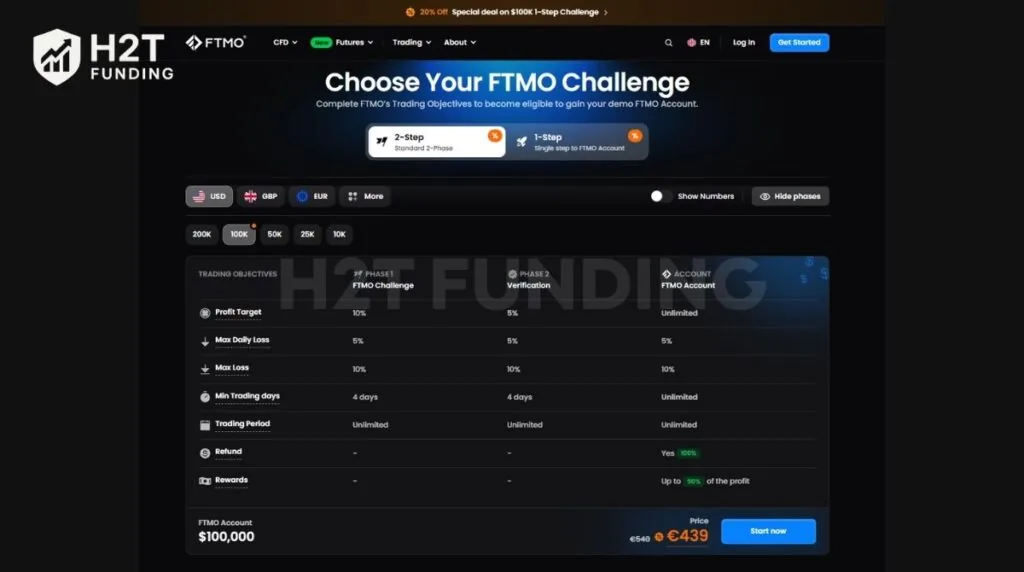
FTMO 2-Step requires a 10% Challenge target, 5% Verification target, 5% Maximum Daily Loss, and 4 trading days per phase, with no time limit. Its Swing account offers fewer news and overnight/weekend holding restrictions at the FTMO Account stage.
Not every FTMO program qualifies as static. The 1-Step Challenge uses a 10% End-of-Day trailing Maximum Loss, so it is excluded from this static-drawdown comparison.
FTMO
#2
Account Types
1-Step Challenge, 2-Step Challenge
Trading Platforms
MT4, MT5, cTrader, TradingView
Profit Target
10% – 15%
Our take on FTMO
FTMO is our Most Established pick for traders who want a clear and predictable static-drawdown structure. Its 2-Step keeps the Maximum Loss fixed at 10% of the initial simulated capital across both evaluation phases and the FTMO Account.
The main trade-off is a smaller drawdown buffer other prop firms. In return, FTMO offers unlimited evaluation time, a refundable fee, and account sizes from $10K to $200K.
| 💳 Challenge Fee | €89 – €1,080 |
| 👥 Account Types | 1-Step Challenge, 2-Step Challenge |
| 💰 Profit Split | 90% |
| 💵 Account Size | $10K – $200K |
| ⏱️ Time Limit | No time limit |
| 🎯 Profit Target | 10% – 15% |
| 📊 Trading Platforms | MT4, MT5, cTrader, TradingView |
| 🛍️ Asset Types | Forex / CFDs |
3.3. BrightFunded – Best for Swing Traders
BrightFunded offers two current 2-Step programs with static maximum loss limits. 2-Step Classic provides the wider buffer, with a 10% static max loss, compared with 8% on 2-Step Bright.
On a $100,000 2-Step Classic account, the loss floor stays fixed at $90,000. The program also has a 5% daily loss limit, no evaluation deadline, and no consistency rule.
| Program | Profit Target | Daily Loss | Max Loss | Min. Trading Days | Regular Price($5K-$200K) |
|---|---|---|---|---|---|
| 2-Step Classic | 10% / 5% | 5% | 10% Static | 5 days/phase | €49-€997 ($55-$1,116) |
| 2-Step Bright | 8% / 5% | 4% | 8% Static | 5 days/phase | €47-€947 ($53-$1,060) |
Note: BrightFunded’s 1-Step uses a 6% trailing maximum drawdown, so it is excluded from this static-drawdown comparison.
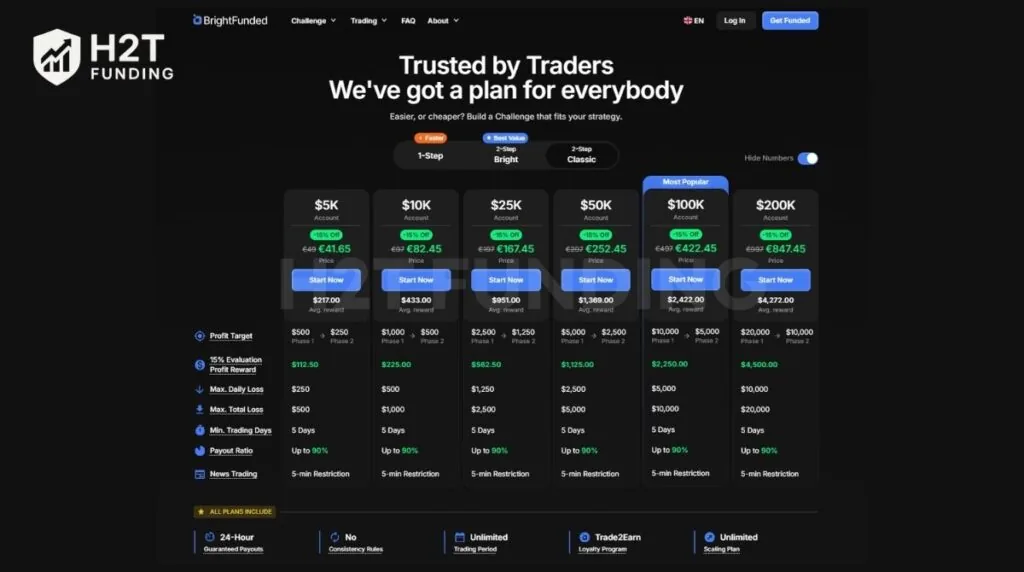
BrightFunded allows overnight and weekend holding. News trading is unrestricted during the Evaluation, but Funded Accounts have a restricted window around major news releases.
The default reward split is 80%, with options to increase it to 90% through an add-on and up to 100% through the scaling plan. The first payout is normally available 30 days after the first funded trade.
BrightFunded
#3
Account Types
1-Step, 2-Step Bright, 2-Step Classic
Trading Platforms
MT5, cTrader, DXTrade
Profit Target
8% – 10% (Phase 1); 5% (Phase 2)
Our take on BrightFunded
BrightFunded is a practical option for swing traders who want static drawdown and flexible holding conditions. The 2-Step Classic offers a 10% fixed max loss, a 5% daily loss limit, and unlimited evaluation time. Overnight and weekend holding are also allowed, making it suitable for traders who hold positions across multiple sessions.
The main trade-offs are the 5 minimum trading days per phase, restrictions around major news events on Funded Accounts, and the standard 30-day wait for the first payout. Traders should also check platform availability, particularly U.S. residents who cannot use MT5.
| 💳 Challenge Fee | €47–€49 |
| 👥 Account Types | 1-Step, 2-Step Bright, 2-Step Classic |
| 💰 Profit Split | 80% |
| 💵 Account Size | $5k–$200k |
| ⏱️ Time Limit | No time limit |
| 🎯 Profit Target | 8% – 10% (Phase 1); 5% (Phase 2) |
| 📊 Trading Platforms | MT5, cTrader, DXTrade |
| 🛍️ Asset Types | Futures Contracts, Forex / CFDs |
3.4. The5ers – Best for High Stakes Flexibility
The5ers’ High Stakes program uses fixed maximum loss limits, but the loss allowance varies by account size. Both NEW and Classic use a 2-Step evaluation, require 3 profitable days per phase, and have no overall time limit.
At the smaller $2.5K size, both versions show a 10% maximum loss and 5% daily loss. On the $100K account, both use a tighter 8% maximum loss and 4% daily loss.
| Program | Profit Target | Daily Loss | Max Loss | Min. Profitable Days | Regular Price($2.5K – $100K) |
|---|---|---|---|---|---|
| High Stakes NEW | 10% / 5% | 4%-5% | 8%-10% Static | 3 days/phase | $19-$405 |
| High Stakes Classic | 8% / 5% | 4%-5% | 8%-10% Static | 3 days/phase | $22-$455 |
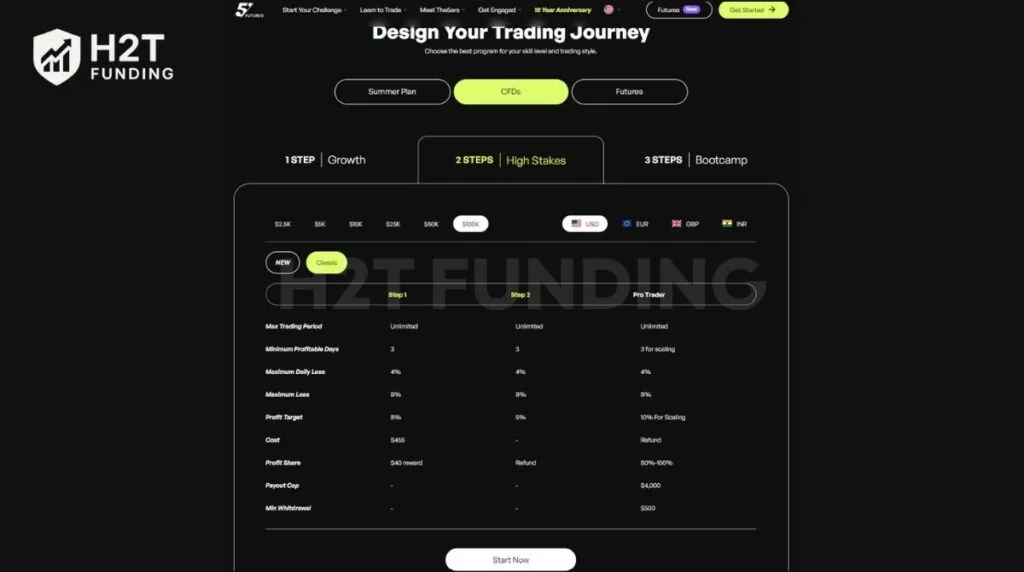
On a $100,000 High Stakes account, the 8% static maximum loss sets the loss floor at $92,000. Both NEW and Classic use the same 8% maximum loss and 4% daily loss at this size; the main difference is the Phase 1 target, at 10% for NEW and 8% for Classic.
The5ers allows unlimited time to complete the evaluation and requires 3 profitable days per phase. At the $100K level, the Pro Trader stage also shows a $4,000 payout cap and $500 minimum withdrawal.
The5ers
#4
Account Types
1-step, 2-step, 3-step
Trading Platforms
MT5, cTrader
Profit Target
5% – 10%
Our take on The5ers
The5ers is a flexible option for traders who want a fixed-loss High Stakes program with two evaluation structures. NEW uses a higher 10% Phase 1 target, while Classic lowers it to 8%.
The main point to watch is that drawdown rules change by account size. Smaller accounts can offer a 10% maximum loss, while the $100K accounts shown on the current pricing page use an 8% static maximum loss and 4% daily loss.
| 💳 Challenge Fee | $19 – $850 |
| 👥 Account Types | 1-step, 2-step, 3-step |
| 💰 Profit Split | 50% – 100% |
| 💵 Account Size | $2.5K – $250K |
| ⏱️ Time Limit | No time limit |
| 🎯 Profit Target | 5% – 10% |
| 📊 Trading Platforms | MT5, cTrader |
| 🛍️ Asset Types | Forex / CFD |
3.5. Other Forex & CFD Prop Firms with Static Drawdown
| Firm | Static Programs | Daily Loss | Static Max Loss | Key Funded / Payout Rules | $100K Regular Price | Profit Split | Coupon Code | Actions |
|---|---|---|---|---|---|---|---|---|
|
4.7
(21,500+ reviews)
|
Alpha Pro 6% / 8% / 10% | Alpha Swing |
Pro 10%: 5% |
Pro: 6% / 8% / 10% | Swing: 10% |
Bi-weekly or on-demand payouts | On-demand: 40% Best Day Rule, 2% min. profit | Qualified $100K accounts purchased after July 21, 2026: 2% max open risk per asset |
Pro 6%: $397 | Pro 8%: $527 | Pro 10%: $447 | Swing: $577 |
80%
|
No code
|
Open an account |
|
3.3
(6,100+ reviews)
|
Two Phase Classic | Two Phase Pro | Three Phase |
4% |
Classic: 10%, Pro: 8% | Three Phase: 5% |
Classic: 25% funded consistency rule | Pro: No consistency rule; funded daily profit cap | Static floor stays fixed through funded stage |
Classic: $549 | Pro: $599 | Three Phase: $399 |
80% – 100%
|
No code
|
Visit Official Website |
|
3.8
(1,500+ reviews)
|
2 Step Standard | 2 Step Nano |
Standard: 4% | Nano: 3% |
Standard: 8% | Nano: 10% |
Standard: 85% initial split, 14-day payouts, no funded consistency rule | Nano: 50% funded consistency rule, 2% payout cap per cycle |
Standard: $463 | Nano: $239 |
80% – 95%
|
h2t
|
Open an account |
|
4.4
(3,200+ reviews)
|
E8 Pro |
2.5% |
8% |
No consistency rule or payout cap | Daily payout requests once eligible | 2% daily profit cap | Loss floor resets to starting balance after first payout |
$488 |
80% – 100%
|
H2T01
|
Open an account |
|
3.8
(2+ reviews)
|
2-Step | 1-Step |
2-Step: 5% | 1-Step: 3% |
2-Step: 10% | 1-Step: 6% |
First payout after 14 days | 80% standard reward split | Funded-stage payout conditions apply |
2-Step: $562.50 | 1-Step: $548.75 |
80% – 100%
|
No code
|
Open an account |
Key Points to Know
- Alpha Capital Group: Offers several static options, including Alpha Pro 6%, 8%, and 10%, plus Alpha Swing with 10% static drawdown. Alpha Pro 10% gives the widest buffer, while Alpha One and Alpha Direct use trailing drawdown instead.
- FXIFY: Offers 10% static drawdown on Two Phase Classic, 8% on Two Phase Pro, and 5% on Three Phase. Classic provides the largest buffer, while Pro removes the consistency rule. FXIFY is not available to U.S. residents, so it is better suited to global traders.
- Blue Guardian: Offers static drawdown on 2 Step Standard (8%) and 2 Step Nano (10%). Nano gives more drawdown room, but Standard has simpler funded rules with no consistency requirement. Nano applies a 50% funded consistency rule and payout cap.
- E8 Markets: E8 Pro offers an 8% static drawdown, 2.5% daily drawdown, no consistency rule, and daily payout eligibility. However, it has a 2% daily profit cap, and after the first payout, the loss floor moves up to the initial balance.
- EverFunded: Offers 10% static max loss on its 2-Step program and 6% on 1-Step, with no consistency rule during the Challenge. However, funded-stage payout conditions apply, and its limited independent review history makes long-term reliability difficult to assess.
4. Best Futures Prop Firms with Static Drawdown
4.1. DayTraders – Best Pure Static Futures
DayTraders offers dedicated Static accounts with a fixed loss floor that never moves. The same static drawdown structure continues from the Evaluation into the simulated Pro Account, so traders do not need to adjust to a trailing model after passing.
Current Static accounts range from $25K to $150K. Depending on account size, prices run from $40 to $90, with no daily loss limit on the Static Evaluation.
| Program | Profit Target | Daily Loss | Max Loss | Min. Trading Days | Regular Price Range($25K-$150K) |
|---|---|---|---|---|---|
| DayTraders Static | $2,500-$6,750 | None | $750-$1,750 Static | 2 qualifying days | $40-$90 |
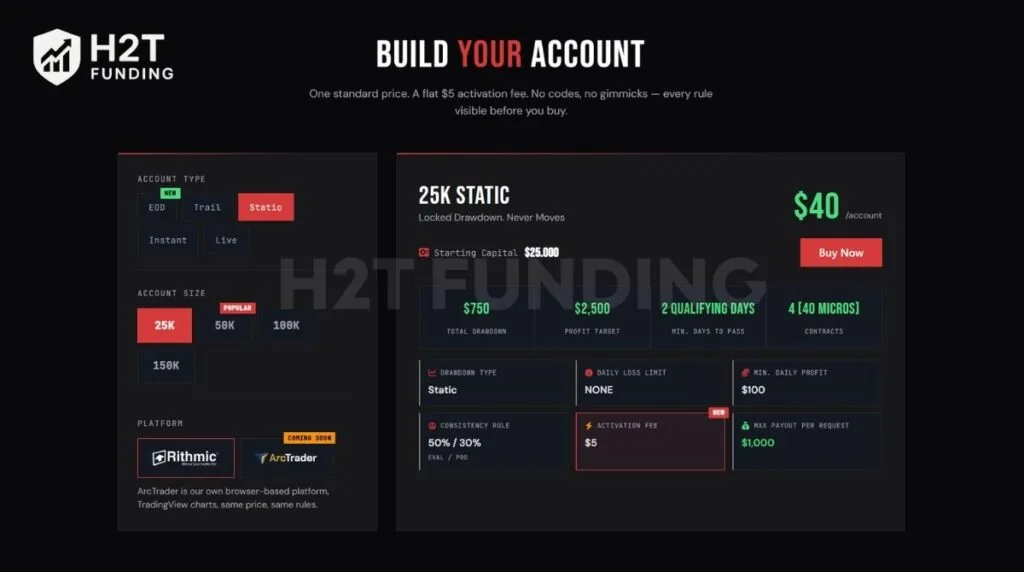
For example, the $100K Static account has a $5,750 profit target and a $1,500 static drawdown, which keeps the loss floor fixed at $98,500. Traders must also meet a 50% consistency rule during the Evaluation, which becomes 30% on the Pro Account.
DayTraders advertises 100% profit retention, but payouts still follow Pro Account rules, including qualifying-day requirements and payout limits. On the $100K Static account, the maximum payout per request is $3,000.
DayTraders
#5
Account Types
Trail, EOD, Static, S2F, S2L
Trading Platforms
Rithmic, Quantower, Onyx
Profit Target
4.5% – 10%
Our take on DayTraders
DayTraders is a strong fit for futures traders who want a simple, predictable static drawdown instead of a trailing loss limit. Its Static accounts are inexpensive and have no daily loss limit, but the drawdown buffer is relatively tight and the consistency rules still require disciplined profit distribution.
It is best suited to traders who prioritize a fixed risk boundary and low entry cost over a larger drawdown allowance.
| 💳 Challenge Fee | $150 – $1,599 |
| 👥 Account Types | Trail, EOD, Static, S2F, S2L |
| 💰 Profit Split | Up to 100% |
| 💵 Account Size | $25K to $300K |
| ⏱️ Time Limit | ≥ 2 days |
| 🎯 Profit Target | 4.5% – 10% |
| 📊 Trading Platforms | Rithmic, Quantower, Onyx |
| 🛍️ Asset Types | CME Futures |
4.2. Phidias – Best Static-to-Live Path
Phidias’ Express to Live (E2L) program uses a static drawdown that never trails. Unlike many futures programs, the same static structure continues from the Evaluation to the simulated CASH account and then to the real LIVE account.
E2L is available from $25K to $150K, with no daily loss limit, no consistency rule, and no minimum trading days.
| Program | Profit Target | Daily Loss | Max Loss | Min. Trading Days | Regular Price($25K-$150K) |
|---|---|---|---|---|---|
| Express to Live | $1,500-$4,500 | None | $500-$1,000 Static | 0 days | $277-$1,125 |
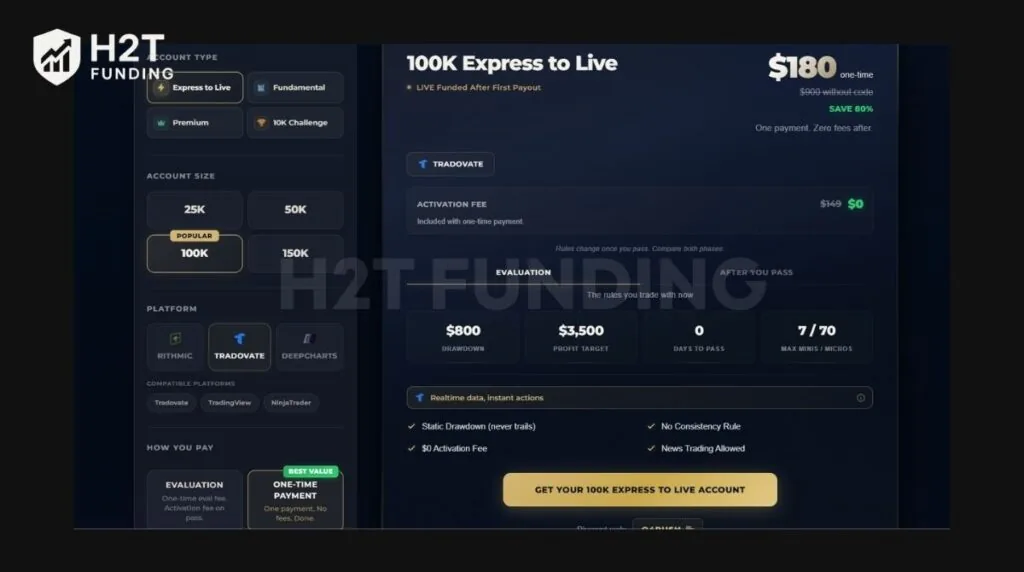
The profit target must first be reached during the Evaluation and then reached again on the CASH account. After completing the CASH target, traders receive an automatic bonus payout and can switch to a real LIVE account funded by Phidias.
For example, the $100K E2L uses an $800 static drawdown, a $3,500 target, a $3,000 bonus payout, and $1,500 in live account credit.
E2L pays an 80% profit split and allows news trading. However, positions cannot be held overnight or over the weekend.
Phidias Prop Firm
#6
Account Types
1-step
Trading Platforms
Sierra Chart, Quantower, Bookmap, MotiveWave, ATAS, DeepCharts, Rithmic, Tradovate, TradingView, NinjaTrader
Profit Target
3.5% – 8%
Our take on Phidias Prop Firm
Phidias is a good fit for futures traders who want a true static drawdown and a defined path to real market trading. E2L removes several common restrictions, including daily loss limits, consistency rules, and minimum trading days.
The main trade-off is the small drawdown buffer, especially on larger accounts, and traders must hit the profit target twice before moving to LIVE. It is best suited to disciplined traders who prioritize static risk rules and a real LIVE account path over a large loss allowance.
| 💳 Challenge Fee | $66 – $1,125 |
| 👥 Account Types | 1-step |
| 💰 Profit Split | 75% – 80% |
| 💵 Account Size | $10K – $150K |
| ⏱️ Time Limit | No time limit |
| 🎯 Profit Target | 3.5% – 8% |
| 📊 Trading Platforms | Sierra Chart, Quantower, Bookmap, MotiveWave, ATAS, DeepCharts, Rithmic, Tradovate, TradingView, NinjaTrader |
| 🛍️ Asset Types | Futures Contracts |
4.3. Elite Trader Funding – Dedicated Static Evaluation Alternative
Elite Trader Funding offers dedicated Static Evaluations in $10K, $25K, and $50K sizes. The loss floor is fixed at account creation and never trails higher as profits grow.
Static accounts have no daily loss limit and no consistency rule during the Evaluation. Traders normally need at least 5 trading days to pass, although an optional One Day to Pass add-on can reduce this requirement.
| Program | Profit Target | Daily Loss | Max Loss | Min. Trading Days | Regular Price Range($10K-$50K) |
|---|---|---|---|---|---|
| Static Evaluation | $1,000-$4,000 | None | $500-$2,000 Static | 5 days | $147-$497 |
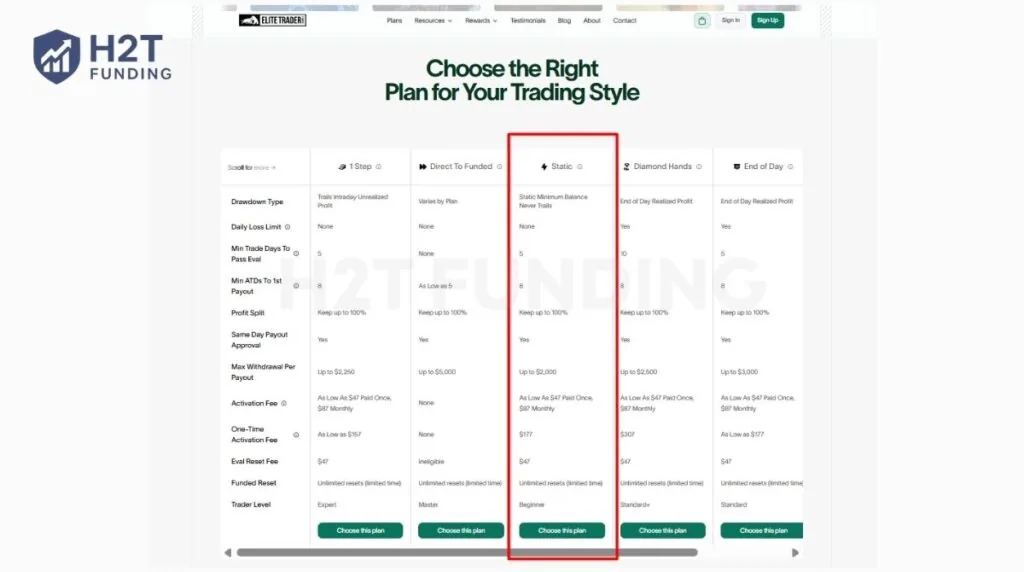
For example, the $50K Static Evaluation has a $4,000 profit target and a $2,000 fixed drawdown, so the minimum balance stays at $48,000 even if the account grows.
After passing, traders move to an Elite Sim-Funded account. The first payout requires 8 qualifying Active Trading Days, and traders must build a safety net equal to the maximum drawdown plus $100. Static funded accounts also require positions to be closed before market close.
Elite Trader Funding
#7
Account Types
Static, 1-step
Trading Platforms
Tradovate, Rithmic, NinjaTrader 8, TradingView
Profit Target
6% – 10%
Our take on Elite Trader Funding
Elite Trader Funding is a practical alternative for futures traders who want a true static drawdown without a daily loss limit or Evaluation consistency rule. Its fixed floor is easy to track, and profits create more room above the minimum balance.
The main trade-offs are the smaller account sizes, relatively tight drawdown limits, and extra payout requirements after passing. It is best suited to traders who prefer a simple fixed-loss structure and do not need overnight holding.
| 💳 Challenge Fee | $57 – $697 |
| 👥 Account Types | Static, 1-step |
| 💰 Profit Split | 90% – 100% |
| 💵 Account Size | $10K – $250K |
| ⏱️ Time Limit | No time limit |
| 🎯 Profit Target | 6% – 10% |
| 📊 Trading Platforms | Tradovate, Rithmic, NinjaTrader 8, TradingView |
| 🛍️ Asset Types | Futures Markets |
5. Static vs Trailing vs EOD Drawdown: How the Rules Actually Work
The main difference between static, intraday trailing, and End-of-Day (EOD) trailing drawdown is whether and when the maximum loss floor moves as the account grows.
| Factor | Static | Intraday Trailing | EOD Trailing |
|---|---|---|---|
| Loss floor | Fixed | Moves upward | Moves upward |
| When it changes | Never from profits | During the trading session | At the program’s EOD calculation point |
| Do profits raise the floor? | No | Yes, depending on the rule | Yes, based on EOD rules |
| Can intraday unrealized profit affect it? | Not the static floor itself* | Often yes | Generally not until the EOD calculation |
| How predictable is the floor? | Highly predictable | Changes more frequently | More predictable than intraday trailing |
Note: Open losses can still cause a breach when a firm measures maximum loss using account equity.
5.1. Static Drawdown
With static drawdown, the loss floor is set from the starting balance and does not move higher with profits. For example, a $100,000 account with a $10,000 static maximum loss has a fixed floor of $90,000. If the account grows to $106,000, the floor remains $90,000, giving the trader $16,000 of room above it.
5.2. Intraday Trailing Drawdown
Intraday trailing drawdown rises with new account highs during a session, based on balance, equity, or unrealized profit, depending on the program. Even open profits can raise the loss floor, which may stay higher if those profits are later lost.
5.3. End-of-Day Trailing Drawdown
An EOD trailing drawdown also moves upward, but the adjustment is generally based on the account value at a specified end-of-day calculation point, rather than every intraday high.
As a result, an intraday profit spike does not necessarily move the floor immediately. The exact calculation depends on the firm’s EOD rule, so traders should check what value and reset time the program uses.
6. How to Choose a Static Drawdown Prop Firm
There are three main steps to choosing a static drawdown prop firm: match the drawdown type to your strategy, calculate your real risk room, and verify the exact program rules before buying.
6.1. Match the drawdown type to your strategy
Start with how you trade, because the drawdown model affects different strategies in different ways.
- Swing / multi-day traders: Static drawdown can be useful because profits create more room above the fixed loss floor. Check whether overnight and weekend holding are allowed.
- Systematic / EA traders: A fixed floor can make position sizing and risk planning easier. Also check EA, copy trading, and automation rules.
- Scalpers / day traders: Daily loss limits and equity monitoring may matter more than the overall static floor. In some cases, an EOD trailing model may still work well.
- When trailing may make sense: Some trailing programs have lower entry prices or a larger initial loss allowance, which may suit traders who do not need a fixed floor.
6.2. Calculate your real risk room
Convert the headline drawdown into dollars, then compare it with the program’s daily loss limit and your normal risk per trade.
For example, a $100,000 account with a 10% static max loss has a $10,000 fixed buffer. But if the same program also has a 5% daily loss limit, you still cannot use the full $10,000 in a single day.
6.3. Verify the exact program before buying
Check the firm’s current official rules to confirm:
- whether the drawdown is truly static,
- whether balance, equity, or both are monitored,
- whether the same drawdown rule continues after the Evaluation,
- and whether payout, news, platform, or country restrictions affect you.
The best option is the one that fits your strategy, risk tolerance, and trading conditions, not simply the program with the largest advertised drawdown.
7. Common Mistakes on Static Drawdown Accounts
A fixed loss floor is easier to track, but traders can still breach a static account by overlooking the rules around it.
- Confusing static with EOD or trailing drawdown: A trailing floor can still move upward as the account grows. For example, FTMO 2-Step uses a static maximum loss, while FTMO 1-Step uses EOD trailing drawdown.
- Ignoring floating losses and trading costs: On equity-based accounts, unrealized losses, commissions, and swaps can push equity below the static floor even when the closed balance still looks safe.
- Mixing up daily loss and maximum loss: A separate daily loss limit can be breached long before the account reaches its overall static loss floor.
- Assuming the same rules continue after passing: Some programs change drawdown, payout, consistency, news, or holding rules between the Evaluation and funded stage. Always check both stages.
- Increasing size because profits created more room: A larger cushion above the fixed floor does not mean position size should automatically increase. Oversizing can quickly give back the buffer.
- Using outdated program rules: Prop firms can change drawdown limits, pricing, platforms, or payout conditions. Check the current official Help Center and program page before buying.
A static drawdown only fixes the overall loss floor. It does not remove the other risk and payout rules attached to the account.
8. FAQs
-
A static drawdown is a fixed maximum loss limit based on the account’s starting balance. The loss floor does not move higher when the account makes a profit. For example, a $100,000 account with a 10% static max loss keeps a fixed floor at $90,000.
-
Yes. Static drawdown is available from firms such as FundingPips, FTMO, BrightFunded, The5ers, Alpha Capital Group, FXIFY, Blue Guardian, E8 Markets, EverFunded, DayTraders, Phidias, and Elite Trader Funding.
-
Not necessarily. Static drawdown keeps the loss floor fixed, while trailing drawdown moves it upward as profits grow. The better choice depends on your trading style, risk limits, costs, and payout rules. Learn more in our static drawdown vs. trailing drawdown comparison.
-
FundingPips offers up to a 12% static maximum loss on its 1 Step Flex and 2 Step Flex programs. That is one of the largest percentage-based static buffers we currently track, but a larger drawdown alone does not make a program better. Profit targets, daily loss limits, price, and payout rules also matter.
-
It depends on the specific program. FTMO 2-Step uses 10% static Maximum Loss, while 1-Step uses EOD trailing. Standard Topstep uses EOD trailing, but Topstep Labs offers $25K and $50K Static Combines with fixed floors of $24K and $48K. Apex and Tradeify mainly use EOD or trailing drawdown.
-
Yes, examples include DayTraders Static, Phidias Express to Live, and Elite Trader Funding Static Evaluations.
Their structures differ. DayTraders and Elite Trader Funding offer dedicated static programs, while Phidias Express to Live keeps a static drawdown through its Evaluation, CASH, and LIVE stages.
-
Some may, but instant funding does not automatically mean static drawdown. Many instant or direct-funded programs use trailing or EOD trailing loss limits. The safest approach is to check the exact program’s Maximum Loss or Drawdown rule and confirm whether the floor remains fixed to the starting balance.
-
Yes, some static-drawdown programs are available to U.S. traders, but access depends on the firm, program, and trading platform.
Platform restrictions are especially important. Some firms may accept U.S. traders while restricting MetaTrader or other platforms for U.S. residents. Traders should check the current country and platform rules before purchasing.
-
Compare the static max loss, daily loss limit, profit target, funded-stage rules, payout requirements, regular price, platform access, and trading restrictions.
H2T Funding recommends comparing the complete rule set rather than choosing only by the largest drawdown percentage. The better program is the one that fits your trading and risk-management style.
-
Reach the required profit target and minimum trading days without breaching the static max loss, daily loss limit, or other program rules. Because the floor stays fixed, profits can create more room above it. However, traders still need to control position size and monitor any daily or equity-based loss limits.
-
Check the exact program name and current drawdown rule on the firm’s official product page or Help Center before checkout. Do not rely on the firm name alone. For example, FTMO 2-Step is static while FTMO 1-Step is EOD trailing, and FundingPips offers both static evaluation programs and the trailing-drawdown Zero model.
9. Conclusion
The best prop firms with static drawdown depend on your trading style, risk tolerance, and preferred account structure. A fixed maximum loss floor can give traders more room as profits grow, but daily loss limits, profit targets, and payout conditions still matter.
- FundingPips: For traders who want multiple static-drawdown programs, with maximum loss limits ranging from 6% to 12%.
- FTMO: For forex traders who prefer an established firm with a 10% static Maximum Loss on its 2-Step program.
- BrightFunded: For swing traders who value overnight and weekend holding, unlimited evaluation time, and a fixed loss floor.
- The5ers: For traders looking for flexibility within its High Stakes programs.
- DayTraders: For futures traders who prioritize a static drawdown structure.
- Phidias: For futures traders interested in a static-drawdown evaluation with a pathway to live funding.
- Elite Trader Funding: For traders seeking an alternative futures evaluation with static drawdown.
Static drawdown alone should not determine your choice. Compare the full trading rules, account costs, and withdrawal requirements before selecting a program.
For more comparisons, explore H2T Funding’s best prop firms category. You can also browse the offers category for available prop firm discounts and promotions.