

Apex vs Take Profit Trader (TPT) are two of the most competitive futures prop firms in 2026, both offering one-step evaluations and verified payout systems. On the surface, they look similar. In reality, they are built for completely different trading priorities.
- Account sizes: Both Apex and Take Profit Trader offer accounts from $25K to $150K, with TPT additionally providing a $75K option for more flexibility.
- Drawdown: Apex allows traders to choose between intraday or end-of-day (EOD) trailing drawdown, while TPT uses a stage-based model (EOD -> intraday -> EOD) depending on account progression.
- Profit Split & payouts: Apex offers a 100% profit split but limits each account to 6 payouts with scheduled withdrawals, while TPT provides 80–90% splits with no payout cap and on-demand (even same-day) withdrawals.
- Number of accounts: Apex allows up to 20 simultaneous accounts, while TPT limits traders to 5 accounts (PRO/PRO+ combined).
- Consistency rule: Apex applies the 50% rule at the payout stage, while TPT enforces the 50% rule during evaluation only.
- Cost: Apex uses a one-time evaluation fee (30-day limit) plus a one-time activation fee, while TPT follows a monthly subscription model with a $130 activation fee after passing.
In this comparison, H2T Funding breaks down the real differences in evaluation logic, payout mechanics, drawdown systems, and execution rules. So you can choose the firm that matches how you actually trade, not just what looks better on paper.
Summary Recommendation
- Choose Apex Trader Funding if: You want to scale aggressively with multiple accounts (up to 20) and maximize profits through a 100% payout model.
- Choose Take Profit Trader (TPT) if: You prioritize fast, flexible withdrawals, including on-demand payouts (even Day One once the buffer is met), and a more stable cash flow.
Quick comparison overview
| Feature | Apex Trader Funding | Take Profit Trader |
|---|---|---|
| Evaluation Phases | 1-phase | 1-phase |
| Min. Trading Days | 1 days | 5 days on the test phase No minimum trading days on PRO/PRO+ account |
| Drawdown Type | Intraday Trailing/ EOD Trailing | EOD Trailing (3% cap) |
| Profit Split | 100% SIM Funded | 80% (PRO) – 90% (PRO+) |
| Max Accounts | 20 simultaneous accounts | 5 simultaneous (Pro/Pro+ combined) |
| Daily Loss Limit | $500 – $2,000 based on EOD account size | None |
| Best Suited For | Scaling / Automation | Fast Payouts / Flexibility |
Note: Always confirm the latest terms and fees on each firm’s official website before signing up. Information is accurate as of 2026.
1. Overview of Apex Trader Funding vs Take Profit Trader
Apex Trader Funding dominates the market with high accessibility and massive scaling options for diverse trading strategies. In contrast, Take Profit Trader focuses on a premium environment with industry-leading payout speed and simplified rules. The table below outlines their fundamental differences at a glance.
| Aspect | Apex Trader Funding | Take Profit Trader |
|---|---|---|
| CEO | Darrell Martin | James Sixsmith |
| Account Size | $25K – $150K | $25K – $150K (include $75K) |
| Profit Target | 6% | 6% |
| Payout Frequency | Twice per month, once payout conditions are met | Anytime when meeting minimum profit/buffer requirements |
| Time Limits | 30 days | No time limit |
| Instruments | Futures contracts | Futures contracts |
| Starting Fees | $199 ($25K Intraday account) | $150/month |
| Trustpilot Ratings | 4.4 / 5 (18,000+ reviews) | 4.4 / 5 (~9,000 reviews) |
Disclaimer: Rules, pricing, and trading conditions may change over time. Traders should always verify the latest terms directly on the official Apex and Take Profit Trader websites before purchasing any challenge.
Dive into the details below to discover which model aligns best with your specific financial goals.
Apex Trader Funding
#1

Account Types
1-step
Trading Platforms
Tradovate, Rithmic, WealthCharts
Profit Target
6%
Our take on Apex Trader Funding
Apex Trader Funding launched in 2021 and operates as a futures-only prop firm using a one-step evaluation model. In March 2026, Apex introduced its 4.0 system, replacing subscriptions with a one-time payment, making the cost structure clearer and more predictable.
This firm is suitable for traders who want to make money fast and scale aggressively. The biggest advantage is the 100% payout model and the ability to run up to 20 accounts at the same time, which can significantly increase total profits.
However, Apex is not easy to manage. The intraday trailing drawdown is very strict, and the 50% consistency rule can block your payouts. On top of that, each account is limited to 6 payouts, after which it is closed, forcing you to start over.
In short, Apex works best for experienced futures traders who can manage trailing drawdown and strict consistency rules.
| 💳 Challenge Fee | $199 – $799 |
| 👥 Account Types | 1-step |
| 💰 Profit Split | 100% |
| 💵 Account Size | $25K – $150K |
| ⏱️ Time Limit | 30 days |
| 🎯 Profit Target | 6% |
| 📊 Trading Platforms | Tradovate, Rithmic, WealthCharts |
| 🛍️ Asset Types | Futures Contracts |
Take Profit Trader
#2
Account Types
1-step
Trading Platforms
NinjaTrader 8, Tradovate, TradingView
Profit Target
6%
Our take on Take Profit Trader
Take Profit Trader focuses on speed, simplicity, and steady payouts. Its biggest strength is the ability to withdraw quickly, sometimes even within the same day, once you meet the buffer requirement.
The structure is more flexible for long-term trading. There is no consistency rule at the PRO stage (after buffer), and there is no cap on payouts, so you can keep withdrawing without resetting your account. This makes it easier to maintain a stable income over time.
The downside is a lower profit split compared to Apex and less focus on scaling multiple accounts. Also, the intraday drawdown on PRO accounts can still be tight if you do not manage trades carefully.
Compared to Apex, TPT is better for traders who want consistent income, faster payouts, and fewer restrictions, rather than maximum scaling.
| 💳 Challenge Fee | $150 – $360 |
| 👥 Account Types | 1-step |
| 💰 Profit Split | 80% – 90% |
| 💵 Account Size | $25K – $150K |
| ⏱️ Time Limit | No time limit |
| 🎯 Profit Target | 6% |
| 📊 Trading Platforms | NinjaTrader 8, Tradovate, TradingView |
| 🛍️ Asset Types | Futures Contracts |
Suppose you want a clearer look at how Apex actually works in real trading conditions. Watch the full Apex review on YouTube here to see whether it’s the right fit for your trading style.
If you’re comparing more prop firms, check out our guides. We cover FundedNext vs Goat Funded Trader, FTMO vs The 5%ers, and FTMO vs The Funded Trader to see how Apex stacks up against other major competitors.
2. Apex Vs Take Profit Trader: Program and account evaluations
Both Apex Vs Take Profit Trader require a 6% profit target, use a one-step evaluation: reach the profit target without breaching the drawdown, and you qualify for a funded account. The difference comes from time limits, payment structure, and failure recovery options, which directly impact how you trade.
2.1. Account types, pricing, and account sizes
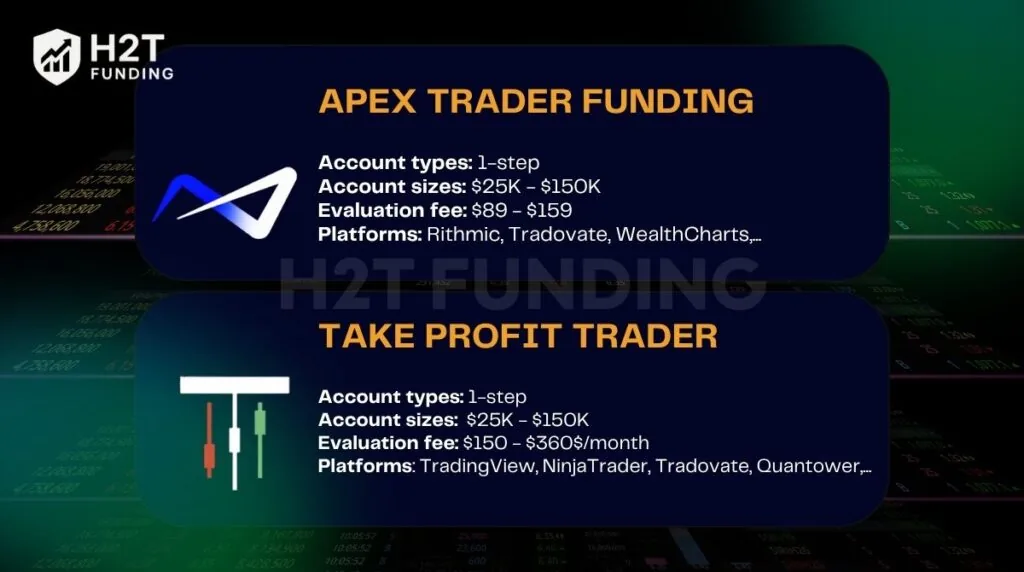
Both Apex and TPT offer account sizes from $25K to $150K, but their pricing models are fundamentally different. Apex uses a one-time payment structure, while TPT charges monthly until you pass.
Apex splits cost into evaluation + activation, making it cheaper long-term. TPT is more flexible upfront but requires ongoing monthly payments until completion.
| Feature | Apex Trader Funding | Take Profit Trader |
|---|---|---|
| Account sizes | $25K – $150K | $25K – $150K |
| Pricing model | One-time (Eval + PA fee) | Monthly subscription + fees for PRO account |
| Evaluation cost | $199 – $799 | $150 – $360/month |
| Activation fee | $89 – $159 | $130 after passing |
| Monthly fees after pass | None | None |
| Max Accounts | 20 simultaneous | 5 simultaneous (Pro/Pro+ combined) |
You can learn more about this fee structure on the Take Profit Trader activation fee.
2.2. Evaluation requirements and steps
Both firms use a one-step evaluation with a 6% profit target, but differ heavily in risk rules and flexibility. Apex is stricter with resets and time limits, while TPT removes many constraints.
Apex allows faster passing (even 1 day) but enforces a fixed 30-day window. TPT removes the deadline and daily loss limit, reducing pressure during execution.
| Feature | Apex Trader Funding | Take Profit Trader |
|---|---|---|
| Evaluation type | One-step | One-step |
| Profit target | 6% | 6% |
| Drawdown | EOD or Intraday trailing | EOD trailing on Test & PRO+ account Intraday trailing on PRO account |
| Daily loss limit | Yes (EOD accounts) | None |
| Min trading days | None | ~5 days (practical) |
| Time limit | 30 days | No limit |
| Consistency rule | Only on payouts (50%) | Yes (50% rule) |
| News trading | Allowed (with limits) | Restricted |
| Account reset | Not available | Up to 3 resets |
| Pass speed | As fast as 1 day | ~5 days minimum |
Key structural difference:
Apex’s 30-day window creates time pressure; if you fail or expire, you can purchase a new evaluation. TPT’s subscription model has no expiry. You keep trading the same subscription until you pass. For traders who take 4–6 weeks to build consistency, TPT’s structure removes a significant source of pressure.
3. Profit split and payout policy at Apex and Take Profit Trader
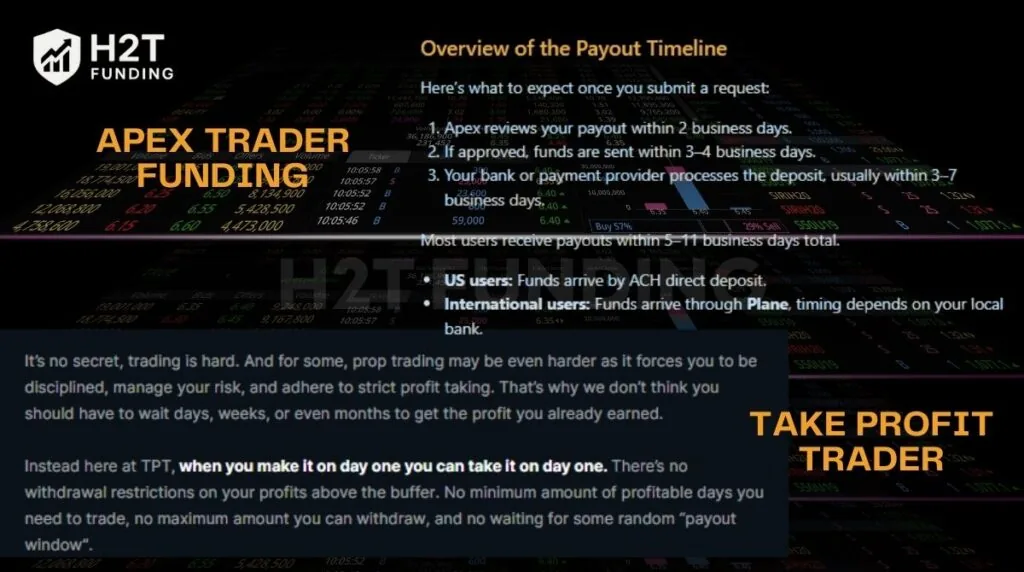
Apex pays 100% of approved payouts, but strictly caps each Performance Account at 6 withdrawals before it is closed. You can request payouts weekly after completing at least 5 qualifying trading days. Each day must meet a minimum profit threshold based on account size.
Apex enforces a 50% consistency rule, meaning no single day can generate more than half of the total profit. It also requires maintaining a Safety Net (drawdown + $100) at all times. Only profits above this Safety Net are withdrawable, and each payout follows a tiered cap system, increasing over time but still limited overall.
Conversely, TPT offers more flexible payouts with no hard cap on the number of withdrawals, allowing traders to continue earning beyond a fixed payout cycle. Instead of trading-day requirements, TPT uses a buffer system, where you must first reach your drawdown level before withdrawing profits.
Once the buffer is met, traders can withdraw with fewer restrictions, and some plans allow daily payouts or fast withdrawals. TPT does not enforce a strict consistency rule after the buffer and processes payouts instantly (6–12 hours) via Plaid, PayPal, or Wise.
| Feature | Apex Trader Funding | Take Profit Trader |
|---|---|---|
| Profit split | 100% on approved payouts | 80/20 (PRO), up to 90/10 |
| Payout frequency | Weekly (after 5 days) | Daily / On-demand |
| Min requirement | 5 profitable days | Reach buffer (drawdown) |
| Min payout | $500 | <= $250 (TPT charge $50 withdrawal fee) |
| Consistency rule | 50% rule enforced | None on the funded account |
| Max payouts | 6 per account | No fixed limit |
| Account lifecycle | Ends after 6 payouts | Ongoing/scalable |
| Withdrawal condition | Above Safety Net | Above buffer |
| Processing time | ~5 – 11 business days | Instant (hours) |
| Payout methods | ACH for U.S trader Plane for an international trader | Plaid for U.S trader PayPal/ Wise for an international trader |
For full details, see our complete breakdown of Apex payout rules: Apex Trader Funding Payout Rules: What Every Funded Trader Must Know
4. Key trading rules and account limits
While both Apex and Take Profit Trader operate in the futures space, their rule structures create very different trading environments.
Apex focuses on structured risk control and payout protection, while TPT emphasizes real-time risk tracking and operational discipline. These differences directly impact how you manage trades, especially under pressure.
4.1. Drawdown rules and risk limits
Apex offers two models: Intraday trailing and EOD trailing. Intraday drawdown moves in real time with unrealized profits, making it highly restrictive. In contrast, EOD drawdown only updates at the end of the day, giving traders more intraday flexibility but still enforcing structured limits.
TPT uses a stage-based risk model. During the Test phase, drawdown is EOD-based, making it more forgiving and easier to manage. Once you move to a PRO account, the system switches to intraday trailing drawdown, where your minimum balance tracks peak equity in real time, significantly increasing pressure.
At the PRO+ stage, TPT reverts to an EOD drawdown model, providing more stability once traders reach a higher level. This progression creates a learning curve: easier evaluation -> stricter funded stage -> more stable advanced stage.
In both firms, breaching the drawdown level results in instant account liquidation, but the experience differs. Apex allows you to choose your risk model upfront, while TPT forces you to adapt as you progress through account stages.
4.2. News, trading hours, and position management
Apex allows trading during news events but restricts certain strategies (e.g., directional news scalping). All positions must be closed by the end of the session (4:59 PM ET), preventing overnight exposure and enforcing a consistent daily reset.
TPT applies tighter rules around volatility. Traders must close all positions before major news events (FOMC, CPI, NFP) and cannot hold trades within restricted time windows. Violations can result in immediate account loss, making execution discipline critical.
Both firms prohibit counterpositions and hedging across accounts, ensuring compliance with CME regulations. However, TPT adds more explicit enforcement around execution timing and risk events.
| Policy | Apex Trader Funding | Take Profit Trader |
|---|---|---|
| News trading | Allowed (with restrictions) | Restricted (no positions during major news) |
| Major news rules | Limited strategy restrictions | Must exit before/after news windows |
| Overnight holding | Not allowed (close by 4:59 PM ET) | Not allowed |
| Trading hours | 23-hour cycle (6 PM – 4:59 PM ET) | Strict session cutoff (~5 PM ET) |
| Automation/bots | Not allowed | Not allowed |
| Copy trading | Allowed (own accounts) | Allowed (own accounts) |
| Counter positions | Prohibited | Prohibited |
4.3. Consistency rules
Apex and TPT both use 50% consistency rules to prevent passing or withdrawing from a single large trading day, but they apply them at different stages.
Apex enforces a 50% consistency rule only at the payout stage (Performance Account). To request a withdrawal, no single trading day can account for 50% or more of total profits since the last payout. This does not affect evaluation but directly impacts your ability to withdraw.
TPT applies its 50% consistency rule during the evaluation phase (Test accounts). Your largest trading day cannot exceed 50% of the total profit target required to pass. This makes it harder to pass quickly with one large trade.
Importantly, violating the consistency rule does not fail your account on either platform. Instead, you must continue trading and generate additional profit across multiple days to reduce the percentage.
| Feature | Apex Trader Funding | Take Profit Trader |
|---|---|---|
| Consistency rule | 50% rule | 50% rule |
| Applied stage | Payout (PA only) | Evaluation (Test) |
| Impact | Affects withdrawals | Affects passing |
| Violation result | Cannot request payout | Cannot pass |
| Account status | Remains active | Remains active |
Learn more about these rules in our detailed guide on the consistency rule for Apex.
5. Platforms and instruments
The trading platform you use directly affects execution speed, charting workflow, and overall trading efficiency. Apex and TPT take different approaches: one focuses on cost simplicity, while the other emphasizes platform flexibility.
5.1. Supported trading platforms and tools
Apex supports the most commonly used futures platforms, including NinjaTrader, TradingView, and Tradovate, with full compatibility across web, mobile, and Mac. A key advantage is that Apex includes both a free NinjaTrader license and real-time data fees, eliminating hidden costs for traders.
TPT, on the other hand, supports a much broader range of platforms, including TradingView, NinjaTrader, Tradovate, Quantower, R|Trader, ATAS, and more. Traders can choose between CQG and Rithmic data feeds, offering more customization depending on their setup.
However, this flexibility comes with trade-offs. While some platforms are free during evaluation, TPT may require traders to manage data feeds and platform configurations separately, especially as they scale.
| Feature | Apex Trader Funding | Take Profit Trader |
|---|---|---|
| NinjaTrader | Yes (free license included) | Yes |
| Tradovate | Yes | Yes |
| TradingView | Yes | Yes |
| Rithmic | Yes | Yes |
| Specialized platforms | Limited | Yes (Quantower, ATAS, VolSys, etc.) |
| Data feeds | Included | CQG / Rithmic (varies) |
| Real-time data fees | Included | May vary by setup |
| Platform cost | Included in pricing | Partially included/varies |
| Device compatibility | Web, Mobile, Mac | Web, Mobile, Desktop |
5.2. Tradable instruments and asset classes
Apex provides access to the most liquid and commonly traded futures contracts, including equity indices, currencies, energy, and some commodities. The product lineup is streamlined, focusing on high-volume instruments like ES, NQ, YM, and RTY, along with their micro counterparts.
This makes Apex suitable for traders who prioritize liquidity and execution consistency, but it offers less variety in niche or specialized markets.
TPT, by contrast, supports a much wider range of futures instruments, covering not only indices and currencies but also metals, agriculture, energy, bonds, and even crypto futures (Micro BTC, Ether).
This broader selection allows traders to diversify strategies across multiple asset classes, including less correlated markets like grains or interest rates.
| Asset Class | Apex Trader Funding | Take Profit Trader |
|---|---|---|
| Equity indices | ES, NQ, YM, RTY (incl. micros) | ES, NQ, YM, RTY (incl. micros) |
| Forex futures | Limited majors | Full set (6A, 6B, 6E, 6J, etc.) |
| Energy | CL, NG (limited set) | CL, NG, RB, HO, QM, MCL |
| Metals | Limited (restrictions may apply) | GC, SI, HG + micro contracts |
| Agriculture | Not emphasized | Corn, Wheat, Soybeans, Livestock |
| Bonds/rates | Limited | Full curve (ZT, ZN, ZB, UB, etc.) |
| Crypto futures | Not available | Micro BTC, Micro Ether |
| Micro contracts | Yes | Yes (extensive coverage) |
Note: Traders who want to trade metals (COMEX) or access a broader range of specialized instruments should prioritize TPT, as these markets may be unavailable or restricted on Apex.
6. Education and customer support
Nothing is more frustrating than a technical glitch with no one to talk to. Your trading experience with support often defines your longevity with a firm. We analyzed whether these companies treat you like a partner or just another ticket number.
| Feature | Apex Trader Funding | Take Profit Trader |
|---|---|---|
| Support Method | Help Desk Tickets (Self-Service) | Live Chat (AI Agent First) |
| Availability | 24/7 Ticket Submission | Sunday 6 PM – Friday 4:30 PM EST |
| Response Speed | Varies (Queue-based system) | Fast (Once past AI Agent) |
| Education | Database & FAQs | Free Trade Context Mentorship |
The support model at Apex Trader Funding reflects its size: efficient but impersonal. You are expected to be self-sufficient, relying on a vast FAQ database before submitting a ticket. Be warned that sending multiple follow-up tickets will actually push you to the back of the queue, rewarding patience over persistence.
Take Profit Trader offers a more accessible Live Chat, though it is not instant human contact. You must first interact with an AI Agent to filter common queries before requesting a human specialist. Despite this initial automation layer, the ability to reach a real person during business hours is still significantly faster than waiting days for a ticket reply.
Read more related articles:
7. What real traders are saying about Apex vs Take Profit Trader
As of April 10, 2026, the online community remains fiercely divided over whether to secure capital through Apex or migrate to Take Profit Trader. Both platforms maintain solid average ratings, yet recent community discussions highlight distinct operational friction points.
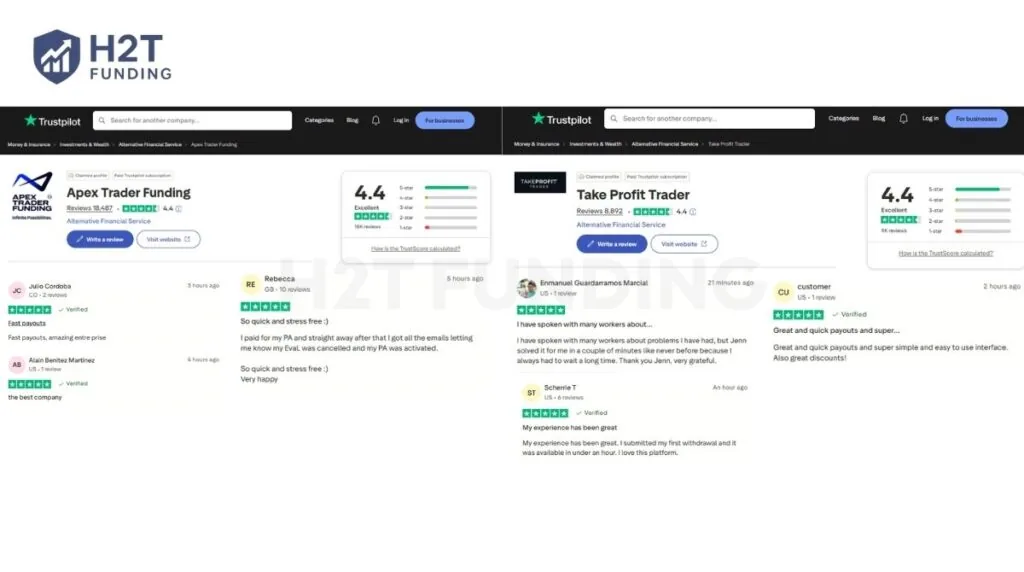
Apex continues to attract users with its “one-time payment” 4.0 model. Many traders praise the streamlined payout process via partners like Plane, confirming that once targets are hit and safety nets are satisfied, the withdrawal experience is often fast.

However, technical complaints persist. Users frequently report setup delays over weekends and claim that support responsiveness drops significantly once they become consistently profitable, leading to community speculation about potential “account churn.”
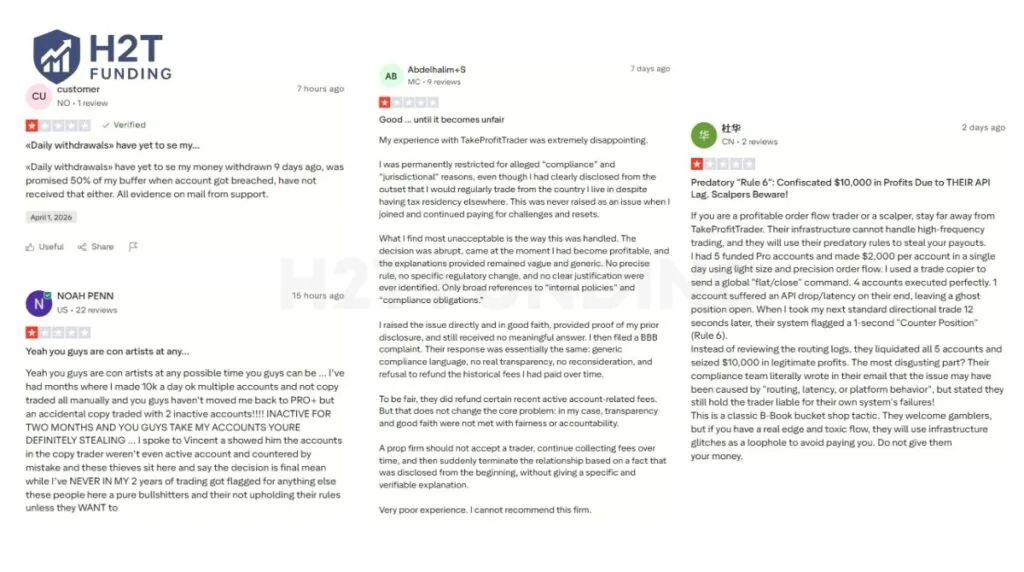
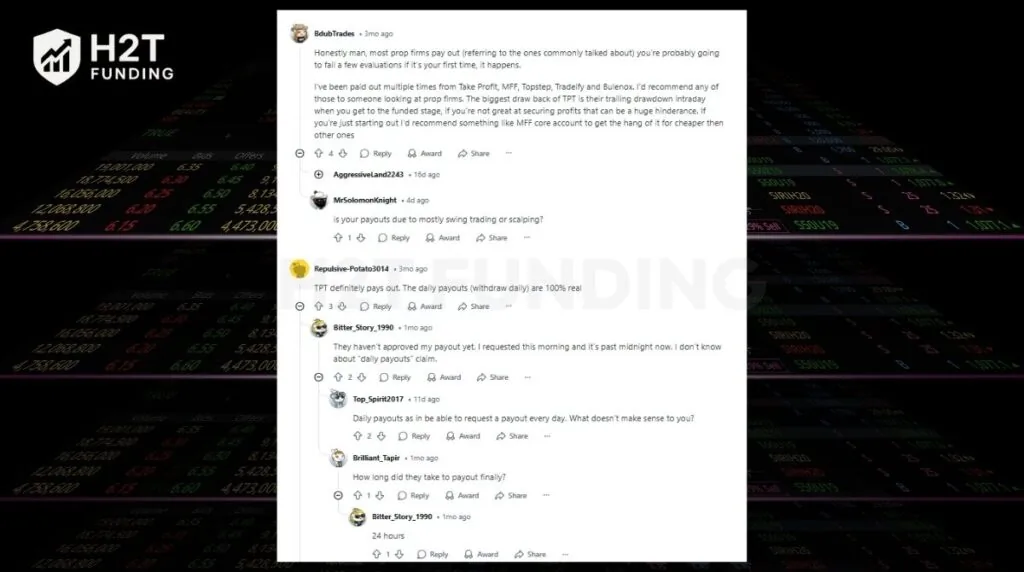
Take Profit Trader faces its own scrutiny. While praised for payout speed, professional scalpers have raised flags regarding platform stability and API latency. Some users report that infrastructure issues lead to “ghost” positions and unfair liquidations, calling into question the platform’s reliability.
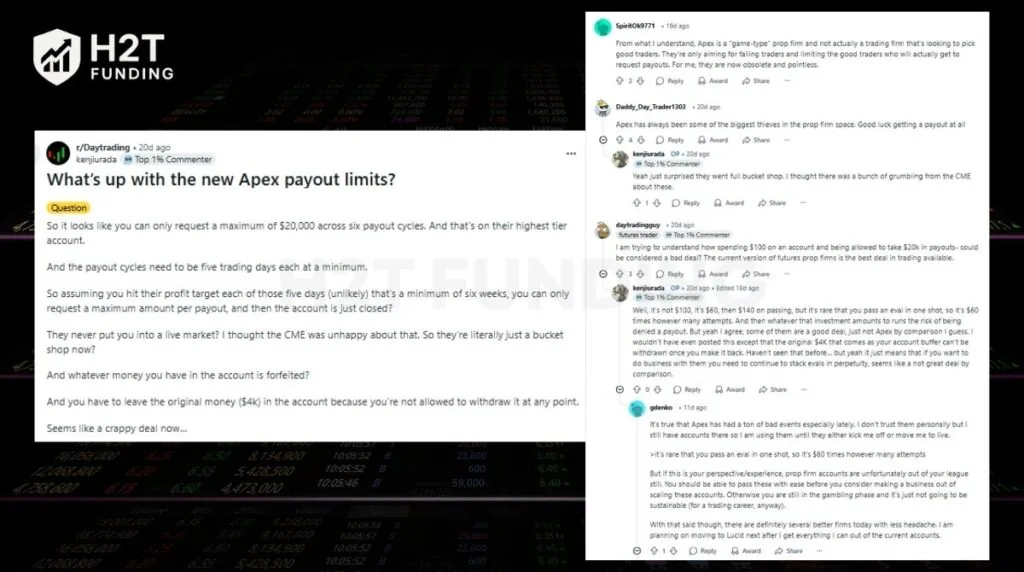
The Reddit Apex discussion provides a more nuanced take, often debating the 6-payout lifetime cap and strict “4.0 rule” changes. Experienced members argue that much of the frustration stems from failing to read the updated rulebook, particularly regarding consistency and drawdown mechanics.
Ultimately, neither firm provides a guaranteed path to wealth. Apex acts as a volume-driven engine that rewards systematic traders, while Take Profit Trader offers a more “premium” experience that prioritizes payout speed.
Your success depends on your ability to execute a strategy that avoids their specific technical traps. Always perform your own due diligence, as firm policies evolve rapidly.
8. Apex vs Take Profit Trader: Which prop firm should you choose?
The right prop firm depends on your trading style, risk tolerance, and long-term goals, not just ratings or marketing claims. While both Apex Trader Funding and Take Profit Trader offer competitive funded accounts, they are built for different types of traders.
Choose Apex Trader Funding if:
- You want to scale aggressively using multi-account strategies (up to 20 accounts).
- You aim to maximize short-term payouts with a 100% profit split.
- You are comfortable trading under intraday trailing drawdown or strict consistency rules.
- You want lower upfront costs during promotions and are confident in passing quickly.
- Your strategy focuses on high-frequency or fast execution, where scaling matters more than longevity.
- You prefer a simplified, all-in-one setup with platform and data costs included.
Choose Take Profit Trader if:
- You prioritize long-term account growth without payout caps or forced account closure.
- You want faster and more flexible withdrawals, including daily or near-instant payouts.
- You prefer a simpler risk model, especially with EOD drawdown at key stages.
- You want access to a broader range of trading platforms and instruments.
- Your strategy benefits from fewer restrictions at the funded stage.
- You value consistency and stability over aggressive scaling.
Final comparison and recommendations
| Criteria | Apex Trader Funding | Take Profit Trader | Edge |
|---|---|---|---|
| Cost (standard price) | Higher | Lower (monthly model) | TPT |
| Cost (during promo) | Deep discounts (80–90%) | Fixed monthly pricing | Apex |
| Speed to funded | As fast as 1 day | ~5 days minimum (practical) | Apex |
| Profit split | 100% on approved payouts | 80/20 (PRO), up to 90/10 | Apex |
| Scaling potential | Up to 20 accounts | No multi-account scaling focus | Apex |
| Payout trust score | 4.4 / 5 (~18,000 reviews) | 4.4 / 5 (~8,700 reviews) | Tie |
| Payout speed | Slower (~5 days processing) | Fast (same day / <24h) | TPT |
| Drawdown flexibility | Intraday + EOD options | Stage-based (EOD -> Intraday -> EOD) | Tie |
| Consistency rule (funded) | 50% rule enforced | No rule after buffer (PRO) | TPT |
| Automation support | Not allowed | Not allowed | TPT |
| Platform flexibility | Limited but bundled | Wide platform support | TPT |
🔥Limited Offer — up to 90% with a promo code — check if one is running now
H2T Funding tracks current Apex discount codes and promo offers — updated weekly.
Apex Trader Funding coupons and discounts →
9. FAQs
Take Profit Trader is generally better for beginners due to its simplified rules and free educational resources. Their Trade Context mentorship helps new traders understand market structure, while Apex Trader Funding assumes you already have a working strategy and focuses purely on providing capital.
Yes, but only with Apex Trader Funding. They allow trading on Micro Bitcoin (MBT) and Micro Ether (MET) futures. Take Profit Trader currently does not support crypto products on its WealthCharts or TradingView integrations, focusing strictly on traditional equity and commodity futures.
If you choose Apex Trader Funding to manage multiple accounts (up to 20), a VPS hosting solution is highly recommended to ensure your trade copier works without lag. For Take Profit Trader, which focuses on manual trading on a single or a few accounts, a VPS is usually optional unless your home internet is unstable.
Take Profit Trader is the winner for speed. They process withdrawals daily, and funds typically arrive in your Wise account within 24 hours. Apex Trader Funding uses a batch system where you request payout every 8 days, and the total processing time can take between 5 and 11 business days.
This rule applies when you request a payout. No single trading day can account for more than 30% of your total profit balance. If you have a massive windfall day, Apex Trader Funding may deny your payout to ensure you are trading consistently rather than gambling.
On their specific PRO accounts, Take Profit Trader often removes the Daily Loss Limit, allowing you to trade freely as long as you do not hit the maximum trailing drawdown. This offers more flexibility for swing traders compared to the strict daily caps found at other firms.
The Apex Trader Funding Live Trailing Threshold is considered harder because it trails your unrealized (open) profits during the trade. Take Profit Trader uses an End-of-Day (EOD) calculation, which is much friendlier as it allows your trade to breathe intraday without prematurely failing the account.
It depends on your goals. Take Profit Trader is better for fast withdrawals and simple rules. Apex is better for scaling, multi-account trading, and higher profit potential.
Profitability depends on your strategy, risk management, and consistency. Apex suits high-volume or automated trading, while Take Profit Trader suits manual, disciplined trading with fast access to funds.
Yes, the Apex app is legitimate. It allows traders to monitor accounts, check profits, and manage multiple funded accounts. However, it is mainly a management tool; trading execution usually happens on supported platforms like NinjaTrader or Tradovate.
10. Conclusion
Apex vs Take Profit Trader are built for different trading styles, despite offering similar funded futures accounts.
Apex stands out with its 100% payout model, strong scaling potential, and deep discounts. It is better suited for traders who want to maximize short-term profits and run multiple accounts. However, it comes with stricter rules and payout limitations per account.
TPT focuses on fast payouts, flexibility, and a smoother trading experience. It is a better fit for traders who prioritize consistency, easier withdrawals, and long-term account growth, even with a lower profit split.
At H2T Funding, we believe transparency is key to your success. To explore more options, reading other prop firm comparisons can provide additional insight and help you decide which platform aligns best with your strategy and growth goals.