

Apex Trader Funding vs My Funded Futures (MFFU) are two of the most popular futures prop firm comparisons in 2026. Both firms offer 1-phase evaluations, no daily loss limits, and real payout track records. Yet they are built for different stages of a trader’s career path. Here’s what you need to know:
- Apex Trader Funding is best for experienced traders focused on scaling, offering up to 20 accounts and a 100% profit split, but with stricter payout rules.
- My Funded Futures is more beginner-friendly, with simpler rules, no activation fees, and flexible payout options, including daily withdrawals.
This comparison, H2T Funding, will cover evaluation structure, drawdown rules, profit splits, platforms, and trust signals, so you can match each firm to your trading style, not just your budget.
Key takeaways:
- Apex is a scaling platform with multiple accounts, automation, and maximum profit retention.
- MFFU is an entry and testing ground, fast funding, lower cost, and strict discipline rules that build consistency.
- Apex uses a stricter intraday trailing drawdown option, while MFFU relies on a simpler end-of-day trailing system with no daily loss limits.
- MFFU provides more flexibility in automation and platform choices, whereas Apex restricts algorithm trading but includes a built-in platform and data costs.
- Choosing between them depends on your trading stage: MFFU for consistency building and low-cost entry, Apex for aggressive scaling and higher earning potential.
Quick Comparison Overview
| Feature | Apex Trader Funding | My Funded Futures |
|---|---|---|
| Evaluation Phases | 1-phase | 1-phase |
| Min. Trading Days | 1 days | 2 days |
| Drawdown Type | Intraday Trailing/ EOD Trailing | EOD Trailing (3% cap) |
| Profit Split | 100% SIM Funded | 80 – 90% |
| Max Simultaneous Accounts | 20 accounts | 5 accounts for $25K and/or $50K Plans 3 accounts for $100K and $150K Plans |
| Daily Loss Limit | None for Intraday Trailing account 1.5% for EOD Trailing account | None |
| Best Suited For | Scaling / Automation | Beginners / Budget-conscious |
Note: Verify current terms and fees directly with each firm before registering. Data accurate as of 2026.
1. Company Profiles: Apex Trader Funding vs My Funded Futures
Both firms operate as sim-based futures prop firms; traders pass an evaluation on a simulated account, then receive a funded account from which real payouts are drawn. Neither firm requires traders to risk personal capital during evaluation, and it focuses exclusively on futures markets.
| Feature | Apex Trader Funding | My Funded Futures |
|---|---|---|
| Founded | 2021 | 2023 |
| Founder | Darrell Martin | Matthew Leech |
| HQ | Austin, Texas, USA | USA |
| Markets Served | 150+ countries | Global |
| Trustpilot Rating | 4.4 / 5 (18,000+ reviews) | 4.9 / 5 (17,000+ reviews) |
| Asset Focus | Futures Contracts | Futures Contracts |
| Payout Processor | Plane/ ACH | Rise Works |
2. Apex vs MFFU: Program and Account Evaluations
Choosing the right prop firm often comes down to balancing upfront costs against evaluation rules. While Apex Trader Funding is known for frequent discounts, MFFU focuses on simplified fee structures. Let’s analyze both programs to help you find the best fit.
2.1. Account Types, Pricing, and Account Sizes
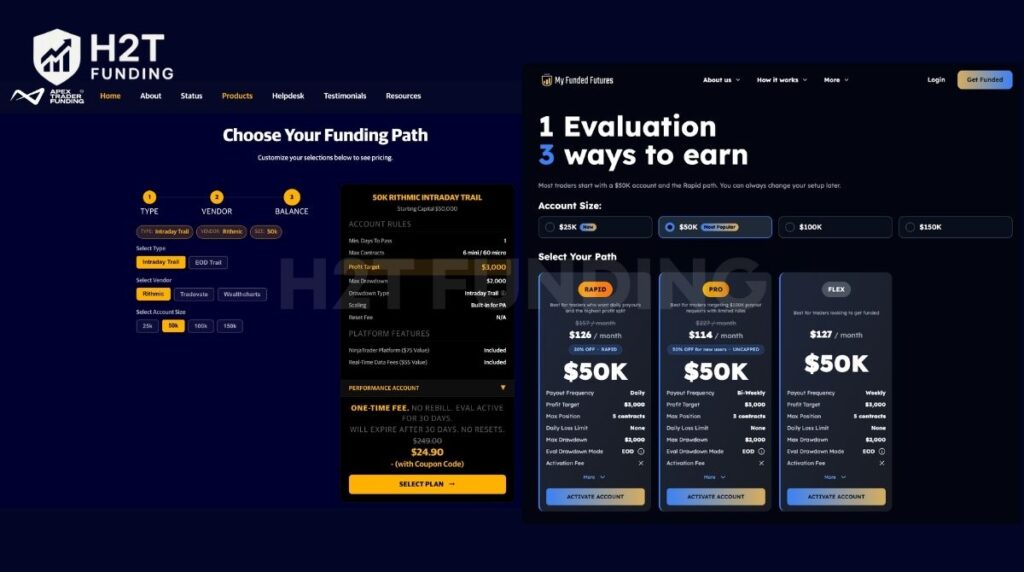
Apex offers account sizes from $25,000 to $150,000. Monthly fees scale with account size and vary between the Rithmic, Tradovate, and Wealthcharts platforms. All data fees and platform fees are included in the monthly cost, with no hidden charges. Apex runs promotional discounts of 80 – 90% regularly, making the effective monthly cost significantly lower than the listed price.
MFFU starts at approximately $84 per month for a $25,000 account. In 2025, MFFU removed activation fees across all plans, reducing the barrier for new traders.
| Account Size | Apex (One-Time Fee) | MFFU (Rapid/ Monthly) |
|---|---|---|
| $25,000 | $118 | $109 |
| $50,000 | $131.33 | $157 |
| $100,000 | $198 | $267 |
| $150,000+ | $264.67 | $347 |
| Max Accounts | 20 simultaneous | 3-5 simultaneous |
| Beginner’s Guide to Multi-Account Stacking at Apex Apex supports multi-account trading, which allows experienced traders to run several funded accounts at the same time and scale their payout potential. This approach can be effective for traders with a proven strategy, disciplined execution, and strong risk management. For beginners, however, multi-account stacking may add unnecessary complexity and increase the risk of rule violations, inconsistent performance, and operational mistakes. |
|---|
2.2. Evaluation Requirements and Steps
Apex Trader Funding offers a fast-track 1-phase evaluation that can be passed in just a single trading day. However, traders face a strict 30-day maximum time limit to hit the 6% profit target, which can add psychological pressure.
Account constraints at Apex depend heavily on the drawdown type you select. Apex enforces a 1.5% daily loss limit on EOD Trailing accounts, whereas Intraday accounts have no daily limit. Upon passing, an Apex one-time activation fee ($89 – $159) is required to access your Performance Account.
MFFU also utilizes a 1-phase system, but requires a minimum of two trading days to pass. On the upside, they offer unlimited time to complete the challenge, completely removing the pressure of a 30-day deadline.
MFFU maintains a straightforward risk structure with a 3% EOD trailing drawdown and zero daily loss limits. Successful traders are initially placed in a Sim Funded account to verify consistency before accessing live markets. Notably, MFFU charges absolutely zero activation fees.
| Evaluation Parameter | Apex Trader Funding | My Funded Futures |
|---|---|---|
| Evaluation Phases | 1-phase | 1-phase |
| Min. Trading Days to Pass | 1 days | 2 days |
| Max. Time Limit | 30 days | None |
| Profit Target | 6% | 6% |
| Max Drawdown | 3% – 4% (Intraday/ EOD Trailing) | 3% (EOD Trailing) |
| Daily Loss Limit | None for Intraday Trailing account 1.5% for EOD Trailing account | None |
| Post-Pass Account Type | Performance Account | Sim Funded |
| Activation Fee | $89 – $159 (One-time fee) | None |
3. Profit Split and Payout Policy at Apex Trader Funding and My Funded Futures
Apex recently overhauled its policies as of March 2026 to guarantee traders a highly attractive 100% profit split. However, each funded account is strictly capped at exactly six withdrawals before it is permanently closed. Traders must pass a new evaluation to continue.
To qualify for a withdrawal, you must log at least five separate days meeting a specific minimum profit threshold. Apex enforces a rigid 50% consistency rule, meaning no single day’s profit can account for half of your total earnings since the last payout.
Furthermore, capital preservation is heavily prioritized during the early funding stages. Your account balance must permanently stay above the Safety Net (drawdown limit plus $100), and each of your six allowed requests has a tiered maximum withdrawal cap.
| Feature | Apex Trader Funding | My Funded Futures (MFFU) |
|---|---|---|
| Profit Split | 100% on all approved payouts | 80% (Flex/Pro), 90% (Rapid Sim-Funded) |
| Payout Frequency | Up to weekly | Daily (Rapid), Every 14 days (Pro), After 5 winning days (Flex) |
| Minimum Trading Days | 5 qualifying days per request | None (Rapid), 5 winning days (Flex) |
| Consistency Rule | Strict 50% rule applies to PA | 50% Rule to Eval account |
| Minimum Payout | $500 | $250 (Flex), $500 (Rapid), $1,000 (Pro) |
| Account Lifespan / Max Payouts | Strictly capped at 6 payouts, then the account closes | No hard cap; transitions to Live Account based on performance |
In contrast, MFFU structures its payouts around specific account tiers: Rapid, Flex, and Pro. The Rapid plan stands out by offering daily payouts and completely removing consistency rules once your initial buffer is cleared.
Speed of capital access is a major advantage here. MFFU now boasts instant payout approvals for most requests, with manual reviews taking just 6 to 12 business hours. This drastically reduces the agonizing waiting periods common in the prop firm industry.
MFFU also utilizes a unique transition model to protect its capital. Successful candidates are placed in a Sim-Funded account first. You must hit specific milestones, like consecutive payouts or profit targets, before the risk team upgrades your account to live market execution.
ROI Calculation: First Payout Cycle
Let’s compare a $50K account on both platforms using current promotional pricing to reveal the actual financial breakdown.
For an Apex $50K Intraday account, the evaluation fee drops to just $24.90 during deep sales, but you must pay a $99 one-time activation fee upon passing. This brings your total initial capital risk to exactly $123.90. If you secure a standard $1,500 first payout, your initial ROI is roughly 12x your total investment.
Conversely, MFFU’s $50K Pro plan costs $114 upfront with absolutely zero backend activation fees. Your total out-of-pocket expense remains exactly $114 to reach the funded stage, making their pricing highly predictable. Assuming a similar $1,500 initial withdrawal, the ROI sits at a very comparable 13x.
Ultimately, MFFU offers slightly better capital efficiency for single-account users due to the absence of hidden activation costs. However, Apex’s extremely cheap upfront evaluation fees allow for aggressive multi-account stacking, which can exponentially scale your potential returns if your risk management is flawless.
4. Key Rules and Account Limits
Understanding a prop firm’s core operational rules is essential to protecting your funded account. To simplify these complex policies, we have compiled a definitive side-by-side comparison of the most critical account limits. Pay close attention to the structural differences in drawdown and Apex consistency requirements.
4.1. Drawdown Rules and Daily Loss Limits
Apex Trader Funding provides two distinct account types with completely different risk environments. Traders must choose between an Intraday Trailing or an End-of-Day (EOD) Trailing drawdown. Each option requires a significantly different approach to trade management.
The Apex Intraday Trailing model tracks your highest open equity in real time. If your $50K account spikes to $52K mid-trade, your minimum account balance moves up instantly. This strict structure demands tight risk control but notably enforces zero daily loss limits.
Conversely, Apex’s EOD Trailing accounts only recalculate your drawdown floor at the session close. However, Apex enforces a strict 1.5% daily loss limit on these EOD accounts. This specific rule prevents traders from holding massive, uncontrolled losing positions throughout the day.
My Funded Futures utilizes a much simpler End-of-Day (EOD) trailing drawdown across its plans. MFFU features absolutely zero daily loss limits, offering massive psychological relief for traders. Your drawdown floor only updates based on your finalized daily closing balance.
4.2. News, Overnight, and Automation Policies
Navigating operational rules during volatile events is crucial for protecting your funded status. Both firms strictly prohibit hedging and directional news scalping. While news trading is technically permitted, MFFU specifically bans open orders two minutes before and after tier 1 data releases to prevent system exploitation.
Market closing times and overnight holding policies also differ slightly between the two platforms. Apex requires all positions to be manually closed by 4:59 PM ET, operating on a standard 23-hour cycle. In contrast, MFFU enforces an earlier daily cutoff at 4:10 PM ET, and relying heavily on its auto-liquidation feature can risk account disqualification.
When it comes to technology, Apex completely bans automated algorithmic trading but allows personal copy trading across a maximum of 20 accounts. Conversely, MFFU supports non-HFT automated tools and seamlessly integrates with TradeSyncer for cross-account execution. This difference in automated trading support is a key factor for algorithmic traders.
Review the quick-reference table below to compare these complex operational rules at a glance.
| Policy | Apex Trader Funding | My Funded Futures |
|---|---|---|
| News Trading | Allowed | Allowed |
| Holiday Trading | Allowed | Allowed |
| Overnight Holding | Not allowed (close by 4:59 PM ET) | Plan-dependent (Starter vs Expert) |
| Automation / Algo Trading | Prohibited | Allowed (No HFT) |
| Copy Trading | Allowed (Own accounts only) | Allowed (Integrated with TradeSyncer) |
| Multi-Account Hedging | Prohibited | Prohibited |
| Directional News Scalping | Prohibited | Prohibited |
| Trading Window | 6:00 PM ET – 4:59 PM ET (23 hrs) | 6:00 PM ET – 4:10 PM ET |
4.3. Consistency rules
Consistency rules cap how much of a trader’s total profit can come from a single day. Both firms use these rules to prevent traders from passing evaluations or hitting payout targets on one outlier session.
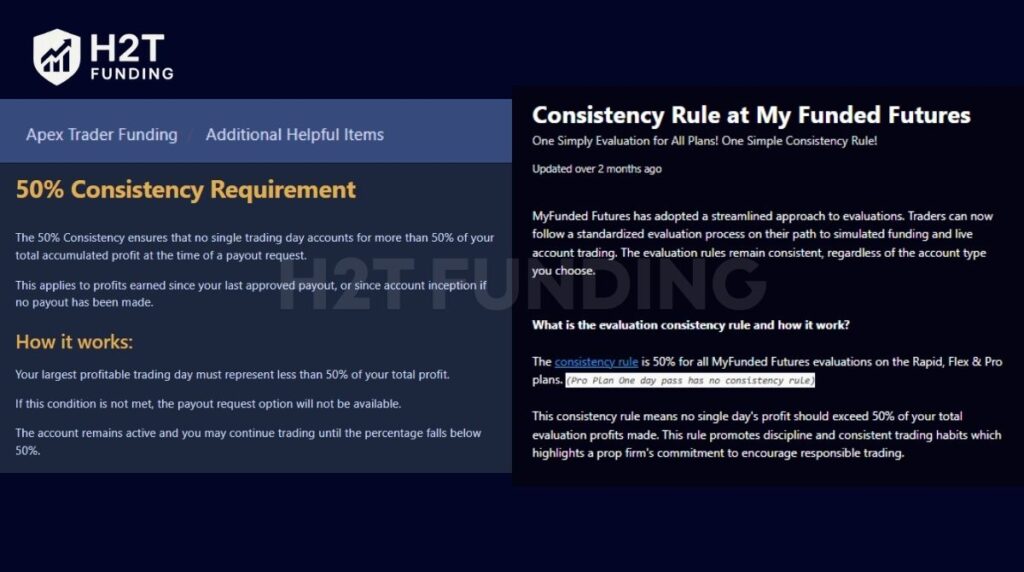
Apex Trader Funding enforces its 50% consistency rule exclusively during the funded PA stage. To request a withdrawal at Apex, no single profitable day can represent 50% or more of your total earnings since your last approved payout.
Conversely, My Funded Futures strictly applies a 50% consistency rule during the evaluation phase across its Rapid, Flex, and Pro plans (excluding the Pro 1-Day Pass). This means your largest daily profit cannot exceed half of your total required profit target to pass the challenge.
Fortunately, exceeding this 50% limit does not breach or fail your account on either platform. You simply lose the ability to request a payout or pass the evaluation until you log additional trading days to naturally dilute the percentage of that outlier day.
Practical Example: The 50% Consistency Rule in Action
Let’s assume you are trading a $50K account and your biggest winning day is $1,500. To satisfy the 50% rule, your overall account profit must be at least $3,000 (calculated simply as $1,500 / 0.5 = $3,000).
If your total profit is currently only $2,500, that single $1,500 day represents a massive 60% of your total earnings. You must continue trading to generate an additional $500 in profit across separate days to bring that ratio down below the 50% threshold.
This rule emphasizes disciplined risk management. Traders who rely heavily on high-impact news events often struggle with consistency limits, as massive windfall days force them to grind out smaller profits just to restore their ratio.
5. Platforms and Instruments
The trading platform and the instruments available to you are fundamental to your daily operations. This section breaks down the core technological differences, associated commission structures, and market access between Apex and My Funded Futures.
5.1. Supported Trading Platforms and Tools
Apex Trader Funding provides an all-inclusive ecosystem, offering a curated selection of top-tier platforms supported. A major advantage is that Apex includes a free NinjaTrader license and covers all real-time data fees within its single monthly cost. This transparent pricing model eliminates unexpected backend expenses for funded traders.
In contrast, My Funded Futures (MFFU) prioritizes flexibility and choice, supporting a much wider range of specialized platforms like Quantower and ATAS. However, traders should be aware that once live-funded, they are responsible for covering all associated data subscriptions and platform licenses. This can introduce additional variable costs not present with Apex.
| Platform | Apex Trader Funding | My Funded Futures |
|---|---|---|
| Rithmic RTrader Pro | Yes | Yes |
| Tradovate | Yes | Yes |
| NinjaTrader 8 | Yes (free license included) | Yes |
| TradingView | Yes | Yes |
| Specialized Platforms | No (WealthCharts is exclusive) | Yes (Quantower, ATAS, Volumetrica, etc.) |
| Data and Platform Fees | Included in Monthly Fee | User’s responsibility in Live Account |
5.2. Tradable Instruments and Asset Classes
Both Apex and MFFU are strictly futures-only trading environments, providing access to a wide range of CME-listed products. While their core offerings are similar, MFFU currently imposes temporary trading restrictions on key commodities like Gold, Silver, and Natural Gas due to market volatility.
A critical note on micro contracts: Using MES or MNQ does not proportionally reduce your drawdown risk. Drawdown is always tracked in total dollar terms, so a trader holding 10 MES contracts faces the same dollar-based risk as one holding a single ES contract. Beginners must manage their contract count carefully to avoid unexpected account breaches.
| Instrument Category | Apex Trader Funding | My Funded Futures |
|---|---|---|
| Equity Index Futures (ES, NQ, MES, MNQ, RTY) | Yes | Yes |
| Energy Futures (CL, NG) | Yes | Yes (Temporary restrictions apply) |
| Metal Futures (GC, SI) | Yes | Yes (Temporary restrictions apply) |
| Currency Futures (6E, 6B) | Yes | Yes |
| Micro Contracts (MES, MNQ) | Yes | Yes |
| Forex (Spot FX) | No | No |
| Equities (Stocks) | No | No |
6. What Real Traders Are Saying: Apex Trader Funding vs My Funded Futures
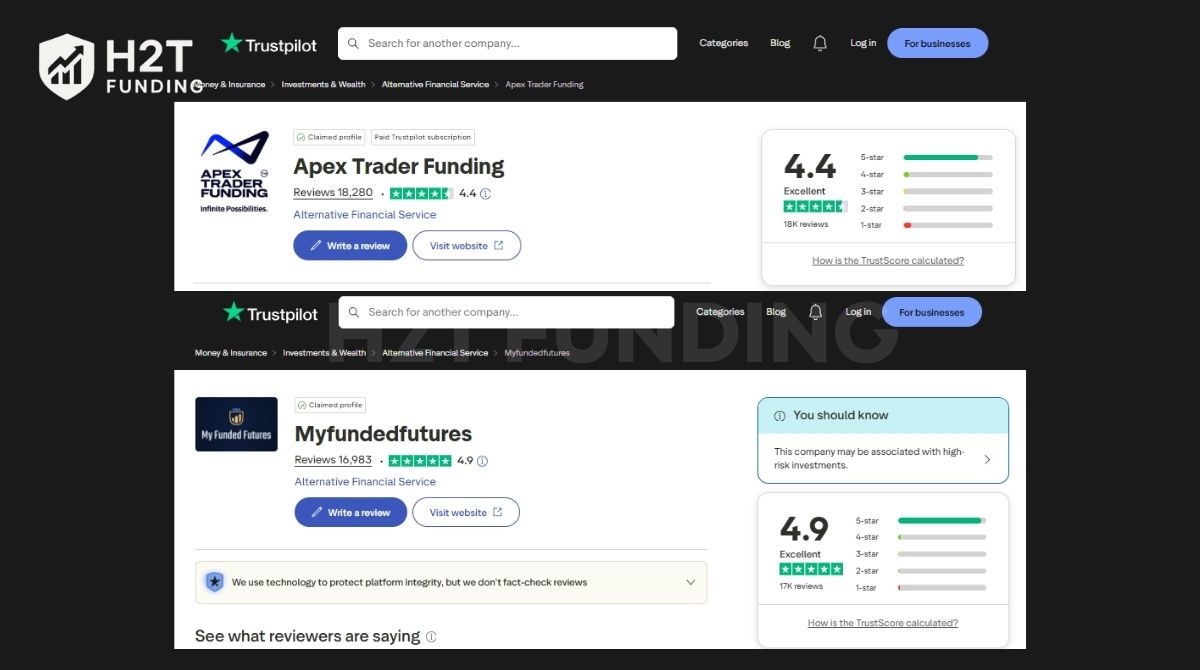
As of April 1, 2026, public reviews on platforms like Trustpilot provide a clear metric of user satisfaction. My Funded Futures holds an exceptional 4.9-star rating from nearly 17,000 reviews, indicating widespread user trust. Apex Trader Funding is also highly regarded, boasting a strong 4.4-star rating from over 18,000 verified traders.
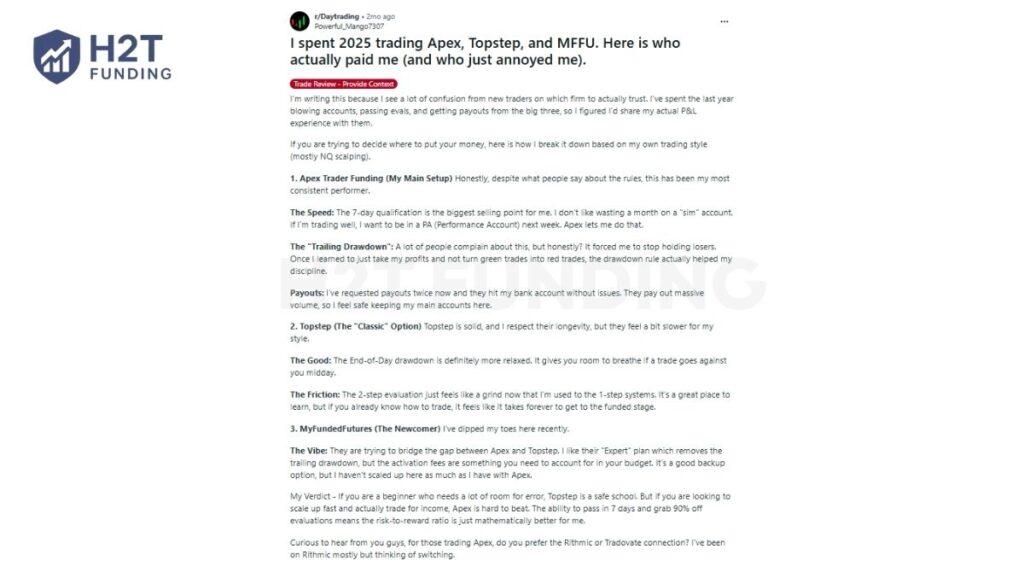
A detailed 2026 review from a trader on the r/Daytrading subreddit offers a powerful first-hand perspective. The user identifies Apex as their “Main Setup,” praising its rapid 7-day qualification path, which avoids lengthy “sim” periods after passing. They also confirm receiving multiple payouts without any issues, building confidence in the firm’s payment process.
The same trader described My Funded Futures as a promising “Newcomer.” They highlighted MFFU’s plan as a major benefit for removing the trailing drawdown, viewing it as a “good backup” to their primary Apex accounts. This feedback suggests both firms are legitimate but cater to different trading styles and risk tolerances.
7. Which Prop Firm Should You Choose?
The right firm depends on your trading style, account goals, and current experience level, not on which firm has the higher Trustpilot score or the larger payout history. Both Apex and MFFU provide robust funded futures accounts; your choice depends on your needs.
Choose Apex Trader Funding if:
- You prioritize maximum scaling potential through multi-account stacking (up to 20 accounts).
- You want the absolute lowest upfront evaluation cost and prioritize affordability through frequent discounts.
- You are confident you can pass an evaluation quickly and want a guaranteed 100% profit split on payouts.
- You need an all-inclusive pricing model that covers your NinjaTrader license and all data fees.
- Your strategy can easily handle an Intraday Trailing Drawdown and a funded-stage consistency rule.
Choose My Funded Futures if:
- You prioritize long-term account growth with no arbitrary payout caps or account closures.
- You prefer a forgiving EOD trailing drawdown, valuing simplicity over aggressive intraday management.
- You value payout flexibility and speed, including daily withdrawals and instant approvals.
- You require access to a wider range of specialized trading platforms like Quantower or ATAS.
- Your strategy benefits from having no consistency rule during the funded stage, making withdrawals simpler.
Final Comparison and Recommendations
| Criteria | Apex Trader Funding | My Funded Futures | Edge |
|---|---|---|---|
| Cost (standard price) | Higher | Lower | MFFU |
| Cost (during promo) | Massive 80% – 90% discounts | No activation fees, fixed pricing | Apex |
| Speed to funded | 1 minimum trading day | 2 minimum trading days | MFFU |
| Profit split (100% threshold) | Flat 100% on all approved payouts | Tiered 80% (Pro) – 90% (Rapid) | Apex |
| Scaling potential | Up to 20 accounts | Performance-based live transition | Apex |
| Payout trust score | 4.4 / 5 (18,000+ reviews) | 4.9 / 5 (17,000+ reviews) | MFFU |
| Multi-asset support | Futures only | Futures only | Tie |
| Drawdown flexibility | Intraday/ EOD trailing | EOD trailing | Tie |
| No consistency rule at funded | Strict 50% rule applies to payouts | No consistency rule at the funded stage | MFFU |
| Automation support | Strictly prohibited (Copy trade only) | Allowed (No HFT) | MFFU |
Advanced Strategy: The Hybrid Approach
Many professional traders actually use both firms in sequence rather than choosing just one. Start your journey with My Funded Futures to build discipline using their forgiving EOD drawdown and strict evaluation consistency rules.
Once your strategy is proven and you have a verifiable track record, use your MFFU profits to aggressively scale at Apex. Buying multiple Apex accounts during an 80% sale allows you to maximize their 20-account limit and 100% profit split.
This phased approach is highly common among veteran prop traders. Understanding which stage of your career you are in is far more valuable than simply arguing over which firm is mathematically “better.”
8. FAQ: Apex Trader Funding vs My Funded Futures
My Funded Futures is generally the safer choice for beginners. MFFU features an End-of-Day (EOD) trailing drawdown, which does not penalize normal intraday market swings. Furthermore, MFFU boasts a stellar 4.9/5 Trustpilot rating and requires zero activation fees upon passing.
Apex guarantees a flat 100% profit split on all approved payouts under their newly updated policies. However, traders must note that each Performance Account is capped at six withdrawals before the firm permanently closes it.
No. MFFU removed daily loss limits on all new plans (Core, Scale, Pro) starting July 2025. The firm now uses only the EOD trailing drawdown, capped at 3% of account size, as the primary risk control.
Up to 20 funded accounts simultaneously. This allows experienced traders to stack capital across multiple accounts, with each account carrying its own $25,000 annual 100% profit threshold.
The 30% evaluation rule states that the combined negative PnL of all open trades cannot exceed 30% of the day’s starting profit. This rule is a legacy policy that was officially retired and changed on March 1, 2026. Currently, Apex enforces a strict 50% consistency rule exclusively during the funded PA stage to dictate your payout eligibility.
You can pass the MFFU evaluation process in a minimum of two trading days. However, successful candidates are initially placed into a Sim-Funded account; the risk team must verify your trading consistency before granting live market access.
Yes, Apex has reliably distributed massive payout volumes since its inception. While they faced processor transitions in the past, they now utilize a highly stable payout infrastructure, routing US payments via ACH and international transfers through Plane.
Apex requires traders to choose between a strict Intraday Trailing drawdown or an EOD trailing option with a 1.5% daily loss limit. Conversely, MFFU utilizes a much simpler EOD trailing drawdown across all plans with zero daily loss limits.
No, both Apex and My Funded Futures are strictly futures-only platforms. While you can trade CME-listed currency futures (like 6E or 6B), neither firm supports spot forex, options, or stock equities.
MFFU offers highly predictable standard pricing with absolutely zero hidden activation fees. However, Apex becomes significantly cheaper during their frequent 80-90% promotional sales, though you must factor in a one-time activation fee upon passing.
9. Conclusion
Deciding between Apex Trader Funding vs My Funded Futures ultimately depends on your specific career stage, trading psychology, and preferred trading conditions and rules.
Apex remains the undisputed choice for aggressive scaling, offering massive 20-account stacking and a flat 100% payout split. Conversely, MFFU provides a highly transparent environment for beginners, featuring relaxed EOD drawdowns and zero hidden activation fees.
We highly recommend testing a single evaluation account before committing significant capital to either platform. Proving your profitability on a smaller scale is essential to truly understanding how these distinct consistency rules and drawdown mechanics affect your daily execution.
If you are still exploring the industry and want to weigh all your options, your research shouldn’t stop here. Discover more data-driven reviews and read our other comprehensive prop firm comparisons directly on the H2T Funding blog to find the absolute perfect match for your trading strategy.