

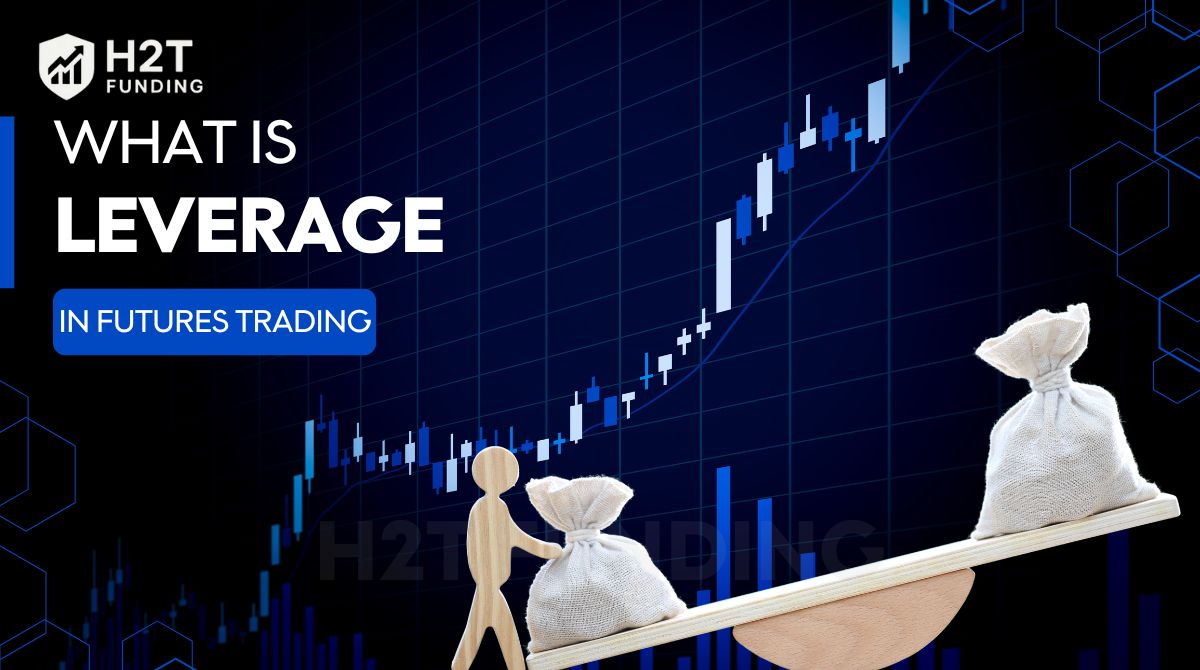
If you’ve ever looked at a futures chart and wondered how traders control huge positions with just a small balance, you’ve already touched on what is leverage in futures trading. Leverage in futures trading lets you borrow capital from your broker so you can open positions far larger than your actual funds.
At H2T Funding, we often remind traders that leverage isn’t about getting rich faster; it’s about using capital efficiently. It can multiply profits, but it can just as easily magnify losses. Understanding how it works is the first step to trading futures with confidence instead of fear.
Key takeaways:
- Leverage in futures trading lets you control large contracts with a small margin deposit, multiplying both potential profits and losses.
- It’s built around key elements like margin requirements, notional value, and broker oversight that define your real market exposure.
- Knowing how to calculate leverage helps you avoid overtrading and manage your risk more effectively.
- Futures offer higher leverage than stocks or ETFs, but that power comes with increased volatility and liquidation risk.
- Smart traders use risk management tools such as stop-loss orders, proper position sizing, and emotional discipline.
- Whether you trade futures, forex, or crypto, leverage should be treated as a tool, not a shortcut to fast profits.
1. What is leverage in futures trading?
Simply put, leverage in futures trading means using borrowed funds to control a contract that’s worth more than the money in your account. You don’t pay the full contract value; you only deposit a portion called margin.
This principle also answers the question of what futures leverage is, because it shows how margin, contract value, and real market exposure interact in a leveraged futures position.
For example, if you use $5,000 to control a $100,000 futures contract, that’s 20x leverage. The rest comes from your broker.
Another example: if a crude oil futures contract is worth $70,000 and the required margin is $7,000, you are using 10:1 leverage. If the price drops by 6%, you would lose $4,200, which is large enough to push your account close to or into a margin call.
Unlike stock trading, where leverage is limited, futures markets naturally offer higher leverage because each contract is a standardised financial instrument regulated by major exchanges.
Still, leverage cuts both ways. When market movement goes in your favour, your profits can grow fast, but when the trend reverses, losses can build up just as quickly. Knowing this balance is what separates a disciplined trader from a lucky one.
2. How does leverage work in futures
To understand how leverage works in futures trading, imagine you only need a small deposit, called initial margin, to control a much larger trade. That small amount acts like a performance bond, showing your broker that you can cover short-term price moves.
This risk management model is a foundational element, similar to the core principles involved in how to set up a prop trading firm.
Let’s look at a clear what leverage is in trading. Suppose you want to trade a crude oil futures contract, which represents the price of an underlying asset worth $100,000.
Your broker might ask for $5,000 in margin. That means you’re using 20x leverage. If the price goes up 2%, your profit is about $2,000, a 40% gain on your capital. But if the price drops 2%, you lose $2,000 just as fast.
Leverage in futures works automatically. The exchange and your broker set the margin requirements based on how volatile the market is. If your trading account balance falls below the maintenance margin, your broker will issue a margin call asking you to deposit more funds to keep the position open. If you don’t, your position may be liquidated to prevent deeper losses.
That’s why leverage can be powerful but dangerous. It multiplies both profits and losses. Understanding how it works helps you stay disciplined, not emotional, when markets move fast.
3. Key components of futures leverage
When people ask what futures leverage is, they often miss the fact that it’s built on a few key pieces working together. To really understand leverage, you need to know what these parts mean and how they connect.
3.1. Margin requirements
Every futures trade starts with margin. There are two main types: initial margin and maintenance margin. The initial margin is the money you put down to open a position. The maintenance margin is the minimum amount you must keep in your account to hold it.
It essentially functions as a critical buffer, and understanding the concept behind the margin of safety formula percentage is essential for managing this risk. If your balance drops below that because the market turns against you at a key price level, your broker may ask for more funds through a margin call. Learning how to use supply and demand zones can help traders anticipate these potential turning points.
3.2. Notional value and contract value
The notional value is the total size of your position. For example, one E-mini S&P 500 futures contract might control about $100,000 in value. You might only need to post $5,000 as margin, which means you’re trading with 20x leverage. This gap between the contract’s full value and your margin is where leverage lives.
3.3. Broker and performance bond
Your broker plays a major role. They collect the margin as a performance bond, ensuring you can meet your obligations if the market turns. The broker also monitors your equity and can close positions if your account doesn’t meet the exchange’s rules. This process applies to all trading styles, including automated systems that might use the best MQL5 strategies for a prop firm.
Together, these elements define how leverage functions in real trading. When you see how margin, notional value, and broker control work together, you realise leverage isn’t a shortcut to profit; it’s a tool to manage risk.
4. How to calculate leverage in futures trading
Many traders hear about leverage but never learn how to measure it. So here’s futures leverage explained in the simplest way possible. Leverage shows how many times bigger your trade size is compared to your actual account balance.
The basic formula looks like this: Leverage = Notional Value ÷ Account Equity
Let’s take an example. You trade a mini S&P 500 futures contract worth $100,000. Your broker requires a $5,000 margin deposit. Divide $100,000 by $5,000, and you get 20x leverage. That means every 1% move in price equals a 20% change in your profit or loss.
It sounds exciting, but here’s what I’ve learned from experience: the math is simple, yet the risk is real. If you use too much leverage, even a small market move can wipe out your balance. That’s why seasoned traders often say, “Treat leverage like fire. It can warm your house, or it can burn it down.”
If you want to double-check your leverage level, many brokers now offer a futures leverage calculator on their platforms. It’s a quick tool that helps you see your real exposure before entering a trade, and it’s worth using every single time.
5. Benefits and risks of using leverage in futures
Before jumping into high leverage, it’s worth understanding what leverage provided in futures trading is and why it matters. Futures markets typically offer much higher leverage than stocks or ETFs, often ranging from 10x to 50x depending on the contract and broker. This gives traders a chance to control large positions with a small amount of capital.
In addition, leverage enhances capital efficiency. Instead of using all your funds to buy a single contract, you can use a small portion as margin and allocate the remaining capital across multiple positions. This allows traders to capture more market opportunities without needing a large amount of upfront capital.
The benefits are clear:
- You can use less capital to access big opportunities.
- It allows flexible strategies like hedging or speculative trading in short-term market conditions.
- Profits can grow faster when the market moves in your favour.
But here’s the part that many new traders overlook. Leverage can also magnify losses just as easily. This significant risk often leads traders to wonder, Can you make money in forex without leverage at all? A 2% market drop on a 20x leveraged position can wipe out 40% of your margin balance. I’ve seen traders make this mistake, turning winning setups into huge losses because they ignored their risk per trade.
In many cases, even a 6% adverse move on a 10x leveraged futures position can wipe out most or all of your margin. This illustrates how sensitive your account becomes when using high leverage.
In practice, leverage allows traders to open positions across multiple markets at the same time, such as indices, energy, or metals. With the same amount of capital, they can allocate margin across several contracts instead of putting all their funds into a single trade.
Key risks to watch for:
- Rapid liquidation if your account equity falls too low.
- Emotional decisions from watching profits and losses swing wildly.
- Ignoring stop-loss orders, thinking the market will “come back.”
Leverage isn’t a way to gamble. It’s a financial tool. Used wisely, it helps you grow consistently. Used carelessly, it can empty your account in minutes. Balance confidence with caution, and you’ll last much longer in the futures market.
6. Risk management tips when trading with leverage
If you’ve ever wondered what leverage is in Binance futures trading, you’ll notice one big difference: traders there can adjust leverage levels freely, often up to 100x. It sounds exciting, but it also means the margin for error gets very small. That’s where risk management becomes your best friend.
Here are some tips that experienced traders, including myself, have learned the hard way:
6.1. Control your position size
Never use all your available margin on one trade. A good rule is to risk only 1–2% of your total capital per trade. This gives you room to stay in the game even when the market turns unexpectedly.
6.2. Always set a stop-loss order
I know it’s tempting to think, “The price will come back.” But in leveraged trading, small moves can cause big damage. Set a stop-loss before entering any position, then stick to it. This single habit can save your account.
6.3. Maintain enough margin
Keep your margin requirements comfortably above the minimum level. If your balance drops close to the maintenance margin, add funds before your broker issues a margin call. It’s better to act early than to see your trade closed automatically.
6.4. Manage emotions like a pro
Leverage can make you feel powerful when you win and desperate when you lose. I’ve been there. Take breaks, track your results, and trade only when you’re calm. Good risk control isn’t just about numbers; it’s also about mindset.
Trading with leverage isn’t about avoiding risk completely; it’s about understanding and controlling it. Once you see leverage as a tool rather than a shortcut, you’ll find that steady profits often come from patience, not speed.
7. Leverage comparison across markets
If you’ve ever tried day trading stocks, you’ve probably asked yourself what leverage futures trading is and why it feels so different from leverage in futures. The answer comes down to how each market handles risk and regulation.
In stock trading, leverage is usually limited. Brokers in the United States, under FINRA rules, often allow a maximum of 2x for regular traders or 4x for pattern day traders. It’s designed to protect retail investors from big, fast losses.
In futures trading, leverage is naturally higher because each contract already represents a large notional value. You might only need to post 5% or less as a margin, which means leverage of 20x or more. This is possible because futures are standardised, exchange-traded instruments with strict clearing rules that help manage counterparty risk.
Meanwhile, the forex and crypto markets can go even further. Forex brokers outside the US often offer 50x or 100x leverage. On Binance Futures, traders can go up to 125x. It looks attractive, but as volatility rises, that power becomes dangerous. One wrong move can trigger a liquidation within seconds.
Here’s a quick summary:
| Market type | Typical leverage range | Notes |
|---|---|---|
| Stocks | 2x–4x | Limited by regulation (FINRA) |
| Futures | 10x–50x | Exchange-controlled margin system |
| Forex | 30x–100x | Depends on the broker and the region |
| Crypto | 20x–125x | Extremely volatile and risky |
Each market gives traders a different balance between opportunity and danger. The key is knowing which level of leverage fits your trading style, risk tolerance, and capital size. The higher the leverage, the less room for error and the more discipline you need.
8. Leverage in prop firm accounts
Actually, leverage in a prop firm account works a bit differently than in a standard retail account. To put it simply, prop firms provide leverage as a tool for you to execute a strategy, not as a blank check for taking on massive risk.
It’s still borrowed capital that lets you control a large position with the firm’s money. For example, a common leverage in trading that you’ll see is 1:30 on forex pairs. This means for every $1 of your “risk capital” (which is tied to your drawdown limit), you can control a $30 position.
But here’s the crucial difference I’ve noticed: the firm’s risk rules, like daily loss limits and maximum drawdown, always come first. So, even if you have access to, say, 1:100 leverage, you can’t actually use it to risk your entire account on one trade. Why? Because you’d hit your daily loss limit and be shut down long before your position could cause catastrophic damage.
I think it’s best to see it as “buying power” within a safety net. The firm gives you enough rope to trade effectively but not enough to hang yourself. This structure forces you to focus on consistent risk management, which, let’s be honest, is what they’re really testing you for anyway.
9. Common mistakes beginners make with leverage
When people first learn how leverage works in futures trading, they often get excited by how much buying power it offers. I’ve seen that same excitement many times, and honestly, I felt it too when I started trading. But leverage is tricky. It rewards discipline, not emotion.
- Using too much leverage too soon: New traders often open positions far larger than their accounts can handle. A small 1% market move can wipe out 20% of their equity. This happens because they confuse potential with control. The more leverage you use, the smaller your margin for error becomes.
- Ignoring volatility: Markets don’t move in straight lines. Futures prices can swing fast, especially during major news or data releases. Those quick reversals can turn profits into losses in seconds. That’s why it’s crucial to measure performance against this risk. For example, comparing the Sortino ratio vs the Sharpe ratio is one way to do it.
- Misunderstanding margin calls: A margin call is not just a warning; it’s your broker telling you that your account no longer meets the required balance. Many beginners wait too long to add funds or close trades, and the result is forced liquidation. Once that happens, recovery becomes much harder.
- Trading emotionally: Fear and greed are the real enemies of leveraged trading. I’ve met traders who double down on losing positions, thinking they can “win it back.” Most of them end up draining their accounts. The best traders know when to stop and protect their capital.
Learning leverage takes time, and making mistakes is part of the process. The key is to make small mistakes, not catastrophic ones. Respect your margin, plan your trades, and never let emotions decide how much risk you take.
10. How to use leverage safely (risk management tips)
Honestly, using futures trading leverage safely comes down to one thing: forgetting about the potential profit and focusing entirely on how much you could lose. It’s a complete shift in mindset, but it’s the only way to survive.
I’ve seen so many new traders get excited by the idea of turning $1,000 into $10,000, but they don’t stop to think that the same leverage can turn that $1,000 into zero in a matter of minutes. That, right there, is what leverage means in futures trading; it’s a magnifier for your decisions, good or bad.
So, here are the non-negotiable rules I learned, often the hard way:
- Your position size is everything. Before you even think about placing a trade, you must know exactly how much you’re willing to risk. A solid rule is to never risk more than 1-2% of your total account balance on a single trade. If you have a $5,000 account, that’s a max loss of $50 to $100. This single habit will save you more times than you can count.
- The stop-loss is not optional. Never, and I mean never, enter a leveraged trade without a predetermined stop-loss order. It’s your safety eject button. That feeling of hope that “the price will come back” is a classic trap that has blown up more accounts than anything else. Trust me on this one.
- Don’t max out your leverage. Just because a broker offers you 50x or 100x leverage, especially in what is leverage in trading forex, doesn’t mean you should use it. To put it simply, using lower leverage gives your trade more breathing room. It prevents you from getting liquidated by a sudden, sharp move that might last only a few seconds. I think it’s far smarter to trade a bit smaller and stay in the game than to go big and get knocked out on the first punch.
Ultimately, it’s not about avoiding leverage but respecting it. The difference between a trader who thrives and one who blows up isn’t luck; it’s discipline. So, treat leverage like the powerful tool it is, not like a lottery ticket.
11. FAQs about leverage in futures trading
Imagine you open a gold futures contract worth $100,000 but only deposit $5,000 as margin. That gives you 20x leverage. If gold rises 2%, you earn about $2,000, a 40% gain on your capital. If it drops 2%, you lose the same amount. This is a simple leverage in trading example that shows both the potential and the risk.
It means you control a position twenty times larger than your actual funds. For every $1 you have, your broker lets you trade $20 worth of contracts. Even a small market change can lead to big profits or losses, depending on your direction.
There’s no single answer. Conservative traders stick to 5x–10x, while aggressive day traders might go higher. The best leverage trading for beginners is usually the lowest one that still fits your strategy. Start small and scale up only after you’re consistent.
This level of leverage is common in crypto platforms but extremely risky. With 100x leverage, a 1% price move against you can wipe out your position. It’s not suitable for new traders or anyone who can’t watch the market closely.
A futures leverage calculator helps you estimate your real exposure. You enter the contract value, margin, and account size, and it shows how much leverage you’re using. It’s a simple way to avoid overexposing yourself without realising it.
In day trading stocks, leverage is limited by regulators, usually up to 4x. In futures trading, leverage can be much higher, often 10x to 50x, depending on the contract and margin requirements. Futures give more flexibility but also demand more discipline.
Crypto markets can offer extreme leverage, sometimes 100x or more, especially on exchanges like Binance. Stock markets in the US are far more conservative, capped at 2x or 4x. Both use the same concept but operate under very different risk rules.
Outside trading, leverage in business means using borrowed money to grow a company. It’s the same principle: use debt to amplify returns. The key is balance. Too much leverage, in trading or business, increases the chance of failure.
Keep position sizes small, use stop-loss orders, and manage risk carefully. Always know your maximum loss before you enter a trade. The best traders don’t avoid risk; they control it.
To put it simply, 5x leverage means you can control a position that is five times larger than your own capital. So, for every $1 you put up as margin, you can trade with $5 of market exposure. It’s a pretty conservative level of leverage, often used by traders who want a bit more buying power without taking on massive risk.
This is a great question because it’s not a single, fixed number. How leverage works in futures is that it’s a result of the margin requirements set by the exchange (like the CME Group). For popular contracts like the E-mini S&P 500, the margin might be around $12,000 for a contract worth over $200,000. This works out to roughly 15x-20x leverage. For other contracts, it can range from 10x to over 50x, depending on the asset’s value and volatility.
The short answer is no, not in the same way. In what is leverage in trading forex, you often select a leverage ratio like 1:50 or 1:100 from your broker. In futures, leverage is implicit; it’s determined by the contract’s notional value versus its required margin. You can, however, control your effective leverage by adjusting your position size relative to your account balance. Trading a smaller size is like choosing lower leverage.
I think the easiest way to explain this is with an analogy. Think of buying a house. The down payment you make is the margin; it’s the good-faith deposit you put down. The ability to buy a $400,000 house with only a $40,000 down payment is the leverage. In trading, margin is the capital you post, and leverage is the amplifying effect it gives you.
Honestly, it’s a situation you never want to be in. A margin call happens when your account equity drops below the “maintenance margin” level required to hold your position. Your broker will demand that you either deposit more funds immediately to bring your account back up or start closing positions to reduce your risk. If you don’t act fast, the broker will begin to force-liquidate your positions for you, often at the worst possible price, to ensure you don’t lose more money than you have.
Yes, in the sense that higher leverage drastically reduces your margin for error. With 50x leverage, a mere 2% price move against you can wipe out your entire margin for that trade. However, risk is ultimately controlled by your position size. A small, well-managed trade using high available leverage might actually be less risky than a massive trade using low leverage. So while the tool itself is riskier, the real danger comes from how you decide to use it.
Actually, firms like Apex don’t offer selectable leverage ratios like 50x or 100x. Instead, they manage risk by giving you a maximum number of contracts you can trade based on your account size. Your real “leverage” is controlled by their strict trailing drawdown rule. This means you get immense buying power, but the drawdown acts as a hard limit on how much risk you can actually take.
12. Conclusion
Now that you understand what leverage in futures trading is, you can see it’s not just about chasing bigger profits. It’s about learning how margin, capital, and risk work together. Leverage can be your best ally when used wisely, but your biggest enemy if you lose control.
At H2T Funding, we’ve seen how traders who respect leverage last longer in the markets. They don’t rely on luck. They focus on structure, patience, and solid trading strategies that keep them consistent.
If you’re serious about improving your trading, explore more guides in our Prop Firm & Trading Strategies section. You’ll find practical insights, real examples, and proven methods to trade smarter, not riskier. Because in the end, mastering leverage isn’t about trading more; it’s about trading right.