

Take Profit Trader is a popular prop firm that provides skilled individuals with large capital and a generous profit split. However, many people fail the trader evaluation not because of bad strategies, but because they misunderstand the Take Profit Trader evaluation rules. Strict limits on daily losses can easily terminate your account instantly.
Prop firms require extreme discipline to protect their funds before granting you a live account. Knowing the exact boundaries of the firm is the only way to protect your evaluation fee.
In this guide, H2T Funding experts break down every requirement you must follow. You will learn exactly how to navigate the test safely and avoid common traps to secure your funding.
Key takeaways:
- The Take Profit Trader evaluation follows a one-step model that requires reaching the profit target while maintaining drawdown control and at least 5 trading days.
- Profit targets and maximum position sizes are fixed for each account, and exceeding limits leads to automatic failure.
- The EOD trailing drawdown acts as a moving minimum balance, making it the most critical rule to monitor.
- Trading is restricted to approved futures products, and all positions must be closed before 5:00 PM ET.
- Profit consistency across multiple days is required, and counter positions across accounts are strictly prohibited.
1. What is the Take Profit Trader evaluation phase?
The Take Profit Trader evaluation is a single-step, simulated test designed to verify your risk management skills and consistency. You must reach a specific profit target without breaching the End-Of-Day (EOD) trailing drawdown to earn a funded account.
This evaluation phase provides a realistic trading environment where you operate with virtual funds rather than risking your own capital. The prop firm uses this process to objectively assess whether your trading strategy is reliable. Only disciplined individuals who strictly follow all guidelines are allowed to progress to the funded stage.
The primary purpose of this test is to verify your consistency and trading discipline. It is not designed to measure your ability to make a quick, lucky profit, but to ensure you can sustain a high evaluation success rate over time. Firms need absolute proof that you can manage risk effectively before granting you access to a live Pro Account. Key aspects of this evaluation include:
- Account Sizes: You choose a starting account balance ranging from $25,000 to $150,000.
- Minimum Trading Requirement: You must actively trade for a minimum of 5 days.
- Risk Control: You must follow the EOD Trailing Drawdown rules carefully to avoid failing the test.
- Performance Metrics: They closely monitor your trading performance to ensure consistent profitability.
Once you successfully prove your discipline and pass the evaluation, you qualify for the PRO account, which offers an attractive 80/20 profit split.
2. Key Take Profit Trader evaluation rules
To pass the TPT evaluation, you must strictly follow the six core requirements designed to test your discipline and risk management. Breaking any of these fundamental guidelines will result in an immediate failure of your account, regardless of your current profits.
Take Profit Trader removes the Daily Loss Limit (DLL) during this phase, but you still face strict boundaries on drawdowns and consistency.
Here are the 6 core rules you must memorize before starting your test (Source: Take Profit Trader Official Guidelines):
- Rule 1: Profit Target
- Rule 2: Maximum Position Size
- Rule 3: End-Of-Day (EOD) Maximum Trailing Drawdown
- Rule 4: Approved Products and Approved Hours
- Rule 5: Consistency rules
- Rule 6: No Counter Positions
Let’s break down each rule in detail below to monitor your trading performance and ensure your trading environment remains compliant, helping you avoid common evaluation traps.
2.1. Rule 1: Profit Target
The profit target is the specific net gain you must achieve to successfully pass the trader evaluation. It acts as the primary benchmark to prove your trading strategy is profitable and generates consistent trading profits relative to your initial account balance. This target varies significantly depending on the initial account size you select when starting the challenge.
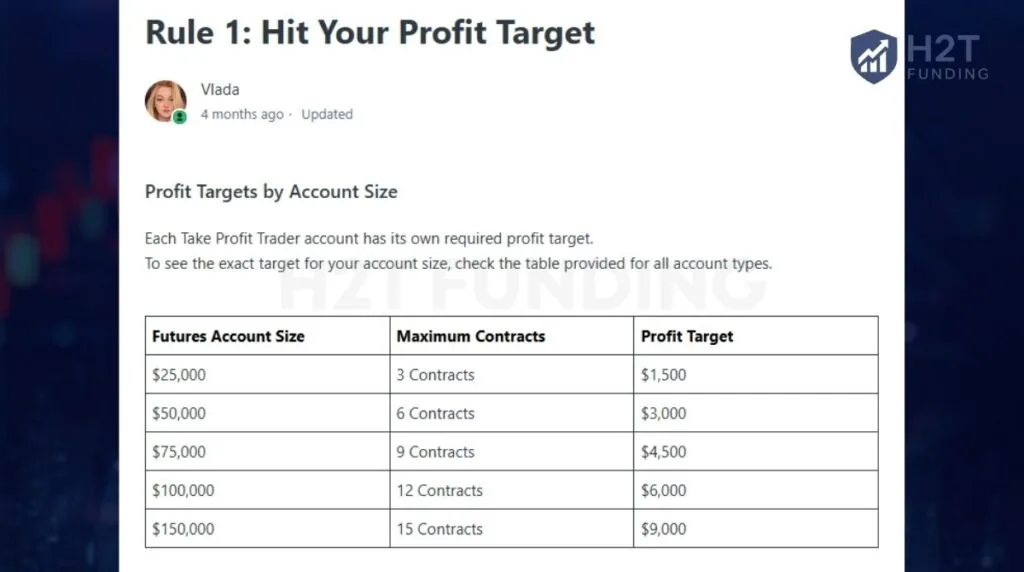
Below is the exact profit target you must achieve based on your chosen Take Profit Trader account size:
| Futures Account Size | Maximum Contracts | Profit Target |
|---|---|---|
| $25,000 | 3 Contracts | $1,500 |
| $50,000 | 6 Contracts | $3,000 |
| $75,000 | 9 Contracts | $4,500 |
| $100,000 | 12 Contracts | $6,000 |
| $150,000 | 15 Contracts | $9,000 |
Let’s look at a practical example:
If you purchase the $50,000 evaluation account, your mandatory profit target is exactly $3,000. This means your account balance must reach $53,000 (after deducting commissions and fees) to satisfy this rule. Even if your balance hits $52,999, you have not passed yet; you must officially cross the target threshold while maintaining your consistency and drawdown limits.
2.2. Rule 2: Maximum Position Size
Maximum position size is a strict, static limit on the total number of futures contracts you can have open simultaneously. This rule is designed to prevent reckless over-leveraging and force disciplined risk management. Exceeding this boundary, even accidentally for a few seconds, results in an automatic evaluation failure.
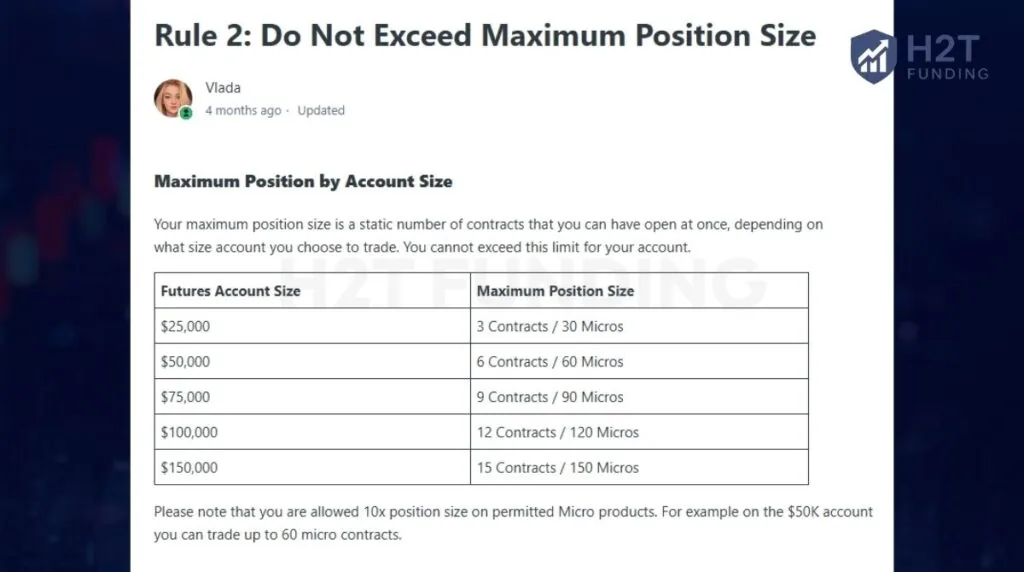
Below is the maximum allowable position size for both standard (E-mini) and Micro contracts according to your account level:
| Futures Account Size | Maximum Position Size |
|---|---|
| $25,000 | 3 Contracts / 30 Micros |
| $50,000 | 6 Contracts / 60 Micros |
| $75,000 | 9 Contracts / 90 Micros |
| $100,000 | 12 Contracts / 120 Micros |
| $150,000 | 15 Contracts / 150 Micros |
Unlike some other prop firms that use dynamic scaling plans, Take Profit Trader sets a fixed contract limit from day one based on your chosen account size. You cannot exceed this limit, which forces you to optimize your trading frequency and keeps your user experience focused on risk management.
Take Profit Trader allows a 10x position size multiplier for permitted Micro products. If you trade the $50,000 account, your absolute maximum limit is 6 standard contracts OR 60 micro contracts.
Example: If you already have 4 standard ES contracts open, you have 2 “standard contract equivalents” left. You can use this capacity to open either 2 more standard contracts or up to 20 micro contracts. Opening 21 micros while holding the 4 standard contracts violates the rule and results in failure.
2.3. Rule 3: End-Of-Day (EOD) Maximum Trailing Drawdown
The End-Of-Day (EOD) trailing drawdown sets a hard floor on your capital, and hitting it is the most common reason participants fail. This rule establishes a minimum account balance that trails your highest end-of-day profits upward.
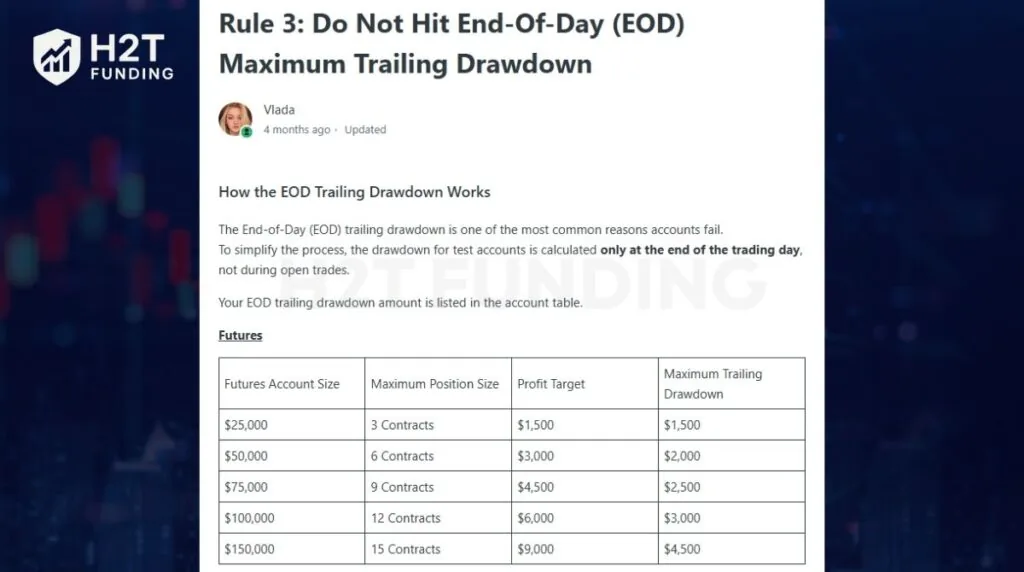
Below are the exact EOD maximum trailing drawdown limits assigned to each account size:
- $25,000 Account: $1,500 maximum limit
- $50,000 Account: $2,000 maximum limit
- $75,000 Account: $2,500 maximum limit
- $100,000 Account: $3,000 maximum limit
- $150,000 Account: $4,500 maximum limit
If your live equity touches this minimum level at any time, including unrealized losses, your account is immediately liquidated. Let’s look at exactly how this trailing mechanism works on a $25,000 account:
Your starting drawdown limit is $1,500, meaning your initial minimum threshold sits at $23,500. If you earn $1,000 on your first day, your new EOD balance becomes $26,000.
Because your highest closing balance increased, your minimum threshold also trails upward by $1,000, moving to $24,500. This safety net continues to follow your highest daily closing balance until it reaches your original starting capital of $25,000.
Once your minimum threshold hits that $25,000 mark, it stops trailing entirely and becomes a fixed floor. You must always track this metric in your dashboard to ensure your trading performance never dips below the failure line.
2.4. Rule 4: Approved Products and Approved Hours
You are only permitted to trade a specific list of futures products during designated market hours to pass the evaluation. This rule ensures you only operate within highly liquid markets and never expose the firm to overnight gap risks.
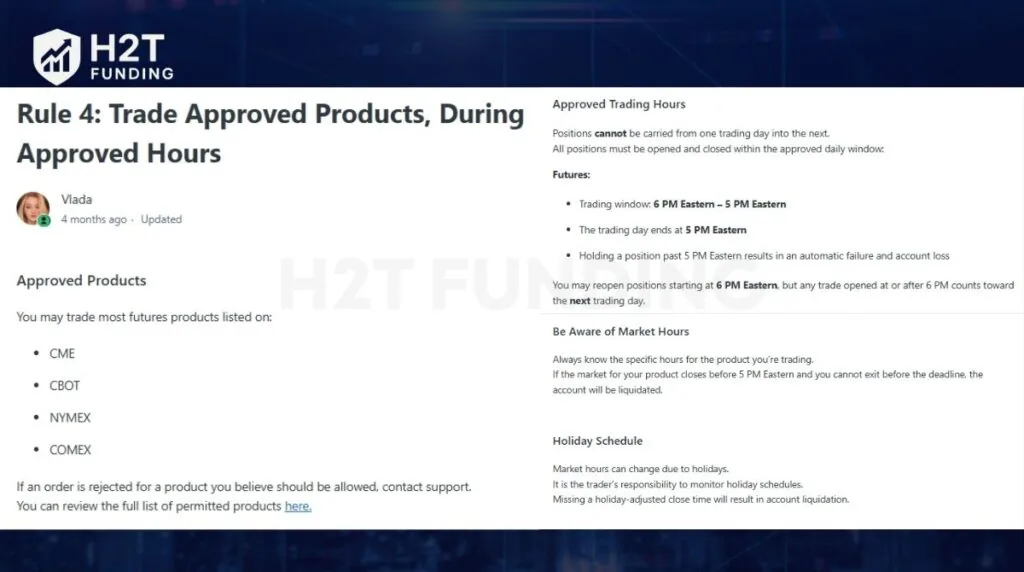
Approved Products:
Take Profit Trader allows you to trade most major futures contracts listed on the following prominent exchanges:
- CME (Chicago Mercantile Exchange)
- CBOT (Chicago Board of Trade)
- NYMEX (New York Mercantile Exchange)
- COMEX (Commodity Exchange)
Note: If a trade is unexpectedly rejected on what you believe is an allowed asset, immediately contact their customer support for clarification.
Approved Trading Hours:
The official trading window spans from 6:00 PM Eastern Time to 5:00 PM Eastern Time the following day. You must adhere to these strict timeframes:
- The 5:00 PM Deadline: All positions must be completely closed before this exact time.
- The 6:00 PM Restart: You can open new positions starting at 6:00 PM Eastern. Any trade executed at or after this time is officially counted toward the next trading day.
The core requirement is that you must be flat (have zero open positions) at the end of every trading session. Holding any trade past 5:00 PM Eastern Time is an automatic failure, regardless of your account balance.
You must understand the market conditions and the exact closing time for each asset to avoid violating the Take Profit Trader news rules or holiday schedules. If a market closes early and you are stuck in a position, your account will fail.
Additionally, you must actively monitor holiday schedules. Market hours frequently shift during holidays, and missing an adjusted, earlier closing time will result in automatic liquidation.
2.5. Rule 5: Consistency rules
The consistency rule ensures you demonstrate genuine trading skill over multiple days rather than passing the test through a single lucky event. You must trade for a minimum of 5 days, and no single day’s profit can exceed 50% of your total net profits. This dual requirement proves your discipline before Take Profit Trader grants you access to real capital.
Prop firms view inconsistent, massive gains as gambling, which introduces unacceptable risk to their capital. Even if you hit your profit target on day two, you must continue trading strategically for at least three more active days to satisfy the evaluation criteria.
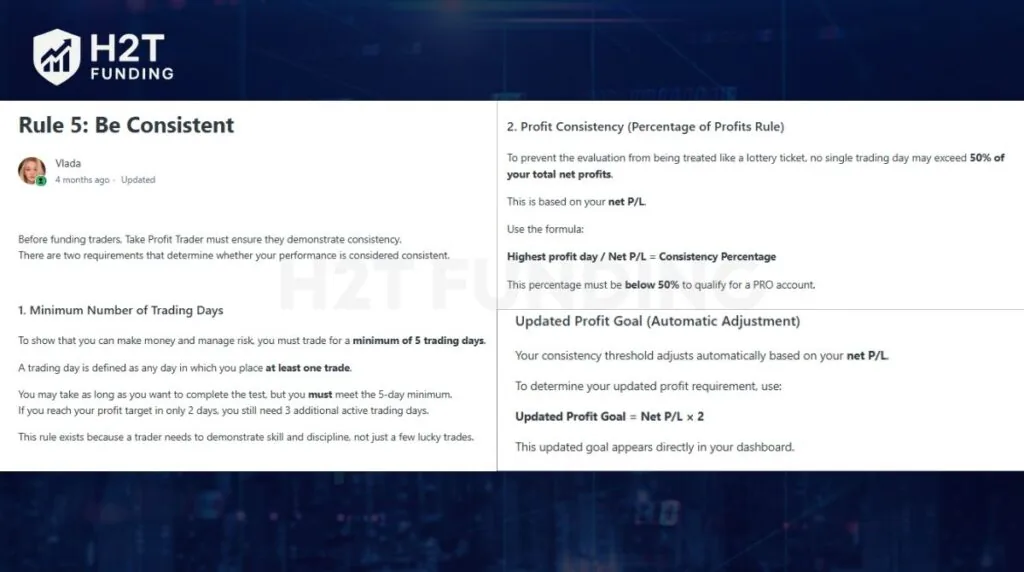
Here are the two critical components of the consistency rule you must master:
1. The 5-Day Minimum Requirement:
- A “trading day” simply means executing at least one trade during the approved market hours.
- There is no maximum time limit to pass the evaluation, but you cannot complete it in fewer than 5 active days.
- This requirement strictly enforces the Take Profit Trader consistency rule and ensures you have enough trading days to prove your skill rather than relying on luck.
2. The 50% Profit Cap (Percentage of Profits Rule):
This is the most strictly enforced metric during your test. Your highest single profit day must remain below 50% of your total Net P/L. If a massive winning trade pushes your daily profit over this threshold, the system automatically recalculates your required profit goal to ensure you prove consistency.
How the Automatic Adjustment Works:
You can easily calculate your updated requirement using this simple formula:
- Highest profit day / Net P/L = Consistency Percentage (Must be < 50%)
- Updated Profit Goal = Net P/L × 2 (This new target appears directly in your dashboard)
Let’s break down a clear example on a $50,000 account:
- Original Profit Target: $3,000
- Day 1 Result: You make a massive +$2,000 profit.
- Remaining Days Combined: You make +$1,100.
- Total Net P/L: $3,100 (You passed the original $3,000 target!)
However, your consistency percentage is $2,000 / $3,100 = 64.5%. Because this is far above the 50% limit, you fail the consistency check.
Your new updated profit goal automatically becomes $2,000 (highest day) × 2 = $4,000. You must continue trading carefully until your total Net P/L exceeds $4,000, ensuring that a $2,000 day represents less than half of your overall success.
2.6. Rule 6: No Counter Positions
Take Profit Trader strictly prohibits holding opposite positions (one long, one short) in the same or highly correlated markets across multiple accounts you control. This rule enforces CME regulatory standards against wash trading and market manipulation.
Prop firms must comply with strict exchange regulations to maintain their ability to offer funded capital. Hedging by buying a contract on one account and selling it on another is not a trading strategy; it is a compliance violation. Take Profit Trader uses advanced technology to detect these overlapping trades in near real-time.
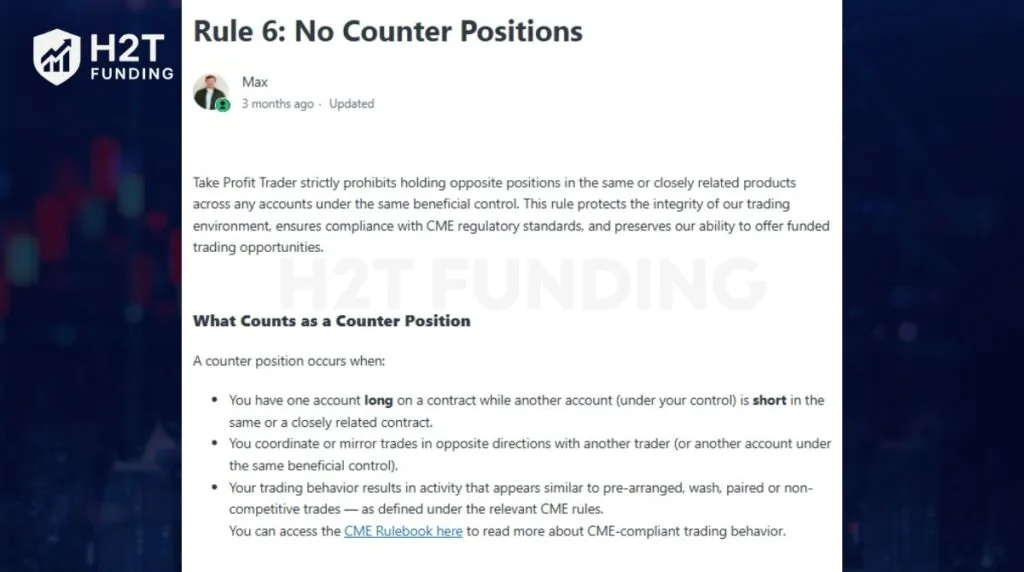
Here is exactly what constitutes a prohibited counter position:
- Direct Conflict: Holding a long position on Account A while taking a short position on Account B in the same asset (e.g., long ES and short ES).
- Correlated Markets: Holding opposite positions in closely related “micro” and “standard” contracts. Examples include ES vs. MES, NQ vs. MNQ, or YM vs. MYM.
- Coordinated Trading: Mirroring trades in opposite directions with another trader or account under the same household/beneficial control.
- Trade Copier Errors: If a third-party trade copier malfunctions and opens opposite trades across your accounts, you are still held 100% responsible for the violation.
Example: If you are managing two evaluation accounts and you open 2 Long ES contracts on Account 1 while holding 1 Short MES contract on Account 2, you’ve broken Rule 6. The system will flag this correlation, instantly liquidate both accounts, and send you a detailed Counter-Positions Report.
You may trade multiple accounts at Take Profit Trader, but all must take the same direction, or stay flat, when trading the same or correlated futures markets.
Read more:
3. Evaluation vs PRO account rules – What changes after you pass?
Once you pass the evaluation, you transition to a PRO account, where the focus shifts from hitting a profit target to active risk management and strict news avoidance.
While many restrictions remain identical, such as the prohibition of counter positions, the drawdown calculation becomes significantly more sensitive, switching from End-Of-Day (EOD) to Intraday Trailing Drawdown.
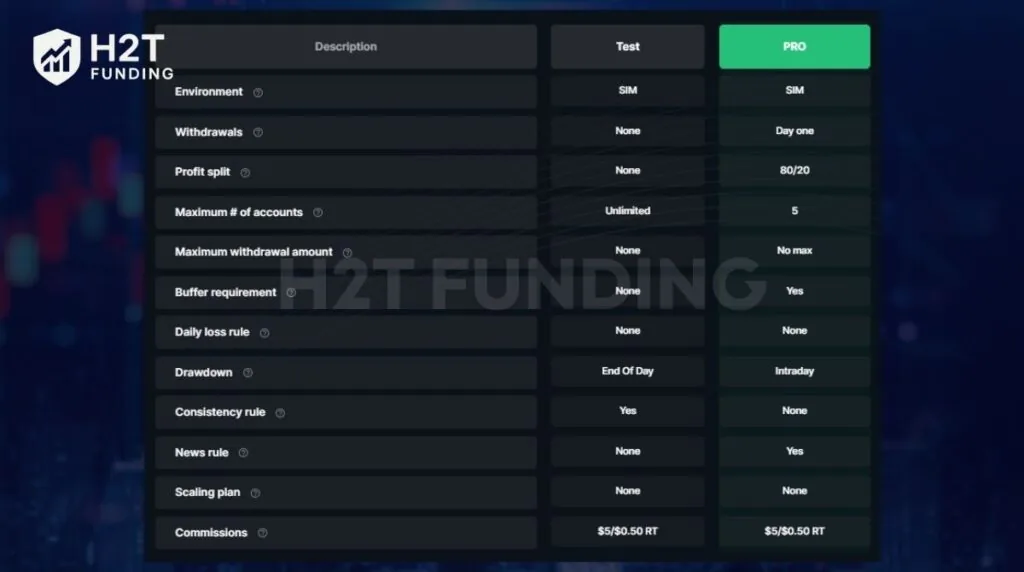
Comparison: Evaluation vs. Take Profit Trader PRO account rules
| Feature | Evaluation Phase | PRO Account |
|---|---|---|
| Drawdown Type | End-Of-Day (EOD) | Intraday (Real-time) |
| Profit Target | Mandatory to pass | None |
| Consistency Rule | Required (50% cap) | None |
| News Events | No specific news rules | Prohibited (Strict restriction) |
| Trading Activity | No requirement | 1 day per week is mandatory |
| Automated Trading | Prohibited | Prohibited (Manual only) |
Key Changes You Must Note
1. From EOD to Intraday Drawdown:
In your evaluation, your drawdown only updated after the market closed. In the PRO account, the Intraday Trailing Drawdown updates in real-time based on your peak unrealized profits.
If a trade moves in your favor, your “minimum balance” floor moves up instantly. If the trade reverses, that floor stays at the new, higher level, making it much easier to hit your liquidation point.
2. The News Restriction:
This is the most common trap for new PRO traders. You must be flat (no open positions or orders) one minute before, during, and one minute after specific prohibited news events, such as NFP, CPI, and FOMC announcements. Failure to exit these positions results in immediate account loss.
3. The Weekly Active Requirement:
To prevent “squatting” on capital, you are required to execute at least one round-trip trade per calendar week. If you expect to be away due to life circumstances, you must contact support for a temporary exception to avoid account deactivation.
4. No More Profit Targets:
Once you move to PRO, the pressure to reach a specific dollar amount vanishes. You are now free to trade at your own pace. However, you must avoid “Limit Up/Down” scenarios; you are responsible for exiting your positions before a market hits its daily price limit, or your account will be liquidated.
Pro-tip for the transition: Focus on your Intraday Drawdown management. Because it captures unrealized gains, avoid letting large “paper profits” remain open too long if you are close to your trailing stop, as any minor retracement could trigger a violation. Always keep a clear view of the economic calendar to avoid trading through restricted news.
4. Common mistakes that make traders fail the evaluation
Most traders fail not because their strategy is wrong, but because they ignore the mechanical boundaries set by the TPT risk system. Mistakes usually stem from trying to “beat the system” rather than trading the market.
Here are the four most frequent traps that cause instant liquidation:
- Ignoring the “Hidden” Trailing Drawdown: Many traders treat the End-Of-Day (EOD) drawdown as a static stop-loss. They keep adding to losing positions, assuming they have “until the end of the day” to recover. In reality, once your equity dips to the minimum balance, the system liquidates you immediately, even before the market closes.
- The “Consistency Trap” (Overtrading for the Target): Traders often hit a lucky streak on Day 1 or 2, then try to “force” the remaining profit. By doing this, they inadvertently breach the 50% consistency rule. If your biggest day exceeds 50% of your P/L, your profit target increases, forcing more trading to catch up and often leading to failure.
- Mismanaging Position Size in Correlated Assets: Traders often forget that ES and MES are “closely related.” They might be flat on ES but hold a heavy position on MES, then panic-buy ES to “hedge.” This violates Rule 6 (No Counter Positions) instantly, as the system detects correlated conflicting exposure across your account.
- Violating the 5:00 PM Eastern Cutoff: Beginners often focus so much on technical analysis that they forget the clock. Failing to be flat before 5:00 PM ET is a non-negotiable violation. If you are stuck in a position because the market for that specific product closed early, the system does not grant “grace periods.”
5. Tips to pass the Take Profit Trader evaluation successfully
Passing the evaluation requires shifting your focus from profit maximization to risk preservation. If you manage the “Minimum Account Balance” correctly, the profit target will naturally take care of itself over time.
Follow these professional strategies to stay compliant and secure your funding:
- Calculate Your “Safe” Entry Size: Before every trade, calculate your position size relative to your EOD drawdown. If your drawdown limit is $1,500, never open a position size where a single stop-loss hit would consume more than 10-15% of that buffer. Treat your “Minimum Account Balance” as your most valuable asset.
- Use the “Micro-Contract” Scaling Method: If you are struggling with consistency, switch to Micro contracts. They allow you to scale into a position more granularly without hitting the maximum contract limit. This keeps your profit distribution “flat” across the 5+ required trading days, effectively neutralizing the 50% consistency cap.
- Implement a Hard News Filter: Do not rely on your memory to avoid prohibited news. Keep the Forex Factory calendar open on a second monitor or set an alarm for 10 minutes before major releases (NFP, CPI, FOMC). Treat “being flat” as a rule of thumb, not an option.
- Maintain a “Trading Journal” for Rule 5: Do not just log your P/L. Track your “Highest Profit Day” vs “Total Net P/L” daily. If your consistency percentage creeps above 40%, stop trading for the day. Use the remaining days to take smaller, low-risk trades to “dilute” that big profit day and keep your consistency metric healthy.
- Prioritize “Time” over “Target”: TPT does not have a time limit. If you hit 80% of your target by Day 3, slow down. Take the smallest possible position size for the next 2 days to satisfy the 5-day minimum requirement without risking a drawdown violation. The fastest way to fail is to rush to finish.
If you shift your mindset from chasing profits to protecting your account, everything changes. Utilize customer support if you are unsure about your performance metrics, and always keep the [daily profit limit] in mind to protect your funded status.
6. FAQs
-
There are 6 core rules: Hit your profit target, respect maximum position size, avoid hitting the EOD trailing drawdown, trade only approved products during authorized hours, maintain consistency, and avoid opening counter positions across accounts.
-
The consistency rule requires you to trade for at least 5 days and ensures that no single day’s profit exceeds 50% of your total net profit. If you exceed this, your profit target automatically increases.
-
The profit target varies by account size as follows: $1,500 for a $25k account, $3,000 for a $50k account, $4,500 for a $75k account, $6,000 for a $100k account, and $9,000 for a $150k account. You must reach these specific net profit thresholds to successfully pass the evaluation phase.
-
An automated system strictly enforces it. If your highest profit day exceeds 50% of your net P/L, you fail the consistency check. You must keep trading until that percentage drops below the 50% threshold.
-
No, there is no maximum time limit. You can take as long as needed to reach your target, provided you meet the 5-day minimum active trading requirement and avoid breaching drawdown limits.
-
No. Automated trading, EAs, or algorithmic bots are strictly prohibited in both the evaluation phase and the PRO account. All trades must be executed manually.
-
If you breach any rule, such as hitting your EOD trailing drawdown or opening counter positions, your account will be immediately liquidated. Depending on the severity, you may need to wait for a reset or re-subscribe to start a new evaluation.
-
Yes, Take Profit Trader utilizes a one-step, simulated evaluation phase. This test is designed to verify that traders possess the necessary risk management skills and discipline before being trusted with a funded PRO account.
-
To pass, focus on risk preservation rather than chasing quick profits. Manage your position size relative to your EOD trailing drawdown, avoid trading during prohibited news, and maintain a steady, consistent performance over at least 5 days.
-
The cost varies by account size, starting from $150/month for the $25,000 account up to $360/month for the $150,000 account. Prices are subject to change based on current promotions or discounts offered by the firm.
7. Conclusion
Mastering the Take Profit Trader evaluation rules is the most critical step toward securing a funded account. Remember that the transition to a PRO account introduces even tighter constraints, like intraday drawdowns and strict news restrictions, so building good habits now is essential for your long-term survival.
If you are ready to refine your approach, we invite you to explore more in-depth analyses and actionable insights in our Prop Firm Guides category at H2T Funding. Learn how to optimize your risk-reward ratio and stay updated on the latest industry standards to maximize your chances of becoming a consistently funded trader.