

The Take Profit Trader consistency rule requires candidates to trade for a minimum of 5 days and ensures no single day exceeds 50% of total net profits. This dual requirement proves you possess actual skill rather than relying on a lucky market spike.
In this guide, H2T Funding breaks down exactly how to calculate your daily limits and avoid common evaluation traps. By mastering these specific Take Profit Trader rules, you will successfully secure your funded status without unnecessary delays.
Key takeaways:
- Take Profit Trader is a US-based futures prop firm that funds traders after they pass a one-step evaluation and offers up to 80–90% profit split.
- The consistency rule requires at least 5 trading days and limits one single day to no more than 50% of the total net profit.
- Breaking the 50% rule does not fail the account, but it increases the profit target and forces traders to continue trading.
- The consistency rule only applies during the evaluation phase and does not affect payouts after becoming funded.
- This rule focuses on risk management by forcing traders to generate stable and repeatable profits instead of relying on one large winning trade.
1. Take Profit Trader consistency rule explained
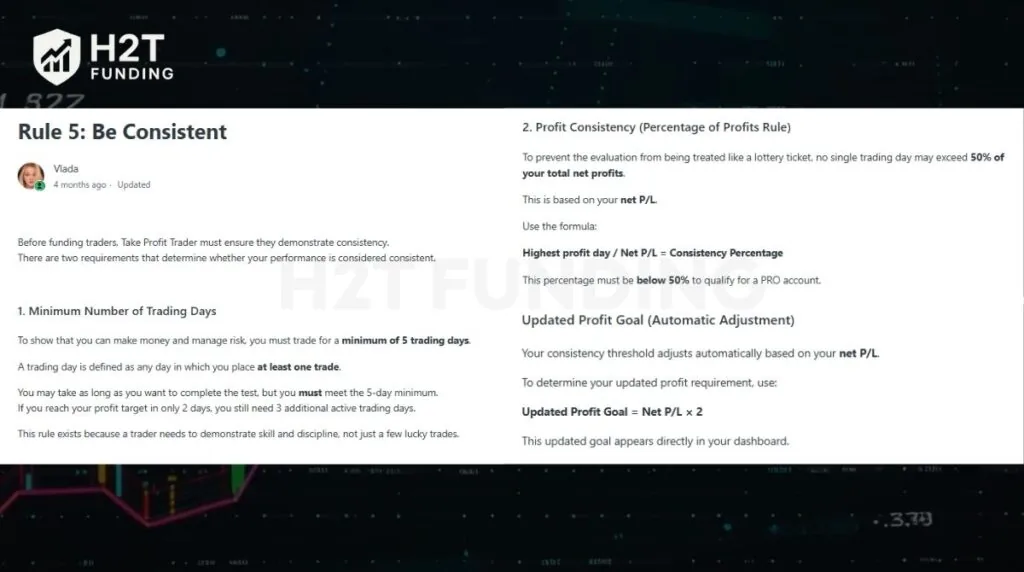
At Take Profit Trader, the consistency rule requires candidates to trade for at least 5 distinct days and ensures no single session generates more than 50% of total net profits. This dual-metric system applies strictly during the evaluation phase to prove your execution relies on actual skill.
1.1. Minimum number of trading days
To successfully pass the test, you must actively participate in the market for a minimum of 5 trading days. A valid day is simply defined as any session where you execute at least one live trade.
Even if you hit your overall profit goal in just two days, you must continue taking managed setups for three additional days. This prevents candidates from treating the evaluation like a lottery ticket and passing on pure luck.
1.2. Profit consistency (The 50% Rule)
The firm strictly mandates that your best performing day must remain below 50% of your total net P/L. This is the core mechanism they use to evaluate your overall Risk Management capabilities.
You can check your current standing by using this exact formula:
Highest profit day / Net P/L = Consistency Percentage
If the resulting figure is 50% or higher, your account will not be eligible to upgrade to a PRO account.
1.3. Automatic target adjustment
Breaking this 50% threshold does not fail your account, but it automatically increases your required profit target. You must continue trading to generate more profits until that massive single-day gain is diluted.
Your dashboard will automatically calculate your updated goal, which effectively becomes more than double your highest earning day. This system forces traders to build a stable Trading Strategy rather than relying on a few massive, unrepeatable wins.
See full Take Profit Trader evaluation rules here: Take Profit Trader Evaluation Rules Explained For 2026
2. Consistency rule illustration
A clear consistency rule illustration demonstrates how two traders can both reach a $3,000 target but face entirely different outcomes based on their profit distribution. The key difference lies in whether one single day dominates their entire performance history.
Below is a realistic example of how this 50% limit determines if you pass the evaluation or need to continue trading.
2.1. Scenario 1: Trader A (Fails the consistency check)
Trader A hits a massive home run on Monday, generating $2,500 from a sudden news event. Over the next four days, they trade defensively, only making $100 per day to hit their 5-day minimum requirement.
Their total net P/L is 2,900, which is close to their target. However, their single highest day (2,500) represents 86% of their total profits, severely violating the 50% threshold.
| Day | Profit/Loss | Percentage of Total |
|---|---|---|
| Monday | +$2,500 | 86% |
| Tuesday | +$100 | 3.4% |
| Wednesday | +$100 | 3.4% |
| Thursday | +$100 | 3.4% |
| Friday | +$100 | 3.4% |
| Total Net P/L | $2,900 | 100% |
Result: Trader A fails to qualify for a PRO account. They must continue trading and generate over $5,000 in total net profits just to dilute Monday’s massive gain below 50%.
2.2. Scenario 2: Trader B (Successfully passes)
Trader B focuses on a steady trading strategy and aims for a daily target of $600. They execute consistent setups throughout the week, avoiding the temptation to chase massive, unrepeatable gains.
Their highest day is $700, and their total net P/L reaches $3,000 after 3 active trading days. Because $700 is only 23% of their total profits, they easily clear the consistency requirement.
| Day | Profit/Loss | Percentage of Total |
|---|---|---|
| Monday | +$600 | 20% |
| Tuesday | +$700 | 23% |
| Wednesday | +$500 | 16% |
| Thursday | +$600 | 20% |
| Friday | +$600 | 20% |
| Total Net P/L | $3,000 | 100% |
Result: Trader B passes the evaluation. Their balanced performance proves they possess reliable emotional control and qualify immediately for live funding.
3. Why does Take Profit apply the consistency rule?
Take Profit applies the consistency rule to prevent gambling mentalities and protect firm capital from unsustainable trading styles. The firm actively filters out candidates who rely on luck during volatile news spikes to ensure their funded traders possess genuine, repeatable skills.
By enforcing these strict limits, the company guarantees that its live capital is only allocated to individuals with disciplined risk management. This framework actively shapes how candidates approach their daily decisions, offering several distinct advantages and a few notable challenges:
- Promotes steady, risk-adjusted returns: It forces you to prioritize proper position sizing over chasing massive, unmanageable wins.
- Curbs impulsive trading behaviors: The rule heavily reduces the temptation to take high-risk, emotional setups that jeopardize your entire account.
- Encourages objective market analysis: Keeping daily profits within predictable ranges helps you rely on sound market analysis rather than reacting out of fear or greed.
- Forces sub-optimal overtrading (Challenge): If you experience one massive winning day, you are mathematically forced to execute additional setups in poor market conditions just to dilute your profit percentage below the 50% threshold.
Ultimately, this requirement serves as the ultimate test of your trading discipline and emotional control. While it may frustrate aggressive traders during major macroeconomic shifts, it ensures the firm’s long-term business model remains profitable and secure against reckless market exposure.
4. How to comply with the Take Profit consistency rule
To successfully comply with the Take Profit consistency rule, you must actively cap your daily gains and maintain strict position sizing.
The most effective strategy to ensure you pass the evaluation involves defining precise, mathematically achievable daily objectives based on your specific account size. You must avoid the temptation to maximize every winning trade and focus entirely on spreading your profits evenly across the mandatory 5-day period.
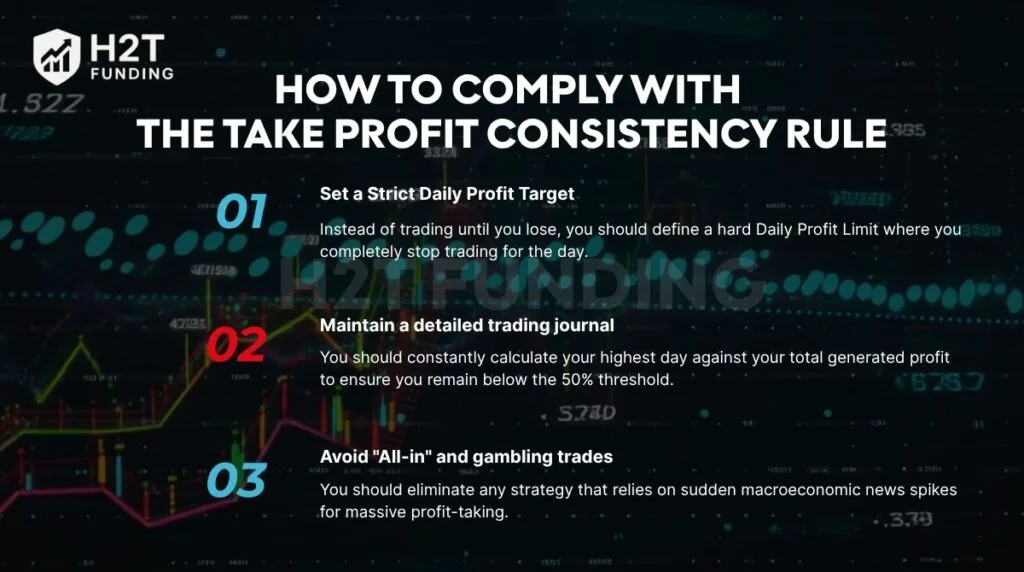
Here are the three most critical steps to safely navigate this requirement:
4.1. Set a Strict Daily Profit Target
Instead of trading until you lose, you should define a hard Daily Profit Limit where you completely stop trading for the day. For example, if you purchase the $50K account with a $3,000 target, aiming for $600 per day over 5 days, it guarantees you pass the 50% threshold comfortably.
If you happen to catch a massive move and hit $1,000 in profits early in the session, close your platform immediately. Earning more than that simply increases your risk of violating the consistency metric and forces you into unnecessary overtrading later in the week.
4.2. Maintain a detailed trading journal
Keeping a detailed log of your daily net P/L allows you to actively monitor your current performance metrics. You must constantly calculate your highest day against your total generated profit to ensure you remain below the 50% threshold.
A robust trading journal also helps you identify patterns in your execution, highlighting when you are prone to emotional decision-making. By tracking your trading habits objectively, you can quickly adjust your risk parameters before a single volatile session ruins your evaluation progress.
4.3. Avoid “All-in” and gambling trades
You must eliminate any strategy that relies on sudden macroeconomic news spikes for massive profit-taking. The firm explicitly prohibits treating the evaluation like a lottery ticket; executing oversized positions during high-impact news events is the fastest way to fail.
Focus on optimizing your risk-adjusted returns by maintaining a strict 1% to 2% risk per trade. Consistent, methodical execution proves to the firm that you possess the necessary emotional discipline to handle their live capital responsibly.
5. Common mistakes that cause rule violations
The most frequent mistake traders make is chasing massive single-day gains during high volatility without realizing that it ruins their consistency percentage. Even skilled candidates fail their Trading Evaluation because they fail to monitor their highest winning day against their total net P/L.
We observe that many individuals treat the $130 fee for a $50K account as an inexpensive lottery ticket. They completely ignore position sizing and attempt to pass the test in a single afternoon, violating the core principle of steady, repeatable performance.
Understanding and avoiding these critical errors is the key to securing your funded status:
- Trading through high-impact news: Holding positions during CPI or NFP releases often results in massive, unrepeatable windfalls that immediately breach the 50% limit.
- Refusing to stop trading when up: Many traders hit a reasonable $600 daily profit but continue pushing their luck, unintentionally skewing their Profit Distribution for the week.
- Revenge trading to recover losses: After a losing streak, candidates often double their lot size to quickly recover, generating an abnormally large winning day that ruins their metrics.
- Ignoring the 5-day minimum requirement: Reaching the Profit Target in two days but executing reckless, tiny 1-tick trades just to count as an active day often leads to accidental rule breaches.
Failing to maintain emotional discipline directly results in having to pay for an account reset or an entirely new evaluation. A systematic approach to daily risk limits is the only reliable way to conquer these trading challenges and prove your long-term viability.
6. Compare the Take Profit consistency rule with other prop firms
When evaluating proprietary trading firms, we consistently see that the Take Profit consistency rule is relatively straightforward: a simple 50% cap during the evaluation phase only. Compared to competitors, it strikes a fair balance between proving skill and allowing traders flexibility once funded.
To help you choose the right platform, we analyzed how Take Profit’s rules stack up against industry giants like Apex, FTMO, and Topstep.
| Feature | Take Profit Trader | Apex Trader Funding | FTMO | Topstep |
|---|---|---|---|---|
| Consistency Percentage | 50% | 30% for legacy (Windfall) or 50% (new account after March 2026) | 50% (Best Day Rule) | 50% (Consistency Target) |
| When is it applied? | Evaluation Phase only | Funded (Payouts) | 1-Step Challenge & Funded | Trading Combine |
| Applies to Payouts? | No | Yes (strict payout condition) | Yes (for 1-Step) | No |
Key differences in trading requirements
- Take Profit vs. Apex Trader Funding: Apex is notably stricter because its consistency rule persists into the funded stage. If a single day’s profit is too high, you cannot withdraw funds. Conversely, Take Profit removes this constraint once you go PRO, offering superior Withdrawal Flexibility.
- Take Profit vs. FTMO: FTMO uses a “Best Day Rule” calculated against Positive Days’ Profit (only winning days). Take Profit is calculated based on Total Net P/L. While FTMO is a global leader, Take Profit provides a faster, specialized 1-step path for futures traders without recurring payout hurdles.
- Take Profit vs. Topstep: Both firms use a 50% consistency rule exclusively during the evaluation. The key distinction is in the withdrawal process. We observe that Take Profit allows for immediate, day-one payouts, whereas Topstep traditionally requires building a larger safety buffer before you can access significant profits.
Ultimately, the best firm for your needs depends on your strategy. If you want a clean break from consistency rules after passing your test, Take Profit offers a more streamlined transition to professional trading. It is more flexible compared to the rigid, ongoing payout conditions found at firms like Apex or FTMO.
7. FAQs
-
It is a risk management policy that ensures no single trading day accounts for more than 50% of your total net profits during the evaluation. It also requires a minimum of 3 active trading days.
-
Yes, this rule applies exclusively during the evaluation phase to ensure that your performance is based on repeatable, disciplined trading rather than a single lucky market event.
-
Yes, the firm requires traders to demonstrate consistent performance by meeting a minimum trading day requirement and adhering to a 50% profit consistency cap during the test phase.
-
Yes, all candidates undergoing the evaluation must comply with the consistency metric to prove they are skilled traders capable of managing risk effectively.
-
Since the consistency rule only applies to the evaluation phase, it does not directly impact your PRO account payouts. Once you pass and are funded, this restriction is lifted, allowing for total payout freedom.
-
You can track your status in your trader dashboard. Once your highest profit day is less than 50% of your total net P/L and you have completed at least 3 active trading days, you have satisfied the requirement.
-
No, it is significantly less restrictive. Take Profit Trader only enforces this rule during the evaluation, whereas Apex applies similar consistency requirements even to your funded account, which can block your ability to request payouts.
-
This metric limits your most profitable trading day to half of your total net profits. It forces you to spread your gains evenly over several days to demonstrate that your trading strategy is not dominated by “all-in” bets.
-
The 20% consistency rule is a strict risk management requirement used by some proprietary trading firms. It dictates that no single trading day’s profit can exceed 20% of the total profit target.
-
The 15% consistency rule is an even more stringent performance metric where a trader’s most profitable day must not account for more than 15% of the total profit goal.
-
You will not fail your account immediately. Instead, your required profit target will automatically increase, forcing you to trade longer to dilute your highest winning day until you fall below the 50% limit.
-
No, Take Profit Trader strictly prohibits the use of automated trading bots to pass the evaluation. The firm aims to verify the genuine analytical skills and emotional discipline of human traders.
8. Conclusion
The Take Profit Trader consistency rule is not a barrier to your success, but rather a vital component of professional risk management. The firm requires a minimum of 5 trading days and ensures that no single day dominates your profit. This helps you build the discipline needed for long-term survival in the futures market.
Remember, consistency is a skill that separates successful traders from those chasing short-term windfalls. If you treat your evaluation with a methodical approach, setting daily targets and avoiding impulsive trades, you will find the 50% threshold easy to navigate.
We encourage you to continue refining your edge and staying updated on the latest industry standards. For more in-depth insights into mastering your craft, explore the extensive range of articles in our Prop Firm Guides category at the H2T Funding blog. These resources can help accelerate your journey toward becoming a funded professional.