

A pip, short for percentage in point, is the smallest standard unit of measurement used to express value movement between two currencies in the financial market. Understanding what pips in forex are is simple: it’s the tiny price movement, usually the fourth decimal place (0.0001), that traders use to calculate profit, loss, and trading costs.
Mastering this concept is the first critical step for any serious trader. For those aiming to pass a challenge with a prop firm like H2T Funding, precise pip calculation is the foundation of the risk management strategies we teach.
This guide will show you exactly how to use pips to your advantage. Start mastering the basics and explore funded trading opportunities with us.
Key takeaways:
- A pip, short for “percentage in point,” is the smallest standard unit of price movement in the forex market. It’s the fundamental metric for all calculations.
- For most currency pairs like EUR/USD, one pip is a move of 0.0001 in the fourth decimal place.
- For any pair involving the Japanese Yen (e.g., USD/JPY), a pip is a move of 0.01, representing the second decimal place.
- Pips are used to measure everything that matters: profit, loss, and the spread (the cost of a trade).
- The actual cash value of a pip depends on your trade size, also known as lot size in forex, and the currency pair. For a standard lot on EUR/USD, one pip is typically worth about $10.
1. What are pips in forex?
A pip, which stands for percentage in point, is the smallest standard unit for measuring a price change in the forex market. It’s the universal way traders measure how much a currency pair’s value has moved.
For example, if the EUR/USD price moves from 1.1050 to 1.1051, that 0.0001 increase is exactly one pip.
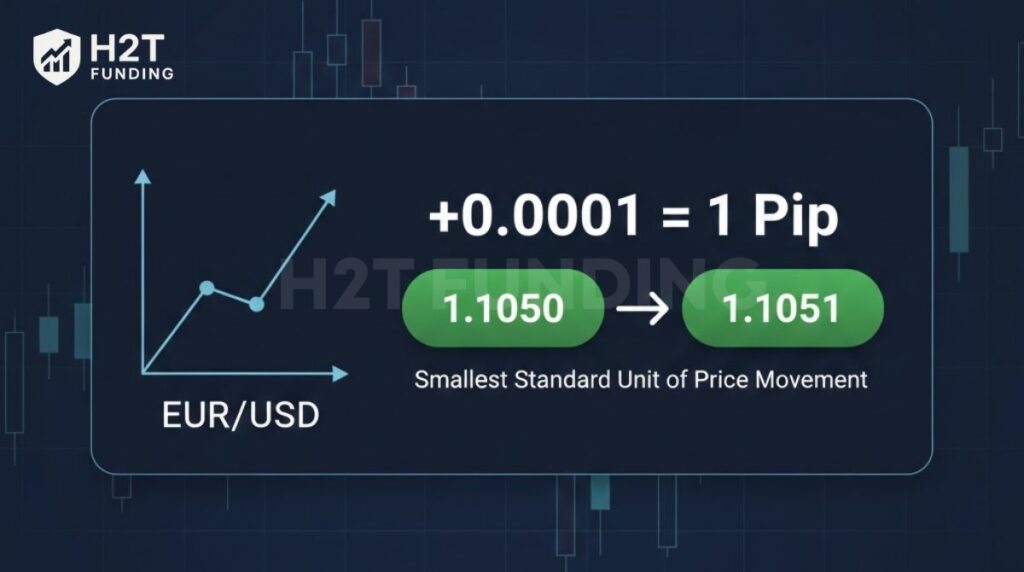
As a general rule, a pip is the last decimal place in a price quote. For most currency pairs, this is the fourth decimal place (0.0001). The main exception is any pair involving the Japanese Yen (JPY), where a pip is the second decimal place (0.01).
This simple measurement is how traders calculate all their outcomes. The distance between your entry and exit points is counted in pips, which directly translates into a monetary profit or loss. Understanding this is absolutely essential for managing risk, as you cannot set a proper stop-loss or choose a safe trade size without first knowing what a single pip is worth in cash.
2. How do pips work in forex trading?
Pips work by translating movements in decimal places into a measurable trading outcome. Every pip movement in your favor contributes to a profit, while every pip that moves against your position results in a loss. The size of this movement determines the final financial result of your trade.
2.1. How a pip works in currencies
Under standard market convention in the forex market, most currency pairs are quoted to four decimal places, and a single pip is a change in the last digit. However, there are exceptions.

A notable one is the Japanese yen (JPY), where pairs are quoted to only two decimal places. In this case, a pip is defined by the second digit in the decimal places of the price quote.
- Standard Pair Example (EUR/USD): If the market price shifts from 1.1600 to 1.1605, this represents a 5-pip increase. This is a simple historical example of how pips translate price movement into real trading profit in forex. Conversely, a drop to 1.1550 would result in a 50-pip loss.
- JPY Pair Example (USD/JPY): With a pair like USD/JPY, a shift from 154.01 to 154.02 represents a single-pip movement. If you opened a long position and the rate climbed to 154.51, your trade would have earned a profit of 50 pips.
2.2. How pips work in other asset classes
While the term ‘pip’ is specific to forex, the concept of a minimum price movement unit exists across all financial markets. However, other markets use their own terminology, such as points or ticks. Understanding this distinction is crucial.
Here is a simple breakdown for different asset classes:
| Asset Class | Instrument Example | Pip Placement (Decimal Place) |
|---|---|---|
| Currency | US Dollar pairs | 4th |
| Currency | Euro pairs | 4th |
| Currency | Japanese Yen pairs | 2nd |
Ultimately, knowing how to count pips is the first step. Whether it’s the fourth or second decimal place, this skill allows you to measure market movement accurately. The next crucial step is to translate these pips into an actual monetary value.
2.3. What is a pip in gold (XAU/USD), indices, and crypto?
It’s important to know that the definition of a “pip” can change when you trade assets other than forex. It is not a universal standard across all markets.
- Gold (XAU/USD): Gold is typically quoted to two decimal places. In this case, one pip usually represents a $0.01 price move. Therefore, a full dollar movement in the price of gold (e.g., from $2000.00 to $2001.00) is equal to a 100-pip move.
- Indices (e.g., US30, SPX500): For stock indices, a “pip” is often defined as a full point move (1.0). For example, if the US30 index moves from 35,000 to 35,001, that is considered one pip. However, the monetary value of that point varies significantly depending on the specific index and the broker.
- Crypto (e.g., BTC/USD): There is no universal definition for a pip in the crypto market. Due to the high volatility of assets like Bitcoin, many traders find it more practical to measure price movements in absolute dollar terms (e.g., “Bitcoin moved $500”) rather than in pips.
Crucially, these definitions can vary between brokers. Always check the ‘Instrument Specifications’ on your trading platform for the exact details of the asset you are trading.
3. How to calculate pips in forex trading
The monetary worth of a single pip isn’t fixed; it changes based on three key factors: the currency pair you’re trading, your lot size (trade volume), and the pair’s current exchange rate. Understanding how to translate pips into a cash value is fundamental to managing your trades.
3.1. When USD is the quote currency
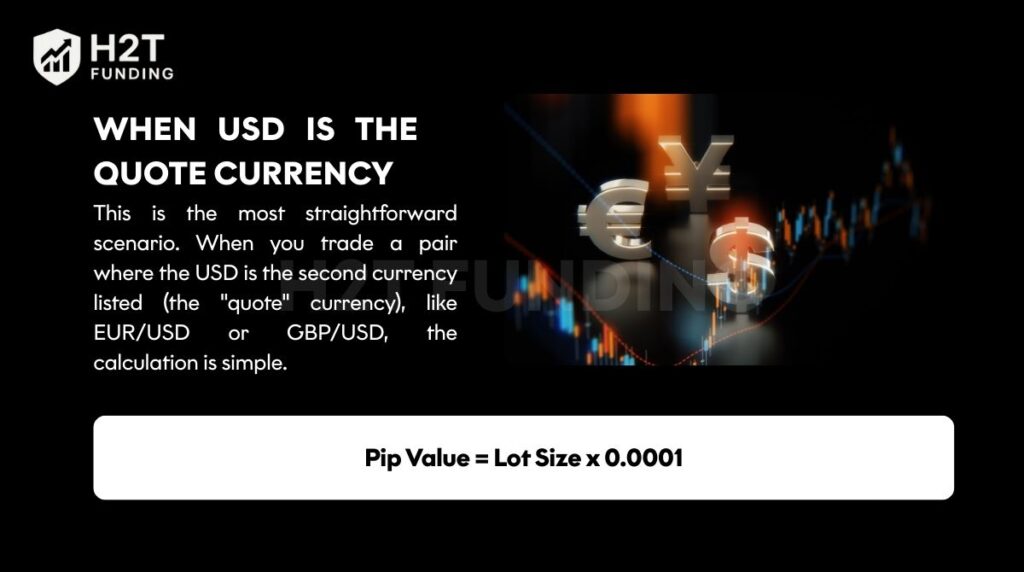
This is the most straightforward scenario. When you trade a pair where the USD is the second currency listed (the “quote” currency), like EUR/USD or GBP/USD, the calculation is simple.
The formula is: Pip Value = Lot Size x 0.0001
For example, if you trade a standard lot (100,000 units) of EUR/USD, the value of one pip is $10.
100,000 (units) x 0.0001 = $10.00 per pip
Here is how the pip value breaks down by common lot sizes for these pairs:
| Lot Type | Units | Calculation | Pip Value (Approx.) |
|---|---|---|---|
| Standard Lot | 100,000 | 100,000 x 0.0001 | $10.00 |
| Mini Lot | 10,000 | 10,000 x 0.0001 | $1.00 |
| Micro Lot | 1,000 | 1,000 x 0.0001 | $0.10 |
3.2. How to calculate pip value for JPY pairs
Remember, for any pair involving the Japanese Yen (JPY), a pip is the second decimal place (0.01). The calculation is slightly different because the pip’s value is first found in JPY and then converted to USD.
The formula is: Pip Value = (0.01 / Exchange Rate) x Lot Size
For example, let’s say you trade a standard lot of USD/JPY when the rate is 110.97. One pip is worth 1,000 JPY (0.01 x 100,000). To find the USD value: 1,000 JPY / 110.97 = $9.01 per pip
3.3. Calculating pip value when usd is the base currency
When USD is the base currency, as in USD/CAD or USD/CHF, the pip value is first calculated in the quote currency and then converted back to USD.
The formula is the same as with JPY pairs, but using 0.0001 for the pip size:
Pip Value = (0.0001 / Exchange Rate) x Lot Size
For instance, if you trade a standard lot of USD/CAD at an exchange rate of 1.2829:
(0.0001 / 1.2829) x 100,000 units = $7.79 per pip
While the formulas might seem complex at first, the logic is consistent. Thankfully, most modern trading platforms perform this calculation for you automatically. However, understanding how it’s done is vital for effective risk management and truly grasping your trade’s potential profit or loss.
Read more:
4. How to read pips on forex price quotes
Reading pips directly from a price quote is a straightforward skill. The key is knowing which decimal place to look at, as this can change depending on the currency pair.
4.1. Standard currency pairs
For the vast majority of currency pairs, the pip is the fourth digit after the decimal point. This rule applies to all major pairs that do not involve the Japanese Yen, such as EUR/USD, GBP/USD, and AUD/USD.
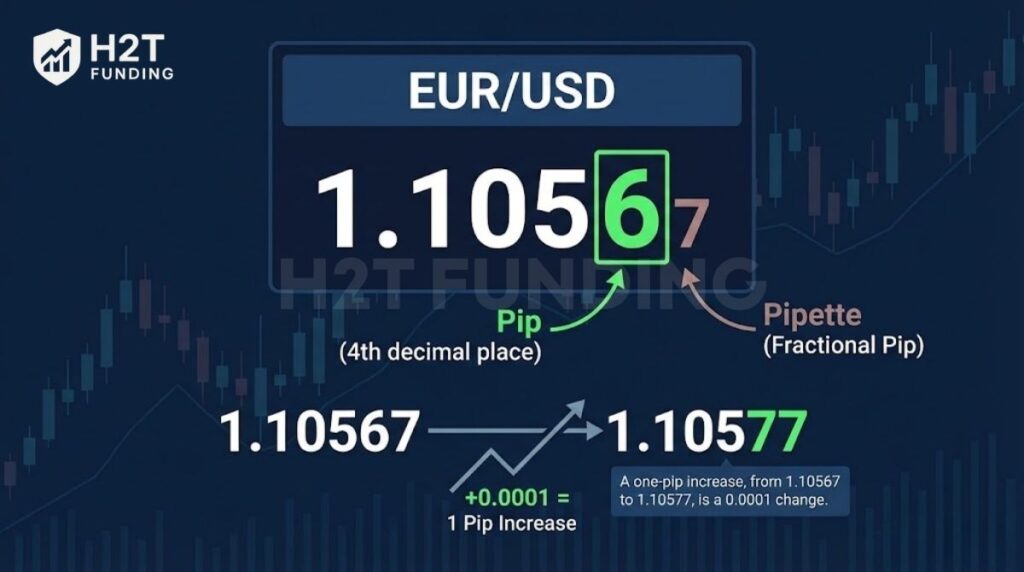
EUR/USD Example: If the price quote is 1.10567, the number 6 represents the pip. The final digit, 7, represents fractional pips (also called a pipette), which is one-tenth of a standard pip. If the price moves from 1.10567 to 1.10577, that is a one-pip increase.
4.2. The Japanese Yen (JPY) exception
Any currency pair that includes the Japanese Yen is an exception to the rule. For these pairs, the pip is the second digit after the decimal point.
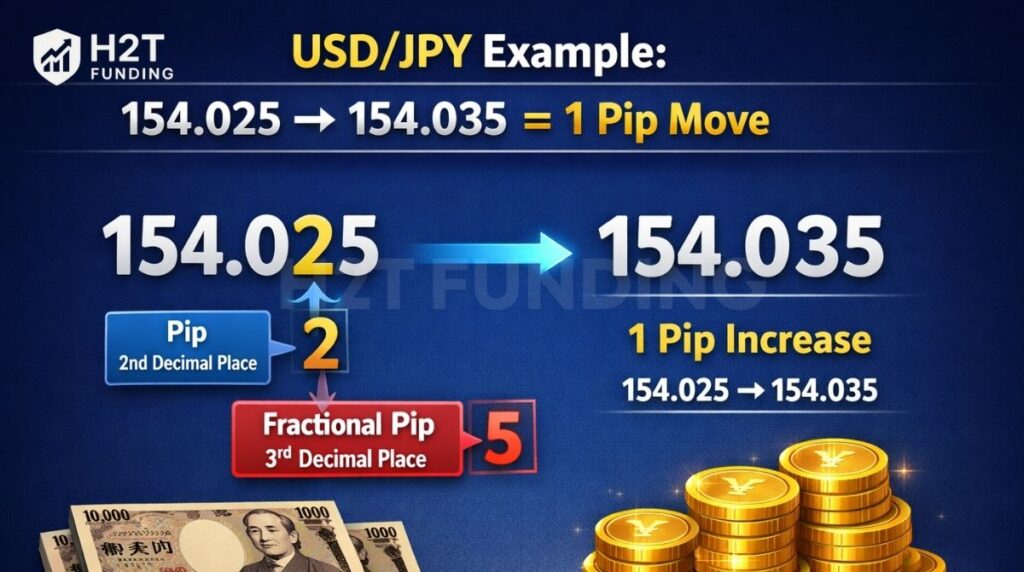
USD/JPY Example: If the USD/JPY quote is 154.025, the number 2 represents the pip. The final digit, 5, represents a fractional pip. A move from 154.025 to 154.035 equals one pip.
Reading pips correctly is the first step in tracking your trades. Once you can instantly identify the pip digit on your trading platform, you can monitor your open positions with much greater accuracy and confidence.
5. Pip vs pipette: What’s the difference?
The main difference between a pip and a pipette comes down to precision. A pipette is simply a fraction of a pip, specifically, one-tenth (1/10) of its volume, and is often called a “fractional pip.” This smaller unit provides a more granular measurement of price changes, which allows brokers to offer tighter spreads and more exact pricing.
In forex trading, pip refers to the fourth decimal place (0.0001), while pipette represents the fifth decimal place (0.00001), adding extra precision to price quotes. This smaller unit is commonly called a fractional pip. For example, in a quote of 1.10567, 6 represents the pip, and 7 represents the pipette.
Brokers introduced pipettes to offer more competitive pricing. By quoting in smaller fractions, they can provide a tighter bid-ask spread, which is the direct cost of your trade. This level of precision is especially valuable for scalpers, who enter and exit trades quickly to capture very small profits. While full pips matter most, understanding pipettes helps you see the true cost of entering a trade more clearly.
6. Pip vs Point vs Tick: What’s the difference?
While pips, points, and ticks all measure price movement, they are not interchangeable and apply to different financial markets. Understanding the distinction is key to discussing market behavior accurately.
Here is a simple breakdown of the key differences:
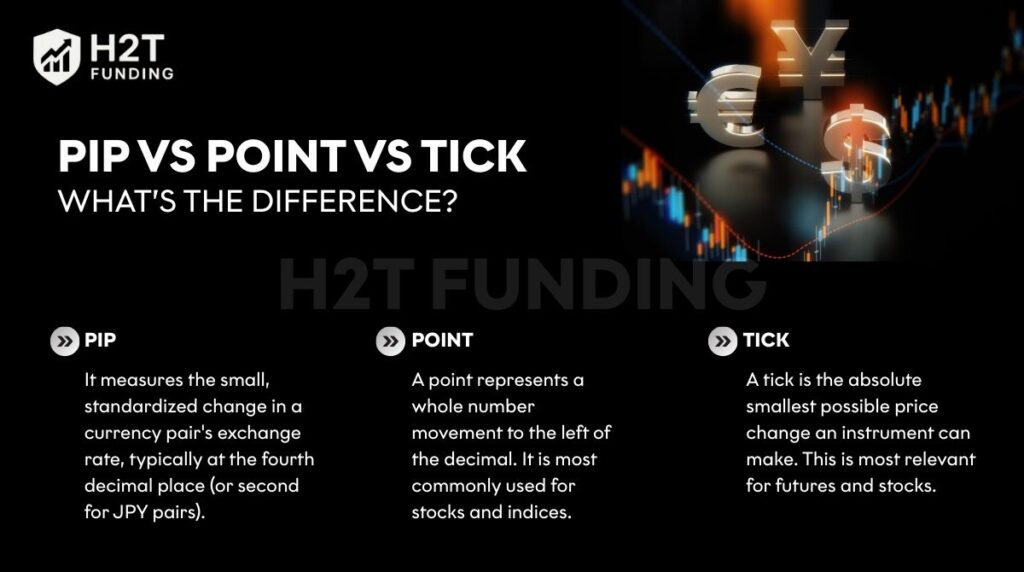
- Pip (Percentage in Points): This is the standard unit for the forex market. It measures the small, standardized change in a currency pair’s exchange rate, typically at the fourth decimal place (or second for JPY pairs).
- Point: A point represents a whole number movement to the left of the decimal. It is most commonly used for stocks and indices. For example, if a stock price moves from $150 to $151, it has moved one point.
- Tick: A tick is the absolute smallest possible price change an instrument can make. This is most relevant for futures and stocks. Unlike a standardized pip, the tick size is specific to each instrument (e.g., a stock’s tick is often $0.01, while a futures contract’s tick might be 0.25).
For a clearer view, here is a direct comparison:
| Feature | Pip | Point | Tick |
|---|---|---|---|
| Primary Market | Forex | Stocks & Indices | Futures & Stocks |
| What it Measures | A small, standardized currency fluctuation | A large, whole-unit price change | The minimum possible price fluctuation |
In short, you use pips to discuss forex, points for large shifts in stocks or indices, and ticks when referring to the smallest possible increment of change. Knowing the correct term for the correct market is a hallmark of an informed trader.
7. How pips are used in real trading
Beyond simple measurement, pips act as a practical tool traders use to define and manage every aspect of a trade, especially under strict prop firm rules. They are essential for turning a trading plan into a live market order. Clear pips in a forex strategy form the foundation of the best trading strategy for beginners.
7.1. Setting stop-loss and take-profit orders
The most fundamental use of pips is setting your exit points. A stop-loss is an order that automatically closes your trade at a predetermined price to limit your potential loss. A take-profit order does the opposite, closing your trade to secure a profit. Both of these levels are defined by a specific number of pips away from your entry price.
7.2. Calculating your risk-to-reward ratio
Pips allow you to easily calculate the risk-to-reward ratio before you even enter a trade. For instance, if you set your stop-loss 20 pips away and your take-profit 60 pips away, you have a 1:3 risk-to-reward ratio. This simple calculation helps you decide if a trade is worth the potential risk.
7.3. Evaluating trading performance
Finally, Pips provide a standardized way to evaluate trading performance over time, similar to how financial professionals use basis points to measure small changes in interest rates. Monetary gains can be misleading due to different lot sizes.
Instead, tracking average pips gained versus pips lost gives a clearer view of trading performance. This gives you a much clearer picture of your trading consistency and effectiveness.
8. Common mistakes beginners make with pips
Understanding the concept of pips is one thing, but applying it correctly is another. Many beginners stumble by making a few common errors that can significantly impact their trading results. Being aware of how to calculate pips in forex for beginners is the first step to avoiding these pitfalls.
Here are the three most frequent mistakes:
- Confusing Pips with Pipettes: Beginners often misread the price quote, mistaking the smaller fractional pip (pipette) for a full pip. This can lead to miscalculating the true distance to their stop-loss or take-profit, causing them to exit trades either too early or too late.
- Failing to Translate Pips into Monetary Risk: A pip is just a number until it’s converted into a cash value. A critical error is failing to complete this calculation. Without knowing what a 20-pip loss means in monetary terms, you cannot manage position size or control drawdown in trading effectively.
- Chasing a High Pip Count: Many new traders become obsessed with “catching” a large number of pips, such as 100 pips in forex, believing it’s the only measure of success. In reality, a profitable strategy is about risk control, not just pip count. A trader who makes a consistent 10 pips with proper risk management is often more successful than one who chases big moves with poor discipline.
Avoiding these simple mistakes is a major step forward in a trader’s development. By focusing on accurate calculation and disciplined risk management, you can build a sustainable and professional trading habit from the very beginning.
9. FAQs
The value of 1 pip depends entirely on the currency pair you are trading and your chosen lot size. For a standard lot (100,000 units) of a pair like EUR/USD, one pip is typically worth about $10.
Using the standard EUR/USD example, what is 10 pips in forex would be worth approximately $100 on a standard lot. If you were trading a mini lot (10,000 units), the same 10-pip move would be worth about $10.
For a standard lot of EUR/USD, 20 pips would equate to roughly $200. This value can and will change for other currency pairs based on their current exchange rate and your trade size.
Assuming a pip value of $10 (as with a standard lot of EUR/USD), a 50-pip move would be worth approximately $500.
You calculate total profit by multiplying pips gained by the specific monetary value of one pip. The simple formula is: Profit = Pips Gained x Pip Value.
Yes, absolutely. The only difference is that for any pair involving the Japanese Yen (JPY), a pip is measured at the second decimal place (0.01), not the fourth.
The spread is the difference between the bid (sell) price and the ask (buy) price of a currency pair. It is measured in pips and represents the primary cost of opening a trade.
The main risk comes from leverage, which can magnify both your profits and your losses significantly. Because of this, strict risk management based on pip calculations is absolutely essential to protect your capital.
There is no guaranteed or safe way to quickly multiply your money. Long-term success in forex comes from consistent risk management, a disciplined strategy, and a deep understanding of pips, not from chasing high-risk trades. This is especially true when trading with a prop firm, where consistency is valued above all else.
100 pips is a major price move. EUR/USD: 0.0100 (e.g., 1.1600 → 1.1700) JPY pairs: 1.00 Standard lot: ~$1,000 | Mini lot: ~$100 For Gold (XAU/USD), price movement is typically measured in points or ticks, not pips. The monetary value of each point depends entirely on your broker’s contract specifications. For example, a $1 price move might equal 100 points. You should always check the instrument’s details on your trading platform.
Pips are mainly used in forex, not stocks. Stocks usually measure price movement units in cents or ticks, not pips.
Pips measure price movement. Lots define trade size and pip value. Example (EUR/USD): Standard lot: $10 per pip Mini lot: $1 per pip Micro lot: $0.10 per pip
10. Conclusion
Mastering what pips in forex is more than just learning a definition; it’s about understanding the very language of the market. These small units are the fundamental building blocks for every critical action you take as a trader. They are the essential tool for measuring your trades, calculating your costs, and, most importantly, managing your risk effectively.
At H2T Funding, we believe that a deep understanding of these fundamentals is what separates successful traders from the rest. To learn how to apply this knowledge effectively, explore our Prop Firm & Trading Strategies section. There, you’ll find in-depth guides on building a robust trading plan, managing risk like a professional, and passing your funded account challenge.