

Most traders who pass the Take Profit Trader (TPT) evaluation focus entirely on the profit target. Few read the PRO account contract before they sign it. That gap, between what the evaluation tests and what the PRO account demands, is where funded accounts break down fastest.
This guide, H2T Funding, covers every rule in the Take Profit Trader PRO account rules: exact numbers, real trade scenarios, and the critical mechanics that catch traders off guard on day one.
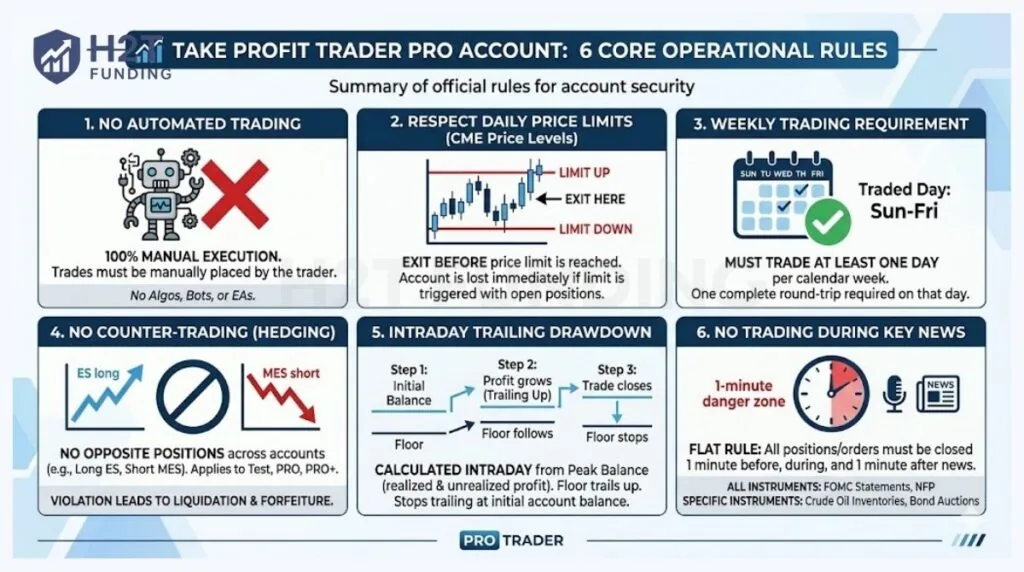
Key Take Profit Trader PRO account rules
- Manual trading only: All trades must be executed by the trader, with no bots, EAs, or automation tools allowed.
- Exit positions before CME price limits: Holding trades during limit-up or limit-down events leads to immediate account liquidation.
- Trade at least once per week: A minimum of one round-trip trade is required between Sunday and Friday to keep the account active.
- No hedging or counter positions: Opposite trades on correlated instruments or across multiple accounts are strictly prohibited and result in full account loss.
- Intraday trailing drawdown applies in real time: The drawdown is calculated based on peak equity, including unrealized profit, and once it moves up, it never moves down.
- Stay fully flat during restricted news events: All positions and pending orders must be closed one minute before, during, and after major releases like FOMC and NFP.
- Buffer zone must be cleared before withdrawals: The account balance must exceed the starting balance plus maximum drawdown to unlock payouts.
1. What is the Take Profit Trader PRO account?
The Take Profit Trader PRO account is a simulated funded account. It is the second of three stages in TPT’s one-step evaluation model, where traders execute real strategies and withdraw real profits from day one.
TPT is a US-based futures prop firm founded in 2021, offering access to CME, CBOT, NYMEX, and COMEX futures. Its model runs on a single evaluation: pass once, get funded. No two-step challenge, no waiting periods.
| Stage | Trading Environment | Drawdown Type | Profit Split | Key Objective |
|---|---|---|---|---|
| Test (Evaluation) | Simulated | EOD trailing | None | Reach a 6% profit target |
| PRO Account | Simulated | Intraday trailing | 80% | Start withdrawing profits from day one |
| PRO+ Account | Live-funded environment | EOD trailing | 90% | Qualify for TPT |
Key data point: According to publicly shared industry estimates, only 16.86% of traders passed the TPT evaluation in 2024, down from 20.37% in 2023. Preparation, especially understanding the PRO-stage rule changes, is the primary differentiator between funded and failed accounts.
2. Core rules of the Take Profit Trader PRO account
The Take Profit Trader PRO account operates under a distinct set of rules from the evaluation stage. These rules are formalized in the PRO contract TPT sends upon account activation.
Most major rule violations are enforced strictly, often without prior warning. Below are all the rules drawn directly from TPT’s official PRO Account Rules page.
2.1. Rule 1: No Trading Bots or Automated Systems
Take Profit Trader does not allow any automated or bot trading of any kind. Every trade must be manually executed by the trader. This restriction covers all algorithmic systems, expert advisors (EAs), high-frequency bots, and any tool that initiates or manages positions without direct human action.
2.2. Rule 2: CME Price Limits (Limit Up / Limit Down)
Futures markets operate with daily price limits, known as circuit breakers, that cap how far a contract can move in a single session. When a market approaches its limit, TPT must hedge against traders who hold positions near those levels.
You must exit all open positions before a price limit is reached. If a price limit is triggered while you have an open position, you lose your PRO account immediately. There are no exceptions to this rule.
2.3. Rule 3: Weekly Activity Requirement
To keep your PRO account active, you must trade at least one day per calendar week, from Sunday through Friday. A ‘traded day’ is defined as any day where at least one complete round-trip has been executed on any permitted instrument.
2.4. Rule 4: No Counter Positions (No Hedging)
You cannot hold open positions in opposite directions within the same product or closely related products. This prohibition extends across all accounts you own or control, not just within a single account. TPT uses enhanced compliance-monitoring technology to detect counter-trading patterns in near real time.
Correlated contract pairs where counter positions are prohibited include, but are not limited to:
| Standard Contract | Correlated Micro Contract |
|---|---|
| ES (S&P 500 futures) | MES (Micro S&P 500) |
| NQ (Nasdaq-100 futures) | MNQ (Micro Nasdaq-100) |
| YM (Dow Jones futures) | MYM (Micro Dow Jones) |
| RTY (Russell 2000 futures) | M2K (Micro Russell 2000) |
Consequence
When counter positions are detected, both accounts involved are automatically liquidated, and all profit in those accounts is forfeited. Repeated or severe violations can result in permanent removal from the platform.
Patterns resembling wash, paired, or non-competitive trades as defined under CME Rules 432, 531, 533, 534, and 539 are treated as violations of this rule.
2.5. Rule 5: Intraday Trailing Drawdown
The trailing drawdown in a PRO account is calculated intraday using your peak balance, which includes both realized gains and unrealized (open) profit. This is the most significant operational difference between the evaluation stage and the PRO account.
The drawdown continues to trail upward as profits grow. Once it reaches your original starting account balance, it stops moving permanently.
Official Example from TPT Help Center – $25,000 PRO Account (Drawdown: $1,500)
| Account Event | Account Balance | Unrealized P&L | Minimum Account Balance | Drawdown Room |
|---|---|---|---|---|
| Account opens | $25,000 | $0 | $23,500 | $1,500 |
| Unrealized profit reaches +$1,000 | $25,000 | +$1,000 | $24,500 (trails up) | $500 |
| Close trade with +$500 realized gain | $25,500 | $0 | $24,500 (stays) | $1,000 |
Note: Balance improved. Position closed. Floor does NOT drop back. Less room than at the start.
2.6. Rule 6: Prohibited News Events
All PRO accounts must be fully flat, no open positions and no open orders, during the one-minute window before, during, and one minute after each prohibited news event.
The following events are prohibited across all instruments:
| News Event | Schedule (ET) | Applies To |
|---|---|---|
| FOMC Statements / Announcements | Wednesdays at 2:00 PM ET | All instruments |
| Non-Farm Payroll (NFP) | Monthly first Friday at 8:30 AM ET | All instruments |
The following events are prohibited for specific instruments only:
| News Event | Prohibited Instrument |
|---|---|
| Crude Oil Inventories | Crude Oil futures (CL, QM) |
| Bond Auctions | 10-Year Note (ZN) and 30-Year Bond (ZB) |
Note: FED speakers and FOMC meeting minutes are explicitly permitted. Only the official FOMC statement announcement triggers the restriction.
3. Payout policy in Take Profit Trader PRO account
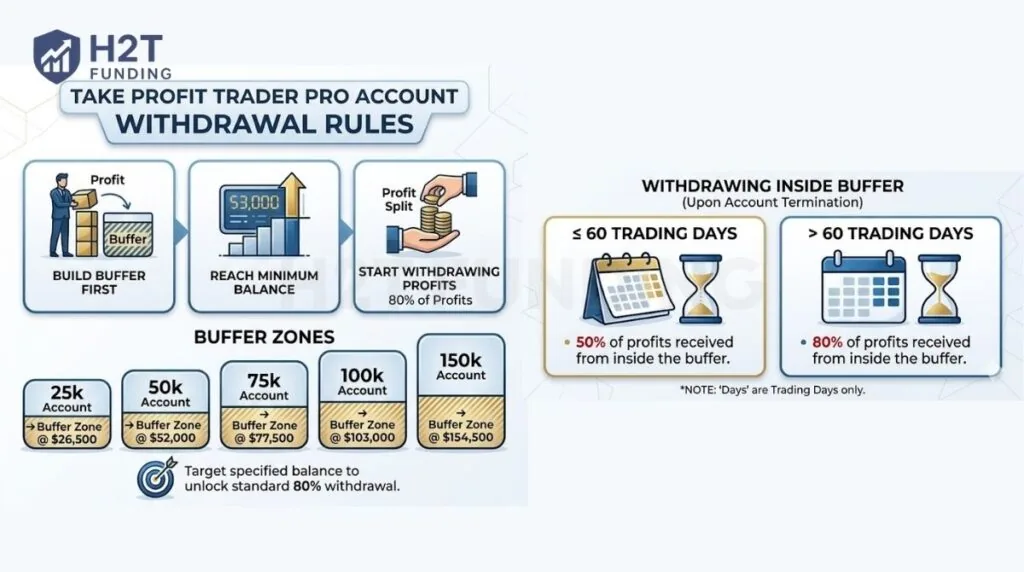
The Take Profit Trader PRO account operates on an 80/20 profit split and allows withdrawals from day one of funding. However, two conditions control when and how much you can withdraw: the buffer zone requirement and the 60-trading-day threshold. Understanding both is essential to maximizing take-home earnings.
3.1. The Buffer Zone: What It Is and How It Works
The buffer zone is the minimum profit threshold you must exceed before you can withdraw funds from a PRO account. It is equal to your account’s maximum drawdown and acts as a safety cushion to protect the firm’s capital.
Formula: Buffer Zone = Maximum Drawdown Amount for your account size.
Withdrawal eligibility: Account Balance must exceed Starting Balance + Buffer Zone amount.
Buffer Zone by account size
| Account Size | Max Drawdown (= Buffer Zone) | Balance Required to Withdraw | Profit Split Unlocked |
|---|---|---|---|
| $25,000 | $1,500 | $26,500 | 80% |
| $50,000 | $2,000 | $52,000 | 80% |
| $75,000 | $2,500 | $77,500 | 80% |
| $100,000 | $3,000 | $103,000 | 80% |
| $150,000 | $4,500 | $154,500 | 80% |
Once the buffer zone is cleared, there is no maximum withdrawal amount and no waiting period between withdrawals. You can withdraw any amount, any day.
Withdrawing inside the Buffer Zone: Profits earned while inside the buffer zone are not accessible during active trading. They are held until the account is closed or terminated. At that point, they are paid according to the profit split applicable at account closure, determined by the 60-trading-day rule described below.
3.2. The 60-Trading-Day Rule
The 60-trading-day threshold governs the profit split applied to profits withdrawn inside the buffer zone (i.e., at account termination). It does not affect your split on profits above the buffer; those always pay at 80%.
| Account Age at Termination | Profit Split on Buffer-Zone Profits | Key Detail |
|---|---|---|
| Less than 60 trading days | 50% | Only 50 cents per dollar on buffer profits |
| 60 trading days or more | 80% | Full standard rate applies to buffer profits |
Practical Implication
A trader who terminates a $50,000 PRO account before 60 trading days with $1,800 in buffer-zone profits receives $900 (50%). The same trader at day 61 receives $1,440 (80%). The 16-day difference costs $540 per $1,800 in buffer profits. Profits above the buffer zone are unaffected by this rule; they always pay at 80% regardless of account age.
3.3. Withdrawal Process and Fees
Withdrawals are processed through the TPT Control Center. The platform calculates available cash automatically, with no withdrawal windows, no minimum profitable days, and no scaling requirements. Even if a PRO account is lost due to a rule violation, TPT allows account resets instead of requiring a new evaluation.
| Step | Action | Timeframe |
|---|---|---|
| 1 | Request withdrawal in the Control Center | Any day of the month |
| 2 | Funds are deducted from the trading account and moved to TPT Wallet | ~24 hours |
| 3 | Withdraw from TPT Wallet to an external payment method | Same day, once in the wallet |
Withdrawal Fees
| Withdrawal Amount | Fee Charged | Recommendation |
|---|---|---|
| $250 or less | $50 fee | Consolidate into a single withdrawal above $250 to avoid the fee |
| Above $250 | No fee | Standard withdrawal, no charges from TPT |
Note: Third-party payment providers such as PayPal may charge their own processing fees on top of TPT’s fee structure. These are not controlled by TPT.
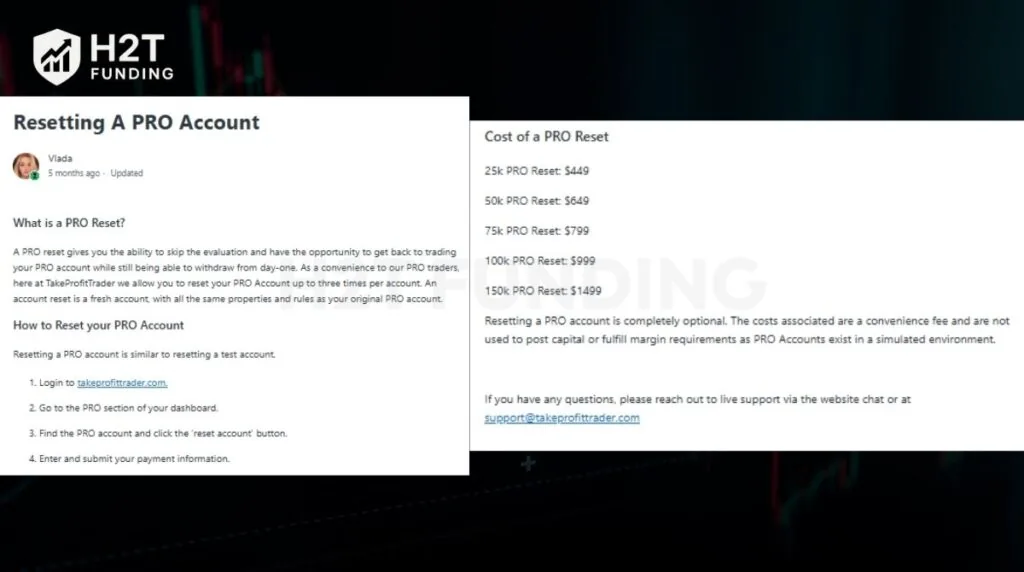
If a PRO account is lost due to a rule violation, TPT allows up to three resets per account, each for a convenience fee. A reset creates a new account with identical rules and maintains key benefits, including withdrawal eligibility from day one. However, traders must rebuild performance and clear the buffer zone again before accessing payouts.
Cost of a PRO Reset
| Account Size | Reset Fee |
|---|---|
| $25,000 | $449 |
| $50,000 | $649 |
| $75,000 | $799 |
| $100,000 | $999 |
| $150,000 | $1,499 |
Resetting a PRO account is optional. The fee is a convenience cost and is not used as trading capital or margin, since PRO accounts operate in a simulated environment.
3.4. Multiple PRO Accounts and Withdrawal Limits
You can maintain up to 5 active PRO and PRO+ accounts simultaneously. The limit applies to the combined total, not 5 of each type. For example, 3 PRO accounts and 2 PRO+ accounts are permitted, but 5 PRO and 5 PRO+ accounts are not.
| Account Type | Max Active Accounts | Notes |
|---|---|---|
| Evaluation (Test) | Unlimited | No restriction during test phase |
| PRO Accounts | Up to 5 combined PRO + PRO+ | Applies per person, not per account type |
| PRO+ Accounts | Up to 5 combined PRO + PRO+ | Same 5-account cap shared with PRO |
There is no maximum withdrawal amount per transaction on accounts above the buffer. No minimum profitable days are required before withdrawal, and no scaling plan restricts how much you can take out.
4. Key differences between evaluation vs PRO account
The key difference between the Evaluation and PRO accounts is how trailing drawdown is calculated. That shifts from End-of-Day (EOD) in the Evaluation phase to Intraday (real-time) in the PRO account, which significantly increases risk sensitivity.
The transition from Evaluation to PRO changes not only payouts but also how risk is tracked and enforced. While both accounts run in a simulated environment, the PRO account introduces stricter capital protection rules, immediate withdrawal access, and real-time risk monitoring.
| Feature | Evaluation (Test) | PRO Account |
|---|---|---|
| Environment | Simulated (SIM) | Simulated (SIM) |
| Withdrawals | Not allowed | Available from day one |
| Profit Split | None | 80/20 (trader keeps 80%) |
| Maximum Accounts | Unlimited | Max 5 (combined PRO + PRO+) |
| Maximum Withdrawal | None | No maximum |
| Buffer Requirement | None | Required (must clear buffer zone) |
| Daily Loss Rule | None | None |
| Drawdown Type | EOD trailing | Intraday trailing (real-time) |
| Consistency Rule | Required | None |
| News Trading Rule | None | Restricted (must be flat) |
| Scaling Plan | None | None |
| Commissions | $5 / $0.50 per RT | $5 / $0.50 per RT |
The impact of this change is best seen through a simple example. With a $50,000 account and a $2,000 drawdown limit, the minimum balance starts at $48,000. A trade reaches +$1,500 unrealized profit, pushing equity to $51,500, then pulls back to $50,300.
- Evaluation (EOD): Drawdown is checked at the end of the day. Intraday swings are ignored, so the account remains safe if it closes above $48,000.
- PRO (Intraday): Drawdown moves with peak equity. The new floor costs $49,500. If equity drops below this level at any moment, the account is liquidated instantly.
In the PRO account, unrealized profit raises your risk floor immediately. Giving back gains is no longer neutral; it can trigger a violation. This forces tighter trade management and a focus on protecting equity, not just closing the balance.
If you need a deeper breakdown of the evaluation phase before moving to PRO, you can review the full Take Profit Trader evaluation rules.
5. 5 Common mistakes traders make in PRO accounts
The five patterns below account for the majority of avoidable PRO account failures. Each is distinct from evaluation-stage errors because the mechanics, especially drawdown, work differently.
5.1. Mistake 1: Trading PRO like it’s still an evaluation
The most common failure pattern: a trader passes evaluation with large intraday swings, down $600, recovers to +$1,000, and carries that same approach into PRO. In evaluation, end-of-day drawdown meant intraday dips didn’t count. In PRO, every dollar of unrealized profit raises the drawdown floor in real time. The same trade structure that was safe during evaluation can liquidate a PRO account before a position is even closed.
5.2. Mistake 2: Missing the News Calendar
FOMC, CPI, and NFP catch traders who use limit orders or bracket orders placed hours in advance. An order placed at 9:00 AM is still active at 2:00 PM ET on a Wednesday. If the FOMC window opens while that order is live, even unfilled, the account is in violation.
Fully flat means zero open positions AND zero open orders of any kind, across all instruments. The safest practice is to set a calendar alert at least 10 minutes before the event and cancel all pending orders before the restriction window begins.
5.3. Mistake 3: One week of inactivity
A single missed calendar week without prior support contact triggers the inactive account rule. The fix is straightforward: place one round-trip trade per week, or email TPT support before the week begins if circumstances prevent trading. The majority of traders who lost accounts to this rule had no awareness that it existed.
5.4. Mistake 4: Early Withdrawal at 50% Instead of 80%
Withdrawing before 60 trading days of account activity reduces the profit split from 80% to 50%, a 37.5% reduction in take-home earnings per dollar. A trader with $5,000 in profits who withdraws at day 45 receives $2,500. The same trader at day 61 receives $4,000. The cost of impatience is 16 additional trading days and $1,500 in earnings.
5.5. Mistake 5: Contract Limit Breach During Volatile Sessions
During fast markets, NFP releases, and gap opens, some traders instinctively increase position size. One extra contract on a $50,000 account (7 minutes instead of 6) is an immediate disqualification regardless of whether the trade is profitable. The platform may reject the order, but it cannot always do so before execution. Position sizing must be managed manually, especially in the first 30 minutes of each session.
Read more:
6. Tips for effectively complying with PRO account rules
To stay compliant in a PRO account, you must manage real-time risk, not just closed trades. The focus shifts to protecting your drawdown room, reacting to news constraints, and tracking how intraday equity changes affect your account floor.
6.1. Pre-Session: Before You Place a Trade
Start each session by opening the TPT Control Center and noting two key figures: your current minimum account balance and the gap between your live balance and that floor. This gap defines your actual drawdown room for the session.
Next, check the economic calendar if it is an FOMC day (Wednesday) or NFP day (first Friday), set alerts at least 10 minutes before the release and at the event time. Your plan should ensure all positions are closed before these windows.
6.2. During the Session: Real-Time Risk Management
Track unrealized P&L as a risk metric, not just realized P&L. When unrealized profit reaches 40% to 50% of your available drawdown room, reduce position size or consider closing the position. The floor has already moved; a reversal from that point carries less cushion than it appears on the surface.
Never size to your maximum contract limit by default. Treat the contract limit as an absolute ceiling, not a target. Traders who size to 80% of their limit retain room to add on strong setups without breaching the rule.
6.3. Post-session: Journaling for consistency
At the end of each session, record three numbers: the highest unrealized P&L reached, the minimum account balance at close, and the difference between peak unrealized profit and final realized profit. This last figure shows how much potential gain was given back and how much of your drawdown cushion was effectively consumed. Tracking this over time helps you align trade management with the intraday drawdown mechanics of the PRO account.
7. FAQs on TPT Pro account rules
-
There is no consistency rule in the PRO account. The 50% consistency rule applies only during the evaluation phase. PRO accounts carry no consistency requirement; traders can generate any portion of profits on any given day.
-
You can withdraw profits at any time once your account balance exceeds the buffer zone. There are no fixed withdrawal windows and no minimum trading day requirement. After clearing the buffer, you can request payouts daily if desired.
-
Yes. Each account size has a defined maximum contract limit. This limit is strict and cannot be exceeded under any condition. Even a temporary breach during volatile market conditions can result in immediate account liquidation.
-
Yes. There are no restrictions on strategy, style, or frequency as long as all rules are followed. You can scalp, day trade, or swing trade within permitted hours and instruments. The only constraint is compliance with risk and execution rules.
-
Yes. A violation results in account loss. However, TPT allows up to three resets per PRO account for a fee. A reset provides a new account with the same conditions, but you must rebuild profits and clear the buffer again.
-
The Evaluation phase has no payouts. In the PRO account, you receive an 80/20 profit split on profits above the buffer zone, with withdrawals available from day one. Profits inside the buffer follow the 60-day rule if the account is closed.
-
No. Support access and commission structure remain the same as in the Evaluation phase. The main difference lies in payout eligibility and stricter rule enforcement, not service level or trading costs.
-
No. Once you move to a PRO account, you cannot revert to the Evaluation stage. If the account is lost, the available options are to reset or start a new evaluation.
-
You can have a maximum of 5 active PRO and PRO+ accounts combined. There is no limit on Evaluation accounts.
-
The PRO account does not use a daily loss limit. Instead, it enforces an intraday trailing drawdown. If your equity falls below the trailing threshold at any moment, the account is liquidated immediately.
8. Conclusion
The Take Profit Trader PRO account enables fast payouts but enforces stricter, real-time risk rules. The shift to intraday trailing drawdown, along with buffer and news constraints, reduces your margin for error.
Success depends on adapting your approach. You must manage equity in real time, protect drawdown room, and follow rules without exception. This is what separates funded traders from failed accounts.
To deepen your edge, explore more breakdowns, comparisons, and practical strategies in the Prop Firm Guides section on H2T Funding.