


The primary difference between CFD trading and spread betting involves their tax status and how you calculate position sizes. While spread betting profits are generally tax-free for UK residents due to their classification as gambling, tax treatment can change if trading is deemed a professional activity.
On the other hand, CFD profits may be subject to capital gains tax depending on your country of residence, though this allows you to deduct trading losses.
At H2T Funding, our experts clarify what is the difference between spread betting and CFD so you can navigate the markets safely. Both are high-risk methods that let you speculate on market fluctuations without owning the actual asset.
Key Takeaways
- Spread betting profits are generally exempt from UK tax, whereas CFD trades require you to declare gains to the tax authority.
- You stake a specific monetary value per point of price movement in a spread bet, while CFDs exchange value via standardized contracts.
- Both are derivative tools, meaning you only track the underlying market rather than actually buying the real stock or currency.
- Professional entities can easily register corporate accounts for CFDs, a feature that is not permitted for spread betting products.
1. What are the difference CFD and spread betting?
Both are methods of speculation where you try to profit from shifting market prices without buying the physical asset. We will get CFDs and spread betting explained simply so you know exactly how each instrument functions.
1.1. What is spread betting?
This is a strategy where you wager a specific amount of money on whether a market will go up or down. If you wonder if CFD is the same as spread betting, the answer is no, mainly because of how you place your stake.
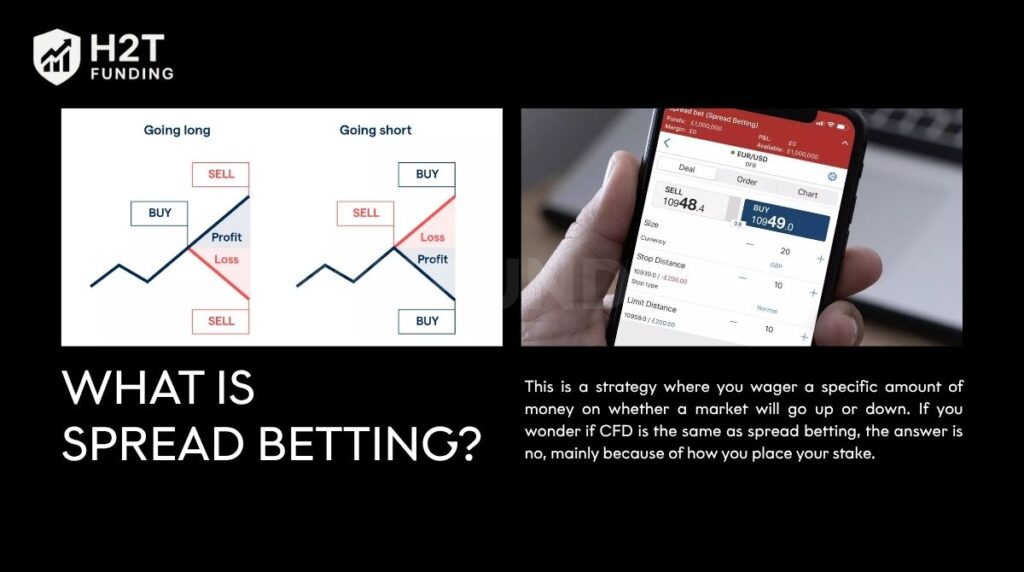
Instead of buying shares, you decide your deal size by choosing a pound value per point. Two figures are always quoted: the buy price and the sell price. The gap between them is the broker’s fee.
For example, if you bet £10 per point on an index and it moves 10 points in your favor, you win £100. Your profits and losses are usually realized in the currency you bet in, which limits foreign exchange risk.
1.2. What is CFD trading?
A CFD is a financial derivative where you agree to exchange the change in value of an asset from open to close. The difference between a CFD and a spread bet lies heavily in this contract structure.
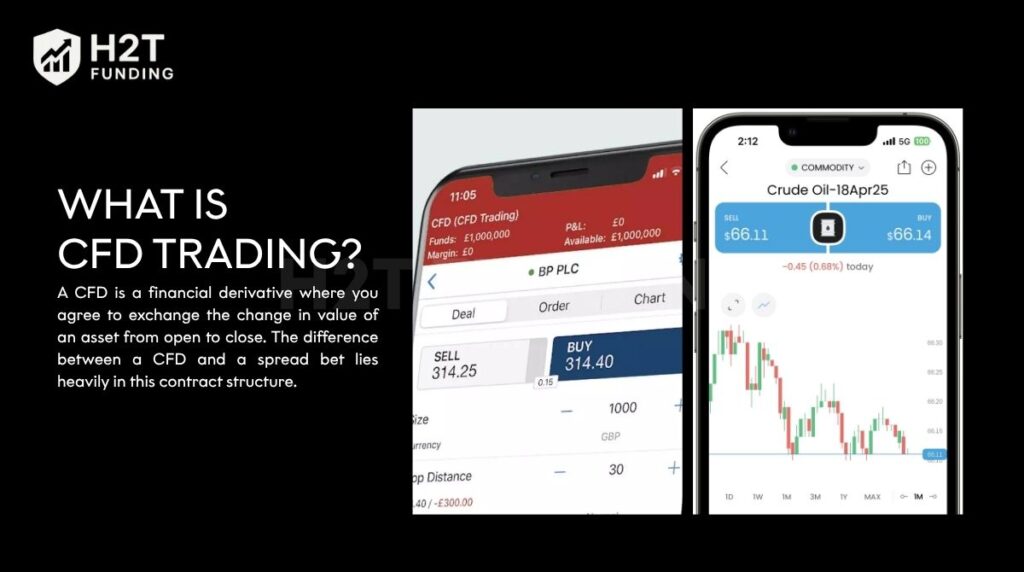
You deal in CFDs using position sizing based on lots, units, or share equivalents rather than a fixed monetary stake per point. For share CFDs, holding 100 contracts can mirror the price movement of 100 underlying shares without requiring actual stock ownership. However, in other markets like Forex or commodities, standardized lots determine your total market exposure.
Your final profit or loss depends on the base currency of that specific market. If you trade an American index, your underlying profits and losses will be calculated in US dollars, not your home currency.
2. Spread betting vs CFDs: The fundamental differences
If you want to know what the difference is between spread betting and CFD, it mainly revolves around tax rules and trade execution methods. Both products let you trade without owning the asset, but they function differently in practice. Here is a quick breakdown to highlight the CFD vs spread betting difference clearly.
| Feature | Spread Betting | CFD Trading |
|---|---|---|
| Taxation | No Capital Gains Tax or Stamp Duty (UK) | Liable for CGT, but losses are tax-deductible |
| Trade Sizing | Cash amount per point | Number of contracts |
| Trading Costs | Built into the spread | May include a separate commission |
| Lifespan | Often has set expiry dates | Usually runs without an expiration |
| Availability | Primarily the UK and Ireland | Global (banned in the US) |
2.1. Tax treatment (Capital gains tax & stamp duty)
The most appealing aspect of spread betting for UK residents is that you keep all your winnings. You do not pay Capital Gains Tax or Stamp Duty on your profits. Conversely, the main difference between spread betting and CFDs is that CFD profits are taxable. However, this allows investors to offset their trading losses against other gains as a tax deduction.
2.2. Trade sizing and execution
When analyzing the difference between CFD and spread trading, look at how you define your position. You choose a set monetary value per point of movement for a spread bet. On the other hand, CFD execution requires you to buy or sell a specific number of contracts. This mimics traditional share trading much more closely.
2.3. Costs and commissions
Brokers make money differently on these two products. Spread betting costs are usually included in the pricing gap. Meanwhile, CFDs often charge a separate execution commission alongside the spread, particularly for share dealing. Both instruments may also apply overnight funding charges and extra transaction fees if you hold positions past daily market closures.
2.4. Expiry dates
Another factor is how long a trade can remain open. Spread bets can either be daily funded with no fixed expiry or futures-style contracts with predetermined expiration dates. Similarly, while many CFD positions are open-ended, markets such as commodities may have expiration dates or contract rollovers depending on the specific broker’s rules.
2.5. Global availability
Your physical location heavily dictates which product you can use. Spread betting is restricted mainly to residents in the UK and Ireland due to specific gambling laws. CFDs provide broader market access globally. However, regulatory bodies strictly prohibit retail CFD trading in the United States.
Ultimately, the CFD and spread betting difference comes down to your personal financial goals and physical location. Spread betting is perfect for a tax-free approach if you live in the UK. On the other hand, CFD contracts fit a broader investment strategy where you might want to deduct trading losses. Both require a solid initial deposit and careful planning to navigate the markets safely.
Read more:
3. Key similarities between spread bets and CFDs
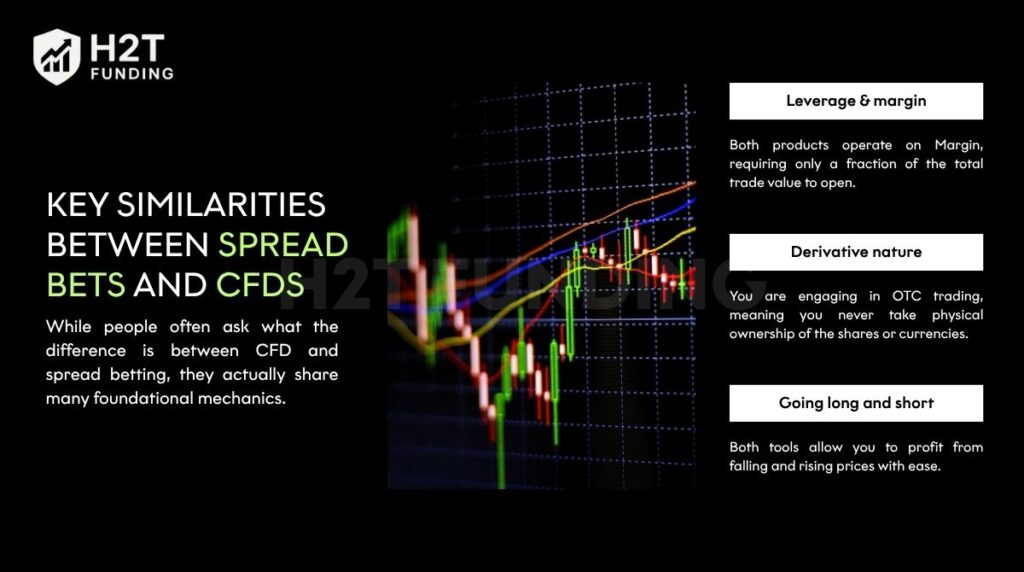
While people often ask what the difference is between CFD and spread betting, they actually share many foundational mechanics. Both instruments provide flexible ways to access the global financial markets without buying the physical assets.
3.1. Leverage & margin
Both products operate on Margin, requiring only a fraction of the total trade value to open. When considering CFD vs spread betting margin requirements, both products typically require an initial margin between 5% and 20%, depending on the asset class.
For instance, major forex pairs may only require 3.33% margin, while individual shares demand 20%. This feature uses leverage to magnify your potential profits and losses equally. Due to sudden market volatility, applying a stop-loss order is a vital piece of risk management.
3.2. Derivative nature (No ownership)
You are engaging in OTC trading, meaning you never take physical ownership of the shares or currencies. Your provider simply tracks the real-world price data. Additionally, even though you do not own the asset, spread bets and CFDs pay dividends via cash adjustments to mimic the underlying market.
If you hold a long position, your account receives a credit equivalent to the net dividend amount, whereas short positions will incur a debit.
3.3. Going long and short
Both tools allow you to profit from falling and rising prices with ease. You can open a long position if you believe the asset’s value will climb. Alternatively, a short position lets you generate returns when the underlying market drops.
In essence, both spread betting and CFDs give you powerful tools to speculate on markets. The core similarities in leverage, derivative nature, and directional trading mean that skills in one can often transfer to the other.
Your choice ultimately depends on whether the tax benefits of spread betting outweigh the flexibility and structure of CFD trading for your specific investment strategy.
4. Which is better: CFD or spread betting?
Deciding whether CFD or spread betting is better depends entirely on your location, tax situation, and trading style. There is no single correct answer for everyone. Both are leveraged instruments that require careful planning. We’ll break down the ideal scenarios for each to help you choose the right path for your goals.
4.1. When to choose spread betting
This option is often best for UK and Irish traders who want a straightforward, tax-efficient way to trade. The biggest advantage is that any profits you make are entirely yours to keep.
You might prefer spread betting if you want to:
- Take profits without paying Capital Gains Tax. This is the primary reason many UK traders choose this method.
- Avoid currency conversion headaches. You can trade international markets but calculate your stake in pounds, making profit and loss easier to track.
- Control your deal size precisely. The ability to bet small amounts per point is ideal for beginners or those testing a new investment strategy.
- Engage in hedging. While possible, the tax benefits of CFDs often make them a more effective hedging tool for physical portfolios.
4.2. When to choose CFDs
CFD trading is generally the standard for traders outside of the UK and for businesses. Its structure closely resembles traditional market trading, which many experienced investors prefer.
You might find CFDs are a better fit if you want to:
- Offset your losses against profits. This tax deduction is a significant benefit if you are managing a larger, diversified portfolio.
- Use Direct Market Access (DMA). This feature allows you to trade directly in the underlying market order book for shares, offering greater price transparency.
- Trade through a corporate account. Businesses and legal entities are permitted to open CFD accounts, but are not allowed to use spread betting.
- Avoid dealing with expiry dates. Most CFD positions can be held open indefinitely, unlike some spread bets that have a fixed end date.
Ultimately, whether you pick a CFD or spread bet is a personal choice. A popular topic on forums like spread betting vs CFD reddit shows that there is no perfect answer. For UK traders, the tax-free status of spread betting is a huge benefit. However, the global market access and loss-offset features of CFDs are invaluable for others.
5. Prop trading context: Spread betting or CFDs?
In the modern prop firm industry, platforms like FTMO rely entirely on CFD systems rather than spread bets. We know that funded trading requires standardized metrics. CFDs allow risk managers to track market exposure efficiently using standardized lots instead of varied monetary stakes.
When analyzing discussions about spread betting vs CFD Reddit, real-world experiences highlight clear trader preferences. Many professionals switch to CFDs to access better execution and tighter pricing. Scalpers often favor CFDs because brokers can offer raw, zero-spread accounts. Spread betting firms typically widen their prices to cover hidden operational costs.

A valuable insight from the community involves the reality of the UK tax-free promise. While spread betting is legally treated as gambling, relying on it as a primary income changes the rules. If you trade for a living full-time, the taxman might reclassify your winnings as normal taxable earnings.
Furthermore, CFDs provide an advantage regarding overnight funding rates, where you can earn positive interest adjustments on certain pairs. While CFDs are widely used by many prop firms like FTMO because standardized lot sizing makes risk monitoring easier, they are not the only standard.
Other industry leaders, such as Apex Trader Funding and Topstep, focus exclusively on the Futures market rather than CFD platforms.
6. FAQs
No, they are distinct products despite their functional similarities. The most significant CFD vs spread betting difference lies in the tax treatment and how positions are sized. Spread bets are categorized as gambling for tax efficiency, while CFDs are financial contracts.
Prop firms like FTMO exclusively provide a virtual CFD platform for their challenges. To understand what is the difference between spread betting and CFD trading, you must look at the software. Prop platforms use lots and units, which are native to the CFD model.
Legally, CFD trading is defined as financial speculation rather than gambling. While both involve risk, a CFD and spread betting difference exists in their regulatory classification. CFD providers must follow strict financial conduct rules, whereas spread betting falls under gambling regulations in the UK.
CFD trading is fully legal and regulated in the UK, but it is strictly prohibited in the United States. The difference between spread betting and CFDs often confuses international traders. US regulators view these products as too risky for retail investors due to extreme leverage.
Yes, the core mechanics of leverage and margin are identical for both instruments. When evaluating the difference between CFD trading and spread betting, you will see that both require a small initial deposit. This allows you to control a much larger market position.
Yes, you can use both for protection, but CFDs are often more effective for this goal. The difference between CFD and spread betting involves tax-deductibility. If your hedge loses money, you can offset those losses against other capital gains with a CFD.
Brokers provide both to cater to different legal jurisdictions and tax requirements. If you ask what the difference is between CFD and spread betting, it is about choice. They offer spread betting to UK residents for tax-free gains and CFDs for international or corporate clients.
7. Conclusion
Understanding the fundamental difference CFD and spread betting is the first step toward becoming a professional. Your choice should align with your tax status and specific financial goals. While one offers tax-free gains, the other provides global versatility and standard lot sizing.
At H2T Funding, we emphasize that every trading tool carries a high level of risk. Mastering these derivatives requires continuous education and a proven system. Approaching the market with a business mindset is what separates winners from casual speculators.
Are you ready to transition from a retail hobbyist to a funded professional? Visit our Prop Firm & Trading Strategies section to find the best platforms and winning methods!